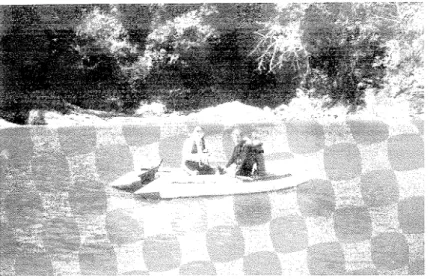
Peter W. Glynn with a new record of Indo-Pacific hydrocoral Millepora exaesa ForskAl, discovered at Clipperton Atoll in April 1994 (Photo Gerald M. Wellington)
BY
PETER
\V. GLYNNrL
, . L,.
.,- ~ i i i ~ i . I cntcrecl thi. i i ~ l t i oi'cor-al seer ecology, i n ihc cai-iy 1960s. I tiwe been intrigled by Dar~vin's (1 842) anti Dana's (1843, 1890) contention that, for reasons of cold water currents and upwellings, coral i-ccfs should not (and do not) erisi off westcrn i-tn~erican shores. 'l'his idea was uphclt! b y Vaughan ( 1 9 10) 3nd i"ross1a1~l ( 1 927 ), among others. alrliost ! 00 years !ater. fr;owe\.er, Joubin's ( 19 1.2) map of' the COI-31 reefs of tile ~vol-i~l, ~reprin~cd with additions by Wells ( i 9571. shows coral reefs present on the Pacific coast of sout11er-n ~Vkxico, and along the coasts of El Salvador, Costa Rica, Panama, Colon~bia, Ecuador, and northern Pen1 (Fig. 1). A coral reef is also shown at Cocos Island, but none is indicated in the Galapagos Islands. To my mind, this was clearly an interesting contradiction violating the dictum that coral reefs are confined to clear tropical waters of low organic productivity. This paradoxstim~iiated one of my first aims ~ ~ p o n reaching P a n a ~ n i in 1967, that is, to determine if coral reefs - wave-resistant, geomorphologic, structures that build the substratum on which they continue to grow do in fact esist in the highiy productive marine
environment of Pacific Panarni. lf coral reefs are found in eastern Pacific waters, then how are they distributed: mhat are their sizes, m d when did they begin to accreie?
Fur-iher, posing some ecological questions, what is their species composition, and how do various interactions, such as competition, grazing, predation, and symbiosis, regulate their community structure? This essay will explore the historical development of coral- reef studies in the eastern tropical Pacific, beginning in the late 1960s, from the
perspective of someone who first observed reef-building corals in the Gulf of California in the early 1950s.
One of the strongest nlotivating factors in any scientific discipline is the excitement of discovery. The discovery of eastern Pacific coral reefs, their associated biota and diverse species interactions, has truly been an exhilarating experience for me.
Many of the broad-ranging questions posed above have required extensive travel to remote areas. This has involved transporting field equipment on back roads, some mapped and some not, by foot and by a variety of watercraft that would never meet the safety requirements of the University National Oceanographic Laboratory Systems Division of Marine Biology and Fisheries, Rosenstiel School of Marine and
Atmospheric Science, University of Miami, 4600 Rickenbacker Causeway, Miami, Florida 33 149-1098
0
E a s t e r I
Figure 1 . Locator map of the eastern Pacific. 1, Guatemala; 2, El Salvador; 3, Honduras; 4, Nicaragua;
5, Costa Rica; 6, Panama. Question marks denote unexplored or relatively little studied areas: MI, Marias Islands; G, Guerrero state; N, Nicaragua; E, Las Esmeraldas; C, El CopC bank; SC, Santa Clara Island.
(UNOLS) National Science Foundation program. These excursions sometimes resulted in false starts, and unexpected, hazardous and amusing events that inevitably occur during field studies at remote sites. A few of these, which have contributed to the adventure of my work, are interlaced in the following narrative.
How did it all begin? My most vivid and cherished memories of first exploring and learning about marine life were with my great aunt, Dora Conrad, an eccentric but
lovable schoolmarm who gloried in explaining the ways of the natural world. During my preadolescent years, we tramped the hills, parks and beaches of southern California, where she extolled 011 the animal, vegetable and mineral worlds that unfolded before us.
Slnce we both lived 011 Coronado Island. our ~valks became more focused on the
shoreline. She was in great measure responsible for sparking my interest in marine life.
which iirst led to making a shell collection, then to the collection and study of various plants, invertebrates and fishes. By the trine I entered hrgh school, my friends - John C. Ehvell, Stephen E Flynn, Marvin A. Nottingham, Charles Quinn, among others -- and 1 began to make dl\ in2 trips ~ n t o Mexico. As time went on my ~nterests shifted illore from spearfishing to exploring the panoply and inten-elationshrps oS marine Me. I
first obscrved Iiv~ng c o ~ a l s 111 the Gulf of Califorma, 111 subtsoplcal areas soulh oi'San Felipe, Raja California, and around San Carlos Bay and Tiburon Island. Our escursrons eventually extended farther south rnto Mkxico, and to tropical areas around MaratIan and h/Ian;.anillo. Stimulated by F. C . LValion Smith's book, Ailirirfr~ Reef COP-(11s (19-18).
1 traveled to Beli/e (fbrmerly British Honduras) In 1959 to observe firsehand the largese coral-reef system In the Caribbean Sea. There 1 offered my d w n g services to a
Mexican iishing crew in exchange for passage to the barrier reef. The three weeks of living and drving along the Belizean Ban-ier Reef left me wlth a lasting impression of the magnrficence of the marine tropical world.
Two of my science teachers at Coronado High School - Curtis J Yeagar in biology and Marvin Nottingham in chemistry - who recognized my interests
encouraged me to continue studying in the natural sciences. In graduate school, at the Hopk~ns Marine Station of Stanford University, I was especially influenced by the high stantiards of scholarship and investigative pursuits of Arthur Giese, Cornelius van Niel, Lawrence Blinks, and Donald P. Abbott. Don Abbott was my doctoral adviser and mentor, gre'ltly admired by me for his love and dedicat~on to teaching and research (Fig
Figure 2. Three vertebrates contemplating the ways of intertidal invertebrates off the Hopkins Marine Station, Pacific Grove, California. Left to right:
Donald P. Abbott, Peter W. Glynn, and Charles (Chuck) Baxter. Pete's (P. W. Glynn) Island is visible behind Chuck. July 20, 1977. (Photo C.
Kitting)
Some experiences related to finding lodging form a vivid part of my memory of graduate school. During my field studies in Pacific Grove I inquired about renting the late Edward F. Rickett's Pacific BiologicaI Laboratories.
Steinbeck's coIorful character "Doc," in his classic novel, Cutznery Row, was in large measure fabhioned from Ricketts, the marine biologist whom I greatly admired. I was shown through the living and laboratory spaces, still cluttered with papers and preserved specimens. I was allowed to keep one of Ed Rickett's desiccated tortoises, which I plucked from a large holding tank.
Unfortunately, when I called the
following week to finalize a contract, I was told that another party had already offered a higher rent that I could not match. I did the next best thing, however, and let a room for
$25.00 per month above the Bear Flag bar and rcstaurant down the street. The clacking and whistling of the predawn freight train assured early morning rises for the summer low tides. While completing course requirements at the Stanford campus in Palo Alto I again began searching for convenient and low-cost accommodations. One afternoon after a seminar in Jordan Hall, the enormous labyrinthine biological sciences building, I wandered up a flight of stairs and discovered a little-known greenhouse loft. Off to one side was a vacant, low-ceiling room with a long desk, book shelves, sink, and electrical outlets. At first I tentatively occupied the desk, moved my books In, then an electrlc heating plate and coffee pot. sleeping bag and clothes, and presto, I had new
accominodations. Early morning trips to the showers in the basement and my constant companions, the cooing pigeons nesting in the eaves, made this a most comfortable arrangement. After a few months my living situation \vas discovered by one of my distinguished committee members, shall we say Professor "Goodheart." Fortunately. he was sympathetic with my situation and allowed me to occupy this niche for the
remainder of my tenure on the Stanford campus.
Upon nearing completion of my dissertation research, a study of the community structure and trophic interrelationships in a high intertidal assemblage, Don Abbott invited me into his office to discuss where I might like to teach. He l a ~ d out several letters from prominent, stateside universities, inquiring of the availability of recent graduates who might be interested in joining their faculties. Don was not surprised when I announced that I preferred to work in a tropical setting, and to take up an available teaching post at the University of Puerto Rico (Mayagiiez) where I could investigate coral reefs. My wife, Carmen S. Glynn (Quiiiones), who was born in southwestern Puerto Rico (Lajas), played no minor role in this decision. Don
understood my desire to move to the tropics and offered his full support, for he too had an abiding interest in coral reefs, having lived for nearly five months in 1953 on Ifzluk Atoll in the Caroline Islands. He was part of a research team, including such other members as Marston Bates, Frederick (Ted) M. Bayer, and Joshua I. Tracey, charged with documenting the way of life of the Ifaluk people (Bates and Abbott, 1958).
The years spent in Puerto Rico (1960-1967), at the Institute of Marine Biology in Mayagiiez and the Magueyes Island (La Parguera) field station, were pleasant and rewarding. There I began to develop an appreciation for the physical controls of reef development and the often subtle and complex biotic interactions regulating coral- community structure. Memories of 24- and 48-hour field exercises on offshore reefs with the Coral Reef Ecology class are still vivid and evoke a feeling of pedagogical accomplishment. At that time I also began reading the Atoll Research Bulletin, which supplied a diverse literature that helped to broaden an understanding of coral reef science in Puerto Rico, e.g., reef studies by J. W. Wells (1951) in the Marshall Islands, P. E. Cloud (1952) in the Gilbert Islands, and D. R. Stoddart (1962) in Belize. One of the star students in this course, Alina M. Szmant, has become a distinguished coral reef biologist. Juan A. Rivero and John E. Randall, successive directors of the Institute, offered invaluable support and encouragement during my employment at the University
of Pucrto Rico. I11 1967, 1 acceptcd a pos~tion with the Smithsonian Tropical Research Institute (STRI) in the Rcpublic of Panami. Upon leaving Pucrto Rico, it was with sadncss on thc one hand, but with excitcmcnt on thc other because I would be able to revisit tropical Pacific shorcs. A major rcsearch goal at STRI, strongly supported by successivc dircctors Martin Moynihan and Ira Rubinoff, was to conduct comparative studics of the ecology, behavior, and evolution of marinc spccies and communities on both Caribbcan and Pacific shores.
Equatorial Eastern Pacific
I t seemed to mc that information on the distribution of coral assemblagcs, their species composilion, ;lonation, and cxtent of buildup undcr different environmental conditions was needed to help understand why reef developnlent was not widespread in the eastern tropical Pacific. With my good friend and colleague, Robert H. Stewart, who had already begun surveying coral reefs in the Pearl Islands, I began a
reconnaissance of coral reefs in the Gulf of Panama. Coral specimens were collected, many of which were identified by J. Wyatt Durham. I was struck by the abundance of coral assemblages and coral reefs present on islands throughout the gulf. This was in stark contrast to Crossland's (1 927) conclusion that coral reefs were absent from the upwelling Gulf of Panama. To locate coral assemblages and reefs, I often flew with pilot friends along coastal areas during midday low-tidal exposures. Ira Rubinoff, Richard Rosenblatt. and othcrs pursuing ichthyological studies suspected the presence of a rich fish fauna associated w ~ t h corals in the nonupwelling Gulf of Chiriqui, western Panama (Fig. 1). Ira arranged with the U.S. Navy an expedition to this remote and poorly known gulf in April 1970 aboard the LST Tr-aver-se Cozrnty. In addition to the discovery of several new fish records and species, an interesting coral fauna and diverse assemblages of associated reef species were found. Several relatively well-developed coral reefs also were discovered, with distinct depth zones and thick framework structures. One of these, at the south end of Bahia Damas, Coiba Island, covers about 160 ha and may be the largest coral reef on the continental margin of the eastern Pacific (Glynn and Mate, 1997). Several coral-reef accumulations also were found along continental shorelines and, surprisingly, at the mouths of some large estuaries. Three species of hydrocorals, a taxon previously unknown in the eastern Pacific, were discovered on the Uva Island coral reef. Two of the hydrocorals belonged to
centrallwestern Pacific species, but one proved to be a new species endemic to the Gulf of Chiriqui (Weerdt and Glynn, 1991). Moderately large populations of the Crown-of- Thorns sea star, Acarzthasterplanci (Linnaeus), were found foraging on a variety of coral prey. Because of the prominent development and relatively high diversity of coral reefs in Chiriqui, a number of workers have been attracted to this region, including Charles Birkeland, Thomas F. Dana, Raymond C. Highsmith, Ian G. Macintyre, William A. Newman, John C. Ogden, James W. Porter, Robert H. Richmond, Ernesto Weil, and
Gerard (Jerry) M. Wellington. One of Tom Dana's (1975) studies, now considered a classic, proposed a model of long-distance dispersal from the central Pacific to explain the origin of eastern Pacific corals and coral reefs following Pleistocene extinctions.
This hypothesis provoked caustic criticism from a few workers who held to a vicariance explanation for eastern Pacific coral origins (McCoy and Heck, 1976; Heck and McCoy, 1978). Some of my students have studied (and continue to study) coral reefs in Chiriqui as well, on one occasion establishing a temporary field laboratory with running seawater and various other amenities (Fig. 3).
Figure 3. Uva Island Beach Club, a temporary field laboratory, Gulf of Chiriqui, Panami). Juan L. Mat6 and C. Mark Eakin (standing, left to right), David B. Smith. Peter W. Glynn. and JosC Manuel Gil Lasso (sitting, left to right). February 21, 1989. (Photo C. M. Eakin)
With information crossing my desk in the early 1970s of the
existence of coral reefs in the Galapagos Islands, this seemed like the next logical place to
investigate. The author of these findings, Jerry Wellington, located several coral-reef fornlations during an assessment of the marine resources of the
Galapagos coastal
environments. Thanks to grants from the
Smithsonian Institution and the generosity of Thomas J. Watson, Jr., we were able to embark on two research cruises in the Galapagos in 1975 and 1976. The research team in 1975 included John W. Wells, Charles (Chuck) Birkeland, Jerry, and myself (Figs. 4, 5, and 6). Working from the MIY Beagle 111, we surveyed several coral-reef sites from the southern sector of the archipelago to the northernmost islands of Darwin and Wolf. Upon completion of a second survey in 1976, aboard the MIY Palawun, we had gained sufficient knowledge to publish a book on the corals and coral reefs of the Galapagos Islands (Glynn and Wellington, 1983).
No fewer than six new species of azooxanthellate corals were named as a result of this work (Wells, 1982).
On our return trip to Panama in 1975, John, Chuck, and I rented a car and drove up the Ecuadorean coast to examine a coral formation spotted earlier during an aerial overflight. It was high tide when we arrived at the beach near Machalilla and the object of our visit was located a few hundred meters offshore at Sucre Island. I spotted some fishermen down the beach with canoes and the stage was set for bartering. After considerable haggling, the best I could negotiate was a round trip to the island for the equivalent of about $40. Chuck and I decided this was too high a price, so we donned our diving gear and started swimming toward Sucre Island. We were soon joined by a
Figure 4. En routc to the M/Y Beagle 111 with a Figure 5 . Examining corals at the U ~ i n a Bay skiff full of gear, Acadcmy Bay, Santa Cruz Island, uplift, Isabela Island, Galapagos Islands. Left to Galapagos Islands. Fore to aft: John W. Wells, Pcter right: Peter W. Glynn? Gcrard M. Wellington, and W. Glynn, and Gcrard FVP. Wellington. January 9, John W. Wells. January 15, 1975. (Photo C.
1975. (Photo C. Bii-1;cland) Eirkeland)
fisherman in his canoe who paddled alongside us. About halfway to the island, the price dropped to $30, then to
$20, and finally to $10 upon nearing the island and its fringing coral assemblages.
By this time the fisherman realized we were serious and proceeded to help us collect corals during the remainder of the dive. By the end of the survey we were
Figure 6. Discussing the day's activities in the
on friendly terms, and he told us of other
salon of the MIY Beagle 111. Left to right: Charles
Birkeland, John W. Wells, and Peter W. Glynn. coral formations in the area that he had
January 22, 1975. (Photo G. M. Wellington) seen while fishing. It had not escaped me that he was admiring my swim fins, so these remained with him as part of the final payoff. The Sucre Island coral formation turned out to be the first coral reef reported on the Ecuadorean coast and, at that time, the southernmost coral reef in the eastern Pacific.
Flying into and out of the Galapagos Islands in the 1970s was sometimes problematical and amusing in retrospect. On one occasion, Jerry and I were bumped from our flight when attempting to leave the islands after a research cruise. This
involved retracing our journey back to the Charles Darwin Research Station via
overcrowded buses and a boat trip across Baltra Canal - - a roundtrip journey that took up most of the day. We were again promised seats by the airline manascr the next morning and 1 slipped him a $20 bill to make certain we wouldn't be left behind. To our consternation, and to that of about 20 other souls standing on the tarmac, the plane was loaded, the doors shut, and it began to taxi down the runway. With engines whining, suddenly a door opened and the manager pointed to us. giving the sign that two more passengers were welcome aboard. With that. everyone started to run toward the plane juggling baggage the best they could. Jerry was quite athletic then (and is still), and was able to jump up to, and grasp, the opened doorway w ~ t h a boost from my cupped hands. I then thr-em our bags to him, ant1 grasped his tiown-stretched arm for the final lit3 into the plane - -- or so I thought. Thc other would-bc passengers saw vihat i s e were d o ~ n g and decided to take advantage of our human chain. One Inan grabbed my legs and another began to climb up my torso to reach the open door. 1 beckoned to J m y on how to extricate myself from this predicament. Without hesitation, he ~nstructcd nle to pummel and kick at the intruders until they fell away. This I did, Jerry quickly hoisted me up, the manager slammed the door shut, and off for the mainland we headed.
On later visits to the Galapagos, I wondered if I might be spotted and "paid back" for this bravado.
One of my intrepid volunteer pilots, Dennis (Capt.) C~smowski, flew hellcopters in the U.S. Army, helping me with reconnaissance flights in his spare time. Not only did Dennis assist me with aerial surveys in Panama, Costa Rica and Colombia, but he was a d r o ~ t at a variety of underwater tasks and-also helped with 111 situ reef studies. Our autoinobile trip to Machalilla in 1975 allowed us to survey the ccntral Ecuadorean coast, but there were rumors of coral reefs in the northern part of Ecuador, at Las Esmeraltias, near the Colombian border. I mentioned this to Dennis and he proposed that we fly to Ecuador from Panama, cruising the coastline on the way. After obtaining pern~ission to cross the PanamiIColombia and ColombidEcuador international borders, w ~ t h the assistance of the Smithsonian Institution and the U.S. State Department, we loaded our Cessna 172 with four scuba tanks and five jemcans of aviation fuel. We flew through some harrowing electric storms along the Choco coast and landed safely in Cali after a brief refueling stop in Buenaventura, Colombia. The administrator at the Cali airport claimed that our papers were not in order and demanded that we return to Panama. I tried convincing him that we did have the necessary clearance, but he would not budge from his position. So we again refueled and took off, heading north to Panama. When we reached a coastal mountain range, Dennis winked at me and said: "If you really want to go to Ecuador I can drop to just above tree level and no radar will be able to detect our progress." I winked back and we were quickly heading south again. B y the time we reached Tumaco, not far from the international border, we were running low on fuel.
We buzzed the airfield, faking engine problems, were given a green light from the tower, and then landed. Our plane was immediately surrounded by armed Colombian soldiers. We were taken into custody and held at an army base for two days. The Cali airport administrator had radioed ahead that we would probably be heading south. We struck up a friendship with the Colombian lieutenant in charge of the garrison, who
allowed us to "escape" early one morning. As of this writing, Las Esmeraldas is still in need of study.
Before the 1980s, virtually nothing was known of the extent of coral-reef dcvclopmcnt along the Colonlbian Pacific coast. On our ill-fated flight to Tumaco, Dennis and I skirted Gorgona Island and spotted coral reefs on the cast side of the island. A fcw years later (1979)' I Lvas invited by Henry vo11 Prahl to participate in the Sula 111 Expedition to Gorgona Island, 01-ganized to conduct inventories and studies of the marine and terrestrial biota of the island. Joining me was Peter Castro, one of my first students 111 Puerto Kico, who was on sabbatical leave (from C'alifomia State Polytechnic IJnivcrsity, Pomona) and norking in my laboratory in Panami. Between Henry, Fclipc Guhl, m d i~iyscll: \.c e were able to characteri/e the cor:il fauna, assess corallivorc activities, and complete reasonably detailed surveys of the distribution and gcomorphology of the Gorgona Island coral rcefs (Glynn ct 4 . . 1982). Peter Castro collected and descr-]bed the decapod cnlstaccm fauna Iiving synbiotically among the branches of poc~lloporic! corals (Castro, 1983).
During our stay at Gorgona we were r-omfor-tably housed in the penal colony's guest quarters and nourished by the prison's finest cuisine. Admittedly, the green- colored needle fish was not my favorite breakfast fare, but the freshly baked bread was a delight. To obtain a bread roll required hard bartering with the inmates, some of whom were assigned to look after our needs. One evening I engaged "El Diablo," one of our inmate helpers who was named for his Mephistophelean features, in a conversation to learn of the misdeed that landed him in prison. Many years ago, so the s t o ~ y went, he was an innocent lad fishing with a group of men in an estua~y. They were dynamite- fishing, which was unlawful at the time. Suddenly a governnlerlt patrol boat rounded the point. Everyone, save El Diablo, quickly jumped into the water and escaped by swimming into mangrove thickets. El Diablo didn't know whether to flee or surrender;
lie panicked, compulsively lit a stick of dynamite, and threw it toward the approaching boat. He never revealed the full extent of the bodily harm done, but did say that he was resigned to remain in prison for the rest of his life.
In the late 1970s we conducted surveys along the Costa Rican coast, first by performing reconnaissance flights at midday low-tidal exposures to locate suspected coral assemblages, and then by traveling to sites by automobile and boat. These in situ inspections revealed the presence of numerous coral reefs from the southwestern sector of Costa Rica near Panama to northwestern Costa Rica close to the Nicaraguan border.
All of our survey work in Costa Rica was pleasant and productive except for one incident on the Santa Elena Peninsula near Nicaragua. Anastasio Somosa, the former president (dictator) of Nicaragua owned a ranch on this peninsula and at that time he still tried to lay claim to this territo~y. Further complicating events were the bands of Sandanista insurgents who were organizing raids in Nicaragua from sanctuaries in Costa Rica. On this occasion, in 1978, we were surveying areas in Santa Elena Bay by diving from a black inflatable. We were unaware that we were being watched by the crew of a Nicaraguan gunboat. When the gunboat suddenly accelerated and started heading directly toward us, we pulled anchor and made haste for the shallow end of the bay where our truck was parked. Fearing that we might be pursued by an armed landing
party, we quickly loaded the truck with our gear and departed the area in haste. My ventures into Costa Rica were not only bcnefici:il 011 the research side, but also allowed me to meet sevcral resident inarine biologists, among whom Manuel M. Murillo, Jorgc Cortds, and Hcctor C u m ~ i n have figured impoi-tantly. Jorgc was to bccoinc my first doctoral student at the Kosenstiel School of Marine and Atmospheric Sciencc, University of Miami.
Other Eastern Tropical Pacific Areas
More recently I have participated in ficlcl seudics ae Clipperton Atoll ( I 994). ar tf~aaeulco on the soueil coast of Mcxrco ( IWO, 1997). and ai E,!sitr Island j 1999. 2(iOOl.
For many years, the coral fauna and extent of rcef dcvelopment ae Clippcrton n c r c largely unknown. Only eantall~ing bner'accounts and ~~npublished field notes were previously aarailable (Allison, 1959: Hcrtlcin and Emerson, 1957) o r what is probably the largcst coral-reef formation 111 thc caster11 Pacific region. Thanks eo I:grant from the National Geographic Society, J . E.
N.
(C'harlic) Veron, Jcn-y Welhngton, and I, among several other marinc scientists, were able to join the Clipperton Expedition organized by John D. Jackson. Our 13-day study revealed that Clipperton contains a meager nine zooxanthellate coral species, of whtcl~ only three or four have contributed importantly toward reef building. One of these, exhibiting an attractive platingmorphology, was recently described by one of my current students and a colleague of his: Porites al-mzdi Reyes Bonilla and Carricart Ganivct (2000). Since total live coraj cover extends over 370 ha of bottom, to a depth of at least 80 n ~ , this is the largest known coral reef in the eastern Pacific (Glynn et a]., 1996). The next largcst studied coral reef occurs at Coiba Island (Panami), and covers 160 ha (Glynn and Mate, 1997).
En route to Clippertoil, about 450 kill SSW of the tip of Baja California, we visited three islands iil the Revillagigedo Archipelago: San Benedicto, Clarion, and Roca Partida. Due to the sudden appearance of Barcena Volcano on San Benedicto Island, which received considerable local press in my home town (Coronado) when it was "born," during an explosive eruption on 1 August 1952, the extent of coral
development on this island was uncertain. Barcena reached 300 n~ in elevation in only 12 days. Amazingly, six coral species were found at shallow depth along the basalt shoreline during our survey in 1994, and some of these corals formed abundant
populations. One-meter-thick living pocilloporid fringing reefs were present at the north end of the island, suggesting rapid colonization and growth since the eruptive event.
Growth rates of pocilloporid branches from 3 to 6 cm per year have been measured in the eastern Pacific (Glynn, 1977; Guzman and Cortks, 1989), so a spurt in reef- framework accumulation of this magnitude is possible. Current studies in the
Revillagigedo Islands, including Socorro Island, are being actively pursued by Mexican researchers (e.g., Reyes Bonilla and Carriquiry, 1994; Ketchum and Reyes Bonilla,
1997).
Palmer's (1928) brief and provocative account of the coral reefs of Huatulco was largely responsible for turning my attention to the southern coast of Mkxico. Like the gulfs of Panami and Papagayo (Costa Rica), Huatulco lay within the upwelling Gulf of
Tehuantepec. Therefore, Palmer's mention of coral reefs was not surprising in light of their occurrence in other eastern Pacific upwelling centers. Initial surveys revealed the presence of 12 zooxanthellate coral species and 17 pocilloporid coral reefs, mostly in bays, ranging in depths from 2 to 14 m, and with framework buildups of 1 to 5 m (Glynn and Leyte Morales, 1997). Additional coral species records and new reefs are being discovered in this area as investigations proceed by workers at the Universidad del Mar, Oaxaca (Leyte Morales, 2001). A heightened interest in Pacific corals by Mexican workers in the 1990s has resulted in much new information regarding the reef- building scleractinian fauna and the distribution and environniental controls of reef development (e.g., Reyes Bonilla, 1993; Can-iquiiy and Reyes Honilla, 1997; Ketchum and Reyes Bonilla, 1997; Reyes Bonilla and Lopez Ph-ex, 1908). An area still in need of study, however, is the Marias Islands, which lie northwest of Banderas Bay (Fig. 1:
MI). A preliminaiy inspection of one of these islands, the northeast side of Maria Cleofk, has revealed the presence of a circular pocilloporid reef several krn in circumference, possibly one ofthe largest coral reefs in the easteru Pacific (H. W.
Chaney, pers. comm.). Since a penal colony is located in the Marias Islands, i t is difficult to obtain permission to work in this area. Finally, the Guerrero state coastline, a 300 km stretch from Acapulco to Zihuatanejo, is another relatively unstudied Mexican area.
Remaining Areas in Need of Study
Other eastern Pacific areas that are still in need of exploration are El Salvador, Nicaragua, and parts of the Ecuadorean coast. A recent survey of El Salvador by Hector Guznian, Jorse Cortes, and Juan Mate (29 March to 3 April 2001) failed to produce any corals. It is likely that turbulent seas and reduced visibility during this survey prevented a t h o r o u ~ h search of favorable coral habitats. Another attempt should be made to investigate this area since local divers have observed corals here, notably offshore of Los Cobanos. The Farallones Islands in the Gulf of Fonseca (within Nicaraguan territory) may also be of interest because these islands are located in a more oceanic setting, of probably higher water quality, near the gulf entrance. The subtidal marine assemblages of the Esmeraldas coast of northern Ecuador are still largely unexplored since my failed attempt to reach this area in the late 1970s. The extensive shallow rocky platforms in this region may support coral communities. Ecuadorean fishermen have reported abundant massive corals further south on offshore banks, e.g., at El Cope off Libertad, and a coral reef at Santa Clara Island in the Gulf of Guayaquil.
Exploratoly studies were recently (1 999, 2000) initiated at Easter Island, an isolated coral outpost in the southeastern Pacific. This area is of interest because of its hypothesized biogeographic link with the far eastern Pacific. It is possible that Easter Island has served as a stepping stone during the migration of corals and reef-associated species from the easternmost Polynesian Islands into the equatorial eastern Pacific. Of the 11 currently recognized zooxanthellate corals, two species are predominant:
Pocillopora verrucosa (Ellis and Solander) and Porites lobata Dana. Incipient reef frameworks are 2 to 7 m in vertical relief in some areas, e.g. on the northeastern insular
shelf that is sheltered from high wzve assault (Hubbard, pcrs. comm.; Glynn ct al., in press).
A central Pacific area that may share a link with the eastern Pacific is thc Line Islands, an island chain located immcdiatcly north of the equator and centered about 1,600 km south of the Hawaiian Islands. These islands lie astride the North Equatorial Counter Current and may rcprcsent a source area for propagules ti-aveling toward the cast as proposed by Tom Dana (1975). Jci-ry Wllington and I arc now planning a research trip to thc Line Islands to study the ecology, morpl~ology, and genetic structure of suspcctcd sclcractinian coral migrants.
From rhc exploratory work outlincd ab0j.e and more focused studies, our understanding of castcrn Pacific coral-reef biology and ecology has bccn greatly broadened in recent years. I offer here a thumbnail sketch of some of these recent advances, emphasizing findings that serve to characterize eastern Pacific reef-coral comn~unities. In the following, 1 comment bricfly on: (a) the nature of eastern Pacific coral reefs and their general comn~unity structure, (b) the dynamics of coral population abundances, (c) coral growth, (d) feeding relationships, (e) bioerosion,
(0
coralreproduct~on, (g) disturbances, (h) zooxanthella symbiont diversity, and (i) coral population modeling.
Eastern Pacific Coral Reefs, a Profile
it quickly became evident from the surveys conducted in Central and South America that structural coral rcefs were abundant in many arcas of thc eastern Pacific, albeit small in size, patchily distributed, and generally present at shallow depths. The established prevalence of coral reefs supports Durham (1 947, 1966) and Squires (i959), who maintained that coral reefs were present along the Pacific coast of the Americas.
Even though most of these reefs are developed at shallow depths, they seldom break the surface and are visible for only short periods during extreme low tidal exposures.
Unlike coral reefs in other provinces, eastern Pacific reefs are best developed in protected bays or along coastal areas not subject to intense wave assault. The most prevalent taxa contributing to reef frameworks belong to species of Pocillopora, which form vertically elongate, interlocking, and highly porous structures. Since these reefs contain sparse amounts of binding crustose coralline algae and exhibit minimal submarine cementation, this may in large part explain why they are not developed on exposed coastlines. In upwelling areas, the best reef development also tends to occur on the sheltered sides of islands, oriented away from the strongest effects of upwelling (Glynn and Stewart, 1973). An additional interesting feature of most eastern Pacific reefs is that they are monogeneric in composition, constructed dominantly of one or only a few species. In addition to Pocillopora spp., some reef assemblages contain massive corals such as Porites lobata, Pavona spp., and Gardineroseris planzrlata
(Dana). See Guzmin and Coi-tCs (1993), Coi-t5s (1 997), and Glynn (2001) for succint overviews of the nature of eastern Pacific coral reefs.
Like having a favorite book, coral reef biologists often have a favorite reef. My favorite reef is the Uva Island reef in the nonup\vclling Gulf of Chiriqui, which has been under constant st~ldy since 1970 (Figs. 7 and 8). Why? Because it has offered ~ l p so many ansbers to a long list of research questions. It also supports a high diversity of
Figure 7. Bird's eye view of the Uva Island study reef, Gulf of Chiriqui, Panama during a midday low tidal exposure. Feb~mary 8.
1989. (Photo C. M. Eakin)
Figure 8. Peter W. Glynn and Ian G. Macintyre preparing for a dive at the Uva Island study reef. February 22, 1989.
reef-associated organisms and is located in a
beautiful cmbayi~icnt of a heav~ly forcstcd,
~~nlnhabitcd island with a waterfall spilling onto a pebble beach. Adding to the exciternmt of our studies, elasmobranch sight~ngs were common at the Uva Island reef in the
1970s. These included mostly white-tip sharks, bull sharks, and numerous manta rays. As many as a half d o x n manta rays could be seen wheeling along the reef front where they were grazing on zooplankton.
Occasionally they became an annoyance by
swimming into our float lines that marked study sites and dragging them seaward beyond the reef.
These graceful animals, and the sharks, are now rarely seen. I must relate a bizarre encounter with one of these mantas, a behavioral maneuver I have not heard repeated.
One morning I was deeply engaged in a task that required close attention to the bottom.
Although it was a sunny day, the light from above would momentarily dim as if from a passing cloud. After two or three such incidents, I looked toward Anibal, my diving partner. He motioned for me to look overhead. I had attracted a large manta, with a four-meter wing span, that was hovering above. I disengaged from my work and began
to watch the manta that was moving ever closer. It moved close cnough for me to touch its mouth. It then began to press against me (I was wearing a black wet suit) and to envelop me with its wings, curling them around my body. When I observed a pair of claspers and realized that this was a male, perhaps in a precopulatory mode, I gently tapped it on the head with my dive knife. After a few additional taps, the manta moved back and slowly swam away.
Coral Population Abundances
With the discovery of new ~ooxanthcllate coral records and new species in the eastern Pacific during the past few decades. generlc and species diversity have increased from 5 to 10, and from 10 to 40+. respectively (compare Figs. 48 and 50 in Veron, 1995, w ~ t h Table 1 111 Clynn and Ault, 2000; Reyes Bonilla, in press). Some new records are instantly recognizable, such as the occun-ence of hydrocorals or fire corals (hlrlleporu spp.) in the Gulf of Chiriqui, Panama. When I first obsened thesc corals at the Uva Island reef in 1970 - and this was not difficult because they were everywhere - it u a s immediately obvious that they represented new species records because fire corals had not been previously reported from the eastern Pacific region. Upon further study, it was found that three species of Milleporu were present on the Uva reef and elsewhere in the Gulf of Chiriqui. Two of these, Milleporu iiztricutu Milne Edwards and Milleporu plutyphyllu Hemprich and Ehrenberg, are well known throughout the Indo-Pacific
region. One of the fire corals proved to be a new species, first recognized by the late Prof. Dr. H. Boschma from specimens that I sent to him. All known colonies of this unnamed species bleached and died during the 1982-83 El Nifio event. Realizing the importance of this mortality event, and not wanting the species to slip into oblivion -
to become an anonymous or "centinelan extinction" (Wilson, 1992) - I invited
Walentina (Wallie) H. de Weerdt, one of Prof. Boschma's disciples, to accompany me to Chiniqui to observe and collect additional dead colonies to describe the species. This we did (Weerdt and Glynn, 1991), and the then presumed extinct new species became known as Millepora boschimi Weerdt and GIynn. Since this disappearance of a reef- building coral species was the first ever - no other coral was known to have become extinct in recent times - it was reported in the journal Science (Glynn and Weerdt, 1991). Five live colonies were rediscovered about a year later, on the north side of Uva Island (Glynn and Feingold, 1992). This site was subsequently christened Lazarus Cove by Mark Eakin. I was both elated to learn that M. boschmui was still alive and
chagrined in having to retract the high profile claim of an extinction. The lesson learned: one must exercise extreme caution in announcing a species extinction in the marine environment, especially for a subtidal species capable of larval dispersal.
Postscript: the five live colonies of M. boschmui again bleached and died during the 1997-98 El Niiio-Southern Oscillation (ENSO) event. Thorough searches in Lazarus Cove and other likely habitats (as of March 2001) have failed to disclose any living colonies.
Extreme fluctuations in population abundances have been documented for several eastern Pacific zooxanthellate corals. The vulnerability of a high proportion of
the coral fauna can be appreciated from the following: ( a ) 15 of 41 species are known from only 1 or 2 localitics; (b) inany consist of small populations (< 100 colonies per site); and (c) 9 species have cxperienccd rcccnt local-to-rcgional scale extinctions (Glynn, 1997; Glynn and Ault, 2000). Some of my colleagues have groused that i t is diflicult to follow the population status of particular spccics from my publications. This is truc, and it is no less difficult for me in light of the rapidly changing abuncianccs that are obscrvcd bctm.cen censuses. Coral population structure at many localities is inciccd dynamic
Anothcr enigmatic occu-rcncc has in\.olvcd the appearance, and sudden
disappearance. of Aci.opoi-n vcilirlri Dana at Gorgona Island, Colombia (Prahl and Mejia, 1985). The "curse of ilci-c>po)-r~, ., as it has become known. 1s a haunting malediction not soon to be forgotten. I t started as a remarkable discovery and ended in terrible
tragedies. Sightings of ilci-opoi.~i off western American shores had been rumored for many ycars, but never substantiated. Then on 8 September 19Z3, three colonies of'
.
I C ~ Y ) ~ O Y L I vulriicr were discovered b y Angela I"vIcjia, one of Henry von Prahl's students, at Gorgona Island, Colombia. The publication of this discovery creatcd quite a stir among the cadre of eastern Pacific cora-reef workers. Many questions concerning these corals were being asked and follow-up studies planned. Sadly, Angela suffered a severe motorcycle accident in 1988, which tctally beclouded her memory of this remarkable find. Then in 1989, Henry von Pralil, the remaining link to the discovery, fatefully boarded an Avianca flight from Bogota to Cali on which he and all others perished in a midair explosion, the pusillaniinous act of a terrorist. Acropoi-cr colonies have not been found subsequently at Gorgona Island or anywhere else in the eastern Pacific. To this day. some supcrstitious-leaning workers are both hopeful and fearful of making such a discovery.A final example of an extremely rare species is Szdertrsrmr glv~zi~i, named in my honor by A1111 (Nancy) Budd and Hector GuzmLin (Fig. 9). This species was found at Uraba Island in Panama Bay, and the only known population consisted of just five
colonies (Budci and Guzman, 1994).
Since the condition of these colonies began to deteriorate during the 1997-98 E N S 0 event, displaying bleaching and tissue loss, Hector transported four of the remaining colonies to Naos Island.
Here they are being cared for, and are showing signs o f recovery, in aquaria o f the Smithsonian Tropical Research Institute. Following the discovery o f
this species, extensive surveys in Figure 9. Live colony of Siderastrea glynni, about Dresumablv suitable habitats have failed 1 1 cm in diameter, in an aquarium. March 16, 1993.
to reveal additional populations. What (Photo C. M. Eakin)
is the origin of this species? Are there source populations elsewhere (locally or distant), perhaps in unexpected habitats? Are the five colonies survivors of a large population, now destined to extinction? This is a sample of the questions raised by this puzzling discovery.
Coral Growth
Oncc i t was establislicd that coral rccfs were widespread in the castern Pacific, the next task was to measure the growth ratcs of a variety of reef-building species to determine if thcsc were co~i~parable \\it11 coral growth elscwhcre in the central and western Pacific whcrc reefs are better developed. Pocilloporld corals, the chicf rcef builders, were found to have vcrtical skeletal extension sates of 3 to 6 cm yr-l (Glynn and Stcwal-t, 1973; Glynn. 1977). During periods of moderate upwelling. coral g s o ~ ? h was considerably less. around 1 to 2 cm y - ' , and g1.0~ tll ceased altogcther at
temperatures of 7 8°C or lower. Massi\.e corals typically grow more slowly than
branching spcclcs, and the mcan outm ard-gson ing skeletons of d~fferent massive species r;ingcfi-om about 0 S to I .7 cni y - - l (Glynn and \\7cllingto~l, 1983: G w n l i n m d Cor-tCs,
1989). The gener-a1 conclusion emerging from thcse studies is that eastern Pacific corals arc capable of sapid gron t11 and that thcir growth 1 ates are approximately equivalent to iilose 0: similar oi lilcl~tical species 111 !hc central and n estcm Paclfic.
Feeding Relatioriships
As Birkeland (1977) noted in his study of coral recruitment in relation to competition with other benthic organisms such as algae, sponges, bryozoans.
barnacles, and t~inicates - slow-growing corals do not compete well with other fast- growing taxa in nutrient-rich environments. Selective grazing by fishes and
invertcbratcs, if sufficient, can tip this balance in favor of corals by removing potentially superior con~petitors that would ot11e1-n ise ovcrgrow the corals. Beyond Birkeland's early study In the Gulf of Pallami, no addltional work has been carried out in the eastern Pacific on the quantitative relations between gra7ing pressure and coral recruitment.
Anothcr aspect of feeding ecology relating to amnals :hat feed on the living tissues of corals (corallivores) has received considcrable attention, p e r h q s because of the unusual numbers of these consumers on eastern Pacific reefs. These range from micropredators, roughly equivalent to parasites, to macroconsuniers that are capable of digesting all tissues from sizable coral colonies. The variety of corallivores that have been studied are species of gastropods, crustaceans, echinoderms, and fishes (Glynn, l982a; Guzmin, 1988).
Acantlmsterplu~zci (Linnaeus), a large sea star that feeds almost evclusively on corals, occurs from the Gulf of California to Colombia (Malpelo Island) and Ecuador (northern Galipagos Islands). Usually, only single individuals are occasionally seen at the latter two localities, suggesting a transient existence in its southernmost range.
Moderately large numbers (20 to 30 inds ha-l) are sometimes observed on reefs in the Gulf of Chiriqui, but population outbreaks - on the scale observed at several central and western Pacific reefs (1 00s to 1000s inds ha-l) - have not been reported in the eastern Pacific. A clue to how the numbers of this sea star might be controlled came from frequent sightings of particular shrimp and worms with Acu?ztlmster: Careful observations revealed that the harlequin shrimp Hynzenocera pictcc Dana and the amphinomid polychaete worm Plzerecardia striafa (Kinberg) were actually attacking
Figure 10 'I'he harlequm shr~nlp, fflwieriocera picriz.
attacking the crown-of-tho~ns sea star Acrrnrl~rz~tcv plnrr~r on the I 1 ~ a Island leef, 3 rn depth Sholkn is
one of a e"?nlale p a r that was follo\vlng the sea stal for several days and reinovlng its organs (hepatlc caeca and gonads) December 19, 1982
Figure 11. A scavengmg polychaete worm (Pherxmzrrirrz ~ t r i n t n ) feedmg o n the dismembered arm of a sea star, Uva Island reef, Panama, 2 rn depth. December 19,1982
Acccnthoster, in lilliputian style (Glynn, l982b). The -3-crn-long shrimp, usually a female-male pair bond, typically rides on the upper surface of -30-cm-diameter sea stars (Fig. 10). I have spent hours to days following individual Acnrzthnster under attack by these shrimp. By means of their sharp chelae, the shrimp pick and tear at the sea star's body until breaking through to thc organs mithin. Thcy then remove and fecd on hcpatic caeca, gonads. and various other soft parts. Then enter the 5-to 10-cm-long wonns (Fig. 1 I), which come streaming out of the porous reef
- upwards of 200 to 400 inds m-2 (Glynn, 1984a). The w o m x crawl into the sea star through the incisions made by the shrimp. The worms also consume the sea star's soft parts, reaching
virtually all internal recesses. These attacks cause slow death, from a few to several days, but occur so frequently they would seem to exercise an important control on adult sea star numbers.
Other intriguing feeding relationships - involving ovulid gastropod and pufferfish corallivores, and crustacean guards and damselfishes that repel corallivores and grazing fishes - have offered a rich source of material for documenting the intricacies of some of the biotic interactions affecting coral-community structure. The gastropod corallivore Jenneria p u s t u l a ~ a (Lightfoot) can sometimes attain high local abundances where it can consume all of the tissues of large colonies of Pocillopora (Glynn, 1984b). Jenneria is truly a beautiful animal, and one cannot help but imagine that its polyp-like mantle extensions and black-encircled, orange shell pustules are not somehow involved in mimicking its coral prey (Fig. 12). A variety of fishes feed on Jenneria, at least when it can be detected. The tenacity with which crustacean guards (Trapezia spp. and Alpheus lottini GuCrin) defend their coral hosts from Acanthaster attacks, and their repertoire of defensive strategies (Fig. 13), are nothing short of amazing (Glynn, 1983). The guards can even detect an approaching
Acnntlmster by means of waterborne chemical cues and ready thcmsclvcs for a defensive attack by scurrying along thc outern~ost co!ony branches (Glynn, 1980). A variety of field observations
Figure 12. Jw~~icv.irr ~ ~ ~ r . s r ~ i / c ~ r r r . an ovulid gastropod corallivore stripping the tissues from P o c ~ i / / o p o ~ - c ~ ricimiconiir at night on 3 coral recf in thc Secas Islands, Gulf of Cliir-iqui, Panama. 5-m dcpth. July 19, 1981.
\
E
Figure 13. Defensive behaviors of a Trclpezra crab guard directed toward the crown-of-thorns sea star.
(A) startle display; (B) pushing; (C) up-down jerking of sea star; (D) pinching and cllpping of sea star's spines and tube feet; (E) resisting retreat of sea star (modified after Glynn, 1983).
and experiments have been performed to document these behaviors (Fig. 14).
Figure 14. Peter W. G l y m investigating the responses of crustacean guards to a model Crown- of-Thorns sea star and the 'juices' of a living sea star, Uva Island study reef. January 14, 1980.
In 1980, Ray Highsmith published an insightful paper relating bioerosion to areas of high nutrients and plankton prirnary productivity. This relationship was based primarily on a correlation of sites of varying productivity with the numbers of boring bivalves in coral skeletons. He ranked the eastern Pacific as the coral-reef region most severely affcctcd by biocrosion. Basically, because most bioeroders prosper in high nutrient environments with high concentrations of plankton, their growth and abundance overwhelm corals that generally do wcil in less productive settings. Several studies have substantiated this pattern and have quantified the high rates of reef erosion, not only by ~nternal bioeroders (e.g., cyanobacteria, sponges, worms, and bivalves), but also by external bioerodcrs (e.g., crustaceans, mollusks. echinoderms, and fishes).
Bioerosion acceleratcs in dead corals, rapidly weakening and reducing the size and integrity of limestone skeletons. This sort of damage often leads to frustration when attempting to secure a complcte core from an old coral colony (see below. Coral and Reef Growth History). The bases of such colonies, with the ear-liest (and oldest) growth records, are often riddled with bioeroders or are completely missing.
Galapagos Islands coral reefs that suffered 95 to 99% mortality during the 1982- 83 El Nifio warming event were attacked continually by large numbers of the blunt- spined sea urchin Euciclul-is galczpugemis Doderlein. This sea urchin feeds on algae that colonize the dead coral skeletons and, in the process, its sharp-cutting teeth erode the dead coral surfaces. It was disheartening to witness the relentless breakdown and disappearance of the Galapagos reefs in less than 20 years following the El Nifio disturbance (Glynn, 1994; Reaka-Kudla et al., 1996). Erosion of the Uva Island reef in Panama following coral mortality in 1982-83 was not so dran~atic as in the Galapagos, but nonetheless substantial, particularly in certain reef zones (Eakin, 1996). In Panama, the most influential surface bioeroder is Dzacienlcz me.xicunttnl A. Agassiz, the black- spined sea urchin. Reef-base zones with low abundances of damselfish are especially susceptible to sea urchin erosion, whose numbers commonly exceeded 50 inds m- 2
.
Damselfishes cultivate algal lawns and remove sea urchin competitors from their territories, thereby protecting portions of the reef frame (Eakin, 1987, 1988; Glynn,
1988). Eakin's (1996) CaC03 budget for the 2.5 ha Uva reef revealed an average net erosion rate of 4,800 kg yr-l in the mid-1 990s, compared with a net deposition of 8,600 kg yr-l prior to the 1982-83 El Niiio event. An updated model suggests the Uva reef is still in an erosional mode, but that extreme La Niiia-related low-tidal coral mortalities in 1989 and 1993 had a greater influence on reef erosion than coral mortalities resulting from the 1997-98 E N S 0 bleaching event (Eakin, 2001).
Thus, Highsmith's (1 980) contention that rates of bioerosion are elevated in high nutrientJprimary productivity environments is still valid, but these rates are accelerated during periods of high coral mortality resulting from a variety of disturbances such as El NiAo warming and low sea-level stands.
Coral Reprod~iction
Many hundreds, if not thousands, of'huinan hours have bccn devoted to the s t d y of coral reproduction by my rcscarch tcam. The first in-depth study by Bob Richmond (1 985) failcd to dctcct planulat~on in colonies of'Poc~llopor-a dunirc.or~rrrs nlonitol-cd wcckly in Panamri for ncarly a ycar. Ccntral and wcstcrn Pacific populations of this spccics are highly fecund, rclcasing larvae monthly throughout thc year. Because of the apparcnt abscnce of spawning (planulac or gamctcs) in castcrn Pacific P
dut?~rcol-t~r.s, Bob concluclcd that these populations wcl-c essentially asexual and had ekolved life-histoi-y cl~aractcristics favoring clonality. Bob furthcr argued that thcsc isolatcd "stcrilc" populations v, oulcl occasionally I-cccit c seuual ian ai rec~uits b y long- d~stance dlspcrsal, especiaily durlng El Niiio ycars when nest-to-east flaming currents incrcasc in volumc and ratc (Kichn~oncl, 1990).
Continuing studies 111 Costa Rica, Pammni, and the Ciallipagos Islands ha~re i-cvenled high levels of gamctc production in I? rlut~~rc.or-~~ls and all othci- rccf-building coral species studied to date (Glynn et al., 199 1 , 1994, 1996, 2000). Only Pol-ltes parlnnlemrs releases planula larvae, with most, and perhaps all, of the remaining
zooxanthellate species spawning gametes. While P danzicor;ir~s is highly fecund, producing large numbers of mature eggs and sperm at these locations, we have never observed this species spawning. As of this writmg, only three eastern Pacific species have been observed spawning gamctcs, namely, PLI\IO~ICI grgmte~i, PCIVOIICI ~ w r n t ~ s , and P n v o m sp. a. The latter species. closely related to P varrafls, is presently being named (Glynn et al., 2001). I-Iistological studics of several other species have rcvcaled mature gametes in abundance, but no sign of plannla larvae. Late one sunny afternoon in the Galapagos Islands, near full moon during a peak high tide, several colonies of P grgrrlltcu lvcrc observed shedding clouds of eggs and sperm. Upon rcvisiting this popuiation In the following and subsequent years, under virt~ially identical conditions, no additional spawning was observed.
Over the years, we have scheduled diving teams to watch for spawhing on the Uva Island coral reef at all times of the day and night, performing late-night and early- m o ~ n i n g observations. Meal times have been partly to blame for not detecting spawning sooner in two coral species. After a full day of diving-related work, none of us was interested in coaxing the ship's cook to schedule dinner later than about 1800, at sunset or a little later. Also, if a night dive was planned, it was better to eat early to allow time for one's stomach to settle. As it turned out, we continually missed the spawning of Pavona sp. a, which occurred shortly after sunset, at peak high tide a few days
following the full moon. Then we were chagrined to learn that breakfast had interfered with observing spawning in Pavonn vnrians, again near peak high tide a few days following full moon, but just before sunrise. It turns out that this 12-hour spawning separation prevents these sibling species from hybridizing. This difference in the timing of spawning serves as a clear-cut trait to help distinguish between these closely related species.
While these studies are contributing to our base of knowledge, there is still a plethora of unanswered questions associated with the reproductive biology of corals.
For exan~ple, more information is needed concerning spawnlng behavior and its relationship with water-column microscale mixing processes, lunar periodicity. the seasonality of spawning, fecundity, and the length of larval lives and their dispersal capabilities. Virtually nothing is known of the reproductive biology of eastern Pacific hydrocorals (Milleporu spp.), the most sensitive of all reef-b~~ilding species to ENSO warming disturbances. A big mystery is the discrepancy bctween the high level of sexual activity in many species and thelr typically low recruitment success. What is occurring bctween the time of mature gamete production and recruitment'? Our
histological studies show no gamete resorption. It is therefore reasonable to assume that spawning most likely occurs? Is mortality high in the water colunm before settlement, or are early benthic stagcs being killed before recruitment? The ansiters to these questions are crucial for an understanding of coral-conmunity developrmcnt and the capacity for recovery following various sorts of disturbances.
Disturbances
Cool currents and local upwellings, long believed to be the leading limiting factors affecting coral growth, are now recognized to be but two of numerous conditions that can influence eastern Pacific reef development. The two major temperate current systems that limit the northern and southern migration of reef-building corals are the Califomla Current off the west coast of Baja California and the Peru Coastal Current near the Peru-Ecuadorean border, respectively. As has been amply demonstrated, however, the three major upwelling centers - the Gulfs of Tehuantepec, Papagayo, and Pananxi - do support abundant coral populations and reef development.
Since ENSO disturbances, including primary and secondary effects, were not recognized until the dislocations documented d ~ ~ r i n g and following the 1982-83 ENSO, the realization of the multifarious effects of this natural perturbation could be regarded as the most important I-evelation of the twentieth century concerning impacts to coral reefs. Mechanically induced mortalities of corals and reef associates by storms and increased wave assault are more likely during ENSO activity (Robinson, 1985; Lirman et al., 2001). The immediate effects of El Niiio warming (i.e., the loss of zooxanthellae leading to coral bleaching and mortality) may be followed by several longer-term secondary effects such as: (a) increased emigration and mortality of obligate coral crustacean symbionts (Glynn et al., 1985); (b) the disruption of live-coral bamers that prevent Acanthaster from entering and feeding on patches of preferred prey (Glynn,
1985); (c) predator concentration on surviving corals (Glynn, 1990; Guzmin and Cortes, 1992); (d) interference with coral reproduction and reduced recruitment (Glynn et al., 2000); and (e) the invasion of dead coral patches by echinoids and damselfishes that interfere with coral regeneration and perhaps larval settlement (Wellington, 1982;
Glynn, 1990). Other effects that can interfere with corals are related to La Niiia or the ENSO cool phase, such as (a) dinoflagellate blooms (Guzmin et al., 1990); (b) extreme low tidal exposures (Eakin et al., 1989; 2001); (c) stressful upwelling events (Glynn and D'Croz, 1990); and (d) the proliferation of macroalgae that compete with, and
sometimes overgrow, corals (Glynn and Mate, 1997).
Another type of seriously degrading impact to coral reefs worldwide - i.e., sedimentation and eutrophication - is increasingly observed in the eastern Pacific.
This is especially true at low-latitude coastal areas with high rainfall. Rampant clear- cutting, with little or no concern for land management, has transfonned verdant forests and mangrove shores to croplands, pasturage, aquaculture ponds, and urban sprawl.
Two of my former students, Jorge Cortks and Bcnlardo Vargas ~ n g e l , have documented this kind of damage to coral reefs in Costa Rica and Colombia, respectively. Several reef scientists attending the Eighth International Coral Reef Symposium in Panama in
1996 were reminded of how a damaged watershed can have far-reaching effects on coral reefs. Rainfall was excessive a few weeks before a post-symposium field trip to coral reefs in the Gulf of Chiriqui, an outing I helped ai-range to showcase our study reefs to a cadre of international reef researchers. Unfortunately, a period of heavy rainfall before the excursion caused extensive soil erosion and river runoff with silt-laden plumes extending over most of the continental shelf. Our field trip was literally a washout nith water visibility often ranging between only 30 to 100 cm.
Sadly, poor land use in coastal areas lias greatly diminished three high-diversity ecosystems: lowland rainforests, mangrove shores, and coral reefs. It is becoming increasingly difficult to swim over pristine coral reefs and to hear howler monkeys and squawking parrots in the adjacent forest. Some additional disturbances to coral reefs and environmental concerns, mainly related to human activities, are addressed below (see, The Future of Eastern Pacific Coral Reefs).
Zooxanthellae Diversity
Molecular genetic studies have revealed that scleractinian corals harbor a diversity of alga1 symbiont tava (Rowan and Powers, 1991; Rowan and Knowlton,
1995; Baker and Rowan, 1997; Rowan, 1998; Baker, 1999). Some intriguing patterns of bleaching resistance in relation to symbiont distribution in scleractinian corals have been recently documented. For example, in Caribbean Montastraeu, much of the
intraspecific variation in response to a natural bleaching event in 1995 was explained by the distribution of symbiont taxa (Rowan et al., 1997). Additionally, one of four
symbiont taxa identified in Panamanian Pocillopora spp., a member of Symhioclinium clade D, was especially resistant to bleaching caused by elevated temperature and high irradiance stress during the 1997-98 El Niiio warming event (Baker, 1999; Glynn et al., 2001). In contrast, the hydrocoral Millepora intricata is often the first to bleach during periods of high-temperature stress, and suffers high rates of mortality. In Panama, Millepora hosts unusual symbionts (Symbiodinium clade A), which have not to date been documented in scleractinian corals from the far eastern Pacific (Symbiodinium clade A), an observation that is intriguing in the context of its bleaching susceptibility (Baker, 1999).
Some workers have suggested that bleaching may provide corals with a mechanism for the removal of sensitive syrnbionts and replacement by more resistant alternatives (Rowan and Powers, 1991 ; Buddemeier and Fautin, 1993). This stress response - termed the "adaptive bleaching hypothesis" - remains controversial, partly
for want of direct empirical investigation (but sce Baker, 2001). Certainly, some
colonies with resistant symbionts farcd better during thc 1997-98 El Nifio than colonies without. Howcver, it is not clear whether bleached corals that contained susceptible symbionts, but still managed to survive, have shown any change in their synlbiont comn~unities since recovcring froin the bleaching event.
Coral Population Modeling
W ~ t h the availability of long-teim data on various aspects of a coral population (namely, gro~vth. recruitnlent. predation, El Niiio-related mortality, and recovery), Peggy Fong and I h a w devclopecl a dynamic simulat~on model of thc abundance and s i x structure of G i ~ ~ l i l i l ~ c . plnnlrllarir on the Uva Island coral reef (Fong and Glynn,
9 9 Results of this init~al simulation cffort demonstrated that predation by
ilc>iltlihil~ter1311i}1~1 was of o ~ . e n i helming importance to coral pop~~lalion structure on the Uva reef due to both stronger effects of predation (larger transitions) and the fkequency of prcdation (yearly) compared with E N S 0 (episodically) disturbances. This model was modified for use at the regional scale to incorporate diverse environmental settings of temperature and predation in nonupwelling and upwelling areas of Panama and the Galapagos Islands (Fong and Glynn, 2000). Results of the regional model suggest that E N S 0 impacts can be accurately predicted by the rate of temperature change in an area during an E N S 0 event. Validation of model predictions in upwelling and nonupwelling eni-ironrnents during the 1997-98 El Nifio event is cncouraging and signals an
understanding of the critical processes that regulate coral population structure (Fong and Glynn, 2001). As we continue to gain confidence in this effort. we plan to expand the modeling to include multiple coral species populations and other aspects, such as nutrient availability, algallcoral competition, and herbivore grazing effects.
One problem inherent in studies of coral-reef ecology is that most reefs have been studied over relatively short ecological time scales (Jackson, 1997), while many processes controlling coral population and community dynamics occur over much longer periods. Simulation modeling is one tool that can be used to synthesize knowledge of processes investigated on ecological time scales in order to develop predictions on a longer time scale (Ebenhoh, 1994; Jsrgensen, 1994). The effects of E N S 0 events in the tropical eastern Pacific have been studied over a relatively long time ( -30 years) compared with ecological studies in many other reef systems (Connell,
1997). These data provide a unique opportunity to develop simulation models that can be used to predict the condition of coral populations, communities, and ecosystems in the future.
CORAL AND REEF GROWTH HISTORY
Since many of the newly found eastern Pacific reefs were well developed, some exhibiting vertical thicknesses of several meters, we began to wonder how old they might be. We started to investigate this question by core drilling, using the same