1
The Role of Cognitive & Affective Drivers in Building Satisfaction and Loyalty: Study on Non Dine in Coffee Shop in Indonesia
1 Eka Prasiyuda Departement of Management
Indonesia Banking School Jakarta, Indonesia [email protected]
2ndTri Lestari Departement of Management
Indonesia Banking School Jakarta, Indonesia [email protected]
3rd Whony Rofianto Departement of Management
Indonesia Banking School Jakarta, Indonesia [email protected]
Abstract—Non dine coffee shops started to grow as an alternative to dine in coffee shops in high mobility society.
Amplified by the pandemic of COVID-19, it is interesting to research this type of coffee shop that potentially grows in a new normal condition. To perform a model retesting of cognitive and affective drivers in building satisfaction and loyalty, specifically in the context of non dine in coffee shops. The sample size used for this study was 150. The empirical data collected through a cross-sectional online survey to consumers in the JABODETABEK area.
Hypothesis testing is conducted using the Structural Equation Modelling (SEM) approach. The result shows that Brand Awareness, Perceived Quality, Brand Image, Perceived Value, Pleasure, Arousal, Brand Satisfaction, Relationship Commitment, Brand Loyalty positively drives satisfaction and loyalty. The study of non dine in coffee shops are still rarely studied in the midst of research in the context of the Food Industry, especially those related to consumer response patterns under conditions of transformation towards the new normal.
Keywords— Brand Loyalty, Brand Satisfaction, Cognitive Aspects, Affective Aspects, Food Industry.
I. INTRODUCTION
The coffee shop industry has experienced significant growth in the last decade in many countries across the world (Ferreira,2020). The number of coffee shop in Indonesia is significantly growing can be seen from the number of coffee shops that do the franchise or open the coffee shop by using a new brand. Coffee shop business in Indonesia began since the inclusion of a coffee shop company originating from Seattle, United States that is Starbucks. Therefore, many emerging local coffee shops by following the concept of Starbucks to compete and create satisfaction experienced by customers to gain loyalty from them [1]. This research aims to investigate local brands of coffee shops in indonesia.
Covid 19 cases were first detected in Jakarta on 3 March 3, 2020. Since then, the number of positive cases has increased. The DKI Jakarta government then decided to implement the PSBB on April 10, 2020 [2]. Food and beverage (F&B) is one of the industries that is seriously affected by coronavirus. The local culinary business also made adjustments as a result of the local government implementing social restrictions by prohibiting people from gathering and eating in one place. However, take-away food increased slightly or around 7% in the January-February 2020 period [3].
Janji Jiwa is one of the local coffee shops or brands in Indonesia. This coffee shops has been opened since 2018 and which is shaded by Jiwa Group [4] . Janji Jiwa continue to develop its brands and coffee products to be better and able to compete with competitors. One of the supporting concepts in the Janji Jiwa brand is the fresh-to-cup concept of using coffee from local Indonesian farmers. With more than a decade of experience, Janji Jiwa also managed to find ways to produce quality products at affordable prices [4].
Coffee shop brand by considering the role of cognitive drivers, affective drivers, brand satisfaction, and relationship commitment. The study aims to theoretical framework contained a sufficient level of explanatory power for brand loyalty.The main interest of the present research was to identify the possible relationships among multiple cognitive dimensions (i.e., brand awareness, perceived quality, brand image, and perceived value),affective factors (i.e., pleasure and arousal), brand satisfaction, relationship commitment, and brand loyalty by proposing and testing a sturdy theoretical model in a chain coffee shop context [5]
This research interested in examining customer loyalty in the coffee shop industry, especially customers of other coffee shop. The theoretical model should also be validated with different samples of populations. Furthermore, it can also be a good research topic to perform research of measurement development for building satisfaction and loyalty on non dine in coffee shops in Indonesia because it is arelatively new topic and a measurement study focusing on non dine in has not been frequently conducted yet [5]
II. MATERIALS AND METHODS Literature Review
A. Cognitive Drivers
The cognitive process will not develop instantaneously, but only after an individual is able to cognitively process and assess the available evidence. In the context of branding, cognition would involve consumer’s knowledge of the brand (brand awareness), their perceptions (brand image) and judgments of it (perceived quality and perceived value). Thus, brand awareness, brand image, perceivedquality and perceived value are the four key concepts under cognitive drivers in this study [5]. Cognitive messages trigger the rational dimension of the decision making process on purchasing a product or service [6].
2 B. Affective Driver
Pleasure is generally related to human positive or negative feelings whose continuum is ranged from significant unhappiness at one hand to tremendous ecstasy at the other hand. However, in another research, pleasure was expressed quite disparately in which references such as excitement, relaxation, love, and tranquility at one end and cruelty, humiliation, disinterest and boredom at the other end were adopted [5], An affective response may result that leads to the development of a cooperative and accommodating attitude towards the service provider [7]
affective messages initiate emotional responses, which, in turn, influence the purchase behavior [6].
Hypotheses Development
Brand awareness was included as a control variable because preexisting knowledge and attitudes toward a brand can affect brand related decision-making [8].In this study, it is postulated that the cognition dimensions: brand awareness, brand image, perceived quality, and perceived value, have a positive impact on two key affective drivers:
pleasure. We believe that all of these outlets create unique brand images by offering symbolic value because customers consume coffee shop brands in addition to beverages and desserts, develop consumption meanings in the reflexive environment, and express their personality and identity through social interactions [8].
Quality has been defined in different ways, describes quality as conformance to requirements. Quality is perceived by consumers [9]. The definition of customer perceived value has changed over time. However, the definition of ‘value’ adopted in this study is: ‘all factors, qualitative and quantitative, subjective and objective, that make up the complete consumption experience. This definition identifies the subjective and multidimensional nature of customer perceived value.It also includes such affective dimensions as selfgratification, aesthetic pleasure, prestige, transaction, and hedonism [10]. The pleasure a person expects from the product can influence the engagement with a brand [11]. Coffee shop managers should continuously develop new and varied sustainable sensory stimuli so that customers can always feel pleasure when visiting coffee shops [12].
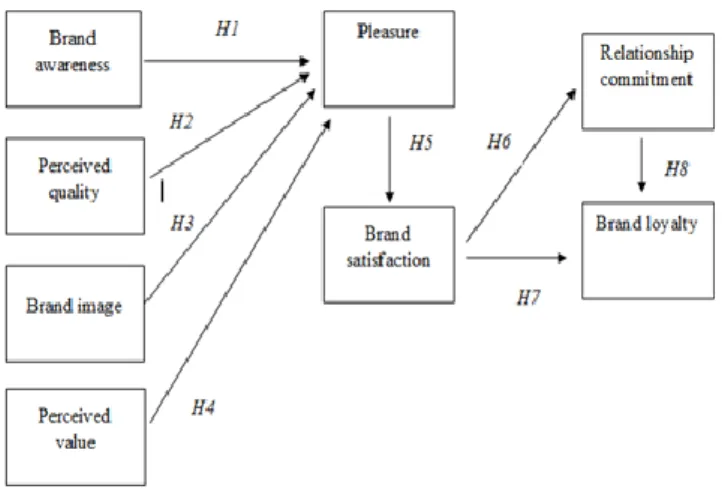
H1: Brand awareness positively influences pleasure.
H2: Perceived quality positively influences pleasure.
H3: Brand image positively influences pleasure.
H4: Perceived value positively influences pleasure.
H5: Pleasure positively influences brand satisfaction.
H6: Brand satisfaction positively influences relationship commitment
Brand loyalty itself is the biased (non-random) behavioral response (purchase) expressed over time by some decision-making unit with respect to one or more particular brands out of a set of brands and is a function of psychological processes. Therefore, we conclude that customer satisfaction fully mediates the
effects of these brand equity dimensions on brand loyalty [13].
H7: Brand satisfaction positively influences brand loyalty
H8 : Relationship commitment positively influences brand loyalty
Therefore, shown in Figure 1 to illustrate the study’s research model that was developed in prior paragraph.
There are 7 hypotheses proposed in this study.
Methodology
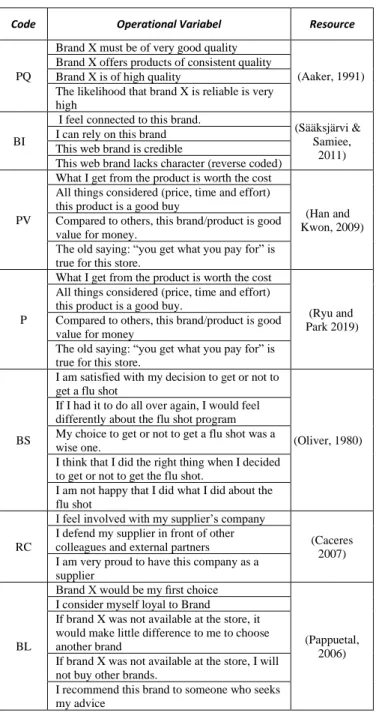
This research applied a quantitative paradigm. The measurement instrument for this study comprises multi- item scales validated in previous studies. Each item was measured on a 7-point Likert-type scale anchored by 1 = strongly disagree and 7 = strongly agree. The items measuring the relationship between Brand Awerness, Perceived Quality, Brand Image, Perceived Value, Pleasure, Brand Satisfaction, Relationship Commitment, Brand Loyality, (see Tabel 1 for the measurement item).
Data were collected using convenience sampling, with an online survey, A qualifier question was used, whereby the respondents can take the survey only if they have buying Janji Jiwa. The respondents were asked to provide demographic details like gender, age, occupation and education. A total of 180 responses, which reduced to 160 after data cleaning were analyzed (see Tabel 2 for the Demography respondes) .
TABLE 1. MEASURMENTITEMS
Code Operational Variabel Resource
BA
When I think of a store, the symbol or the logo comes to mind
(Graciola 2020) I am very acquainted or accustomed
with the brand of this store
This retail brand is different from other competing brands
3 TABLE 2. DEMOGRAPHYRESPONDENS
III. RESULTS
Validity and Reliability of Measurements
The indicators used in this study were subjected to reliability and validity analyses. Confirmatory factor analysis (CFA) was conducted to verify the reliability and validity. After analyzing a total of 32 items, CFI (comparative fit index) = 0,756, RMSEA (root mean square error of approximation) = 0,161, CMIN/DF (the minimum sample discrepancy function devided with degrre of freedom) = 5,124. All results that were unconsistent with standards except for CFI (comparative fit index) [14].
The composite reliability of all construct items was 0.7 or above except variable brand awareness. Convergent validity was verified, as the average variance extracted (AVE) was also 0.5 or above [14]. (See Table 3).
TABLE 3. VALIDITYANDRELIABILITYTESTING
Hypotheses Testing
This study used a structural equation model analysis (SEM) using AMOS software was used to verify its hypotheses. The standardized path coefficients were used for interpreting the causal relationships. All the hypotheses were supported in the research model. Tabel 4 showed the SEM analysis of the research model.
Code Operational Variabel Resource
PQ
Brand X must be of very good quality
(Aaker, 1991) Brand X offers products of consistent quality
Brand X is of high quality
The likelihood that brand X is reliable is very high
BI
I feel connected to this brand.
(Sääksjärvi &
Samiee, 2011) I can rely on this brand
This web brand is credible
This web brand lacks character (reverse coded)
PV
What I get from the product is worth the cost
(Han and Kwon, 2009) All things considered (price, time and effort)
this product is a good buy
Compared to others, this brand/product is good value for money.
The old saying: “you get what you pay for” is true for this store.
P
What I get from the product is worth the cost
(Ryu and Park 2019) All things considered (price, time and effort)
this product is a good buy.
Compared to others, this brand/product is good value for money
The old saying: “you get what you pay for” is true for this store.
BS
I am satisfied with my decision to get or not to get a flu shot
(Oliver, 1980) If I had it to do all over again, I would feel
differently about the flu shot program My choice to get or not to get a flu shot was a wise one.
I think that I did the right thing when I decided to get or not to get the flu shot.
I am not happy that I did what I did about the flu shot
RC
I feel involved with my supplier’s company
(Caceres 2007) I defend my supplier in front of other
colleagues and external partners I am very proud to have this company as a supplier
BL
Brand X would be my first choice
(Pappuetal, 2006) I consider myself loyal to Brand
If brand X was not available at the store, it would make little difference to me to choose another brand
If brand X was not available at the store, I will not buy other brands.
I recommend this brand to someone who seeks my advice
Items Categories %
Gender Male 32%
Female 68%
Age
<20 7%
21-30 88%
31-40 5%
<40 -
Occupation
Student 23%
Government employees 18%
Private employees 49%
Entrepreneur 7%
Housewife 3%
Education
Equivalent 19%
Diploma 41%
S1 38%
S2 2%
S3 -
Variable Indicator Loading
Factor CR AVE
BA
BA1 0,819
0,640 0,842
BA2 0,791
BA3 0,789
PQ
PQ1 0,935
0,805 0,943
PQ2 0,852
PQ3 0,925
PQ4 0,874
BI
BI1 0,909
0,728 0,914
BI2 0,925
BI3 0,814
BI4 0,754
PV
PV1 0,844
0,771 0,931
PV2 0,854
PV3 0,888
PV4 0,924
P
P1 0,867
0,852 0,958
P2 0,908
P3 0,956
P4 0,959
BS
BS1 0,925
0,872 0,971
BS2 0,900
BS3 0,967
BS4 0,949
BS5 0,927
RC
RC1 0,938
0,855 0,946
RC2 0,927
RC3 0,908
BL
BL1 0,862
0,834 0,962
BL2 0,942
BL3 0,872
BL4 0,949
BL5 0,937
4 TABLE 4. HYPOTHESESTESTING
IV. RESULTS
Profile of respondents can be submitted as follows. The majority of respondents are either respondent whose data are taken from female aged 21 – 30 years, more than half of the respondents in coffe non dine in from private employees. This funding indicate relate with previous research [15].
Hypothesis 1 states that there is insignificant relationship between brand awerness and pleasure, this funding is contradictory with the previous research [10], that’s state the previous consumer behavior and marketing studies that identified the significant relationship between cognition and affect in diverse contexts. Also that given these important results, practitioners of coffe non dine should consider making diverse endeavors to improve patrons’ brand awareness and perceived value in order to increase the level of customers’ affective/emotional experiences at a coffee shop and brand loyalty.
Futuremore, brand image, brand satisfaction and relationship commitment show the higher significant in this model, this in line with previous research [10] Satisfaction is often regarded to be one of the most vital factors in generating individuals’ purchasing decision/intention and behavior in consumer behavior and marketing.
Despite the contributions of this study to coffee non dine in and services marketing literatures, it is not without limitations. First, limitation of the research relates with Janji Jiwa applied as the research object. Therefore, this study can not be used as representative for coffee shops other than objects of this research.
Based on the limitations of the study and the results of this study, it can be offered some suggestions for further research. The first suggestion is based on the research object. In other words, future research may apply different brand names of coffee shops. It aims to produce new knowledge in science
REFERENCES
[1] Pratama MA, Siregar RPS, Sihombing SO. The Effect of Consumer- Based Brand Equity and Satisfaction on Loyalty: An Empirical Study. J Econ. 2019;15(2):275–91.
[2] Sabrina Asril. Protokol Restoran Saat PSBB Transisi di Jakarta:
Makan di Tempat Boleh, Prasmanan Dilarang. 2020; Available from:
https://megapolitan.kompas.com/read/2020/06/04/14505531/protoko l-restoran-saat-psbb-transisi-di-jakarta-makan-di-tempat-
boleh?page=all
[3] Radika. 7 Tips Agar Bisnis Restoran dan Kedai Kopi (F&B) Bertahan di Masa Corona. 2020; Available from:
https://www.gadjian.com/blog/2020/04/17/tips-restoran-masa- corona/
[4] Janji jiwa. Available from:
https://www.lunarabrands.com/kopijanjijiwa
[5] Song HJ, Wang JH, Han H. Effect of image, satisfaction, trust, love, and respect on loyalty formation for name-brand coffee shops. Int J Hosp Manag [Internet]. 2019;79(June 2018):50–9. Available from:
https://doi.org/10.1016/j.ijhm.2018.12.011 1. Comput Human Behav [Internet]. 2016;58:98–108. Available from:
http://dx.doi.org/10.1016/j.chb.2015.12.047
[6] Pappas IO, Kourouthanassis PE, Giannakos MN, Chrissikopoulos V.
Explaining online shopping behavior with fsQCA: The role of cognitive and affective perceptions. J Bus Res [Internet].
2016;69(2):794–803. Available from:
http://dx.doi.org/10.1016/j.jbusres.2015.07.010
[7] Kim AJ, Johnson KKP. Power of consumers using social media:
Examining the influences of brand-related user-generated content on Facebook.
[8] Kim SH, Kim M, Holland S. How Customer Personality Traits Influence Brand Loyalty in the Coffee Shop Industry: The Moderating Role of Business Types. Int J Hosp Tour Adm [Internet]. 2018;19(3):311–35. Available from:
https://doi.org/10.1080/15256480.2017.1324340
[9] Ribeiro MA, Prayag G. Perceived quality and service experience:
mediating effects of positive and negative emotions. J Hosp Mark Manag [Internet]. 2019;28(3):285–305. Available from:
https://doi.org/10.1080/19368623.2018.1517071
[10] El-Adly MI. Modelling the relationship between hotel perceived value, customer satisfaction, and customer loyalty. J Retail Consum Serv [Internet]. 2019;50(xxxx):322–32. Available from:
https://doi.org/10.1016/j.jretconser.2018.07.007
[11] Parihar P, Dawra J, Sahay V. The role of customer engagement in the involvement-loyalty link. Mark Intell Plan. 2019;37(1):66–79.
[12] Jang HW, Lee SB. Applying effective sensory marketing to sustainable coffee shop business management. Sustain. 2019;11(22).
[13] Susanty A, Kenny E. 4481-8316-5-Pb. 2015;(1):14–27.
[14] Hair, J.F.; Black, W.C.; Babin, B.J.; Anderson, R.E. Multivariate Data Analysis; Pearson Education Limited: London, UK, 2014.
[15] Susetyo prihadi. Siapa penikmat kopi di Indonesia. 2019; Availabel from: https://uzone.id/survei-siapa-penikmat-kopi-di-indonesia-
.
Ho Effects β
Estimate CR. P Remaks
H1 BA P -0,41 -1,076 0,282 Not Supported H2 PQ P 0,292 7,379 *** Supported H3 BI P 0,958 14,083 *** Supported H4 PV P -0,18 -4,53 0,650 Not Supported H5 P BS 1,021 21,111 *** Supported H6 BS RC 0,892 15,024 *** Supported H7 BS BL 0,236 1,740 0,082 Not Rejected H8 RC BL 0,915 6,318 *** Supported
Author Names Page
Hery Suliantoro, Baby Monica I Simanjuntak, Kirana Rukmayuninda 1
Budi Ismoyo, Muhammad Idrus Alhamid , Nasruddin, Muswar Muslim, Arnas Lubis 2
Siti Jahroh, Janita S Meilala 3
Ahmad Shaharudin Abdul Latiff 4
Rozaina Ali, Ahmad Shaharudin Abdul Latiff, Sazali Abdul Wahab 5
Muhammad Faizurrohman, Lukman M Baga, Siti Jahroh 6
Danjuma Tali Nimfa, Ahmad Shaharudin Abdul Latiff, Sazali Abdul Wahab, Patrick Ethe Raj 7
Murodjon Urmonov, Ahmad Shaharudin Abdul Latiff 8
Nusrat Hafiz, Ahmad Shaharudin Abdul Latiff, Sazali Abdul Wahab 9
Kamna Anum, Sazali Abdul Wahab, Ahmad Shaharudin Abdul Latiff 10
Md Ahsanuzzaman Nishu, Ahmad Shaharudin Abdul Latiff, Huam Hon Tat 11
Luthpiyah Juliandara, Siti Jahroh, Budi Purwanto 12
Khairunnisa Mohd Azmi, Ahmad Shaharudin Abdul Latiff, Sazali Abdul Wahab 13 Mohamad Jatiardi, Dodik Siswantoro, Miranti Kartika Dewi, Evony Silvino Violita 14 Muhammad Isradi Zainal, Wahyu Ismail Kurnia, Kuswandi Arifin, Seherdi Siman 15
Wahyu Ismail Kurnia, Muhammad Isradi Zainal, Alex Kisanjani 16
Ferry Ardiansyah, Hermanto Siregar, Dedi Hakim, Mulya Siregar 17
Rifqi Jalu Pramudita, Niniet Indah Arvitrida 18
Dhaha Praviandi Kuantan, Hermanto Siregar, Anny Ratnawati, Solikin Juhro 19
Suhaila Abdul Hanan, Emy Ezura A. Jalil, Nizamuddin Zainuddin 20
Alfa Chasanah, Nindita Ayu Mutia Lestari, Siti Jahroh 21
Eka Sudarmaji, Noer Azam Achsani, Yandra Arkeman, Idqan Fahmi 22
Morgan Parlindungan, Muslim Efendi Harahap 23
Siti Jahroh, Intan Adhitya Rosmasari, Achmad Fadillah 24
Agus Masrianto, Hartoyo, Aida Vitayala S Hubeis, Nur Hasanah 25
Muhammad M. Maulana, Arif Imam Suroso, Yani Nurhadryani, Kudang Boro Seminar 26
Besty Hasyati, Taufik Djatna, Erliza Noor 27
Johannes Widjaja Wahono, Ujang Sumarwan, Bustanul Arifin, Herry Purnomo 28 Meuthia Rachmaniah, Arif Imam Suroso, Muhammad Syukur, Irman Hermadi 29 Afeez Kayode Ibikunle, Mohamad Farizal Rajemi, Fadhilah Mohd Zahari 30
Raden Isma Anggraini, Rifa Herdian 31
Ahmad Giffari, M Syamsul Maarif, Setiadi Djohar, Arif Imam Suroso 32
Heri Susanto, Noni Noerkaisar, Raden Isma Anggraini 33
Esaputra Mangarul Rajagukguk, Muslim Efendi Harahap 34
Asaduddin Abdullah, Dikky Indrawan 35
Nyayu Lathifah Tirdasari, Andina Oktariani, Dikky Indrawan, Nur Hasanah 36
Achmad Fadillah, Muhammad Asyam Dzaki Hasibuan, Anny Ratnawati 37
Achmad Fadillah, Andre Eka Hizkia Barus, Noer Azam Achsani, Lien Herlina, Febriantina Dewi, Fithriyyah Shalihati
38
Joko Rurianto, Ujang Sumarwan, Budi Suharjo, Nur Hasanah 39
Heny Herawati, Agus Soemantri, Elmi Kamsiati, Muchamad Bachtiar 40
Aini Ayu Zahara Tsulusi, Anton Mulyono Azis 41
Khairun Nisha Khirul Anuar, Nurul Amirah Faiqah Sallehuddin, Suhaila Abdul Hanan 42
Audy Joinaldy, Luki Abdullah, Yandra Arkeman, Siti Jahroh 43
Rakhmat Dicky Mohammad, Sisdjiatmo Kusumosuwidho Widhaningrat 44
Nur Khairiah Muhammad, Nor Hasni Osman, Nurul Azita Salleh 45
Heny Herawati, Agus Soemantri, Elmi Kamsiati, Muchamad Bachtiar 46
Masanori Fukui, Jo Hagikura, Yuji Sasaki, Jun Moriyama, Yusuke Hayashi, Tsukasa Hirashima 47
Belal Zidan Rimawi, Wan Fadzilah Wan Yusoff, Abu Sofian Yaacob 48
Table of Contents
Author Names Page Fithriyyah Shalihati, Suhendi, Asaduddin Abdullah, Agustina Widi Palupiningrum 49
Fanar Shwedeh, Norsiah Hami, Siti Zakiah Abu Bakar 50
Setyo Ferry Wibowo, Mukhamad Najib, Ujang Sumarwan, Yudha Heryawan Asnawi 51
Anita Mustikasari, Agung Utama 52
Tri Lestari, Whony Rofianto 53
Ni Made Dwidhyana, Dadang Gunawan 54
Aklima Akter, Wan Fadzilah Wan Yusoff, Mohamad Ali Abdul-Hamid 55
Annuridya Rosyidta Pratiwi Octasylva, Lilik Noor Yuliati, Hartoyo, Agus W Soehadi 56 Rina Uswatun Hasanah, M Syamsul Maarif, Nimmi Zulbainarni, M. Joko Affandi 57 Intan Shafira, Aditya Tri Nugroho, Imam Fathur Rahman, Ahmad Setiawan Nuraya 58
Nyayu Lathifah Tirdasari, Dikky Indrawan 59
Adhika Prajna Nandiwardhana, Muslim Efendi Harahap 60
Mokhamad Syaefudin Andrianto, Anis Daifatin Masruroh 61
Y. Dony Antarius, Rinaldy Dalimi 62
Muhammad Azman, Intan Delia Rustandi, Putri Gayatri 63
Rafdi D. Ramdhani, Lukman M Baga, Popong Nurhayati 64
Erwin Widodo, Dwi Handayani, Suparno 65
Idqan Fahmi, Fithriyyah Shalihati, Suhendi 66
Darlyn Jasmin Magno, Karl Benedict Ong 67
Mohd Rizal Razalli, Mobashar Sadik, Kamaruddin Radzuan 68
Samah Rozana, Zakirah Othman, Noor Hidayah Abu , Salleh Nurul Azita 69
Zakirah Othman, Mohd Zahari Fadhilah, Salleh Nurul Azita 70
Jay Omotoy 71
Shimol Philip, Rakendu R, Hanna Paul 72
Shafini Shafie 73
Rahimi Abidin, Nor Hasni Osman, Rushanim Hashim 74
Daniel Hofilena 75
Siti Zakiah Abu Bakar, Chun Houng Choo 76
Noorulsadiqin Azbiya Yaacob, Risyawati Mohamed Ismail, Siti Norhasmaedayu Mohd Zamani 77
Noor Hidayah Abu , Nik Muhammad Aqil Ajman, Mohd Fitri Mansor 78
Aryo Pinandito, Tsukasa Hirashima, Yusuke Hayashi 79
Norlena Hasnan, Ng Weng Seng Benson, Shahimi Mohtar, Nor Hasni Osman, Rahimi Abidin 80 Balakrishnan Bavaani, Zakirah Othman, Shafie Shafini, Ahmad Zaidi Mohamad Faizal 81
Mawaddah Mohamad 82
Muhamad Syafiq Mat Kassim, Shafini Mohd Shafie, Zakirah Othman 83
Swathi J, Deepika Sasi, Vibesh V Panicker 84
Deepika Sasi, Swathi J, Vibesh V Panicker 85
Marlita D. Yulianti, Elok S. Pusparini 86
Tu Vy Thuy Nguyen, Yuwalee Unpaprom, Rameshprabu Ramaraj 87
Huyen Thu Thi Nong, Yuwalee Unpaprom, Rameshprabu Ramaraj 88
Retnaningsih, Achmad Fadillah, Rezky Bella Agata 89
Nur Hasanah, Asaduddin Abdullah, Arif Imam Suroso 90
Adhil Iqbal, Robin David, Anandu M. S, Sijo G. Joy, Sharukhan S 91
Aldi Febrian, Ma'mun Sarma, Saadiatul Ibrahim 92
Thomas Ubina, Raymart Villena 93
Intan Azizka, Lindawati Kartika 94
Intan Widya Pertiwi, Lindawati Kartika 95
Ricky Arnaz, Muslim Efendi Harahap 96
Salis Musta Ani, Amelia Oktrivina Siregar, Basis G. Andamari 97
Zaky Abdullatif, Ninuk Purnaningsih, Megawati Simanjuntak 98
Muhammad Fariz Tiowiradin, Nurmala 99
Didik Dwi Prasetya, Tsukasa Hirashima, Yusuke Hayashi 100
Ilham Buana, Ratih Dyah Kusumastuti 101
Dion Achmad, Ratih Dyah Kusumastuti 102
Author Names Page
Marjea Jannat 103
Wan Farez Saini Muner, Zulkornain Yusop, Norashida Othman 104
Ade Candra, DS Priyarsono, Nimmi Zulbainarni, Roy Sembel 105
Siti Jahroh, Lokita Rizky Megawati, Robinsar Jogi Yoshua Manullang 106
Mohd Norullah Razak, Ahmad Shaharudin Abdul Latiff 107
Arif Imam Suroso, Hansen Tandra, Achmad Fadillah 108
I Made Harry Kurniawan 109
Rifa Herdian, Raden Isma Anggraini 110
Salsa Dilla, Linda Karlina Sari, Noer Azam Achsani 111
Asaduddin Abdullah, Suhendi, Fithriyyah Shalihati 112
Anita Primaswari Widhiani, Retnaningsih 113
Linda Karlina Sari, Salsa Dilla, Noer Azam Achsani 114
Jemmy Rinaldi, Eko Nugroho Jati, I Ketut Mahaputra, Anella Retna Kumala Sari, Yusti Pujiawati 115
Ayotunde Adelaja, Rosna Awang Hashim 116
Sri Ambarwati, N Aryani 117
Binsar Naipospos 118
Adrin Rauf 119
Fithriyyah Shalihati, Qurroh Ayuniyyah 120
Oumaima Hafide, Yacoutt Zenjali, Younes Lafraxo 121
Gabriel Bucu, Alexis Joseph Baarde, Rosarie Joy Balneg, Lara Isabelle Cabral, Maria Jocelyn Cerezo 122 Gabriel Bucu, Carmella Altares, Danessa Eunice Candelaria, Rheena Amor Chavez, Cyrille Enan Rivera 123 Mohamad Firwan Aprizal, Bambang Juanda, Anny Ratnawati, Abdul Muin 124
Reni Lestari 125
Gabriel Bucu, Karl Benedict Ong 126
Gabriel Bucu, Polo Miguel Elefante, Julien Christiane Gicalao, Loreto Jaen , John Danyael Taguinod 127 Gabriel Bucu, Glenn Gerald Castañeda, Keziah Marella Cueto, Clara Franchesca Mendoza, Angeline
Nicole Regalado
128
Franciskus Antonius Alijoyo, Ridwan Hendra, Kevin Bastian Sirait 129
Syaipul Malik Ibrahim, Dewi Hanggraeni 130
Sugeng Wahyudi, Wisnu Mawardi, Julia Safitri 131
Yasmine Ramadhana Harahap, Dewi Utami Saptaningrum, Dwi Athika Widyanti 132 Ana Kadarningsih, Irene Rini Demi Pangestuti, Sugeng Wahyudi, Julia Safitri 133
Jihar Mayangsari, Muhamad Asvial, Alvin Yudistriansyah 134
Mary Cliedy Angelie Bersola, Tomas Tiu 135
Harold Cao, Tomas Tiu 136
Santi Rimadias, Feza Rahman, Deasy Ariyani, Devita Rosaliana 137
Kezia Bella, Noer Azam Achsani, Suhendi 138
M. Lucky Akbar, Arif Imam Suroso, Anggraini Sukmawati, Bambang Juanda 139
Madania Agusta, Retnaningsih, Dikky Indrawan 140
Rhea Nisa Humaira, Idqan Fahmi, Dikky Indrawan 141
Rizal Ardianto, Lien Herlina, Raden Isma Anggraini 142
Irfan Manaf, Nimmi Zulbainarni, Dikky Indrawan 143
Mazlan Yasin 144
Rahmi Jamza, Noer Azam Achsani, Dikky Indrawan 145
Desviana A. Ramadhani, Henny K. Suwarsinah, Dikky Indrawan 146
Erin Diana Sari, Siti Jahroh, Agustina Widi Palupiningrum 147
Maria Patty, Popong Nurhayati, Fuad Muhibuddin 148
Aqira Pakuanzahra, Noer Azam Achsani, Asaduddin Abdullah 149
Ruchi Tantra, Alifiannisa Diar, Farisya Setiadi 150
Minhajuddin Kasman Ar, Farisya Setiadi 151
Eka Prasiyuda, Tri Lestari, Muhammad Bahari Putra, Whony Rofianto 152
Sherin Andiana Gatot, Whony Rofianto, Ajeng Dwi Utami, Anneria 153
Thanh Long Le, Tan Tien Nguyen 154
Author Names Page
Stevia Septiani, Dikky Indrawan 155
Kesha Jonathan, Ani Nuraisyah, M Syamsul Maarif 156
Vibesh V Panicker, Deepika Sasi, Swathi J 157
Laras Insiya Pertiwi, Arif Imam Suroso, Achmad Fadillah 158
Andhyka Tyaz Nugraha, Nor Hasni Osman 159
Achmad Fadillah, Retnaningsih, Wisnu Murti Khaliffaturrahman 160
Achmad Fadillah, Dikky Indrawan, Nur Hasanah 161
Achmad Fadillah, Dikky Indrawan, Siti Jahroh 162
Achmad Fadillah, Arief Daryanto, Rafii Yoga Pramana 163
Achmad Fadillah, Andre Eka Hizkia Barus, Noer Azam Achsani, Lien Herlina, Febriantina Dewi, Fithriyyah Shalihati
164
Fariz Shidqi, Pramono D Fewidarto, Hamimah Hassan 165
Ilham Rizky Ghozali, Rindang Matoati, Abdul Rashid Abdullah 166
Dexan Seganoval Cahyadi, Pramono D Fewidarto, Noor Azlin Ismail 167
Aldy Rizaldy, Lindawati Kartika, Roni Jayawinangun 168
Nooraini Ismail, Nor Hasni Osman, Siti Norhasmaedayu Mohd Zamani 169
Yudha Heryawan Asnawi, Hanifah Rosyidah Sari 170
Anita Primaswari Widhiani, Febriantina Dewi, Nada Widyanto Rizki 171
Arif Imam Suroso, Febriantina Dewi, Dita Yuniar 172
Andina Oktariani, Nyayu Lathifah Tirdasari, Nur Hasanah, Dikky Indrawan 173
Armaudiah Putri, Andina Oktariani, Arief Daryanto 174
Novsa Fakhira, Andina Oktariani, Nimmi Zulbainarni 175
Nastasya Larasati Lontoh, Andina Oktariani, Joyo Winoto 176
Linda Karlina Sari, Noer Azam Achsani, Bagus Sartono, Lukytawati Anggraeni 177
Suhendi, Noer Azam Achsani, Mukhamad Najib, Tanti Novianti 178
Henry Siahaan, DS Priyarsono, Bustanul Arifin, Amzul Rifin 179
Lokita Rizky Megawati, Siti Jahroh, Annisa Falimantik 180
Eka Sudarmaji, Noer Azam Achsani, Yandra Arkeman, Idqan Fahmi 181
M. Fauzi Aditra, Popong Nurhayati, Siti Jahroh 182
Dystiana Putri Abistha, Henny K. Suwarsinah, Annisa Ramadanti 183
Savelia Salsa Bila, Agustina Widi Palupiningrum, Hartoyo 184
Neldo Irawan, Salsa Dilla, Anny Ratnawati 185
Setyo Wibowo, Noer Azam Achsani, Arif Imam Suroso, Hendro Sasongko 186 Achmad Fadillah, Abdul Jabbar Hartanto, Noer Azam Achsani, Nur Hasanah 187
Achmad Fadillah, Adisti Permatasari Putri Hartoyo 188
The Effect of Purchase Skills on The Purchasing Strategics and Financial Performances
Hery Suliantoro, Baby Monica I Simanjuntak, Kirana Rukmayuninda Diponegoro University
ABSTRACT
Restaurant business is one of the fastest growing businesses and is increasing in number at the moment. Also noted that in 2018 food and beverage industry‟s development rate reached 8.67%. Where the number exceeds the value of Indonesia national economic development. With the increasing population of people in Indonesia, the effect of demand for food and beverages has also increased. Therefore restaurant is an important type of business at this time. However, many problems occured in restaurants which related to the amount of procurement costs that occur in the budget plan. There is no research that explains the steps to improve financial performance through procurement. Therefore, this study was conducted to look at the relationship between the ability of employees in procurement to strategic purchasing and its impact on the financial performance of restaurants. After the research finished, it will give advice and recommendations to the restaurant to improve its performance. This research uses Structural Equation Modeling- Partial Least Square method with a sample of 60 restaurants in Semarang. After the research, it was found that the ability that would improve the implementation of strategic purchasing and improve the financial performance of the restaurant was technical knowledge. And also by implementing strategic purchasing the financial performance will also improve.
Keywords: Strategic Purchasing, Purchasing Skill, Restaurant Procurement, Semarang Restaurant, Structural Equation Modeling-Partial Least Square
Email Correspondence:
Working Fluid Selection for A Simple System of Low-Temperature Organic Rankine Cycle Plant
Budi Ismoyo, Muhammad Idrus Alhamid , Nasruddin, Muswar Muslim, Arnas Lubis University of Indonesia
ABSTRACT
Heat sources such as geothermal brine, biomass, and other waste heat sources have the potential to be recovered. Organic Rankine Cycle (ORC) plants can use to convert low- temperature heat sources into electrical energy. Working fluid selection for a simple system of the Organic Rankine Cycle plant is essential because the system works in limited conditions. This research will analyze the performance of several fluids that can use as working fluids. Simulation using EES, the selected fluid must have excellent cycle efficiency, a high volumetric vapor flow rate, and a high expansion pressure difference.
Working fluids compared at a constant pump flow rate of 4.5 lpm with a heat source temperature range of 70-180 oC to obtain thermal efficiency, volumetric vapor flow rate, and expansion pressure difference of the expander. The simulation results obtained 11 types of work fluids that meet these criteria. Considering environmental aspects, three types of working fluids are ideal for testing. N-Pentane as a working fluid with the highest volumetric vapor flow rate. R-123 as a working fluid with the highest cycle efficiency. R- 1233zd as a working fluid with the highest expansion pressure difference.
Keywords: Organic Rankine Cycle, Working Fluid, Scroll Expander
Email Correspondence:
Impacts of Business Aggregator on Farmers’ Income
Siti Jahroh, Janita S Meilala IPB University
ABSTRACT
Agricultural produces pass a long journey from the farms up to the end consumers. With the advancement of information technology, aggregator businesses have emerged in order to shorten the long distribution chain. Therefore, farmers as producers can access information both on prices received by consumers and the characteristics of products demanded by consumers. This study aims to (1) explain the distribution chain mechanism through the aggregator business, and (2) analyze the impact on farmers who join the aggregator business distribution chain. There were 12 aggregator businesses and 36 farmers were interviewed as respondents in February to April 2019. The results showed that the distribution chain through the aggregator business was shorter compared to conventional whereas farmers had specific contracts or agreements with the aggregator business. The impact on farmers who join the aggregator business distribution chain is receiving higher prices, leading to increase farmers' income, transparency in prices where farmers know the selling prices at the consumer level, and farmers know consumer preferences for the products. It is expected that farmers will be able to produce better agricultural produces according to consumer preferences as well as to increase farmers' income.
Keywords: Price, Consumer Preferences, Distribution Chain, Transparency
Email Correspondence:
Ontology Requirements Specifications for Islamic Banking Products
Ahmad Shaharudin Abdul Latiff Universiti Putra Malaysia
ABSTRACT
An ontology defines the basic terms and relations comprising the vocabulary of certain topic area or domain as the rules for combining terms and relations to define extensions to the vocabulary. It is used by people, databases and applications that need to share domain information. They are surrogates for representing knowledge which involve ontological commitments, as fragmentary theory of intelligent reasoning, act as mediums for computation and also human reasoning. Domain ontologies describe the vocabularies related to a specified domain; they describe and represent the domain knowledge. They are needed to improve the dissemination of knowledge within any discipline; such as the Islamic banking industry. They could also be used to facilitate financial engineering;
particularly for the design of new banking products, which in turn may provide more product options to the customers. This paper provides the ontology requirements specification for Islamic banking products.
Keywords: Financial Engineering, Knowledge Modelling, Ontology Development Specifications, Software Engineering
Email Correspondence:
Factors Influencing Decision-Making (DM) Process In Relation To Public Service Delivery (PSD) In Malaysia
Rozaina Ali, Ahmad Shaharudin Abdul Latiff, Sazali Abdul Wahab Universiti Putra Malaysia
ABSTRACT
Efficient public service delivery is a main objective for every government. An important aspect of public service delivery is ensuring services provided fulfil the changing needs of the citizens and benefiting the general public. However, the challenge on how best the government can serve the public continues to be the major issues in improving public service delivery. Information gap and no integrated system are affecting government‟s responsiveness. Despite the efficiency of service delivery system is a priority of the government, deficiency of viable, persistent and timely information for decision-makers happen due to data silos, lack of data gathering with poor data governance and integration instead of operative unified data. The objectives of this paper are to examine and gain a better understanding of the complexities that are associated with decision-making process in relation to public service delivery from the perspective of government of Malaysia. In terms of academic contribution, this paper provides a better understanding of the critical factors for effective decision-making from the perspective of the government. With regards to practical implications, this article provides the Malaysian government and public organisations with relevant factors of consideration on how the public service delivery can be improved.
Keywords: Public Service Delivery, Decision-making, Data Governance, Shared Information
Email Correspondence:
THE BUSINESS STRATEGY TRANSFORMATION OF DIGITAL MARKETING OF MICRO, SMALL, AND MEDIUM ENTREPRISES
(A CASE STUDY OF CULTIVE APPAREL)
Muhammad Faizurrohman, Lukman M Baga, Siti Jahroh IPB University
ABSTRACT
The existence of MSMEs (Micro, Small, and Medium Entreprises) has proven to be a pillar of the economic improvement of a country. The industrial era 4.0 has caused intense of business competition that emphasizes in the internet-based interconnection. Therefore, a business formulation is needed that can be adopted by MSMEs in order to be able to maintain their existence and not be crushed by the intense of competition by the capital- intensive businesses. This research aims to formulate a business strategy that can be applied by MSMEs to enter and compete in the online business. The research will be conducted as a case study at MSME Cultive Apparel. The methods used will include Benchmarking, Internal and External Environmental Analysis, and IE Matrix. The alternative business strategy will be useful for the Cultive Apparel to survive and develop in the industrial era 4.0.
Keywords: Business formulation, Environmental analysis, Online business
Email Correspondence:
Effect of Organisational Culture on Sustainable Growth of Manufacturing SMEs: Mediating Role of Innovation Competitive
Advantage
Danjuma Tali Nimfa, Ahmad Shaharudin Abdul Latiff, Sazali Abdul Wahab, Patrick Ethe Raj
Universiti Putra Malaysia
ABSTRACT
In spite of incessant efforts to encourage sustainable growth of small and medium enterprises (SMEs), challenges in terms of organisational culture innovation have continued to hinder the progress of SMEs. This study investigates the effect of organisational culture on the sustainable growth of manufacturing SMEs and the mediating role of innovation competitive advantage. The electrical small and medium enterprises production is the realm of this study. The study used a sample size of 247 electrical SMEs.
The partial least squares structural equation modelling (PLS-SEM) via SmartPLS was employed to test the hypotheses. The study reveals that there was a significant relationship between organisational culture and sustainable growth of electrical manufacturing SMEs.
Also, there was a positive and significant relationship between innovation competitive advantage and sustainable growth of electrical manufacturing SMEs. Furthermore, the findings confirmed that innovation competitive advantage mediates the relationship between organisational culture and sustainable growth of electrical manufacturing SMEs in Nigeria. This study sets out purposeful measures to encourage owner-managers of the electrical manufacturing SMEs to maintain as well as installing innovative organisational culture that enhances innovation competitive advantage efficiently for sustainable growth of SMEs in Nigeria. This study is distinctive because it tries to fill the small and medium enterprises gaps through encouraging managers of the electrical manufacturing SMEs to always strategies for better sustainable growth in the rapidly changing business environment.
Keywords: Organisational culture, Sustainable growth, SMEs, Innovation competitive advantage, PLS-SEM (SmartPLS)
Email Correspondence:
Blockchain technology for enhanced Halal food integrity
Murodjon Urmonov, Ahmad Shaharudin Abdul Latiff Universiti Putra Malaysia
ABSTRACT
Incidents around the Halal food products are diminishing the trust in the effectiveness of Halal Assurance Systems and integrity of halal products. Trust concerns include proper product and process verification techniques, reliable information sharing and record keeping systems. Hence, there is a need for a proof to show the products sold are really in compliance with religious requirements and guidelines. Blockchain Technology with other Industry 4.0 components can allow businesses to store and send information securely and transparently thanks to its unique features: distributed, decentralized, secure, permanent and tamper-proof. Despite of interest among researchers and practical benefits of Blockchain to solve traceability and transparency issues, there is still a need to study on the applications of Blockchain in the Halal Assurance Systems, thus representing a knowledge gap. Consequently, our understanding of inner-workings of Blockchain technology as well as its implications on ensuring halal integrity remains limited. Hence, principal aim of this study is to discover how Blockchain will likely be the solution to issues around Halal Assurance System and transform it to achieve true Halal integrity. The study has vital business implications in the form best practices for performance enhancement, and governments may use study findings to make modifications or create new policies and regulations as well as extending the knowledge about Blockchain and its applications in various areas.
Keywords: Blockchain, Halal supply chain, Food integrity, Halal Assurance System
Email Correspondence:
Challenges faced by Urban Women Entrepreneurs on Small Firm Growth of Bangladesh
Nusrat Hafiz, Ahmad Shaharudin Abdul Latiff, Sazali Abdul Wahab Universiti Putra Malaysia
ABSTRACT
Women entrepreneurs are crucial transformation agents of the economic growth in a developing country. In order to enhance their value-added participation in the Small and Medium Enterprises (SME) sector for a developing nation, Bangladesh, it is essential to accentuate the unexploited segment of women entrepreneurs, such as those who operate from urban settings. The present study aims to investigate the challenges and constraints that the urban women entrepreneurs are facing pertaining to their venture growth. The findings of the extensive review of the extant literature reveals that financial illiteracy, inadequate human capital, insufficient social capital and business environmental hiccups are the key challenges for them. While many women from urban cities are better equipped to utilize their human capital for venture growth, most of them are still quite susceptible towards economic and social-denials. If not treated prudently with immediate affects, the constraints may lead to the substandard venture growth and eventually to the closure of firms; and leave adverse effects on the economic status of the country. The paper also offers strategic recommendations in order to halt the probable catastrophe caused by the constraints and to reap maximum benefits from urban women entrepreneurship to prompt the development process of the country.
Keywords: Challenges, Small Firm Growth, Socio-economic development, Urban Women Entrepreneurs, Bangladesh
Email Correspondence:
Women-owned MSMEs – Startup to Survival
Kamna Anum, Sazali Abdul Wahab, Ahmad Shaharudin Abdul Latiff Universiti Putra Malaysia
ABSTRACT
Despite the significant contributions of women entrepreneurs in various socio-economic advancements of a country, only a few studies explain how women entrepreneurs manage to sustain their business performance for a longer run. Under the premise of Triple Bottom Line (TBL), this study intends to provide a detailed insight into the multidimensional perspectives of women entrepreneurs‟ sustainable performance. This conceptual paper contributes to the existing women entrepreneurship literature by highlighting the under- researched issues associated with women-owned micro, small and medium enterprises‟
long term survival, particularly in the context of Pakistan. In addition, the study serves as a basis for future research in the field of sustainable entrepreneurship by providing a direction to business academics in order to identify the factors associated with women entrepreneurs‟ sustainable performance.
Keywords: Women Entrepreneurs‟ Sustainable Performance (WESP), Women-owned MSMEs, Sustainable Development
Email Correspondence:
Entrepreneurial Marketing (EM): An Innovative Paradigm of Growth for the SMEs of Bangladesh
Md Ahsanuzzaman Nishu, Ahmad Shaharudin Abdul Latiff, Huam Hon Tat Universiti Putra Malaysia
ABSTRACT
The small and medium enterprise (SME) sector is one of the thriving sectors of Bangladesh which has significant contributions in terms of GDP growth, reduction of unemployment and overall progress of the economy. SMEs in Bangladesh create an estimated manufacturing output of 40%, employment of 7.8 million individuals supporting 31.2 million people‟s livelihood and contribution of 25% to the GDP of Bangladesh as of 2017.
However, the sector is suffering from major constraints such as limited access to finance, lack of information and communication technology (ICT) adoption, barriers to internationalization, absence of innovative, entrepreneurial and managerial skills. Out of the several challenges that the SMEs face, the development of marketing and sales channels had been less emphasized due to lack of capital. If we look into the current situation of the SME sector from the marketing perspective, the new paradigms of marketing such as entrepreneurial marketing (EM), which is most suitable for the SMEs due to its capabilities and feasibilities mentioned by previous researchers, can be a turning point for the SMEs. Indeed, EM has emerged as a marketing practice that helps SMEs to operate in a rapidly changing environment. Nevertheless, there are very few studies outlining the impacts of EM on performance outcomes of SMEs in different contexts creating a research gap. Thus, this conceptual paper recognizes how EM can assist to unravel the key constraints impeding the growth of SMEs using contemporary platforms of innovative marketing strategies and digital technologies.
Keywords: SMEs, Constraints, Growth, Entrepreneurial Marketing (EM), Bangladesh
Email Correspondence:
ANALYSIS OF MAPPING DISCLOSURES ON SUSTAINABILITY REPORTS IN INDONESIA
Luthpiyah Juliandara, Siti Jahroh, Budi Purwanto IPB University
ABSTRACT
In the modern industrial era, the role of companies that expresses their social responsibility in the form of sustainability reports is important. The Biodiversity Foundation (Sri-Kehati) plays an important role in publishing this report every year. The report contains social, economic and environmental disclosures that have been carried out by the company during one operating period. This study aims to analyze the mapping of Sustainability Report Disclosures conducted by companies in Indonesia. The data used are secondary data that are processed through descriptive and plot analyses. The results showed that the companies in the SRI-Kehati index group and the LQ45 index had similar characteristics to those on the company charts that tended to cluster. They had a fairly large positive correlation when viewed from the shape of the angle formed which is a sharp angle. For companies in the SRI-Kehati Index group, they had an advantage in market performance, especially in Unilever Indonesia companies, while for companies in the LQ45 index group, they had an advantage in market performance and its fundamental performance, especially in the Matahari Departement Store company.
Keywords: correlation, fundamental performance, market performance
Email Correspondence:
ENTREPRENEURSHIP ECOSYSTEMS AND SUSTAINABLE ENTREPRENEURSHIP ECOSYSTEMS
Khairunnisa Mohd Azmi, Ahmad Shaharudin Abdul Latiff, Sazali Abdul Wahab Universiti Putra Malaysia
ABSTRACT
Entrepreneurship ecosystems concept has received growing attention over the past decade as policy makers, universities, private enterprises, and communities have started to recognize the potential of cohesive structures, policies, programs and processes that foster regional entrepreneurship activities and also can support innovation, productivity and employment growth. Scholars too have turned their attention to understanding entrepreneurship more holistically, as part of a larger ecosystem of institutions, firms and individuals that engage in innovative and entrepreneurial activity. However, the entrepreneurial ecosystem approach has to this point been constructed ad hoc by different authors, without any mutual definition. In addition, following the path of sustainable development, an increasing number of researchers have started paying attention to the connection between sustainable development and entrepreneurship and sustainable entrepreneurship has received substantial recognition from academics and practitioners in the last decade. Cohen (2006) pioneered in introducing the concept of a sustainable entrepreneurial ecosystem; an ecosystem that focuses on sustainable development.
Nonetheless, the lack in Cohen answering several doubts such as how important the community culture is towards sustainability or which components of entrepreneurial ecosystems are more important than others in the emergence of sustainable entrepreneurship ecosystem has led other authors in search for more. Thus, this paper will discuss on the prior literatures on entrepreneurship ecosystem as well as the concept of sustainable entrepreneurship ecosystem.
Keywords: Entrepreneurship, Entrepreneurship ecosystem, Sustainable entrepreneurship ecosystem
Email Correspondence:
For The Better Halal Industry Environment: Evaluation and Resolution of Halal Certification Audit in Indonesia
Mohamad Jatiardi, Dodik Siswantoro, Miranti Kartika Dewi, Evony Silvino Violita University of Indonesia
ABSTRACT
Halal industry has become world phenomenon that cannot be ignored, especially in food &
beverages industry. Due to the continuously growing demand of halal industry, the existence of halal certification is very crucial for the assurance of halal products. However, the problem occurred because of many inappropriate practices that can lead to unreliable information about halal products and can turn to consumers disbelief of halal product in the future. Therefore, the existence of halal certification audit is considered necessary. This paper seeks to explain and evaluate the practice of halal certification, especially in terms of halal audit practices in Indonesia, the biggest Muslim country in the world. We did a literature review from academic papers, international standards, and other resources. We also examine news, regulations, and other relevant information that can capture the existing halal audit practices in Indonesia. This paper finds that the implementation of halal certification audits in Indonesia is far from perfect, therefore exposes a lot of room for improvements. This paper emphasizes the importance of several elements such as openness and transparency regarding the audit procedures and outcomes, clear government regulations, and pressure from customers for the better halal audit environment in Indonesia.
Keywords: Halal industry, Audit, Assurance, Indonesia, Literature Review
Email Correspondence:
Analysis on the Impact of Total Quality Management (TQM) Practices Towards Business Performance; A Case Study
Muhammad Isradi Zainal, Wahyu Ismail Kurnia, Kuswandi Arifin, Seherdi Siman Universitas Balikpapan
ABSTRACT
The improvement of c