Chapter 6 Sorting
Concepts:
. Natural sorting techniques . Recursive sorting techniques . Vectorsorting
. Use ofcompareTomethods . Comparatortechniques
“Come along, children. Follow me.”
Before you could wink an eyelash Jack, Knak, Lack, Mack, Nack, Ouack, Pack, and Quack fell into line, just as they had been taught.
—Robert McCloskey
COMPUTERS SPEND A CONSIDERABLE AMOUNTof their time keeping data in or- der. When we view a directory or folder, the items are sorted by name or type or modification date. When we search the Web, the results are returned sorted by “applicability.” At the end of the month, our checks come back from the bank sorted by number, and our deposits are sorted by date. Clearly, in the grand scheme of things, sorting is an important function of computers. Not surpris- ingly, data structures can play a significant role in making sorts run quickly. This chapter begins an investigation of sorting methods.
6.1 Approaching the Problem
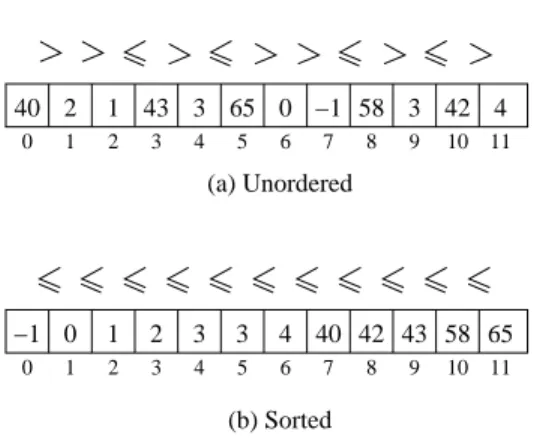
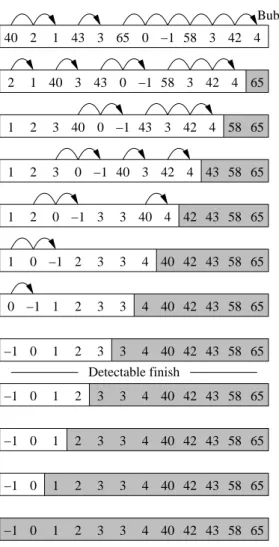
For the moment we assume that we will be sorting an unordered array of in- tegers (see Figure 6.1a).1 The problem is to arrange the integers so that every adjacent pair of values is in the correct order (see Figure 6.1b). A simple tech- nique to sort the array is to pass through the array from left to right, swapping adjacent values that are out of order (see Figure 6.2). The exchange of values is accomplished with a utility method:
BubbleSort public static void swap(int data[], int i, int j)
// pre: 0 <= i,j < data.length
// post: data[i] and data[j] are exchanged { int temp;
1 We focus on arrays of integers to maintain a simple approach. These techniques, of course, can be applied to vectors of objects, provided that some relative comparison can be made between two elements. This is discussed in Section 6.7.
(b) Sorted
1 43 58 42 4
0 1 2 3 4 5 6 7 8 9 10 11
3
0 1 2 3 4 5 6 7 8 9 10 11
−1 0 1 2 3 3 4 40 42 43 58 65
40 2 65 0 −1 3
(a) Unordered
Figure 6.1 The relations between entries in unordered and sorted arrays of integers.
temp = data[i];
data[i] = data[j];
data[j] = temp;
}
After a single pass the largest value will end up “bubbling” up to the high- indexed side of the array. The next pass will, at least, bubble up the next largest value, and so forth. The sort—calledbubble sort—must be finished aftern−1 passes. Here is how we might write bubble sort in Java:
public static void bubbleSort(int data[], int n) // pre: 0 <= n <= data.length
// post: values in data[0..n-1] in ascending order { int numSorted = 0; // number of values in order
int index; // general index while (numSorted < n)
{ // bubble a large element to higher array index for (index = 1; index < n-numSorted; index++) {
if (data[index-1] > data[index]) swap(data,index-1,index);
}
// at least one more value in place numSorted++;
} }
Observe that the only potentially time-consuming operations that occur in this sort are comparisons and exchanges. While the cost of comparing integers is rel-
6.1 Approaching the Problem 121
40 2 1 43 3 65 0 −1 58 3 42 4
2 1 40 3 43 0 −1 58 3 42 4 65
2 3 40 0 −1 43 3 4 58 65
65
65
65
65
65
65
65
65 58
58
58
58
58
58
58
1 42
1 2 3 0 −1 40 3 42 4 43
1 2 0 −1 3 3 40 4 42 43
43
43
43
43
43 42
42
42
42
42 2
−1 3 3 4 40
40
40
40
40
58
58 43
43 42
42 40
40 65
4
4
4
4
4
4 3
3
3
3
3
3 3
3
3
3
3
3 2
2
2
2
2
2 0
0
0
0 0 1
0
1
−1 1
−1 1
−1 1
−1 0
1
−1
1
−1
Bubble
Detectable finish
Figure 6.2 The passes of bubble sort: hops indicate “bubbling up” of large values.
Shaded values are in sorted order. A pass with no exchanges indicates sorted data.
atively small, if each element of the array were to contain a long string (for ex- ample, a DNA sequence) or a complex object (for example, a Library of Congress entry), then the comparison of two values might be a computationally intensive operation. Similarly, the cost of performing an exchange is to be avoided.2 We can, therefore, restrict our attention to the number of comparison and exchange operations that occur in sorts in order to adequately evaluate their performance.
In bubble sort each pass of the bubbling phase performsn−1comparisons and as many asn−1exchanges. Thus the worst-case cost of performing bubble sort isO((n−1)2)orO(n2)operations. In the best case, none of the comparisons leads to an exchange. Even then, though, the algorithm has quadratic behavior.3 Most of us are inefficient sorters. Anyone having to sort a deck of cards or a stack of checks is familiar with the feeling thatthere must be a better way to do this. As we shall see, there probably is: most common sorting techniques used in day-to-day life run inO(n2)time, whereas the best single processor comparison- based sorting techniques are expected to run in onlyO(nlogn)time. (If multi- ple processors are used, we can reduce this toO(logn)time, but that algorithm is beyond the scope of this text.) We shall investigate two sorting techniques that run inO(n2)time, on average, and two that run inO(nlogn)time. In the end we will attempt to understand what makes the successful sorts successful.
Our first two sorting techniques are based on natural analogies.
6.2 Selection Sort
Children are perhaps the greatest advocates of selection sort. Every October, Halloween candies are consumed from best to worst. Whether daily sampling is limited or not, it is clear that choices of the next treat consumed are based on “the next biggest piece” or “the next-most favorite,” and so on. Children consume treats in decreasing order of acceptability. Similarly, when we select plants from a greenhouse, check produce in the store, or pick strawberries from the farm we seek the best items first.
This selection process can be applied to an array of integers. Our goal is to identify the index of the largest element of the array. We begin byassuming that the first element is the largest, and then form a competition among all the remaining values. As we come across larger values, we update the index of the current maximum value. In the end, the index must point to the largest value.
This code is idiomatic, so we isolate it here:
SelectionSort
int index; // general index
int max; // index of largest value // determine maximum value in array
2 In languages like Java, where large objects are manipulated through references, the cost of an exchange is usually fairly trivial. In many languages, however, the cost of exchanging large values stored directly in the array is a real concern.
3 If, as we noted in Figure 6.2, we detected the lack of exchanges, bubble sort would run inO(n) time on data that were already sorted. Still, the average case would be quadratic.
6.2 Selection Sort 123
max = 0;
for (index = 1; index < numUnsorted; index++) { if (data[max] < data[index]) max = index;
}
(Notice that the maximum is not updated unless alargervalue is found.) Now, consider where this maximum value would be found if the data were sorted:
it should be clear to the right, in the highest indexed location. This is easily accomplished: we simply swap the last element of the unordered array with the maximum. Once this swap is completed, we know that at least that one value is in the correct location, and we logically reduce the size of the problem by one.
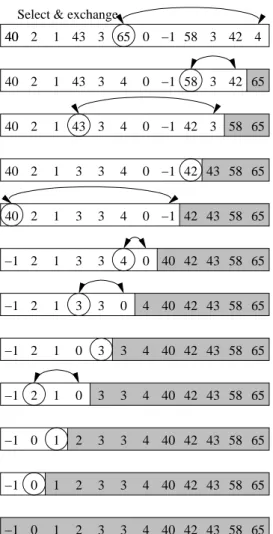
If we remove then−1largest values in successive passes (see Figure 6.3), we have selection sort. Here is how the entire method appears in Java:
public static void selectionSort(int data[], int n) // pre: 0 <= n <= data.length
// post: values in data[0..n-1] are in ascending order { int numUnsorted = n;
int index; // general index
int max; // index of largest value while (numUnsorted > 0)
{ // determine maximum value in array max = 0;
for (index = 1; index < numUnsorted; index++) { if (data[max] < data[index]) max = index;
}swap(data,max,numUnsorted-1);
numUnsorted--;
} }
Selection sort potentially performs far fewer exchanges than bubble sort: se- lection sort performs exactly one per pass, while bubble sort performs as many as n−1. Like bubble sort, however, selection sort demands O(n2) time for comparisons.
Interestingly, the performance of selection sort is independent of the order of the data: if the data are already sorted, it takes selection sort just as long to sort as if the data were unsorted. We can improve on this behavior through a slightly different analogy.
40 2 1 43 3 65 0 −1 58 3 42 4 40
65
58
43
42
40
4
3
43
43 65
65
65
65 65 58
58
58 42
2
1
0
−1
65
65
65
65
65 58
58
58
58
58
58 43
43
43
43
43
43 42
42
42
42
42
42 40
40
40
40
40
40 4
4
4
4
4 3
3
3
3 3
3
3 2
2 1 40
40
40
40
−1
−1
−1
−1
−1 2
2
2
2
2
2
2
2 1
1
1
1
1
1
1
1
1 43
43 3
3
3
3
3
3 4
4
4
4
4 0
0
0
0
0
0
58
42 42 3
3
3
3
3
3
0
0
42
−1
−1
−1
−1
−1 0
3 0 3 Select & exchange
Figure 6.3 Profile of the passes of selection sort: shaded values are sorted. Circled values are maximum among unsorted values and are moved to the low end of sorted values on each pass.
6.3 Insertion Sort 125
6.3 Insertion Sort
Card players, when collecting a hand, often consider cards one at a time, in- serting each into its sorted location. If we consider the “hand” to be the sorted portion of the array, and the “table” to be the unsorted portion, we develop a new sorting technique calledinsertion sort.
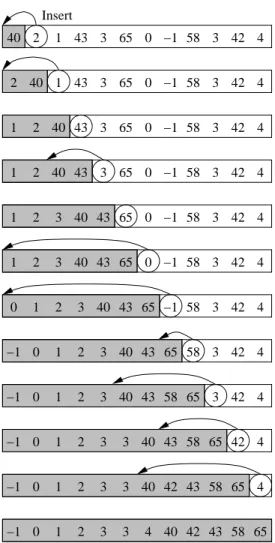
In the following Java implementation of insertion sort, the sorted values are kept in the low end of the array, and the unsorted values are found at the high end (see Figure 6.4). The algorithm consists of several “passes” of inserting the
InsertionSort lowest-indexed unsorted value into the list of sorted values. Once this is done,
of course, the list of sorted values increases by one. This process continues until each of the unsorted values has been incorporated into the sorted portion of the array. Here is the code:
public static void insertionSort(int data[], int n) // pre: 0 <= n <= data.length
// post: values in data[0..n-1] are in ascending order {
int numSorted = 1; // number of values in place int index; // general index
while (numSorted < n)
{ // take the first unsorted value int temp = data[numSorted];
// ...and insert it among the sorted:
for (index = numSorted; index > 0; index--) {
if (temp < data[index-1]) { data[index] = data[index-1];
} else { break;
} }
// reinsert value data[index] = temp;
numSorted++;
} }
A total of n−1 passes are made over the array, with a new unsorted value inserted each time. The value inserted may not be a new minimum or maximum value. Indeed, if the array was initially unordered, the value will, on average, end up near the middle of the previously sorted values. On random data the running time of insertion sort is expected to be dominated byO(n2)compares and data movements (most of the compares will lead to the movement of a data value).
If the array is initially in order, one compare is needed at every pass to determine that the value is already in the correct location. Thus, the inner loop
1 2 40 43 3 65 0 −1 58 3 42 4 40 2
40
2 1 43 3 65 0 −1 58 3 42 4
1 2 40 43 3 65 0 −1 58 3 42 4
1 2 40 43 65
65
65
65
65
65
65
65 4
4
4
4
4
4
4 42
42
42
42
42
42 3
3
3
3
3 58
58
58
−1
−1
−1 0
0 58 3
0
−1
−1
−1
−1
−1 0
0
0
0
0 1
1
1
1
1
1
1 2
2
2
2
2
2
2 3
3
3
3
3
3
3 3
3
3 4 40
40
40
40
40
40
40 43
43
43
43
43
43
43 58
58
58
58 42
42 Insert
1 43 3 65 0 −1 58 3 42 4
Figure 6.4 Profile of the passes of insertion sort: shaded values form a “hand” of sorted values. Circled values are successively inserted into the hand.
6.4 Mergesort 127
is executed exactly once for each ofn−1passes. The best-case running time performance of the sort is therefore dominated byO(n)comparisons (there are no movements of data within the array). Because of this characteristic, insertion sort is often used when data are very nearly ordered (imagine sorting a phone book after a month of new customers has been appended).
In contrast, if the array was previously in reverse order, the value must be compared witheverysorted value to find the correct location. As the compar- isons are made, the larger values are moved to the right to make room for the new value. The result is that each ofO(n2)compares leads to a data movement, and the worst-case running time of the algorithm isO(n2).
Note that each of these sorts uses a linear number of data cells. Not every sorting technique is able to live within this constraint.
6.4 Mergesort
Suppose that two friends are to sort an array of values. One approach might be to divide the deck in half. Each person then sorts one of two half-decks. The sorted deck is then easily constructed by combining the two sorted half-decks.
This careful interleaving of sorted values is called amerge.
It is straightforward to see that a merge takes at leastO(n)time, because every value has to be moved into the destination deck. Still, withinn−1com- parisons, the merge must be finished. Since each of the n−1 comparisons (and potential movements of data) takes at most constant time, the merge is no worse than linear.
There are, of course, some tricky aspects to the merge operation—for exam- ple, it is possible that all the cards in one half-deck are smaller than all the cards in the other. Still, the performance of the following merge code isO(n):
MergeSort private static void merge(int data[], int temp[],
int low, int middle, int high) // pre: data[middle..high] are ascending
// temp[low..middle-1] are ascending
// post: data[low..high] contains all values in ascending order {
int ri = low; // result index int ti = low; // temp index
int di = middle; // destination index
// while two lists are not empty merge smaller value while (ti < middle && di <= high)
{ if (data[di] < temp[ti]) {
data[ri++] = data[di++]; // smaller is in high data } else {
data[ri++] = temp[ti++]; // smaller is in temp }
}// possibly some values left in temp array
while (ti < middle) {
data[ri++] = temp[ti++];
}
// ...or some values left (in correct place) in data array }
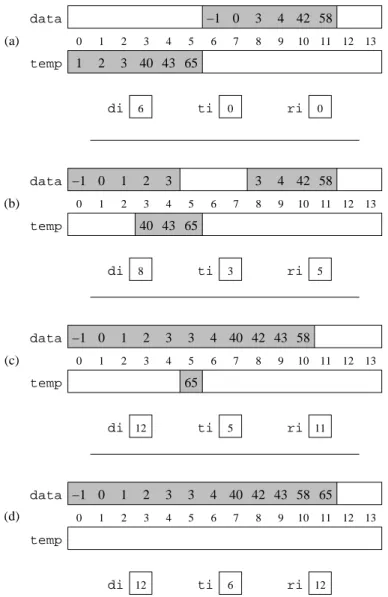
This code is fairly general, but a little tricky to understand (see Figure 6.5). We assume that the data from the two lists are located in the two arrays—in the lower half of the range intempand in the upper half of the range indata(see Figure 6.5a). The first loop compares the first remaining element of each list to determine which should be copied over to the result list first (Figure 6.5b). That loop continues until one list is emptied (Figure 6.5c). Ifdatais the emptied list, the remainder of thetemplist is transferred (Figure 6.5d). If thetemplist was emptied, the remainder of thedatalist is already located in the correct place!
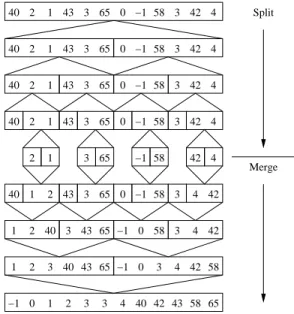
Returning to our two friends, we note that before the two lists are merged each of the two friends is faced with sorting half the cards. How should this be done? If a deck contains fewer than two cards, it’s already sorted. Otherwise, each person could recursively hand off half of his or her respective deck (now one-fourth of the entire deck) to a new individual. Once these small sorts are finished, the quarter decks are merged, finishing the sort of the half decks, and the two half decks are merged to construct a completely sorted deck. Thus, we might consider a new sort, called mergesort, that recursively splits, sorts, and reconstructs, through merging, a deck of cards. The logical “phases” of mergesort are depicted in Figure 6.6.
private static void mergeSortRecursive(int data[], int temp[], int low, int high) // pre: 0 <= low <= high < data.length
// post: values in data[low..high] are in ascending order { int n = high-low+1;
int middle = low + n/2;
int i;
if (n < 2) return;
// move lower half of data into temporary storage for (i = low; i < middle; i++)
{ temp[i] = data[i];
}// sort lower half of array
mergeSortRecursive(temp,data,low,middle-1);
// sort upper half of array
mergeSortRecursive(data,temp,middle,high);
// merge halves together
merge(data,temp,low,middle,high);
}
6.4 Mergesort 129
data data
di ti ri
ri ti
di
di ti ri
ri ti
di temp
data temp data temp temp
3 4 5 6 7 8 9 10 11 12 13
0 1 2
0 1 2 3 4 5 6 7 8 9 10 11 12 13
12 1
4
5 11
12
5 6 7 8 9 10 11 12 13 0
3
2 3 4 5
(a)
(b)
(d)
(c) 6 7 8 9 10 11 12 13
0 1 2
5
−1 0 3 4 42 58
2 3 65
1 40 43
−1 0 1 2 3 3 4 40 42 43 58 65 65
−1 0 1 2 3 3 4 40 42 43 58 58 42 3 4
65 43 40
−1 0 1 2 3
6 12
8 3
6 0 0
Figure 6.5 Four stages of a merge of two six element lists (shaded entries are partic- ipating values): (a) the initial location of data; (b) the merge of several values; (c) the point at which a list is emptied; and (d) the final result.
Merge 40 2 1 43 3 65 0 −1 58 3 42 4
40 2 1 43 3 65 0 −1 58 3 42 4
40 2 1 43 3 65 0 −1 58 3 42 4
40 2 1 43 3 65 0 −1 58 3 42 4
3 65 −1 58
40 43 3 65 0 −1 58 3
2 65 58 3
2 65 42
1 3
4 42 1 2
1
2 42 4
40 3 43 4 42
1
3
1 40 43 −1 0 3 4 58
65 58
3 42 43
−1 0 2 4 40
0
−1
Split
Figure 6.6 Profile of mergesort: values are recursively split into unsorted lists that are then recursively merged into ascending order.
Note that this sort requires a temporary array to perform the merging. This temporary array is only used by a single merge at a time, so it is allocated once and garbage collected after the sort. We hide this detail with a public wrapper procedure that allocates the array and calls the recursive sort:
public static void mergeSort(int data[], int n) // pre: 0 <= n <= data.length
// post: values in data[0..n-1] are in ascending order { mergeSortRecursive(data,new int[n],0,n-1);
}
Clearly, the depth of the splitting is determined by the number of times thatn can be divided in two and still have a value of 1 or greater: log2n. At each level of splitting, every value must be merged into its respective subarray. It follows that at each logical level, there areO(n)compares over all the merges.
Since there arelog2nlevels, we haveO(n·logn)units of work in performing a mergesort.
Mergesort is a common technique for sorting large sets of data that do not fit completely in fast memory. Instead, the data are saved in temporary files that are merged together. When the recursion splits the collection into subsets of a manageable size, they can be sorted using other techniques, if desired.
6.5 Quicksort 131
One of the unappealing aspects of mergesort is that it is difficult to merge two lists without significant extra memory. If we could avoid the use of this extra space without significant increases in the number of comparisons or data move- ments, then we would have an excellent sorting technique. Our next method demonstrates anO(nlogn)method that requires significantly less space.
6.5 Quicksort
Since the process of sorting numbers consists of moving each value to its ul- timate location in the sorted array, we might make some progress toward a solution if we could movea single valueto its ultimate location. This idea forms the basis of a fast sorting technique calledquicksort.
One way to find the correct location of, say, the leftmost value—called a pivot—in an unsorted array is to rearrange the values so that all the smaller values appear to the left of the pivot, and all the larger values appear to the right. One method of partitioning the data is shown here. It returns the final location for what was originally the leftmost value:
QuickSort private static int partition(int data[], int left, int right)
// pre: left <= right
// post: data[left] placed in the correct (returned) location { while (true)
{ // move right "pointer" toward left
while (left < right && data[left] < data[right]) right--;
if (left < right) swap(data,left++,right);
else return left;
// move left pointer toward right
while (left < right && data[left] < data[right]) left++;
if (left < right) swap(data,left,right--);
else return right;
} }
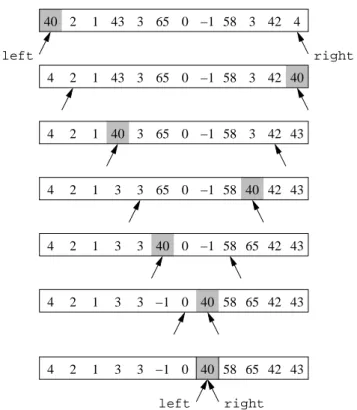
The indicesleftandrightstart at the two ends of the array (see Figure 6.7) and move toward each other until they coincide. The pivot value, being leftmost in the array, is indexed byleft. Everything to the left ofleftis smaller than the pivot, while everything to the right ofrightis larger. Each step of the main loop compares the left and right values and, if they’re out of order, exchanges them.
Every time an exchange occurs the index (left orright) that references the pivot value is alternated. In any case, the nonpivot variable is moved toward the other. Since, at each step, left andright move one step closer to each other, withinnsteps,left andrightare equal, and they point to the current location of the pivot value. Since only smaller values are to the left of the pivot, and larger values are to the right, the pivot must be located in its final location.
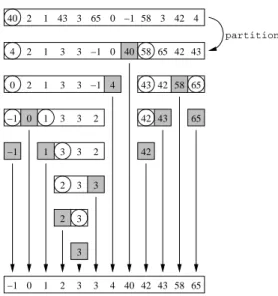
Values correctly located are shaded in Figure 6.8.
right
right left
left
2 1 43 3 65 0 −1 58 3 42 40 4
2 1 3 65 0 −1 58 3 42
4 40 43
2 1 3 65 0 −1 58 42
4 3 40 43
2 1 3 0 −1 58 42
4 3 40 65 43
2 1 3 0 42
4 3 −1 40 58 65 43
2 1 3 0 42
4 3 −1 40 58 65 43
2 1 43 3 65 0 −1 58 3 42 4 40
Figure 6.7 The partitioning of an array’s values based on the (shaded) pivot value40.
Snapshots depict the state of the data after theifstatements of thepartitionmethod.
6.5 Quicksort 133
partition
40 43 58 65 40 58 65 42 43
1 3
2 0
4 3 −1
1 3 58 42 4
40 2 43 65 0 −1 3
−1 0
−1
1 3
2 3 −1
0 4
43 42
42 43 58 65
65
1 3 3 2
3 2 3
2 3
3 1 3 3 2
42
−1 0 1 2 3 3 4 42
Figure 6.8 Profile of quicksort: leftmost value (the circledpivot) is used to position value in final location (indicated by shaded) and partition array into relatively smaller and larger values. Recursive application of partitioning leads to quicksort.
Because the pivot segregates the larger and smaller values, we know that none of these values will appear on the opposite side of the pivot in the final arrangement. This suggests that we can reduce the sorting of a problem of size n to two problems of size approximately n2. To finish the sort, we need only recursively sort the values to the left and right of the pivot:
public static void quickSort(int data[], int n)
// post: the values in data[0..n-1] are in ascending order { quickSortRecursive(data,0,n-1);
}
private static void quickSortRecursive(int data[],int left,int right) // pre: left <= right
// post: data[left..right] in ascending order
{ int pivot; // the final location of the leftmost value if (left >= right) return;
pivot = partition(data,left,right); /* 1 - place pivot */
quickSortRecursive(data,left,pivot-1); /* 2 - sort small */
quickSortRecursive(data,pivot+1,right);/* 3 - sort large */
/* done! */
}
In practice, of course, the splitting of the values is not always optimal (see the placement of the value4in Figure 6.8), but a careful analysis suggests that even with these “tough breaks” quicksort takes onlyO(nlogn)time.
When either sorted or reverse-sorted data are to be sorted by quicksort, the results are disappointing. This is because the pivot value selected (here, the leftmost value) finds its ultimate location at one end of the array or the other.
This reduces the sort ofn values ton−1 values (and notn/2), and the sort requires O(n) passes of an O(n) step partition. The result is anO(n2) sort.
Since nearly sorted data are fairly common, this result is to be avoided.
Notice that picking the leftmost value is not special. If, instead, we attempt to find the correct location for the middle value, then other arrangements of data will cause the degenerate behavior. In short, for any specific ordetermin- isticpartitioning technique, a degenerate arrangement exists. The key to more consistent performance, then, is a nondeterministic partitioning that correctly places a value selected at random (see Problem 6.15). There is, of course, a very unlikely chance that the data are in order and the positions selected in- duce a degenerate behavior, but that chance is small and successive runs of the sorting algorithm on the same data are exceedingly unlikely to exhibit the same behavior. So, although the worst-case behavior is stillO(n2), its expected behavior isO(nlogn).
Quicksort is an excellent sort when data are to be sorted with little extra space. Because the speed of partitioning depends on the random access nature of arrays orVectors, quicksort is not suitable when not used with random access structures. In these cases, however, other fast sorts are often possible.
6.6 Radix Sort
After investigating a number of algorithms that sort inO(n2)orO(nlogn)time, one might wonder if it is possible to sort in linear time. If the right conditions hold, we can sort certain types of data in linear time. First, we must investigate a pseudogame, 52 pickup!
Suppose we drop a deck of 52 cards on the floor, and we want to not only pick them up, but we wish to sort them at the same time. It might be most natural to use an insertion sort: we keep a pile of sorted cards and, as we pick up new cards, we insert them in the deck in the appropriate position. A more efficient approach makes use of the fact that we know what the sorted deck looks like. We simply lay out the cards in a row, with each position in the row reserved for the particular card. As we pick up a card, we place it in its reserved location. In the end, all the cards are in their correct location and we collect them from left to right.
Exercise 6.1 Explain why this sorting technique always takes O(n) time for a deck ofncards.
Such an approach is the basis for a general sorting technique calledbucket sort.
By quickly inspecting values (perhaps a word) we can approximately sort them
6.6 Radix Sort 135
into different buckets (perhaps based on the first letter). In a subsequent pass we can sort the values in each bucket with, perhaps a different sort. The buck- ets of sorted values are then accumulated, carefully maintaining the order of the buckets, and the result is completely sorted. Unfortunately, the worst-case behavior of this sorting technique is determined by the performance of the al- gorithm we use to sort each bucket of values.
Exercise 6.2 Suppose we havenvalues andmbuckets and we use insertion sort to perform the sort of each bucket. What is the worst-case time complexity of this sort?
Such a technique can be used to sort integers, especially if we can partially sort the values based on a single digit. For example, we might develop a support function, digit, that, given a number n and a decimal place d, returns the value of the digit in the particular decimal place. Ifdwas 0, it would return the units digit ofn. Here is a recursive implementation:
RadixSort public static int digit(int n, int d)
// pre: n >= 0 and d >= 0
// post: returns the value of the dth decimal place of n // where the units place has position 0
{ if (d == 0) return n % 10;
else return digit(n/10,d-1);
}
Here is the code for placing an array of integer values among 10 buckets, based on the value of digitd. For example, if we have numbers between 1 and 52 and we setdto 2, this code almost sorts the values based on their 10’s digit.
public static void bucketPass(int data[], int d) // pre: data is an array of data values, and d >= 0 // post: data is sorted by the digit found in location d;
// if two values have the same digit in location d, their // relative positions do not change; i.e., they are not swapped {
int i,j;
int value;
// allocate some buckets
Vector<Vector<Integer>> bucket = new Vector<Vector<Integer>>(10);
bucket.setSize(10);
// allocate Vectors to hold values in each bucket
for (j = 0; j < 10; j++) bucket.set(j,new Vector<Integer>());
// distribute the data among buckets int n = data.length;
for (i = 0; i < n; i++) {
value = data[i];
// determine the d'th digit of value
j = digit(value,d);
// add data value to end of vector; keeps values in order bucket.get(j).add(value);
}
// collect data from buckets back into array // collect in reverse order to unload Vectors // in linear time
i = n;
for (j = 9; j >= 0; j--)
{ // unload all values in bucket j while (!bucket.get(j).isEmpty()) {
i--;value = bucket.get(j).remove();
data[i] = value;
} } }
We now have the tools to support a new sort,radix sort. The approach is to use thebucketPasscode to sort all the values based on the units place. Next, all the values are sorted based on their 10’s digit. The process continues until enough passes have been made to consider all the digits. If it is known that values are bounded above, then we can also bound the number of passes as well. Here is the code to perform a radix sort of values under 1 million (six passes):
public static void radixSort(int data[])
// pre: data is array of values; each is less than 1,000,000 // post: data in the array are sorted into increasing order { for (int i = 0; i < 6; i++)
{ bucketPass(data,i);
} }
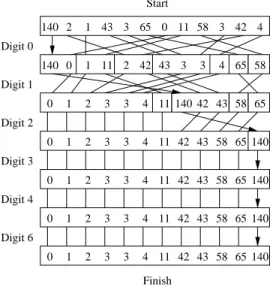
After the firstbucketPass, the values are ordered, based on their units digit. All values that end in0are placed near the front ofdata (see Figure 6.9), all the values that end in9appear near the end. Among those values that end in0, the values appearin the order they originally appeared in the array. In this regard, we can say thatbucketPassis astablesorting technique. All other things being equal, the values appear in their original order.
During the second pass, the values are sorted, based on their 10’s digit.
Again, if two values have the same 10’s digit, the relative order of the values is maintained. That means, for example, that140will appear before42, because after the first pass, the140appeared before the42. The process continues, until
6.6 Radix Sort 137
0 0 0
1 2
Start
Finish Digit 0
Digit 1
Digit 2
Digit 3
Digit 4
Digit 6
3
4
58
0 1 2 42 3 4 65
2 1 43 3 65 0 11 58 3 42
11 140
140
0 3 3 4 11 140 42 43 58 65
1 2 3 3 4 11 42 43 58 65 140
1 2 3 3 4 11 42 43 58 65 140
1 2 3 3 4 11 42 43 58 65 140
0 1 2 3 4 11 42 43 58 65 140
43 3
Figure 6.9 The state of the data array between the six passes of radixSort. The boundaries of the buckets are identified by vertical lines; bold lines indicate empty buck- ets. Since, on every pass, paths of incoming values to a bucket do not cross, the sort is stable. Notice that after three passes, theradixSortis finished. The same would be true, no matter the number of values, as long as they were all under 1000.
all digits are considered. Here, six passes are performed, but only three are necessary (see Problem 6.9).
There are several important things to remember about the construction of this sort. First, bucketPassis stable. That condition is necessary if the work of previous passes is not to be undone. Secondly, the sort is unlikely to work if the passes are performed from the most significant digit toward the units digit.
Finally, since the number of passes is independent of the size of thedataarray, the speed of the entire sort is proportional to the speed of a single pass. Careful design allows thebucketPassto be accomplished inO(n)time. We see, then, thatradixSortis aO(n)sorting method.
While, theoretically,radixSortcan be accomplished in linear time, practi- cally, the constant of proportionality associated with the bound is large com- pared to the other sorts we have seen in this chapter. In practice,radixSortis inefficient compared to most other sorts.
6.7 Sorting Objects
Sorting arrays of integers is suitable for understanding the performance of vari- ous sorts, but it is hardly a real-world problem. Frequently, the object that needs to be sorted is anObjectwith many fields, only some of which are actually used in making a comparison.
Let’s consider the problem of sorting the entries associated with an electronic phone book. The first step is to identify the structure of a single entry in the phone book. Perhaps it has the following form:
PhoneBook
class PhoneEntry {
String name; // person's name String title; // person's title int extension; // telephone number int room; // number of room String building; // office building public PhoneEntry(String n, String t, int e,
String b, int r) // post: construct a new phone entry { ...
}
public int compareTo(PhoneEntry other) // pre: other is non-null
// post: returns integer representing relation between values { return this.extension - other.extension;
} }
6.7 Sorting Objects 139
Rep.
DeFazio, Peter 56416 2134 Rayburn
Hooley, Darlene Rep. 55711 1130 Longworth
Rep.
Walden, Greg 56730 1404 Longworth
Rep. Longworth
Wu, David 50855 1023
Senator
Wyden, Ron 45244 516 Hart
Smith, Gordon Senator 43753 404 Russell
Smith, Gordon Senator 43753 404 Russell Senator
Wyden, Ron 45244 516 Hart
Rep. Longworth
Wu, David 50855 1023
Rep.
Blumenauer, Earl 54881 1406 Longworth
Hooley, Darlene Rep. 55711 1130 Longworth Rep.
DeFazio, Peter 56416 2134 Rayburn
Rep.
Walden, Greg 56730 1404 Longworth
Data before sorting
Data after sorting by telephone 0
1
3 4 5 6 2 0 1
3 4 5 6 2
Rep.
Blumenauer, Earl 54881 1406 Longworth
Figure 6.10 An array of phone entries for the107thCongressional Delegation from Oregon State, before and after sorting by telephone (shaded).
We have added the compareTomethod to describe the relation between two entries in the phone book (the shaded fields of Figure 6.10). ThecompareTo method returns an integer that is less than, equal to, or greater than 0 when thisis logically less than, equal to, or greater thanother. We can now modify any of the sort techniques provided in the previous section to sort an array of phone entries:
public static void insertionSort(PhoneEntry data[], int n) // pre: n <= data.length
// post: values in data[0..n-1] are in ascending order { int numSorted = 1; // number of values in place
int index; // general index while (numSorted < n)
{ // take the first unsorted value PhoneEntry temp = data[numSorted];
// ...and insert it among the sorted:
for (index = numSorted; index > 0; index--) {
if (temp.compareTo(data[index-1]) < 0) {
data[index] = data[index-1];
} else { break;
} }
// reinsert value data[index] = temp;
numSorted++;
} }
Careful review of this insertion sort routine shows that all the<operators have been replaced by checks for negativecompareTovalues. The result is that the phone entries in the array are ordered by increasing phone number.
If two or more people use the same extension, then the order of the resulting entries depends on the stability of the sort. If the sort is stable, then the relative order of the phone entries with identical extensions in the sorted array is the same as their relative order in the unordered array. If the sort is not stable, no guarantee can be made. To ensure that entries are, say, sorted in increasing order by extension and, in case of shared phones, sorted by increasing name, the followingcompareTomethod might be used:
public int compareTo(PhoneEntry other) // pre: other is non-null
// post: returns integer representing relation between values {
if (this.extension != other.extension) return this.extension - other.extension;
else return this.name.compareTo(other.name);
}
Correctly specifying the relation between two objects with thecompareTometh- od can be difficult when the objects cannot betotally ordered. Is it always possi- ble that one athletic team is strictly less than another? Is it always the case that one set contains another? No. These are examples of domains that arepartially ordered. Usually, however, most types may be totally ordered, and imagining how one might sorta collection of objects forces a suitable relation between any pair.
6.8 Ordering Objects Using Comparators
The definition of thecompareTomethod for an object should define, in a sense, the natural ordering of the objects. So, for example, in the case of a phone
6.8 Ordering Objects Using Comparators 141
book, the entries would ideally be ordered based on the name associated with the entry. Sometimes, however, the compareTo method does not provide the ordering desired, or worse, thecompareTomethod has not been defined for an object. In these cases, the programmer turns to a simple method for specifing an external comparison method called acomparator. A comparator is an object that contains a method that is capable of comparing two objects. Sorting methods, then, can be developed to apply a comparator to two objects when a comparison is to be performed. The beauty of this mechanism is that different comparators can be applied to the same data to sort in different orders or on different keys.
In Java a comparator is any class that implements thejava.util.Comparator interface. This interface provides the following method:
Comparator package java.util;
public interface Comparator
{ public abstract int compare(Object a, Object b);
// pre: a and b are valid objects, likely of similar type // post: returns a value less than, equal to, or greater than 0 // if a is less than, equal to, or greater than b
}
Like the compareTo method we have seen earlier, the compare method re- turns an integer that identifies the relationship between two values. Unlike the compareTomethod, however, the comparemethod is not associated with the compared objects. As a result, the comparator is not privy to the implemen- tation of the objects; it must perform the comparison based on information that is gained from accessor methods.
As an example of the implementation of a Comparator, we consider the implementation of a case-insensitive comparison ofStrings, calledCaseless- Comparator. This comparison method converts bothStringobjects to upper- case and then performs the standardStringcomparison:
Caseless- Comparator public class CaselessComparator implements java.util.Comparator<String>
{ public int compare(String a, String b) // pre: a and b are valid Strings
// post: returns a value less than, equal to, or greater than 0 // if a is less than, equal to, or greater than b, without // consideration of case
{ String upperA = ((String)a).toUpperCase();
String upperB = ((String)b).toUpperCase();
return upperA.compareTo(upperB);
} }
The result of the comparison is that strings that are spelled similarly in differ- ent cases appear together. For example, if an array contains the words of the children’s tongue twister:
Fuzzy Wuzzy was a bear.
Fuzzy Wuzzy had no hair.
Fuzzy Wuzzy wasn't fuzzy, wuzzy?
we would expect the words to be sorted into the following order:
a bear. Fuzzy Fuzzy Fuzzy fuzzy, had hair.
no was wasn't Wuzzy Wuzzy Wuzzy wuzzy?
This should be compared with the standard ordering of Stringvalues, which would generate the following output:
Fuzzy Fuzzy Fuzzy Wuzzy Wuzzy Wuzzy a bear.
fuzzy, had hair. no was wasn't wuzzy?
To use a Comparator in a sorting technique, we need only replace the use of compareTomethods withcompare methods from aComparator. Here, for example, is an insertion sort that makes use of aComparatorto order the values in an array ofObjects:
CompInsSort
public static <T> void insertionSort(T data[], Comparator<T> c) // pre: c compares objects found in data
// post: values in data[0..n-1] are in ascending order { int numSorted = 1; // number of values in place
int index; // general index int n = data.length; // length of the array while (numSorted < n)
{
// take the first unsorted value T temp = data[numSorted];
// ...and insert it among the sorted:
for (index = numSorted; index > 0; index--) {
if (c.compare(temp,data[index-1]) < 0) {
data[index] = data[index-1];
} else { break;
} }
// reinsert value data[index] = temp;
numSorted++;
} }
Note that in this description we don’t see the particulars of the types involved.
Instead, all data are manipulated asObjects, which are specifically manipulated by thecomparemethod of the providedComparator.
6.9 Vector-Based Sorting 143
6.9 Vector-Based Sorting
We extend the phone book example one more time, by allowing thePhoneEntrys to be stored in aVector. There are, of course, good reasons to useVectorover arrays, but there are some added complexities that should be considered. Here is an alternative Java implementation ofinsertionSortthat is dedicated to the sorting of aVectorofPhoneEntrys:
PhoneBook protected void swap(int i, int j)
// pre: 0 <= i,j < this.size
// post: elements i and j are exchanged within the vector { PhoneEntry temp;
temp = get(i);
set(i,get(j));
set(j,temp);
}
public void insertionSort()
// post: values of vector are in ascending order
{ int numSorted = 0; // number of values in place int index; // general index
while (numSorted < size()) {
// take the first unsorted value
PhoneEntry temp = (PhoneEntry)get(numSorted);
// ...and insert it among the sorted:
for (index = numSorted; index > 0; index--)
{ if (temp.compareTo((PhoneEntry)get(index-1)) < 0) { set(index,get(index-1));
} else { break;
}
}// reinsert value set(index,temp);
numSorted++;
} }
Recall that, for Vectors, we use the getmethod to fetch a value and setto store. Since any type of object may be referenced by a vector entry, we verify the type expected when a value is retrieved from the vector. This is accomplished through a parenthesized cast. If the type of the fetched value doesn’t match the type of the cast, the program throws a class cast exception. Here, we cast the result ofgetin thecompareTomethod to indicate that we are comparing PhoneEntrys.
It is unfortunate that theinsertionSorthas to be specially coded for use with thePhoneEntryobjects.
Exercise 6.3 Write aninsertionSortthat uses aComparatorto sort aVector of objects.
6.10 Conclusions
Sorting is an important and common process on computers. In this chapter we considered several sorting techniques with quadratic running times. Bubble sort approaches the problem by checking and rechecking the relationships between elements. Selection and insertion sorts are based on techniques that people commonly use. Of these, insertion sort is most frequently used; it is easily coded and provides excellent performance when data are nearly sorted.
Two recursive sorting techniques, mergesort and quicksort, use recursion to achieveO(nlogn) running times, which are optimal for comparison-based techniques on single processors. Mergesort works well in a variety of situations, but often requires significant extra memory. Quicksort requires a random access structure, but runs with little space overhead. Quicksort is not a stable sort because it has the potential to swap two values with equivalent keys.
We have seen with radix sort, it is possible to have a linear sorting algorithm, but it cannot be based on compares. Instead, the technique involves carefully ordering values based on looking at portions of the key. The technique is, practi- cally, not useful for general-purpose sorting, although for many years, punched cards were efficiently sorted using precisely the method described here.
Sorting is, arguably, the most frequently executed algorithm on computers today. When we consider the notion of anordered structure, we will find that algorithms and structures work hand in hand to help keep data in the correct order.
Self Check Problems
Solutions to these problems begin on page 445.
6.1 Why does it facilitate theswapmethod to have a temporary reference?
6.2 Cover the numbers below with your hand. Now, moving your hand to the right, expose each number in turn. On a separate sheet of paper, keep the list of values you have encounted in order. At the end you have sorted all of the values. Which sorting technique are you using?
296 457 -95 39 21 12 3.1 64 998 989
6.3 Copy the above table onto a piece of scrap paper. Start a column of numbers: write down the smallest table value you see into your column, cross- ing it out of the table. Continue until you have considered each of the values.
What sorting technique are you using?
6.10 Conclusions 145
6.4 During spring cleaning, you decide to sort four months of checks re- turned with your bank statements. You decide to sort each month separately and go from there. Is this valid? If not, why. If it is, what happens next?
6.5 A postal employee approximately sorts mail into, say, 10 piles based on the magnitude of the street number of each address, pile 1 has 1-10, pile 2 has 11-20, etc. The letters are then collected together by increasing pile number. She then sorts them into a delivery crate with dividers labeled with street names. The order of streets corresponds to the order they appear on her mail route. What type of sort is she performing?
6.6 What is the purpose of thecompareTomethod?
Problems
Solutions to the odd-numbered problems begin on page 464.
6.1 Show that to exchange two integer values it is not strictly necessary to use a third, temporary integer variable. (Hint: Use addition and/or subtrac- tion.)
6.2 We demonstrated that, in the worst case, bubble sort performs O(n2) operations. We assumed, however, that each pass performed approximately O(n)operations. In fact, passiperforms as many as O(n−i)operations, for 1≤i≤n−1. Show that bubble sort still takesO(n2)time.
6.3 How doesbubbleSort(as presented) perform in the best and average cases?
6.4 On any pass of bubble sort, if no exchanges are made, then the rela- tions between all the values are those desired, and the sort is done. Using this information, how fast will bubble sort run in worst, best, and average cases?
6.5 How fast does selection sort run in the best, worst, and average cases?
6.6 How fast does insertion sort run in the best, worst, and average cases?
Give examples of best- and worst-case input for insertion sort.
6.7 Running an actual program, count the number of compares needed to sortnvalues using insertion sort, wherenvaries (e.g., powers of 2). Plot your data. Do the same thing for quicksort. Do the curves appear as theoretically expected? Does insertion sort ever run faster than quicksort? If so, at what point does it run slower?
6.8 Comparing insertion sort to quicksort, it appears that quicksort sorts more quickly without any increase in space. Is that true?
6.9 At the end of the discussion on radix sort, we pointed out that the digit sorting passes must occur from right to left. Give an example of an array of 5 two-digit values that do not sort properly if you perform the passes left to right.
6.10 In radix sort, it might be useful to terminate the sorting process when numbers do not change position during a call tobucketPass. Should this mod- ification be adopted or not?
6.11 Using the millisecond timer, determine the length of time it takes to perform an assignment of a nonzero value to anint. (Hint: It will take less than a millisecond, so you will have to design several experiments that measure thousands or millions of assignments; see the previous lab, on page 115, for details.)
6.12 Running an actual program, and using the millisecond timer,System.- currentTimeMillis, measure the length of time needed to sort arrays of data of various sizes using a sort of your choice. Repeat the experiment but use Vectors. Is there a difference? In either case, explain why. (Hint: You may have to develop code along the lines of Problem 6.11.)
6.13 A sort is said to be stable if the order of equal values is maintained throughout the sort. Bubble sort is stable, because whenever two equal val- ues are compared, no exchange occurs. Which other sorts are stable (consider insertion sort, selection sort, mergesort, and quicksort)?
6.14 Thepartitionfunction of quicksort could be changed as follows: To place the leftmost value in the correct location, count the number of values that are strictly less than the leftmost value. The resulting number is the correct index for the desired value. Exchange the leftmost value for the value at the indexed location. With all other code left as it is, does this support a correctly functioning quicksort? If not, explain why.
6.15 Modify the partitionmethod used by quicksort so that the pivot is randomly selected. (Hint: Before partitioning, consider placing the randomly selected value at the left side of the array.)
6.16 Write a recursiveselectionSortalgorithm. (Hint: Each level of recur- sion positions a value in the correct location.)
6.17 Write a recursiveinsertionSortalgorithm.
6.18 Some of the best-performing sorts depend on the best-performing shuf- fles. A good shuffling technique rearranges data into any arrangement with equal probability. Design the most efficient shuffling mechanism you can, and argue its quality. What is its performance?
6.19 Write a program calledshuffleSort. It first checks to see if the data are in order. If they are, the sort is finished. If they aren’t, the data are shuffled and the process repeats. What is the best-case running time? Is there a worst-case running time? Why or why not? If each time the data were shuffled they were arranged in a never-seen-before configuration, would this change your answer?
6.20 Write a program to sort a list of unique integers between 0 and 1 million, but only using 1000 32-bit integers of space. The integers are read from a file.
6.11 Laboratory: Sorting with Comparators
Objective.To gain experience with Java’sjava.util.Comparatorinterface.
Discussion.In Chapter 6 we have seen a number of different sorting techniques.
Each of the techniques demonstrated was based on the fixed, natural ordering of values found in an array. In this lab we will modify theVectorclass so that it provides a method,sort, that can be used—with the help of aComparator—to order the elements of theVectorin any of a number of different ways.
Procedure.Develop an extension ofstructure.Vector, calledMyVector, that includes a new method,sort.
Here are some steps toward implementing this new class:
1. Create a new class,MyVector, which is declared to be an extension of the structure.Vectorclass. You should write a default constructor for this class that simply callssuper();. This will force thestructure.Vector constructor to be called. This, in turn, will initialize the protected fields of theVectorclass.
2. Construct a newVectormethod calledsort. It should have the following declaration:
public void sort(Comparator<T> c) // pre: c is a valid comparator
// post: sorts this vector in order determined by c
This method uses aComparatortype object to actually perform a sort of the values inMyVector. You may use any sort that you like.
3. Write an application that reads in a data file with several fields, and, de- pending on theComparator used, sorts and prints the data in different orders.
Thought Questions.Consider the following questions as you complete the lab:
1. Suppose we write the followingComparator: import structure5.*;
import java.util.Iterator;
import java.util.Comparator;
import java.util.Scanner;
public class RevComparator<T> implements Comparator<T>
{ protected Comparator<T> base;
public RevComparator(Comparator<T> baseCompare) { base = baseCompare;
}
public int compare(T a, T b) {
return -base.compare(a,b);
} }
What happens when we construct:
MyVector<Integer> v = new MyVector<Integer>();
Scanner s = new Scanner(System.in);
while (s.hasNextInt()) { v.add(s.nextInt());
}
Comparator<Integer> c = new RevComparator<Integer>(new IntegerComparator());
v.sort(c);
2. In our examples, here, a new Comparator is necessary for each sorting order. How might it be possible to add state information (protected data) to theComparatorto allow it to sort in a variety of different ways?
One might imagine, for example, a method calledascendingthat sets the Comparatorto sort into increasing order. Thedescendingmethod would set theComparatorto sort in reverse order.
Notes: