Global Nursing Challenges in The Free Trade Era
i
Global Nursing Challenges in The Free Trade Era
ii The Proceeding of 7
thInternational Nursing Conference:
Global Nursing Challenges in The Free Trade Era
Fakultas Keperawatan Universitas Airlangga
Hak Cipta © 2016,
Fakultas Keperawatan Universitas Airlangga Surabaya Kampus C Mulyorejo Surabaya 60115
Telp. : (031)5913754, 5913257 Faks. : (031)5913752
Website : http:/ners.unair.ac.id Email : [email protected]
Hak cipta dilindungi undang-undang. Dilarang memperbanyak sebagian atau seluruh isi buku ini dalam bentuk apapun, baik secara elektronis maupun mekanis, termasuk tidak terbatas pada memfotokopi, merekam, atau dengan menggunakan sistem penyimpanan lainnya, tanpa izin tertulis dari Penerbit.
UNDANG-UNDANG NOMOR 19 TAHUN 2002 TENTANG HAK CIPTA
1. Barangsiapa dengan sengaja dan tanpa hak mengumumkan atau memperbanyak sutu Ciptaan atau memberi izin untuk itu, dipidana dengan pidana penjara paling lama 7
(tujuh) tahun dan/atau denda paling banyak Rp. 5.000.000.000,00 (lima miliar rupiah)2. Barangsiapa dengan sengaja menyiarkan, memamerkan, mengedarkan, atau menjual kepada umum suatu Ciptaan atau barang hasil pelanggaran Hak Cipta atau Hak Terkait sebagaimana dimaksud diatas, dipidana dengan pidana penjara paling lama 5 (lima)
tahun dan/atau denda paling banyak Rp 500.000.000,00 (lima ratus juta rupiah).Fakultas Keperawatan Universitas Airlangga
The Proceeding of 7
thInternational Nursing Conference:
Global Nursing Challenges in The Free Trade Era
716 hlm, 21 x 29,7 cm
ISSN : 2407-0629
Global Nursing Challenges in The Free Trade Era
iii
CONTENTS
Greeting from Steering Committe ... iv
Opening remarks from Dean of Faculty of Nursing, Universitas Airlangga ... v
Opening remarks from Rector of Faculty of Nursing, Universitas Airlangga ... vi
Committee ... ix
Scientific Paper Reviewer ... xii
Conference Schedule ... xiii
Keynote Speaker : Junaidi Khotib, S.Si, M.Kes., PhD Plenary Sessions ... 1
Speaker 1: SEKI Ikuko MPH, R.N, R.M.W, P.H.N ... 1
Speaker 2: Dr. Muhammad Hadi, SKM., M.Kep. ... 2
Speaker 3: Harif Fadilah, S.Kp, SH, MH.Kes. ... Speaker 4: Dr. Nur Mukarromah.,S.KM.,M.Kes.. ... 7
Speaker 5: Kristen Graham, RN,RM,MNg,MPH&TM,MPEd&Tr,GDipMid,GDipHSc ... 13
Speaker 6: Dr. M. Hasinuddin, S.Kep., Ns., M.Kep. ... 14
Speaker 7: Dr. Tri Johan Agus Y., S.Kp., M.Kep. .. ... 20
Speaker 8: Dr. Hanik Endang N, S.Kep., Ns., M.Kep. ... 27
Speaker 9: Dr. Makhfudli, S.Kep., Ns., M.Ked.Trop. ... 32
Speaker 10: Madiha Mukhtar, RN, MScN, BScN, RM ... 37
Speaker 11: Ima Nadatien, SKM.,M.Kes. ... 38
Oral Presentation ... 42
Poster Presentation ... 507
Global Nursing Challenges in The Free Trade Era
iv
GREETING FROM STEERING COMMITTEE
Assalamualaikum Warahmatullahi Wabarakatuh Honorable Rector of Universitas Airlangga
Honorable Dean of Faculty of Nursing, Universitas Airlangga Honorable Head of Co-Host Institutions
Distinguished Speakers and all Participants
Praise the presence of God Almighty, for his mercy so that Faculty of Nursing Universitas Airlangga can organized The 7th International Nursing Conference on the theme ”The Global Nursing Challenges in The Free Trade Era”. Welcome in Surabaya, City of Heroes Indonesia.
This international nursing conference is conducted in cooperation with 12 nursing schools throughout the nation. These institutions are the Faculty of Nursing and Midwifery Universitas Nahdlatul Ulama Surabaya, Faculty of Health Science Universitas Muhammadiyah Surabaya, STIKES Ngudia Husada Bangkalan, STIKES Pemerintah Kabupaten Jombang, STIKES Maharani Malang, Poltekkes Kementerian Kesehatan Malang, Poltekkes Kementerian Kesehatan Surabaya, Faculty of Health Science Universitas Islam Sultan Agung Semarang, Faculty of Health Science Universitas Pesantren Tinggi Darul Ulum Jombang, STIKES Insan Cendekia Husada Bojonegoro, STIKES Nurul Jadid Probolinggo, STIKES YARSI Mataram, and Faculty of Nursing Universitas Muhammadiyah Banjarmasin. Fortunately, this international nursing conference also supported by our partner institutions abroad: Flinders University* (Australia), and Japan International Cooperation Agency (JICA); and also by professional and other organisations including: AINEC* (The Association of Indonesian Nurse Education Center), Ibn- e-Seina Hospital & Research institute Multan (Pakistan) and INNA* (Indonesian National Nurses Association).
Participants of this conference are lecturers, nurses, students both from clinical and educational setting, regional and overseas area.
Finally, I would like to thanks to all speakers, participants, co-host institutions and sponsors so that this conference can be held succesfully.
Please enjoy the international conference, i hope we all have a wonderful experience at the conference.
Wassalamualaikum Warahmatullahi Wabarakatuh Steering Committee
Global Nursing Challenges in The Free Trade Era
v
OPENING REMARK FROM THE DEAN OF FACULTY NURSING
Assalamualaikum Warahmatullahi Wabarakatuh Honorable Rector of Universitas Airlangga Distinguished speakers and all Participants
First of all I would like to praises and thanks to God for the blessing and giving us the grace to be here in a good health and can hold this conference together. Secondly, it is a great privilege and honor for us to welcome every one and thank you very much for your participation and support for the 7th International Nursing “The Global Nursing Challenges in The Free Trade Era”.
Globalization opens opportunities for nurses to compete with other nurses and work abroad.
Nurses should constantly improve their competency in providing excellent nursing care. The sustainability of education related to the latest science and nursing knowledge is very important for all nurses who are working in the clinic, community, and educational nursing system, to enhance their competencies
Research and education into clinical and community practice is very important to enhance nursing competencies with nurse colleagues in the international sphere. Indonesia face problems such low frequency of nursing conference, number of researches, also international publications. This problem can hinder quality improvement of nursing services.
Along with Universitas Airlangga vision to become a world class university and enter top World University Ranking, Faculty of Nursing, participates actively in reaching the vision. To achieve World Class University ranking, faculty needs to meet the standards of World’s top Universities such as Academic reputation, employer reputation, publication, faculty standard ratio, international students and exchange. International Nursing Conference is one of the few strategies that have been implemented by the faculty to increase Publication standard.
In 2016, the Faculty of Nursing Universitas Airlangga started to collaborate with 12 nursing schools throughout the nation that have the same concern to overcome the situations. These institutions including Faculty of Nursing and Midwifery Universitas Nahdlatul Ulama Surabaya, Faculty of Health Science Universitas Muhammadiyah Surabaya, STIKES Ngudia Husada Bangkalan, STIKES Pemerintah Kabupaten Jombang, STIKES Maharani Malang, Poltekkes Kementerian Kesehatan Malang, Poltekkes Kementerian Kesehatan Surabaya, Faculty of Health Science Universitas Islam Sultan Agung Semarang, Faculty of Health Science Universitas Pesantren Tinggi Darul Ulum Jombang, STIKES Insan Cendekia Husada Bojonegoro, STIKES Nurul Jadid Probolinggo, STIKES YARSI Mataram, and Faculty of Nursing Universitas Muhammadiyah Banjarmasin. Under the concern of long commitment for better health outcome of Indonesia, the Faculty of Nursing Universitas Airlangga once more aims to elaborate with the aforementioned institutions and international universities through holding an international nursing conference. The international universities include: Flinders University*
(Australia), Japan International Cooperation Agency (JICA); and professional organisations including: AINEC* (The Association of Indonesian Nurse Education Center), Ibn-e-Seina Hospital & Research institute Multan (Pakistan) and INNA* (Indonesian National Nurse Association).
Global Nursing Challenges in The Free Trade Era
vi
Finally, I would like to thanks to all speakers, participants, and sponsorships that helped the success of this event. I hope that this conference have good contribution in increasing the quality of nursing and nursing care.
Please enjoy the international conference. I hope, we all have a wonderful time at the conference.
Wassalamualaikum Warahmatullahi Wabarakatuh
Prof. Dr. Nursalam, M.Nurs (Hons) Dean, Faculty of Nursing
Universitas Airlangga
Global Nursing Challenges in The Free Trade Era
vii
OPENING SPEECH
UNIVERSITAS AIRLANGGA RECTOR
Assalamu’alaikum wa-rahmatullahi wa-barakatuh.
May the peace, mercy and blessings of Allah be upon you.
Alhamdulillah! Praise be to Allah, the Almighty which gives us the opportunity to gather here in “THE 7TH INTERNATIONAL NURSING CONFERENCE“. Let us also send shalawat and salam to our Prophet Muhammad SAW (Praise Be Upon Him): Allaahumma shalli ‘alaa Muhammad wa ‘alaa aali Muhammad. May Allah give mercy and blessings upon Him.
Ladies and Gentlemen,
“Everything changes and only the change itself remain unchanged,” that is some words of wisdom reminding us to the absolute truth that there is no such thing in this world can hold back the tide of change.
Nursing Education, as a professional field, inevitably has to improve along with the changes. And if it is possible, it should always be vigilant to anticipate a period of change ahead.
In this regard, we are already in ‘THE FREE TRADE AREA’. It is one of those changes and we have to deal with the problems of its implementation. Related to these problems, we expect universal Nursing Education to be able to provide attention to all aspects of public healthcare services, anywhere and in any social classes. Therefore, let us always make efforts to quality improvements, such as in the relationship between nurses and the patients, disease prevention, and patients’ treatments.
Ladies and Gentlemen,
Higher education on Nursing has its strategic roles to achieve excellent public healthcare services. Therefore, its education format must be flexible, able to adapt and anticipate any influences such as from boundless improvements of technology, economy, politics, culture and other aspects of development. At this point, joint-researches or joint-programs, seminars, scientific publications, or any other collaborations should be conducted more frequently by all nursing higher education institutions. These advance steps are necessary to achieve “Healthy Global Communities” sooner.
As a result, let us exploit these changes around us to create a condition where the quality of public healthcare service is so high that it brings happiness to all. Thus, competence’s improvement of all nursing students is indispensable. This improvement, of course, should be synchronized with the changes in all aspects. Let us optimally develop this nursing science by maintaining connections and cooperation with other institutions and finding opportunities for future collaborations with others.
Ladies and Gentlemen,
The organization of this international nursing conference must be appreciated. Firstly, because it is the seventh time of the conference organization. Secondly, the theme of this conference, “THE GLOBAL NURSES CHALLENGES IN THE FREE TRADE ERA”, has a strong sense of urgency and very appropriate at this moment.
Therefore, I would like to express my deepest gratitude to the organizing committee, the nursing education institutions- domestic or international-, all the keynote speakers and other parties which support this splendid conference.
viii
Global Nursing Challenges in The Free Trade EraWe extend a warm welcome to all delegates and those who have travelled from foreign parts. We hope that your attendance will be rewarded academically, that you will make new friends and that you will be fulfilled through the conference activities and the artistic delights of Surabaya.
Ladies and Gentlemen,
Merely to expect Allah gracious blessings, I hereby officially open this “SEVENTH INTERNATIONAL NURSING CONFERENCE“ by saying grace: "Bismillahirrahmanirrahim".
May the objectives of this organization fulfilled and the conference be a success. Therefore let us again say: Alhamdulillah! Praise be to Allah.
Wassalamu’alaikum wa-rahmatullahi wa-barakatuh.
Universitas Airlangga Rector,
Prof. Dr. Moh. Nasih, SE., MT., Ak., CMA.
NIP. 196508061992031002
Global Nursing Challenges in The Free Trade Era
ix
COMMITTEE
Patron : Rector of Universitas Airlangga Advisor : Prof. Dr. Nursalam, M.Nurs (Hons)
Dean Faculty of Nursing,Universitas Airlangga
Dean Faculty of Nursing and Midwifery Universitas Nahdlatul Ulama Surabaya
Dean Faculty of Health Science Universitas Muhammadiyah Surabaya
Head of STIKES Ngudia Husada Bangkalan Head of STIKES Pemerintah Kabupaten Jombang Head of STIKES Maharani Malang
Head of Nursing Programme Poltekkes Kementerian Kesehatan Malang
Head of Nursing Programme Poltekkes Kementerian Kesehatan Surabaya
Dean Faculty of Health Science Universitas Islam Sultan Agung Semarang
Dean Faculty of Health Science Universitas Pesantren Tinggi Darul Ulum Jombang
Head of STIKES Nurul Jadid Probolinggo
Head of STIKES Insan Cendekia Husada Bojonegoro
Dean Faculty of Nursing Universitas Muhammadiyah Banjarmasin STIKES YARSI Mataram
Steering Committee : Dr. Kusnanto, S.Kp.,M.Kes.
Vice Dean 1 of Faculty of Nursing Universitas Airlangga Eka Mishbahatul Mar’ah Has.,S.Kep., Ns., M.Kep.
Vice Dean 2 of Faculty of Nursing, Universitas Airlangga Steering Chairman : Dr. Ah. Yusuf, S.Kp.,M.Kes.
Vice Dean 3 of Faculty Nursing, Universitas Airlangga Organizing
Committee
Chair : Laily Hidayati, S.Kep., Ns., M.Kep.
Secretaries : Rista Fauziningtyas, S.Kep. Ns, M.Kep.
Lailatun Ni’mah, S.Kep. Ns, M.Kep.
Treasury : Erna Dwi W., S.Kep., Ns., M.Kep.
Ninik Setyaningrum D, S.H
Global Nursing Challenges in The Free Trade Era
x
Event divisionboard : Retnayu Pradanie, S.Kep., Ns.M.Kep.
Tiyas Kusumaningrum, S.Kep.,Ns.M.Kep.
Ika Nur Pratiwi, S.Kep., Ns.M.Kep.
Iqlima Dwi Kurnia, S.Kep., Ns.M.Kep.
Fauziyatun Nisa’, S.S.T., M.Kes.
Ana Farida Ulfa, S.Kep., Ns., M.Kep.
Sestu Retno D.A,S.Kp,M.Kes Rahmawati Maulidia., M.Kep Wahyu Endang S. S.KM, M.Kep.
Dede Nasrullah, S.Kep., Ns.M.Kep.
Nisfil Mufidah, S.Kep., Ns.M.Kep.
Ferawati, S.Kep., Ns
Ns. Dwi Adji Norontoko, M.Kep.
Scientific board
: Dr. Joni Haryanto, S.Kp.,MSi Dr. Tintin Sukartini, S.Kp, M.Kes EstyYunitasari, S.Kp, M.Kes Harmayetty, S.Kp, M.Kes
Yulis Setiya Dewi, S.Kep., Ns.,Mng Erna Dwi Wahyuni, S.Kep., Ns.M.Kep.
Elida Ulfiana, S.Kep., Ns.M.Kep.
Praba Diyan Rahmawati, S.Kep., Ns.M.Kep.
Ilya Krisnana, S.kep, Ns, M.kep.
Khamida, S.Kep.Ns.,M.Kep.
Dr. Ririn Probowati,S.Kp,M.Kes Lilla Maria., M.Kep
Diah Ayu Fatmawati, S.Kep., Ns., M.Kep.
Ns Suyanto, M.Kep.
Yuanita Wulandari, S.Kep.,Ns.MS.
Mulia Mayangsari, S.Kep., Ns.M.Kep.
Sp.Kep.MB.
Sri Astutik Andayani, S.Kep.Ns, M.Kes.
M. Roni Al faqih, S.Kep., Ns
Ns. Endah Suprihatin, M.Kep., Sp. Mat.
Dr. Luluk Widarti, M.Kes.
Hasyim As’ari, S.Kep. Ns., M.Ked.
Publications, partnership, &
Sponsorship
: Setho Hadisuyatmana, S.Kep., Ns., M.NS (CommHlth&PC)
Dimas Dwi Arbi, S.Kom.
Sylvia Dwi W., S.Kep., Ns.M.Kep.
Nur Hidayah, S.Kep.Ns.,M.Kes.
Anis Satus Syarifah, S.Kep,Ns,M.Kes Feriana Ira Handian., M.Kep Edi Wibowo S., S.Kep,Ns,M.Kes Septian Galuh Winata, S.Kep., Ns.
Mufarika, M.Kep.
Ns. Handono Fathur R.
M.Kep.Sp.Kep.MB.
Global Nursing Challenges in The Free Trade Era
xi
Maslicah, S.Kep., Ns.Accomodation board
: Kristiawati, S.Kp,M.Kep., Sp. Kep. An.
Candra Panji A., S.Kep., Ns., M.Kep.
Nur Rohmawati
Logistics : Dr. Hanik Endang N, S.Kep., Ns.M.kep Suyatik
Equipment division : M. Anwari Suharto Sukardjianto Arifin Sodikin
Global Nursing Challenges in The Free Trade Era
xii
SCIENTIFIC PAPER REVIEWER
Prof. Dr. Nursalam, M.Nurs (Hons) Universitas Airlangga, Surabaya, Indonesia Ellen Rosskam, PhD, MPH. University Research Council & Center for
Human Services, United States
Dr. Ah. Yusuf, S.Kp.,M.Kes. Universitas Airlangga, Surabaya, Indonesia Dr. M. Hasinuddin, S.Kep., Ns., M.Kep. STIKES Ngudia Husada, Bangkalan,
Indonesia
Dr. Joni Haryanto, S.Kp.,MSi. Universitas Airlangga, Surabaya, Indonesia Dr. Ririn Probowati,S.Kp,M.Kes. STIKES Pemerintah Kabupaten Jombang,
Indonesia
Dr. Kusnanto, S.Kp.,M.Kes. Universitas Airlangga, Surabaya, Indonesia Dr. Tintin Sukartini, S.Kp, M.Kes. Universitas Airlangga, Surabaya, Indonesia
Global Nursing Challenges in The Free Trade Era
42
LIST OF ORAL PRESENTATION
Theme : Community Health & Primary Care Nursing & Family Nursing page Family Support Among Students With Maladaptive Behaviour
Prima Khairunisa, Elis Hartati 49
Awareness And Barriers To Tb Dots Program In Selected Community In Indonesia: Basis For Information Dissemination Campaign Material
Wijar Prasetyo1, Liwayway T. Valesteros2
50
Prenatal Care Satisfaction In Temporary Housing Following Natural Disaster
Yuanita Wulandari 51
Nurse role on building Community resilience in merapi: preparedness phase
Melyza Perdana, Nurul Hidayah, Ratna Puji Priyanti 56
Health Volunteer’s Role Enhancement As A Change Agent Of Leprosy Related Stigma At Community By Using Training
Eka Mishbahatul Mar’ah Has, Elida Ulfiana, Retno Indarwati
64
Perception Affects The Hsp 70 Family Members Who Care For Sufferers Of Tuberculosis Chilyatiz Zahroh
Public Participation In Health Development Program In Wonokromo District
Wiwik Afridah 68
Analysis of the change of intent keep skin hygiene in dormitories at Al-Mukmin Daughter Asror Bangkalan Madura
Eppy Setiyowati
72
The influence of mozart classical music therapy onThe learning ability among students in grade xii Social class at sman 1 pagak malang
AmilaWidati, Anggoro Bayu Krisnowo
78
Effect KIB (Kelas Ibu Balita) Aged 0-59 Months Of Practical Use Of Buku Kia In Megaluh And Jogoloyo Primary Health Care In Jombang City
Septi Fitrah Ningtyas
83
Analysis Factors Affecting Diphtheria Epidemic in Bangkalan Madura
Meiana Harfika 84
Tuberculosis Patient Habitual Of Coughing And Sputum Dispose
Suprajitno 85
The Effect Of Peer Group Discussion To Improve Adolescent’s Knowledge And Attitude About Free Sex Prevention On 8th Grade Student’s At Smp Panca Jaya Surabaya
Suhartina, Mira Triharini, Eka Misbahatul Mar’ah Has
94
Macro cosmos effect on human health behavior and cultural perspective by java
(behavior study of java society in taking care of And improving health in blitar east java) Imam Sunarno
95
Theme : Education and Inter professional Collaboration page
Fostering Soft Skills in Nursing Through Caring Theory in Nursing Ethics Course
Rr. Sri Endang Pujiastuti 95
An Analysis of Learning English for Spesific Purposes (ESP) for Nursing Using Video Media to Increase The Students’ Speaking Ability
I’in Noviana
96
The Relation Between the Teacher’s Roles in Teaching English for Specific Purposes to
the Three Different Degrees of Nursing Program Students’ Motivation of Applying 97
Global Nursing Challenges in The Free Trade Era
43
English in Nursing TermsNurul Arifah
The Conventional Model and Problem Based Learning Model to Motivate Learning in Midwivery Student at Pemkab Jombang Institute of Health Science
Erika Agung Mulyaningsih, Pepin Nahariani, Effy Kurniati
98
Internal Analysis of Self Regulated Learning: Developmental Study
Pepin Nahariani, Erika Agung Mulyaningsih 102
English Role Play Activity Research on Blood Pressure Measurement in Nursing Class
Tiyas Saputri 106
Relationship of Level of Anxiety with Learning Clinic Achievement Midwifery Student on Surabaya
Nur Masruroh
112
Effectiveness of Achievement in Learning Media Installation of Competence Nasogastric Tube (NGT)
Nurul Hidaya, Agus Setyo Utomo
119
Distance Learning Using Social Media in Nursing Education Process
Ema Yuniarsih , Maria Frani Ayu Andari Dias 124
Theme : Geriatric Nursing Page
The Comparative Of Knowledge And Elderly People’s Visiting At Posyandu (Centre For Health At The Neighborhood) In Dusun Sidowaras And Dusun Belut
Wiwiek Widiatie, Andi Yudianto
128
The Effect Of Range Of Motion Exercise At Lower Limb To Elderly Postural Balance In Posyandu Alamanda 99 Jember Lor Village Jember District
Muhammad Athok Fitriyansyah, Tantut Susanto., Hanny Rasni
132
The Relationship Of Cognitive Status And Quality Of Life Of Elderly In Nursing Home
Ises Reni, Lenni Sastra, Ninit Yulistini 137
Supportive Therapy In Improving The Independence Of The Elderly Based On Orem’s Nursing Theory
Khamida , Umdatus , Juliana Enggar Brildyh
138
The effectiveness of reminiscence therapy for reducing depressive symptoms in eldery
Rodiyah 145
Moslem Spiritual Behaviour And Readiness To Face Death In Elderly
Pipit Festy, Musrifatul Uliyah, Arif Tri Ardianto 149
The effectiveness of the mc. Kenzie extension method On the low back pain in elderly
Amila , Henny Syapitri, Yefita Realisman Zebua 154
Effect of garlic toward cholesterol level of elderly At sumengko village, distric of Gresik
Ahmad Kanzul Khoir, Yulis Setiya Dewi, Erna Dwi Wahyuni 157
Theme : Management and Health Policies Page
Complaint management on health care improvement efforts as a customer satisfaction
Pratiwi.Y, Fresty.A, Martini.W 162
External and internal factors influencing job stress in nursing at emergency department
Nur Ainiyah 167
Nurses Perceptions Of Leadership Behavior Manager In The Application Of The Six Quality Targets Patient Safety In Private Hospital
Ratna Agustin
169
Theme : Medical Surgical and Critical Care Nursing Page
Study comparation to find correlation between clinical manifestations and clinical 173
Global Nursing Challenges in The Free Trade Era
44
utcomes of typhoid fever Patients and type of salmonella typhi Strain that are non MDR and MDR
Erika Martining Wardani
Effect of foot diabetic exercise on foot neuropathy in diabetic type ii non ulcer patient at endocrine polyclinic dr. Wahidin sudirohusodo hospital Makassar
Elly L. Sjattar, Handayani Arifin, and Ummi Pratiwi
178
Systemic Lupus Erythematosus : Correlation Between Sensory Knowledge, Self-Efficacy, Preventive Action Towards Trigger Factors, Self-Care Practice And Quality Of Life Ni Putu Wulan Purnama Sari
182
Preventing Cardiovascular Complications Behaviors In Elderly With Poorly Controlled Type 2 Diabetes Mellitus In Indonesia
Dayan Hisni, Tippamas Chinnawong, Ploenpit Thaniwattananon
185
Fatigue As Dominant Factor Associated With Quality Of Life Hemodialysis’s Patient
Rumentalia Sulistini*, Sukma Wicaturatmashudi 186
HIV/AIDS-Related Stigma Prevention Among Nursing Students
Ahmad Rifai, Dodi Wijaya, Retno Purwandari 191
Intradialysis exercise increasing the hemodialysis adequacy On chronic kidney disease patients
Marthalena Simamora, Galvani Volta Simanjuntak , Dewi Prabawati
198
Presurgical Skin Preparation With Chlorhexidine Gluconat 2% Bath-Cloth No-Rinse For Avoiding Surgical Site Infection (SSI) In Orthopaedic Surgical Patients
Deni Yasmara, Sartika Wulandari
199
The impacts of the use of traction In femoral fracture patients
Arief Bachtiar 204
The comparison of germ number between the patients washed by traditional method using povidone iodine antiseptics and another method using disposable bed baths in icu of rsud Prof.dr. Margono soekarjo purwokerto
Endiyono
205
Effectiveness education empowerment in increasing self efficacy among patients with chronic disease A literature review
Resti Utami, Eka Afdi S, Anggia Astuti
206
The effectiveness of oral hygiene by using a antiseptic oral hygiene on the prevention of ventilator associated pneumonia (vap) in patients installed mechanical ventilator:
A literature review
Dewi Purnama Sari, Ni Ketut Suadnyani, Ramdya Akbar Tukan
210
Relationship knowledge and attitude of nurse with technical ability in the implementation of oral hygiene in Stroke patients
Abdul Ghofar, Mokhamad Imam Subeqi
211
Promoting self care behaviour in diabetes type 2 Based on levine’s conservation model
Alik Septian Mubarrok, Ahmad Nur Khoiri, Ratna Puji Priyanti 216 Update hyperbaric oxygen therapy for diabetic foot ulcer: wound healing, prevention
risk to amputation, and cost efficiency A literature review Istiroha, Mareta Dea Rosaline, Yohana Agustina Sitanggang
221
Coaching Support Intervention To Improve Compliance Management Of Type 2 Diabetes Mellitus
Difran Nobel Bistara, Arlina Dewi, Sri Sumaryani
225
The Effect Of Individual And Family Self Management On Health Locus Of Control With Diabetic Foot Ulcers
Yohanes Andy Rias, Ratna Agustin
229
Factors Affecting The Incidence Of Pulmonary Tuberculosis In Children In Puskesmas Of
East Perak Surabaya 236
Global Nursing Challenges in The Free Trade Era
45
Diyah Arini, Ari Susanti, Laela Nur HidayahDecreased Intracranial Pressure With Optimal Head Elevation Of 30 Or 45 Degrees In Traumatic Brain Injury Patients (Literatur Review)
Heni Maryati
242
The Relationship Between Dietary And Pseudodemensia In The Nursing Students Of S1 Study Program Of University NU Surabaya
Farida Umamah
248
The Correlation Between The Levels Of Activities Of Daily Life With Stress Levels Among Stroke Patients
Christina Yuliastuti, Nurhidayati
252
The impact of using nigella sativa oil on Pressure sores patients for risk reduction of consciousness
Mufarika
257
Length Of Diabetes, Diabetic Peripheral Neuropathy
Suyanto, Ahmad Ikhlasul Amal, Furaida Khasanah 262
The Correlation Of Diabetes Mellitus With Incidence Of Fluor Albus In The Middle Age Women
Anis Satus Syarifah
272
The effectiveness of efficacy training toward quality of life patient’s undergo hemodialysis
Dwi Retno Sulistyaningsih, Retno Setyawati
276
Effectiveness Of Providing Virgin Coconut Oil (Vco) Towards Pruritus Reduction: Study On Patients With Chronic Kidney Diseases Undergoing Hemodialysis
Erna Melastuti, Desy Ari Dwi Setyaningrum
281
Diabetes self management education (DSME) increase knowledge level patient diabetes mellitus type 2 (study in Puskesmas bangkalan)
Mulia Mayangsari
286
The Difference Effectivity Of Bekam Therapy And Progressive Muscle Relaxation Exercise In Blood Pressure Levels Among Patients Suffered From Hypertension In Puskesmas (Public Health Center) Kwanyar Bangkalan
Nisfil Mufidah
292
The Application of Close Suction To Help Ineffectiveness Of Airway Clearance In Patients With Ventilator In The Intensive Care Unit
Fatin Lailatul Badriyah
297
Self-management programs in hypertensive patients:A literature review
Vivop Marti Lengga 302
The Effect Of Teams Game Tournament To Behaviour Prevention Of Acute Respiratory Infections Among School Age Children
Navira Chairunisa, Ninuk Dian Kurniawati, Eka Mishbahatul Mar’ah Has
303
Theme : Mental Health Nursing Page
A Family Burden Perception Of Mental Retardation Child Its Correlation With Anxiety Shanti Rosmaharani, Supriliyah Praningsih
309
Family Stigma Who’s Family Members Have Schizophrenia DyahWidodo, Tri Anjaswarni, Risca Maya Proboandini
312
Promoting Social Inclusion For Indonesian Mental Health Context: A Review of the Emerging Social Inclusion Literature.
319
Global Nursing Challenges in The Free Trade Era
46
Iswanto KarsoDifferences In Organization Learning (OL), Learning (OL), Learning Organization (LO), and faster learning organization (FLO) On Nursing Services.
Mundakir
326
Theme: Women Health and Pediatric Nursing Page
Whole Body Comfort Swadd (Bedong, Ind.) Model for Body Temperature Stabilization and Motoric Movement Stabilization in Lawang Public Health Center Coverage Area of Malang Regency
Hurun Ain
330
Lesson learn mothers social support decrease adolescents anxiety to confront menstruation
Dewi A Purwaningsih, Ni Ketut Alit Armini, Aria Aulia Nastiti
335
Effect of music therapy on pain, anxiety and cortisol level in primigravida during active phase based on kolcaba’s theory
Yurike Septianingrum, Hermanto Tri Juwono, Mira Triharini
342
Zika virus and pregnancy Rini Hayu Lestari
350 Mindfulness therapy as tertiary prevention For child abuse survivors
Eltanina Ulfameytalia Dewi
356 The effectiveness of the application of prevention of HIV infection transmision from
mother to child in reducing the vertical infection Kolifah
360
Miliary model baby’s nursing with topical breastfeeding on the incidence of in the baby's skin infection
Kasiati Kasiati, Arief Bchtiar, Nurul Hidayah
365
The effect of oxytocin massage on breastmilk production postpartum mothers in peterongan phc area, jombang, east java, indonesia
Ike Johan, Ninik Azizah
374
Effectiveness of applying breastfeeding/milk on umbilical cord tohasten umbilical cordremoval compared to ethanol and dry care of newborn
Nita arisanti yulanda, Andikawati, Achmad Sya’id
382
Effect of social skills training ( dramatic play ) to decrease the stress hospitalization preschoolers 4-6 year with model Approach interpersonal peplau
M. Suhron
387
Sleep quantity assign development gross motor progression of preschool Dwi Ernawati, Antonius Catur S, Nur Muji Astuti
388 The relationship between economic status and exclusive breastfeeding at infant
morbidity Uliyatul Laili
393
The correlation of age and sex with delinquency behavior in preschooler at kindergarden school in surabaya
Qori’ Ila Saidah
397
Global Nursing Challenges in The Free Trade Era
312
FAMILY STIGMA WHO’S FAMILY MEMBERS HAVE SCHIZOPHRENIA
DyahWidodo*), Tri Anjaswarni*), Risca Maya Proboandini*) Poltekkes Malang
Email: [email protected]
ABSTRACT
Introduction: Schizophrenia’s stigma has a serious effect for schizophrenics and their family. This stigma may worsen the relationship between a schizophrenic and normal people. Once this stigma is detected within a person, they will do anything to reject the fact. Such example is by social isolation or some extreme cases of this are being put in a stock and family’s refusal in taking the proper medication. The purpose of the research is to identify the schizophrenia stigma in the inflected family.
Method: This research is a study case descriptive with 2 research subjects. It was held in 2-27 April 2015. This research used free guidance interview to take the data with previously prepared instrument.
The data was in the form of narration. Result: Result of this research showed that the second subject (Mr. M’s family) suffered from public stigma and self stigma. These two points were indicated by labelling, separation, and discrimination on their social relationship with the neighborhood rapidly.
Discuss: for families do not cover your self with the presence of schizophrenic at home and still socialize with their environment, as well as play an active role in their care.
Key words: stigma, family, schizophrenia
INTRODUCTION
Recently, mental disorders has become serious problem. Increase the number of mental disorders have considerable influence in the increased morbidity of a nation, as well as a decrease in the number of productivity of a country. Schizophrenia is the most severe form of functional psychosis (Ingram, 1993) which is characterized by disorganization of the personality that is severe enough, the distortion of reality and an inability to interact with daily life (Ardani, 2008). The disease is likely to continue or chronic and require treatment in the long term.
Various clinical manifestations, symptoms, and treatment of patients with schizophrenia are at cause various perceptions in society. Negative perceptions regarding patients with mental disorders are often the labeling and stereotypes for patients with mental disorders.
Baron (2002) defines stigma as the characteristics of a person that is considered negative by some other individual. NN (2014) also explained that the stigma is a marker of the disgrace that is formed on the part of someone. When someone has been labeled on their diseases, they look like a group stereotypes. The negative attitude creates a
presumption that forms the negative action and discrimination.
The existence of stigma often cause negative impacts. Stigma can lower self- efficacy, self-esteem and self-concept is also owned by a person or group, without exception by a family with a mental disorder. When this happens to a family stigma, the effectiveness of the treatment and cure of patients with schizophrenia can be said to be doubtful.
While the role of the family is fairly important for further treatment in dealing with this schizophrenic patients as well as to prevent recurrence.
The number of shackled person who suffer schizophrenia is quite large. The phenomenon that occurs at this time is about the denial of family to schizophrenic patients.
Schizophrenic patients often ostracized by society and often for security reasons many patients shakcled (Kurniawan, 2014).
In the other cases concerning the treatment of schizophrenia, there is rejection by the family toward the patient of schizophrenia. Neglect is often found in some of the services which are managed by the department of health or social services. The family did not want to take back and care for family members with schizophrenia. The results of observation the author, the patients
Global Nursing Challenges in The Free Trade Era
313
with psychotic has improved rarely visited byfamily or heard from family.
Based on preliminary studies that have been conducted in 2015, recorded at least 40 psychiatric patients who are in Singosari Community Health Center and 62.5 % of these patients are schizophrenic. The existence of these patients led to differing perceptions on the surrounding community, especially among teenagers who have a negative perception of this. Some people believe that person with mental disorders (schizophrenia) scary, disgusting appearance, they do not understand when is being talked to, difficult to cure and their recovery is doubtful. One of the families of schizophrenia patients also revealed that families sometimes feel embarrassed and confused by his condition and appearance.
Based on the above description of the phenomena, it is important to do a further study on the stigma of families who have family members with schizophrenia.
Formulation of the problem in this research is
"How does stigma overview of families who have family members with schizophrenia?"
The purpose of the research is to describe the picture of the stigma of families who have family members with schizophrenia.
This study is expected to be beneficial to health workers, the health department and social services, which is expected to assist in preparing the program which can reduce the stigma that exist in the community or family about mental disorders the stigma.
METHODS
This type of research used in this research is a case study that aims to describe (explain) the stigma of families who have family members with schizophrenia will intensively examines the stigma of the research subjects.
Subjects in this study is a 2-3 member family of two families who have family members with schizophrenia. The criteria established in this case study are as follows:
Has a close relationship with a schizophrenic and is responsible for the care him/her.
Live in a house with schizophrenic.
Communicative
The main focus of research or focus study is the stigma of families who have family members with schizophrenia. The operational definition of the focus study, as follows stigma families who have family members with schizophrenia in this case study are the views
and negative thoughts that are owned by families who have family members with schizophrenia, which is based on the level can be classified into three, namely: public stigma , self- stigma and label avoidance. 1) Public stigma or social stigma is the negative perceptions held by the public regarding mental disorder schizophrenia that appear on people's lives and felt schizophrenic patients and his family. 2) Self -Stigma is the perception or negative view of themselves are often marked with self-esteem and low self- efficacy, lack of confidence, and a sense of self-blame that one of them as a result of the stigma that exists in society. 3) Label avoidance is an attempt to avoid the health service in order to avoid the label or stamp mental disorder given by others. This is done as a result of the stigma about mental illness, either of oneself or others
The parameters used is based on the components of stigma which consists of labeling, stereotyping, separation, loss of status, and discrimination.
Research was conducted in February 2015 at the family house who have family members with schizophrenia in Singosari Community Health Center is one of 39 health centers located in Malang East Java.
This research used the free guided interview technique. The research instrument is the questionnaire with open-ended questions that had been prepared in advance and made by researchers according to the theory of Link and Phelan (2004) of the component stigma.
Research carried out by the data collection techniques such as interviews intensively and observation by visit to the home of research subjects.
In the case study used data processing nonstatistic is a qualitative analysis, that used inductive thinking process. The data has been processed will be presented in textual form and accompanied by footage of the verbal expression of the research subjects. The author will omit some dialog or sentence delivered by research subjects as supporting data to support conclusions or identification data obtained.
This research used the ethics approach, included: informed consent, anonimity and confidentiality.
RESEARCH RESULT
Global Nursing Challenges in The Free Trade Era
314
In this study, researchers took tworesearch subjects who have family members with schizophrenia.
1) Overview of Subject 1
Subject 1 live in a permanent house with an area ranging from 72 m2. The housing conditions is fairly clean and neat with tile floors and sufficient ventilation.
The neighborhood around the house is a settlement with people who have a social relationship and concern is high enough.
Various social activities in the township is also often carried out as a routine recitation and tahlil (Islamic religius activity)
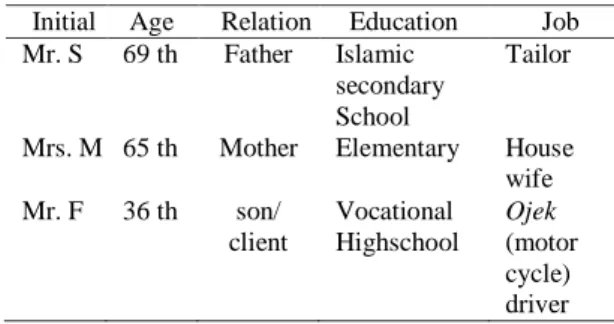
Subject 1 in this case study is the family of Mr. S. The subject is a Muslim family with the ethnic background of Java. Mr. S is the biological father of clients. Mr. S 69. The family members Mr . S can be seen in the table 1 as follows:
Table 1. List of family members subject 1
Clients in the subject 1 was Mr. F. The client was 36 years old and suffered schizophrenia since 2002, is six years since graduating vocational school. At that time he became the students and pursue his Islamic studies in one of the Islamic Boarding School in Kediri.
Mr. F still experiencing hallucinations with frequency reduced and he has been able to control his hallucinations. Currently he is undergoing treatment in the way Dr. Radjiman Wediodiningrat Mental Health Hospital of Lawang. Previous history he had been treated in Dr. Radjiman Wediodiningrat Mental Health Hospital of Lawang much as 13x and 10x Saiful Anwar Hospital. He underwent treatment last in about 1 month, that is September 2014 at Dr. Radjiman Wediodiningrat Mental Health Hospital of Lawang.
2) Overview of Subject 2
Subject 2 live in permanent residential houses with an area of about 28m2 or 7x4 m, consists of two floors. Ventilation and lighting of the house can be somewhat less because of the location of the house which coincide with the house next to it. The home environment area is in the villages with a fairly dense population.
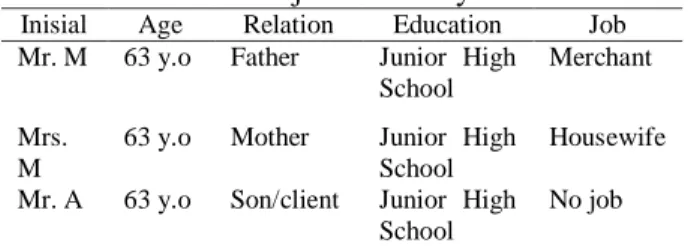
Subjects 2 in this study is the family of Mr. M. The subject is a Muslim family. Mr M is the biological father of the client, he is 63 years old, the last junior high education background and Sundanesse. Mrs. M. is the biological mother of Mr. A that directly involved in the care of Mr. A. She is 62 years old, with the last junior high education background and Javaness. The family members Mr. M can be seen from the following table 2:
Table 2 List of subjects 2 family members
Inisial Age Relation Education Job Mr. M 63 y.o Father Junior High
School
Merchant
Mrs.
M
63 y.o Mother Junior High School
Housewife Mr. A 63 y.o Son/client Junior High
School
No job
Clients in the subject 1 was Mr. A. He is the third child of four siblings who are all married. The client is 32 years and suffered from schizophrenia since 2009. He has been undergoing treatment at Dr. Radjiman Wediodiningrat Mental Health Hospital of Lawang as 1x in 2009. The treatment was not long since he ran away from this hospital.
This time he underwent treatment in the outpatient treatment of Dr. Radjiman Wediodiningrat Mental Health Hospital of Lawang but still do not comply with good treatment. With regard to this day he is still experiencing some hallucinations, such as auditory hallucinations, visions, and also smell and he still has not been able to control his hallucinations well. In addition, he also ever hurt other family members, which beat his mother up to the area around her eyes and also hit his brother
Focus Exposure Study
The focus of study in this research is the stigma of families who have family members with schizophrenia. Here is a description of the exposure of stigma on both the research subjects.
Initial Age Relation Education Job Mr. S 69 th Father Islamic
secondary School
Tailor
Mrs. M 65 th Mother Elementary House wife Mr. F 36 th son/
client
Vocational Highschool
Ojek (motor cycle) driver
Global Nursing Challenges in The Free Trade Era
315
1) Subject 1Mr. S family’s always try to have positive thoughts about healing his disease.
Subject had never tried to discriminate or differentiate the client from other family members. In the family, the subjects also had several children have grown up and successful, who continue to give positive support to the family for the healing process of the client until the client 's wedding plans .
The exposure of the components of stigma interviews conducted on the subject 1 as follows
a) Labeling
The subjects revealed that people still give a good response to the client and his family. Society always call the client with his name and no discrimination to the family members of schizophrenia. It is a statement that reveals the subject:
"The response of people still good to my family, they understand my son condition".
The subject also revealed that the condition of the client sometimes made her sad, but she never felt shame or remorse.
Subject has positive thoughts and believe that this was a test from God for their families.
This is the subject said:
"I do not feel embarrassed, because this is all the trials of God. Only sometimes I feel sad, stressed by conditions like this and kept me thinking". Subject also explained that the family will never cover their schizophrenic in his family.
b) Stereotypes
Family has the perception that mental disorders experienced by members is a disease that occurs because of a trance. Families have a perception that because inside there is no family history of family members with mental disorders. The family thought that this disease is still curable. This is consistent with the statement that expresses the subject:
“I am confident that this time he has healed in shaa Allah by looking at his condition now, hopefully this is the last, because something bad that is not properly has been taken from my child. I'm sure there is not even a disease that has no cure, there must be a cure for every disease".
c) Separation
Subject says that they never felt separated from the environment, isolated, ostracized or to isolate themselves. The process is also well established interaction
between the family and society. This is the subject said:
“The process of interaction is good, my son is also aware of his condition and previously known as child friendly and courteous. He often recite Al Qur’an/prayer in mosques sometimes led the recitation in the mosque. My relationship or family are good people, people can accept me and my son".
Based on observations, people in the village subject of a fairly high level of awareness. This is shown by the attitude and friendliness of the people against the client's family.
d) Lost status
The family is still running the role and duties as normal. Mother's clients continue to have its role as a housewife, client’s father run his role as head of the family and toilor, as well as clients remain a child and will soon propose to his future wife. In community activities, client and client’s mother is still active in participating in various activities.
e) Discrimination
Family and client have never discriminated against or treated differently from others. Families are always seeking the best for the client and the client wants a speedy recovery. This is the subject explains:
“..They understand but do not attempt to distinguish or designated of the environment. I also attempted to apologize when my son makes mistakes on them. I always tried to do everything, and I hope in return to goodness and success for my children later.”
2) Subject 2
Second subject is the family of Mr. M.
In the process of interview subjects tell all about her family and her condition and occasionally the subject cries when she felt her condition. He also explained that the relationship with other family members is not good and do not understand the conditions of perceived subject and client. The exposure of the interview concerning the components of stigma on the subject as follows:
a) Labeling
Based on current observations and a description of the subject, the subject is rarely socialize with their environment unless their next home and health authorities. This is the subject saying:
"I do not know what people are says about us. I do not care others as well. It
Global Nursing Challenges in The Free Trade Era
316
makes me not to listening to them, donot know what their response. I also do not join with them. "
Subjects also said that he felt shame and regret with their schizophrenic in his family:
"I was crying and crying. I kept thinking of how to do something with him and his activities. He was loud and constant angry with me, like he does not want to take medication, and if he was angry sometimes hitting goods... "
In addition, the subjects makes the opinion that it is better the client (Mr.A) who died ahead than us, while other family members are still there who do not understand and care about the condition of the schizophrenic.
b) Stereotypes
In terms of stereotypes regarding their mental disorder schizophrenia, the subject stated that he did not understand the disease, the symptoms it causes, and the genetic factors and the potential reduction in these diseases are genetic. The subjects also found the disease is likely due to the existence of the problem and still be cured
c) Separation
The subjects explained that clients shunned by the local community. Subjects also explained that they are also less care for his family. The existence of these conditions and supported by the state of poor families as well as the client's condition as such, make the subject more restricted himself and clients to associate with their environment. Many communities that do not provide a response in particular to the clients. When clients talk, a lot of people do not care and leave the client.
Subjects said:
"Yes someone say that A is mumbling, or say something which is no clear...”
Additionally, subjects also added:
” …. nobody can be trusted, sometimes they good at the only time but after that just like that… " The subjects were also limiting the client to associate with their environment.
d) Lost status
Subjects revealed no change in the role that occur in the presence of mental disorder schizophrenia. But the other explanation, the subject explained,
"His father did not want to know about things like this, housing conditions,
etc. He just get to work and earn some money, work, and work. I take care and bear all the things, nobody seem not understand. "
Based on the observations, the family tends to be the subject of a passive society.
The client and his father rarely join and take part in community. This is consistent and approprate by one of the speakers outside the research subject, namely Mr. X. He says “ he has a close relationship with clients and find out how the client's life and family”.
According to Mr. X, the client is a child which has limited freedom by his mother. His mother is an authoritarian where his every step and association severely restricted and monitored. The client's mother did not want the client to have too close a relationship with others. Mr. X also argues that the restrictions made by his mother to make the client more stress and frustration with life. So with these restrictions, also rarely socialize and follow the activities on the environment.
e) Discrimination
The subject explains that the public is less caring to client and being picky, especially in people with a family less fortunate and are characterized as clients. The subjects revealed that people tend to talk about something in the back and there are some people who initially close to be so much for no apparent reason and a definite problem.
DISCUSSION
Based on the presentation, it can be concluded that there is no negative stigma towards clients and research subjects. The public has a positive assessment and showed sympathy to the family and the client schizophrenia. Subjects also have a good attitude towards the client and there is no stigma and negative thoughts to himself.
This is not in accordance with the opinion of Been Zeev et al (2010) which explains that a psychiatric disorder is havoc in the life of someone who has the disorder.
Gullekson in Florez and Sartorius (2008) also revealed that stigma is a loss, which resulted in the issue of unresolved grief which could also lead to mistrust other people and families will bear the effect of the continuation of the effects of the stigma (Dubin & Fink, 1992;
Fink & Tassman, 1992).
Some of the things that allow influential that stigma does not occur, such as: the
Global Nursing Challenges in The Free Trade Era
317
existence of a good reception from the family,the factors of good socialization, family support and social identity are positive, and environmental conditions that support that is the people who have a concern is high enough to each other.
In theory and the concept model of consistency of the cultural heritage of Spector RE: Cultural diversity in health and illness ed.
3 in Potter and Perry (2005) explains that there are several factors that can affect the socialization factor. These factors, namely:
cultural factors, religion, and ethnicity. In addition, several important points were involved in it, namely: a large family and its role in raising a person, place of residence and raised, and the name they owned.
Based on the exposure it can be concluded that the subject 2 experienced public stigma and self-stigma. This is indicated by the presence of some components of stigma experienced, that their labeling, lost of status, discrimination and separation from society.
Based on interviews, the subjects also had low self-esteem and to restrict themselves to the social environment.
This is consistent with the theory described by Passman (2010), which explains that the negative experiences of stigmatization and discrimination result in a person fear of rejection, impaired self-efficacy, and someone could act more defensive, the decline in confidence, or sometimes avoid social interaction.
With self stigma and publicly stigma owned by the subject can be caused by several factors. These factors, among others: poor social identity, lack of socialization factors, and family support as the main support system is inadequate.
Social identity according to Goffman (1963) is the appearance that helps a person assess and put others first, and their social life and regular repetition will explain which of these categories is expected (Larsen & Lubkin, 2009). Social identity includes a variety of characteristics, such as: gender, name, self- concept, ideology, interpersonal relationships, custom attributes, and ethnic or religious affiliation (Baron & Byrne, 2004).
The existence of discrimination by the society makes these families increasingly withdraw from social life. Link and Phelan (2001) explains, there are five components of stigma: labeling, stereotyping, separation,
missing status (status loss), and discrimination.
Link (2001) in Green et al (2005) found that labeling is a recognition of difference and determination of social protrusion of the discrepancy. Involvement labeling not only on the perception that someone is different, but also on the determination of the differences in social meaning. Rosenhan (1973; Foster, 2005) revealed that as in the case of psychiatry, for example schizophrenia, when the person has been labeled with schizophrenia and schizo impressions are formed, then the views or other people's expectations of the person will be forever.
Another characteristic of social identity which refers to the emergence of stigma is a factor of interpersonal relationships. There are various things that can affect or change the social identity, such as the inability or 'disability' which could potentially form the stigma (Markowits, 1998; Larsen & Lubkin, 2009). Interpersonal relationships in the family is quite less because of the family that limits itself to socialize with their environment.
Besides this, the symptoms shown clients, lack of family support as the main support system and role dysfunction can further lower sense of confidence in solving this problem.
Subjects also had ever a problem with the social environment, it may cause him more shy with their surroundings. Their negative experiences of stigmatization and discrimination result in a person fear of rejection, impaired self-efficacy, and someone could act more defensive, the decline in confidence, or sometimes avoid social interaction (Passman, 2010).
CONCLUSSION AND RECOMMENDATION Conclusion
Based on the exposure results and discussion, it can be concluded that:
On the subject 1 of family research Mr.
S did not reveal any stigma associated with schizophrenia in their client families. This is supported by the good perception of the family, good socialization factors, family support and positive social identity, as well as environmental conditions favorable for that is the people who have a fairly high awareness of each other
On the subject 2 of family research Mr.
M suffered the stigma of public stigma and self-stigma. This is indicated by the presence
Global Nursing Challenges in The Free Trade Era
318
of some components of stigma felt by family,namely: labeling, separation, loss of status, and discrimination. Families also have the self- confidence is low and resulted in more families avoid the social interaction with the environment. It can be influenced by several factors, among others: poor social identity, lack of socialization factors, and family support as the main support system is inadequate.
Recommendation
For health professionals, health services and social services related with the stigma of families who have family members with schizophrenia, it is expected health personnel both health centers, health departments, or agencies associated establish a program to reduce the stigma of schizophrenia in the community or the family of the patient, such as health education and advertising and propaganda assessed can reduce the stigma about schizophrenia.
Family, expected families do not cover yourself with the presence of schizophrenic at home and still socialize with their environment, as well as play an active role in their care.
REFERENCES
Ardani, T. A., 2008. Psikiatri Islam. Malang:
Malang press.
Baron, R. A. and Byrne, D., 2004. Psikologi Sosial ed.10. Jakarta: PT. Gelora Aksara Pratama.
Been-Zeev, D., Young, M. A., Corrigan, P.
W., 2010. DSM-V and the Stigma of Mental Illness. Journal of Mental Health, 19 (4): 318-327.
Fink, P. J. and Tassman, A., 1992. Stigma and Mental illness. Washington DC:
American Psychiatric Press.
Florez, J. A. and Sartorius, N., 2008.
Understanding the stigma of mental illness: theory and intervention. Great Britain: Jones & Barlett.
Foster, G. M. and Anderson, B. G., 2005.
Antropologi Kesehatan. Jakarta:
Penerbit Universitas Indonesia (UI Press).
Green, S., Davis, C., Karshmer, E., Marsh, P., and Straight, B., 2005. Living Stigma:
The Impact of Labelling, Stereotyping, Separation, Status Loss, and Discrimination in the Lives of Individuals with Disabilities and Their Families. Sosiological Inquiry,75 (2):
197-215.
Goffman, E., 1963. Notes on The Management of Spoiled Identity. New York: Prentice Hall
Ingram, I. M., Timbury, G.C., and Mowbray, R.M., 1993. Psikiatri: Catatan Kuliah.
Jakarta: EGC.
Larsen, P. D. and Lubkin, I. M., 2009. Chronic Illness: Impact and Intervention ed. 7.
USA: Jones & Barlett Learning
Link, B. G., Yang, L.H., Phelan, J.C., and Collins, P.Y., 2004. Measuring Mental Illness Stigma. Schizophrenia Bulletin:
30 (3): 511-531.
Link, B.G., and Phelan, J.C., 2001.
Conceptualizing Stigma. Annual Review of Sociology: 27 (1).
Passman, J. ND. The Consequencesof Labeling Mental Ilnesses on the Self- Concept: A Review of the Literature and Future Directions. Social Cosmos.
Phelan, J. C., Bromet, E. J., & Link, B. G., 1998. Psychiatric Illness and Family Stigma. Schizophrenia Bulletin, 24 (1).
Potter, P. A. and Perry, A. G., 2005. Buku Ajar Fundamental Keperawatan: Konsep, Proses, dan Praktik, vol. 1 edisi 4. Jakarta: EGC