Chapter Topics
Overview
This opening chapter seeks to define what might be considered the true essence of marketing: that it is the establishment of mutually satisfying exchange relation- ships. The modern marketing concept would appear to have undergone at least three major phases of evolution – the emergence of the mass market, the articu- lation of the modern marketing concept, and the transition from an emphasis upon the transaction to the relationship.
The chapter concludes with a review of specific definitions of marketing to document how these have changed over time and to speculate as to the possible nature and direction of future change in order to ponder the question, what is marketing?
Introduction
On first introduction to a subject it is understandable that one should seek a clear and concise definition of it. If nothing else, this definition should enable one to
1
Overview 03
Introduction 03
Exchange and economic growth 04
The rediscovery of marketing 09
The marketing management school 13
The European perspective 14
So what is marketing? 18
Marketing’s mid-life crisis 20
A new model of marketing? 21
Summary 23
Marketing – philosophy or function?
Michael J. Baker
distinguish the domain of that subject from others whilst also giving an indication of its scope and nature. Of course, none of us expect that a short definition will be able to encompass the complexity of a subject as extensive as marketing. That said, it does seem reasonable that persons who profess or claim expertise on the subject should be able to define it.
In this introductory chapter it will become clear that there is no scarcity of definitions of marketing and we will review a number of them. In doing so it will also become clear that views as to the scope of the subject tend to polarize in the manner implied by the title of this chapter between those who perceive market- ing as a philosophy of business, or state of mind, and those who regard it as a managerial function responsible for particular activities, in much the same way as production, finance or human resource management.
To throw light on this dichotomy it will be helpful first to review what is seen to be the true essence of marketing – mutually satisfying exchange relationships – and its evolution over time in parallel with stages of economic growth and development.
On the basis of this review it will be argued that marketing has always been an intrinsic element of the commercial exchange process but that its importance has waxed and waned with shifts in the balance between supply and demand. Without anticipating unduly Brian Jones’ discussion of historical research in marketing it will be suggested that we can detect at least three major phases in the evolution of the modern marketing concept – the emergence of the mass-market circa 1850, the articulation of the modern marketing concept circa 1960, and the transition from an emphasis upon the transaction to the relationship circa 1990. In conclusion we review specific definitions of marketing to document how these have changed over time and speculate as to the possible nature and direction of future change in order to answer our opening question, marketing – philosophy or function?
Exchange and economic growth
Since time immemorial humans have had to live with scarcity in one form or another. In its most acute form scarcity threatens the very existence of life itself, but, even in the most affluent and advanced post-industrial societies its existence is still apparent in the plight of the homeless and the poor. Indeed, in some senses it is doubtful whether mankind will ever overcome scarcity, if for no other reason than that there appears to be no upper limit to human wants.
The use of the noun ‘wants’ is deliberate, for early on in any study of marketing it is important to distinguish clearly between ‘needs’ and ‘wants’. Needs have been classified as existing at five levels by Abraham Maslow (1943) and his ‘hierarchy of human needs’ (Figure 1.1) is a useful starting point for discussion of the nature of marketing. As can be seen in Figure 1.1, Maslow’s hierarchy conceives of human needs as resting on a foundation of physiological needs, essential to existence, and ascending through a series of levels – safety, love and esteem – to a state of self- actualization in which the individual’s specification of a need is entirely self- determined. According to this conceptualization one can only ascend to a higher
level once one has satisfied the needs of a lower level, and the inference may be drawn that scarcity would only cease to exist once every individual has attained the highest level of self-actualization.
From this description it is clear that ‘needs’ are broadly based and defined and act as a summary statement for a whole cluster of much more precisely defined wants which reflect the exact desires of individuals. In a state of hunger the Westerner may want bread or potatoes but the Easterner is more likely to want rice. Both of these wants are fairly basic. While they have the ability to satisfy the need ‘hunger’, they offer little by way of variety. The desire for variety, or choice, is another intrinsic element of human nature and much of human development and progress may be attributed to a quest for variety – for new ways of satisfying basic needs. Indeed, the process appears to be self-sustaining which prompted us to propose that a maxim of marketing is that ‘the act of consumption changes the consumer’ (Baker, 1980). In other words, each new experience increases and extends the consumer’s expectations and creates an opportunity for a new supplier to win their patronage by developing something new and better than existing solutions to the consumers need.
Faced with an apparent infinity of wants the challenge to be faced is in deter- mining what selection of goods and services will give the greatest satisfaction to the greatest number at any particular point in time. Indeed, the purpose of economic organization has been defined as ‘maximising satisfaction through the utilisation of scarce resources’. Marketing is a function which facilitates achieve- ment of this goal. To understand how it does this, it will be helpful to review the process of economic development. Rostow’s (1962) Stages of Economic Growth model provides an excellent basis for such a review.
Rostow’s model is shown in Figure 1.2 and proposes that human societies progress from the lowest level of subsistence or survival in a series of clearly identified Figure 1.1 Maslow’s hierarchy of human needs (Maslow, 1943: 370–96)
Self- actualization
Esteem
Love
Safety
Survival
stages until they achieve the sophistication and affluence of the modern post- industrial state. In grossly simplified terms, certain key events appear to be associated with the transition from one stage to the next.
At the lowest level of all is the subsistence economy based upon hunting, gathering and collecting. Such economies are nomadic and entirely dependent upon nature for their survival. While members of such nomadic tribes may share food and shelter, and band together for safety, they are societies which are devoid of any recognizable form of commercial exchange.
With the domestication of animals and the development of primitive agriculture man begins to exercise a degree of control over his environment. At the same time new activities create new roles and the potential for the first step towards increased productivity and economic progress – task specialization. Once it becomes recognized that some people are better suited to some tasks than others then the potential for task specialization exists. For it to be realized, however, an agreed system of exchange must be developed. Indeed, it seems likely that the creation of a system of exchange was a necessary prerequisite for task specializa- tion to flourish.
A fundamental law of economics is that beyond a certain point each additional unit of any good or service becomes worth progressively less and less to its owner (the law of diminishing marginal utility). Given a surplus of any specific good the owner will be able to increase their overall satisfaction by exchanging units of their surplus for another good which they want. Thus hunters can exchange meat for vegetables with farmers to their mutual and enhanced satisfaction.
For an exchange to occur there must be at least two persons, each with a surplus of one good which is desired by the other. Once contact has been established between the two persons they can then negotiate an exchange which will increase Figure 1.2 Rostow’s Stages of Economic Growth model (Rostow, 1962)
Beyond high mass consumption
Age of high mass consumption
Drive to maturity Take-off Preconditions for take-off
Traditional society
their overall satisfaction by swapping units until the marginal utility of the two goods is equal (i.e. one would receive less satisfaction by acquiring one additional unit of the other person’s surplus than by retaining a unit of one’s own output).
While this concept is easy to understand in principle, especially when discussing only one exchange, its implementation in practice poses numerous problems. To reduce these problems three additional developments are called for.
First, in order that those with services to exchange can be brought together it will be helpful to set aside a specific place for the purpose – a market. Second, one needs an accepted store of value that will act as a universal medium of exchange – money.
Third, because marketing is a separate task from production it will further increase productivity and add value if specialist intermediaries – merchants and retailers – come into existence to perform these functions. Clearly, markets, money and intermediaries have existed since the earliest civilization. Indeed, it would be no exaggeration to claim that the development of formal commercial exchange relationships was the foundation for civilization as we know it today. It would seem that marketing is perhaps not such a recent phenomenon as many believe it to be!
The creation of markets and the development of exchange provides preconditions for take-off
‘… take-off consists, in essence, of the achievement of rapid growth in a limited number of sectors, where modern industrial techniques are applied’. (Rostow, op. cit. 317)
For take-off to occur task specialization has to be taken a stage further, to what economists call the division of labour. One of the earliest and best known examples of the division of labour is provided by Adam Smith’s description of the pin-making industry.
To take an example, therefore, from a very trifling manufacture; but one in which the division of labour has been very often taken notice of, the trade of the pin maker; a workman not educated to this business (which the division of labour has rendered a distinct trade), nor acquainted with the use of the machinery employed in it (to the invention of which the same division of labour has probably given occasion), could scarce, perhaps, with his utmost industry, make one pin in a day, and certainly could not make 20. But in the way in which this business is now carried on, not only the whole work is a peculiar trade, but it is divided into a number of branches, of which the greatest part are likewise a peculiar trade. One man draws out the wire, another straights it, a third cuts it, a fourth points it, the fifth grinds it at the top receiving the head; to make the head requires three distinct operations; to put it on is a peculiar business, to whiten the pins is another; it is even a trade by itself to put them into the paper; and the important business of making a pin is, in this manner, divided into about 18 distinct opera- tions, which, in some manufacturies, are all performed by distinct hands, though in others the same man will sometimes perform two or three of them. I have seen a small manufactury of this kind where 10 men only were employed and where some of them consequently performed two or three distinct operations. But though they were very poor, and therefore but indifferently accommodated with
the necessary machinery, they could, when they exerted themselves, make among them about 12 pounds of pins in the day. There are in a pound upwards of 4000 pins of the middling size. These 10 persons therefore, could make among them upwards of 48,000 pins in the day. Each person, therefore making a tenth part of 48,000 pins, might be considered as making 4800 pins in a day. But if they had all wrought separately and independently, and without any of them having been educated to this peculiar business, they could certainly not each of them have made 20, perhaps not one pin in a day; that is, certainly, not the 240th, perhaps not the 4800th part of what they are at present capable of performing, in consequence of a proper division and combination of their different operations.
(Smith, [1776] 1970)
It seems reasonable to assume that under conditions of craft industry, where each craftsman was responsible for all the tasks associated with the production of a particular good, the number of craftsman in a community would be approxi- mately sufficient to satisfy the demands of that community. Indeed, the medieval craft guilds (and, more recently, trade unions) strictly controlled the number of apprentices that could be trained in a craft to ensure that a satisfactory balance between supply and demand be maintained. Clearly, the enormous increase in productivity associated with the division of labour destroyed this control and flooded the market with the product in question, driving the price down and making many craftsmen redundant. One new pin factory employing 10 pin makers could match the output of 240 craftsmen and so service the needs of 240 times as many customers. As a result production became concentrated in locations possess- ing natural advantages associated with the product – sources of power and raw material, labour, good channels of communication – and it became necessary to employ salespersons to help sell the output into a greatly enlarged market.
Because of the enormous increase in output associated with factory production, standards of living improved substantially with a consequential increase in life expectancies and the numbers of children surviving infancy. As the size of the market is determined ultimately by the size of the population, an expanding population represented an expanding market and further fuelled the rapid economic growth associated with take-off. This growth was to receive an even greater impetus with the spate of scientific and technological innovation of the eighteenth century, which gave birth to what has become known as the industrial revolution and form the foundation for Rostow’s fourth stage of economic growth – the age of high mass consumption.
In his original conceptualization Rostow (1962) perceived that some of the more advanced and affluent industrialized economies were approaching the limits of mass consumption. While population growth had slowed to a near steady rate, further improvements in productivity had created saturated markets and the potential for excess supply. John Kenneth Galbraith (1958) designated this the post-industrial society while Rostow merely termed it the age beyond high mass consumption. Eight years later, in 1970, Rostow revised his model and designated the final stage, the ‘search for quality’ – the inference being that if a static population could not physically consume more, then the only way growth could be sustained would be to consume ‘better’.
Elsewhere (Baker, 1994) we have discussed the way in which the stages in Maslow’s need hierarchy correspond closely to the stages in Rostow’s economic stages model, for example, subsistence economies are concerned primarily with physiological needs; the search for quality with self-actualization, etc. Clearly, human needs (demand) motivates supply creation and the matching of supply and demand is achieved through a process of exchange and marketing. It is also clear that these processes have existed for a very long time indeed, so why is marketing often represented as a twentieth-century phenomenon? We turn to this question in the next section, but, before doing so, will summarize some of the key points that have emerged from a greatly simplified account of economic development.
First, exchange adds value and increases satisfaction. It also encourages variety and improves choice. Second, the parties to a commercial exchange are free agents so that for an exchange to occur both parties must feel that they are benefiting from that exchange. It is from these observations that we derive our basic defini- tion of marketing as being concerned with mutually satisfying exchange relation- ships. Third, task specialization and the division of labour greatly enhance productivity and increase the volume of goods available for consumption. In turn this increased supply results in an improved standard of living and growth in the population, thereby increasing demand and stimulating further efforts to increase supply.
Fourth, the concentration of production and the growing size and dispersion of the market increases the need for specialized channels of distribution and other inter- mediaries to service and manage them. Fifth, improved standards of living in the advanced industrialized economies lead to a stabilization of population growth and absolute market size (demand), but accelerating technological innovation continues to enhance our ability to increase supply. It was this which was to lead to the ‘rediscovery’ of marketing.
The rediscovery of marketing
As we have seen, markets and marketing are as old as exchange itself yet many people regard marketing as a phenomenon which emerged in the second half of the twentieth century – to be precise about 1960 when Professor Ted Levitt published an article entitled ‘Marketing myopia’ in theHarvard Business Reviewin which he addressed the fundamental question of why do firms, and indeed whole industries, grow to a position of great power and influence and then decline. Taking the American railroad industry as his main example, Levitt showed that this indus- try displaced other forms of overland transportation during the nineteenth century because it was more efficient and effective than the alternatives it displaced. By the beginning of the twentieth century, however, development of the internal combustion engine, and the building of cars and trucks, had provided an alterna- tive to the railroads for both personal and bulk transportation. In the early years this challenge was limited because of the high cost of the substitute product, its lack of sophistication and reliability and low availability. However, its potential was clear to see – if you owned a car or truck you had complete personal control over
your transportation needs and could travel from door to door at your own convenience.
Henry Ford perceived this market opportunity, invented the concept of mass assembly and began to produce a reliable, low-cost motor car in constantly increasing numbers.
From this time on the fortunes of the railroad began to decline so that, by the 1950s, this once great industry appeared to be in terminal decline.
What went wrong? Levitt’s thesis is that those responsible for the management of the railroad were too preoccupied with their product to the neglect of the need that it served, which was transportation. Because of their myopia, or ‘production orientation’, they lost sight of the fact that the railroad product had been a substi- tute for earlier, less attractive products, so that, offered a choice, consumers have switched from the old to the new to increase their personal satisfaction. It should have been obvious, therefore, that if a new, more convenient mode of transporta- tion was developed then consumers would switch to it too. Thus, if the railroad management had concentrated on the need served – transportation – rather than their product, they might have been able to join the infant automobile industry and develop a truly integrated transportation system. In other words the railroads failed because they lacked in marketing orientation.
At almost the same time as the appearance of Levitt’s seminal paper, Robert Keith (1960) published an article in which he described the evolution of market- ing in the Pillsbury Company in which he worked. In Keith’s view the company’s current marketing approach was a direct descendant of two earlier approaches, or eras, which he termed production and sales. This three eras, or stages, model – production, sales, marketing – was widely adopted by what has come to be known as the marketing management school whose ideas dominated the theory and practice of marketing for 30 years or more.
The essence of the production orientation – a preoccupation with the product and the company – and the marketing orientation – a focus on the consumer’s needs and the best way to serve it – have already been touched on in reviewing Levitt’s ‘Marketing myopia’. Keith’s contribution then was to propose an interme- diate or transitional phase he termed the ‘sales era’. In the sales era firms were still largely production orientated but, as demand stabilized supply, continued to grow, resulting in fierce competition between suppliers. One aspect of this was that producers committed more effort to selling their products with an emphasis on personal selling, advertising and sales promotion – hence the ‘sales orientation’.
Chronologically the production era dated from the mid-1850s and lasted until around the late 1920s, at which point the sales era was born, which lasted to around the mid-1950s, when the marketing era commenced. This conceptualiza- tion is now seen to be seriously flawed in terms of its historical accuracy but nonetheless remains a useful pedagogical device for reasons we will return to. First, however, it will be helpful to set the record straight.
As we have noted on several occasions there has been a tendency to date the emergence of marketing to the late 1950s and early 1960s. In an article entitled
‘How modern is modern marketing?’ Fullerton (1988) provides a rigorous analysis based on historical research.
At the outset it will be helpful to summarize the three key facets of the historical approach. First, there is a ‘philosophical belief that historical phenomena such as
markets are intrinsically rich and complex; efforts to simplify or assume away aspects of such phenomena are deeply distrusted’ (Fullerton, 1988: 109). Second, the historical research tradition emphasizes ‘systematic and critical evaluation of historical evidence of accuracy, bias, implicit messages, and now extinct meanings’
(1988: 109). The third facet of historical research is the process itself through which the researcher seeks to synthesize and recreate what actually happened in the past.
While there is considerable evidence that supports the existence of a production era there are also strong arguments to support a contrary view. Fullerton summa- rizes these as follows:
1. It ignores well-established historical facts about business conditions – competition was intense in most businesses, overproduction, and demand frequently uncertain.
2. It totally misses the presence and vital importance of conscious demand stimulation in developing the advanced modern economies. Without such stimulation the revolution in production would have been stillborn.
3. It does not account for the varied and vigorous marketing efforts made by numerous manufacturers and other producers.
4. It ignores the dynamic growth of new marketing institutions outside the manufacturing firm. (Fullerton, 1988: 111)
Each of these arguments is examined in detail and substantial evidence is marshalled to support them. A particularly telling point concerns the need for active demand stimulation and the need for production and marketing to work in tandem.
Some of the famous pioneers of production such as Matthew Boulton and Josiah Wedgwood were also pioneers of modern marketing, cultivating large-scale demand for their revolutionary inexpensive products with techniques usually considered to have been post-1950 American innovations: market segmentation, product differentiation, prestige pricing, style obsolescence, saturation advertis- ing, direct mail campaigns, reference group appeals, and testimonials among others. (Fullerton, 1988: 112).
In Fullerton’s view ‘demand enhancing marketing’ spread from Britain to Germany and the USA. In the USA it was adopted with enthusiasm and Americans came to be seen as ‘the supreme masters of aggressive demand stimulation’, a fact frequently referred to in contemporary marketing texts of the early 1990s. Numerous examples support Fullerton’s contention that producers of the so-called production era made extensive use of marketing tools and techniques as well as integrating forward to ensure their products were brought to the attention of their intended customers in the most effective way. That said, the examples provided (with one or two possible exceptions) do not, in my opinion, invalidate the classification of the period as the ‘production area’ in the sense that it was the producer who took the initiative and differentiated his product to meet the assumed needs of different consumer groups based on economic as opposed to sociological and psychological factors. In other words, producers inferred the consumer’s behaviour but they had
not yet developed techniques or procedures which would enable them to define latent wants, and design, produce and market products and services to satisfy them.
Similarly, while the period from 1870 to 1930 saw the emergence and develop- ment of important marketing institutions in terms of physical distribution, retail- ing, advertising and marketing education, which are still important today, it does not seem unreasonable to argue that all these institutions were designed to sell more of what was being produced. This is not to deny the ‘rich marketing heritage’
documented by Fullerton, but to reinforce the point that the transition to a
‘marketing era’ was marked by a major change in business philosophy from a producer-led interpretation of consumer needs to a consumer-driven approach to production.
As to the existence of a sales era (rejected by Fullerton) this seems as convenient a label as any to give to the transitional period between a production and market- ing orientation. In addition to the reality of a depressed world economy in the 1930s, which required large-scale producers to sell more aggressively to maintain economies of scale, the period saw the migration of many behavioural scientists from a politically unstable Europe to the safety of the USA. In retrospect it appears that it was this migration that led to the more rigorous analysis of consumer behav- iour which was to underpin the emergence of a new ‘marketing era’.
Combined with its greater insight into consumer behaviour was a period of great economic growth and prosperity following the Second World War, together with a major increase in the birth rate, which was to result in a new generation of consumers brought up in a period of material affluence (the baby boomers). It was this generation which sought to reassert consumer sovereignty and so initiated the change in the balance of power between producer and consumer which heralded the ‘marketing era’.
Fullerton’s argument that the production–sales–marketing era framework is a
‘catastrophic model’ ‘in which major developments take place suddenly, with few antecedents’ (1988: 121) is not without merit. Certainly, it could and has had the effect of disguising the evolutionary nature of marketing thought and practice.
In place of a catastrophic model, or indeed, a continuity model which tends to observe differences over time, Fullerton suggests a ‘complex flux model’. Such a complex flux model has the ability to incorporate dramatic changes but it also
‘stresses that even dramatic change is based on and linked to past phenomena’
(Fullerton, 1988: 121). It is also neutral in the sense that it does not automatically equate development or evolution with ‘improvement’, leaving such judgements for others to make.
Fullerton’s complex flux model embraces four eras:
1. Setting the stage: the era of antecedents. A long gestational period beginning around 1500 in Britain and Germany, and the 1600s in North America. The period of low levels of consumption in which ‘75–90% of the populace were self-sufficient, rural and viscerally opposed to change’ (1988: 122). Commerce was generally discredited but its standing improved as the benefits of trade became apparent.
2. Modern marketing begins: the era of origins. Britain in 1759; Germany and the USA circa 1830. ‘This period marked the beginning of pervasive attention to stimulating
and meeting demand among nearly all of society’ (1988: 122). Precipitated by the Industrial Revolution, and the mass migration from the countryside to an urban environment, potential markets had to be created through marketing techniques and activities.
3. Building a superstructure: the era of institutional development. Britain in 1850;
Germany and the USA circa 1870 until 1919. ‘During this period most of the major institutions and many of the practices of modern marketing first appeared’ (1988: 122).
4. Testing, turbulence and growth: era of refinement and formalization. From 1930 to the present day. ‘The era’s most distinguishing characteristic, however, has been a further development, refinement, and formalization of institutions and practices that were developed earlier’ (1988: 122).
Fullerton’s analysis reflects a growing interest in the history of marketing thought and confirms that ‘modern marketing has a rich heritage worthy of our attention’
(1988: 123). Whether one should substitute his conceptualization as contained in his complex flux model for the widely accepted production–sales–marketing era’s model is not seen as an either/or choice. Indeed, Fullerton’s emphasis on the origins and evolution of marketing thought and practice reflects the historical research approach and merits attention in its own right. By contrast the ‘era’s model’ is seen, at least by this author, as serving a different purpose in that it seeks to distinguish between marketing as a practice clearly present in both the production and sales eras, and marketing as a philosophy of business which shifts the emphasis from the producer’s pursuit of profit as the primary objective to the achievement of customer satisfaction which, in the long run, is likely to achieve the same financial reward.
In other words the three eras model provides a convenient framework for summarizing changes in the dominant orientation of business management. Thus it is a useful, albeit oversimplified, model of the evolution of modern marketing, or what I prefer to designate ‘the rediscovery of marketing’ (Baker, 1976). In truth, marketing has been around since the very first commercial exchange but there can be little doubt that until comparatively recently it has been of secondary or even tertiary importance to other more pressing imperatives in terms of increasing supply to meet the needs and wants of a rapidly expanding population. The objec- tive of authors and teachers in using the three-stage evolutionary model has been to highlight the major changes in the dominant orientation of business rather than to analyse in detail the much more complex processes which underlay and resulted in these changes. What is beyond doubt is the fact that from around 1960 onwards marketing thinking and practice has been dominated by the marketing management school of thought.
The marketing management school
The marketing management school which evolved in the late 1950s and early 1960s is inextricably linked with the concept of the marketing mix and an analytical
approach to marketing management following the positivist sequence of Analysis, Planning, Control. As with most major paradigms shifts, no single author/researcher can claim sole credit for the new phenomenon. Among those who contributed signif- icantly to the new school of thought were Joel Dean (1951), Peter Drucker, Ted Levitt, E. Jerome McCarthy, Neal Borden and Philip Kotler. Dean and Drucker writing in the early 1950s paved the way but it was McCarthy’s Basic Marketing (1960) which first promoted what came to be known as the four Ps of marketing – the idea that the marketing manager’s task was to develop unique solutions to competitive marketing problems by manipulating the four major marketing factors – product, price, place and promotion. This idea of a ‘marketing mix’ (the four Ps) was elaborated on by Neil Borden (1964) building on an earlier idea of James Culliton (1948), and confirmed by the appearance in 1967 of the first edition of Philip Kotler’s bestsellingMarketing Management: Analysis, Planning and Control.Levitt’s contribu- tion in distinguishing the essence of the marketing orientation/concept – a focus on customer needs – has already been referred to.
An authoritative view of the marketing management school is to be found in Frederick E. Webster Jr’s 1992 article in theJournal of Marketing(‘The changing role of marketing in the corporation’). In his own words,
the purpose of this article is to outline both the intellectual and the pragmatic roots of changes that are occurring in marketing, especially marketing manage- ment, as a body of knowledge, theory, and practice and to suggest the need for a new paradigm of the marketing function within the firm. (Webster, 1992: 1)
While Webster’s article recognized the need for ‘a new paradigm of the marketing function within the firm’, in the opinion of many European scholars a much more radical reappraisal was called for which challenged the very roots of the marketing management school.
The European perspective
One of the leading critics of the marketing management school was French professor Giles Marion. Marion’s views are contained in a paper ‘The marketing management discourse: what’s new since the 1960s?’ (1993), which is ‘an attempt to describe the formalisation of ideas which make up marketing management as a school of thought’
(1993: 143), based upon the content of the most popular marketing textbooks (American and European).
Marion argues that ‘marketing as a discipline, should show greater humility by presenting its prescriptions in a more prudent manner, and by describing more systematically the interaction between supply and demand and the organisational consequences that follow’ (1993: 166). In conclusion he expresses the view that, while the normative theory of marketing management may well have had a useful impact on managerial thinking and practice ‘there has been nothing new since the 1960s or even well before’ (1993: 166).
While Marion’s critique struck at the very heart of the marketing management school promoted in the USA it was comparatively mild compared with the trench- ant criticism expressed by Evert Gummesson, a leading member of the Scandinavian School. In Gummesson’s view ‘the traditional textbooks do not satisfactorily reflect reality’ and he proposed six objections to support his thesis (1993):
1. Textbook presentations of marketing are based on limited real-world data – specifically, they are largely concerned with mass marketed, packaged consumer goods.
2. Goods account for a minor part of all marketing, but the textbook presentations are focused on goods; services are treated as a special case.
3. Marketing to consumers dominates textbooks, while industrial/business marketing is treated as a special case.
4. The textbook presentations are a patchwork; new knowledge is piled on top of existing knowledge, but not integrated with it.
5. The textbooks have a clever pedagogical design; the form is better than the content.
6. The Europeans surrendered to the USA and its marketing gurus and do not adequately promote their own original contributions.
In sum, Gummesson argues that US textbooks represent the colonization of thought and that this thought excludes or ignores much of the development in marketing thinking which had occurred in the fields of industrial and services marketing in Europe during the 1970s and 1980s, and even before. To some extent the blame must rest with the Europeans for failing to promote their ideas in the USA but the dismissive, not-invented-here attitudes of American academics who act as gatekeepers to US-based publications must also bear some of the blame.
Many of the views expressed by Marion and Gummesson are echoed in the works of Christian Grönroos (another leading member of the Scandinavian school). In Grönroos’ view (1994) the majority of marketing academics and textbooks treat marketing as a subject which emerged in the 1960s and is founded upon the concept of the marketing mix and the four Ps of product, price, place and promotion (McCarthy, 1960) which comprised it. As a consequence ‘empiri- cal studies of what the key marketing variables are, and how they are perceived in use by marketing managers have been neglected. Moreover structure has been vastly favoured over process considerations’ (Kent, 1986).
While McCarthy’s simplification of Borden’s original conceptualization of the marketing mix has obvious pedagogical attractions, its application appears best suited to mass markets for consumer packaged goods, underpinned by sophisti- cated distribution channels and commercial mass media. Indeed, this is the context or setting of many marketing courses and texts, but it is clearly representative of a limited aspect of the domain and process of marketing.
However, the concept of the marketing mix is more seriously flawed. To begin with, the paradigm is a production-oriented definition in the sense that its approach is that customers are persons to whom something is done rather than persons for whom something is done (see Dixon and Blois, 1983; Grönroos, 1989, 1990.)
A second deficiency is that while McCarthy recognized the interactive nature of the four Ps, ‘the model itself does not explicitly include any interactive elements.
Furthermore, it does not indicate the nature and scope of such interactions’
(Grönroos, 1994).
However, perhaps the major deficiency of the four Ps approach is that it defines marketing as a functional activity in its own right and so creates the potential for conflict with other functional areas, discourages persons from becoming involved in marketing because it is the preserve of the marketing department, and, as a result, can frustrate or compromise the adoption of the marketing concept.
Grönroos sees the four Ps as a direct development from the microeconomic theory of imperfect competition developed by Robinson (1933) and Chamberlin (1933) in the 1930s, but argues that the separation of the four Ps model from its theoretical foundations left it without roots. Indeed, Grönroos goes even further and argues that ‘the introduction of the four Ps of the marketing mix with their simplistic view of reality can be characterised as a step back to the level of, in a sense equally simplistic, microeconomic theory of the 1930s’. This observation is largely prompted by the apparent failure of marketing academics in the USA to detect the evolution of the Copenhagen School’s parameter theory. Building upon the work of Frisch (1933), Von Stackelberg (1939), Kjaer-Hansen (1945) and Rasmussen (1955), Gosta Mickwitz observed:
When empirically based works on marketing mechanisms show that the enterprise uses a number of different parameters markedly distinct from each other, the theory of the behaviour of the enterprise in the market will be very unrealistic if it is content to deal only with ... [a few] ... of them. We have therefore tried throughout to pay attention to the presence of a number of different methods which firms employ to increase their sales. (Mickwitz, 1959: 217)
Grönroos (1994) explains further: ‘The interactive nature of the marketing variables was explicitly recognised and accounted for in parameter theory by means of varying market elasticities of the parameters over the life of the product life cycle.’
At the same time that the four Ps was becoming the established ‘theory’ or norma- tive approach to marketing in the USA, and many other countries, new theories and models were emerging in Europe – specifically, the interaction network approach to industrial marketing and the marketing of services (1960s), and, more recently, the concept of relationship marketing.
The interaction/network approach originated in Uppsala University in Sweden during the 1960s and was subsequently taken up in many countries following the establishment of the IMP (Industrial Marketing and Purchasing) Group. As Grönroos explains:
Between the parties in a network various interactions take place, where exchanges and adaptation to each other occur. A flow of goods and information as well as financial and social exchanges takes place in the network. (See, for example, Håkansson 1982, Johanson and Mattson 1985, and Kock 1991). In such a network the role and forms of marketing are not very clear. All exchanges, all sorts of
interactions have an impact on the position of the parties in the network. The interactions are not necessarily initiated by the seller – the marketer according to the marketing mix paradigm – and they may continue over a long period of time, for example, for several years. (1994: 353)
The interaction/network model recognizes that exchanges are not the exclusive preserve of professional marketers and may, indeed, involve numerous other members of the interacting organizations, some of whom may well have more influence and impact on the relationship than the functional specialists.
In the 1970s interest in the marketing of services developed simultaneously in the USA and Europe. But, while the four Ps framework continued to prevail in the USA, in Scandinavia and Finland the Scandinavian School of Services saw the marketing of services as an integral element of overall management. Grönroos and Gummesson have been strong proponents of the school and have written exten- sively on the subject.
The interaction and network approach to industrial marketing and modern service marketing approaches ‘clearly views marketing as an interactive process in a social context whererelationship buildingandmanagementis a vital cornerstone’
(Grönroos, 1994: 353). He argues that this approach is similar to the system-based approaches to marketing of the 1950s (e.g. Alderson, 1957) and contrasts strongly with the clinical approach of the four Ps paradigm which makes sellers active and buyers passive. As noted earlier, the latter emphasis tends to put exchange relation- ships into the hands of professional marketers which may psychologically alienate other members of an organization from becoming involved. This is a far cry from Drucker’s (1954) observation that the sole purpose of the business is to create customers!
As a consequence of rapid advances in both manufacturing (flexible manufac- turing, CAD, CAM) and information technology, the mass consumer markets suited to the four Ps approach have become fragmented and call for flexible and adaptable marketing approaches. In the 1980s relationship marketing emerged in response to this need. Grönroos refers to his own (1990) definition of relationship marketing: ‘Marketing is to establish, maintain and enhance relationships with customers and other partners, at a profit, so that the objectives of the parties involved are met. This is achieved by mutual exchange and fulfilment of promises’.
While more extended and explicit, this definition is essentially similar to that proposed by Baker (1976) a number of years earlier: ‘Marketing is a process of exchange between individuals and/or organizations which is concluded to the mutual benefit and satisfaction of the parties’ (4). Similarly, Baker (and other authors) have argued consistently for the need to regard marketing both as a philosophy of business and a business function. As a business function responsible for coordinating and executing the implementation of a marketing plan, market- ing is likely to continue to find the marketing mix model a useful one, albeit that the four Ps is an oversimplified version of the original concept. It is, of course, important to emphasize that continuing to use such an organizational and planning framework is in no way inimical to the emphasis on relationship marketing as contrasted with the prior emphasis on a transactional model.
Today, relationship marketing is widely accepted as reflecting the essence of the marketing concept. In reality, this has always been the case in the majority of buyer–seller interactions since commercial exchanges were first initiated. Buyers have always looked for reliable sources of supply at a fair price as this reduces the dissonance and uncertainty of having to consider every single transaction as an entirely new decision. Similarly, sellers recognize that there are increased opportu- nities for long-term survival and profit if they can establish a customer franchise and repeat purchasing behaviour. That said, there can be no doubt that there exist two radically different interpretations of capitalism and the market economy, one of which emphasizes long-term relationships, the other the one-off transaction.
It was perhaps only with the collapse of the centrally planned and controlled command economies of Eastern Europe and the Soviet Union that the existence of two models of capitalism came into sharper relief and focus. Based on a book by Michel Albert (1991), Christian Dussart (1994) highlighted the differences between the Anglo-Saxon model of capitalism, as practised in the UK and USA, which is essen- tially short-term and transactionally based, and the Alpine/Germanic model, which also embraces Scandinavia (and Japan), that emphasizes long-term relationships as a source of buyer satisfaction and seller profitably.
So what is marketing?
At the 1993 UK Marketing Education Group conference a group of researchers from the Henley Management College (Gibson et al., 1993) presented their findings of a content and correspondence analysis of approximately 100 definitions of marketing in an attempt to answer the question ‘What is marketing?’
Specifically, the authors set out to ‘shed some light on the nature of the process of defining marketing, to identify strong and emerging themes, and to develop a map of the territory’. By using content analysis to evaluate the definitions collected, and using these findings as an input to a correspondence analysis, the authors provided both a qualitative and quantitative analysis of how scholars had defined marketing over the years and up to that time.
To begin with, a collection of approximately 100 explicit marketing definitions were collected from textbooks, journals and institutes/association publications spanning the twentieth century. The majority of these definitions were academic and originated in the USA, UK and Europe. Themes were selected as the unit of assessment and five clusters were established as:
1. Object of marketing 2. Nature of the relationship 3. Outcomes
4. Application
5. Philosophy or (versus) function.
They explain:
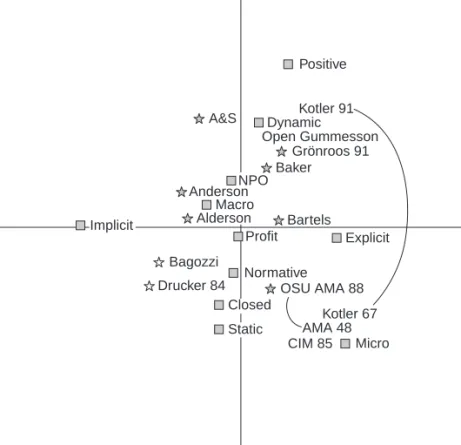
the authors’ perspective on the original themes were constructed as dichotomies and include, first ‘profit and non-profit’, which related to the outcomes and appli- cation themes; secondly, ‘micro and macro’, which translated across to philoso- phy or function; thirdly, ‘static and dynamic’ and ‘open and closed’ which referred
Positive
Kotler 91 A&S Dynamic
Open Gummesson Grönroos 91 Baker
AndersonNPO Macro
Alderson Bartels
Explicit Profit
Implicit
Bagozzi
Normative OSU AMA 88
Kotler 67 Drucker 84
Closed
Static AMA 48 CIM 85 Micro
−2.0
−2.0
−1.5
−1.5
−1.0
−1.0
−0.5
−0.5
0.0 0.0
c2
0.5 0.5
1.0 1.0
1.5 1.5
2.0 2.0
Figure 1.3 Marketing definitions: a map of the territory
The authors describe in some detail how each of these themes was derived and how definitions falling within them have changed in approach and emphasis over time. However, ‘in order to simplify the definitions of various authors, and give more relevance to the five themes identified earlier, some of the definitions gathered and analysed for content were subjected to a process of correspondence analysis’ (Gibson et al., 1993). In essence, correspondence analysis is a graphical technique which enables one to develop a two-dimensional plot indicating the degree of similarity or correspondence between rows or columns of data which have similar patterns. Using the authors as rows and their perspectives on the themes as columns the map reproduced here as Figure 1.3 was produced.
to the relationship theme and to some extent provided some insight into the conten t and nature of the whole definition; and finally, two additional dichotomies
were included, ‘positive and normative’, namely, whether the definitions described what exists or prescribed what ‘ought’ to happen, and whether the definition was
‘explicit or implicit’. (Gibson et al., 1993)
Based upon both qualitative and quantitative analyses certain conclusions were derived.
‘1. Changes have occurred across all five content themes indicating significant evolution in the concept of marketing since its earliest definition.
2. The greatest change has occurred in the ‘nature of the relationship’ (i.e. between provider and user), from one-way narrow, discrete transactions to the recognition and positioning of relationships as a key strategy resource’. This change is also reflected in the other themes, particularly ‘philosophy or function’, and marks the moderation of economic explanations of consumption behaviour through the admission of concepts derived from psychology and sociology.
3. Changes in the marketing environment have resulted in a broadening and softening of the original concept and its transfer to other domains – services, not-for-profit, etc.
4. ‘Marketing’ has shown itself to be adaptable, flexible, international and open. But Gibson et al. warn that ‘this latitude has allowed ambiguity to creep into its definition and cause confusion. Definitional clarity is essential in the future’.
In conclusion, Gibson et al. (1993) offer three further points prompted by their analysis:
‘1. Marketing and its guardians continue to foster its open and innovative culture.
2. A single definition is not aimed for, as its existence would probably discourage future development of the subject.
3. Nonetheless, greater rigour should be given to the formulation of definitions in future.’
Marketing’s mid-life crisis
In the turbulent and recessionary environment which characterized the early 1990s Webster’s call for a new approach to the practice of marketing cited earlier was widely echoed, particularly in practitioner publications. Among the more influential of these was Brady and Davis’ (1993) observation that marketing was experiencing a ‘mid-life crisis’. In simplified terms the argument ran that if exchange was concerned with relationships between individuals and organizations then marketing must be everybody’s business and not the preserve of a privileged few to be found within a formal marketing department. This perception was
probably magnified by the fact that several important developments in managerial thinking such as benchmarking, total quality management, strategic alliances, globalization and strategic thinking might properly be considered the primary concern of marketers. These fields had been pre-empted by others.
In the new millennium marketers appear to have recovered some of their confi- dence and are able to take a more balanced view of their discipline. It is now gener- ally accepted that the relationship marketing approach has effectively extended the marketing concept into areas such as services and business-to-business market- ing, which were poorly served by the marketing management model, based as it was upon concepts of mass production, mass distribution and mass marketing, essentially of packaged consumer goods. At the same time, it has also been appreciated that many marketing exchanges are based upon low involvement and transactions and that the two distinct approaches can co-exist together. Simultaneously, a clearer distinction is being drawn between the philosophy of marketing which is encapsulated in a marketing orientation that can be held by everybody, both inter- nal and external to an organization, and the market-oriented organization which is customer oriented and market driven. The former marketing-orientated organiza- tion is committed to the philosophy of mutually satisfying exchange relationships while the latter market-oriented company is focused on how to achieve this through the professional practice and management of the marketing function.
A new model of marketing?
In 2004 the Journal of Marketing published an article by Stephen Vargo and Robert Lusch that prompted extensive debate about the need for a new model, or paradigm, of the domain of marketing. The article that precipitated this debate is entitled ‘Evolving to a new dominant logic for marketing’. In the abstract the authors write:
The purpose of this article is to illuminate the evolution of marketing thought toward a new dominant logic ... Briefly, marketing has moved from a goods- dominant view, in which tangible output and discrete transactions were central, to a service-dominant view, in which interchangeability, exchange processes, and relationships are central. (Vargo and Lusch, 2004: 2)
The authors then stress that their interpretation of ‘service-centred’ should not be equated with current conceptualizations of services as a residual, that is not a tangible good; something to add value to a good – value-added services; or service industries like healthcare and education. They state:
Rather, we define services as the application of specialised competences (knowl- edge and skills) through deeds, processes, and performances to the benefit of another entity or the entity itself ... Thus, the service-centred dominant logic represents a reoriented philosophy that is applicable to all marketing offerings,
including those that involve tangible output (goods) in the process of service provision. (ibid.)
In effect Vargo and Lusch are arguing that we move away from a model of exchange inherited from economics with a focus on ‘goods’ in which intangible services are treated as a residual or special case. One consequence of the economic model is its emphasis upon the management and allocation of scarce resources. This, in turn, results in a focus on the supply side and the marketing management model which is concerned with advising suppliers how to manipulate demand in order to dispose of the supply which they have created. This is not to say that suppliers do not take into account the needs and wants of customers in determining what goods and services to create, but rather that their interpretation could be much improved through closer collaboration with their intended customers.
While some would point to the emergence of customer relationship management as recognition by the supply side of a need to engage more closely with the customer, my own, more cynical, view is that this is paying lip service to the notion of ‘relation- ships’. Relationships are interactions that have to be worked at by both parties; as soon as one party believes that they can ‘manage’ or manipulate the relationship to their advantage – the objective of most CRM schemes I have come across – then it would seem to be doomed to failure.
Elsewhere (Baker, 2007) I review the arguments deployed by Vargo and Lusch in some detail (2007: 533–6). At the heart of their argument is the distinction between what they term operand and operant resources. Operand resources are those on which some actual operation has to be performed to produce an effect, while operant resources are those that produce effects. Put another way operand resources are equivalent to the economist’s ‘scarce resources’ while operant resources may be equated with the actions that transform these into goods and services.
Clearly it is decisions with regard to the latter which are the more important, and I agree with Vargo and Lusch when they claim:
Operant resources are often invisible and intangible; often they are core compe- tences or organisational processes. They are likely to be dynamic and infinite and not static and finite, as is usually the case with operand resources. Because operant resources produce effects, they enable humans both to multiply the value of natural resources and to create additional operant skills. (Vargo and Lusch, 2004: 3)
In light of this it is then argued that a ‘service-centred logic’ is necessary to reflect this change of emphasis. This proposal is based on the view that traditional marketing is seen as focusing on operand resources, is goods centred and concerned with the notion of utility(ies). By contrast, service-centred marketing is grounded in and largely consistent with resource advantage theory and is customer centric and market driven.
In the original article (it has been revisited by the authors and many others since) Vargo and Lusch (2004) develop their arguments through a comparison between traditional and service-centred marketing and conclude that the latter is the model to be followed in future. For my part I tend to agree with Evert Gummesson (2007)
that ‘Their logic opened up an international dialogue on the output of marketing as value propositions rather than as goods or services’. He goes on to say: ‘Theservice- dominant logic suggestsservice(in the singular) as the core concept replacing both goods and services. A supplier offers avalue proposition, butvalue actualisationoccurs in the usage and consumption process. Thus value is the outcome of co-creation between suppliers and customers’ (2007: 117).
In the final chapter of this new edition, Gummesson develops these ideas in some detail. Initially, he was asked to revisit his contribution to the first edition on the
‘Marketing of services’. However, as will rapidly become apparent when you read this chapter, the debate initiated by Vargo and Lusch is prompting a radical reappraisal of the nature of marketing and its theory. While all marketing academics would not subscribe to the proposition that service-dominant logic has displaced or superseded alternative theorizations, there can be little doubt that it has become a major focus of attention. In light of this the editors decided that it would form an effective postscript to the contributions to this book and have positioned it accordingly.
It is my view that an emphasis on value as opposed to ‘service’ is more consistent with the original conceptualization of marketing as a philosophy of exchange focused upon ‘mutually satisfying relationships’. This view is supported by a subse- quent definition offered by Lusch and Vargo (2006) to the effect that ‘marketing is the process in society and organisations that facilitates voluntary exchange through collaborative relationships that create reciprocal value through the application of complementary resources’ (p. 5). Somewhat lengthier, but very much in the spirit of my own (Baker, 1976) definition.
By contrast, stressing ‘service’ may merely prolong the goods versus services debate; but the reader will need to consult current marketing journals to deter- mine how this debate is developing. What is clear to my mind is that the concept or ‘philosophy’ of marketing remains the same – it is the implementation of the function through marketing practice that continues to evolve to better achieve the intention and objectives of the philosophy.
Summary
In this chapter we have endeavoured to shed some light on the nature and scope of ‘marketing’. As we have seen, marketing is a large and complex subject which covers a multitude of economic and social activities. Many of these are described in some detail in the chapters which follow. That said, the practice of marketing is founded on a very simple philosophy, that of ‘mutually satisfying (commercial) exchange relationships’.
In the 1990s relationship marketing became the dominant theme almost every- where, despite its somewhat belated recognition in the USA. As my review has attempted to show, it was ever thus, but, depending upon the existing balance between supply and demand at any point in time, one or other of the parties to an exchange is likely to exercise more control over the relationship than the other. If
this is the producer/seller it does not necessarily mean that they are production or sales oriented and insensitive to customer needs. Indeed, it is a truism that all successful businesses are marketing orientated – if they were not meeting and satis- fying customers’ needs profitably they would not be successful. What matters is the state of mind of the producers/sellers – their philosophy of business. If this philos- ophy includes a concern for the customer’s needs and wants, and appreciation of the benefits and satisfactions which are looked for, together with a genuine effort to establish a dialogue and build a long-term relationship, then this is the market- ing philosophy irrespective of whether or not the organization possesses any personnel or function designated as ‘marketing’.
In the chapters which follow many facets and aspects of the subject are examined and explored by internationally recognized experts. Taken together these provide an extensive overview and introduction to the underlying theories and principles which underpin both the theory and practice. While personal perspectives may vary, the core proposition remains – marketing is concerned with the identifica- tion, creation and maintenance of mutually satisfying exchange relationships.
References
Albert, Michel (1991)Capitalisme contre Capitalisme,Paris: Seuil, L’Histoire Immédiate.
Alderson, W. (1957)Marketing Behavior and Executive Action,Homewood, IL: Irwin.
Baker, Michael J. (1976) ‘Evolution of the marketing concept’, in Michael J. Baker (ed.) Marketing Theory and Practice,London: Macmillan.
Baker, Michael J. (1980) ‘Marketing maxims’,Advertising66: Winter.
Baker, Michael J. (ed.) (1994) The Marketing Book, 3rd edn, Oxford: Butterworth Heinemann Ltd.
Baker, Michael J. (2007)Marketing Strategy and Research, 4th edn, Handmills: Palgrave Macmillan.
Borden, Neil H. (1964) ‘The concept of the marketing mix’, Journal of Advertising Research.
Brady, J. and Davis, I. (1993) 'Marketing's mid-life crisis’,The McKinsey Quarterly2: 17–28.
Chamberlin, E.J. (1933)The Theory of Monopolistic Competition,Cambridge, MA: Harvard University Press.
Culliton, James W. (1948)The Management of Marketing Costs,Andover, MA: The Andover Press Ltd.
Dean, Joel (1951)Managerial Economics,Englewood Cliffs, NJ: Prentice-Hall.
Dixon, D.F. and Blois, K.J. (1983) ‘Some limitations of the 4 Ps as a paradigm for marketing’, Proceedings,Marketing Education Group Conference, Cranfield.
Drucker, Peter (1954)The Practice of Management,New York: Harper & Row.
Dussart, Christian (1994) ‘Capitalism versus capitalism’, in Michael J. Baker (ed.)Perspectives on Marketing Management,Vol. 4, Chichester: John Wiley & Sons.
Frisch, R. (1933) ‘Monopole–Polypole – la notion de la force dans l’économie’, Nationalokonomisk Tidskrift, Denmark.
Fullerton, Ronald A. (1988) ‘How modern is modern marketing? Marketing’s evolution and the myth of the production era’,Journal of Marketing52, January: 108–25.
Galbraith, J. K. (1958)The Affluent Society,Harmondsworth: Penguin.
Gibson, Helen, Tynan, Caroline and Pitt, Leyland (1993) ‘What is marketing?: a qualitative and quantitative analysis of marketing decisions’,Proceedings,Marketing Education Group Conference, Loughborough.
Grönroos, C. (1989) ‘Defining marketing: a market-oriented approach’,European Journal of Marketing23: 52–60.
Grönroos, C. (1990)Service Management and Marketing. Managing the Moments of Truth in Service Competition, Lexington, MA: Free Press/Lexington Books. p. 138.
Grönroos, Christian (1994) ‘Quo vadis marketing? Toward a relationship marketing paradigm’,Journal of Marketing Management10(5): 347–60.
Gummesson, E. (1993) ‘Broadening and specifying relationship marketing’, invited paper, Monash Colloquium on Relationship Marketing, Monash University, Melbourne, Australia, 1–4 August.
Gummesson, Evert (2007) ‘Exit services marketing – enter service marketing’, Journal of Customer Behaviour6(2): 113–41.
Håkansson, H. (ed.) (1982) International Marketing and Purchasing of Industrial Goods, New York, NY: Wiley.
Johanson, J. and Mattson, L.-G. (1985) ‘Marketing investments and market investments in industrial networks’,International Journal of Research in Marketing2: 185–95.
Keith, R.J. (1960) ‘The marketing revolution’,Journal of Marketing24: 35–8.
Kent, R.A. (1986) ‘Faith in 4 Ps: an alternative’,Journal of Marketing Management2(2): 145–54.
Kjaer-Hansen, M. (1945)Afsaetningsokonomi[Marketing], Copenhagen: Erhvervsokonomisk Forlag.
Kock, S. (1991) A Strategic Process for Gaining External Resources through Long-lasting Relationships, Helsingfors/Vara, Finland: Swedish School of Economics and Business Administration.
Kotler, Philip (1967)Marketing Management: Analysis, Planning and Control,Englewood Cliffs, NJ: Prentice-Hall.
Levitt, T. (1960) ‘Marketing myopia’,Harvard Business ReviewJuly-August.
Lusch, R.F. and Vargo, S.L. (2006) (eds)The Service-Dominant Logic of Marketing: Dialog, Debate, and Directions, New York: M.E. Sharpe.
McCarthy, E. Jerome (1960) Basic Marketing: A Managerial Approach,Homewood, IL:
Irwin.
Marion, G. (1993) ‘The marketing management discourse: what’s new since the 1960s?’, in Michael J. Baker (ed.)Perspectives on Marketing Management,Vol. 3, Chichester: John Wiley & Sons.
Maslow, A.H. (1943) ‘A theory of human motivation’,Psychological ReviewJuly: 370–96.
Mickwitz, Gosta (1959)Marketing and Competition,Helsingfors, Finland: Societas Scientarium Fennica.
Rasmussen, Arne (1955)Pristeori eller parameterteori – studier ombring virksomhedens afsaetning, Copenhagen: Erhvervsokonomisk Forlag.
Robinson, Joan (1933)The Economics of Imperfect Competition,London: Macmillan.
Rostow, W. W. (1962)The Process of Economic Growth,2nd edn, NewYork: W.W. Norton.
Smith, Adam (1776)The Wealth of Nations,Andrew Skinner (ed.) (1970), Harmondsworth:
Pelican Books.
Stackelberg, H. von (1939) ‘Theorie der Vertreibspolitik and der Qualitatsvariation’, Schmollers Jahrbuck63/1.8
Vargo, S.L. and Lusch, R.F. (2004) ‘Evolving to a new dominant logic for marketing’,Journal of Marketing68(1), January: 1–17.
Webster, Frederick E., Jr (1992) ‘The changing role of marketing in the corporation’,Journal of Marketing56: 1–17.