Western China has some of the most beautiful, picturesque and strange landscapes in the world. The following pages are an attempt to objectively present the religious life of the Chinese of Szechuan.
THE RELATION OF RELIGION TO THE BASAL HUMAN NEEDS The writer believes that the basal human needs are for food, pro-
Chinese government officials of influence, one of the leading Buddhists of China, a Da Yung Fah Si, and many others. The following story illustrates the fear of disease and death on the part of the Szechuan.
THE ANCESTRAL CULT AND DEMONS
THE ANCESTRAL CULT
NO. 4 RELIGION IN SZECHUAN PROVINCE GRAHAM I3
- THE BELIEF IN DEMONS
- THE CI-l'lN MIN CEREMONY
- DEMON POSSESSION
- SUM MAR v
- BIRTH, MARRIAGE, DEATH, AND BURIAL
- VARIETY OF CUSTOMS IN SZECHUAN PROVINCE
- THE DESIRE FOR AND THE METHODS OF SECURING CHILDREN Like other branches of the human race, the Chinese desire a
Three years before the events we are going to tell, Mrs. Ch'en died in Chungking. At the time of his wife's death, Mr. Ch'en opened a shop in Suifu, and because of his business was unable to.
NO. 4 RELIGION IN SZECHUAN TRGVINCE GRAHAM 17 There are several ways by which people believe that they can secure
BIRTH CUSTOMS
If a mother dies in childbirth, she is not taken into Hades, but becomes a demon called a ts'an Ian kuci. Some of the ideas regarding childbirth are given in the Classic Of The Bloody I'asin, the author's.
THE TRUE CXASSIC OF THE BLOODY BASIN
THE TRUE CLASSIC OF (OR FOR) THE SAVING OF MOTHERS BY DI TSANG FUSAH
The Belief of the Bloody Basin Classically explained by the great Tibetan Orthodox religion spoken by Buddha. The completion of the classic of the orthodox Tibetan religion, explaining the belief of the bloody basin.
NO. 4 RELIGION IN SZECHUAN PROVINCE — GRAHAM 21
DEATH AND THE FUNERAL PROCESSION
Shortly after death, paper money is burned to provide the spirit with travel expenses for use on the way to Hades. This is personally prepared paper money for use along the way, package number .. to cover expenses in the spirit world.
NO. 4 RELIGION IN SZECHUAN PROVINCE GRAHAM 25 throw pieces of iron into the cofifin for that would cause disaster
THE BURIAL AND GRAVE CUSTOMS
The most extensive collections that have been created are in the British Museum and the Museum of the Union of Western China. Their age is from the end of the Ts'in B. dynasty to the time of the Three Kingdoms.

NO. 4 RELIGION IN SZECHUAN PROVINCE GRAHAM 29
YINYANG AND FENGSHUI
THE YINYANG CONCEPTION
NO. 4 RELIGION IN SZECHUAN PROVINCE — GRAHAM 33
FENGSHUI
Below the city of P'in Shan, on the bank of the river, is a round stone which is the fengshui stone of P'in Shan. It is said that the rock used to move when wood was split in the house of the Lo family. The Tsang family lived on the opposite side of the river.. and owned the land on which the fengshui stone is located.
If the fcngshui of the ancestral grave is good, the family will increase and prosper.
NO. 4 RELIGION IN SZECHUAN PROVINCE GRAHAM 37
INCANTATIONS, CHARMS, AND AMULETS
INCANTATIONS WIDELY USED
- NEW YEAR MOTTOES SUPPOSED TO HE POTENT
- CHARMS TO TRANSFORM UNLUCKY DREAMS TO LUCKY ONES The people of Szechuan take dreams very seriously. They are much
- CHARMS TO CAUSE P.AIJIES TO SLEEP AT NIGHT
- CHARMS WRITTEN ON PAPER
- THE USE OF BLOOD ON CHARMS
- OTHER CHARMS
8o The characters in the written charms are often so fantastically written that an ordinary Chinese scholar cannot decipher them. The yellow paper and the official seals of the temples are meant to convey the same impression to the demons and thus make the charm more effective. They often wear the eight figures called theboh kua, or images of the 12 creatures that determine luck.
Very often they have mottos in four large characters which express the wishes of the parents for their sons.
IMPORTANT PUBLIC CEREMONIES
The spells, charms and amulets that have been described are illustrations of one of the methods of the natives of Szechuan to secure happiness, good fortune and the securities of life.
NO. 4 RELIGION IN SZECHUAN PROVINCE GRAHAM 43 In 1925 this ceremony was performed in Suifu on the tweny-first
THE GREAT FESTIVALS
NO. 4 RELIGION IN SZECHUAN PROVINCE — GRAHAM 45
46 SMITHSONIAN MISCELLANEOUS COLLECTIONS VOL. 80
NO. 4 RELIGION IN SZECIIUAN PROVINCE GRAHAM 47
DIVINATION, LUCKY DAYS, VOWS, PRAYER, RELIGIOUS OFFERINGS, AND WORSHIP
DIVINATION
- LUCKY AND UNLUCKY DAYS
- OATHS
- vows
- PRAYERS
- RELIGIOUS OFFERINGS
When the rod falls out of the tube, a paper with the corresponding number is found. All these lucky days are determined by the compilers of the national almanac, a copy of which is found in almost every house. Oaths are generally taken in the name of deities, and there are few unscrupulous who would break such an oath.
The following is the writer's own translation of a prayer to the Kitchen God, which is sealed in an envelope like a letter and burned on the twenty-third day of the twelfth moon, when the Kitchen God ascends to heaven.
NO. 4 RELIGION IN SZECHUAN PROVINCE — GRAHAM 5
WORSHIP
8o The burning of incense is to some extent a complimentary act, but incense is pleasant to the smell, and is intended to put the ancestor or the god in a good humor. As part of the author's painful language study, he had to read the account in the Chinese Bible of Noah's flood with the Chinese teacher. A bell is rung to wake the gods and notify them of the presence of the worshipper.
One of the most beautiful and impressive ceremonies the writer has heard was that of an evening worship in the lower part.
NO. 4 RELIGION IN SZECHUAN PROVINCE GRAHAM 53
THE RELATION OF THE TEMPLE TO THE COMMUNITV Temples are considered more or less to be com-.
THE RELATION OF THE TEMPLE TO THE COMMUNITV Temples are considered more or less the property of the com-
- CONFUCIAN TEMPLES
The Buddhist and Taoist temples are really the home of the gods and of the priests.
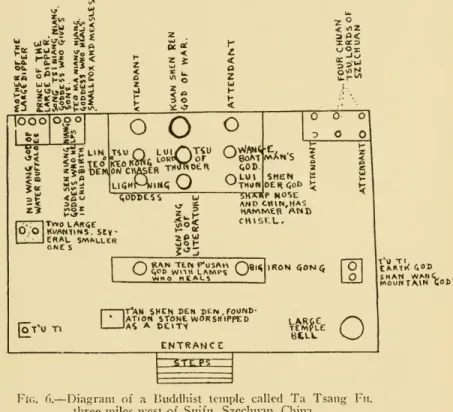
ENTRANCE
SOURCES OF TE^[PLE INCOMES
Members give according to their means as priests conduct funerals, cast out demons, or help with scripture readings.
TEMPLES AS SACRED PLACES
NO. 4 RELIGION IN SZECHUAN PROVINCE GRAHAM 57
Here again a place of wondrous beauty, naturally arousing feelings of wonder and awe, has been chosen as the site of a temple, a sacred place set aside for the worship of the gods. Because of the mineral in the water, groups of air bubbles rise from the bottom, which to the Chinese appear to resemble clusters of grapes. The water in this stream is so full of minerals that the mineral matter is deposited all the way down the gorge and forms a bright yellow stone.
Leaves, sticks and trees that fall into the water are surrounded by the mineral and buried deeper and deeper.
NO. 4 RELIGION IN SZECHUAN PROVINCE— GRAHAM 59
ATTENDANT
OPCN COURT
SACRED MOUNTAINS
East of Suifu near Ngan Lin Ch'iao is I'uh Lai Shan, a Buddhist sacred mountain. This beautiful and majestic mountain stands out above its neighbors, and has long been a sacred mountain. And in all the seven layers (of the mountain) the caves open (to display wonders). P'nshien came from the west.
One of the earliest Euro]) journeys in western China was Iv Col-borne Babcr.
P'USHVEN
OPEN
JREAT O
TREE
MILITARY qoD OF
QREAT COMPASSION. HAS TEN ARN\S
THE GODS IN SZECHUAN PROVINCE
NO. 4 RELIGION IN SZECHUAN PROVINCE — GRAHAM 65
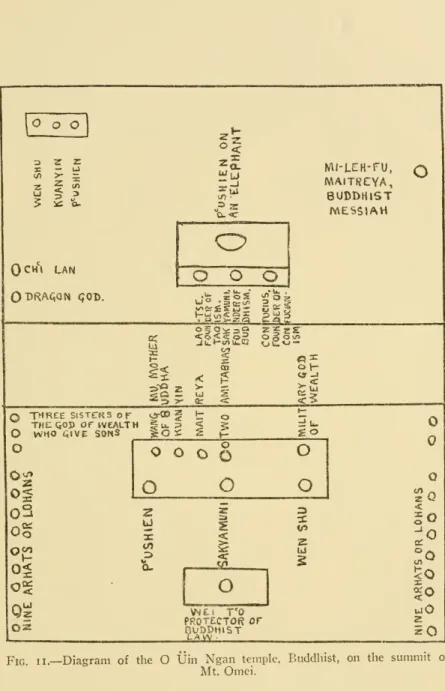
MAITRCYA, BUDDHIST
Sometimes this is accomplished by simply inscribing the name of the deity on paper, wood or stone. The most common household deity consists of a red paper scroll hung on the wall in the most prominent place, on which are written in large letters T'ien, Di, Guin, Ch'in, Si, Wei, or the throne of Heaven, Earth is written. , Rulers, Relatives and Scholars. In general, however, the use of the word guin has continued, giving it the meaning of rulers, those who are the parents and protectors of the people.
A further step beyond this is the drawing, painting or printing of the image of the deity.
WATER
WATER •" ^'^
COURT
FOUR
GRE^T
BUODH A
The pictures of the door deities are printed on paper or painted and pasted on the outside of the doors. The image of the kitchen god, found in almost every kitchen, is usually printed on paper. The god is only one and invisible, but in every temple can be an image of the god.
He is in space, but he is capable of being everywhere, and when men worship him in the presence of the image, he is there and becomes actually embodied in the image, so that the image is the god.
NO. 4 RELIGION IN SZECHUAN PROVINCE — GRAHAM 69
ENTKAMCE
70 SMITHSONIAN MISCELLANEOUS COLLECTIONS VOL. 80 To the common people of Szechuan Province the presence of the
THE LIST OF GODS
NO. 4 RELIGION IN SZECHUAN PROVINCE — GRAHAM 71
On the twenty-third day of the twelfth moon, he ascends to heaven, and the behavior of the household is reported by Pearly Em-. There are five gods, often found in shrines or exposed to the weather, at intervals along the roads to protect travelers from demons who might do harm. It is generally made of stone, and the inscription suggests that it is a stone from a sacred mountain.
The image of a wild being that has four tusks and holds a dagger in its mouth is.
NO. 4 RELIGION IN SZECHUAN PROVINCE — GRAHAM 73
The Buddhism of Amitabha, who rules the western heavens which is heaven for the souls of the dead, is. As Tibetans repeat over and over "Om-mani padme-hum," so the most devout Buddhists repeat as they say their rosary beads, "Lan u Omitofuh." On Mount 34;Omitofuh." At the many roadside places, Amitabha stands ever ready to help the traveler in need.
Among these are the God of War, who was a famous warrior in Szechuan; Ch'uan Chu, lord of Szechuan, credited with developing a large irrigation system on the Chengtu Plain; Wang E.
NO. 4 RELIGION IN SZECHUAN PROVINCE GRAHAM 75
76 SMITHSONIAN MISCELLANEOUS COLLECTIONS VOL. 80 very well dressed, is reputed to have taught the Chinese how to make
Probably the process began with the natural feeling of being tired due to the size and whiteness of the stone. When such a turnip is found, it is called a turnip king and is considered an agod of turnips. As a result of thus honoring the turnip king, it is believed that turnips will thrive in that locality.
It is therefore customary to place foundation stones under the wooden posts to keep them from rotting and to protect them from the damage of the bleachers.
NO. 4 RELIGION IN SZECHUAN PROVINCE — GRAHAM 79
SUMMARY AND CONCLUSION
The emotions of awe and wonder and the emotional excitement associated with human reaction are elements that are extremely important and lie at the heart of primitive religions. The customs of this world are carried over to the spirit world of the dead, so food and money must be given to the souls of the dead. Under Tsang Tao Lin and other leaders, Taoism won the favor of the masses in China many centuries ago by identifying itself.
4 RELIGION IN SZECHUAN PROVINCE — GRAHAM 8l found in both Buddhist and Taoist temples.
BIBLIOGRAPHY
Even the Pearl Emperor is found in Buddhist temples, and Taoist temples may have pictures or images representing the transmigration of souls, a concept the Buddhists brought with them from India, and scenes representing the judgments and punishments of the hadith. which were originally Buddhist. The idea is not that a deity or a spirit has taken up residence in the rock, but that the stone is a god. Omei is one of the four great sacred mountains of China and has many Buddhist temples and monasteries.
He is the head of one of the three major religious sects in Tibet, and is believed to be the ninth reincarnation of the main disciole of the founder of Lamaism in Tibet. The building in the foreground has been used as a magistrate's yanien, a lamasery or temple, and a fortress.