SPECIAL SESSION ON COLD WATER DIVING
*£>
> • , * .
PROCEEDINGS OF SPECIAL SESSION ON COLDWATER DIVING
AMERICAN ACADEMY OF UNDERWATER SCIENCES COLDWATER DIVING FOR SCIENCE SYMPOSIUM
29 OCTOBER - 1 NOVEMBER 1987 UNIVERSITY OF WASHINGTON SEATTLE, WASHINGTON
MICHAEL A. LANG CHARLES T. MITCHELL EDITORS
AMERICAN ACADEMY OF UNDERWATER SCIENCES
Copyright 1988
AMERICAN ACADEMY OF UNDERWATER SCIENCES 947 Newhall Street
Costa Mesa, CA 92627 U.S.A.
All rights reserved, including the right to reproduce this book, or portions thereof.
Copies of these Proceedings can be purchased from A.A.U.S. at the above address.
FOREWORD
These proceedings contain seven invited papers which were presented during a special session on coldwater diving at the American Academy of Underwater Sciences' Coldwater Diving for Science...1987 Symposium, October 29 to November 1, 1987 at the University of Washington, Seattle. The Symposium proceedings of contributed papers were published separately and are available from the AAUS.
The primary goal of the Academy is the safety of the individual diving scientist. The United States of America maintains an active role in research programs in polar and subpolar environments. A portion of this research is conducted underwater in waters that are numbingly cold. Because of the extreme environmental conditions both above and below the water surface, an extra measure of preparation and training is required. As new researchers and diving scientists are attracted to such environments they must be properly prepared if they are to productively pursue their research goals.
The Academy has produced this resource document to assist in preparing researchers for what they might expect in coldwater environments. This document serves as a preliminary written record by compiling the knowledge and experiences of long-time coldwater researchers for the benefit of less experienced colleagues. In the past, this experience has been passed down by word of mouth. In order to establish a more organized method of information transfer, the Academy has also organized a Polar Diving Workshop, which can be held at regular intervals.
In addition to the topics of coldwater physiology and diver training, new technology in exposure protection suits and insulation are covered. The important aspects of logistics in coldwater environments and Arctic/Antarctic regions are also addressed.
We thank the contributors for their efforts and input to these proceedings and for their interest in advancing the practice of scientific diving in the coldwater environments.
Michael A. Lang Charles T. Mitchell Editors
CONTENTS
Thermal Problems During Cold Water Diving
Igor B. Mekjavic 1 Training Scientific Divers for work in Cold Water and Polar Environments
Lee H. Somers 13 Exposure Protection: Dry Suits and Thermal Insulation
Richard Long 29 Cold Water Diving with Vulcanized Rubber Dry Suits
Steve Barsky 65 Cold Water Diving Logistics
James R. Stewart 69 The Under Ice Dive
Lee H. Somers 75 Underwater Research in the Southern Ocean on the Antarctic Krill, Euphausia
Superba, and on Baleen Whales
William M. Hamner and Gregory S. Stone I l l Operational Strategies for Arctic Research Diving
Bruce E. Townsend 115
THERMAL PROBLEMS DURING COLD WATER DIVING Igor B. Mekjavic School of Kinesiology Simon Fraser University Burnaby, British Columbia Canada, V5A 1S6
The maintenance of normal body temperature is imperative for the unhindered performance of workers. Our understanding of the functioning of the thermoregulatory system in normobaric conditions has led to the design and development of equipment and protective clothing preventing excessive displacements of body temperature of workers exposed to thermal extremes.
The effects of hyperbaric environments on the mammalian thermoregulatory control system remain unresolved. The present review focuses on the thermal problems encountered by cold water divers and suggests possible effects of pressure and inert gas narcosis, respectively, on the maintenance of thermal equilibrium. The frequent reports of hypothermia during diving may not only be associated with the increased magnitude of heat loss as a result of the high density air, or cold water environment, but may in part also be due to an alteration in the autonomic responses to a cold stimulus. Cold exposure may also significantly impair divers' performance, by affecting manual dexterity and mental acuity, thus it may indirectly add to their risk of accident and injury.
With the progress that has been achieved in underwater technology and life support systems over the past few decades, hypothermia should become a technological impossibility, occurring only as a result of unforeseen circumstances.
INTRODUCTION
Man initially dominated only the tropical regions of the Earth, and as a result is considered a tropical animal. Thus, from an evolutionary perspective, the human thermoregulatory system is most efficient in maintaining body temperature within the fairly narrow limits of 37° ± 1°C in tropical climates. Though the efficiency and versatility of the human thermoregulatory system assisted in man's migration to moderate and thermally more extreme environments in search for food and new habitats, it is the human traits of inventiveness and creativity which has enabled the human species to survive and populate all regions of the Earth. Human ingenuity has enabled the development of technological solutions to the problems of protection from the environment.
The advance in recent decades of exploration of the polar regions and continental shelves in search of natural resources has placed a greater reliance on technology to sustain life under these adverse conditions. Undoubtedly, some of the greatest challenges to life support technology have been posed by the harsh subsea environments, where divers provide valuable support for offshore drilling operations.
1987 AAUS - Cold Water Diving Workshop
The susceptibility of divers working in cold waters to hypothermia or cold strain may be analyzed by discussing the effects of hyperbaria on the major components involved in the maintenance of their thermal equilibrium. Namely, thermal balance of an individual exposed to any given environmental conditions may be assessed according to the following equation:
S = M - W ± R ± C ± K - E ± RES where, S = rate of storage of body heat.
M = rate of metabolic heat production.
W = rate of energy expenditure for work.
R = rate of heat exchange via radiation.
C = rate of heat exchange via convection.
K = rate of heat exchange by conduction.
E = rate of heat loss through evaporation of sweat from the skin surface.
RES = rate of heat exchange in the respiratory tract.
The role of the human thermoregulatory system is therefore to balance the above pathways of heat loss and heat gain in order to maintain a thermal equilibrium (AS=O).
In the event of heat accumulation or heat dissipation, AS will assume a positive or negative value, respectively. Autonomic and behavioral responses are initiated to counteract any displacements of body temperature; the former involving changes in the rate of metabolic heat production, sweating and vasomotor tone, and the latter involving more complex responses ranging from altering the posture of the body to reduce or enhance heat loss to developing complex life support systems. The contribution of each component of the above equation to the overall heat loss and heat gain depends upon the prevailing ambient condition. For individuals immersed in water, as would be the case for divers, the radiative and evaporative pathways of heat exchange may be omitted.
THE REGULATION OF BODY TEMPERATURE
Information regarding the thermal status of the peripheral and core regions is derived from cold and warm sensors, which transduce the thermal energy into neural coded information and convey this information to the hypothalamic region. It has been suggested (Benzinger 1969) that there are two distinct regions within the hypothalamus responsible for the appropriate effector mechanisms to counteract any thermal disturbance. The temperature sensitive pre-optic anterior region of the hypothalamus is said to initiate heat loss mechanisms in response to elevation in body temperature, which it senses by monitoring the temperature of the blood perfusing this region. In contrast, the pre-optic posterior hypothalamus is predominantly concerned with the initiation of heat preservation and heat gain mechanisms in response to the increased cold stimulation of the peripheral and core regions of the body. As a result of the precise mechanism by which body temperature is maintained at about 37°C, the human thermoregulatory control system has been described as a "thermostat" with an internal reference point, this set- point or reference temperature being normally maintained at 37°C.
Recent work by Bligh (1988) proposes that it is unnecessary to search the body for an anatomical structure generating this reference point, but that the zone of thermoneutrality (the range of temperatures through which deep body temperature may
Mekjavic: Thermal problems during cold water diving.
vary without the initiation of effector mechanisms) may be explained on the basis of the reciprocal inhibition of the neural information emanating from the peripheral and core cold and warm sensors, as depicted in Figure 1. The pattern of activity of the cold and warm sensors is such that the warm sensors are increasingly quiescent below 30°C, and as the temperature is elevated, they increase the frequency of discharge of action potentials, reaching a peak at approximately 40°C and thereafter becoming silent again.
In contrast, the cold sensors have a peak of activity in the 20° to 30°C range, becoming increasingly silent as the temperature is either reduced or elevated from this range of peak activity. It is interesting to note that there exists a zone of equal activity, which coincides with the thermoneutral zone. Should the temperature decrease below this region, the increase in cold sensor activity initiates an increase in heat production (HP), but also inhibits the warm sensor activity as indicated in Figure 1. Increasing the temperature above the thermoneutral zone will activate heat lost effector mechanisms, while simultaneously inhibiting the heat production pathway. It is this principle of reciprocal inhibition which establishes a zone of stable body temperature and, as Bligh (1988; see also Mekjavic and Bligh 1987) points out, eliminates the need for an anatomical structure generating the reference temperature. Furthermore, it demonstrates that the set-points or critical core temperatures for shivering and sweating may be established by the relationship between sensor activity and temperature. The neuronal model presented in Figure 1 introduces the concept that other thermoregulatory and non- thermoregulatory excitatory and inhibitory inputs may influence the relationship between the sensors and effectors, which may affect the magnitude of the thermoneutral zone, the critical core temperatures for sweating and shivering, and the gains of the sweating and shivering responses.
•CNS-
PW- CW
°y
Heat Loss Effectors Heat Production Effectors
Temperature
Figure 1. A neuronal model of the human thermoregulatory system. The thermal status of the body is sensed by the peripheral cold (PC) and warm (PW) sensors, as well as similar sensors situated in the core regions (CC and CW, respectively). This thermal afferent Information is integrated within the central nervous system, along with other thermoregulatory and non- thermoregulatory factors (represented by £ ) , to initiate appropriate heat loss and heat production effectors. The range of overlapping activity of the sensors may explain the zone of thermoneutrality, a zone devoid of active HP or HL effectors. Such a theory of reciprocal inhibition of the cold and warm sensor activity may also adequately explain the existence of set-temperature (from Mekjavic and Bligh 1988).
1987 AAUS - Cold Water Diving Workshop
There is, unfortunately, a paucity of information regarding the effect of elevated ambient pressure per se and inert gas narcosis on the thermoregulatory control system. It has been shown that during compressed air dives, nitrogen exhibits a narcotic effect by virtue of its lipid solubility and the distribution of the molecules at the water-lipid interfaces in cell membranes, which may explain the detrimental effect on the conduction of action potentials along neural fibers and on the synaptic transmission of action potentials (Bennett 1982, Carpenter 1954). It remains to be proven whether the nitrogen absorbed by the phospholipids of neural membranes while breathing air at high pressures distorts the thermal afferent information from peripheral and core sensors, as well as the subsequent hypothalamic integration of this information. Subjective observations reported in the literature would tend to support this hypothesis (Bennett 1988), as ambient temperatures within hyperbaric chambers need to be maintained at high temperatures, (32°C) and should not deviate more than several degrees in order to maintain the thermal comfort of divers. Thus, in comparison to normobaric conditions, the thermal comfort zone appears to be narrower and elevated towards higher levels in hyperbaric ambients.
To what degree the respective contributions of pressure and nitrogen narcosis are responsible for these observations remains to be elucidated.
HEAT PRODUCTION
Displacement of skin and core temperature from the set-zone elicits a proportionate thermogenic response as indicated in Figure 2. Some controversy has existed with regards to the true nature of the relationship between core temperature and metabolic heat production at any given skin temperature (for example, the results of Craig and Dvorak (1966) suggest a different gain of the response than do those of Benzinger (1969) for similar skin and core temperature conditions).
Mekjavic (1983) has suggested that, in part, the discrepancy may be due to the different rates of cooling in core temperature as his results indicate a substantial effect of core cooling rate on the shivering response. However, in most cases, the cooling rate is quite different for a range of subjects and seldom reported in the literature. Thus, a level of heat production observed for a combination of skin and core temperatures in the same subject may be quite different if the rate of cooling of the core or skin is different. Furthermore, Mekjavic et al. (1986b) have demonstrated that the thermogenic response is subject dependent and appears not to be a function of morphology (Mittleman and Mekjavic 1988). Previously, studies have suggested a strong influence of morphology on the magnitude of thermogenesis (Tikusis et al. 1988); however, when similar cold stimuli are applied to the peripheral (Mekjavic et al. 1986a) and core regions (Mittleman 1987) for a range of physiques, no apparent relationship between shivering thermogenesis and morphology is observed.
Again, information regarding the effect of hyperbaric ambients on shivering thermogenesis is scant. There is some evidence, however (Piantodosi and Thalmann 1980, Piantodosi et al. 1981), of an inhibitory effect, but the mechanism for this inhibition is yet to be determined.
HEAT LOSS
The main pathways of heat loss which contribute to the overall progressive cooling of the body during cold water diving are: 1) heat loss from the surface of the skin mmmm mmmm
Mekjavic: Thermal problems during cold water diving.
0)
1.8 1.6
1.4
1.2 1.0
.8 .6 .4 .2
Skin Temperature Isotherms
10\ Benzinger (1970)
Craig & Dvorak (1966) Mekjavic (1983)
35 36 37 Tympanic Temperature (°C)
38
Figure 2. The relationship between the rate of metabolic heat production and tympanic temperature obtained by several investigators for a range of water temperatures. The discrepancy observed between the relationships of Benzinger and those of Craig and Dvorak for the same combinations of Tty and Tsk may be due to different cooling rates of the core region and differential thermal responsiveness of the subjects (from Mekjavic 1983).
through conduction/convention; and b) evaporative and conductive/convective heat loss from the respiratory tract.
a) Heat Flux from the Skin Surface. In a normobaric and thermoneutral environment, the mean heat flux from the skin surface in a resting individual may range from 50 to 70 W.m'2. Sudden immersion in cold water will increase the magnitude of heat flux 25-fold due to the greater thermal conductivity of the water. Such a high rate of heat loss would precipitate hypothermia very rapidly; however, as the vasoconstrictor tone increases and consequently decreases the diameter of the cutaneous blood vessels and thus blood perfusion of this region, heat flux decreases towards a stable level usually 4- to 6-fold greater than that observed in air (Figure 3).
1987 AAUS - Cold Water Diving Workshop
E
skin
1200 - 1000 -
• 8 0 0 - 6 0 0 - 400 - 200 - 0 -
D
D ?calf
• Qback
-5 15 25
Time (min.)
35
Figure 3. Heat flux from the skin surface (mean ± s.d. for four sites). There is a transient elevation in heat flux immediately upon immersion in cold water, whereupon it decreases toward a level only 4 to 6 fold greater than pre- immersion values (from Mittleman 1987).
The magnitude of heat flux from the skin surface depends upon the thickness of the insulative layer, specifically the skin and subcutaneous adipose layers. Heat loss is further reduced with the addition of an insulative layer of neoprene, as would be the case for divers wearing either drysuits or wetsuits. The obvious advantage of drysuits is their ability to trap a layer of air within the microenvironment of the suit, thus enhancing the insulative capacity of the suit. In contrast, wetsuits allow water to penetrate into the microenvironment of the suits, but decrease the heat flux from the skin surface by elevating the temperature of the water and, thus minimizing the temperature gradient.
Heat loss by convection in nude individuals immersed in water is proportional to the temperature gradient between the skin surface and the water and the convective heat transfer coefficient. Boutelier et al. (1977) have shown that, in stirred water the convective heat transfer coefficient can be defined as a power function of the water velocity. Similar adjustments to the calculation of convective heat transfer need to be made for the clothed diver, with the exception that the thermal gradient between the skin and water will be less as a result of the diving suit. However, the reduction in the thickness of the neoprene layer with increased ambient pressure will diminish the thermal resistance of the suit and further enhance heat loss (Warkander et al. 1985). For 3/16 inch thick wetsuit, Rawlins and Tauber (1971) observed that the thickness decreases to 55-55% of its initial thickness up to a pressure of 4 atmosphere absolute (ATA), but thereafter remains virtually unchanged.
Mekjavic: Thermal problems during cold water diving.
b) Respiratory Heat Loss. Heat is lost from the respiratory tract via conduction/convection and by evaporation of water from the mucous lining which requires thermal energy for the latent heat of vaporization. Thus the colder and/or drier the inspired air, the greater the total respiratory heat loss. At normobaria, the major pathway for respiratory heat loss is through the evaporation of the water lining the respiratory tract. Although the specific heat of air does not vary significantly with pressure, its density will increase with increasing pressure and decreasing temperature.
Thus, in cold hyperbaric environments, the conductive/convective pathways for respiratory heat loss become dominant. Indeed, research by Hoke et al. (1975), Piantadosi (1980), and Piantadosi and co-workers (1980, 1981) demonstrated that while exercising in a warm high pressure environment, breathing a cold heliox gas mixture will induce a progressive cooling of the core region. In addition to emphasizing the significance of respiratory heat loss at high ambient pressures, it also indicated that the core cooling was not sensed by the core cold sensors as there appeared to be a blunted thermogenic response to the core cooling.
The analysis of the respiratory heat exchange is based upon our knowledge of the thermal gradients in the respiratory tract obtained at sea level conditions. Webb (1982) suggests that with depth, there is a greater penetration of the cold gas in the lungs;
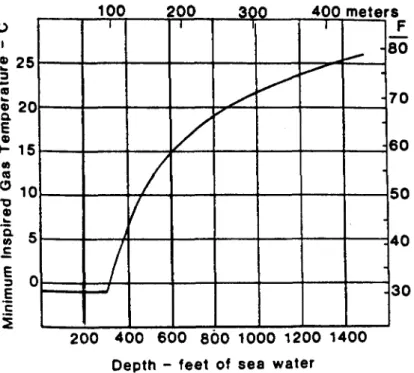
thus, the thermal gradients may be substantially different and may, in this manner, enhance the respiratory heat loss from the core. Cold gas breathing may also cause bronchoconstriction (Guleria et al. 1969) and stimulate the secretion of mucus which may result in respiratory distress in divers (Goodmann et al. 1971, Hoke et al. 1975). To avoid excessive cooling and other problems associated with cold air breathing, Piantadosi (1980) has constructed a nomogram for the determination of the lowest recommended breathing gas temperature as a function of depth shown in Figure 4.
With increasing depth, the ability to warm the diver's breathing gas becomes imperative. Unfortunately in most cases, divers have to resort to breathing air at a temperature equivalent to the surrounding water which enhances the risk of core cooling in cold water diving.
THE EFFECT OF MORPHOLOGY ON SHIVERING THERMOGENESIS AND COOLING RATE
It has often been reported that the core cooling rate is inversely proportional to the thickness of the subcutaneous adipose layer. However, Mekjavic et al. (1986b) suggest that this relationship does not account for the shivering response and may, therefore, be a gross generalization. They report similar core cooling rates in two subjects differing immensely in their adipose content. Their results show that the subject with minimal adiposity had a very high rate of metabolic heat production, whereas the highly adipose individual had a very small elevation in shivering thermogenesis. The result was that both individuals had identical core cooling rates. Further work by Mittleman (1987) revealed that there was no significant relationship between the thermogenic response to a standardized cold stimulus to the core and peripheral regions and subject morphology, thus supporting the notion that in the range of the normal population (in terms of body composition), it cannot be assumed that core cooling rate will be proportional to the subcutaneous adipose layer thickness since the rate of metabolic heat production is unrelated to morphology and counteracts the cooling process.
1987 AAUS - Cold Water Diving Workshop
O i 0) w
15 oa Ea
a CD
QW
E
3
E 25
20 15 10
5
100 0 0 300 400 meters
200 400 600 800 1000 1200 1400 Depth - feet of sea water
80 70 60 50 40 3 0
Figure 4. The lowest recommended temperature of a diver's breathing mixture as a function of depth (from Webb 1982; originally adapted from Piantadosi el al.
1980).
Her work also suggests that repeated cold water immersion may decrease the magnitude of the thermogenic drive which will tend to potentiate the cooling effect of the cold water (Skreslet and Aareflord 1968).
HYPOTHERMIA
Hypothermia is defined as the condition of a temperature regulator when the core temperature is below its set-range specified for the normal active state of the species (Cabanac 1987), and is a consequence of a temporary or permanent imbalance in the rate of heat production and the rate of heat loss. In the absence of physiological monitoring equipment in the field, it is very likely that a diver is suffering from hypothermia if the following symptoms are evident: violent shivering, loss of coordination, impaired judgement, and stupor. If the cooling process is not arrested, the continued reduction of the body core temperature will result in loss of consciousness and ultimately heart and respiratory failure (Maclean and Emslie-Smith 1977).
Accidental cold water immersion hypothermia is usually associated with rapid cooling of the core region. In contrast, divers conducting repeated cold water dives or exposed to a cold hyperbaric air environment may experience an insidious cooling process which may induce hypothermia with little warning. Divers trapped in a "lost" diving bell, one
Mekjavic: Thermal problems during cold water diving.
which has had its umbilical severed, experience this type of insidious cooling (Hope et al.
1987). As soon as power to the diving bell is lost, the wall and air temperature decreases to the level of the surrounding water. Unless the divers have well insulated parkas and sleeping bags available with a self-heated breathing device, they may die of hypothermia within 12 hours. Such thermal protective aids appear to extend the survival time to at least 24 hours (Tonjum et al. 1980).
PERFORMANCE
In addition to the effects of nitrogen narcosis and pressure on performance, divers exposed to cold water may suffer detriments in performance due to the effect of cold per se. Davis et al. (1975) suggest three main effects of cold: 1) cooling of the peripheral tissue will impair tactile sensitivity and decrease muscle power; b) cooling of the inner core of the body, and thus the central nervous system, may impair mental performance;
and c) the cold may impose a "distraction effect", whereby the perceived threat of the cold may distract the diver and interfere with performance.
Davis et al. (1975) compared the performance of divers wearing 3/16 inch neoprene wetsuits in 5°C water with that observed in 20°C water (at a depth of 30 ft in fresh water). Their results indicate a marked decrease in manual dexterity (17%), word recall (37%), word recognition (11%), logical reasoning (13%), and arithmetic test scores (13%).
Their findings are in general agreement with other studies evaluating performance of divers during cold exposure (Bowen 1968, Clark 1961, Stang and Weiner 1970) and emphasize the need to not only prevent core cooling of divers in cold water, but also to provide sufficient heat to maintain the temperature of the peripheral tissues and thus allow unhindered performance.
VENOUS GAS EMBOLI
The formation of venous gas emboli ("bubbles") or nucleation results primarily from an excessive decrease in ambient pressure, thus leading to the symptoms of decompression sickness. However, any factors which will affect the rate of elimination of inert gas from the tissues and its subsequent transfer to the pulmonary capillaries, may also effect bubble formation. It is well established that the tissue, blood, and plasma solubility of nitrogen decreases with increasing temperature, thus with increasing temperatures, less nitrogen will be dissolved in these compartments. Furthermore, the elimination of inert gas through the respiratory tract relies on an adequate perfusion of the tissue compartments. Any alterations in blood perfusion of the tissue may result in a decreased rate of nitrogen elimination and enhance the formation of a gas phase in the circulation.
There is a dichotomy of opinion with regards to the optimal body temperature during decompression and immediately following a dive. The practice of Kalymnian sponge divers in Greece (Bernard 1967) of placing victims of decompression sickness in hot sand is in conflict with the suggestions of Simmons et al. (1982) of placing afflicted limbs in ice.
The former would decrease the nitrogen tissue solubility but enhance the peripheral perfusion, whereas the latter would increase the nitrogen tissue solubility but reduce the perfusion of the tissues due to the vasoconstriction. Recent findings of Mack and Lin (1986) in rats indicate a significantly decreased rate of nitrogen elimination if the rats were hypothermic, and do not reveal any advantage of hyperthermia when compared to the euthermic state in enhancing nitrogen elimination. Mekjavic and Katitsuba (unpubl.
results) exposed divers to either a hot (40°C) or cold (10°C) air environment following a
1987 AAUS - Cold Water Diving Workshop
12-hour dive to 30 fsw, and found greater VGE scores (as determined with Doppler ultrasonic monitoring) during the cold air exposure. Much more surprising were their observations of skin itching and pruritus in four divers immediately following a hot shower upon completion of the cold air exposure. These symptoms which were not present during the 3-hour cold air exposure, were undoubtedly instigated by the sudden dramatic change in the peripheral tissue temperatures. Much more work is required to elucidate the significance of peripheral tissue and inner core temperature in VGE formation and onset of decompression sickness. Presently, it appears that hypothermia is detrimental to N2 elimination and that any sudden rapid rewarming of the periphery may enhance nucleation.
SUMMARY
The nature of heat exchange and heat production in humans working in normobaric conditions is well understood. However, to date most of the observations regarding heat exchange at depth have been discussed in terms of the physical principles of heat exchange, with disregard of the effect of pressure and inert gas narcosis, respective, on the physiological mechanisms responsible for heat production (shivering thermogenesis) and heat loss (vasomotor tone). Subjective observations suggest that there is a general shift in the thermoneutral zone to higher temperatures and a decrease in its width.
With the technology available today, we are able to sustain unhindered human performance in a wide range of environments. Thus, hypothermia is a technological impossibility and should only occur in instances of equipment malfunction or of an overburdening of the physiological regulatory process (Mekjavic and Bligh 1987). In the event that hypothermia is induced, proper management of the hypothermic victims will ensure a safe and uneventful recovery (Harnett et al. 1983a, b).
REFERENCES
Bennett, P. B. 1988. Physiological limitations of performance in hyperbaric environments.
In: I. B. Mekjavic, E. W. Banister, and J. B. Morrison (eds.), Environmental ergonomics. Taylor and Francis, London.
Bennett, P. B. 1982. Inert gas narcosis. In: P. B. Bennett and D. H. Elliott (eds.), The physiology and medicine of diving. Bailliere Tindall, London.
Benzinger, T. H. 1969. Heat regulation: Homeostasis of control temperature in man.
Physiol. Rev. 49:671-759.
Bernard, H. R. 1967. Kalymnian sponge diving. Hum. Biol. 39:103-131.
Bligh, J. 1988. Human cold exposure and the circumstances of hypothermia. In: I. B.
Mekjavic, E. W. Banister, and J. B. Morrison (eds.), Environmental ergonomics.
Taylor and Francis, London.
Bowen, H. M. 1968. Diver performance and the effects of cold. Hum. Factors 10:445-464.
Mekjavic: Thermal problems during cold water diving.
Boutelier, C , L. Bouges, and J. Timbal. 1977. Experimental study of convective heat transfer coefficient for the human body in water. J. Appl. Physiol. 42:93-100.
Cabanac, M. 1987. Glossary of terms for thermal physiology. 2nd ed. (rev.) IUPS Thermal Comm. Pflugers Arch. 410:567-587.
Carpenter, F. G. 1954. Anesthetic action of inert and unreactive gases on intact animals and isolated tissues. Am. J. Physiol. 178:505-509.
Clark, R. E. 1961. The limiting hand skin temperature for unaffected manual performance in the cold. J. Appl. Psysiol. 46:276-280.
Craig, A. B. and M. Dvorak. 1966. Thermoregulation during water immersion. J. Appl.
Physiol. 21(5):1577-1585.
Davis, F. M., A. D. Baddeley, and T. R. Hancock. 1975. Diver performance: The effect of cold. Undersea Biomed. Res. 2:195-213.
Goodman, M. W., N. E. Smith, J. W. Colston, and E. L. Rich. 1971. Hyperbaric heat loss study. Final report. Cont. N00014-71-C-0099, Off. Naval Res., Washington, D.C.
Guleria, J. S., J. R. Talwar, O. P. Malhotra, and J. N. Pande. 1969. Effect of breathing cold air on pulmonary mechanics in normal man. J. Appl. Physiol. 27:320-322.
Harnett, R. M., J. R. Pruitt, F. R. Sias. 1983a. A review of the literature concerning resuscitation from hypothermia. Part I - Problems and general approaches. Avia.
Space Environ. Med. 54:425-434.
Harnett, R. M., J. R. Pruitt, F. R. Sias. 1983b. A review of the literature concerning resuscitation from hypothermia. Part II - Selected rewarming protocols. Avia. Space Environ. Med. 54:487-495.
Hoke, B., D. L. Jackson, J. M. Alexander, and E. T. Flynn. 1975. Respiratory heat loss and pulmonary function during cold gas breathing at high pressures. In: C. J.
Lambertsen (ed.), Underwater Physiol. V.
Hope, A., E. H. Padbury, G. Knudsen, K. Segadal, R. Vaernes, G. Jorgensen, and E.
Thorsen. 1987. Undetected hypothermia: The effect of cooled breathing gas on thermal balance during simulated diving to 360 meters of sea water. Proc. 13th Ann.
Meeting E.U.B.S., Palermo, Italy.
Mack, G. W., and Y. C. Lin. 1986. Hypothermia impairs but hyperthermia does not promote inert gas elimination in the rat. Undersea Biomed. Res. 13:133-145.
Maclean, D., and D. Emslie-Smith. 1977. Accidental hypothermia. Blackwell Scientific Publ., Oxford.
Mekjavic, I. B. 1983. A model of shivering thermogenesis based on the characteristics of central and peripheral thermoreception. Ph.D. thesis, Simon Fraser Univ., Burnaby, B.C. Canada V5A 1S6.
1987 AAUS - Cold Water Diving Workshop
Mekjavic, I. B., and J. Bligh. 1987. The pathophysiology of hypothermia. Int. Rev.
Ergonomics 1:201-218.
Mekjavic, I. B., A. La Prairie, W. Burke, and B. O. Lindborg. 1986a. Respiratory drive during sudden cold water immersion. Respiration Physiol. 56:999-1004.
Mekjavic, I. B., K. D. Mittleman, and W. Burke. 1986b. Incorporating individual variability in the prediction of shivering thermogenesis. 10th Symp. on Man-Thermal Environ.
Sys., Tokyo, Japan.
Mittleman, K. D. 1987. Central thermosensitivity of metabolic heat production during cold water immersion. Ph.D. dissertation. Simon Fraser Univ., Burnaby, B.C., Canada.
Mittleman, K. D., and I. B. Mekjavic. 1988. The role of morphology in the central thermosensitivity of shivering thermogenesis during cold water immersion. In prep.
Piantadosi, C. A., E. D. Thalmann, and W. H. Spaur. 1981. Metabolic response to respiratory heat loss-induced core cooling. J. Appl. Physiol. 50:829-834.
Rawlins, J. S. P., J. F. Tauber. 1971. Thermal balance at depth. In: C. J. Lambertsen (ed.), Underwater Physiol. IV. Academic Press, New York.
Simmons, E. H., S. W. O'Driscoll, J. A. Gammarra. 1982. Clinical and experimental evidence for the use of hypothermia in decompression sickness. Avia. Space Environ.
Med. 53:266-268.
Skreslet, S., and F. Aareflord. 1968. Acclimatization to cold in man induced by frequent scuba diving in cold water. J. Appl. Physiol. 24:177-181.
Stang, P. R., and E. L. Weiner. 1970. Diver performance in cold water. Hum. Factors 12:391-399.
Tikusis, P., R. R. Gonzalez, R.A. Oster, and K. B. Pandolf. 1988. Role of body fat in the prediction of the metabolic response for immersion in cold water. Undersea Biomed.
Res. 2:123-134.
Tonjum, S., R. W. Hamilton, A. O. Brubakk, R. E. Peterson, and D. A. Youngblood. 1980.
Project Polar Bear: Testing of diver thermal protection in a simulated "Lost Bell."
Rep. 2-80, Norwegian Underwater Inst., Bergen, Norway.
Warkander, D. E., O. A. Traff, and G. O. Dahlback. 1985. The effects of the insulation properties of different dry suit systems on the diver's heat balance and comfort during diving to 50 m. Proc. 11th Ann. Mtg. E.U.B.S., Goteborg, Sweden.
Webb, P. 1982. Thermal problems. In: P. B. Bennett and D. H. Elliott (eds.), The physiology and medicine of diving. Bailliere Tindall, London.
TRAINING SCIENTIFIC DIVERS FOR WORK IN COLD WATER AND POLAR ENVIRONMENTS Lee H. Somers Department of Atmospheric, Oceanic, and Space Sciences The University of Michigan Ann Arbor, Michigan 48109
INTRODUCTION
Cold water and polar environments place exceptional stress on both divers and their equipment. Safe and efficient diving operations can only be conducted by dive teams who are specially trained and equipped for these environments. Scientific divers have been successfully working in cold water and the polar environment for more than three decades. However, the diver's working efficiency and, in some cases, safety has been compromised by the fact that much of the learning process has taken place in the field, often under severe environmental conditions. Divers trained in southern California or Florida often have their first cold water experience in polar waters. They simply learned techniques from fellow divers with prior cold water experience and adapted to the new environment.
The record of accomplishments for these divers has been excellent. Thousands of dives have been conducted with only a few unfortunate incidences of injury or death.
However, as we enter the last decade of this century, we are faced with the necessity of re-evaluating our polar research programs for the following reasons:
1. There has been an increased emphasis on polar research in the Arctic because of oil exploration in a very fragile environment and a need for a better understanding of the ecosystem. Antarctica will receive increasing attention at the international level and the need for a strong American research presence ranks high with funding agencies.
Simply expressed, there will be a significant increase in the requirements for scientific diving in cold water and polar regions.
2. The cost of research will continue to rise. Consequently, funding agencies will have to take a close look at operational efficiency as well as scientific productivity in order to sponsor cost-effective research. Polar scientists will have to perform efficiently under severe environmental conditions as well as intensified agency scrutiny.
3. New technologies have extended the working capability of the scientific diver.
However, the same technologies have also increased the complexity of diving. The diver can now remain underwater for longer periods of time to perform more complex tasks.
However, to perform these tasks safely and efficiently, a higher level of training and preparation is required.
4. Federal scrutiny of the scientific diving community and the ever present possibility of regulatory intervention at state and federal levels make it necessary for our community to set the highest possible standards to insure safety in the work place — especially under 5 meters of polar ice.
1987 AAUS - Cold Water Diving Workshop
Most scientific divers are trained in recreational-oriented scuba diving courses. Ice diving specialty courses presented by recreational diving instructors are inadequate for preparing a scientist to perform research in polar regions and under the ice [5]. For these and other reasons the scientific community must assume leadership in training its divers for working in cold water and polar environments.
There is a considerable volume of literature on the physiology of cold stress.
However, there is only a limited number of publications on the techniques and procedures of cold water [8], under ice [4,7], and polar diving operations [2]. The U.S. Navy is currently preparing an updated manual on polar diving.
The recommendations presented below are based on the author's personal views, research, and experience. They by far do not represent a complete overview of training requirements. In some cases they may appear excessive and in others inadequate. These recommendations are intended to provide a "starting point" for a responsible committee of scientific polar divers, diving instructors, diving safety officers, and funding agency representatives to develop a National Polar Scientific Diver Training Program.
ACADEMIC TRAINING
The academic portion of the training program can be conducted concurrently with confined water and open water training, as a separate workshop program or, in part, as a self-study correspondence course. Ideally, such topics as polar survival should also include practice exercises in the field.
The details of the academic training program are included in the following discussion and a course syllabus is presented in Appendix I.
TRAINING SITES AND ENVIRONMENTAL CONSIDERATIONS Confined Water Training
Experienced scuba divers are sometimes reluctant to participate in confined water training exercises. For example, the majority of cold water divers purchasing dry suits use them for the first time in cold open water rather than going through a learning phase in a controlled environment. It is imperative that divers and tenders learn to handle equipment, suits, and themselves under controlled, warm water conditions before submitting to an actual cold water dive. Every item of equipment to be used by the diver in open water should be first used in the controlled environment. This is especially true of suits and special scuba/buoyancy control items.
Under-ice training can be simulated in a large swimming pool by covering the surface of the pool with plastic tarps and establishing an entry opening at a corner.
Divers can simulate entry and under-ice swimming on a tether. This is an excellent way to familiarize divers and tenders with line handling and line signals. Both tenders and divers must wear the same gloves or mitts that they will wear on the actual diving operation. The tarp may be supported by placement of small floats on the surface of the
Somers: Training scientific divers for work in cold water and polar environments.
water and the entry opening can be reinforced with wood as required. This is also an excellent time to test sampling apparatus and measurement techniques.
The number and duration of confined water training sessions depend on the type of diving operation for which the team is being prepared, the prior dry suit diving experience of the divers, and other special training requirements. Persons with no prior dry suit diving experience should have at least six controlled warm water training sessions prior to open water exposure.
Cold Water Training
I can train a diver to use a dry suit and manage a tether any place including the warm temperate waters of southern California or tropical waters of the Caribbean.
However, I am reluctant to train a cold water or polar diver in any place but a cold environment. Ideally, the divers, tenders, and support personnel should complete the final phase of their training in a cold climate with cold water and ice cover.
If one were looking for the most ideal situation, it would be found in our northern states and Canada. A cold water dry suit diver could receive theory and confined water training in the spring or early summer followed by open water training in the summer.
The diver could acquire experience dressing under pleasant conditions, master diving techniques in moderate temperature surface waters, and slip below the thermocline to become familiar with colder water. The diver would continue to dive into the fall and early winter in open water with progressively colder surface conditions. By mid-winter the diver could complete under-ice training and acquire under-ice experience during late winter. I would recommend this progression to any diver planning to work in polar environments. A diver must be an experienced open water dry suit diver before venturing under ice cover. Working proficiency should be gained in 25 to 50 dives, depending on the individual.
Unfortunately, this sequence of progressive experience dives would not be possible for a one- or two-week polar diving training program. However, a condensed version could be presented during the training program and divers encouraged to gain additional open water diving experience before committing to under-ice working dives.
If I were asked to recommend a location within the continental United States for conducting a polar diver training program, I would have to select a Great Lakes state, such as Michigan, Minnesota, or Wisconsin. Northern Michigan winters can approximate polar conditions. A program could be conducted at a university with classrooms, pools, living quarters, and nearby lakes in the months of January or February. Transportation and overall training cost would be lower than operating in a remote area.
Ideally, the training should be conducted in two phases. Phase One would include classroom, confined water, and open water training under milder climatic conditions.
Phase Two would be conducted in a cold environment with under-ice training capabilities.
The divers should be allowed a period of time between Phase One and Two in order to acquire open water dry suit diving experience.
1987 AAUS - Cold Water Diving Workshop PREREQUISITES FOR POLAR DIVER TRAINING
Applicants for Polar and Cold Water Diver Training must complete the following prerequisites prior to acceptance into the training program:
1. Hold a Scientific Diver Certificate in accordance with the standards of the American Academy of Underwater Sciences (AAUS) or equivalent;
2. Successfully pass a Diving Medical Examination in accordance with the standards of the AAUS or equivalent within nine months of the course starting date;
3. Demonstrate physical fitness and watermanship by completing the Cooper 12-Minute Swimming Test in Fitness Category III or higher;
4. Hold current American Red Cross or equivalent certifications in Cardiopulmonary Resuscitation and Standard First Aid;
5. Submit a record of no less than 50 open water scuba dives;
6. Hold a 60 Foot Depth Certification or deeper in accord with the standards of the AAUS; and
7. Submit a letter of recommendation from the sponsoring university or research organization attesting to the need for special training in cold water diving procedures.
Prior Training and Experience
Prior to entry into a Cold Water Diver Training Program an individual must be a skilled warm/temperate water scuba diver. Basic requirements for sport diver certification often lack the skill proficiency and knowledge level demanded of a working scientific diver. Thus, the AAUS Scientific Diver Certificate or an equivalency is recommended.
Furthermore, the adversities encountered in cold water diving dictate that a diver must be completely comfortable with his/her equipment and the environment. Prior experience of 50 open water scuba dives and a 60-foot depth certification are considered as a minimum. There is no substitute for prior diving experience when training a diver to work under adverse conditions.
Since cold water scientific divers may be working in remote locations with minimum support, all members of the dive team must be qualified in basic/advanced first aid and cardiopulmonary resuscitation. Special training in the management of cold-related injuries will be included in the training program. However, time will not permit for training in basic first aid/CPR procedures.
Medical Fitness
The physical and thermal stress associated with cold water diving can be extremely high. All applicants for training must have completed a Diving Medical Examination within no more than nine months prior to the beginning of the training program. The examination shall also be in accord with the standards recommended by the AAUS.
Somers: Training scientific divers for work in cold water and polar environments.
Physical Fitness
Scuba diving in cold water, particularly for the unskilled novice, can place serious stress on the entire body, especially the cardiovascular and respiratory systems. Anxiety, skill inefficiency, poorly conditioned heart, hyperventilation, obesity, equipment restrictions, breathing resistance, and heat loss are among the many factors which can cause increased heart rate and onset of fatigue. Experience suggests that a person in reasonably good physical condition is a "better learner" in a training program and is more apt to be a safe and comfortable diver. Scuba diving will generally be a "higher quality" and safer experience for the individual in good physical condition. In my opinion, physical fitness and the ability to deal with physical and emotional stress are of paramount importance to the cold water diver.
In order to assist divers in evaluating their personal physical fitness level, I recommend the Cooper Aerobic 12-Minute Swimming Test. This test is age and sex adjusted and designed for the average swimmer, not a competitive swimmer. Ideally, a cold water diver should maintain a fitness level of Category III (Fair) or higher. This means that an individual between the age of 20 and 29 years should be able to swim at least 500 yards (male) or 400 yards (female) in 12 minutes. Complete instructions and fitness charts can be found in The Aerobics Wav by Kenneth H. Cooper [1].
I must caution you about fitness testing. Since the heart rate and blood pressure cannot be continuously monitored during this field test, there is a certain degree of risk if one takes the test without having been properly conditioned by previous exercise. If you are over 30 years of age, do not take this type of fitness test prior to beginning an exercise program. Cooper suggests that you postpone testing until you have completed a six-week starter program. Ideally, all persons should have a medical examination prior to testing. Furthermore, if you feel extreme fatigue, shortness of breath, lightheaded, or nausea during the fitness test, stop immediately. Do not repeat the test until your fitness level has been gradually improved through regular exercise.
I am often asked by divers claiming to be poor swimmers if the Cooper 12-Minute Running Test can be substituted for the swimming test as a measure of physical fitness.
Most people can run or jog. Jogging is an excellent way to build physical condition.
However, the diver is most likely to encounter physically demanding situations in the water, not on land. The ability to perform physically in a water environment is vital.
Therefore, I am reluctant to substitute the running test for divers.
Watermanship
Equipment cannot be a substitute for poor watermanship or physical fitness. A scuba diver must be capable of handling any situation which might involve the loss or malfunction of any or all components of the diving system.
It is my opinion that all scuba divers must be good swimmers who are comfortable in the water. In general, good swimmers are comfortable and poor swimmers are uncomfortable in the water. Furthermore, the more comfortable that a diver is in the water, the safer that diver will be in the water. And the more comfortable the diver, the better the quality-of-the-experience. The cold water diver must be completely at ease in the water, especially when working under ice cover!
1987 AAUS - Cold Water Diving Workshop
How can you determine if a diver is comfortable in the water? Such determinations are both subjective and objective. First, only the diver can actually assess his/her emotional comfort level. If the trainee exhibits signs of emotional stress or anxiety when swimming away from the security of the side of the pool without mask, fins, and a buoyancy compensator or "struggles" to stay afloat and move in the water, that diver is obviously not comfortable and, in my opinion, is a poor candidate for cold water diver training. I personally feel that a person who can swim at least 400 yards without exhibiting signs of significant fatigue or serious emotional/physical stress is more likely to be a better and safer diver.
SUPPORT PERSONNEL TRAINING
Cold water diver training programs must also be designed for training non-diving support personnel. I recommend that all support personnel who will be assigned responsibility for working directly with divers should participate in all aspects of the training program except actually diving. They should attend all lectures and participate in confined and open water training sessions in order to gain greater insight into the management of diving operations, assisting divers in the field, and providing emergency assistance. All support perons must have current CPR and first aid certifications.
ORIENTATION TO COLD WEATHER AND POLAR ENVIRONMENTS
All dive team members must receive a complete orientation to cold weather climates and polar regions. It is necessary for persons planning to work in these environments to understand atmospheric and water temperature ranges, wind, snow, white-out conditions, weather patterns, and weather forecast interpretation in order to safely and effectively plan diving operations. They must be familiar with ice thicknesses and bearing strength, sea ice movements, tidal influences on nearshore ice floes, iceberg movements and fracturing, and so on. Only through awareness of potential risk factors can a principal investigator, diving supervisor, and dive team safely plan and execute cold water and under-ice dives.
Polar Logistics
Working in remote and polar areas requires a complete understanding of transportation by aircraft and ground vehicles. Persons who have never visited a polar region often fail to comprehend the logistics of simply getting from one place to another.
The successful coordination of scientific and support personnel with transportation services and weather conditions can make the difference between successful research or the loss of a week of valuable time. Furthermore, the safety of all personnel depends upon understanding the complexity and risk of operating in polar regions.
Clothing and Thermal Protection
All persons working in the polar environment must have a working knowledge of thermal protection both on the surface and underwater. In addition to an in-depth presentation of diving suits and undergarments, the polar scientist must be instructed in selection and use of proper clothing. This includes emphasis on thermal regulation,
Somers: Training scientific divers for work in cold water and polar environments.
prevention of cold injury through proper use of clothing, care of clothing, and personal hygiene.
Dive Site Preparation and Management
Diving under environmentally harsh conditions requires more than a casual approach to selecting, preparing, and managing a dive site. In many cases shelters must be erected, heaters installed, and ice holes cut. Divers must be prepared to work from various land, ice shelf, and vessel platforms. An emergency plan must be prepared for each diving operation.
Polar/Cold Climate Survival
As we approach the twenty-first century many of us have become accustomed to living in a very controlled and relatively risk-free environment. Most of us live, work, and play in locations where professional emergency services are only a few minutes away.
By dialing 911, we can solve most of our survival problems. Unless a scientist is somewhat of an outdoor adventurer or has prior military schooling, he/she may have little or no knowledge of survival under adverse conditions.
Our lifestyles have shifted our natural survival skills from those associated with wilderness to those of an urban culture. We may be able to survive on the street, but can we survive hundreds of miles from our support station in temperatures that may exceed -75°C (-100°F) and winds that have been measured at more than 320 kilometer (about 200 miles) per hour? Even those who work at stations like McMurdo tend to become complacent because life seems so normal that they forget the potential dangers of Antarctica.
Whether working on a northern Michigan lake in winter, in the Canadian Northwest Territories, or on the Ross ice shelf, one must have a working knowledge of the risks, skills, and equipment associated with polar survival. This must be included in the formal training program for polar divers.
HUMAN FACTORS IN COLD WATER DIVING
The human body is designed to function within a relatively limited temperature range. Deviation of core temperature can cause serious physiological and psychological responses.
Cold Stress Physiology
Divers and support personnel must have a working knowledge of hypothermia and cold-related injuries. They must understand principles of heat loss and prevention of heat loss. They must be able to recognize the signs and symptoms of both classic hypothermia and "silent" hypothermia. Divers must learn to assess themselves for performance degradation. Tenders and other support persons must learn to recognize signs of thermal stress and performance degradation in divers as well as other support persons.
1987 AAUS - Cold Water Diving Workshop
In addition to hypothermia, persons working in cold environments must take special measures to prevent and recognize signs and symptoms of frostbite and snowblindness.
Carelessness can lead to cold injury in a matter of minutes. All team members must be prepared to administer first aid for hypothermia, frostbite, and snowblindness.
Special precautions must also be considered in the prevention of decompression sickness. The U.S. Navy has long recognized the need for decompression schedule adjustment when working in cold water. Such precautions become critical when working in remote locations with limited availability of decompression chambers.
Psychological Stress in Polar Diving
All members of the dive team must be familiar with psychological factors associated with polar operations. In the polar environment individuals must adjust to long periods of daylight, darkness, immobility and/or isolation. Groups of individuals must co-exist in potentially stressful situations for extended periods of time. The emotional aspects of polar living can adversely affect operational efficiency and safety of some divers.
In addition, the diver working under ice is faced with the temporary emotional stress of isolation from the surface by ice cover and mental degradation from thermal stress. In addition, the long and complex requirements associated with preparing for a polar dive and simply working in extreme cold can heighten pre-dive emotional stress.
The diver must understand and be prepared to prevent and cope with these stresses.
EQUIPMENT FOR POLAR DIVING
Most cold water and polar divers will use selected conventional open-circuit scuba and dry suits. Divers must be trained in the handling and management of this equipment in cold environments and the effects of thermal stress on the equipment. Techniques and equipment alternatives for dealing with air supply malfunction or loss must be included in the training program. Comprehensive training and practice in using dry suits will be a training priority. In addition, the use of alternate diving modes (i.e. tethered scuba and surface-supplied diving) may expand diver capability and safety.
To my knowledge, the use of special mixed-gas underwater breathing apparatus in polar environments has had only limited success. This equipment requires special training for use and extensive maintenance procedures. Subjectively, I feel that this higher degree of complexity and additional maintenance requirements associated with mixed-gas scuba places the user at higher risk than when using simpler open-circuit scuba. If anything can go wrong, it will go wrong in the polar environment. Although the potential benefits of technological advancements can not be overlooked, objective evaluation for performance under adverse conditions is required. Furthermore, will the added cost of the equipment, higher complexity, and personnel time to maintain it yield significantly higher returns in diver performance and safety. A large number of $500 SCUBA units can be purchased for the $25,000 cost of a single mixed-gas rebreather.
In preparing for polar diving operations one must also consider the desirability of including duplicate items of equipment. Equipment loss and malfunction can be high under environmental extremes.
Somers: Training scientific divers for work in cold water and polar environments.
Dry Suit Training
All divers being trained for cold water diving operations must have special training in the use of dry suits. The divers should train in the same suits that they will use for the actual diving operation. Both theory and practical training sessions must be included.
Special training courses have been prepared by Diving Unlimited International (San Diego, California) and Viking-America (Solon, Ohio). Dry suit training must include, but not necessarily be limited to, the following:
Selection of suits and undergarments;
Care and repair of suits and undergarments;
Inlet and exhaust valve operation and maintenance;
Special procedures/precautions for polar climates;
Weighting requirements and buoyancy control;
Dressing and undressing the diver;
Underwater swimming with suits;
Control of air in suits;
Swimming in a flooded suit; and
Dealing with an out-of-control ascent (blow-up).
Ideally, all divers, regardless of experience, should participate in dry suit training.
Most experienced dry suit divers have never flooded their suits to determine swimming and buoyancy characteristics. Nor have they practiced how to deal with over-inflation of the suit and blow-up management.
Although divers will experience some overheating, the actual diving suit and undergarments to be used in the field should be worn during at least some of the confined water training sessions. There should be no surprises under the ice!
Tenders and divers must master dressing and undressing techniques in a warm, controlled environment before committing to a cold weather experience. I require my students to go through complete dressing procedures in a classroom setting the first time. Ideally, everything possible should be done to duplicate actual field conditions. For example, if divers will be required to dress in a small shelter/tent on the ice or in a support vehicle, do it during training.
Tethered Scuba Diving
Deployment of a single tethered scuba diver is a reasonable and safe alternative to conventional free-swimming buddy team diving. The tethered scuba diver is equipped with a full-face mask with communications, high capacity scuba air supply, and a separate emergency air source. A combination safety line-communications cable is secured to a body harness. The diver's tether is handled by a tender on the surface who is in constant voice communication with the diver. A standby diver is available. The deployment of a single diver is cost and personnel effective and, in some situations such as near zero visibility, safer than conventional diving. For additional information, consult Tethered Scuba Diving [6].
1987 AAUS - Cold Water Diving Workshop Surface-Supplied Diving
University of Michigan researchers have used the surface-supplied diving mode for more than two decades [3, 9]. A lightweight umbilical assembly supplies the diver with air, depth measurement, voice communications, and a safety line. A hot water hose may also be included in the umbilical assembly. The diver can wear either a lightweight helmet or a full-face mask and an emergency scuba. As with tethered scuba diving, a single diver is deployed and tended from the surface. In addition to the advantages of single diver deployment mentioned above, the surface-supplied diver has a virtually unlimited air supply available.
Other Equipment Considerations
Each dive team must be equipped with the necessary equipment to provide emergency first aid for injured divers or hypothermic individuals. First aid supplies, extra thermal protection items, and an oxygen delivery system must be available in the field. A hypothermia management kit should be considered.
All research and diver support equipment must be properly prepared for polar environments. Diver and support personnel must be instructed in requirements and procedures so that they may properly prepare their equipment. Photographic equipment is very important to some scientific projects and may require modification or special care for use in polar regions.
Equipment selection and maintenance must be given a high priority. In some cases the loss or malfunction of a single item of equipment can result in the loss of a considerable amount of time and, possibly, the inability to complete a project.
POLAR DIVING OPERATIONS
Conducting a diving operation in a polar environment requires more extensive planning and preparation than most warm water operations. There are simply more things that must be considered for the safety of both surface personnel and divers. Simply getting to the dive site may be a major effort.
A key person in the operation is the diving supervisor who must take responsibility for designating personnel assignments, site evaluation, equipment evaluation, dive management, and general safety. The efficiency of an operation often depends upon the skill of this individual. Supervisors are experienced divers who have demonstrated leadership capability and have been specially trained in dive operation management.
During training the divers must participate in polar dive simulations in order to appreciate the requirements and complexities associated with working in that environment. Simulations and training dives are the keys to safe, efficient diving in the field.
Somers: Training scientific divers for work in cold water and polar environments.
SUMMARY
Proper preparation of scientific divers for research in cold water and under ice cover is important to the nation's polar studies programs. Divers and support personnel must have a complete understanding of the polar environment, cold climate physiology, psychological stress factors in polar diving, survival, and logistics. Divers must be trained in the use of special equipment and dry suits. In addition, these divers must gain experience in the use of dry suits under moderate temperature conditions prior to polar diving.
The dive team must be capable of establishing and maintaining a diving station on the ice and be prepared to deal with any diving related emergency situation that might arise. Training must involve cold water and under-ice dives.
The key to safe and efficient cold water diving is a trained, skilled diver who is properly equipped to operate under the most severe diving conditions on earth. This diver must be supported by an equally capable surface team.
ACKNOWLEDGEMENT
This paper is, in part, the result of work sponsored by the Michigan Sea Grant College Program with grant number NA86AA-D-SG043 from the National Sea Grant College Program, National Oceanic and Atmospheric Administration (NOAA), U.S.
Department of Commerce, and funds from the State of Michigan.
LITERATURE CITED
1. Cooper, K. 1977. The Aerobics Way. Bantam Books, New York.
2. Jenkins, W. 1976. A Guide to Polar Diving. Naval Coast Systems Laboratory, Panama City, Florida.
3. Somers, L. 1972. Research Divers Manual. MICHU-SG-71-212. Michigan Sea Grant College Program, Ann Arbor, MI.
4. Somers, L. 1973. Cold Weather and Under Ice Scuba Diving. National Association of Underwater Instructors Technical Publication No. 4. Montclair, California.
5. Somers, L. 1984. NAUI Ice Diving Specialty Course. NAUI News, October.
6. Somers, L. 1987. Tethered Scuba Diving. MICHU-SG-87-503. Michigan Sea Grant College Program, Ann Arbor, MI.
7. Somers, L.I986. Under Ice Scuba Diving. MICHU-SG-86-500. Michigan Sea Grant College Program, Ann Arbor, MI.
8. Somers, L. In Press. Scuba Diving in Cold Water. MICHU-SG-88-500. Michigan Sea Grant College Program, Ann Arbor, MI.
1987 AAUS - Cold Water Diving Workshop
9. Somers, L. 1988. Surface Supplied Air Diving. Unpublished Manuscript. Michigan Sea Grant College Program, Ann Arbor, MI.