Where these marks appear in this book and the publisher was aware of a trademark claim, the marks appear as requested by the trademark owner. The information in the Workbook is based on the ITIL Version 3 framework, focusing on five phases of the ITIL lifecycle.
Step 1
Service Strategy
Service Design
Service Transition
Service Operation
Continual Service Improvement
Step 2
Service Strategy
Service Design
Service Transition
Service Operation
Continual Service Improvement
Step 3
Demand and Capacity Management – Roles & Responsibilities
To be aware of potential future demand for IT services and assess this at performance service levels. Maintaining knowledge of future demand for IT services and predicting the effect of demand on performance service levels.
Financial Management – Roles & Responsibilities
Service Portfolio Management – Role & Responsibilities
Critical Knowledge, Skills and Experience
They must also have demonstrated sustained performance in previous assignments, sound business judgment, negotiation skills and people skills. They must have excellent communication skills and the ability to accept challenges and manage the positive and negative aspects of risks, and develop solutions on time and within cost targets.
Organizing of Service Design – Roles & Responsibilities
- Example RACI Matrix
- Functional Roles Analysis
- Activity Analysis
- Skills & Attributes
- Service Level Manager
Negotiating and agreeing OLAs and, in some cases, other SLAs and agreements that underpin the SLAs with the customers of the service. Regularly reviewing the service scope, SLAs, OLAs and other agreements, ideally at least annually.
Availability Management – Roles & Responsibilities
Demand and Capacity Management – Roles & Responsibilities
Sizing all proposed new services and systems to determine the computing and network resources required, hardware utilization, performance service levels and cost implications. Recommends configuration services and systems, and makes recommendations to IT management on the design and use of systems to ensure optimal use of all hardware and operating system software resources.
ITSCM – Roles & Responsibilities
Security Management – Roles & Responsibilities
Service Catalogue Management – Role & Responsibilities
Service Level Management – Roles & Responsibilities
Supplier Management – Roles & Responsibilities
Organizing of Service Transition
Service Transition’s Role in Organizational Change
Service Transition will be involved early in the life cycle to ensure that these aspects are assessed and included in the design and construction of organizational change. The transition of the Service will focus on simple measures at all times to ensure consistency in the implementation of changes.
Understanding the Organizational Culture
Knowledge flow How people describe the way knowledge and information are transferred around the organization. Work environment Does the work environment create the right conditions for knowledge transfer and integrated work, e.g.
Service Transition – Managing Communications and Commitment
Communications During Service Transition
The Service Transition team will soon become familiar with the need to change attitudes and the operation of converting culture. It is important that Service Transition team members are able to understand the impact of their work on others and therefore tailor their own approach to the stakeholder audience.
Service Transition – Roles & Responsibilities
Service Transition Manager
The Service Transition Manager manages and supervises the service transition teams and their activities on a day-to-day basis. Acts as the primary interface to senior management in terms of service transition planning and reporting.
Build and Test Environment – Roles & Responsibilities
Service Validation and Test – Roles & Responsibilities
- Validation and Test Management
- Plan and Design Test
- Verify Test Plan and Test Design
- Prepare Test Environment
- Perform Tests
- Evaluate Exit Criteria and Report
- Test Clean up and Closure
This ensures that the test model provides adequate and suitable test coverage for the risk profile of the service and covers the main aspects and interfaces of the integration. If a test fails, the reasons for the failure are fully documented and testing must continue according to the test plans and scripts.
Change Management – Roles & Responsibilities
The Change Authority
The Change Manager
Change Advisory Board
CMDB – Roles & Responsibilities
- The Service Asset Manager
- The Configuration Manager
- The Configuration Analyst
- The Configuration Librarian
- The CMS/Tools Administrator
- The Configuration Control Board
Represent the scope of the asset and configuration management processes, function, the items to be controlled and the information to be recorded; develop asset and configuration management standards, plans and procedures. Support the creation of the asset and configuration management plans and principles and their implementation. Evaluate proprietary asset and configuration management tools and recommend those that best meet the organization's budget, resource, timescale and technical requirements;.
Knowledge Management – Roles & Responsibilities
The Knowledge Management Process Owner
Planning and Support – Roles & Responsibilities
Release & Deployment – Roles & Responsibilities
- The Release and Deployment Manager
- Release Packaging and Build
- The Release Packaging and Build Manager
- Deployment
- Early Life Support
- Build and Test Environment Management
Provide technical and application guidance and support throughout the release process, including known bugs and workarounds. Early life support should be considered an integral role within the release and deployment phase. The function of the build and test environment is mainly to ensure that all relevant people have the right environments, test data, versioned software, etc.
Event, Access and Request Fulfillment Management – Roles & Responsibilities
- The Role of the Service Desk
- The Role of Technical and Application Management
- The Role of IT Operations Management
- Access Management Roles
- The Role of the Service Desk
- The Role of Technical and Application Management
- The Role of IT Operations Management
- Request Fulfillment Roles
Technical and Application Management will also be involved in handling incidents and problems related to the events. If incident management activities are delegated to the service desk or IT operations management, Technical and Application Management must ensure that the staff are adequately trained and have access to the appropriate tools to enable them to perform these tasks. If access management activities are delegated to the help desk or IT operations management, Technical and Application Management must ensure that the staff are adequately trained and have access to the appropriate tools to enable them to perform these tasks.
Incident Management – Roles & Responsibilities
- Incident Manager
- First Line
- Second Line
- Third Line
- Service Desk Supervisor
- Service Desk Analysts
- Super Users
It is conceivable that this group could be outsourced - and it is more likely and practical if the Service Desk itself is outsourced. This can also be extended to any other activity undertaken by the Service Desk - e.g. Conduct briefings to service desk staff on changes or deployments that may affect volumes at the service desk.
Service Operation Functions – Roles & Responsibilities
Technical Management Function
Documentation of the competencies that exist in the organization, as well as the competencies that must be developed. Initiate training programs to develop and refine the skills of the relevant technical resources and maintain training records for all technical resources. Definition of standards used in the design of new architectures and participation in the definition of technology architectures in the service strategy and design phases.
IT Operations Management
Maintaining the status quo to achieve stability of the organization's daily processes and activities. Rapid application of operational skills to diagnose and resolve any IT operations errors.
Application Management
By performing these two roles, Application Management is able to ensure that the organization has access to the right type and level of human resources to manage applications and thereby achieve business objectives. Providing guidance to IT operations on how to best perform the ongoing operational management of applications. This role is partly performed during the service design process, but it is also part of everyday communication with IT operations management as they seek to achieve stability and optimal performance.
Sourcing – Roles & Responsibilities
CSI – Roles & Responsibilities
Key Activities and Roles Assigned
Demand & Capacity Manager
It is aware of the potential future demand for IT services and evaluating this in performance service levels. Size all proposed new services and systems to determine computer and network resources required, hardware usage, performance service levels, and cost implications. Maintains knowledge of future demand for IT services and predicts demand effects on performance service levels 21.
Financial Manager
Will assist in the development of account plans and investment cases for the IT organization and its clients. Will provide close support to Service Level Management, Capacity Management and Business Relationship Management, particularly during budget and IT investment planning. Must have the ability to successfully communicate with all levels of customer and IT organization management.
Product Manager
Tracks variety-based positions and looks for new sources of demand for items in the service catalog. Balances change and innovation in the service pipeline with stability, reliability and financial performance of the service catalog. Must be good at negotiating, managing conflict and building consensus to achieve the organization's strategic positions and financial objectives.
Availability Manager
High level of analytical skills required to be able to help process or restore service as quickly as possible. The Availability Manager must be able to communicate with people at all levels of the organization. The process manager must be able to demonstrate ways to "do things differently" that will improve the process.
ITSCM Process Manager
Organize and execute all IT Service Continuity Management reviews with the IT Service Continuity Management team. Technical ability to be able to read data from the IT Service Continuity Management process that will help identify trends and improvements related to disaster recovery. The ITSCM manager must be able to communicate with people at all levels of the organization.
Security Manager
Must be able to focus on other aspects of security not just the technical side. The process manager will be able to plan for organizational, procedural and physical security needs. The security manager must be able to communicate with people at all levels of the organization.
Service Catalogue Manager
Ensure that all information within the Service Catalog is accurate and up to date. Will ensure that all information within the Service Catalog matches the information within the Service Portfolio 4. If you wish to hire a process manager or promote someone within the organisation.
Service Level Manager
The Service Level Manager will demonstrate a communication style based on listening and demonstrable genuine interest. The Service Level Manager will take an active interest in learning about services offered by external and internal providers. The Service Level Manager must be able to communicate with people at all levels of the organization; this is a contributing factor that will also require a high degree of understanding of human emotions and resistance.
Supplier Manager
Ensures that all IT vendor processes are consistent and aligned with all corporate vendor strategies, processes and standard terms and conditions. Ensure that any underlying contracts, agreements or SLAs developed are aligned with those of the business. Conduct contract or SLA review at least annually and ensure that all contracts, where possible, conform to organizational requirements and standard terms and conditions.
Change Manager
Receives, logs and, in collaboration with the initiator, prioritizes all RFCs that are completely impractical. If you want to apply for a process position, check yourself against the list (checking boxes or checking to update your resume). Demonstrates awareness of the role IT plays in achieving business objectives.
Service Asset & Configuration
Works towards overall objectives agreed with the IT services manager; implements the organization's configuration management policy and standards. Manages the evaluation of proprietary configuration management tools and recommends those that best meet the organization's budget, resources, timeline, and technical requirements. Assists auditors to audit configuration management team activities for compliance with established procedures;.
Knowledge Manager
Monitors the dissemination of knowledge information to the public to ensure that information is not duplicated and is recognized as a central source of information, etc. Acts as an advisor to business and IT staff on knowledge management matters, including policy decisions on storage, value, value, etc. able to articulate all information related to knowledge management in written and oral form.
Planning & Support Team
Maintains a monitor of progress related to Service Transition changes, issues, risks and deviations, including tracking progress with actions and mitigating risks. Maintains records of and provides management information on resource usage, project/service transition and coordinates requests for resources. Conducts formal quality reviews of the service transition, release and implementation plans, and agreed upon transition activities in accordance with the quality management plan.
Release & Deployment Manager
High degree of analytical skills to be able to assess the impact of a release on different business systems and people. The Release & Deployment Manager must be able to communicate with people at all levels of the organization. Must be able to think logically about potential releases and release packages that may impact the organization and design appropriate release templates, rules, and schedules.
Event, Access and Request Fulfillment Team
Investigates and resolves events identified as incidents before escalating to the appropriate Service Operation team. 2. Communicates information about this type of incident to the relevant technical or application management team and, if applicable, the user. Ensures that staff are adequately trained and have access to the appropriate tools to perform these tasks.
Incident Manager
There is an awareness of what IT can deliver to the business, including the latest capabilities. Is able to articulate all information related to incident management in written and verbal form.
Problem Manager
High level of analytical skills to assess the impact of problems and known errors on various business systems and people. A problem manager must be able to communicate with people at all levels of the organization. Must be able to think logically about potential problems and known errors that could affect the organization and design appropriate assessment and diagnostic activities.
Service Desk
This can also be extended to any other activity undertaken by the Service Provider, such as monitoring certain classes of events. Conducts briefings with Service Desk staff on changes or deployments that may affect volumes at the Service Desk. It is responsible for the creation, maintenance, marketing and distribution of the Service Catalog (which documents the IT Services provided by the organization).
Understanding ‘Who Does What’
- Techniques
- Table 1: Key to Abbreviations for Tables 2-4
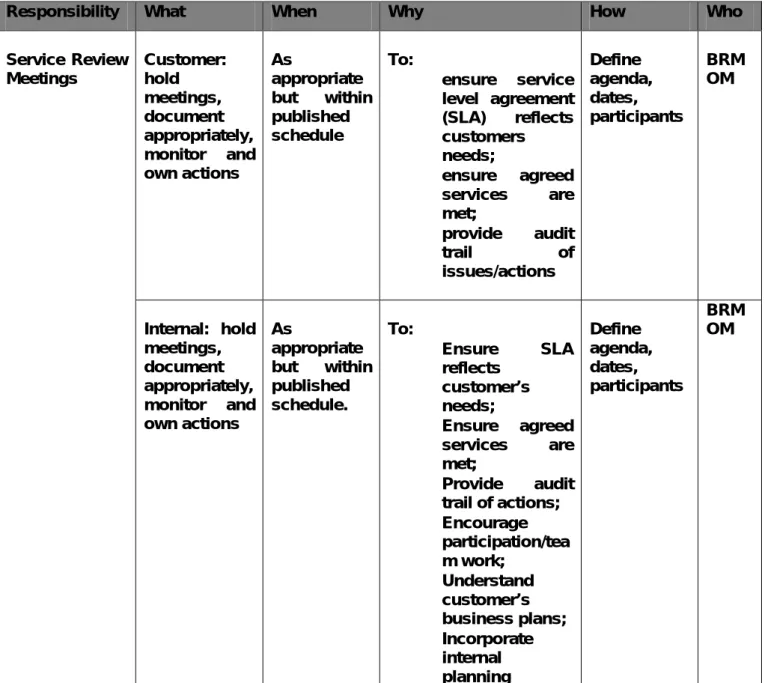
- Table 2: Service Review Meetings
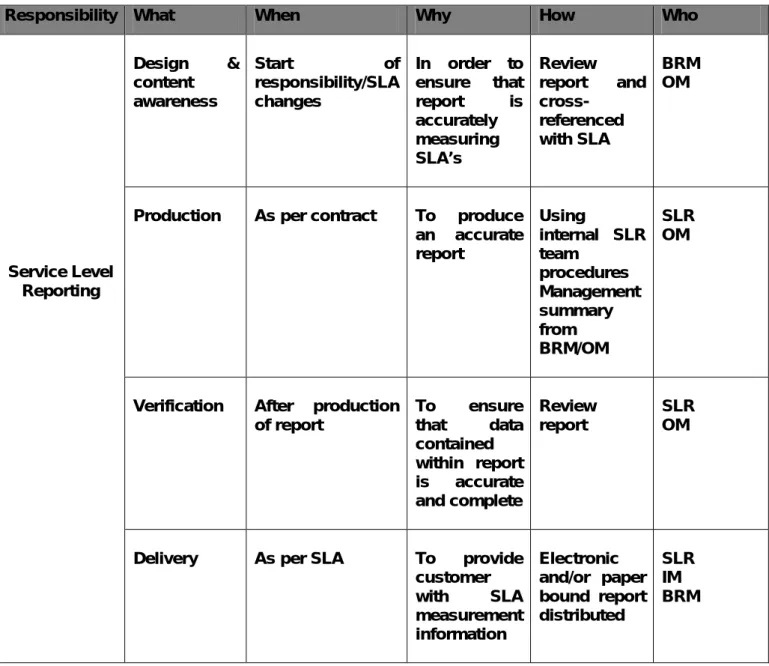
- Table 3: Service Level Reporting
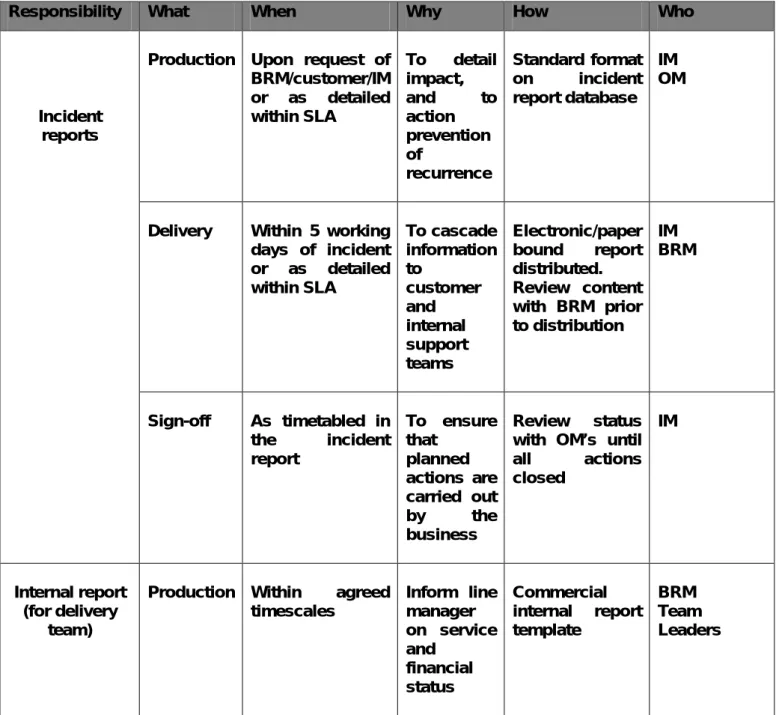
- Table 4: Incident and Internal Reports
- RACI Matrices
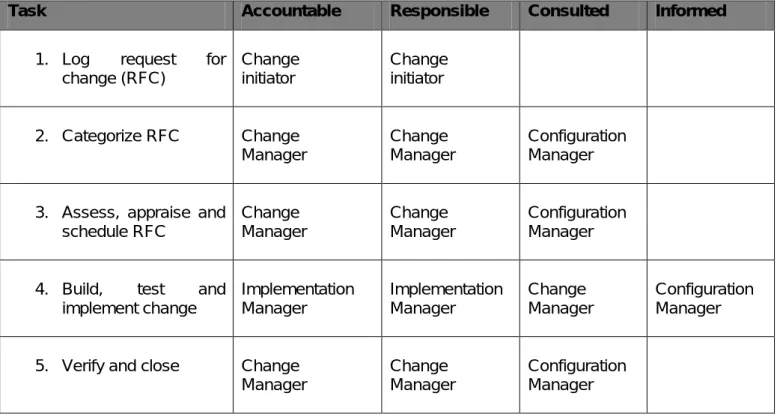
- Table 5: ARCI Matrix Example (Level 1)
- Table 6: ARCI Matrix Example (Level 2)
When?..explains when a particular process/procedure should be followed Why?..explains why the practice exists and how it was developed. How?..explains how the practice is achieved. Documenting roles and responsibilities in this way reduces some of the ambiguity that can arise from a text-only description. A lower level of detail may be useful for each of the tasks shown in the matrix in Table 5.