The Politics of History: Indonesian High School Textbooks during the New
Order period (1966-1998)
Abstract
This study traced historical footprints of national identity discourses production through high school history textbooks. The main question is, what did the New Order's politics look like to the national history of Indonesia? The method used was qualitative research that focused on analyzing the content of history textbooks. This research examined nine history textbooks from three national curriculums. Critical Discourse Analysis (CDA) is used to analyze the content of the textbooks. The results show that New Order was discoursing Indonesian national identity as a nation that runs a modern and militaristic society. The discourse of modernity presents Western culture as the only source of Indonesian progression. As a result, national history exclusively narrates many of the Dutch colonial policies as a determinant factor for the development of the Indonesian people. In contrast, history textbooks negated indigenous culture as traditional that is inappropriate for modern life. On the other hand, militaristic discourse exposing the army's success in defending Indonesian independence. Instead, civil government and diplomatic negotiation were negated as the loser.
Keywords: history textbook, New Order, national identity, modernism, militarism
La política de la historia: libros de texto de la escuela secundaria de Indonesia durante el período del Nuevo
Orden (1967-1998)
Resumen
Este estudio trazó huellas históricas de la producción de discursos de identidad nacional a través de los libros de texto de historia de la escuela secundaria. La pregunta principal es, ¿cómo se ve la política del Nuevo Orden en la historia nacional de Indonesia? El método utilizado fue la investigación cualitativa que se centró en analizar el contenido de los libros de texto de historia. Esta investigación examina nueve libros de texto de historia de cuatro planes de estudios nacionales. El Análisis Crítico del Discurso (CDA) se utiliza para analizar el contenido de los libros de texto. Los resultados muestran que New Order estaba disertando sobre la identidad nacional de Indonesia como una nación que dirige una sociedad moderna y militarista. El discurso de la modernidad presenta a la cultura occidental como la única fuente de progresión de Indonesia. Como resultado, la historia nacional narra exclusivamente muchas de las políticas coloniales holandesas como un factor determinante para el desarrollo del pueblo indonesio. Por el contrario, los libros de texto de historia rechazan la cultura indígena como tradicional que es inapropiada para la vida moderna. Por otro lado, el discurso militarista que expone el éxito del ejército en la defensa de la independencia de Indonesia.
En cambio, el gobierno civil y las negociaciones diplomáticas fueron negativas como perdedoras.
_____________________________________________________________
2021 Hipatia Press ISSN: 2014-3567
DOI: 10.1783/hse.2020.XXX
Palabras clave: libro de texto de historia, nuevo orden, identidad nacional, modernismo, militarismo
Introduction
New Order is the name of a regime in Indonesian politics led by General Suharto as President. The New Order policies constituted a fundamental change in Indonesia, and it is contrary to the policy of the previous Indonesian government under President Soekarno (1945-1965). Under the administration of President Sukarno, Indonesia was known as an anti-Western country (Budianta, 2007). Indonesia at that time was well known in Asia and Africa as the leader of the ex-colonial countries resisting Western pressure during the Cold War (Gerges, 2013). When the discourse developed in Indonesia, Western was viewed as countries that pursued neocolonialism (Nkrumah, 1965).
On the other hand, President Soeharto decided to take part in the Western block. The decision was shown up through eliminating leftist movements and developing close international relationships with western countries. The elimination was implemented in a decree of MPR (Majelis Permusyawaratan Rakyat/the People's Consultative Assembly) that banned PKI (Partai Komunis Indonesia/Indonesian Communist Party) and prohibited the spreading of Communism, Marxism-Leninism, and Socialism (McGregor et al., 2018;
Melvin, 2018). The change of international relations with western countries is represented through the opening investment of multinational corporations and the establishment of IGGI (the Inter-Governmental Group on Indonesia) in 1967 (Posthumus, 1972).
The New Order governed from 1966 to 1998. There are at least two prominent characteristics of the New Order period, i.e., militarism (Bhakti, 2001) and modernism (Wie, 2002). New Order was the military regime led by the army's general President Suharto. During his reign, the New Order used military leaders to occupy strategic positions in the civilian bureaucracy, such as the interior minister, governors, and regents. To legitimize the entry of the military into the civilian sphere, the New Order assumed that the military has two functions, called the military and socio-political forces. The assumption was widely known as the dual function of the army. The army's involvement
2021 Hipatia Press ISSN: 2014-3567
DOI: 10.1783/hse.2020.XXX
in the civilian bureaucracy led to authoritarianism and the concentration of political power in the military. Various aspects of civilian life were tightly controlled by the government, such as the press, political parties, and even artistic disciplines (Hill, 2006).
The second character of the New Order is modernism (Dhakidae, 2003).
Briefly, modernism can be understood as a belief that all nations would develop into a modern industrial society in a sense as in Europe and North American countries. New Order formed a partnership with Western countries as guides, loan providers, and investors in Indonesian development programs (Hüsken et al., 1997).
The consequence of the ideological shift of the New Order was a rearrangement in Indonesian national identity. The step was critical because national identity is the central pillar in supporting the existence of a nation.
Borrowing an analogy from Kartodirdjo (2005), a nation will not recognize itself from the other nations without a national identity, so there will be a constant miscommunication. From a historical perspective, national identity has two main components, the sameness of fate or “a historical result brought about by a series of phenomena converging in the same direction” and the desire to unite (Renan, 1882).
The importance of the role of history in building a national identity makes New Order take great care in writing the National History of Indonesia. In 1970, the government-held Second National Seminar on History. In contrast to the atmosphere of the First National History Seminar in 1957, which was characterized by a heated debate between the ministers of education and intellectual figures like Soedjatmoko, the second seminars were much colder.
Moreover, the committee could draft the national history books without much trouble and successfully published them in 1975 (Ali, 2005).
National History of Indonesia became the primary source of high school history textbooks. In the same year, high school textbooks of history were published and became compulsory textbooks for high school students. When the national curriculum was refurbished in 1984, the substance of the subject
matter of history had not changed much. In 1994, the history curriculum changed, especially in putting together national history and world history.
Nevertheless, national historical materials are essentially the same as before.
Methodology
The main question of this study is: what did the New Order's politics look like to the national history of Indonesia? This research examines nine textbooks published and used in learning processes throughout the implementation of the three national curriculums, 1975, 1984, and 1994. The focus of the study is directed on subject matters that discuss national movement and independence revolution because the two topics were explored in a relatively prominent way by authors of national identity discourse production.
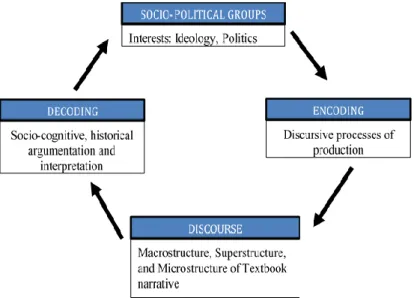
This study is qualitative research. High school history textbooks were viewed as historical documents containing "the expression of past subjective human about their lives as manifested through text or writing" and, in particular, the production and reproduction of discourse (Wodak & Meyer, 2006). However, the textbooks can also be viewed as an ideological weapon of dominant groups to subjugate and hegemon people. By viewing explanation on school textbooks as "the subjective expression" of the dominant group who has power and interests, text analysis becomes possible to not only stop in grammatical meaning, but it could be more profound, i.e., contextual meaning in order to understand assumption, ideology, and messages that are discussed and presented in the textbooks and deliver to students as the audience (Crawford, 2001). Assumptions, ideology, and discourse message comes in various forms, such as terms, sentences or phrases.
Discourse analysis is done by reviewing the content of textbooks with a focus on the superior terms, either in the form of words, sentences, or phrases.
The superior terms are "not only the object of a particular knowledge, but also the object of a vision" (Spivak, 1977), so it could be understood as a marker
2021 Hipatia Press ISSN: 2014-3567
DOI: 10.1783/hse.2020.XXX
of the presence of interest groups (Derrida, 1997). In other words, the superior terms function is to describe the interest groups (self). Conversely, the study was also conducted on the inferior terms as the binary opposition of the superior terms. For the opposition, the terms inferior contextually are used to negate the other parties (others). Negation can be an expression of blaming, villainizing, and sacrificing other groups who are not in the same way with the interests of the ruling group.
Discourses on Indonesian History Textbooks
The West as a determinant
Generally speaking, all high school history textbooks from 1975 to 1998 outline the background of the emergence and development of the Indonesian national movement. In the 1975 curriculum, textbooks are written by Widyosiswoyo (1979), and Idris & Tugiyono (1979) describe a brief background of the Indonesian national movement in pointers. Most of the narrations describe the development of national movement organizations.
Only Notosusanto and Basri's textbook (1981) discusses the background and development of the national movement in depth. In the 1984 curriculum, Notosusanto and Basri's textbook (1981, 1992) became the primary reference for almost all history textbooks published later. Moreover, Moedjanto’s textbook (1992) has chapters and sub-chapters headings precisely like Notosusanto’s textbook.
On the Notosusanto & Basri (1981) and textbooks published after that, the background of the national movement is described in a separate chapter with depth explanation. Most explanations present various Dutch colonial government policies that are viewed as the background of the birth of the Indonesian national movement. In explaining the economics aspect, the textbook narrates the spreading of Dutch plantation companies into many Indonesian villages. The phenomenon is called the penetration of Western
economy into Indonesian rural areas and interpreted that the emergence of large plantations caused farmland and irrigation to expand, and in line with the increased ways of farming (Notosusanto & Basri, 1981). Western economic penetration is also described positively as the cause of the differentiation of jobs, expansion of money, and migration.
In the education aspect, history textbooks bring up a new topic called Ethical Politics or Politics of Retaliation as a significant factor for the spread of western education in Indonesia and national consciousness. The previous textbook did not discuss Ethical Politics at all (Pane, 1956). Moreover, Moedjanto (1992) analogizes the Ethical Policy was "digging his own grave"
of the Dutch colonial government. Because the consequence of the policy is that western education spread out in many Indonesian cities, and indigenous students have broadened insights. Moedjanto’s analogy explains that the development of students’ insight is an inevitable result of the expansion of Western education in Indonesia. The textbook also explained in the positive sense that Western education has also spawned vertical and horizontal mobility of indigenous people, integrating many ethnic groups, and it is culminating in the born of national consciousness.
From the explanation done, textbooks for 1975's and 1984's national curriculum put the Dutch colonial government as the main actor or protagonist in the history of Indonesia. Instead, Indonesian indigenous people would only serve as a secondary actor or even as an object. In 1994’s national curriculum, there is a subject matter change because of the fusion of national history and world history. Nevertheless, the viewpoint used in the narration of the national movement remains relatively the same as before. The 1994 textbook’s curriculum still put Western powers as a determinant factor of the historical dynamics of Indonesian society. The decisive difference is that textbooks for 1994’s curriculum have a new chapter titled "New Ideologies that affect the movement of Asia, Africa and Indonesia's struggle for independence." The new chapter strengthens the discourse of Western dominance in the repertoire of Indonesian history. It explains the birth and development of new ideologies
2021 Hipatia Press ISSN: 2014-3567
DOI: 10.1783/hse.2020.XXX
in Europe, such as nationalism, liberalism, socialism, and democracy (Badrika, 1997; Waridah et al., 2000).
The discourses that view Western culture as determinant, narrated in the textbooks, make Indonesian historiography fail to implement the idea of Indonesia-centrism proposed by Sartono Kartodirdjo (Kartodirdjo, 1982).
Purwanto (2006) criticizes Indonesian historiography as stuck on a deterministic view. The criticism can also be used for history textbooks narrative because it also puts the West as the only driving force of the birth and growth of Indonesian nationalism. From this perspective, the deterministic explanation makes more sense when it is regarded as intentional rather than stuck, as considered by Purwanto (2006).
By placing the deterministic explanation as intentional, analysis of national identity discourse becomes possible. Borrowing Ali's categorization (Ali, 2005), the placement of the West as the determinant force for the born of the national movement is a foreign-center history (Xenocentrism). Like Ali, Sutherland (2008) called historians who put the West power as the determinant factor called Modern Professional Historians (MPH).
Characteristics of historical explanation of MPH is "to show history as progress that is culminating in the triumph of modernity of nation-state, which is a way of thinking or way of life of the West" and teleological explanation that is culminating in the birth of a society which Francis Fukuyama calls as free-market democracy (Sutherland, 2008). In other words, the construction of Indonesian national identity, which is delivered through history textbooks, is that Indonesia is a nation which "adopted Western culture." From this point of view, giving the critical role of the West as a determinant power in the historical phenomenon of Indonesian nationalism is a representation of Indonesian modernist historians' discourse that national identity today is done by copying and following Western modernity as an ideal type.
Modernistic views are visible when they give a vital role to intellectuals who studied Western education systems as pioneers of the national movement because they are "the group absorbing a most Western way of thinking and
acting." It was explained that the intelligentsia is a social group in Indonesian society which is described as educated, who work according to their expertise, have a broad overview, sensitivity enforces modern organizations with national consciousness, and promote the importance of unity. Therefore, the movement encompasses national wide, so this group was also called as national elite (Moedjanto et al., 1992; Notosusanto & Basri, 1981).
Besides showing groups who are already experiencing Westernization, the narration of the history textbook was also trying to negate those who still hold indigenous mindset and lifestyle considering them regionalist, traditional, or whose jobs were inherited. Moreover, Moedjanto's textbooks stamps this group as ''architect of people's misery" (Moedjanto et al., 1992).
Posing Indonesian and Western cultures in binary opposition is not a new insight because the history textbook in the colonial era written by Eykman and Stapel has already voiced it in 1941. The textbook explains that "the powers of Nederland (in Indonesia) mainly benefit the indigenous people. They were treated arbitrarily by regional leaders (kings). However, now the Netherlands Government guarantees safety and considers people's interest" (quote in Ali, 2005).
Similar to the views that highlight modernity as a way of thinking and living like the West, the narration of textbooks also heroificating the Association of Indonesia (PI/Perhimpunan Indonesia), an organization of Indonesian students in the Netherlands, as the essential national movement organization formatting Indonesian independence. The textbooks describe the prominent role of PI as an arranger of political manifesto in 1925, whose contents change PI into a political organization. The manifesto consists of four foundations of movement: national unity, solidarity, non-cooperative, and self-help (Badrika, 1997). The position of PI's manifesto is viewed as very important because it gives direction to national movements in Indonesia and the foundation of the independent Indonesian state. According to Sartono Kartodirdjo, the manifesto's position is more important than the Youth Pledge in 1928 (Adam, 2009).
2021 Hipatia Press ISSN: 2014-3567
DOI: 10.1783/hse.2020.XXX
Besides producing discourse that PI's political manifesto is essential, history textbooks are also trying to convey that members of PI have a prominent role at praxis, especially in directing the Indonesian national movement. The textbook explains that "the PI believes that the most crucial part of their job was to hold nationalist propaganda in Indonesia. In June 1925, the PI commissioned Budiarto, Sartono and Arnold Monomutu to prepare and disseminate propaganda PI in the Netherlands and Indonesia" (Badrika, 1997).
Historically the construction of national identity in textbooks can be traced from the study of Western historians widely referred to by Indonesian historians, including the author of school textbooks. One of the Western historians' writing is the work of Robert van Niel, The Emergence of the Modern Indonesian Elite, published in 1960. The book was translated into the Indonesian language in 1984. The Niel thesis is that all modern Indonesian elite are the result of Western education or have adopted Western culture.
They are described as "the most Westernized in education and teaching and their conception of state and society"(Niel, 2009). Therefore, the colonial government's policy that triggered the emergence of the modern Indonesian elite is a logical consequence of the position taken. Furthermore, Achmad and Hossein Djajadiningrat, two sons of the regent of Serang, Djajawinata, whom Christiaan Snouck Hurgronje adopts, became icons of successful westernization projects for indigenous Indonesian youth (Niel, 2009).
To prove his thesis, Niel attempts to westernize all historical phenomena associated with the emergence and development of Indonesian nationalism.
One of them is establishing the Islamic Trade Association, which is incidentally spirited by Islamic religion (not the West). Niel tries to westernize the historical phenomenon by inserting a figure, Raden Mas Tirtoadisuryo, who studied at the school of administrators (OSVIA) as the architect of some organizations, such Islamic Trade Association (Ricklefs, 2001). From this viewpoint, Niel's thesis, that all modern Indonesian elites are the result of a project of Westernization, could be defended. The same pattern is made in
various movements based on Islam, including the Muhammadiyah (Niel, 2009).
This kind of discourse was also produced by Indonesian historians. One of them is Sartono Kartodirdjo. When discussing ethical politics as the central pillar of the Westernization program, he explained that "the next of colonial task is a cultural mission which is characterized by moral and politics for profit" has been abandoned. The ideal aspiration is "entering Indonesian people into the orbit of its ruler culture so that they have a Western culture"
(Kartodirdjo, 1992).
The result of the ethical policy is a political formation of intellectuals who have a western way of thinking and life. They were very impressed by the "level of progress that has been achieved in the West" and "become aspirations to hold invasion or modernization with a Western model in general and the Dutch in particular" (Kartodirdjo, 1992). In addition, to accentuate the process of Westernization, the author negates the original culture as unworthy and deserves to be abandoned. Negation is done by giving an explanation that
"In facing social change caused by the penetration of the colonial system on the one hand, and the openness of indigenous communities to influences from the outside, on the other hand, the traditional system inevitably cracks and becomes a crisis."
The deterministic view of history makes the explanation far from objective reality (Purwanto, 2006) because it puts the historical phenomenon in Indonesia solely as a manifestation of Western culture that the agents of history absorb. The inability to find the objective reality is most visible when historians are discoursing Indonesian intellectuals due to Western education and put it as the only group that leads the national movement and establishes the nation-state. The discourse covers various historical phenomena of the Indonesian national movement, for example, the Islamic Trade Association, Jamiat Khier, and Societies of Minahasa, where their founders went beyond Westernization, following Western education. Explanation of Robert van Niel that Islamic Trade Association composed by Tirtoadisuryo cannot hide the
2021 Hipatia Press ISSN: 2014-3567
DOI: 10.1783/hse.2020.XXX
reality that the life of its founder is outside the circle of Westernization, including his thoughts.
Another historical phenomenon that the modernist view cannot contain is Cultural Polemics that occurred in 1935. Starting from the Consultative Congress of Indonesia Education debate in Solo (Central Java), spread out to be a polemic in newspapers. The polemic was about Indonesian culture in the future. Only Sutan Alisjahbana argued that Indonesia should adopt the spirit of Western culture. He was against almost all Indonesian movement activists who believed that Indonesia should maintain and develop its own culture (Kartamihardja, 1977). Therefore, the historical phenomenon contradicts the view of modernist historians, so none of the textbooks narrate the cultural polemics. In other words, the polemics were scuttled or deemed as an unimportant historical event to be written.
Putting the West in general and the Dutch colonial government in particular as the determinant force, make no single textbook trying to dig the indigenous culture as habitus for the birth of Indonesian nationalism. Local structures such as socio-cultural conditions were the perpetrators of the history of the national movement born and raised, ignoring it as an essential element in the reconstruction of Indonesian nationalism history. Consequently, the historical explanation could not establish a "linguistic connection"
(Andersons, 1991) between high school students and the Indonesian national movement activists. The narration of school textbooks cannot be a suitable medium for high school students to understand the Indonesian national movement actors' thoughts, feelings, and dreams. The emergence and development of nationalism are not regarded as representing Indonesian historical actors with their mental construction but as an unexpected result of Western innovations. Putting the West as a determinant factor makes Indonesia's history narration "a history without people" because people feel that the narration is not about them. On the extreme side, the term 'history' became a synonym of “not us” (Nordholt, 2004).
As history school textbooks, deterministic narrations displayed will powerfully deliver messages to high school students that the West has various advantages which are absorbed by Indonesian national movement actors and lead to the progress of Indonesia. From this viewpoint, it is not a shock if Indonesian youth has no emotional bonding to their own country. A newspaper reportage shows that Indonesian youths have little sense of nationhood. Being Indonesian means nothing more than a "geographical fact"
-- because they were born and raised in the country: nothing more, nothing less" (Wulandari, 2002).
Following the view of Heidegger, the nationalism crisis in Indonesian youth is closely related to how students read the history textbook. The high school students interpret the text not only of an intended message delivered by the author. They interpret history textbooks with the enclosed interests in developing their potential to achieve their dreams by themselves (Heidegger, 1996). From this perspective, national movements topics discussed in those history textbooks give lessons to the students that they will make their dream come true when they become culturally Westernized.
The army as the protagonist
From the beginning, Indonesia is established as a democratic country. It means that area of politics is only for civilians, and it is closed for the military.
From this viewpoint, the role of General Suharto as president in 1967 was a political deviation or unconstitutional. In order to legitimize his power, General Soeharto and his New Order regime used history as “an ideological weapon with which to double the oppression of already vanquished groups by depriving them of their historical pasts and consequently of their identities as well" (White, 2008). One of the historical events explored by the New Order to legitimize its political position is the independence revolution period (1945- 1950).
On the topic of the independence revolution, all textbooks have a similar pattern of narration. The difference between one textbook from another is only in diction and data to support the explanation. The most popular
2021 Hipatia Press ISSN: 2014-3567
DOI: 10.1783/hse.2020.XXX
characteristics are extraordinary attention to militaristic events, such as the seizure of weapons and war. As a result, among the various historical events during the Indonesian independence revolution, most prominently discussed is a physical conflict between Indonesia with foreign nations, especially Japan, the Allied (UK), and the Netherlands. Prioritization of physical conflict can be seen in its chapter headings, i.e., "The War of Independence"(Moedjanto et al., 1992, p. 91; Notosusanto & Basri, 1981, p.
97; Widyosiswoyo, 1979, p. 192). With the title "War of Independence," the author intended to deliver the message that the period is colorizing by significant conflict in the struggle for defending independence shaped by physical conflict or war.
Protrusion of the physical conflict is also presented in the content of history textbooks. In narrating the conflict, Indonesia is described as in the proper position but suffers from the greed of foreign nations. To support the correctness of the position of Indonesia, Idris (1979, pp. 65-66) using the Charter of San Francisco 26 June 1945 and the establishment of the UN Charter, which stated that every nation has the same right to self- determination. On the other hand, the Japanese, Allies, and Dutch described antagonist nations that defend their interest without even considering other nations' interests (Soewarso, 1986).
The physical conflict protrusion on history textbooks occurs, especially when discussing the presence of Allied forces in Indonesia. All textbooks were discussed at length about the militaristic actions that occurred during the period of revolution. It is even claimed that "an armed clash occurred in Indonesia" (Notosusanto & Basri, 1981, p. 105). The reasons for war compiled by history textbooks are that "the government and people of Indonesia accept the arrival of Allied troops with a note that they would not let Dutch colonial rule back. However, when it is known that they let themselves hitchhiked by the Dutch who intend to restore the colonial government, the Indonesian people are forced to make resistance. The resistance happened when they armed Dutch soldiers whom Allied Forces freed from Japanese captivity. The
battle of the Indonesian people against the Allied forces spread out at various places. One of the most famous Indonesian wars is the battle of Surabaya (Andersons, 1972). McGregor (2008, p. 120) points out the importance of the Surabaya battle as the heaviest of any Republican offensives, including those against the Dutch, and represented the climax of attack upon allied British soldiers: by both Republican soldiers and other Pemuda. The heroic battle is commemorated as Hero Day and celebrated every 10 November.
The narration of physical conflict in war is always accompanied by the emergence of figures depicted as heroes. One of the figures who is certificated by textbooks is Sudirman. He is described as a leader who provided grip and inner strength to the people and the soldiers who fought vigorously for the country's survival (Notosusanto & Basri, 1992). Certification is also conducted to Lieutenant Colonel Soeharto, who became President of the Republic of Indonesia in 1966-1998. Soeharto, who served as Commander of Wehrkreise III, is described as a hero, especially in a historical event known as the General Offensive on 1 March 1949. It is said that Suharto was an actor who "launched the General Offensive at daylight" and "lead his battle on the morning, dated l March 1949, by carrying on his shoulder an automatic rifle Owen gun MK 143" (Waridah et al., 2000).
To further highlight the role of physical struggle, textbooks distort and negate non-physical historical events, such as diplomacy. Distortion and negation could be found in the narration of Notosusanto's textbook (1992).
When describing the Linggarjati Agreement, the textbook describes the agreement as "a tool to allow them (the Dutch) to bring more troops from their country. Once they felt strong enough, they switched into their original intent, which was destroying the Republic of Indonesia by the force of arms". The statement denying the historical reality shows that since the Dutch signed the Linggarjati Agreement, formally recognizing the independence of Indonesia.
After the agreement was signed, many countries followed the Dutch and admitted the existence of Indonesia as an independent state (Idris & Tugiyono, 1979). In addition, besides Indonesia earned international recognition, Linggarjati Agreement also allowed the United Nations to get involved in
2021 Hipatia Press ISSN: 2014-3567
DOI: 10.1783/hse.2020.XXX
trying to resolve the conflict between Indonesia and the Dutch. In other words, the Dutch recognition of the existence of the Republic of Indonesia through Linggarjati is a prerequisite for the involvement of the United Nations. From this viewpoint, the recognition of Indonesian independence as the primary purpose of the struggle waged by national leaders becomes more understandable, while understanding that the result of the Linggarjati Agreement is an outstanding achievement that carved during Sjahrir as Prime Minister.
Distortion and negation also occurred when the textbooks describe Renville negotiations. Moedjanto (1992) illustrates that the Indonesian government is under "insistence of Committee of Good Offices (CGO)," so willing to sign the Renville Agreement although "very favorable to the Dutch"
and "extremely harmful for Republic Indonesia." Even with a very firm author states that the Renville Agreement "represents the biggest defeat of Indonesian diplomatic effort on an agreement."
Judgment as the "biggest defeat of an agreement" is more an attempt to negate the decision of Indonesian diplomats than an academic exploration to find and convey the truth. In diplomacy, the decision of the Indonesian delegation could be seen as a form of granting concessions to the Dutch to achieve a final political settlement immediately. As a result of the concession, since the Renville Agreement was signed, international powers pressured the Dutch to reach an established settlement immediately. Van Beel, a member of CGO, declared that Indonesia has already provided 10% of Dutch craving.
Therefore, the Netherlands must immediately take a more rational attitude (Agung, 1983).
Patterns of narration that highlight the military effort and heroification to relevant figures and distortion and negation of civil roles conducted by history textbooks do not walk alone. That pattern is part of a significant "movement"
that the New Order government sponsors. One of the crucial milestones of the movement is the Army Seminar 1972, where the results were, among other things, the military instructed to circulate the military version of the history of
Indonesian society in general. Spreading is done through writing memoirs, making movies, building museums, monuments, and writing history textbooks. The target of the deployment is mainly directed to the young generations so that they appreciate the Generation of 1945 (McGregor, 2008).
From this standpoint, it can be understood that high school history textbooks from the curriculum in 1975 have already become one of the media in infusing values of the spirit of 1945. Among other things, the values of 1945's spirit are willing to sacrifice, unity and integrity, cooperation, mutual respect, and love to the homeland (Badrika, 1997).
The movement of promoting the military role in history does not stop by compiling history textbooks that suit the tastes of rulers. In the 1984 curriculum, the government gave rise to a new school subject, known as the Historical Education of National Struggle (Pendidikan Sejarah Perjuangan Bangsa/PSPB). PSPB focuses on the physical struggle in a long Indonesian history. The difference with history is that the physical struggle on PSPB has a broader historical period, starting from Cultivation Era to the New Order.
For the period of the revolution, the contents of both are relatively the same.
However, regarding the style of language and historical interpretation, PSPB textbooks look more provocative, so Darmiasti (2002) concludes that the PSPB are ideological textbooks.
The dominance of militaristic stories would indirectly explain to the students that the representation of the best national identity uses physical force to fight for the truth. The rise of physical struggle, either in demonstrations, fights, and terror, could not be released from their understanding of his nation's past. Militaristic discourse produced by history textbooks will develop the character of the Indonesian younger generation that glorified violence as a way to get the truth. They will not be interested in finding the truth through critical discourse discussion, such as examining the rational and moral foundation of truth (McCarthy, 2009).
Conclusion
2021 Hipatia Press ISSN: 2014-3567
DOI: 10.1783/hse.2020.XXX
From the historical retracement that has been done in the content of history textbooks can be concluded that in New Order’s national identity discourse, Indonesia was imagined to become a modern nation similar to Western standards. The discourse was narrated on high school history textbooks by putting colonizers (West) as the determinant in doing various innovations in Indonesia. In contrast, the Indonesian people were placed as an object of Westernization. From this perspective, the development of the Indonesian national movement is narrated as a result of Western education, initiated by the Dutch colonialists through Ethical Policy.
New Order also produces a national identity that puts the military, especially the army, as a group that contributed to Indonesian independence.
The discourse was narrating the military in the fight against the Dutch who wanted to re-colonize Indonesia. From this perspective, through history textbooks, the New Order wanted to deliver the message that Indonesia's independence can be defended only because of military sacrifice. Therefore, from the discourse viewpoint, it is proper that New Order is considered a representation of Indonesia's military ruling from 1966 to 1998.
List of textbooks quoted
Gregorius Moedjanto, Nani Sunarti, Chr. Kristanto Dh., Anton Haryono, and A.A. Padi, Sejarah Nasional Indonesia untuk SMA [National history of Indonesia for high school], vol. 3 (Yogyakarta: Gramedia Widiasarana, 1992).
I Wayan Badrika, Sejarah Nasional Indonesia dan Umum untuk SMA [National history of Indonesia and the world for high school], vol. 2 (Jakarta: Erlangga, 1997).
Ibnoe Soewarso, Sejarah Nasional Indonesia dan Dunia [The National History of Indonesia and The world] (Vol. 3). (Surakarta: Widya Duta, 1986).
Nugroho Notosusanto and Yusmar Basri, eds., Sejarah Nasional Indonesia Untuk SMA [The national history of Indonesia for high school],
vol. 3 (official textbook) (Jakarta: Departemen Pendidikan dan Kebudayaan, 1981).
Nugroho Notosusanto and Yusmar Basri, eds., Sejarah Nasional Indonesia Untuk SMA [The national history of Indonesia for high school], vol. 3 (official textbook) (Jakarta: Departemen Pendidikan dan Kebudayaan, 1992).
Sardiman A.M. and Kusriyantinah, Sejarah Nasional dan Umum untuk SMA [National history of Indonesia and the world] (Surabaya: Kendang Sari, 1996).
Siti Waridah Q., Sukardi and Sunarto, Sejarah Nasional dan Umum untuk SMA (National history of Indonesia and the world), vol. 2 (Jakarta:
Bumi Aksara, 2000).
Supartono Widyosiswoyo Sejarah Untuk SMA [History for High School] (Vol. 1). (Klaten: Intan, 1979).
Z.H. Idris & Tugiyono, Sejarah Untuk SMA [History for High School].
(Jakarta: Mutiara, 1979).
Reference
Adam, A. W. (2009). Membongkar Manipulasi Sejarah: Kontroversi Pelaku dan Peristiwa [Deconstructing Manipulation of History: Controversy of Actors and Events]. Kompas.
Agung, A. A. G. (1983). Renville. Sinar Harapan.
Ali, R. M. (2005). Pengantar Ilmu Sejarah Indonesia [Introduction to History of Indonesia]. LKiS.
Andersons, B. R. O. G. (1972). Java in a time of revolution: Occupation and Resistance, 1944 - 1946 Cornell University Press.
Andersons, B. R. O. G. (1991). Imagined Communities: Reflection on the Origin and Spread of Nationalism. Verso.
2021 Hipatia Press ISSN: 2014-3567
DOI: 10.1783/hse.2020.XXX
Badrika, I. W. (1997). Sejarah Nasional Indonesia dan Umum untuk SMA [National history of Indonesia and the World for High School] (Vol.
2). Erlangga.
Bhakti, I. N. (2001). Militer dan Politik Kekerasan Orde Baru : Soeharto Di Belakang Peristiwa 27 Juli? [Military and Political Violence New Order: Suharto Behind the 27 July Incident?]. Mizan.
Budianta, M. (2007). Discourse of cultural identity in Indonesia during the 1997-1998 monetary crisis. In C. Kuan-Hsing & C. B. Huat (Eds.), The Inter-Asia Cultural Studies Reader (Vol. 1). Routledge.
https://doi.org/https://doi.org/10.4324/9780203960981
Crawford, K. (2001). Constructing National Memory: The 1940/41 Blitz in British History Textbooks. Internationale Schulbuchforschung, 23, 323-338.
Darmiasti. (2002). Penulisan Buku-Buku Teks Pelajaran Sejarah Untuk Sekolah Menengah Atas 1964-1984: Sejarah Demi Kekuasaan
Universitas Indonesia]. Jakarta.
http://www.lontar.ui.ac.id/opac/themes/libri2/detail.jsp?id=71077&l okasi=lokal
Derrida, J. (1997). Of Grammatology (G. C. Spivak, Trans.). The Johns Hopkins University Press.
Dhakidae, D. (2003). Cendekiawan Dan Kekuasaan Dalam Negara Orde Baru [Scholars and State Power in the New Order]. Jakarta:
Gramedia Pustaka Utama.
Gerges, F. A. (2013). The New Middle East: Protest and Revolution in the Arab World. Cambridge University Press.
Heidegger, M. (1996). Being and Time (J. Stambaugh, Trans.). SUNY.
Hill, D. T. (2006). The Press in New Order Indonesia. Equinox Publishing.
Hüsken, F., Rutten, M. a., & Dirkse, J.-P. (1997). Indonesia Di Bawah Orde Baru: Pembangunan Dan Kesejahteraan Sosial [Indonesia's Experiences Under The New Order: Development And Social Welfare]. Gramedia Widiasarana Indonesia.
Idris, Z. H., & Tugiyono. (1979). Sejarah Untuk SMA [History for High School]. Mutiara.
Kartamihardja, A. (1977). Polemik Kebudayaan [Cultural Polemics]. Pustaka Jaya.
Kartodirdjo, S. (1982). Pemikiran dan Perkembangan Historiografi Indonesia: Suatu Alternatif [The Thought and Development of Indonesian Historiography: An Alternative]. Gramedia.
Kartodirdjo, S. (1992). Pendekatan Ilmu Sosial dalam Metodologi Sejarah [Social sciences approach in Methodology of History]. Gramedia.
Kartodirdjo, S. (2005). Sejak Indische sampai Indonesia [From Indische to Indonesia]. Kompas.
McCarthy, T. (2009). Teori Kritis Jurgen Habermas [The Critical Theory of Jurgen Habermas] (Nurhadi, Trans.). Kreasi Wacana.
McGregor, K., Melvin, J., & Pohlman, A. (2018). The Indonesian Genocide of 1965: Causes, Dynamics and Legacies
McGregor, K. E. (2008). Ketika Sejarah Berseragam: Membongkar Ideologi Militer Dalam Menyusun Sejarah Indonesia [History in Uniform:
Military Ideology and The Construction of Indonesia’s Past] (D. Oka, Trans.). Syarikat Indonesia.
Melvin, J. (2018). The army and the Indonesian genocide: mechanics of mass murder. Routledge.
Moedjanto, G., Sunarti, N., Kristanto, C. D., Haryono, A. a., & Padi, A. A.
(1992). Sejarah Nasional Indonesia [National History of Indonesia for High School] (Vol. 2). Gramedia Widiasarana.
Niel, R. v. (2009). Munculnya Elite Modern Indonesia [The Emergence of the Indonesian Elite] (Z. D. Noer, Trans.). Pustaka Jaya.
Nkrumah, K. (1965). Neo-Colonialism, the Last Stage of Imperialism.
Thomas Nelson & Sons, Ltd.
Nordholt, H. S. (2004). De-colonising Indonesian Historiography the Centre for East and South-East Asian Studies public lecture series ‘Focus Asia’ Sweden.
2021 Hipatia Press ISSN: 2014-3567
DOI: 10.1783/hse.2020.XXX
Notosusanto, N., & Basri, Y. (Eds.). (1981). Sejarah Nasional Indonesia Untuk SMA [The National History of Indonesia for Secondary School] (Vol. 3). Departemen Pendidikan dan Kebudayaan.
Notosusanto, N., & Basri, Y. (Eds.). (1992). Sejarah Nasional Indonesia Untuk SMA [The National History of Indonesia for Secondary School] (Vol. 3). Departemen Pendidikan dan Kebudayaan.
Pane, S. (1956). Sedjarah Indonesia [History of the Indonesia] (Vol. 2).
Departemen Pemuda, Pendidikan dan Kebudayaan.
Posthumus, G. A. (1972). The Inter-Governmental Group on Indonesia (IGGI). University Press.
Purwanto, B. (2006). Gagalnya Historiografi Indonesia?! [The Failure of Indonesian Historiography?!]. Ombak.
Renan, E. (1882). What is A Nation? In S. Woolf (Ed.), Nationalism in Europe, 1815 to Present. Routledge. (Reprinted from 1996)
Ricklefs, M. C. (2001). A History of Modern Indonesia since c.1200 (Third ed.). Palgrave.
Soewarso, I. (1986). Sejarah Nasional Indonesia dan Dunia [The National History of Indonesia and The world] (Vol. 3). Widya Duta.
Spivak, G. C. (1977). Introduction. In J. Derrida (Ed.), Of Grammatology. The Johns Hopkins University Press.
Sutherland, H. (2008). Meneliti Sejarah Penulisan Sejarah [Study of Historiography]. In H. S. Nordholt, Bambang Purwanto and Ratna Saptari (Ed.), Perspektif Baru Penulisan Sejarah Indonesia [The New Perspectives in Writing the Indonesian History]. Yayasan Obor Indonesia.
Waridah, S. Q., Sukardi, a., & Sunarto. (2000). Sejarah Nasional Indonesia dan Umum untuk SMA [National history of Indonesia and the World for High School] (Vol. 2). Bumi Aksara.
White, H. (2008). The Historical Event. Differences: A Journal of Feminist Cultural Studies, 19(2), 9-34.
Widyosiswoyo, S. (1979). Sejarah Untuk SMA [History for High School]
(Vol. 1). Intan.
Wie, T. K. (2002). The Soeharto Era And After: Stability, Development, And Crisis, 1966–2000. In H. Dick, V. J. H. Houben, J. T. Lindblad, & T.
K. Wie (Eds.), The Emergence of A National Economy: An Economic History Of Indonesia, 1800–2000. Allen & Unwin.
Wodak, R. a., & Meyer, M. (Eds.). (2006). Methods of Critical Discourse Analysis. Sage Publications.
Wulandari, F. (2002, 16 August 2002). Indonesian Youths Have Little Sense
of Nationhood Jakarta Post.
http://www.thejakartapost.com/print/106294
Purwanta Hieronymus:
We have reached a decision regarding your submission to Social and Education History, "The Politics of History: Indonesian High School Textbooks during the New Order period (1966-1998)".
Our decision is to: Recommendation: Resubmit for Review
Reviewer’s Comments (to be sent to the author):
1. Precise presentation should be there
2. The study and few results may be presented in the tabular as well as a pictorial form for quick analysis and clarity.
Reviewer’s Comments (to be sent to the author):
The authors have provided a very good political and historical contextualization which is very helpful in understanding the research.
In the methodological section, we suggest reviewing the formal aspects, in fact, the authors do not quote which books have been analysed. Still in this section, in the analysis of results, we believe that authors should be more systematic with the analysis of data and the reading of results. We consider that it is not adequately clarified how the analysis of the text has been carried out following the CDA.
What type of coding was used, for example?
It seems, rather, a critical description of the textbooks analysed, but without giving the reader the keys that have led to this critical reading in most cases. In short, we believe that the method used needs to be more rigorous. It might be easier if the authors differentiated the results from the analysis of results. Especially in the section "the western as determinant" there are occasions when it is not clear which conclusions are derived from the research and which from the scientific
literature.
Finally, the section on conclusions lacks the pedagogical implications or social impact that the article may have. The CDA, following Habermas, would require a critical section engaging in critical
reflexivity. We suggest that the conclusions could be much more profound than those now presented by the authors.
Order designed happened in other countries that have also been studied.
https://mail.google.com/mail/u/0?ik=4c74231318&view=pt&search=all&permthid=thread-f%3A1711398041797481463&simpl=msg-f%3A17113980… 1/1
Dr. Hieronymus Purwanta, M.A. <[email protected]>
Submission Acknowledgement (ESSR00833)
1 message
IJESSR <[email protected]> Mon, Sep 20, 2021 at 12:38 PM To: [email protected]
Dear Author,
Hieronymus Purwanta
Thank you for submitting a manuscript to the International Journal of Education and Social Science Research. The submitted research paper has been sent to the reviewer panel.
Paper title: THE PRESENTATION QUALITY OF INDONESIAN HIGH SCHOOL HISTORY TEXTBOOKS DURING THE NEW ORDER ADMINISTRATIVE AND AFTER (1975-2008)
Paper ID: ESSR00833
Submission Date: 20/09/2021
We will get back to you after review within 5 to 7 days.
Thank you for considering this journal as a venue for your works.
If you received this Submission email, please reply RECEIVED for confirmation.
With Regards, Editor-in-Chief
IJESSR (International Journal of Education and Social Science Research) Website: www.ijessr.com
/01ÿ34506789:;ÿ<:0=>7?>@ÿA1B1ÿCDE:0=>7?>F;?>GG1:7;1>H14IJ
K6:0ÿ >0? 4 HL 5ÿ D>;ÿ M557ÿ E:ML 4 ;D5I
1ÿ "
N6H4>Lÿ>7IÿOI:H>?467ÿ34;?608ÿP3NOQÿRS! T U4ÿVÿ1'4ÿ1811ÿÿ007''ÿW X7ÿYZ!ÿ[\ ÿW*4ÿ!!YÿR*S++!!!T
Zÿ4
Uÿÿ ÿ*ÿ+\ÿÿ\ÿÿÿÿÿÿÿV\ÿÿ+ÿ[]!ÿUÿ"ÿ\ÿ
\ÿ*$ÿÿ$ÿ\ÿ+ÿ\ÿÿ*ÿ[]!
ÿÿÿÿÿÿÿ*7ÿ722! 2^2_!222*29&8 Uÿÿ\ÿÿ ÿ\ÿ!ÿ[]ÿ*ÿÿÿ ÿ ÿ!
`ÿ"4
WZ!ÿa ÿbcÿ)ÿWZ!ÿÿbdW ]ÿ+ÿÿÿ]ÿ[\ÿe[]f S!
722!!
/01ÿ34506789:;ÿ<:0=>7?>@ÿA1B1ÿR*S++!!!T X4ÿVÿ194ÿ1811ÿÿ379-ÿ X7ÿYÿÿ]ÿ[\ÿe[]fYÿRS! T
Zÿÿÿ]ÿ[\ÿ
X$ÿ\ÿ\ÿ ÿ+ÿ+ "ÿ !ÿ4ÿ*ÿ*ÿÿÿ$!
`ÿ*
[\ ÿW*
ghÿ_ÿi
Instructions for authors, subscriptions and further details:
http://hse.hipatiapress.com
The Politics of History: Indonesian High School Textbooks during the New Order period (1966-1998)
Hieronymus Purwanta1, Victor Novianto2
1) PSPP Universitas Sebelas Maret, Indonesia 2) Universitas PGRI Yogyakarta, Indonesia
Date of publication: online first
Edition period: February 2022-June 2022
To cite this article:Purwanta, H. & Novianto, V. (2022). The Politics of History: Indonesian High School Textbooks during the New Order period (1966-1998) Social and Education History, 11(1), 55-79.
http://doi.org/10.17583/hse.9606
To link this article: http://dx.doi.org/10.17583/hse.9606
PLEASE SCROLL DOWN FOR ARTICLE
The terms and conditions of use are related to the Open Journal System and to Creative Commons Attribution License(CCAL).
The Politics of History: Indonesian
High School Textbooks during the New Order period (1966-1998)
Hieronymus Purwanta Victor Novianto
PSPP Universitas Sebelas Maret Universitas PGRI Yogyakarta
Abstract
This study traced historical footprints of national identity discourses production through high school history textbooks. The main question is, what did the New Order's politics look like to the national history of Indonesia? The method used was qualitative research that focused on analyzing the content of history textbooks. This research examined nine history textbooks from three national curriculums. Critical Discourse Analysis (CDA) is used to analyze the content of the textbooks. The results show that New Order was discoursing Indonesian national identity as a nation that runs a modern and militaristic society. The discourse of modernity presents Western culture as the only source of Indonesian progression. As a result, national history exclusively narrates many of the Dutch colonial policies as a determinant factor for the development of the Indonesian people. In contrast, history textbooks negated indigenous culture as traditional that is inappropriate for modern life. On the other hand, militaristic discourse exposing the army's success in defending Indonesian independence. Instead, civil government and diplomatic negotiation were negated as the loser.
Keywords: history textbook, New Order, national identity, modernism, militarism
2022 Hipatia Press ISSN: 2014-3567 DOI: 10.1783/hse.9606
La Política de la Historia: Libros de Texto de la Escuela Secundaria de
Indonesia durante el Período del Nuevo Orden (1967-1998)
Hieronymus Purwanta Victor Novianto
Universitas Sebelas Maret Universitas PGRI Yogyakarta Resumen
Este estudio trazó huellas históricas de la producción de discursos de identidad nacional a través de los libros de texto de historia de la escuela secundaria. La pregunta principal es, ¿cómo se ve la política del Nuevo Orden en la historia nacional de Indonesia? El método utilizado fue la investigación cualitativa que se centró en analizar el contenido de los libros de texto de historia. Esta investigación examina nueve libros de texto de historia de cuatro planes de estudios nacionales. El Análisis Crítico del Discurso (CDA) se utiliza para analizar el contenido de los libros de texto.
Los resultados muestran que New Order estaba disertando sobre la identidad nacional de Indonesia como una nación que dirige una sociedad moderna y militarista. El discurso de la modernidad presenta a la cultura occidental como la única fuente de progresión de Indonesia. Como resultado, la historia nacional narra exclusivamente muchas de las políticas coloniales holandesas como un factor determinante para el desarrollo del pueblo indonesio. Por el contrario, los libros de texto de historia rechazan la cultura indígena como tradicional que es inapropiada para la vida moderna. Por otro lado, el discurso militarista que expone el éxito del ejército en la defensa de la independencia de Indonesia. En cambio, el gobierno civil y las negociaciones diplomáticas fueron negativas como perdedoras.
_____________________________________________________________
Palabras clave: libro de texto de historia, nuevo orden, identidad nacional, modernismo, militarismo
ew Order is the name of a regime in Indonesian politics led by General Suharto as President. The New Order policies constituted a fundamental change in Indonesia, and it is contrary to the policy of the previous Indonesian government under President Soekarno (1945-1965).
Under the administration of President Sukarno, Indonesia was known as an anti-Western country (Budianta, 2007). Indonesia at that time was well known in Asia and Africa as the leader of the ex-colonial countries resisting Western pressure during the Cold War (Gerges, 2013). When the discourse developed in Indonesia, Western was viewed as countries that pursued neocolonialism (Nkrumah, 1965).
On the other hand, President Soeharto decided to take part in the Western block. The decision was shown up through eliminating leftist movements and developing close international relationships with western countries. The elimination was implemented in a decree of MPR (Majelis Permusyawaratan Rakyat/the People's Consultative Assembly) that banned PKI (Partai Komunis Indonesia/Indonesian Communist Party) and prohibited the spreading of Communism, Marxism-Leninism, and Socialism (McGregor et al., 2018;
Melvin, 2018). The change of international relations with western countries is represented through the opening investment of multinational corporations and the establishment of IGGI (the Inter-Governmental Group on Indonesia) in 1967 ( Posthumus, 1972).
The New Order governed from 1966 to 1998. There are at least two prominent characteristics of the New Order period, i.e., militarism (Bhakti, 2001) and modernism (Wie, 2002). New Order was the military regime led by the army's general President Suharto. During his reign, the New Order used military leaders to occupy strategic positions in the civilian bureaucracy, such as the interior minister, governors, and regents. To legitimize the entry of the military into the civilian sphere, the New Order assumed that the military has two functions, called the military and socio-political forces. The assumption was widely known as the dual function of the army. The army's involvement in the civilian bureaucracy led to authoritarianism and the concentration of political power in the military. Various aspects of civilian life were tightly controlled by the government, such as the press, political parties, and even artistic disciplines (Hill, 2006).
N
develop into a modern industrial society in a sense as in Europe and North American countries. New Order formed a partnership with Western countries as guides, loan providers, and investors in Indonesian development programs (Hüsken et al., 1997).
The consequence of the ideological shift of the New Order was a rearrangement in Indonesian national identity. The step was critical because national identity is the central pillar in supporting the existence of a nation.
Borrowing an analogy from Kartodirdjo (2005), a nation will not recognize itself from the other nations without a national identity, so there will be a constant miscommunication. From a historical perspective, national identity has two main components, the sameness of fate or “a historical result brought about by a series of phenomena converging in the same direction” and the desire to unite (Renan, 1882).
The importance of the role of history in building a national identity makes New Order take great care in writing the National History of Indonesia. In 1970, the government-held Second National Seminar on History. In contrast to the atmosphere of the First National History Seminar in 1957, which was characterized by a heated debate between the ministers of education and intellectual figures like Soedjatmoko, the second seminars were much colder.
Moreover, the committee could draft the national history books without much trouble and successfully published them in 1975 (Ali, 2005).
National History of Indonesia became the primary source of high school history textbooks. In the same year, high school textbooks of history were published and became compulsory textbooks for high school students. When the national curriculum was refurbished in 1984, the substance of the subject matter of history had not changed much. In 1994, the history curriculum changed, especially in putting together national history and world history.
Nevertheless, national historical materials are essentially the same as before.
Methodology
The main question of this study is: what did the New Order's politics look like to the national history of Indonesia? This research examines nine textbooks published and used in learning processes throughout the implementation of the three national curriculums, 1975, 1984, and 1994.
Table 1
Textbooks used as data
Curriculum Author (s) Year Title Publisher
1975
Z.H. Idris & Tugiyono 1979 Sejarah Untuk SMA [History for High School]
Mutiara
Supartono Widyosiswoyo
1979 Sejarah Untuk SMA [History for High School]
Intan
Nugroho Notosusanto
& Yusmar Basri (Editors)
1981 Sejarah Nasional Indonesia Untuk SMA [The National History of Indonesia for Secondary School]
Departemen Pendidikan dan
Kebudayaan
1984
Ibnoe Soewarso 1986 Sejarah Nasional Indonesia dan Dunia [The National History of Indonesia and The world]
Widya Duta
Nugroho Notosusanto
& Yusmar Basri (Editors)
1992 Sejarah Nasional Indonesia Untuk SMA [The National History of Indonesia for Secondary School]
Departemen Pendidikan dan
Kebudayaan Gregorius Moedjanto,
Nani Sunarti, C.
D.Kristanto, Anton Haryono, & A.A. Padi
1992 Sejarah Nasional Indonesia [National History of Indonesia for High School]
Gramedia Widiasarana
1994
A.M. Sardiman, &
Kusriyantinah
1996 Sejarah Nasional Indonesia dan Umum untuk SMA [National history of Indonesia and the World for High School]
Kendang Sari
Table 1
Textbooks used as data (continued)
Curriculum Author (s) Year Title Publisher
1994
I Wayan Badrika 1997 Sejarah Nasional Indonesia dan Umum untuk SMA [National history of Indonesia and the World for High School]
Erlangga
Siti Q. Waridah, Sukardi, and Sunarto
2000 Sejarah Nasional Indonesia dan Umum untuk SMA [National history of Indonesia and the World for High School]
Bumi Aksara
The focus of the study is directed on chapters that discuss the national movement and the war of independence because the two topics were explored in a relatively prominent way by authors of national identity discourse production.
This study is qualitative research. Following Unesco's recommendation, the study of this history textbook uses a hermeneutic approach (Pingel, 2010).
Following Heidegger's view that the narrative of a textbook is a representation of the presence of the authors with their thoughts and interests (Heidegger, 1996). From this point of view, high school history textbooks were viewed as historical documents containing "the expression of past subjective human beings about their lives as manifested through text or writing" and, in particular, the production and reproduction of discourse (Wodak & Meyer, 2006). However, the textbooks can also be viewed as an ideological weapon of dominant groups to subjugate and hegemon people (White, 2008). By viewing explanation on school textbooks as "the subjective expression" of the dominant group who has power and interests, text analysis becomes possible to not only stop in grammatical meaning, but it could be more profound, i.e., contextual meaning in order to understand assumption, ideology, and messages that are discussed and presented in the textbooks and deliver to