The Politics of the Nazi Past in Germany and Austria
This book argues that Germans and Austrians have dealt with the Nazi past very differently and that these differences have had important con- sequences for political culture and partisan politics in the two countries.
Drawing on different literatures in political science, David Art builds a framework for understanding how public deliberation transforms the political environment in which it occurs. The book analyzes how public debates about the “lessons of history” created a culture of contrition in Germany that prevented a resurgent far right from consolidating itself in German politics after unification. By contrast, public debates in Austria nourished a culture of victimization that provided a hospitable environ- ment for the rise of right-wing populism. The argument is supported by evidence from nearly200semistructured interviews and an analysis of the German and Austrian print media over a twenty-year period.
David Art is an assistant professor of political science at the College of the Holy Cross. He teaches courses in European politics, international relations, and globalization. He received his B.A. from Yale University and his Ph.D. from the Massachusetts Institute of Technology. His cur- rent research focuses on the development of right-wing populist parties in comparative and historical perspective.
i
ii
The Politics of the Nazi Past in Germany and Austria
DAVID ART
College of the Holy Cross
iii
First published in print format
isbn-13 978-0-521-85683-6 isbn-13 978-0-521-67324-2 isbn-13 978-0-511-13554-5
© David Art 2006
2005
Information on this title: www.cambridge.org/9780521856836
This publication is in copyright. Subject to statutory exception and to the provision of relevant collective licensing agreements, no reproduction of any part may take place without the written permission of Cambridge University Press.
isbn-10 0-511-13554-8 isbn-10 0-521-85683-3
isbn-10 0-521-67324-0
Cambridge University Press has no responsibility for the persistence or accuracy ofurls for external or third-party internet websites referred to in this publication, and does not guarantee that any content on such websites is, or will remain, accurate or appropriate.
hardback paperback paperback
eBook (EBL) eBook (EBL)
hardback
For Julija
v
vi
Contents
Preface and Acknowledgments pageix
1 Introduction 1
2 Public Debates and Political Change 13
3 The Culture of Contrition 49
4 The Victim Culture 101
5 Combating the Far Right in Germany 145
6 Taming the Far Right in Austria? 176
7 Conclusions and Extensions 196
Appendix A Coding Scheme forDie ZeitContent Analysis 213 Appendix B Breakdown of Interviews Conducted 214 Appendix C Coding Semistructured Interviews with
German Politicians 215
Appendix D Coding Semistructured Interviews with
Austrian Politicians 219
Appendix E Question Set – Germany 220
Appendix F Question Set – Austria 221
Bibliography 223
Index 225
vii
viii
Preface and Acknowledgments
This book analyzes the influence of the Nazi past on postwar German and Austrian politics. Given the omnipresence of that past in both soci- eties, and given the tomes that have already been written on the subject of historical memory in Germany in particular, this was from the start an audacious enterprise. My interviewees often told me as much, and many friends feared that nothing really new could be written about the subject. Yet from the early stages of my research, I became convinced that the connections between ideas about the Nazi past, political culture, and partisan competition in the two societies had barely been uncovered.
Sometimes it is the influence of the800-pound gorilla in the room that is most difficult to measure. When the gorilla takes the form of an idea, rather than a structural or institutional force, elucidating and measuring its effects become even more difficult. Yet, ideas clearly matter in politics.
Shying away from phenomena as significant as interpretations of the rise of Nazism and the Final Solution in the successor societies of the Third Reich was no longer an option once my inquiry began, attractive as it seemed at times.
I never intended to write about public deliberation and debates, much less offer a framework for analyzing the ways in which they can transform politics. Yet, the deeper I delved into ideas about the Nazi past, the clearer it became that the engine of ideational change was elite-led public debates.
These public debates occurred in a discontinuous fashion and produced enduring legacies that shaped not only future debates about the Nazi past, but also the political environment more generally. I found intellectual sustenance for this observation from diverse fields in political science, borrowing liberally from studies of issue evolution, media effects, public ix
opinion, deliberative democracy, and historical institutionalism. My hope is that students and scholars working in these fields, whether or not they are intrinsically interested in the Nazi past, may find the approach I have taken useful.
One of my central arguments is that debates about the Nazi past have created very different environments for right-wing political parties and movements in Germany and Austria. I thus offer a political-cultural expla- nation for the divergent success of the postwar far right in Germany and Austria, one that challenges several of the prevailing theories in the lit- erature. Although I admittedly do not test the hypothesis in this book, I believe that the long-term development of right-wing populist parties is critically influenced by the reaction of political parties, the media, and civil society to them. Despite several recent setbacks in some states (including Austria), their power and influence continue to grow in others. The rise of right-wing populist parties has clearly been one of the most dramatic changes in European politics over the past several decades, and uncov- ering the elements that help or hinder their development is an important area of research, particularly as European integration, immigration, and globalization raise the types of issues around which the far right appears positioned to mobilize.
It is a pleasure finally to be able to thank all the individuals and organi- zations that have contributed to this book. Fellowships from the German Academic Exchange Service (DAAD) and from the Program for the Study of Germany at the Minda de Gunzburg Center for European Studies at Harvard University supported two years of field research in Austria and Germany. A grant from the Center of International Studies at MIT allowed me to devote a summer to writing. Professor Karl Kaiser offered institu- tional support at the German Council on Foreign Relations in Berlin, where Heike Zanzig and R ¨udiger Witke were of invaluable help. Gesine Schwann allowed me to participate in conferences at the European Uni- versity Viadrina and helped me to extend my stay in Germany. In Austria, Anton Pelinka, Ruth Wodak, Heidemarie Uhl, and Walter Manoscheck taught me to navigate the Austrian political scene and provided much hos- pitality. Nearly two hundred people graciously agreed to be interviewed for this book, and I thank each and every one of them.
Many friends and colleagues commented on this project at various stages. For their helpful suggestions and moral support, I would like to thank Marcos Ancelovici, Steve Ansolabehere, Tim Bale, Adam Berinsky, Dan Carter, Elisabeth Carter, Josh Cohen, Doug Fuller, Kelly Greenhill,
Roger Haydon, Ruud Koopmans, Chappel Lawson, Sarah Lischer, Marc Howard, Dan Metz, Gero Neugebauer, Jessica Piombo, Jeremy Press- man, Jens Rydgren, Steve Van Evera, and Cory Welt. Special thanks go to Danny Breznitz, Dana Brown, Brian Crawford, Sara Jane McCaffrey, Chris Wendt, Amos Zehavi, and Adam Ziegfeld for going far beyond the call of duty and commenting on multiple drafts of this manuscript, and for putting up with me over the years. I thank Lew Bateman at Cambridge for shepherding me through the publication process and the two anonymous reviewers whose helpful suggestions I have done my best to incorporate. I thank the journalGerman Politics and Societyfor allowing me to reprint materials that first appeared in “The Wild, Wild East,”GP&S(Winter 2004).
I owe substantial intellectual debts to scholars I studied with at Yale and MIT. Fascinating courses with Alex Wendt and Juan Linz spurred me to apply to graduate school in political science. My dissertation committee at MIT provided more guidance and support than I had any right to expect.
Melissa Nobles gave me copious and insightful comments on more drafts than I would care to admit, and discussions with her often prevented me from going astray. Richard Samuels came on board to give this project a burst of enthusiasm and helpful criticism on the structure of the argument.
I “recruited” Andrei Markovits from the University of Michigan for the dissertation that led to this book, and his deep knowledge of German and Austrian politics was a critical resource. His warmth, wit, and wisdom at crucial stages of this project were more important than he knows.
My greatest intellectual debt is to Suzanne Berger. It was she who made me enthusiastic about comparative politics in the first place, and her intellectual influence appears in multiple forms throughout this book.
Suzanne’s inimitable combination of unwavering support and razor-sharp criticism helped me grow as a scholar, and I thank her for all the guidance she has given me over the years.
Families are normally thanked last in books of this sort, not because they are an afterthought but rather because their contributions are often so fundamental to the success of the project and the emotional well-being of the author. Mine is no different and, given its academic bent, has con- tributed more directly than most to my own intellectual development. My father has set a standard in scholarship and professionalism in the field of international relations that I can aspire to. I can only dream of being as prolific and widely read as my mother, Suzanne, who writes history, or my sister Robyn, who writes poetry. I am grateful to have been raised in a family where learning is a way of life. I am also blessed to have found
a new family in Austria that shares similar values and makes fieldwork there a joy.
Finally, no one deserves more thanks than my wife, Julija. She claims to know little about political science, but I turn to her more often than anyone else for ideas, advice, and encouragement. Without her, this book would never have been written and I would not be so happy. I dedicate this work to her as a small token of my gratitude.
The Politics of the Nazi Past in Germany and Austria
xiii
xiv
1
Introduction
Public deliberation and debate are central to both our normative concep- tions and everyday observations about liberal democracies. Politicians, journalists, scholars, and ordinary citizens in the United States often refer to the public debate about health care, or gay marriage, or Iraq, or some other issue of national importance. Concerned individuals also often call for a public debate about a topic that has either been ignored or consid- ered unproblematic. In some cases, they might have a specific setting in mind: the floor of the Senate, a town meeting, or perhaps a radio talk show. But in general, what people mean by a public debate, I suspect, is something like a national discussion extending beyond any particular institution or building. Public debates, in this intuitive definition, involve political elites discussing and contesting basic issues, the media reporting these fights and taking sides, and the general public coming to regard the topic of debate as an important national issue.
This book builds on this intuition by analyzing what public debates are, whom they involve, and why they matter. My central claims are that public debates produce new ideas, shift the weight of elite opinion, and change the language elites use to discuss certain political issues. For analytical clarity, I conceive of this process as a three-step sequence:
r Step One: Public debates create and consolidate “frames,” which I define as an ordered set of messages concerning some aspect of the political world. These frames influence political behavior and can also become enduring elements of political culture.
r Step Two: Public debates produce shifts in elite opinion. They can bring the beliefs of political actors closer together or push them further apart.
1
Although these outcomes are difficult to predict, they matter for future political conflicts and for the formation of mass attitudes.
r Step Three: Public debates shift the boundaries of legitimate discur- sive space in the larger body politic in one of three ways. First, they can create something akin to “political correctness,” which defines the realm of acceptable terms and sanctions for those who violate them.
Second, public debates can introduce previously taboo subjects into political discourse and extend the limits of acceptable political space.
Third, debates can create new “code words” for old ideas. The result of any of these processes is a change in the language that elites, and later ordinary citizens, use to discuss political issues. Changes in discursive space reflect broader ideological shifts in politics and society.
Political elites are the central participants in public debates.1 I draw upon research in public opinion that explains how elite discourse, and shifts in elite discourse, change mass attitudes.2This does not mean, how- ever, that any particular individual, or group of individuals, can manipu- late mass attitudes as they wish. Although politicians often spark public debates and hope to profit from them, deliberation often produces out- comes that elites neither intended nor desired. Although mine is largely a top-down version of ideational change, I do argue that public debates can open windows of opportunity for civic activists (still elites, in my def- inition) to increase their political salience and mobilize portions of civil society. Drawing on work in political communication, I also analyze how the media disseminate and modify elite messages while also injecting their own views into public debates.
My argument is about discontinuous and elite-led political change.
It offers a different take on the process of ideational transformation from several existing views in political science. Rather than conceiving of ideas as shifting slowly and gradually, the result of large-scale social pro- cesses such as modernization, democratization, or generational change, it focuses on those moments when ideas change rapidly and dramati- cally. Instead of viewing ideas as preconceived entities waiting for some
1Following Robert Putnam’s definition, I define elites as “those who in any society rank toward the top of the (presumably closely intercorrelated) dimensions of interest, involve- ment, and influence in politics.” Putnam, “Studying Elite Political Culture,”American Political Science Review65, no.3(September1971),651.
2John Zaller,The Nature and Origins of Mass Opinion(New York: Cambridge University Press,1992).
powerful carrier to make them salient, I analyze how ideas are created and changed through political battles. Although strategic calculations play a role in this process, deliberation and argument do much of the work. I do not contend that the better argument carries the day; indeed, sometimes ideas that many people find repugnant emerge and attain a broad follow- ing during public debates. In other cases, public debates do change the political-moral foundations of political communities in ways that corre- spond to common conceptions of progress. In either case, public debates set in motion a series of processes that reshape the political environment in which they occur.
There are a limited number of issues that can spark such transforma- tions. Technical policy questions, or other topics that require specialized knowledge, known in the American politics literature as “hard issues,”
cannot muster the broad participation required for the types of national discussions I have in mind. The universe of cases for public debates is thus restricted to those over foundational issues, such as race, abortion, gender, war, and the like. These issues are often described as “easy,” not because they are always pleasant to think about or conceptually simple, but rather because one does not require an extensive background to form opinions about them. Such gut issues have real consequences for the basic ideas and values that guide political communities.3 The meanings of histori- cal events, particularly traumatic historical events, are such foundational issues.
Debating the Lessons of History
Over the past several decades, “coming to terms with the past” has become a global phenomenon. In advanced industrial societies, the victims of past atrocities have demanded material and symbolic redress from the state.
In third-wave democracies, transitions from communism and authoritar- ianism have involved reckoning with the crimes of the previous regime.
In states emerging from ethnic conflict, political elites have established truth commissions to create a public record of atrocities and give victims a forum to tell their stories. International organizations have recently begun to assist developing countries in dealing with their pasts and to identify this reckoning with history as a human rights concern.
3On hard and easy issues, see Edward G. Carmines and James A. Stimson, “The Two Faces of Issue Voting,”The American Political Science Review74, no.1(March1980),80.
The “politics of the past” has captured the attention of academics and intellectuals. Some view coming to terms with the past simply as a moral imperative, but many others claim that dealing with the past goes beyond settling moral accounts. Carl Nino, for example, argued that deliberation about past atrocities fosters democratic attitudes among citizens in a state transitioning from authoritarian rule.4Others view the reconciling of clashing historical narratives as a method of healing rifts in societies plagued by ethnic conflict or of mending fences between adver- sarial states.5Confronting history has also been linked to the deepening of democracy in advanced industrialized countries.6 There is, in other words, a strong presumption that the way in which a state confronts the past has profound implications for its long-term political development.
This claim, however, rests on scant empirical evidence. Political scien- tists have only begun to explore how coming to terms with the past matters for later political outcomes.7There is currently no vocabulary for analyz- ing the process of confronting the past, no set of theories or hypotheses to guide inquiry into it, no research program organized around it. As a consequence, we need to ask a number of first-order questions about how ideas about the past, specifically a shameful past, shape the political present. What are the political stakes of coming to terms with the past?
Who are the relevant actors in this process? How might such an analysis contribute to enduring concerns for political scientists and for scholars of comparative politics in particular?
I recast coming to terms with the past as a series of punctuated elite- led debates over the lessons of history. Historical interpretations matter because they contain normative and causal claims about politics in gen- eral. Political elites try to use the past by framing historical events in ways that justify both their immediate political aims and their worldviews, but history – especially a history burdened by massive violations of human rights – is an unwieldy tool because it invites multiple interpretations.
Even in the prototypical case of “radical evil” – the Holocaust – the
4Carl Nino,Radical Evil on Trial(New Haven: Yale University Press,1998).
5See, for example, Stephen Van Evera, “Primed for Peace: Europe After the Cold War,”
inThe Cold War and After: Prospects for Peace, eds. Sean M. Lynn-Jones and Steven E.
Miller (Cambridge: MIT Press,1994),209–211.
6W. James Booth, “Communities of Memory: On Identity, Memory, and Debt,”The Amer- ican Political Science Review93, no.2(June1999):249–263.
7Two examples are Nancy Bermeo, “Democracy and the Lessons of Dictatorship,”
Comparative Politics24, no.1(April1992):273–291; Samuel P. Huntington,The Third Wave(Norman: University of Oklahoma Press,1991).
“lessons of history” are far from self-evident. Indeed, they are wide open to ideational contestation among political elites seeking a foundation for their policies and ideologies.
The Nazi past is ubiquitous in contemporary German and Austrian politics.8Far from fading into history, public debates about the Nazi past have only increased in frequency and intensity. What the legacy of the Holocaust means for politics in the present and future is a question that continues to preoccupy political elites in both states. It is also one that Germans and Austrians have answered very differently over the past two decades, and these differences have had important consequences for polit- ical culture and partisan politics.
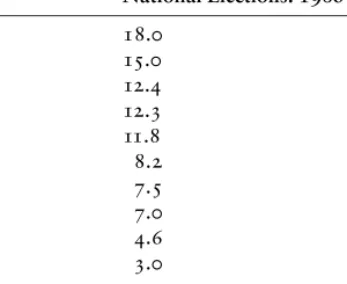
One consequence is particularly striking: the extent to which right-wing populist parties have established themselves in Austria and Germany over the past two decades. The rise of the far right is, of course, a pan-European phenomenon, and as recent developments in countries like Denmark and Belgium show, a strong indigenous Nazi or fascist movement is not a his- torical prerequisite for developing a successful right-wing populist party half a century later. But what is nonetheless remarkable about the German and Austrian cases is how divergent the development of the far right in the two surviving successor societies of the Third Reich has been. In terms of the far right’s electoral success and integration into the political estab- lishment, Austria and Germany represent opposite ends of the continuum in Western Europe, as Table1.1demonstrates.
This divergence is puzzling for many reasons. Germany possessed sev- eral of the underlying conditions – such as persistently high unemploy- ment, massive immigration, and popular discontent with the European Union – that right-wing populist parties successfully exploited elsewhere in Western Europe.Eurobarometersurveys also regularly show that nega- tive attitudes toward immigration are more widespread in Germany than in practically every other European country. Sixteen straight years of Christian Democratic (CDU) rule (1982–1998), coupled with the mas- sive financial scandal that accompanied the party’s fall from power, also would have seemed to augur well for the development of a political party to the right of the Union (the political coalition between the CDU and its Bavarian sister party, the Christian Socialists [CSU]). For these and other reasons, German specialists predicted in the early1990s that the
8“Germany” refers here to the Federal Republic of Germany (West Germany) until1990 and unified Germany thereafter. The German Democratic Republic (GDR), the former East Germany, is not the focus of this book.
table 1.1. The Far Right in Western Europe
Country
Average Far-Right Vote in National Elections: 1986–2002
Austria 18.0
Switzerland 15.0
Italy 12.4
Norway 12.3
France 11.8
Denmark 8.2
Belgium 7.5
Portugal 7.0
Netherlands 4.6
Sweden 3.0
Germany 1.4
Luxembourg 0.8
United Kingdom 0.2
Greece 0.1
far-right Republikaner Party (REP) would become a permanent presence in the German party system. Why this party failed to do so, and why the far right more generally has failed politically in Germany, is an important and underexplored question.
The success of the Austrian Freedom Party (FP ¨O) is also surprising given Austria’s strong economic performance over the past two decades.
The party engineered its electoral breakthrough in1986, when the unem- ployment rate was3.1 percent, and continued to gain strength over the next thirteen years, when Austria had a lower annual average unemploy- ment rate than any other Western European country except Luxembourg and Switzerland. When the FP ¨O won 26.9 percent of the vote in the 1999national parliamentary elections, the unemployment rate was only 3.9 percent (compared with 8.4 percent in Germany). While immigra- tion was high in Austria, it was slightly less than in Germany and fell off dramatically after1993. Compared with most other Western European states over the1980s and1990s, Austria does appear to have preserved its status as the “island of the blessed,” as former Prime Minister Bruno Kreisky once described it. That the FP ¨O could do so well under such con- ditions, and enter a national government with the Austrian People’s Party ( ¨OVP) in2000, to the consternation of the international community, is remarkable. Whether or not the FP ¨O recovers from its electoral implo- sion in2002, and whether or not J ¨org Haider’s newly formed Alliance for Austria’s Future (BZ ¨O) gets off the ground, the populist right has
succeeded in radically altering the Austrian party system and will most likely remain an important political force.
To account for the divergent success of the far right in Germany and Austria, I explore the main conventional hypotheses about right-wing populism in advanced industrial societies. Some scholars claim that a postmaterial transformation has led to the rise of right-wing populist par- ties, and that the variance in their strength depends on their ability to offer a “winning combination” of neoliberalism and xenophobia to a shifting voter base.9 The German and Austrian cases, I argue, provide only limited support for this theory. The two cases also do not confirm a second group of explanations that focus on immigration and unemploy- ment as the key independent variables. Nor do explanations that focus solely, or mainly, on differences in electoral institutions, such as elec- toral formulas and district magnitude, provide much analytical leverage.
I find some evidence for the hypothesis that established political parties decrease support for right-wing populism by adopting xenophobic dis- course and strict policies on immigration. Such cooptation was one factor in the demise of the REPs in Germany. Yet the Austrian case, as well as other cases in Western Europe, suggests that cooptation can also backfire by legitimating right-wing populist parties and increasing their electoral strength.
Using the German and Austrian cases for theory construction, I develop an alternative explanation for the variation in the far right’s success.
Although postmaterialism, immigration, and European integration have created a host of pressures that favor the far right, these forces in them- selves do not translate into electoral success. Like the cooptation hypoth- esis, I see a large role for other political parties in influencing the fate of right-wing populist parties, but cooptation is not the only possible strategy.
Existing political parties can choose to cooperate with, or try to
“tame,” the far right and integrate it into the party system. This process often begins at the municipal and state levels, and can result in the forma- tion of coalition governments that include right-wing populist parties at the national level. Although participation in government weakens right- wing populist parties in the short run by eliminating their protest votes, I suggest that cooperation and integration strategies ultimately strengthen them.
9Herbert Kitschelt, in collaboration with Anthony J. McGann,The Radical Right in West- ern Europe(Ann Arbor: University of Michigan Press,1995). See also Hans-Georg Betz, Radical Right-Wing Populism in Western Europe(New York: St. Martin’s Press,1994).
On the other hand, political parties can choose to combat right-wing populist challengers. The most effective strategy for doing so appears to be a combination of cooptation, confrontation, and marginalization.
Established political parties seize on the themes of right-wing populist parties (cooptation) while simultaneously denouncing them as enemies of the system (confrontation) and refusing to cooperate with them, or even speak with them, at any political level (marginalization). By pursuing this strategy, political parties are sometimes forced into unpopular alliances with other parties to avoid cooperation with the far right. In some cases, parties have given up power rather than rely on the support of right-wing populist parties. By denying the far right any hope of participating in coalitions or passing its own legislation, the combat strategy ultimately undermines its electoral appeal.
For the combat strategy to be effective, it must be supported by the national media and by civil society. When the media universally denounce right-wing populist parties and launch campaigns against them, some contumacious voters might be attracted to the far right, but the net result is to weaken public support for it. When members of civil society protest against and stigmatize right-wing populist parties, they create a host of organizational and recruitment problems for such parties. When parts of the national media and civil society are either quiescent or actively supportive of right-wing populist parties, however, this can allow them to overcome their marginalization and attract a wider following.
In short, this book departs from previous studies of right-wing populist parties, and from much of the literature on political parties in general, by focusing on the broader political-cultural environment in which they operate. The emphasis is on the long-term trajectory of parties rather than on the results of any particular election, although I do maintain that the initial reactions of political parties, the media, and groups in civil society to the far right critically influence the latter’s development and position in the party system. In this sense, I view party development as path dependent.10
How do political parties, the media, and civil society choose between combating and taming right-wing populism? Although strategic consider- ations can be important for political parties, I argue that reactions to the far right are basically structured by ideas about the legitimacy of right- wing populist movements and perceptions of the threat they pose to the
10On the path dependence of political parties, see Angelo Panebianco,Political Parties:
Organisation and Power(Cambridge: Cambridge University Press,1988).
quality of democracy. These ideas and perceptions, I hypothesize, vary across time and space. In the case of postwar Europe, the fascist era of the interwar years is an important point of reference for contemporary views about the far right.11
As noted previously, Germany and Austria have confronted the Nazi past in radically different ways. This was not always the case. In the early postwar period, elites in both states held remarkably similar ideas about the relevance of the Nazi past for contemporary politics. Both saw Nazism as a historical aberration in their nation’s histories. Both viewed their own populations as the primary victims of Nazism. Both made only fleeting and vague references to the Holocaust. The political integration of for- mer Nazis proceeded rapidly in both countries, and those who called for critical examinations of the recent past were either isolated or came from the margins of politics and society. Although the extraparliamentary protest movement in Germany challenged this wall of silence in the1960s, it was only in the1980s that the Nazi past became a serious political issue in Germany. In Austria, there was no challenge to the idea that Austria was
“Hitler’s first victim” until the presidential candidacy of Kurt Waldheim evolved into a debate about his, and by extension Austria’s, Nazi past.
In both states, public debates about the past in the1980s produced new frames, reshaped elite opinion, and created new discourses about the Nazi era. As we shall see, however, these debates produced radically different outcomes.
This book represents an exercise in theory construction. My arguments about both public debates and the development of right-wing populist par- ties were arrived at inductively during more than two years of fieldwork in the two countries. I present my theories in abstract, generalizable term so that they may be used, or contested, by scholars working in other areas. I make no claim to have tested them here. For scholars less concerned with social science methodology and more interested in my substantive find- ings, the theoretical architecture helps to structure what would otherwise be an intricate, unwieldy narrative.
11It is important to note that I do not view these parties as neofascist, nor do I argue that they share programmatic affinities with National Socialism. Like other far-right parties in Western Europe, such as the National Front in France, the Progress Parties in Denmark and Norway, and the Northern League in Italy, these parties are nor- mally classified as right-wing populist parties. For a further discussion of the differences between neofascist and right-wing populist parties, see Cas Mudde, “The War of Words:
Defining the Extreme Right Party Family,”West European Politics19, no.2(1996):
225–248.
Plan of the Book
Chapter2develops a framework for analyzing public debates in advanced industrial societies. I take issue with the concept of “historical memory,”
and argue that interpretations of historical atrocities contain both nor- mative and causal claims about politics in general. Drawing from work on deliberative democracy, elite discourse, public opinion, media effects, and the policy-making process, I build a theory of public debates as crit- ical junctures in the process of ideational change. I outline the three-step sequence noted previously in greater depth, and finally, I turn to issues of research design and methodology.
Chapter3applies my theoretical framework to public debates about the Nazi past in Germany. After sketching the development of elite ideas about Nazism over the first four postwar decades, I analyze the pub- lic debate – in fact, a series of public debates – that consumed German politicians, the media, and intellectuals in the mid-1980s. This debate produced two distinct frames linking the Nazi past to contemporary pol- itics. The “normalization” frame, championed by the right, demanded that the Nazi past be allowed to “pass away” in order to allow Germans to develop a healthy national identity. The “contrition” frame, developed and disseminated by the left, countered that memory of, and atonement for, the Nazi past must remain a permanent political duty for all Germans.
The only legitimate basis for national identity, in this view, is identifica- tion with Germany’s democratic institutions and values or “constitutional patriotism.” During the second stage of these public debates, the weight of elite opinion converged around the contrition frame and pushed the normalization frame from the political mainstream. The third step was the institutionalization of discursive norms, which I refer to as “politi- cal correctness, German style,” that demarcate the limits of acceptable interpretations of the Nazi period and sanction those who violate them.
Chapter4focuses on Austria and the1986debate over Kurt Waldheim.
The Austrian right created and disseminated what I term the “new victim”
frame, which identified Austria as the victim of international forces seek- ing to denigrate its history and called on patriotic Austrians to resist this foreign interference. A small group of artists, intellectuals, and left-wing politicians challenged this view and seized upon a version of the German contrition frame. While German elites converged around the contrition discourse, elites in Austria polarized on the issue of the Nazi past. The right used the new victim frame to stoke nationalist sentiment; the left adopted the contrition frame, and began to criticize conservatives for downplaying
and trivializing Austria’s Nazi past. In Austria, then, the Nazi past became a salient political issue and the subject of many future political battles.
Discursive norms were not created, as they were in Germany; instead, the right developed a set of code words that primed anti-Semitic stereotypes and introduced nationalist-chauvinist language into mainstream political discourse.
Chapter5shifts back to Germany and explains the failure of the far right to become a permanent force in German politics. Surveying existing explanations for the success and failure of right-wing populist parties, I find that none of them offer an adequate interpretation of the German case. Instead, by utilizing the combat hypothesis sketched previously, I show how it provides the most compelling explanation for why the Repub- licans, as well as several other far-right movements, failed to consolidate themselves in German politics. Elite norms against right-wing populism, a legacy of public debates about the Nazi past, motivated German political parties, the media, and civil society to take active, and ultimately effective, measures against it.
Chapter6analyzes the rise and consolidation of the FP ¨O. I demonstrate how the nationalist backlash from the Waldheim debate in1986created ideal conditions for the FP ¨O’s breakthrough in parliamentary elections later that year. Despite occasional statements to the contrary, other polit- ical parties tolerated the FP ¨O. The party also received strong support from the most powerful paper in Austria, the tabloidKronen Zeitung.
Civic groups did not initially protest the FP ¨O nearly as actively as their counterparts in Germany, which meant that the FP ¨O faced few obstacles to recruitment and organization. Elite ideas about the Nazi past did not prove a handicap, but rather a boon, in the FP ¨O’s meteoric rise.
Chapter7summarizes the key theoretical and empirical arguments of the study. It then reviews some recent changes in German and Austrian political discourse about the Nazi past, particularly the newfound res- onance of the German narrative of victimization. I suggest that critical examinations of the fire bombing of German cities or the suffering of German expellees from Eastern Europe (die Vertriebenen) do not rep- resent a threat to the hegemony of the contrition discourse. Rather, by raising the theme of German suffering itself, the German left is attempt- ing to wrest the issue of victimization from the German right, thereby robbing it of a tool for stoking nationalist sentiment.
I then turn to the rising tide of far right activity in the former German Democratic Republic (DDR). In the newl ¨ander, where the lessons of his- tory are different from those in the West, the far right has done remarkably
well in recent local and state elections. Even more importantly, right-wing extremist movements have permeated social and political life in many eastern German cities and towns. I show how other political and social actors in the east either tolerated, tacitly supported, or ignored neo-Nazi movements, and how these reactions allowed far-right movements to con- solidate and thrive.
The conclusion also uses the shadow cases of Weimar Germany and contemporary France, the Netherlands, and Sweden to demonstrate the portability of my argument about right-wing success and failure. In both Weimar Germany and France, political elites failed to erect a cordon sanitairearound incipient right-wing movements, but rather gave them tacit and overt support. Although National Socialism cannot be equated with the French National Front (FN), both right-wing movements prof- ited immensely from the actions of other mainstream political parties, the media, and groups in civil society. In the Netherlands and Sweden, how- ever, political elites combated right-wing populist movements when they first appeared in the1980s. It is no coincidence that the two countries are home to some of the the least electorally successful right-wing populist parties in Western Europe (see Table1.1).
This study closes with an appeal to scholars to study other cases of public debates in addition to those concerning the lessons of history. It is my hope that public debates about such foundational issues in the United States and elsewhere can be analyzed using the framework developed in this study. Such deliberative moments – moments when the fundamental values of political communities are intensely contested – represent critical junctures in the process of political change and transform the political environment in which they occur.
2
Public Debates and Political Change
This chapter develops a framework for analyzing public debates in advanced industrial democracies. Although public deliberation is an essential feature of these states, there are certain periods when a soci- ety appears to be involved in a “national discussion” – periods when politicians, the media, intellectuals, and civic activists intensely debate a particular set of issues. Some examples in the United States include the health care debate of the early1990s, the debate about Iraq in2002, and, potentially, the unfolding debate over gay marriage. To go back further, one might include battles over civil rights, the Equal Rights Amendment, and the Vietnam War as episodes of public debates over foundational issues in American politics.1 Public debates about such foundational or easy issues are marked by clashes between basic political orientations and values.
Do such public debates matter for political outcomes? Many political scientists argue that they do not. Politics, after all, is all about power and interest; those who possess enough of each determine policy, regardless of
1On the health care debate, see Jacob S. Hacker,The Road to Nowhere(Princeton: Prince- ton University Press,1997). The literature on the civil rights debate is massive, but for an analysis of the debate see Edward G. Carmines and James A. Stimson,Issue Evolution:
Race and the Transformation of American Politics(Princeton: Princeton University Press, 1989). See also Doug McAdam,Political Process and the Development of Black Insur- gency, 1930–1970(Chicago: University of Chicago Press,1982). On the debate over the Equal Rights Amendment, see Jane Mansbridge,Why We Lost the ERA(Chicago: Uni- versity of Chicago Press,1986). On Vietnam, see John R. Zaller,The Nature and Origins of Mass Opinion(New York: Cambridge University Press,1992).
13
what others have to say.2Several central paradigms in political science also assume that the interests of political actors are fixed (or exogenous) and do not change markedly through social interaction.3In such accounts, public debates and political discourse have, at best, only a marginal influence on political outcomes.
This book challenges this view. As scholars working in the deliberative democracy paradigm have suggested, deliberation produces changes that are not reducible to power or interest.4Drawing on this insight, I conceive of public debates as dynamic political battles with important and endur- ing legacies. Public debates create new frames for interpreting political issues, change the ideas and interests of political actors, restructure the relationships between them, and redefine the limits of legitimate political space. These changes do not occur because the better argument carries the day, but rather because public debates set in motion a series of processes that reshape the political environment in which they occur.
This chapter analyzes those processes. Before doing so, it defines a public debate and identifies objective measures of its political saliency. It also claims that the relevant participants are political elites rather than ordinary citizens, and that elite messages are both reported and framed by the mass media. In other words, it develops a top-down view of public debate and opinion change, one that is at odds with many normative conceptions of deliberative democracy but is consistent with the dominant paradigms within public opinion and political communications research.
My case studies of public debates are those about past atrocities. The burgeoning literature on coming to terms with the past has raised many of the normative issues in this process but has had much less to say about its political stakes.5Although the notion of “historical memory” has gained
2Ian Shapiro, “Enough of Deliberation: Politics Is about Interests and Power,” inDeliber- ative Politics: Essays on Democracy and Disagreement, ed. Stephen Macedo (New York:
Oxford University Press,1999),28–38.
3The assumption of fixed interest is central to all rationalist theories of politics, from rational choice to Marxism to neorealist theory in international relations.
4For introductions to the literature on deliberative democracy, see James Bohman,Public Deliberation:Pluralism, Complexity and Democracy(Cambridge: MIT Press,1996); Jon Elster, ed.,Deliberative Democracy(New York: Cambridge University Press,1998).
5This study analyzes the empirical issues in coming to terms with the past and does not deal with the moral ones. For those interested in ethical considerations, see Avishai Margalit,The Ethics of Memory(Cambridge: Harvard University Press,2002); Martha Minnow, Between Vengeance and Forgiveness (Boston: Beacon Press, 1998); Elazar Barkan,The Guilt of Nations: Restitution and Negotiating Historical Injustices(New York: Norton, 2000). For an empirical analysis of coming to terms with the past, see Samuel P. Huntington,The Third Wave(Norman: University of Oklahoma Press,1991).
wide currency within several scholarly fields, it distracts our attention from the contemporary political relevance of historical interpretations.
I argue that ideas about the past, particularly about a traumatic past, matter because they constitute both causal and normative claims about politics in general. In debating the lessons of history, political elites are in fact deliberating over the basic ideas and values that should guide the contemporary political community. This is the primary reason that debates about history, like debates about abortion and civil rights, often become so politically salient. In the final sectionof this chapter, I out- line my comparative research design and explain the eclectic qualitative and quantitative methods – interviews, media analysis, content analysis, participant observation, public opinion data – that provide the primary evidence in the empirical chapters. But let us begin with an investigation of coming to terms with the past, both in theoretical terms and in the cases of Germany and Austria.
The Past in the Present
In1959, the German sociologist Adorno delivered a lecture entitled “What Does It Mean to Come to Terms with the Past?”6Since then, politicians, intellectuals, and ordinary citizens in many other societies have asked themselves the same question. Like Germans, they have confronted the legacy of a state massacre – a “large-scale violation of basic human rights to life and liberty by the central state in a systematic and organized fash- ion.”7In many third-wave democracies, reckoning with authoritarian or communist pasts has been integral to democratic transitions.8In advanced industrial democracies, minorities have demanded symbolic and material redress for past state massacres, like slavery and the annihilation of abo- riginal populations.9 While Adorno implicitly treated dealing with the Nazi past as an exclusively German imperative, it has since emerged as a salient issue in many other countries. The legacy of collaboration has
6Theodor W. Adorno, “Was beduetet: Aufarbeitung der Vergangenheit,” inErziehung zur M ¨undigkeit(Frankfurt am Main: Suhrkamp,1970),10–28.
7Mark J. Osiel, “Ever Again: Legal Remembrance of Administrative Massacre,”University of Pennsylvania Law Review144(1995),463. This is Osiel’s definition of “administrative massacre,” a term I avoid because it can easily be understood as a euphemism for genocide.
8Nancy Bermeo, “Democracy and the Lessons of Dictatorship,”Comparative Politics24, no.1(April1992):273–291.
9Melissa Nobles, “Official Apologies: The Politics of Reconciliation in Australia, Canada, and the United States,” paper presented at the Comparative Center for Social Analysis, UCLA,2000.
sparked debate in several Western European states since the late1960s and has recently become an explosive issue in some Eastern European ones as well.10Even Switzerland and Sweden, neutral states during the Second World War, have started to reexamine, and atone for, their complicity in Nazi crimes. In short, dealing with the past has become a political issue in societies across the globe.
Scholars have just begun to analyze how political elites confront state massacres. Those working from a “transitional justice” perspective have assessed how trials, amnesties, truth commissions, apologies, reparations, and other policies are used, or should be used, to promote justice in soci- eties emerging from authoritarian or communist rule.11Yet, as many have noted, transitional justice is bound to be imperfect. When democratic con- solidation depends on the integration of a large number of former per- petrators, many of whom may still occupy powerful positions in politics and society, dealing with the past is likely to be perfunctory. The legal system in many societies is unable to handle the number of cases resulting from state massacres. The problem of post facto justice renders it diffi- cult to establish individual crimes under criminal regimes. Reparations will never be more than symbolic, and even then they are only exacted through a long and tortuous legal process that often leaves a bitter taste.
Given these constraints, many groups focus on a minimum conception of transitional justice that involves publicly examining past atrocities and including them in the national historical narrative.
This minimum requirement, however, is difficult to achieve even under the most auspicious political circumstances. It is difficult to argue that the stability of advanced industrial democracies, as opposed to emerging ones, can be undermined by publicly discussing past atrocities. And since these atrocities occurred decades or even centuries ago, the number of individuals directly involved in them is small or nonexistent. Yet even in advanced industrial democracies, critical examinations of state massacres
10For the French case, see Henri Rousso,The Vichy Syndrome(Cambridge: Harvard Uni- versity Press,1991). On cases from both Eastern and Western Europe, see Istvan Deak, Jan Gross, and Tony Judt, eds.,The Politics of Retribution in Europe(Princeton: Prince- ton University Press,2000). See also Jan M ¨uller, ed.,Memory and Power in Postwar Europe(New York: Cambridge University Press,2002).
11On transitional justice, see Neil Kritz, ed.,Transitional Justice,3vols. (Washington, DC:
United States Institute of Peace,1995); A. James McAdams, ed.,Transitional Justice and the Rule of Law in New Democracies(Notre Dame, IN: University of Notre Dame Press, 1997); Jon Elster, “Coming to Terms with the Past: A Framework for the Study of Justice in the Transition to Democracy,”Archives of European Sociology39, no.1(1998):7–48;
Ruti G. Teitel,Transitional Justice(New York: Oxford University Press,2000).
have proceeded slowly and fitfully, and have been marked at every step by resistance from powerful political and social actors. Nowhere has this been more true than in Western European confrontations with the Second World War.
In the decades after the war, Europeans rebuilt their shattered nations in an atmosphere of collective amnesia. In place of critical examinations of the recent past, the majority of politicians, intellectuals, and citizens con- structed and accepted what one scholar has termed “founding myths.”12 Each state nourished its own specific myth, but they all shared several common features. By hanging the blame on a foreign power or a small clique of domestic fanatics, they absolved the general population of any complicity in sins of commission or omission during the war. By treat- ing the rise of Nazism, fascism, or wartime collaboration as aberrations in their nations’ histories, the purveyors of founding myths sought to restore historical continuity and national traditions. These foundation myths proved to be remarkably enduring, and began to unravel only in the late 1960s as discussions about national guilt became increasingly frequent across Western Europe. These debates led to concrete political outcomes in the1990s when many states, and groups within states, paid reparations, issued apologies, and otherwise sought to atone for their nation’s crimes during the Second World War.
How can we account for this shift from amnesia to critical examination of national crimes? One way of approaching this question is through the study of “historical” or “collective” memory. “Memory” has become a fashionable concept in recent years, and the “memory boom” that began in the humanities in the1980s has since spread to the social sciences. But despite, or perhaps because of, the vastness of the literature, the study of collective memory remains a “centerless enterprise” fractured by dis- agreements over basic concepts.13Scholars disagree over the precise dif- ferences between “history” and “memory.” They are conflicted over the proper unit of analysis for the study of memory: individuals, groups, or nations. And while many scholars have analyzed how memories are formed, there has been little attempt to understand how memory shapes social and political life.
12Tony Judt, “The Past Is Another Country: Myth and Memory in Post-War Europe,”
Daedalus121, no.4(Fall1992):83–118.
13Jeffrey K. Olick and Joyce Robbins, “Social Memory Studies: From ‘Collective Memory’
to the Historical Sociology of Mnemonic Practices,”Annual Review of Sociology,24 (1998):105.
Although many political scientists would agree that memory matters, there have been few studies that trace the nexus between ideas about the past and political power.14Scholars of international relations and German foreign policy have made the largest contribution to our understanding of how historical ideas shape political outcomes.15Comparativists have done much less.16One of the principal reasons for this neglect, I suspect, is the murkiness of the concept of memory. What exactly is historical or collective memory? Whose memories count in politics? How can political scientists demonstrate that memory influences political behavior?
Several studies have floundered in trying to answer such questions. The most successful efforts tend to avoid the conceptual minefield and con- ceive of memory as a set of beliefs about the past, articulated by political elites, that contain causal and normative claims about politics. Andrei Markovits and Simon Reich, for example, see collective memory as the
“process through which ideological frameworks are contested and subse- quently constructed.”17Consuelo Cruz views collective memory as cen- tral to the construction of a “collective field of imagined possibilities,”
which she defines as “a restricted array of plausible scenarios of how the world can or cannot be changed and how the future ought to look.”18 In anthropology, Claude L´evi-Strauss developed the notion ofbricolage, a process by which political elites pick elements from the past in order to mold the future.19Richard Samuels has recently used this concept to explain how politicians shaped political development in Italy and Japan.20 All of these scholars have analyzed how political elites construct and dis- seminate ideas about history to justify some set of actors, policies, and
14Jan-Werner M ¨uller, “Introduction,” inMemory and Power in Postwar Europe,1.
15See, for example, Andrei S. Markovits and Simon Reich,The German Predicament (Ithaca: Cornell University Press, 1997); Thomas Berger,Cultures of Antimilitarism (Baltimore: Johns Hopkins University Press,1998); Thomas Banchoff,The German Prob- lem Transformed(Ann Arbor: University of Michigan Press,1999); Peter J. Katzenstein, ed.,Tamed Power: Germany in Europe(Ithaca: Cornell University Press,1997).
16 An important exception is Consuelo Cruz, “Identity and Persuasion: How Nations Remember Their Pasts and Make Their Futures,”World Politics52, no.3(April2000):
275–312; See also Peter Katzenstein,Cultural Norms and National Security: Police and Military in Postwar Japan(Ithaca: Cornell University Press,1996). On how breaking with the past was important for the regeneration of Communist parties in Eastern Europe, see Anna M. Grzymala-Busse,Redeeming the Communist Past(New York: Cambridge University Press,2002).
17Markovits and Reich,German Predicament,13.
18Cruz, “Identity and Persuasion,”276.
19Claude L´evi-Strauss,The Savage Mind(London: Weidenfeld and Nicolson,1966).
20Richard J. Samuels,Machiavelli’s Children: Leaders and Their Legacies in Italy and Japan (Ithaca: Cornell University Press,2003).
large-scale ideologies. The word memory, however, is misleading since the actual recollection of an event is not a requirement for purveying, or believing, historical ideas.
From this perspective, dealing with the past is less about getting the history right, or reconstructing memory, than about defining the basic political ideas and values ofcontemporary political communities. State massacres were the product of political ideas and social visions that, if initially disseminated by fanatical cadres, became deeply embedded in the population. Criminal regimes rested not only on terror, but also on the acquiescence, obedience, and often allegiance of important sectors of society. One task for elites emerging from a state massacre would seem to be the destruction of those ideas that predated, facilitated, and survived the criminal regime. This strategy for dealing with the past, however, is rarely used in the immediate aftermath of transitions. The historical record demonstrates, instead, that most elites have pursued an “institu- tional” strategy. They have wagered that new institutions would not only prevent the recurrence of atrocities but would also slowly purge their societies of pernicious ideas.21This was very much the case in the Federal Republic. The slow but steady growth of democratic attitudes among the population, coupled with West Germany’s remarkable political stability, is often taken as evidence that institutional strategies for dealing with the past work.22
But West Germany also demonstrates the limits of such strategies.
During the1960s, many West Germans began to call for a “cultural strat- egy” of dealing with the Nazi past that demanded a critical confrontation with the political ideas that had preceded, flourished under, and survived Nazism. Many attacked institutional strategies as attempts to whitewash the Nazi past and to allow former Nazis to remain in power.23 They viewed, although they did not always clearly articulate, a critical con- frontation with Nazism as a precondition for the deepening of democ- racy in the Federal Republic. Over the past two decades, groups in other
21On the difference between institutional and cultural strategies in dealing with the past, see Anne Sa’adah,Germany’s Second Chance: Truth, Justice and Democratization(Cam- bridge: Harvard University Press,1998),2–5.
22Herman L ¨ubbe, “Der Nationalsozialismus im polititischen Bewusstsein der Gegenwart,”
inDeutschlands Weg in die Diktatur: Internationale Konferenz zur nationalsozialistis- chen Macht ¨ubernahme im Reichstagsgeb ¨aude zu Berlin. Referate und Diskussionen: Ein Protokoll, ed. Martin Broszat et al. (Berlin: Siedler,1983).
23Ralph Giordano,Die Zweite Schuld oder Von der Last Deutscher zu sein(Hamburg:
Rausch and R ¨ohring,1987).
countries that have pressed for critical examination of state massacres have made similar claims about the relationship between dealing with the past and increasing the quality of democracy.24The idea is that by draw- ing lessons from history, societies can both inoculate themselves against pernicious ideas and, in the process, develop liberal democratic values.
But what lessons of history are to be learned from state massacres?
One universal slogan that politicians can agree on is “Never again!” In German, this translates asNie Wieder, and politicians of all stripes reg- ularly invoke it when discussing the Nazi past. But what exactly do they mean by it? In one sense, “Never again!” implies a wholesale rejection of the ideas and values that drove societies to commit massive and systematic abuses of human rights. In the case of Nazi Germany, this would appear to be common sense. But even in this most extreme case, the matter is much more complex. If the Nazis created a new ideology, they also constructed it from many preexisting strands of German political thought. To take a well-known example, the Nazis elevated devotion to the German nation to a central political principle. Some politicians thus interpret “Never Again!” as the rejection of any conception of political loyalty based on ethnic or cultural criteria. They view the Nazi past not only as a prohi- bition against such ideas, but also as an injunction to create a new form of national identity based on a commitment to democratic values. Other politicians who proclaimNie Wiederdraw different lessons from the Nazi past. They argue that since Hitler “misused” appeals to the “fatherland”
and patriotism, the Nazi past need not rule out the possibility for Germans to identify positively with a shared community of fate. The point is that just what political ideas the Nazi past precludes, and enables, is up for debate. In short, the lessons of history are not self-evident but wide open to ideational contestation.
It is this ideational contestation about the basic, or foundational, polit- ical ideas and values of the contemporary political community that is at the heart of the process of coming to terms with the past. At many points over the past six decades in both Germany and Austria, the Nazi past has intruded into the political present and absorbed politicians, members of the media, intellectuals, and civic activists. Historical narratives about the Nazi past have varied widely across time and place, but a general pattern is discernible in each country. In Germany, elites during the first few postwar decades made only fleeting references to the Nazi past, normally describ- ing it as a natural catastrophe that had overcome Germany between1933 and1945. During the1960s, distinctive left and right narratives of the
24See Carlos Nino,Radical Evil on Trial(New Haven: Yale University Press,1998).
Nazi past developed, and the clash of these historical narratives was espe- cially salient in the1980s. Since then, German elites across the political spectrum have adopted the contrition narrative – a narrative that iden- tifies atonement for the Holocaust as a central political and moral duty.
In Austria, the consensus that Austria was Hitler’s first victim prevailed until the mid-1980s. As the victim narrative unraveled, several conflicting narratives of the Nazi past emerged. No new consensus was formed, and multiple narratives of the Nazi past exist in Austria to this day.
The following chapters explain the construction of the first postwar consensus in both Germany and Austria, the erosion of this consensus in each state, the development of the new consensus in Germany, and the multiple narratives in Austria. In other words, they are concerned with the dynamics of ideational change. Although political scientists have recently rediscovered the importance of ideas in political life, the issue of ideational change has been understudied.25As one observer suggests, ideational scholars have been so concerned with demonstrating that ideas matter that they have paid little attention to how ideas enter the political arena and change.26Before I present my own account of this process, I analyze two general political science paradigms that have been applied to explain the evolution of ideas about the Nazi past in Germany and Austria.
Explaining Ideational Change
The first paradigm identifies generational turnover as the crucial mecha- nism for ideational change.27 Scholars working in this paradigm argue that beliefs and attitudes are formed in early adulthood, and that
25A recent exception is Jeffrey W. Legro, “The Transformation of Policy Ideas,”American Journal of Political Science44, no.3(July2000):419–432.
26Sheri Berman, “Ideas, Norms, and Culture in Political Analysis,”Comparative Politics 33, no.2(January2001):233.
27Although they are often conflated, there are three distinct models of generational change:
the “maturation” model, whereby beliefs change in predictable ways as people age;
the “pendulum” model, whereby the members of one generation react to the beliefs of the previous one; and the “experiential” model, whereby the beliefs of members of generations are shaped by critical events. It is the combination of the experiential and pendulum models that is often applied to explain Germany’s confrontation with the Nazi past. On these three models, see Richard J. Samuels, ed.,Political Generations and Political Development(Lexington, MA: Lexington Books,1977). The experiential model of generations was first developed in Karl Mannheim, “The Problem of Generations,”
inFrom Karl Mannheim, ed. Kurt H. Wolff, second expanded edition (New Brunswick:
Transaction Books,1993):351–395. A recent application of the experiential paradigm is Ronald Inglehart, Modernization and Postmodernization: Cultural, Economic and Political Change in 43 Societies(Princeton: Princeton University Press,1997).