How Non-Centrist Parties Gain Electoral Success in German Politics: An Analysis of the Alternative für Deutschland’s Success in the 2017 Federal Election.
© 2019
By Madison B. Bickert
A thesis presented in partial fulfillment of the requirements for completion Of the Bachelor of Arts degree in International Studies
Croft Institute for International Studies Sally McDonnell Barksdale Honors College
The University of Mississippi
University, Mississippi May 2019
Approved:
__________________________________ Advisor: Dr. Joshua First
_________________________________ Reader: Dr. Oliver Dinius
__________________________________ Reader: Dr. Alice Cooper
TABLE OF CONTENTS
INTRODUCTION 3
SECTION: LITERATURE REVIEW 4
SECTION: THEORY 6 SUBSECTION: POPULISM 6 SUBSECTION: NATIONALISM 8 SUBSECTION: EUROSCEPTICISM 11 SECTION: METHODOLOGY 13
CHAPTER 1: ELECTORAL SUCCESS 16
SECTION 1:ELECTORAL ANALYSIS 16
SUBSECTION 1.1:GERMAN ELECTORAL SYSTEM 16 SUBSECTION 1.2:THE AFD BEFORE 2017 17
CHAPTER 2: DEMANDING A CHANGE 26
SECTION 2.1:VOTER DEMOGRAPHICS 26
SUBSECTION 2.1A:2013 FEDERAL DEMOGRAPHICS 26
SUBSECTION 2.2B:2017 FEDERAL DEMOGRAPHICS 28 SECTION 2.2:VOTER DEMANDS 30
SUBSECTION 2.2A:ECONOMIC VARIATION 31 SUBSECTION 2.2B: CULTURAL PROTECTION 32
CHAPTER 3: SUPPLYING A NATION 35
SECTION 3.1: SHIFTS IN MANIFESTOS 35 SUBSECTION 3.1A: THEMES OF POPULISM 36 SUBSECTION 3.1B: THEMES OF NATIONALISM 38 SUBSECTION 3.1C: THEMES OF EUROSCEPTICISM 39 SECTION 3.2: POSTER ANALYSIS 42
CONCLUSIONS 46
SECTION :LIMITATIONS 46
SECTION :CONCLUDING REMARKS 47 SECTION :CITATIONS 49
Introduction
On September 24, 2017, Germany held its federal elections for the 19th Bundestag, the lower house of the federal German legislature. The Alternative für Deutschland (AfD), which previously went unrepresented in the Bundestag, won 12.6% of vote, making them the third largest party. The 2017 election marked history, since this particular election awarded a right wing party a spot in the Bundestag for the first time since reunification. Since the Alternative für Deutschland, or AfD, has made its debut in the Bundestag, there have been ongoing questions of why the party has received so much support from voters.
This particular political party has puzzled political scientists and media analysts alike.
The AfD has formed a hybrid party that combines traditional, center-right ideologies as well as a far-right rhetoric. This party has, in turn, attracted voters from mainstream parties and the
unrepresented far right wing, as well as mobilized traditional non-voters. Though success of the far right is a growing phenomenon throughout Europe, Germany has remained one of the few countries to withstand this growing right-wing movement, In this thesis, I seek to answer the question: How do non-centrist parties gain electoral success in German federal elections? This thesis will use the Alternative für Deutschland’s case.
This research is important because though there is some literature on right wing party success in Europe, but little research has been done on the factors that contributed to the AfD’s success in 2017. Since the AfD is the first right wing party to gain seats in parliament since 1949, is the purpose of this thesis to help fill gaps in literature, as well as analyze the implications of a non-centrist party gaining such immense voter support in such a short amount of time.
My hypothesis is that voter demands for an alternative option to mainstream parties on hot-button issues (in the Alternative für Deutschland’s case, immigration and the Euro) provide
non-centrist parties, such as the AfD, with enough incentive to shift their policy agendas closer to the center in order to supply voters with their needs and results in seats in parliament. The AfD’s sudden and impressive rise to power is due to a combination of strategic changes to its manifesto and the provision of an alternate platform to mainstream parties to disgruntled voters.
This thesis uses a basic economic model of supply and demand as a loose structure for explaining the AfD’s success. By utilizing this framework, it will provide structure to the analysis the AfD’s techniques and their successes across both space and time, as well as help develop to understand if this success is due to strategy or circumstance. On the demand side of the model, voters demand a change to an unsatisfactory government leadership as well as demand representation of specific issues.
On the supply side of the model, the AfD supplies the voters with the opportunity to have an unmet political beliefs voiced in the Bundestag, as well as supply an “opposition” or “protest”
vote to those voters who are not content with more centrist parties, such as the CDU/CSU (the center-right party) or the SPD (the center-left party). Previous literature on right wing parties, the AfD, and the concepts that they use in their campaigns highlight how the AfD is able to utilize concepts of populism, nationalism, and Euroscepticism to supply voters along the political spectrum with their demands.
Literature Review
The growing phenomenon of right wing parties in Europe has elicited scholarly review on both the formation and implications of their successes. Though not all right wing parties are the same, there is an established pattern of shared characteristics that help scholars identify right wing parties when they emerge. In Polyakova and Shekhovtsov’s article, “On The Rise:
Europe’s Fringe Right,” the authors analyze some of the “fringe right’s” influences on the
current political world. The sudden resurgence of the extreme right in Europe can be attributed to the 2008 economic crisis. Right wing parties utilize frustration with current or mainstream parties to gain votes by utilizing concepts such as Euroscepticism and Islamization of Europe.
In De Vries and Edwards’ article "Taking Europe to its extremes: Extremist parties and public Euroscepticism," the authors talk about the downward slope of public support of the European integration project. This increased skepticism of the project leads to discussions of national identity and what it means to be a nation. In turn, support for nationalist right wing parties that facilitate this discussion and foster frustrations within voters are driven by nationalist rhetoric. The article provides insight to right wing nationalist parties techniques to using voter emotions and discourse to inspire voter support.
In Van Hiel’s article, “A psycho-political profile of party activists and left-wing and right-wing extremists,” he conducts a few observational studies to compare the characteristics of both right and left wing extremists. The idea that right wing and left wing extremist should hold many similarities outside of their ideologies is an interesting concept presented within this article. Voter behavior and support for parties that media and general public deem as indecent provide a populist effect of party supporters and the “others: This article uses a combination of psychology and political theories to lay a foundation for hypotheses of why voters can identify with extremes on the political spectrum.
In Arzehimer and Carter’s article, "Political Opportunity Structures and Right-Wing Extremist Party Success," the authors try and expand on the current literature of the internal structures of political parties, specifically with right wing parties. It is a common problem for new parties to struggle to stabilize their leadership and consolidate support. Through this struggle, parties sometimes sway in their previous ideological stances in order to better serve
their constituents. With right wing parties in particular, the struggle to consolidate a clear
direction leads to fractionalization within the party and the alienation of some groups of support.
Arzehimer and Carter argue that those parties that are able to stabilize internal structures within their leadership are able to gain electorate success.
In the article, “Ideological alternative? Analyzing Alternative für Deutschland
candidates’ ideal points via black box scaling,” the authors, Jankowski, Schneider, and Tepe, apply black box scaling to the German Longitudinal Election Study candidate survey that was conducted in 2013. By doing so, the authors were able to prove that the right wing party did not present as purely right wing. The scaling procedure extracts two meaningful ideological
dimensions described, as socialism versus liberalism and libertarian versus authoritarian, which found that the AfD’s leadership combined stances from multiple dimensions.
The AfD is able to themes of populism, nationalism, and Euroscepticism to mobilize voters to support a small, non-centrist political party, regardless of previous political affiliations.
Growing support of these concepts within Germany are indicative of a much more complex cultural shift than this thesis aims to clarify. However, the identification and analysis of these concepts are crucial to understanding the AfD’s mobilization of voters.
Theory Review Populism
The Alternative für Deutschland has been labeled as a populist right wing party
consistently by the media (Eckhardt, 2016; Eddy, 2017; McGuinness, 2014). Though some of the individual leadership of the AfD occasionally referenced populist themes, the party’s agenda showed little sign of populism. However, the term populism is highly contested and is often confused with other theories of the term. The definition used by Mudde and Kaltwasser in their
article, “Populism: A Very Short Introduction” provides a general understanding of the complexities of the term. They define populism “… as a thin-centered ideology that considers society to be ultimately separated into two homogeneous and antagonistic camps, ‘the pure people’ versus ‘the corrupt elite,’ and which argues that politics should be an expressions of the volonté générale (general will) of the people” (Kaltwasser & Mudde, 2017, p. 6). The use of populism in right wing parties has proven useful in Europe. Populism invokes a sense of urgency within voters to fight against an enemy that does not necessarily exist.
Mudde and Kaltwasser further explain that by defining populism as a “thin-centered ideology,” it allows the term to be more generalized, and therefore able to be applied more political entities and candidates. Because populism is thin-centered, it is flexible, and shapes itself to other ideologies that the authors describe as “thick-centered” (Kaltwasser & Mudde, 2017). Unfortunately, because of its fluidity, this allows variation between definitions of populism. This means that what is considered a populist movement in Latin America might not look the same as it does in Europe. It is not limited to a specific side of the spectrum, but rather translates to any point on the political spectrum.
Though the media uses this complex term generously, it can be unclear as to which version of the term various news sources are referring to. The authors state “part of the confusion stems from the fact that populism is a label seldom claimed by people or organizations
themselves. Instead, it is ascribed to others, most often with a negative connotation” (Kaltwasser
& Mudde, 2017, p. 2). Though the term itself brings negative connotations with it, the sentiments and emotions that are evoked in voters are still just as effective.
According to Laclau’s article, “Populism: What’s in a Name?” populism is rooted in politics itself. “To ask oneself if a movement is or is not populist is, actually, to start with the
wrong question. The question that we should, instead, ask ourselves, is the following: To what extent is a movement populist?” (Laclau, 2004, p. 112). He poses the idea that it is impossible to separate democratic institutions and political parties from the concept of populism, because with democracy, it inherently is by the people, for the people. In a way, every political party uses some form of populism to create a divide of “them” versus “us.” This context is applied to
political elitists and the common voter, immigrants and natives, and lastly Germans and other EU states in the manifestos.
It is because of this applicability to all political parties that political scientists and media analysts struggle to determine whether or not the AfD is indeed a populist party. European media sources might be referring to the European version of this definition, which includes points such as shock factor media, the critical attacks on current leadership, and the sense of polarization between groups of people.
The concepts and ideas that have been discussed in previous literature have laid
significant groundwork for the complicated concept of populism. These statements and analyses are vital to identifying the characteristics of populism and establishing patterns of populist rhetoric.
Nationalism
The use of nationalistic remarks and rhetoric is another characteristic of right wing parties in Europe. The exploitation of basic human emotions such as pride and self-preservation prove useful to right wing parties in mobilizing voter support. In Anderson’s “Imagined
Communities,” he defines a nation as “an imagined community.” His theory is, is that even in the smallest of cities, though neighbors will never fully meet or know all of the other neighbors, there is an imagined connection to one another. There is such a strong sense of community and
connection that people are willing to fight and die for something as ordinary and random as the location that they are from (Anderson, 2006). Since these nations are social constructs, unique to each person, citizens hold in their minds this fierce understanding of identity and self.
However, to define ones identity, is complicated. It is far easier to define what it is not, than what it is. Nations are “limited” in that they have “finite, if elastic boundaries, beyond which lie other nations” (Anderson, 2006, p. 7) Its this understanding of nation and national identity that leads us to the idea that these things must be protected by citizens, otherwise there will be no nation left. Right wing parties use this desire of self-preservation as a driving
mechanism to inspire support. These parties create a divide between other nations and their states in an attempt to create competition. Thus the concept of nationalism is formed.
Nationalism takes the sense of identity and connection further than location of origin.
Right wing parties take this concept to the extreme. European far right parties combine themes of populism and nationalism to create a divide between themselves and “foreigners.” Immediately following WWII, the concept of national pride in Europe was a fragile topic to discuss. Hitler used nationalist-populist rhetoric to drive support for the Nazi party. In Peck’s article, “Rac(e)ing the Nation: Is There a German Home?” he discusses the complexities of forming a national identity in Germany.
Deciding who is and is not a citizen of a nation is complicated. Especially “…in Germany, unlike other European countries, the classification of who is German and who is foreign is more complicated because of laws of consanguinity for citizenship and the continued political, historical, and territorial impact of the collapse of the Nazi regime” (Peck, 1992, p. 76).
Basing German citizenship on ancestral lineage was a key component in the Nazi party agenda, and is a common theme within far right nationalist parties in Europe. For a nationalist party in
Germany, this line between racism and xenophobic criteria and requirements for German citizenship is very delicate. It is important to a far right parties success that they highlight cultural aspects of Germans. In this way, German culture can be defined against other cultures, thus making German identity more defined.
In Morley and Robins’ article, “No Place Like Heimat: Images of Home(land) in European Culture,” the authors discuss cinema and its role in national identity. Cinematic portrayals of Germans and German culture help shape how the rest of the world views them. By discussing how Germans and Germany are portrayed culturally, it reemphasizes what is
inherently German or unique to Germany.
This article lays an important foundation on the concept of both German and European identity. First, let’s consider German identity. Morley and Robins discuss that “identity… is also a question of memory, and memories of ‘home’ in particular” (Morley & Robins, 1990, p. 6).
The concept of Heimat is special to German. Though there is not a sufficient translation of the concept into English, Heimat can refer to a person’s place of origin, or a place where a person feels that their identity is connected to.
Similar to Anderson’s definition of nation, the authors claim that home is also an
imagined concept. They argue that “whether ‘home’ is imagined as the community of Europe or the national state or of the region, it is drenched in the longing for wholeness, unity, integrity. It is about community centered on shared traditions and memories… Heimat is a mystical bond rooted in a lost past, a past that has already disintegrated… It is about conserving the
‘fundamentals’ of culture and identity. And as such, it is about sustaining cultural boundaries and boundedness. To belong in this way is to protect exclusive, and therefore, excluding, identities against those who are seen as aliens and ‘foreigners’. The ‘other’ is always and continuously a
threat to the security and integrity of those who share a common home” (Morley & Robins, 1990, p. 4). Because it is imagined and impressionable, right wing parties can manipulate certain words and imagery to invoke this concept of home and nostalgia within voters.
Throughout Brubaker’s article, “Between nationalism and civilizationism: the European populist moment in comparative perspective” he claims that “(nationalism), like populism, is a supremely flexible and adaptable discourse” (Brubaker, 2017, p. 1211). This allows nationalist parties the ability to apply this concept to numerous policies and situations to incite public outrage.
Brubaker makes a key distinction between varying right wing parties. He claims that there is a difference between populist, and national populist, especially in Europe. He argues that the polarized opposition between ‘us’ and ‘them’ in both vertical and horizontal dimensions can define national populism. Brubaker argues that “in the vertical dimension… ‘the people… are seen as virtuous, struggling, hard-working, plain-spoken and endowed with common sense…
while ‘the elite’ is seen as corrupt, self-serving, paralyzed by political correctness… and out of touch with… the concerns and problems of ordinary people.” (Brubaker, 2017, p. 1192).
This distinction is important to make, while though it sounds similar to the populist definition mentioned above, this particular clarification is specific to the nationalist populist rhetoric. Though it also utilizes the “us” and “them” concept, it blends the idea of censorship of the people and political correctness into the definition. Nationalism and the demand for a national identity leads to doubt and concern about the integration of states in Europe.
Euroscepticism
Euroscepticism, in broader context, simply refers to a doubtful view of European integration. It has been a hotly contested issue since the formation of the European Union. Like
populism and nationalism, Euroscepticism can be a difficult concept to clarify. Euroscepticism can be better explained as a spectrum rather than a definition. According to Taggart and Szczerbiak, “soft” Euroscepticism “is where there is NOT a principled objection to European integration or EU membership but there concerns on one (or a number) of policy areas leads to the expression of qualified opposition to the EU, or where there is a sense that ‘national interest’
is currently at odds with the EU trajectory” (Taggart & Szczerbiak, 2002, p. 4). By choosing a soft version of this narrative, political parties can attract voters that can recognize the benefits of a union of states, but are hesitant to relinquishing sovereignty in some policy areas.
The concept stands, that there is a certain point where the EU’s policy will take away a nation’s ability to implement changes for its citizens. Right wing parties are able to use this concern for the European Union’s involvement in certain policy areas to facilitate discussion of the limitations the EU places on national sovereignty. They create this narrative that citizens of a state should be in control of how policies are implemented, not citizens from another state.
However, in Mudde’s article, notes that in the face of low salience of Europe and Euroscepticism, it can be difficult to determine whether a party is soft Eurosceptic, hard
Eurosceptic, or not Eurosceptic at all (Mudde, 2012). Though not every right wing party utilizes this narrative, it is important to point out that the ability to capitalize on this concept will stand as long as the European Union exists. With incidents such as the immigration crisis and terrorist attacks, other topics present themselves as more important to citizens than Euroscepticism.
These three concepts of populism, nationalism, and Euroscepticism are able to blend together to give right wing parties the ability to mobilize electorate support. They combine these into whichever narrative they need to supply voters with their demand for representation within government.
Methodology
Understanding how the AfD was able to gain electorate success in Germany in 2017 requires analysis from multiple sources. This research consists of qualitative analysis of both quantitative and qualitative data. To help construct an analysis of electorate success, the economic model of supply and demand provides this research with a framework to explain results. This framework has been used by previous literature to explain right wing party success in Europe.
For quantitative data, both regional election results and federal election results provide a picture to how supply and demand factors worked together to aid the AfD in gaining seats in the Bundestag. Results from individual region election results and the federal election results were collected from the ARD’s website, a public broadcasting provider in Germany. This website provided organized federal results into charts and graphs, as well as graphics of where AfD support came from. This data is useful to analyzing both where the AfD’s support is strongest, and which parties the AfD was able to draw votes away from.
I conducted a small observational study on the regional election results collected from the ARD’s website, as well as individual Landtag archives to identify previously established
coalition types between the time frames. Using two hypotheses, I sought to explain where the AfD’s votes came from, and why the AfD was able to draw support from not only the right-side parties (CDU/CSU and FDP), but also from parties on the left (SPD, Greens, and the Left) in regional elections between September 22nd, 2013 and September 24th, 2017. By placing a time frame on this analysis, it helps to make the results from these hypotheses act as an indicator of shifting voter demands. I defined AfD regional electorate success as earning a double-digit percentage.
H1: The AfD will attract voters from the center right of the political spectrum, i.e. CDU/CSU.
The CDU/CSU’s vote percentage will decrease more than the other parties in the Landtag. There is a negative correlation between CDU/CSU percentage loss and AfD percentage success.
The independent variable is the percent of votes lost from the CDU/CSU. If the majority of the seats are lost from the CDU/CSU, then the AfD was able to pull voters who are
dissatisfied with Merkel’s leadership, as well as provide a right-sided political party that drives a hardline to hot topic issues. The dependent variable is the amount of votes from the CDU/CSU that the AfD was able attract. In order to determine where the votes came from, data from the ARD’s elections page provided data that illustrates where the AfD’s supporters came from. The ARD provides compiled data of Wahlwanderung, or wandering votes, into charts.
H2: The previous establishment of CDU-SPD or SPD-CDU coalitions, also known as a “grand
coalition,” will be positively correlated to AfD support.
The independent variable is the type of coalition that sat in local government from the 2011-2013 cycles. These could be any combination of coalitions formed by the following parties:
CDU/CSU, FDP, Pirates/NPD, SPD, Greens, and the Left. The dependent variable is the amount of votes the AfD won in during the 2014-2016 cycle. Data from regional Landtag websites were used to determine previous coalitions. Election results came from the Federal Return Office of Germany’s website. Further analysis of where votes came from will be required to develop a deeper understanding of voter behavior.
Several complications arose during this section of research. There are several
confounding variables that skewed the election result analysis. Historical biases towards specific parties, varying forms of voter demands, circumstantial events, and the overall shift in the party’s focus are possible confounding variables. It is unclear if one, or multiple factors played bigger
roles in the AfD’s regional successes. However, though the factors differ in their composition, they all share the characteristic of opposition.
Survey responses on numerous topics provide insight to voter behavior. This data was collected from Eurobarometer, a public site run by the European Commission that implements surveys to varying member-states of the European Union. This is done in an attempt to gage opinions of Europeans on certain topics as a whole. There are tools on Eurobarometer Interactive that allows users to select a survey to analyze, manipulate the time frames the surveys were conducted, choose which countries are included in the data sets, and select the type of chart results are organized into.
The data collected from clarifies German citizens opinions of numerous topics over a period of time. Surveys from German citizens on topics such as “Two most important issues are facing the EU,” “Perceptions of Immigrants,” and “Views of the Economic Crisis on Jobs”
provide insight to citizen opinions of these various subjects. By manipulating the time frame that these surveys were given, analysis of citizen opinions can then be linked to voter behavior and correlated back to election results. The results of these surveys indicated that there was a demand for a party to represent certain policy stances, thus providing demand factors of the theoretical framework.
For qualitative data, the party manifestos provide a general understanding of policies that a party wants to implement. These documents were collected from The Manifesto Project’s website. A textual analysis of the AfD’s manifestos will provide justification to the supply side of the theoretical framework. Through quote analysis, themes of populism, nationalism, and Euroscepticism contribute to the AfD’s ability to supply voters along the political spectrum.
However, since it is rare for a constituent to read a party’s manifesto, the AfD utilizes varying forms of media to spread their policy platforms.
Political posters provide parties with non-verbal communication to potential constituents.
The AfD is notorious for its use of shock-moderation tactic in their use of media. Analyzing visual political tools will give my analysis of media strategies a deeper understanding of specific political techniques the party implemented. The imagery analysis of the political posters that the AfD used between 2013 and 2017 provides a much more useful indicator of supplying
opposition to voters.
The imagery analysis of the posters consisted of various factors. First and foremost, the initial reaction of viewing the poster for the first time is analyzed. The initial emotions or shock of the viewer is crucial to drawing them into the message of the poster. Other forms of analysis included use of colors, symbols, and specific word choices.
Chapter 1: Electoral Analysis German Electoral System
How votes are translated into institutions help determine the effectiveness of the government. “Electoral systems, or the manner in which votes cast in a general election are translated into seats in the legislature, matter because they influence key governance dimensions and dynamics. Electoral systems provide different kinds of incentives to appeal to voters in order to yield electoral payoffs” (Menocal, 2011, p. 2). Understanding how electoral systems work provides insight into the interests, opportunities and constraints that drive political actors.
The German electoral system is quite complicated. Germany’s party and mixed electoral systems allow citizens to split their votes across two different parties. Votes are cast on a two- ticket system, which means that there are two votes that every voter gets to cast. The first vote
goes to a SMDP (Single Member District Plurality)-based candidate who may belong to one party. Relative majority voting is used for each constituency, which means that the candidate who receives most of the votes gets the mandate. This allows citizens to vote on candidates that they believe will best represent their district in the Bundestag, regardless of party affiliation.
However, for the distribution of seats in the Bundestag, the second vote is more important than the first. The second vote can be cast for a different party than the party associated to the first SMDP-based vote. Federal elections are run as a closed list mixed-member proportional representation system with a 5% threshold to gain seats in the Bundestag. Using the number of second votes, the 598 mandates are distributed proportionally to parties who have achieved at least 5 percent of valid second votes (Bundesrepublik Deustchland, 2019).
This type of electoral process often compels German citizens to be much more strategic with their voting. For example, the SMDP voting system is a winner-take-all system; so citizens may feel compelled to vote only for candidates that have a realistic chance to win a plurality.
However, this allows citizens to be able to vote for candidates outside of their party, who they think would represent their district better than other candidates. Because of its proportional design, the electoral process allows both executive and legislative structures to be formed indirectly, thus taking some decisions away from voters. Though this can be seen as less democratic than other nation-states, it allows for a much more efficient and smooth transition from elections to office.
AfD Before 2017
The Alternative für Deutschland was founded in April of 2013 by a group of professors and former CDU politicians, Bernd Lucke, Alexander Gauland, and Konrad Adam. The primary
concern and goal of the party was to criticize German-supported bailouts for insolvent EU members and the overall effectiveness of the Euro in Germany.
The AfD's initial supporters were the same notable economists, business leaders and journalists who had supported the Wahlalternative of 2012, or Electoral Alternative. These supporters included former members of the Christian Democratic Union, or CDU, who had previously challenged the legitimacy of the German government's Eurozone policies at the Federal Constitutional Court (Boesler, 2013) (Czuczka, 2013). Bernd Lucke, the founder and an original spokesperson of the party, was an economics professor who formed the AfD in an attempt to bring the destabilized Euro and the European Union’s policies on the currency to the forefront of German politics.
The growing concern over the Euro sparked debates across Germany. In 2013, the AfD’s party platform was the only one that offered voters an alternative to Euro policies. And with the growing doubt that the Euro’s value would hold, citizens saw this as a warning that if something does not change, Germany’s economy could end up like Greece.
On April 14th 2013, the AfD officially presented itself to the public when it held its first convention in Berlin. There, they elected the party leadership and adopted a party platform.
Bernd Lucke, Frauke Petry, and Konrad Adam were elected as the party’s first speakers (Jahn, 2013). Between March 31st and May 12th of 2013 the AfD founded affiliates in all 16 German states in order to participate in the federal elections.
In Jankowski, Schneider, and Tepe’s article, the authors applied black box scaling to the German Longitudinal Election Study candidate survey that was conducted in 2013. The scaling procedure extracted two meaningful ideological dimensions described as socialism versus liberalism and libertarian versus authoritarian. Placing the ideal point of candidates from all
parties into this two-dimensional line shows that AfD candidates are significantly more market liberal than Christian Democratic Union candidates but not more authoritarian.
The authors continued their analysis by exploring ideological heterogeneity within parties. They found that East German AfD candidates are generally more authoritarian than their West German colleagues, highlighting a potential source, or possible result, of the party’s recent shift from its primarily economic policy focus, toward a more nationalist conservative position.
Their research suggested that the party had faction based off of region, as well as ideological stances especially by party leaders (Jankowski, Schneider, & Tepe, 2017). That is, at least in the 2013 election cycle.
On September 22nd, 2013, federal elections were held to elect members and parties for the 18th Bundestag (Federal Returning Office of Germany, 2013). The AfD narrowly missed the threshold to earn seats within the Bundestag. However, they only missed this by only 0.3%.
Some members within the party began to question Lucke’s leadership and the AfD’s overall direction.
Soon after the 2013 federal election, the party experienced an internal power struggle. In the article, “The ‘Alternative for Germany,’” Decker points out that the AfD’s internal structure, or lack thereof, proves to be a bigger problem for the party than Germany’s electoral law or its party financing provisions (Decker, 2016). The AfD had split into two factions: the economic liberal and Eurosceptic wing under Lucke and the national-conservative and anti-immigrant wing under Frauke Petry.
After months of internal turmoil and the cancellation of a party gathering June 2015, on July 4th, 2015, at a party congress in Essen, an internal election was held which ousted Lucke as the leader and primary spokesperson, and named Petry as the new primary spokesperson (Welle,
2015). Frauke Petry, a former chemist and engineer, had gained a lot of influence within 3 eastern states, which is where the majority of the AfD’s support came from. But this internal power struggle was much more complex than her gaining favor within key states. The entire dynamic of the party had shifted. Though Petry represented the more moderate side of the right wing faction, her rise to leadership was seen as a shift of the party to the far right.
The failure to reach parliament provided enough doubt in Lucke’s leadership and voter support of the sole party’s economic focus for Petry to gain power over the party. The AfD’s first time participating in regional elections proved to be more successful than their first federal elections. However, voters did not voice their support of the party due to their stance on economic reform, but rather the AfD’s call for immigration reform.
In 2015, there was a sudden influx of immigrants flooding into Europe. These immigrants and refugees were primarily Syrian, Afghan, and African. Even though most Syrian refugees were hosted by neighboring countries such as Turkey, Lebanon, and Jordan, the number of asylum applications lodged by Syrian refugees in Europe steadily increased between 2011–17.
By December 2017, UNHCR reports had counted over 1,000,000 asylum applications in 37 European countries (including both EU members and non-members) (UNHCR, 2017).
The AfD’s primary focus pivoted from the Euro and economic reform to issues such as migration, immigration, and anti-Islamic policies. On July 8th 2015, Lucke announced that he was resigning from the AfD, citing the rise of xenophobic and pro-Russian sentiments in the party. It was this shift that Lucke claimed as turning the party into a "Pegida party". PEGIDA stands for the Patriotische Europäer gegen die Islamisierung des Abendlande or, the Patriotic Europeans against the Islamization of the Occident. This is a party that is notorious in Germany for its extremist views and xenophobic rhetoric. At the party congress held on April 30th to May
1st 2016, the AfD adopted a policy platform based upon opposition to Islam, calling for the ban of Islamic symbols including burkas, minarets, and the call to prayer, using the slogan "Islam is not a part of Germany."
Regional Election Analysis
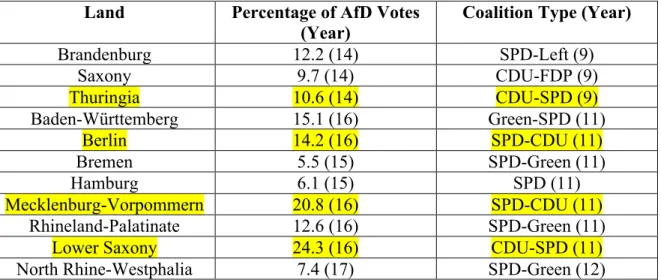
The AfD gained influence and success throughout the country and began focusing more on expanding the various regional branches. The party’s first successful election was in Saxony in 2014 with 9.7% of the overall vote. This success was later confirmed to not be a coincidence, as the party did significantly well in Brandenburg and Thuringia, reporting 12.2% and 10.6% of the vote respectively later that same year.
It seemed that in spite of failing to reach the Bundestag, the AfD was struggling to remain relevant in German politics. In time, the party’s electorate support was beginning to decline. In 2015, the AfD managed to barely skim past the 5% threshold in Hamburg with 6.1 % and Bremen with 5.5%. This incited the party’s internal power struggle. While it had originally focused on the then hotly contested issue of the Euro, as time progressed, voter doubt in the Euro dwindled. Voter demand for Germany’s elimination was not great enough to sustain the party, nor was it enough to gain seats in the Bundestag. However, in the wake of the immigration crisis, the AfD boasted impressive support in numerous states in 2016.
With the immigration crisis as the new primary focus of the party, on March 13th 2016, elections were held in the three states of Baden-Württemberg, Rhineland-Palatinate, and Saxony- Anhalt. In the 2016 Saxony-Anhalt state election, the AfD reached second place in the Landtag, receiving 24.2% of the vote. In the 2016 Baden-Württemberg state election, the party achieved third place with 15.1% of the vote. In the 2016 Rhineland-Palatinate state election, the AfD again reached third place with 12.6% of the vote (ARD).
In Angela Merkel's home state of Mecklenburg-Vorpommernher, the CDU was beaten into third by the AfD who claimed the second-highest polling with 20.8% of the vote in the 2016 Mecklenburg-Vorpommern state election (FoxNews, 2016). In the 2016 Berlin regional election, which the AfD also contested for the first time, they achieved a vote of 14.2%, making them the fifth largest party represented in the state assembly (ARD).
These numbers were quite impressive, but this led to the question of where the AfD’s voters were coming from. After gathering data from individual Landtag archives, I applied my hypotheses to the data.
In order to highlight fluctuations in electorate support, regional elections that took place between September 22nd, 2013 and September 24th, 2017 are broken down by year. This eliminated 3 regions from my analysis, Bayern, Hessen, and Niedersachsen, since the Landtag elections in these regions happened outside of this timeframe. Tables 1 & 2 show the results of my analyses.
Land Percentage of AfD Votes
(Year)
CDU Percentage
Change Greatest Negative Percentage Change
(Party)
Saxony 9.7 (14) -0.8 -6.2 (FDP)
Thuringia 10.6 (14) +2.3 -6.1 (SPD)
Brandenburg 12.2 (14) +3.2 -8.6 (The Left)
Bremen 5.5 (15) +2 -7.4 (Greens)
Hamburg 6.1 (15) -6 -6 (CDU)
Lower Saxony 24.3 (16) -2.7 -10.9 (SPD)
Rhineland-Palatinate 12.6 (16) -3.4 -10.1 (Greens)
Berlin 14.2 (16) -5.7 -7.2 (Pirates)
Baden-Württemberg 15.1 (16) -12 -12 (CDU)
Mecklenburg-
Vorpommern 20.8 (16) -4 -5.2 (The Left)
Schleswig-Holstein 5.9 (17) +1.2 -7 (Pirates)
Saarland 6.2 (17) +5.5 -6.7 (Pirates)
North Rhine-
Westphalia 7.4 (17) +6.7 -7.9 (SPD)
Table 1. Data was retrieved from wahl.tagesschau.de
Table 1 consists of 13 out of the 16 German regions, or Länder, the percentage of the vote that the AfD earned, the percentage changes of the CDU/CSU, and the parties with the greatest negative percentage changes. My hypothesis was:
H1: The AfD will attract voters from the center right of the political spectrum, i.e. CDU/CSU.
The CDU/CSU’s vote percentage will decrease more than the other parties in the Landtag. There is a negative correlation between CDU/CSU percentage loss and AfD percentage success.
After analyzing the results, my hypothesis was disproved. There are numerous instances where the CDU/CSU gains percentages, and only in two instances did the CDU/CSU’s negative percentage change outweigh other parties’.
This hypothesis was formulated on the assumption that the AfD was a right wing party, and in turn, it should have attracted voters with similar ideological characteristics right wing parties, such as the CDU/CSU. However, it seems that other parties lost considerable percentages and the AfD managed consolidate enough voters to push past the 5% threshold in every regional election.
Land Percentage of AfD Votes
(Year) Coalition Type (Year)
Brandenburg 12.2 (14) SPD-Left (9)
Saxony 9.7 (14) CDU-FDP (9)
Thuringia 10.6 (14) CDU-SPD (9)
Baden-Württemberg 15.1 (16) Green-SPD (11)
Berlin 14.2 (16) SPD-CDU (11)
Bremen 5.5 (15) SPD-Green (11)
Hamburg 6.1 (15) SPD (11)
Mecklenburg-Vorpommern 20.8 (16) SPD-CDU (11)
Rhineland-Palatinate 12.6 (16) SPD-Green (11)
Lower Saxony 24.3 (16) CDU-SPD (11)
North Rhine-Westphalia 7.4 (17) SPD-Green (12)
Saarland 6.2 (17) CDU-SPD (12)
Schleswig-Holstein 5.9 (17) SPD-Green-SSW (12)
Table 2. Data was retrieved from each respective Land’s archives and wahl.tagesschau.de
Table 2 consists of 13 out of the 16 German regions, or Länder, the type of coalition that was in power before the AfD’s first elections, and finally the percentage of the vote that the AfD earned.
My first hypothesis was:
H2: The previous establishment of CDU-SPD or SPD-CDU coalitions, also known as a “grand
coalition,” will be positively correlated to AfD support. Overlapping political policies between the center-right and center-left open up enough space for a non-centrist party to gain votes.
In Brubaker’s article, “Between nationalism and civilizationism: the
European populist moment in comparative perspective”, he makes the argument that regional elections are testing grounds for future federal elections. He wrote that “success in state elections provides the federal opposition the opportunity to gain ‘regional access’ to power. It creates the possibility of federal–provincial relations being defined in partisan terms and provides
opposition forces with an incentive for using regional arenas as a means of challenging the legitimacy of an existing federal majority party or coalition” (Burkhart, 2005, p. 17).
I argued that the AfD challenged SPD-CDU/CSU coalitions in regional government, by offering voters a way to punish the center-right and left for its homogeneity. At first glance, there seems to be a strong correlation between AfD electorate success between 2013 and 217 and a previous “grand coalition.” 4 out of the 5 Lands that had a grand coalition before the AfD’s first election reported double-digit percentages.
However, there are further conclusions that must be drawn from this table. These electoral results could also be explained based on the combination of timing of elections and
certain circumstances. During the elections in 2014, the AfD was able public discourse over the Euro to facilitate support, with a gradual decline into 2015, before reaching an all time low for the Saarland 2017 elections (European Commission). During the 2016 elections, the immigration crisis outrage was at its peak. There were some regions where the AfD was able to consolidate double-digit support without a previous establishment of a grand coalition, such as Brandenburg, Baden-Württemberg, and Rhineland-Palatinate, and during varying years. There are too many confounding variables to make a definitive conclusion from these results.
The possible conclusions of these results include, but are not limited to historical biases towards specific parties, varying forms of voter demands, circumstantial events, and the overall shift in the party’s focus are possible confounding variables. It is unclear if one, or multiple factors played bigger roles in the AfD’s regional successes. Table 1, illustrated that voter discourse was not limited to one party, nor was one side of the spectrum. Table 2, provided furthered the conclusion that the AfD’s success cannot be attributed to just one factor. However, though the factors differ in their composition, they all share the characteristic of opposition.
After seeing the response to a more right wing rhetoric, the AfD approved a platform that, according to The Wall Street Journal, "urge(d) Germany to close its borders to asylum applicants, end sanctions on Russia, and to leave the EU if Berlin fails to retrieve national sovereignty from Brussels, as well as to amend the country's constitution to allow people born to non-German parents to have their German citizenship revoked if they commit serious crimes”
(Bender, 2016). Citizens were in need for a change, and demanded it from political parties. The AfD stepped up to fill the gaps.
At the party conference in April 2017, Frauke Petry announced that she would not run as the party's main candidate for the 2017 federal election. This announcement grew out of internal
power struggle as the party's support had fallen in polls from 15% in the summer of 2016 to 7%
just before the conference. Björn Höcke, from the far-right wing of the party, and Petry were attempting to push each other out of the party. Petry's decision was partly seen as a step to avoid a vote at the conference on the issue of her standing.
The party chose Alexander Gauland, a stark conservative who worked as an editor and was a former member of the CDU, to lead the party in the elections. Gauland supported the retention of Höcke's membership in the party. Alice Weidel, who is perceived as more moderate and neoliberal than Gauland, was elected as his running mate to help run the AfD’s 2017 federal campaign.
Chapter 2: Demanding a Change Voter Demographics
2013 Federal Demographics
To better understand the Alternative für Deutschland, it is important to look at the demographics of the AfD’s support. Understanding a party’s demographics and voters’ needs is crucial to consolidating and maintaining electorate support and a party’s survival. In previous literature, far right parties held fairly consistent voter demographics. Most scholars hypothesized that the vast majority of AfD supporters would be undereducated, Caucasian men between the ages of 18-25 and 44-55. With previously successful right wing parties, supporters consist of lower class, uneducated citizens.
However, after more in depth research, scholars found that the core of AfD 2013 supporters were not uneducated men that were reliant on the welfare system, but “(were) predominantly male, belong(ing) to the age-groups 25-35 years or 45-54 years, (were) well educated, financially well situated, and also interested in politics…moreover, AfD sympathizers
report being dissatisfied with democracy in Germany and the European Monetary Union”
(Jankowski, Schneider, & Tepe, 2017, p. 705).
Parts of original hypotheses were correct, that the vast majority of AfD supporters are Caucasian men from the same age-groups, however these failed to explain why this group, as homogenous as it seems, should lack several similar characteristics of consistent ideologies.
Citizens that voted for the AfD came from all over the political spectrum.
Image 1. illustrates the approximate amount of vote increase from mainstream parties to the AfD. This signaled a shift in voter demands. Some citizens were choosing to vote not
according to of their previous political affiliations, but for a small party that offered a solution to combat the rising immigration and taxation numbers. In 2013, the majority of the AfD’s support came from traditional FDP and Left voters, both of which are on opposite sides of the political spectrum. Even though the party had been identified as a right wing party, it was able to capture votes from the left side of the spectrum as well.
In Van Hiel’s article, “A psycho-political profile of party activists and left-wing and right-wing extremists,” he explains that moderate voters on the left/right spectrum show a great amount of homogeneity. This meant that if a small or non-centrist party can use an event or circumstance and apply it to a general centrist policy stance, the party could attract voters from both sides of the political spectrum.
Jankowski, Schneider, and Tepe’s research showed that the homogeneity of voters were less than four main points. Their research points out that “compared to voters of other parties, AfD voters evaluate Germany’s European Union membership negatively, consider the influence of the EU on Germany as too large, (and) are afraid that Germany has to pay for other EU member states” (Jankowski, Schneider, & Tepe, 2017, p. 705). The two parties whose policy
platforms focus heavily on economic policies were the ones who lost the most voters to the AfD.
The AfD met the demand for opposition to current economic policies.
The AfD’s party support began to lose momentum in its support in 2015. The EU had implemented a bailout for Greece, the AfD had not made it into Parliament in 2013, and the Euro was still in effect. Because the majority of the supporters were so focused on the AfD’s
economic policies, the AfD needed another hot topic issue to push. As voter demand for alternative plans to economic policies declined, voter demand for a hard-lined immigration policy skyrocketed.
Image 1. Image retrieved from wahl.tagesschau.de
2017 Federal Demographics
According to Image 2., the two primary sources of AfD support in 2017 came from non- voters and the CDU. This indicates that the overall demand for opposition and change was strong enough to motivate non-voters to participate in the federal elections.
Approximately 1.47 million non-voters cast their first-ever ballot for the AfD. This means that traditional non-voters were displeased enough with current democracy in Germany that they voted for the first time. In addition to that impressive statistic, about 1 million people who had traditionally voted for the CDU/CSU, decided to vote for the AfD. This can be
interpreted in two ways. Either this is in response to the CDU/CSU’s immigration policies, or the demand for a party on the right side of the spectrum that includes a hardline stance to
immigration has become strong enough that people are willing to overlook certain nationalist- populist characteristics. The center-left Social Democrats lost about 500,000 voters to the AfD while the far-left Left Party saw 400,000 defections (Mohr, et al., 2017).
Another study conducted by Martin Schröder in 2018 showed that voters in 2017, also displayed very little similarities. In his article, he shows that AfD voters differ from other voters in terms of very few attitudes. They are, however, dissatisfied with democracy and are more concerned about crime and social cohesion than previously. AfD supporters believe that refugees are undermining Germany's culture, and that current leadership does not take this concern
seriously. Schröder proves that supporters of the 2017 AfD come from all over the political spectrum and relate to each other almost exclusively by their attitudes towards refugees and immigration (Schröder, 2018).
Once again, the AfD was able to mobilize and unite voters that disagree ideologically on many policies, and yet they cast the same vote. The demand for opposition of current democratic leaders was strong enough to influence voter behavior.
Image 2. Image retrieved from wahl.tagesschau.de
Voter demands for a specific policy or in response to a circumstance can cause voter demographics to mix. However, when the demand for representation is strong enough, voters will address that need regardless of previous affiliations or allegiances. It is the voter demands that drive the AfD’s 2017 success.
Voter Demands
When it comes to the electoral process, voter demands influence both party agendas and voter behavior. Democratic elections allow voters to choose parties and candidates that they believe best represent their needs in governmental matters.
The lack of a new party in German politics since reunification would suggest that the majority of voters felt that mainstream parties were meeting their needs. However, this
assumption was challenged by the 2013 federal elections. The AfD was offering something that 4.7% of voters wanted. But during the 2017 federal elections that number nearly tripled. This can be broken down into 3 categories, economic variation, cultural protection, and opposition, and analyzed across time.
Economic Variation
In 2013, the need for opposition against the Euro and EU economic policies such as the Greek bailout resulted in a demand for economic variation. Though it wasn’t successful in establishing political power in the Bundestag, the AfD managed to attract voters a significant amount of support with just a single focus. The AfD was able to supply economic variation to the left voters, who feared for their job security and governmental benefits during an economic crisis, as well as from the right who believed in less government intervention of economic policies.
Numerous surveys conducted by the European Commission showed that German participants voiced their concerns when it came to the Euro and the European economy. The timing of these surveys are very important to note, as it provides insight to voter opinions of certain topics right before the 2013 federal elections were held.
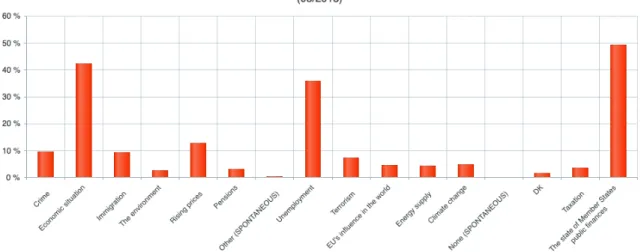
In Graph 1, the responses of the survey, “What do you think the two most important issues facing the EU at the Moment? (5/2013), show that 42% of German participants believe that the economic situation of the EU is one of the two most important issues the EU is facing in.
If the Euro were to lose its value, the German economy and its citizens would suffer. The graph also shows that 49% of German participants believe that the state of Member States public finances is one of the two most important issues the EU is facing. These results indicate that German participants felt threatened by the inadequacy of other EU Member States, and were concerned about their ability to regulate their markets. Once again, if the Euro were to fail, not because of the German economy or its political leaders, but because of another EU Member State, German citizens would suffer because of it.
Graph 1. Graph was retrieved from ec.europa.eu
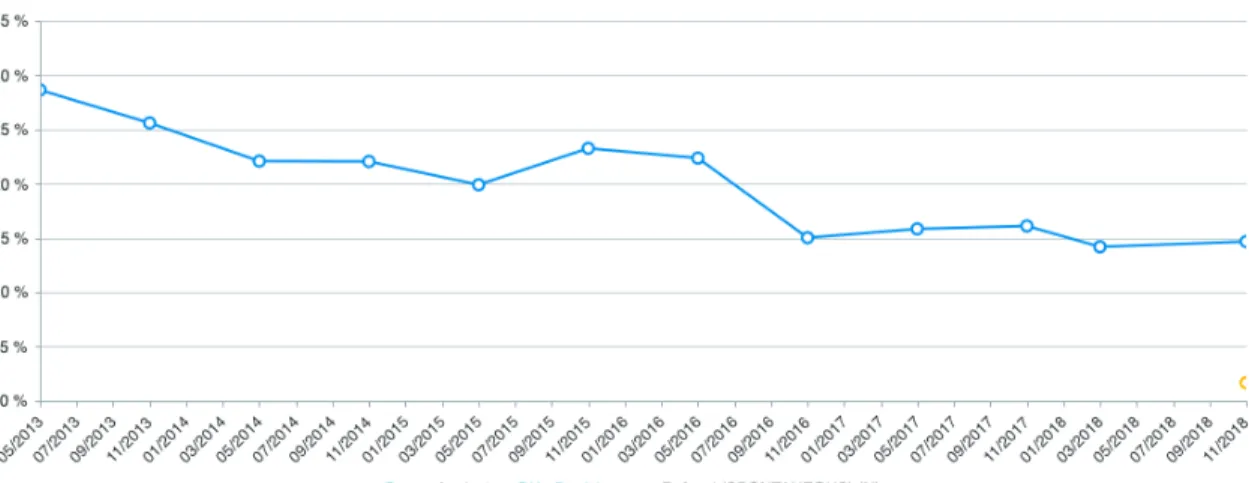
According to Graph 2, in May of 2013, 29% of German participants were against Germany’s use of the Euro. This was an all time high for this response, which indicated that the need for economic variation in German politics was particularly relevant to voters before the 2013 federal elections.
Graph 2. Graph was retrieved from ec.europa.eu
After the AfD’s failure to reach the Bundestag, voter disapproval of the Euro began a gradual decline. Graph 2 shows that, over time, participants were not as adamantly against the Euro, as they had been in May of 2013. Other than a brief spike in 2015, which was most likely due to the implementation of monetary policies for immigration, the decreasing concern for Germany’s future with the Euro indicated that the need for economic variation in politics was no longer as crucial to voters. The demand that this topic be discussed at length in politics was no longer as significant to voters. As the AfD’s primary policy focus lost its influence on mobilizing voters, there was a massive influx of immigration throughout Europe.
Cultural Protection
The influx of immigrants in Europe sparked nationalist and xenophobic debates all over the EU. Citizens began to resent immigrants and refugees in their states.
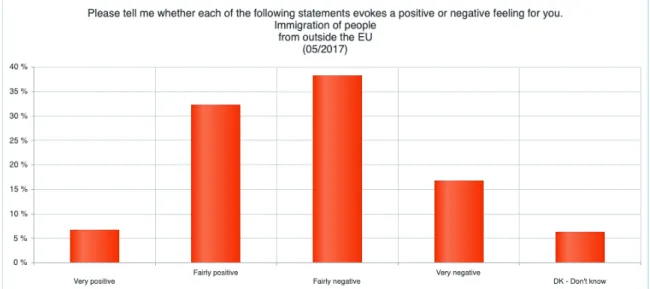
According to graph 3, the results of the survey of whether immigration from people outside the EU evoked positive or negative feelings from them, 55% of participants stated that the thought evoked negative feelings (38% reported fairly negative feelings; 17% reported very negative feelings). Even though over 50 percent of participants report feeling this way about immigrants from outside the EU, the two largest parties within the Bundestag do not address it.
To voters, this can be seen as these parties are either ignoring the problem it, or do not take it as seriously as their constituents.
Graph 3. Graph was retrieved from ec.europa.eu
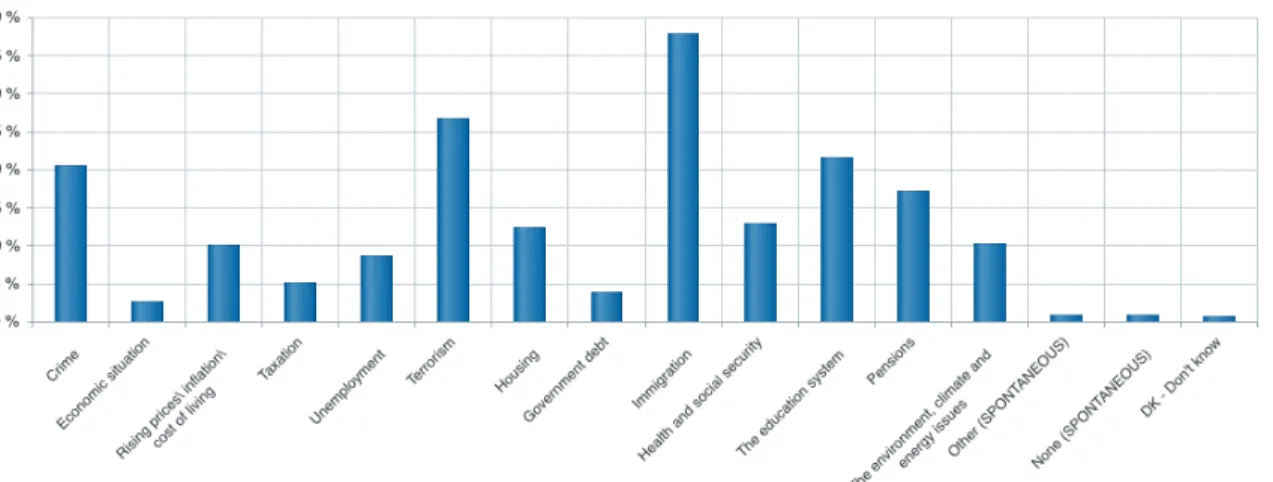
In Graph 4., survey participants reported that the two biggest issues that Germany is facing in May of 2017 is Immigration, at 38%, and Terrorism at 26%. Once again, voters are expressing their concerns to the increasing number of immigrants. These two categories are linked to the influx of immigrants and the membership of the EU, both of which the AfD provides an alternative platform to those in Parliament
Graph 4. Graph was retrieved from ec.europa.eu
These surveys provide quantitative proof of various forms of the demand for opposition.
The goal of political parties is to mobilize voters to gain power within the government. In order to attract voters to their platform, political parties must supply enough voters with their needs.
Chapter 3: Supplying a Nation Shifts in Manifestos
Before one can understand why the Alternative für Deutschland had such strong support in the 2017 German federal election, it is important to evaluate the various policies that the AfD calls for in its manifesto. Political scientists and media analysts struggle to accurately define the AfD. This could be a result of the hybrid nature of the party, its tumultuous history, or its stark shifts from its original party program to its 2017 manifesto.
A party’s manifesto is important to how it’s interpreted by the media and its overall direction for future policies. The AfD’s manifesto focus shifted a great deal between 2013 and 2017. The 2013’s version primarily focused on opposing Merkel’s and the EU’s economic policies.
In Arzheimer’s article, “The AfD: Finally a Successful Right-Wing Populist Eurosceptic Party for Germany?” he disproves that the AfD is a populist party through analyzing the party’s 2013 manifesto through a quantitative analysis of the types of words that the AfD used.
According to the study, Arzheimer places the AfD the left of the CSU (Arzheimer, 2015).
Arzheimer disputes the media’s labeling of the AfD as a far right party, because of its lack of certain characteristics traditionally defined as populist. The AfD has since redesigned its manifesto and overall message, and therefore this literature must be expanded and built upon.
However, by utilizing populism, nationalism, and Euroscepticism, the 2017’s manifesto was able to supply opposition to voters with varying needs of opposition. The three theories of
populism, nationalism, and Euroscepticism are themes that arise in the 2017 manifesto. It is the unique combination of these three that helped the AfD consolidate voter support during the 2017 election cycle.
Over the course of 4 years, voter support of the AfD increased from 4.7% to 12.6%. Such numbers are unheard of in the Bundestag’s history. Themes of populism, nationalism, and Euroscepticism within the 2017 manifesto helped to shape what it was supplying to voters. By creating a new party manifesto that combines elements of protecting common citizens from exploitation, establishing national pride and cultural identity, and placing restrictions on outside influence on national sovereignty, the AfD effectively mobilized traditional non-voters,
marginalized right-wing supporters, and disgruntled centrist supporters respectively.
Themes of Populism
Themes of populism arise several times throughout the manifesto. In fact, before the AfD even mentions any type of policy proposal, the party leads off with the fact that “(they) have come together as citizens with different back- ground, experience, qualifications and political careers…(They) share a firm conviction that citizens have the right to true political alternatives, not only those presented by the political class” (Alternativ für Deutschland , 2017, p. 5). This presents the AfD as a group of citizens rather than a group of politicians, and places them and their constituents on equal grounds from the very beginning of the document. They are claiming that this is a fight between ‘us’, the common people, and them, the political class. By using this
“us” versus “them” mindset, the AfD is able to instill a type of psychological connection from one voter to another.
Another example of the AfD’s strategic use of populism in their manifesto draws the reader back to the party’s original focus. “(They) call for an end to the Euro experiment and its
orderly dissolution. Should the German Federal Parliament not agree to this demand, Germany’s continued membership of the single currency area should be put to a popular vote” (Alternativ für Deutschland , 2017, p. 17). The political leaders who drafted this document know that the demand for a popular vote over something as complex as the Euro is extremely difficult, if not impossible. However, by framing the statement in this way, it highlights the powerlessness of a common German citizen to change their economic situation, even if they wanted to. It also illustrates that the AfD is not unreasonable. They want to allow the people to decide on whether or not Germany continues to use the Euro as its national currency. By denying that right, it only strengthens the divide between citizens and political elites.
The AfD is able to construct a narrative using populist themes to mobilize traditional non-voters. By constructing a narrative that democracy is failing them, non-voters support of the AfD dramatically increases from 2013 to 2017. Non-voters could have been prompted to vote for the AfD since they were the only party offering talks immigration reform, as it too is connected to the populist rhetoric of the AfD. An example of the “Negative developments in the field of asylum and immigration are not addressed in order to prevent a turnaround in public opinion. At the same time, the ruling German political parties have tried to disguise the complete failure of their policies on asylum and immigration of recent years. An open discussion is prevented in this way” (Alternativ für Deutschland , 2017, p. 57). This portrays the government as untrustworthy, and censoring the truth from the people. The AfD is claiming that the government has been outright dishonest to citizens about immigration, simply because of the paralysis that is political correctness.
Themes of Nationalism
The Alternative für Deutschland is a specific type of nationalist party. As Brubaker described in his article, there is a slight, but noteworthy, distinction between a nationalist and a nationalist-populist party. Nationalist populist parties tend to advocate for the freedom of speech, the rights of hard-working citizens, and the aid to struggling citizens, while nationalist parties focus on reiterating who is and is not a part of the nation (Brubaker, 2017).
By claiming that when citizens wish to discuss issues of immigration, “(n)obody should be afraid of voicing an opinion on this controversial topic. The fundamental right of freedom of speech must be re-established when dealing with this policy area,” the AfD is able to blend themes of nationalism and populism together (Alternativ für Deutschland , 2017, p. 57). The freedom of speech is a common characteristic of nationalist-populist parties. However, as
Brubaker points out in his article, they are very particular in the freedom of speech that they wish to defend. “(T)hey have defended freedom of speech against what they claim is a dictatorship of political correctness. But they are not interested in defending speech in general; they are
especially interested in defending speech that is critical of Islam and Muslims” (Brubaker, 2017, p. 1204).
The AfD is able to use nationalist-populist rhetoric to generate support with varying political ideological stances. By applying this tone to their immigration policy, the AfD is able to include some left ideologies in its manifesto. “… political parties currently in government (are in) support (of) mass immigration, mainly from Islamic states, without due consideration of the needs and qualifications of the German labour market” (Alternativ für Deutschland , 2017, p.
41). Through this statement, the AfD is creating a narrative that undermines the entire left side of the political spectrum.
It is the goal of the left to preserve the German labor force, because communism is supported on the backs of the working force. The SPD has traditionally been the party of the working class citizen and trade unions. For the Green party, though environmentalism remains its primary focus, it has also tried to a push a leftist agenda on tax and social policy. However, all three of these parties, according to the AfD, are failing their constituents by not being able to insure their job security against the growing number of immigrants.
Another example of nationalism within the party’s 2017 manifesto is the statement that
“(Europe) is characterized by different national and regional traditions, which lend it its uniqueness” (Alternativ für Deutschland , 2017, p. 15). Because this statement highlights the uniqueness of nations and regions, it makes the reader relate back to the concept of Heimat. It pushes the reader to consider what makes his or her own nation and region unique in a broader context. This, in turn, furthers the nationalism mindset of what is and is not a part of a national identity or culture.
“It is one of the primary political goals of the AfD to preserve the great cultural heritage for future generations, and to develop and retain its unique characteristics in an age of
globalisation and digitalization” (Alternativ für Deutschland , 2017, p. 46). As Anderson said, a nation is limited because its boundaries are ‘finite’ (Anderson, 2006). There is a point where one nation stops and another begins. Nevertheless, it is easier to define what is not German, than to define what is. However, this imagined identity is protected fiercely by the AfD’s manifesto against outside threats, such as migrants from EU member states.
Themes of Euroscepticism
After the Euro crisis, the growing political need to represent the feeling of
“Euroscepticism” led right wing parties throughout Europe to absorb this platform into their