AN UNDERGRADUATE THESIS
IMPROVING STUDENTS’ WRITING ABILITY BY USING SRSD (SELF REGULATED STRATEGY DEVELOPMENT) AT THE EIGHT
GRADERS OF MTS AL ASROR SEKAMPUNG
By : Pyngki Soraya Student Number: 13108087
Tarbiyah and Teacher Training Faculty English Education Department
THE STATE INSTITUTE FOR ISLAMIC STUDIES OF METRO 1439 H / 2018 M
ii
AN UNDERGRADUATE THESIS
IMPROVING STUDENTS’ WRITING ABILITY BY USING SRSD (SELF REGULATED STRATEGY DEVELOPMENT) AT THE EIGHT
GRADERS OF MTS AL ASROR SEKAMPUNG
By : Pyngki Soraya Student Number: 13108087
Tarbiyah and Teacher Training Faculty English Education Department
THE STATE INSTITUTE FOR ISLAMIC STUDIES OF METRO 1439 H / 2018 M
iii
iv
v
vi
vii
IMPROVING STUDENTS’ WRITING ABILITY BY USING SRSD (SELF REGULATED STRATEGY DEVELOPMENT) AT THE EIGHT
GRADERS OF MTs AL ASROR SEKAMPUNG ABSTRACT
BY
PYNGKI SORAYA
The aim of this research is to show that self regulated strategy development can improve the writing ability of the tenth graders of MTs Al Asror Sekampung.
The problem which had been identified was the students had difficulties to express their ideas to practice their writing in the classsroom. The researcher used self regulated strategy development to improve students’ writing ability. Self regulated strategy is an instructional approach designed to improve a writer’s strategy knowledge, and motivation.
The researcher did Classroom Action Research. In order to get the accuracy in data collecting, the researcher used data collecting technique such as test (pre- test and post test), observation, and documentation. This research used two cycle that consisted of four stages: planning, acting, observing and reflecting for each cycles. This research was conducted on November 15th , 2017 until November 30th , 2017 that involved the tenth graders which consisted of 18 students.
The result of the research showed that précis writing strategy increase the students writing ability and also students’ learning activities. It proved by the result of the students vocabulary score. The students who got score 60 or more was 6 students (33,33%) at pre test, 7 students (38,89%) at cycle I, and 16 students (88,89%) at cycle II. It achieved the indicator of success where 75% of students got score 60 or more.
Considering the result of the data above, it can be concluded that self regulated strategy development can improve the writing ability of the eighth graders of MTs Al Asror Sekampung. The students had more opporunities to gain and practice their writing in the classroom.
(Keyword :Writing ability, Self Regulated Strategy Development Classroom Action Research)
viii
MENINGKATKAN KEMAMPUAN SISWA DALAM MENULIS MENGGUNAKAN STATEGI REGULASI DIRI PADA KELAS DELAPAN
MTs AL ASROR SEKAMPUNG ABSTRAK
OLEH PYNGKI SORAYA
Tujuan penelitian ini adalah untuk menunjukan bahwa strategi regulasi diri dapat meningkatkan kemampuan menulis siswa kelas delapan di MTs Al Asror Sekampung. Hal ini terkait dengan identifikasi masalah bahwa siswa kesulitan dalam mengungkapkan pemikiran untuk praktik menulis di dalam kelas.peneliti menggunakan strategi regulasi diri untuk meningkatkan kemampuan menulis siswa. Strategi regulasi diri adalah model pendekatan belajar untuk meningkatkan kemampuan menulis siswa, dan motivasi siswa.
Dalam penelitian ini, peneliti melaksanakan penelitian tindakan kelas yang dilakukan dalam dua siklus. Setiap siklus terdiri dari perencanaan, pelaksanaan, observasi dan refleksi. Dalam pengumpulan data, peneliti menggunakan tes (pre- test, post test 1 and post test 2), observasi dan dokumentasi. Objek penelitian adalah 18 siswa kelas delapan MTs Al Asror Sekampung. Penelitian ini berlangsung dari tanggal 15 November 2017 sampai tanggal 30 November 2017.
Hasil dari penelitian ini menunjukkan bahwa strategi regulasi diri dapat meningkatkan kemampuan menulis siswa. Peningkatan ini dapat dilihat dari kemajuan nilai siswa yang mendapatkan nilai lebih dari 60 di pre-test adalah 6 siswa (33,33%), di post-tes I 7 siswa (38,89%), di post-tes II adalah 16 siswa (88,89%). Pencapaian nilai lebih dari 60 telah mencapai indikator sukses yaitu 75%.
Kesimpulan dari penelitian ini adalah, strategi regulasi diri dapat meningkatkan kemampuan menulis siswa kelas delapan MTs Al Asror Sekampung. Siswa berkesempatan untuk lebih berlatih menulis di dalam kelas.
(Kata Kunci :Kemampuan menulis, Strategi Regulasi diri, penelitian tindakan kelas)
ix
x
xi MOTTO
Who made the earth a resting-place for you, and placed roads for you therein, that may find your way. (Q.S Az-Zukhruf: 10)
“when there is a will, there is a way”
xii
DEDICATION PAGE
I highly dedicate this undergraduate thesis to:
My beloved parents
(Mr. Suhardi and Mrs. Sugiyatmi) My beloved old sisters
(Devia Safitri,S.Pd) My beloved friends of TBI ‘13
My Alamamater IAIN Metro
xiii
ACKNOWLEDGEMENT
In the name of Allah, the Most Gracious, the Most Merciful. Praise is only to Allah SWT, the Lord of the worlds whom without His Mercy and Blessings, none of these would be possible. Thanks also to our idol of life, the man of perfection, Prophet Muhammad SAW, his families and companions. Finally the researcher can accomplish this proposal entitles “IMPROVING STUDENTS’ WRITING
ABILITY BY USING SRSD (SELF REGULATED STRATEGY
DEVELOPMENT) AT THE EIGHT GRADERS OF MTS AAL ASROR SEKAMPUNG”
Regarding to the undergraduate thesis, the researcher offers her big thank to the Mr. Dr. Mahrus As’ad, M.Ag as the sponsor and to Syahreni Siregar, M.Hum as the co-sponsor. May Allah SWT gives them His better reward for their spending time to support and guide during the proposal writing process.
As human being, the researcher completely realizes that this undergraduate thesis still has a plenty of weaknesses. The researcher does apologizes for all mistakes made in writing and presentation items. All constructive comments and suggestions are very welcomed to measure the quality of this proposal. Hopefully, this proposal can be a meaningful benefit for the other researchers, our campus and all readers generally.
Metro, November 02th, 2017 The Researcher,
Pyngki Soraya St.N. 13108087
xiv
TABLE OF CONTENTS
COVER ... i
TITLE PAGE ... ii
APPROVAL PAGE ... iii
NOTIVICATION LETTER ... iv
ABSTRACK ... vii
STATEMENT OF RESEARCH ORIGINALITY ... ix
MOTTO ... xi
DEDICATION PAGE ... xii
ACKNOWLEDGEMENTS ... xiii
TABLE OF CONTENS ... xiv
LIST OF TABLE ... xvii
LIST OF FIGURE ... xviii
LIST OF CHART ... xix
LIST OF APPENDIX ... xx
CHAPTER I INTRODUCTION A. Background of the Study ... 1
B. Problem Identification ... 13
C. Problem Limitation ... 13
D. Problem Formulation ... 13
E. Objectives and Benefits of The Study ... 14
1. The Objectives of the Study ... 14
2. Benefits of the Study ... 14
CHAPTER I I REVIEW OF THE RELATED THEORIES A. Theoritical Review ... 15
1. Concept of Writing ... 15
2. Concept of Writing Ability ... 17
3. Kinds of Writing ... 18
4. The Types of Writing ... 20
xv
5. Process of Writing ... 21
6. Component of writing ... 22
B. Self Regulated Strategy Development ... 27
1. The Concept of Self Regulated Strategy Development ... 27
2. Models of Self Regulated Strategy development ... 28
3. The Characteristic Of Self Regulated Strategy Development ... 29
4. The Procedures of Self Regulated Strategy Development ... 30
5. The Function of Self Regulated Strategy Development ... 33
C. Action Hypothesis ... 34
BAB III RESEARCH METHODOLOGY ... 35
A. The Operational Definition of Variable ... 35
1. Independent Variable (X) ... 35
2. Dependent variable (Y) ... 35
B. Setting and Subject of the ... 35
C. Object of the Study ... 35
D. Action Plan ... 36
1. Cycle 1 ... 39
2. Cycle 2 ... 41
E. Data Collection Technique ... 43
1. Test ... 43
2. Observation ... 44
3. Documentation ... 44
F. Data Analysis Technique ... 44
G. Indicators of Success... 45
CHAPTER IV RESULT OF THE RESEARCH AND DISCUSSION A. Result of the Research ... 40
1. Description of the Research Location ... 40
2. Description of the Research Data ... 42
B. Discussion ... 70
xvi CHAPTER V CONCLUSION
A. Conclusion ... 73 B. Suggestion ... 73
BIBLIOGRAPHY APPENDIX
CURRICULLUM VITAE
xvii
LIST OF TABLES
Table 1 The Percentage of Students’ writing Score ... 4
Table 2 The Measurement Rubrics of Writing ... 16
Table 3 Data of the Subject of the Study ... 30
Table 4 Data of Teacher ... 40
Table 5 Data of Administration Staff ... 41
Table 6 Total the Students ... 43
Table 7 Total the Students... 43
Table 8 The List of Students Name Class ... 44
Table 9 The Students' Pre-test Result of writing ability ... 45
Table 10 The Frequency of the Students’ Score in Pre-Test ... 46
Table 11 Students’ Writing Score Post Test 1 ... 49
Table 12 The Frequency of the Students’ Score in Post Test 1 ... 50
Table 13 The Result of the Students Activity in the Teaching and Learning Process in Cycle I... 52
Table 14 The Result of the Students Activity in the Teaching and Learning Process in Cycle I ... 54
Table 15 The result of the students’ writing score (post test II) ... 57
Table 16 The Frequency of the Students’ Score in Post Test II... 58
Table 17 The Result of the students Activity in the teaching and learning process in Cycle II ... 60
Table 18 The Result of the Teacher Activity in the Teaching and Learning Process in Cycle II ... 62
Table 19 The result of students writing score in pre test and post test I ... 64
Table 20 The Result of Students writing Score in Post Test I and Post Test II 66 Table 21 The Recapitulation of Students’ increase in writing Score ... 68
Table 22 The result of the Teacher’s Activity in Cycle I and Cycle II ... 70
Table 22 The result of the Teacher’s Activity in Cycle I and Cycle II ... 71
xviii
LIST OF FIGURES
Figure 1 McKernan ... 32 Figure 2 Organization Structure MTs Al-Asror Sekampung ... 42 Figure 3 Location MTs Al-Asror Sekampung ... 43
xix
LIST OF CHART
Chart 1 The Frequency of the Students’ Score in Pre-Test ... 48 Chart 2 Result of the Students at the Post test 1 ... 51 Chart 3 The Result of the Students Activity in the Teaching and Learning
Process in Cycle I... 54 Chart 4 The Result of the Teacher Activity in the Teaching and
Learning Process in Cycle I ... 56 Chart 5 Result of the Students writing Score in the Post Test II Cycle I ... 59 Chart 6 The Result of the students Activity in the teaching and Learning
process in Cycle II ... 62 Chart 7 The Result of the Teacher Activity in the Teaching and Learning
Process in Cycle II ... 64 Chart 8 The Result of Students Writing Score in Pre Test and Post Test 1 ... 66 Chart 9 The Result of Students writing Score in Post Test I and Post Test II . 68 Chart 10 The Result of Students writing Score in Pre Test Post Test I and
Post Test II ... 70
xx
LIST OF APPENDIX
1. The syllabus of the eighth grade of MTs Al-Asror Sekampung.
2. The lesson plan of the eighth grade of MTs Al-Asror Sekampung.
3. The instrument of students writing test 4. The table of students’ writing score
5. The observation sheet of the students’ activity.
6. The table of the students’ attendance list.
7. Photograph documentation.
8. Field note.
9. The letter
1 CHAPTER I INTRODUCTION
A. Background Of The Study
Language is one of the most important things in communication and it is used as a tool communication among the nations in all over the world. As an international language, English is very important and has many interrelationships with various aspects of life owned by human being. English has been learned since early childhood education till university. In learning process, there are four basic skills that must be mastered by student. They are listening, speaking, reading, and writing.In Indonesian English is taught at school from ElementarySchool, JuniorHighSchool and SeniorHighSchool to University as a foreign language. Therefore, English becomes important in today’s era as a means of transferring science, technology, art, culture, and also to maintain good relationship with others countries.
In learning process, writing is one of important skills which is taught in school. Writing is language skill that can be used to communicate and to express with other in written form. Based on the statement, writing is very important because writing can help you to express our idea, feeling, and expanding our knowledge.
The goal of teaching learning at Junior High School is that the students must be able to develop communicative competence in written as well as in spoken to achieve functional literacy level. They are expected to be able to
communicate both in spoken and written form to solve problems in their daily lives. In this curriculum, the English material is taught based on the text. One of the texts that have to be learnt by the students of Junior High School is the students have to be able to understand and create a cohesively based on the social function and generic structure of the text. In this study focused on teaching writing of the text.
Most of the students’writing abilityare far away from their learning target.
Students know or have the ideas what they are going to write but they do not know how to put them into words. Some students cannot build a good sentence and express their ideas in written form although they might know what would be written. They still could not understand or create a although the teacher had explained it.
Based on the data of pre survey at MTs Al AsrorSekampung especially at eight graders, the student’s writing ability is still low, the students have difficulties to improve their writing ability, the students have less self regulated, some students did not respond in following the English lesson.
3
Table 1
The Percentage of Pre Survey Score Writing at The Eighth Graders of Mts Al-AsrorSekampung.
No
Interval of Score
Category Frequencies Percentages
1. ≥ 60 Pass 5 28 %
2. ≤60 Fail 13 72 %
Total 18 100 %
Source: taken on the pre-survey at November 05,2016
From the table above, we can see that there are 5 students passed level for the score ≥60 (28%), and 13 students failed level for the score ≤60 (72%).
According to this table only 5 students can do well. It means 13 students in class VIII are low in writing . The ability to write is still poor because the average grade is 55 in MTs Al-Asror Sekampung.
Based on the table the study know that the good gramatical becomes the problem in writing English. Concerning the problems that the students faced when they try to express their ideas into written form, a teacher should choose an appropriate technique in teaching and learning is one of the ways to solve the problems. It is needed in order to make the students be motivated in writing English in the classroom.
There are many technique to make English teaching especially writing is eaasy,fun interesting and not bored. One of the techniques which can be
applied in English writing is Self-Regulated Strategy Development. The studyerchose this a technique to increase the students’ writing ability because it gives the opportunity for the students to develop their own idea.
It means that the technique that used by the teacher be appropriate yet with the material and the situation of student’s need. That is a reason why the studyer interests to use Self-Regulated Strategy Development by classroom action study.
B. Problem Identification
Referring to the background above, the problems can be identified as follows:
1. The students have low motivation in English subject,especially in writing ability.
2. The students have difficulties to improve their writing ability.
3. The students are lack motivation in the study English.
4. The students have less self regulated.
5. Some students do not respond in following the English lesson.
C. Problem Limitation
Based on the problem identification above, there are several problems which experienced by rhe students, but the studyer limits the problem only focused on the some students difficulties to improve their idea in writing by
5
using SRSD at the eighth graders of MTs Al Asror Sekampung in Academic 2017/2018.
D. Problem Formulation
Based on the problem above, the formulation of the problem is as follows:
“Can the use of self regulated strategy development improve the students writing ability at the eighth graders of MTs Al Asror Sekampung in academic years 2017/2018.
E. Objective of the Study
The objective of the study to show that using self regulated strategy developmentcan improve the students writing ability.
F. Benefits of the Study 1. For Teacher
As information for the English teacher,especially in MTs Al- AsrorSekampung. Self Regulated Strategy Development is effective to be used in teaching writing ability.
2. For Students
As facilitator to help the students in wrting ability. The students can express their idea with their learning from the teacher.
3. For The Study
By this study, the studyer will improve the students writing ability to optimal result in teachng learning process.
7 CHAPTER II
REVIEW OF THE RELATED THEORIES A. Theoritical Review
1. Concept Of Writingand Writing Ability a. Concept of Writing
In English learning there are four skills that must be mastered by students, those are listening, speaking, writing, and reading. Writing is one of language skills and productive skill that will be learnt by students in junior high school, senior high school, and University. All of skills are important to learn about English directly. Student will be able to express their idea and feeling by English writing.
According to Peter Knapp, writing is “the most importantmeans of access to the vast repository of knowledge of literate cultures.Those facts alone demand that students in school should gain thefullest, deepest, and richest means of using the cultural technology ofwriting.
Equity of access and full participation both rest on that.”1 Writing is
“forms of communication that use themedium of language, but they do so quite differently. It is usual to thinkthat they are simply different aspects of the same thing”.2
Writing is important “to know as much as possible about your readers. Knowing your readers will help you decide what to say and
1Peter Knapp and Megan Watkins, Genre, Text, Grammar: Technologies for Teaching and Assessing Writing,(Sydney: A UNSW Press Book, 200)5, p. 7
2Ibid, p. 15
how to say it”3. Writing skill deals with the ability to arrange the graphic system such as letter, words, and sentences of certain language being used in written communication in order that the reader can understand the message or the information.
Furthermore, Lucy Pollard says that writing is a productive skill and, as such, the way we treat it in class has some similarities with the teaching and learning of speaking.4
Make Sharples suggested that writing is solitary task, but a writer is immersed in a world of social and cultural influences. Writing is both solitary and collaborative, in that writer often work alone, but with language that has involved in society, drawing on the ideas and texts of other.5
Writing is the one of the basic skills of the English language. It is generally consideredone of the most difficult that other skills for foreign language students.6 Moreover writing is a way of sharing personal meanings and writing courses emphasize the power of the individual to construct his or her own view on a topic.7
Based on the definition above, the studyer can conclude that writing is the activity of transfer the information to the other in written form.
3 Ferguson, Careers Skills Library: Communication Skill, 2nd ed.,( New York: An Imprint of Facts On File, Inc., 2004), p. 14
4 Lucy Pollard, Lucy Pollard’s Guide to Teaching English A Book to Help You Through Your First Two Years in Teaching, 2008), p. 49
5 Make Sharples, How We Write, (New York: 1999), p. 11.
6Javed, Juan, and Nazli, “A Study of Students’ Assessment in Writing Skills of the English Language”,International Journal of InstructionVol.6, No.2,(2013) p.130.
7 Ken Hyland, Second Language Writing, (City University of Hong kong, 2003 ),p.9
9
Furthermore, brown argues that written products are often the result of thinking, drafting, and revising procedures that require specialized skills, skills are not every speaker develops naturally.8
Based on the quotation above, the writer concludes that writing is one language skills which combine to express, process, and productive skill that can be used ideas, and speech sound which is by public books, paper, magazine, and writing letters.
b. Concept of Writing Ability
The word ability in Oxford Advanced Learner’s Dictionary can be defined as:
a. To do something the fact that somebody/something is able to do something.
b. A level of skill or intelligence.9
Not Only that, the word ability can be defined as:
a. The quality of being able to do something, especially the physical, mental, financial, or legal power to accomplish something.
b. A skill, talent, or capacity.
c. The quality of being suitable for or receptive to a specified treatment, capacity, the ability of a computer to be configured for use as a file server.10
8H. Douglas Brown, Teaching by Principles An Interactive Approach to Language Pedagogy 2nd ,(New York: Addison Wesley Longman, 2001), p. 335.
9 A.S Homby, Oxford Advanced Learner;s Dictionary, Eight Editions, (New York:
Oxford University Press, 2010), p. 2.
Based on statement above, the writer can conclude that ability is talent or skill which by person to do something activities in life.
Thus, by writing ability means the levels of skill of mental activity to do something or produce useful written text which is the result in a text able to convey message between writer and rider in good communicate.
c. Kinds of Writing
In generally, there are three kinds of writing namely academic writing, personal writing, and creative writing. Alice and ann explained that Academic writing is the kind of writing used in high school and college classes. Academic writing is different from creative writing and personal writing. Creative writing is the kind of writing you do when you write stories. Personal writing is the kind of writing you do when you write letters or e-mails to your friends and family. Beside that, creative writing and personal writing are informal and academic writing is formal.11
Academic Writing is a new kind of writing course for all international students who have to write exams or coursework in English. Academic Writing allows both teachers and students to quickly find the help they need with all writing tasks.12
Academic writing is divided into four parts there are:
10 http://www.the freedictionary.com/ability, Ability, 3-9-2015
11 Alice Oshima& Ann Haque, Introduction to Academic Writing, (The United State of America: Longman, 2007), 3th Edition, p.3
12 Stephen Bailey, Academic Writing A Hanbook for International Students Second edition, (USA and Canada: Routledge), 2006. p.2
11
1) The writing process, guides students from the initial stage of understanding the essay title, trough note making and paraphrasing, to the organization of the essay and finally proof-reading.
2) Elements of writing, deals with the skills that are needed for most types of assignment, such as making comparisons, giving examples and describing graphs.
3) Accuracy in writing, gives remedial practice in those areas that students often find confusing, such as using articles, passives or prepositions.
4) Writing models, offers examples of the type of writing that students commonly need, including letters and survey reports as well as assays.13
Beside that personal writing is subjective, it means that personal writing is based on personal opinions or feelings rather than facts or evidence. The content of personal writing is based on our own observation, experience, or opinion.14 It means that personal writing produce the write that on own observation, experience or opinion.
After that creative writing may be defined as having the power to create an imaginative, original literary production or
13 Stephen Bailey, Academic Writing,.p.vii
14http://awc.ashford.edu/tocw-personal-writing.html, access on may 14, 2017
composition and can be applied to avery broad spectrum of writing genres.15
c. Type Of writing 1) Descriptive
Descriptive writing appeals to the senses, so it tells how something looks, feels, smells, tastes, and/or sounds. A good description is a word picture; the reader can imagine the object, place, or person in his or her mind.16
2) Narrative
Narrative is story writing. When you write a narrative paragraph, you write about events in the order that they happen.
In other words, you use time order to organize your sentences.17
3) Argumentation
Argumentation is a text in which you agree or disagree whit a problem, using reasons to support your opinion, your goal is to convince your reader that your opinion is right. Its means that argumentation is used to make a case or to prove or disprove a statement or proposition.
15Adele Rahmet, Creative Writing: How to Unlock Your Imagination, Develop Your Writing Skills-and Published, (United Kingdom: Spring Hill Road), 2007. p.xi
16 Alice Oshima& Ann Haque, Introduction to Academic Writing,.p.61
17Ibid,p.24
13
4) Expository
Expository paragraphs deal with facts, ideas, beliefs. it explain, analyze, define, compare, illustrate. They answer questions like What? Why? How? What was the cause? The effect? Like what? Unlike what? They are the kinds of paragraph we write in reports or term papers or tests.18
d. Process of Writing
Writing is not easy, more than more than picking up a pen and putting the words on paper Writing is a recursive process, which means students revise throughout the process, frequently moving back and forth among the stage. So, when the learners want to write, must know steps writing process.
In the following section, we examine this question in the context of the stages of the writing process: prewriting,drafting, revising and editing. A brief description of each stage follows:
1) Prewriting: the period where writers get ready to write-gathering information, organizing ideas, identifying audience and purpose, and selecting genre.
2) drafting: the prodution stage of getting ideas down using complete sentences and reflecting the general conventions of writing.
18 Thomas S. Kane, Essential Guide to Writing, (New York: Oxford University Press, 2000), p. 89
3) Revising: the time when writers review their work, checking for clarity of message, word choice, and organization.
4) Editing: the process of checking written work for the conventions of writing and any lingering concerns with voice ,tone and style.19 e. Component of Writing
Writing involves the mastery of all elements in target language such as content, organization, vocabulary, language use, and mechanics. It involves complex process. There are five general categories in writing, they are:
According to Jacobs (1981) the criteria of each writing score are:
content (13-30), organization (7-20), vocabulary (7-20), language use (5-25) and mechanic (2-5). So the total of the score of writing skill is 100.
Table 2
The Measurement Rubrics of Writing Essay Performance Writing
performance
Score Criteria Criteria
Content
30-27
26-22
21-17
Excellent to Very Good
Good to Average
Fair to Poor
Knowledgeable, substantive, development of thesis, relevant to assigned topic.
Some knowledge of subject, adequate range, limited development of thesis, mostly relevant to topic, but lacks detail.
Limited knowledge of subject, little
19Vicki Urquhart and Monette Mclever. Teaching Writing in the Content Areas,Association for supervision and Curriculum Development, Virginia, 2005. p.11
15
16-13
Very poor
substance, inadequate development of topic.
Does not show knowledge of subject, non-substantive, not pertinent, or not enough to evaluate.
Organization
20-18
17-14
13-10
9-7
Excellent to Very Good Good to Average
Fair to Poor
Very Poor
Fluent expression, ideas clearly stated/ supported, succinct, well- organized, logical sequencing, cohesive.
Somewhat choppy, loosely organized but main ideas stand out, limited support, logical but incomplete sequencing.
Non-fluent,an ideasconfusedor disconnected, lacks logical sequencing and development.
Does not communicate, no organization, or not enough to evaluate.
Vocabulary
20-18
17-14
13-10 9-7
Excellent to Very Good
Good to Average
Fair to Poor Very Poor
Sophisticated range, effective word/idiom choice and usage, word from mastery, appropriate register.
Adequate range, occasional errors of word/idiom form, choice, usage but meaning not obscured.
Limited range, frequent errors of work/idiom form, choice, usage, meaning confused or obscured.
Essentially translation, little knowledge, of English vocabulary, idioms, word form, or not enough to evaluate.
Language Use
25-22
21-18
17-11
10-5
Excellent to Very Good
Good to Average
Fair to Poor
Very Poor
Effective complex constructions, few errors of agreement, tense, number, word order/function, articles, pro- nouns, preposition.
Effective but simple constructions, minor problems in complex constructions, several errors of agreement, tense, number, word order/function, article, pronouns, prepositions, but meaning seldom obscured.
Major problems in simple/complex constructions, frequent errors of negation, agreement, tense, number, run-ons, deletions, meaning confused or obscured.
Virtually no mastery of sentence construction rules, dominated by errors, does not communicate, or not enough to evaluate.
Mechanic
5
4
3
Excellent to Very Good
Good to Average
Fair to Poor
Poor
Demonstrates mastery of conventions, few errors of spelling, punctuation, capitalization, paragraphing.
Occasionalerrorsofspelling,punctuati on, capitalization, paragraphing but meaning or obscured.
Frequenterrorsof spelling,
17
2 punctuation, capitalization,
paragraphing, poor handwriting, meaning confused or obscured.
No mastery of conventions, dominated by errors of spelling, punctuation,
capitalization,paragraphing, hard writing illegible, or not enough to evaluate.20
In conclusion, there are some criteria to measure the students’ especially in writing skill and it has each writing score and level of score for each criteria. And all of the score criteria it can be the total score of students’
writing skill.
B. Self- Regulated Strategy Development
1. The Concept of Self- Regulated Strategy Development
Self Regulated Strategy Development (SRSD), a well-studyed program, focuses onteaching writing to learning disabled and at-risk students.
Thisapproach focuses on explicitly teaching both the strategies and the content necessary towrite a coherent essay or paper.21
The self-regulated strategy development (SRSD)is an instructionalapproach designed to improve a writer'sstrategicbehavior,
20BatoulGhanbari, et al. “Rating Scales Revisited: EFL Writing Assessment Context of Iran under Scrutiny” Language Testing in Asia, (Iran: English Department, Faculty of Foreign Languages, University of Isfahan, Issue one), NO. 2/Februari 2012, p.94
21Hacker J.Douglas, Dunlosky John, Graesser C. Arthur, Handbook of Metacognition in EducationNew York: London,2009,P.35
knowledge, and motivation.SRSD instruction focuses on three goals.22It means that self regulated strategy development as a form of students motivation themselves to be able to achieve optimal results in learning.
Then, one empirically validated model for teachingstrategies to less skilled writers with deficits inself-regulation is the self-regulated strategydevelopment (SRSD) approach.23 In aditions The Self-Regulated Strategy Development (SRSD) model of instruction to meet the needs of their studentd, showing their awareness of the need for adaptation after explicit intruction.24 Self-Regulated Strategy Development (SRSD) is an approach to writing which can help language learners learn specific strategies for planning, drafting, and revising text.25
From the statement above, it can be concluded that self-regulated strategy development (SRSD) is an integrated learning process, which occurs the individuals (students) try to adjust their own learning behavior, motivation, and knowledge to be able to achieve optimal results in learning. It is most important that control and goal setting are come from within the students not externally forced.
22Saodler Asaro- Kristie, and Saddler Bruce, “Planning Instruction andSelf-Regulation Training:Effects on Writers WithAutism Spectrum Disorder”,Vol. 77, No.1,2010, p.108
23 Ibid,p.79
24Dean Deborah, What Works in Writing Instruction Study and Practice, United State of America, 2010,p.6
25Roohani Ali, Baghbadorani Elham ,”Impact of Self-Regulated Strategy Development on the Persuasive Writing and Self-Efficacy of Iranian EFL Learners” Iranian Journal of Applied Linguistics (IJAL), Vol. 15, No. 2, (2012), p.108
19
2. The Characteristics of Self Regulated Strategy Development Characteristics of SRSD InstructionThere are five critical characteristics ofSRSD instruction:
a. Strategies, accompanying self-regulationprocedures, and needed knowledge areexplicitly taught, as children with LDtypically require more extensive and directinstruction to master processes andknowledgethat other students acquiremoreeasily.
b. The SRSD model stresses interactivelearning between teacher and students,consistent with the dialectical constructivistviewpoint.
c. Instruction is individualized so that theprocesses, skills, and knowledge targetedfor instruction are tailored to children’sneeds and capabilities. An appropriate modification mightincludegenerating one or more possibleexamplesfor each supporting reason.Instructionis further individualizedthroughthe use of individually tailoredFeedbackand support.
d. Instruction is criterion rather than timebased, as students move through each instructional process at their own pace anddo not proceed to later stages of instructionuntil they have met the criteria fordoingso.
e. SRSD is an ongoing process in whichnew strategies are introduced and previouslytaught strategies are upgraded. 26
26Swanson lee. H, et. al, Handbook of Learning Disabilities, The Guilford Press:New York London, 2003 P.329
3. The Procedures of Self Regulated Strategy Development
a. Develop background knowledge, developing background knowledge sometimes seems so obvious, but in practice it isjust this type of obvious task that is often overlooked. It is critical that students masterprerequisite skills to effectively use a strategy.
b. Discuss it, discussion of the strategy is a more involved process than merely going through thesteps of a strategy. Remember that one major goal of SRSD is to help students developinto self-regulated learners.
c. Model it, modeling is one of the most crucial components of strategy instruction.
d. Memorize, in this stage, students commit to memory the steps that constitute the strategy.
e. Support, supporting the strategy is another critical step in the SRSD process. In this stage, theteacher and student(s) work together collaboratively and practice using the strateguntil the student is able to perform the strategy effectively and independently. Duringthis stage, teachers and students repeatedly model strategy use and discuss how, when,and why to use the strategy.27
So from the statement above, SRSD is aflexible andmodifiable approach that meets thestyles and needs of both
27 Reid Robert,andLienemann Ortiz Torri, Strategy Instruction for Students with Learning Disabilities, The Guilford Press:New York London,2006,p.34-40
21
teacher and student. Self regulated strategy development help the students become fluent especially in writing ability.
4. The Function of Self Regulated Strategy Development
SRSD hasproven to be an effective tool for improving writingachievement forstudents with low writing ability.The SRSD approach integrates findings from studyers and educators whohave focused on cognitive development andlearning, those who have focused on behavior, and those whohave emphasized the role of affect in learning and development. Self-regulated strategydevelopmenthas been used to support students in a variety of academicareasincludingreading,spelling,math,and writing. In writing, the major goals ofSRSD are threefold:
a. Assist students in developing knowledge about writing and powerful skills and strategies involved in thewriting process, including planning, writing, revising, and editing.
b. Support students in the ongoing development of the abilities needed to monitor and manage their ownwriting.
c. Promote children's development of positive attitudes about writing and themselves as writers.28
28Mujibul Hasan siddiqui, Techniques of Teaching Strategies,(New Delhi:Paragon Computer, 2007),p.242
C. Action Hypothesis
Based on the frame of theory, the studyer formulates the action hypothesis as follow:
Using Self Regulated Strategy Development toimprove the studentswriting ability at the eighth graders of MTs Al Asror Sekampung.
23
CHAPTER III STUDY METHOD A. The Operational Definition of Variable
Variable study consist of two variables. The object of study in this study include 2 variable, they are independent variable and dependent variable.
Independent is the variable which selected, manipulated, and measured by the studyer. The two variables can be explained as follows:
1. Independent Variable (X)
Independent variable is a variable which functions to influence to the other variable. The independent variable in this studyis self regulated strategy development. Self regulated strategy developmentwill be effective to improve the students/ writing ability.
2. Dependent variable (Y)
Dependent variable is variable can be influenced by an independent variable. Dependent variable in this study is the students` writing ability.
Writing ability that defined as activities to understanding.
B. Setting and Subject of the Study
The setting of the study is the MTs Al-AsrorSekampung, which is located in DesaSumbersari, KecamatanSekampung, Kabupaten Lampung Timur.The English teacher name is Mr, Ridwan, S.HI. It is one of the school which has not been implemented Self Regulated Strategy Development yet.The writer will ask to the teacher as he collaborator in this study that the function is as
controller in teaching process. Therefore, the studyer will be easy to know the students development in teaching learning process.
The subject of this study is the students of the eight grader of the MTs Al- AsrorSekampung East Lampung data about the subject can be seen below:
Table 3
Data of the Subject of the Study
No Class
Sex Total
Male Female
1. VIII B 13 5 18
Data aboveexplained that there are 13 male students and 5 female students in the eighth graders. The total of the subject are 18 students. The studyer chooses the eighth graders as subjects of the study based on suggestion from the teacher because most of the students are very low especially in writing skill.
C. Object of The Study
In this study, the study will aplly classroom action study (CAR), because the studyer want to know whether the use Self regulated strategy development to improve the students writing ability. The subject of classroom action study is students of eight grader of MTs Al Asror Sekampung, Lampung Timur. The studyer has chosen this class because most of the students were low ability
25
especialy in writing, so the studyer wants to improve the students writing ability by using self regulated strategy development.
D. Action Plan
Action study is study carried out in the classroom by the teacher of the course, mainly with the purpose of solving a problem or improving the teaching or learning process.29It means that action study is a study that is used to investigate and evaluate their work in teaching and learning with the aim of collecting information about what they want.
Furthermore, Classroom action study is the inquiry about teaching and learning process by action in the class. It means that classroom action study is a form of enquiry that enables practitioners everywhere to investigate and evaluate their work in the class.
There are four components in one cycle for conducting classroomaction study. It consists of planning, action, observation, and reflection. The four phases of the classroom action cycle were conducted integrated like spiral.
Each phase was concluded based on the previous one and the next. It means that the activities in the classroom action study were based on planning, action, and observation, then, the studyer could make a reflection to determine the next cycle.
In the classroom action study, the writer would like to hold thestudy in two cycles. There is a relationship between one and the other. They are planning,
29Anne Burns, “Doing Action Study in English Language Teaching”, (New York:
Routladge, 2010), Page 5.
acting, observing, and reflecting. It means that, action study consist of four steps include: planning, action, observation, and reflection.
Figure 1
Design of classroom action study from McKernan (1991):30
Based on design above, model design from McKernan there are four steps in action. They are planning, acting, and reflection and the last evaluation.
Which is all activity has relationship with the other.
1. Cycle I a. Planning
Planning is the first step on teaching and prepares the studyer before doing an action. With the planning the step will run well. Here is the step that the writer can make in planning:
1) The studyer identifies the problem and find the problem solving.
2) The studyer explains the reason why the study have to do
30Karen Goodnough, “Taking Action in Science Classroom Trough Collaborative Action”, (Canada, Sense Publishers, 2011), Page 8.
27
3) The studyer makes a lesson plan.
4) The studyer prepares the material, approach, method, technique and strategy of teaching.
5) The studyer prepares the source of learning.
6) The studyer prepares format to observe.
7) The studyer prepares format to evaluate the students’ activities after teaching learning process.
b. Action
The second step in the action study is acting. It is the implementation of the planning. Without the action the planning just imagination that never can be real. In this step the studyer acts as follows:
1) Pre Teaching Activities
a) The studyer greets, lead praying and check attendance list.
b) The studyer asks the students some questions related the topic.
c) The studyer chooses the appropriate with the material going to be taught.
2) While Teaching Process
a) The studyer applies the lesson plan.
b) The studyer explains about the Self Regulated Strategy Development as a strategy that used in teaching learning.
c) The studyer say with the students, to choose their own topics.
d) The students start to write and take time to think about and reflect upon what they are writing about.
3) Post Teaching Activates
a) The studyer asks the students about the difficulties of the lesson.
b) The studyer made conclusion together with the students.
c) The studyer gavehomework for them.
d) After giving treatment in cycle 1. The studyer would gave the post-test. The instrument will have different type from the instrument given in the pre-test.
c. Observing
The third step is observing. In observing the studyer must be able to analyze the learning process, the student’s activities, the teacher performance, the material and the result in learning procces. Based on the observeing, the studyer decides whether there is anything that the studyer has to be increase soon in order that action achieve the aim of the studyer goals. The studyer observes them in every activity..
d. Reflecting
The last activity is reflecting,After observation process is done, the studyer made a reflection to evaluate teaching learning process and the improvement of students’ writing skill.Reflection is an activity to analyze, understand, and make conclusions based on observation. The studyer will know the strength and weakness from action by
29
reflecting. The studyer applies the data for evaluation of making improvement the next cycle.
2. Cycle II a. Planning
a) The studyer identifies the problem and finds the problem from the first cycle.
b) The studyer makes a lesson plan.
c) The studyer prepares the material, method and strategy of teaching.
d) The studyer prepares format to evaluate the student’s activities after teaching learning process.
b. Acting
The studyer applies the action plan II:
a) Pre Teaching Activities
(1) Praying and greets the students.
(2) Checkingthe attendant list.
(3) Asking the students condition.
(4) Chooses the appropriate with the material going to be taught.
b) While Teaching Process
(1) The studyer applies the lesson plan.
(2) The studyer show some topic, and the students choose one of them to write about it.
(3) The studyer say with the students to apply Self regulated strategy development in your task. Chose the topic, and why you choose the topic, explain about your topic, and ending.
a) Post Teaching Activities
(1) The teacher asks the student about they have learnt.
(2) The teacher asks student’s difficulties in learning writing skill.
(3) Summarize the material and give reflection to what have been done (self reflection).
(4) Motivate the student to study hard.
(5) The teacher closed the meeting by saying Sallam.
c. Observing
In this step, the reseacher observes the process of teaching learning by using format of observation to collect the data in action plan II.
d. Reflecting
In this step,the studyer will analyze all of the result in order to know the strength and weakness of the action by comparing the score of pre-test and post-test.
31
E. Data Collection Technique 1. Test
Test is a set of stimuli presented to an individual in order to elicit responses on the basis, which a numeral score could be assigned. The tests were divided into two parts: pre-test and post-test.
1) Pre-test
The purpose of pre-test is to know the students’ achievement before they are given treatment. The writer administrated pre-test in the first meeting of the study in order to find out the initial the differences between the groups who have similar level. The pre-test in this study is in the form of essay.
2) Post-test
The post-test is given in the last meeting after the treatment in order to find out whether the treatments gave any contribution to the students’ achievement in the experimental. The improvement can be seen if the mean score of the experimental group is higher than the control group if there is significant difference between the pre-test and post-test scores of the experimental group.
2. Observation
Observation is a data collection method by observing directly to the object that examined. In this study is used observation sheet. Observation sheet observes the students activates. The purpose of the observation is to explain the situation being investigated; activities, people, or individuals
are involved in data collecting strategy in which the activities of subjects are visully examined.
3. Documentation
Documentation is the data collection method which is used to know about the history of the school, the sum of the teacher, official employed, data of the students such as; activities of students, score of students and structure at MTs Al-AsrorSekampung.
4. Field Note
Field note is a note that is used in the study to write the activities during learning process. So, if the teacher is teaching, the collaborator notes everything that happened in the class. This is to know students activities during teaching process.
F. Data Analysis Technique
The data would be analyzed step by step to take the average score of the pre-test and post-test.Below is the formula to analyze the data and to get the average:31
Where:
= Average = Total of Score N = Total of Students
31 Timothy C. Urdan, Statistic in Plain English 2nd, (London: LawrencErbaulm Associates Publisher, 2005), p.8.
33
Furthermore, to know the students achievement after the test, the study will compare between pre-test and post- test. If 75 % of the students get score at least 60 in the post-test, it means that elf regulated strategy development can improve the students writing ability. Then, the result is matched by Minimum Standard Criteria (MSC) at the school at least 60. If from the cycle 1, there are some students are not successful so study conduct cycle 2. The minimum cycle in Self regulated strategy development is two cycles, if from cycle 2 all of the students are success; the cycle is able to stop until cycle 2.
G. Indicator of Success
The Indicator of the success takes from the process and the result of the learning activities. The study is called success if 75% students get more 60 score in the post test writing descriptive text, it means that the Self regulated strategy development will be improve the students writing ability. The Minimum Standard Criteria (MSC) at the Mts Al-Asror Sekampung East Lampung is 60.
34 A. Result of the Research
1. The Brief of MTs Al-AsrorSekampung
MTs Al-AsrorSekampungwas located in
SumbersariSekampung Lampung Timur. It was established in 2007.
Mts Al-AsrorSekampunghad been led by the following principals:
a. Ridwan, S.Hi
2. The Condition of Teachers and Officials in MTs Al- AsrorSekampung
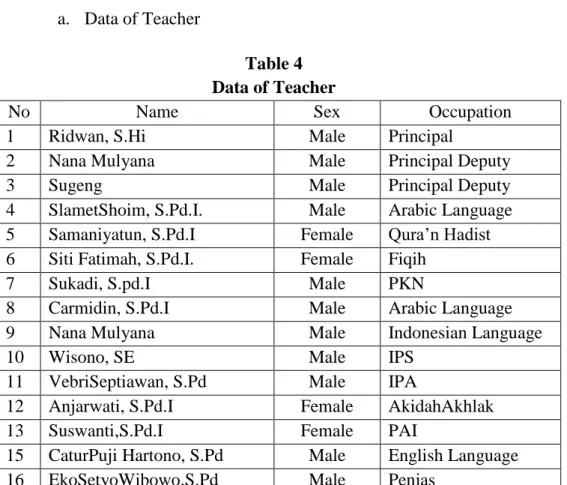
a. Data of Teacher
Table 4 Data of Teacher
No Name Sex Occupation
1 Ridwan, S.Hi Male Principal
2 Nana Mulyana Male Principal Deputy
3 Sugeng Male Principal Deputy
4 SlametShoim, S.Pd.I. Male Arabic Language
5 Samaniyatun, S.Pd.I Female Qura’n Hadist 6 Siti Fatimah, S.Pd.I. Female Fiqih
7 Sukadi, S.pd.I Male PKN
8 Carmidin, S.Pd.I Male Arabic Language
9 Nana Mulyana Male Indonesian Language
10 Wisono, SE Male IPS
11 VebriSeptiawan, S.Pd Male IPA
12 Anjarwati, S.Pd.I Female AkidahAkhlak
13 Suswanti,S.Pd.I Female PAI
15 CaturPuji Hartono, S.Pd Male English Language
16 EkoSetyoWibowo,S.Pd Male Penjas
35
17 Sugeng Female SeniBudaya
18 Devia safitri,S.Pd Female Computer
19 Andi Saputra Male Aswaja
20 Ekanurjanah, S.Pd Female Mathematic
21 Sirojudin Mustofa Male IPA
22 Mudasir,S.Pd.I Female Lampung Language
Source: Documentation of MTs Al-AsrorSekampung in the academic year 2017/2018
b. Data of Administration Staff Table 5
Data of Administration Staff
No Name Occupation
1 EkoSetyoWibowo Leader of Staff
2 EkaMistika Sari Staff
3 Nurul Huda Security
Source: Documentation of MTs Al-Asror Sekampung in the academic year 2017/2018
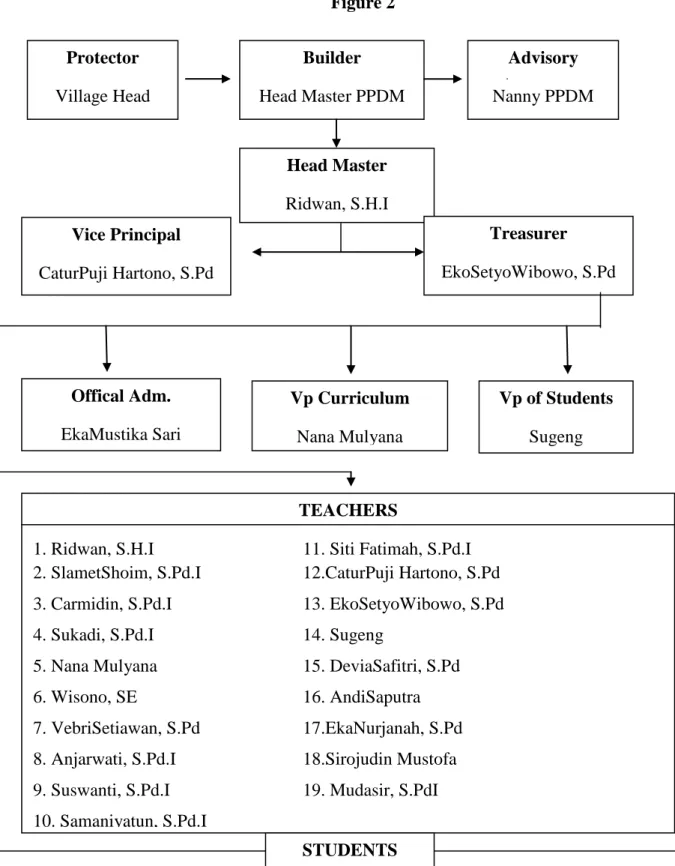
3. Organization Structure of MTs Al-AsrorSekampung in the Academic Year 2027/2018
Figure 2 Protector
Village Head Sumbersari
Builder Head Master PPDM
Advisory Nanny PPDM
Head Master Ridwan, S.H.I Vice Principal
CaturPuji Hartono, S.Pd
Treasurer EkoSetyoWibowo, S.Pd
Offical Adm.
EkaMustika Sari
Vp Curriculum Nana Mulyana
Vp of Students Sugeng
TEACHERS
1. Ridwan, S.H.I 11. Siti Fatimah, S.Pd.I 2. SlametShoim, S.Pd.I 12.CaturPuji Hartono, S.Pd 3. Carmidin, S.Pd.I 13. EkoSetyoWibowo, S.Pd
4. Sukadi, S.Pd.I 14. Sugeng
5. Nana Mulyana 15. DeviaSafitri, S.Pd
6. Wisono, SE 16. AndiSaputra
7. VebriSetiawan, S.Pd 17.EkaNurjanah, S.Pd 8. Anjarwati, S.Pd.I 18.Sirojudin Mustofa 9. Suswanti, S.Pd.I 19. Mudasir, S.PdI 10. Samaniyatun, S.Pd.I
STUDENTS
37
Figure 3
KANTIN KELAS VIII.B KELAS IX.A KELAS IX.B WC
PARKIRANRUANG GURU MTs AL ASRORPERPUSTAKAANMUSHOLA MTs AL ASROR
RUANG TU MTs AL ASROR LAB.KOMPUTER
KELAS VII.AKELAS VII.BKELAS VIII.A LAPANGAN MTs AL ASROR
GERBANG
4. Total of the Students at MTs Al-AsrorSekampungin Academic Year 2017/2018
MTs Al-AsrorSekampung has 116 students. It divided into some classes that can be identified as follows:
Table 6
Total the Students of MTs Al-AsrorSekampung No Class
Sex
Amount Male Female
1 VII 22 14 36
2 VIII 29 10 39
3 IX 27 14 41
Total 116
Source: Documentation of MTs Al-AsrorSekampung in the academic year 2017/2018
5. The Infrastructure of MTs Al-AsrorSekampung MTs Al-AsrorSekampung has some buildings as follow:
Table 7
The Infrastructure of MTs Al-AsrorSekampung No Name of Building Sum
1 The headmaster room 1 Room 2 The teacher office
room 1 Room
3 The classroom 6 Room
4 The Laboratory room 1 Room
5 The library room 1 Room
6 The parking area 1 Room
7 Storehouse 1 Room
8 Toilet 2 Room
Source: Documentation of MTs Al-AsrorSekampung in the academic year 2017/2018
39
6. The List of Students Name Class VIII B Table 8
The List of Students Name Class VIII B
No Name L/P
1 AjizSetiawan L
2 BagasSetiawan L
3 DaniIrawan L
4 DiniLionitaSeptiani P
5 DoniSaputra L
6 FamuraUlilAlbab L
7 FebriNurulIrawan L
8 IkhsanFuadi L
9 M. AlfahreziRidwan L
10 M.MaulanaIlham L
11 Rafi Ramadhana W L
12 RafidaIstiqomah P
13 Rio Efendi L
14 RiskaWidia Sari P
15 SiskaAgustina P
16 SulisTiyawati P
17 TaufikAditya L
18 Tri SukronVaka L
B. Description of the Research Result
This research used classroom action research. The purpose of this research was to increase the writing ability and the students learning activity at the tenth grade of MTs Al Asror Sekampung. The research was conducted in two cycles where the writer did pre test before the treatment.
The writer used précis writing strategy to increase the students writing ability. The research result was gotten through test that conducted in the end of each cycles while the data of students activity was gotten from the observation during the learning process.
Before the process of cycle one, the research conducted the pre test on Wednesday, November, 15th 2017. The writer gave a pre test for the students to see how far the students writing ability before the treatment was given. In the pre test activity, the writer gave an essay test. The writer asked them to write descriptive text. Some students were enjoying the task and others looked so worry. The score of students writing ability in pre- test, as follow:
Table 9
The Students' Pre-test Result of writing ability
No Name Score Category
1 AS 51 Incomplete
2 BS 50 Incomplete
3 DI 58 Incomplete
4 DLS 61 Complete
5 DS 58 Incomplete
6 FUA 72 Complete
7 FNI 59 Incomplete
8 IF 60 Complete
9 MAR 50 Incomplete
10 MMI 50 Incomplete
11 RI 71 Complete
12 RRW 58 Incomplete
13 RE 59 Incomplete
14 RWS 55 Incomplete
15 SA 51 Incomplete
16 Su 64 Complete
17 TA 51 Incomplete
18 TSV 60 Complete
Total 1038
Average 57,67
Highest Score 72
Lowest Score 50