i
WRITING SKILL IN DESCRIPTIVE TEXT AT THE EIGHTH GRADER OF SMP NEGERI 1 METRO KIBANG EAST LAMPUNG IN ACADEMIC
YEAR 2017/2018
BY :
RISKI RISMAWATI Student Number 1293277
TARBIYAH AND TEACHER TRAINING FACULTY ENGLISH EDUCATION DEPARTEMENT
STATE INSTITUTE ISLAMIC STUDIES METRO LAMPUNG
1439 H / 2018 M
ii
IN ACADEMIC YEAR 2017/2018
Presented as a Partial Fulfillment of the Requirements For the Degree of Sarjana Pendidikan (S. Pd)
In English Department
By:
RISKI RISMAWATI Students ID: 1293277
Tarbiyah And Teacher Training Faculty English Education Department
Sponsor : Drs. Kuryani Utih, M. Pd Co-sponsor : Trisna Dinillah Harya, M. Pd
STATE INSTITUTE OF ISLAMIC STUDIES OF METRO 2017/2018
iii
iv
v
vi ABSTRACT
By:
RISKI RISMAWATI
This research is aimed to find out whether the Mind Mapping technique can improve the students’ writing descriptive text skill at the eight graders of SMP Negeri 1 Metro Kibang. This research is classroom action research. In collecting the data, this research used test, observation, documentation to collect the data.
Based on the pre-survey data, the problems which had been identified was the students found difficulties in writing descriptive text because of not having ideas. Which are from Mind Mapping technique the students couid find the idea in writing descriptive text. By Mind Mapping technique the students got the information and illustration through their own words.
This classroom action research was conducted by 2 cycles. There are four steps in each cycles, such as : planning, acting, observing and reflecting. The researcher gave one pre-test before treatment, two treatments and two post-tests, the subject of this action research are the eight graders of SMP Negeri 1 Metro Kibang. This research used 30 students as object of research. To prove whether the hyphotesis was accepted or rejected, the researcher used average formula.
The invention of this research shows that there was improving from cycle I to cycle II. The result from the data in cycle I, it was gained the average score of pre-test was 54% and post test I 64% and post test from cycle II was gained the average score 72%. The result of cycle II was higher than the result of post-test at cycle I. The condition of the class was getting better. The students pay attention to teacher’s explanation in learning activity. The students are more active in learning process. The students can write descriptive text correctly. It means that the use of Mind Mapping technique could improve the students writing skill at the eight graders of SMP Negeri 1Metro Kibang.
Key Word: Writing Descriptive Text, Mind Mapping Technique.
vii ABSTRAK
Oleh:
RISKI RISMAWATI
Tujuan utama dari penelitian ini adalah untuk mengetahui apakah teknik Mind Mapping (X) dapat meningkatkan kemampuan menulis deskriptif siswa (Y) pada kelas VIII SMP NEGERI 1 METRO KIBANG. Dalam pengumpulan data, penelitian ini menggunakan tes tertulis, observasi, dan dokumentasi.
Berdasarkan data pra-survey, permasalah yang ditemukan dapat di simpulkan bahwa para siswa mengalami kesulitan dalam penulisan descriptif karena tidak mempunyai ide. Melalui teknik Mind Mapping siswa dapat menemukan ide dalam penulisan descriptif. Karena dengan teknik Mind Mapping siswa mendapatkan informasi dan ilustrasi melalui tulisan-tulisan atau rangkaian kata yang mereka buat.
Penelitian tindakan kelas ini dilakukan 2 siklus. Ada 4 tahap dalam setiap siklus, yaitu perencanaan, tindakan, observasi dan refleksi. Peneliti memberikan pre-test sebelum tindakan, 2 kali tindakan, dan 2 post test. Penelitian ini dilaksanakan di kelas VIII SMP NEGERI 1 METRO KIBANG. Penelitian ini menggunakan 30 siswa sebagai objek penelitian. Untuk membuktikan hipotesis diterima atau ditolak, penelitian ini menggunakan rumus rata-rata.
Temuan penelitian ini menunjukan bahwa ada peningkatan dari siklus I ke siklus II. Hasil dari data pada siklus I, mendapatkan nilai rata-rata pre-test adalah 54% dan post test I 64% dan dari siklus II diperoleh nilai rata-rata 72%
Hasil siklus II lebih tinggi dari hasil post-test pada siklus I. Kondisi kelas menjadi lebih aktif selama proses pembelajaran dan sIswa dapat menulis dengan benar. Ini berarti bahwa penggunaan teknik Mind Mapping dapat meningkatkan kemampuan menulis siswa pada kelas VIII SMP Negeri 1Metro Kibang.
Kata Kunci: Menulis Teks Descripsi, Mind Mapping Technique.
viii The Undersigned:
Name : RISKI RISMAWATI
Students’ Number : 1293277
Departement : English Education Departement (TBI) Faculty : Tarbiyah and Teacher Training
States that this undergraduate thesis is original except certain parts of it is quoted from the bibliography mentioned.
Metro, January 2018
RISKI RISMAWATI St. ID. 1293277
ix Yang bertanda tangan di bawah ini:
Nama : RISKI RISMAWATI
NPM : 1293277
Jurusan : Tadris Bahasa Inggris (TBI) Fakultas : Tarbiyah dan Ilmu Keguruan
Menyatakan bahwa skripsi ini secara keseluruhan adalah hasil penelitian saya kecuali bagian-bagian tertentu yang dirujuk dari sumbernya dan disebutkan dalam daftar pustaka.
Metro, Januari 2018
RISKI RISMAWATI NPM. 1293277
x
ۚ ِة الََّصلااو ِْبَّْصلِبِ اوُنيِعاتْسا اوُنامآ انيِذَّلا ااهُّ ياأ ايَ
انيِ ِااَّصلا ا ام اَّاا َّ ِ
O you who have believed, seek help through patience and prayer. Indeed, Allah is with the patient.
Al-Baqarah [2:153]
xi
All praise be to Allah SWT, this undergraduated thesis is dedicated to:
1. My beloved parents Mr. Ahmad Muhtar and Mrs. Salem, who have giving their endless love and parenting me since I was born and breathed for the first time in this world, thank you so much for everything.
2. My beloved brother and sisters, Amid Nurachman, Ria Rahmawati, Umar Hasan and, M. Anwar Sidiq thanks for your loving, praying and supporting me.
3. My Almamater State Institute of Islamic Studies of Metro.
xii
Allah, the lord of the world whom without his mercy and blessing, none of these would be possible. Let us thank to Allah SWT who always blesses us until now and keeps our healthy so that I can finished this research proposal. I would like to say thanks to lecture who has guided in the process of this research and also for everyone who helps me until this research be complete.
This Undergraduate Thesis entitles “Using Mind Mapping Technique to Increase Stdents’ Writing Skill in Descriptive Text at the Eight Grade of SMP Negeri 1 Metro Kibang Lampung Timur In academic year 2017/2018”. Realize there is no perfect, the good suggestion and critics are waited to make the good change in the future. Finally, the writers hope that this paper can be useful thing and add the knowledge for the reader.
Metro, January 2018 The Writer,
Riski Rismawati S.t Number. 1293277
xiii
TITTLE ... ii
ABSTRACT ... iii
STATEMENT OF RESEARCH ORIGINALLITY ... vi
MOTTO ... vii
DEDICATION PAGE ... viii
ACKNOWLEDGMENT ... ix
TABLE OF CONTENT ... x
LIST OF TABLES ... xi
LIST OF FIGURES ... xiii
LIST OF PICTURES ... xiv
LIST OF APPENDIXES ... xv
CHAPTER I INTRODUCTION ... 1
1. Background of Study ... 1
2. Problem Identification ... 4
3. Problem Limitation ... 4
4. Problem Formulation ... 4
5. Objective and Benefits of Study ... 5
CHAPTER II THEORETICAL REVIEW ... 7
1. The Concept of Writing Skill ... 7
1. The Concept of Writing ... 7
2. The Concept of Writing Skill ... 9
2. The Concept of Mind Mapping Technique ... 19
Definition of Technique ... 19
Definition of Mind Mapping ... 21
Definition of Mind Mapping Technique ... 22
The Rules of Mind Mapping Technique ... 23
3. Action Hypothesis ... 24
xiv
3. Subject of Study ... 30
4. Research Procedure ... 30
6. Cycle 1 ... 32
7. Cycle 2 ... 34
5. Data Collection Technique ... 36
6. Research Instrument ... 37
7. Data Analysis Technique ... 38
8. Indicator of Success ... 40
CHAPTER IV ... 44
1. Research Result ... 44
2. The Description of Result Research ... 52
3. Cycle 1 ... 55
4. Cycle 2 ... 67
3. Discussion ... 79
CHAPTER V ... 87
1. Conclusion ... 87
2. Suggestion ... 88
BIBILOGRAPHY APPENDIXES
xv
Table of Pre- Survey Data Students’ writing descriptive text ... 3
Table of Purpose descriptive text ... 18
Table of Measurement Rubric in Writing easy skill ... 27
The teacher data of SMP Negeri 1 Kibang Lampung Timur ... 52
Table of administration staff of SMP Negeri 1 Kibang ... 53
Number of students SMP Negeri 1 Kibang ... 54
Table of infrastructure SMP Negeri 1 Kibang Lampung Timur ... 56
Table score of Pre-Test students writing descriptive text ... 59
Percentage score of Pre-Test ... 60
Table students result writing descriptive text post-test 1 score ... 64
Percentage score of Post-Test 1 ... 65
Result of Students learning activity at first meeting in cycle 1 ... 67
Result of Students learning activity at second meeting in cycle 1 ... 68
Percentage of students learning activity at cycle 1 ... 69
Table of comparison between Pre-Test and Post-Test 1 score ... 71
Table of result students Post-Test II score ... 72
Score percentage of Post-Test II score ... 76
Result of Students learning activity at first meeting in cycle 2 ... 77
Result of Students learning activity at second meeting in cycle 2 .... 82
Percentage of students learning activity at cycle 2 ... 83
Table of comparison between Post-Test 1 and Post-Test 2 score .... 83
Comparison of Pre-Test, Post-Test 1, and Post-Test 2 score ... 85
Students result activity cycle 1 and cycle 2 ... 86
xvi
Percentage of Students Pre-Test score ... 60
Graph percentage of Post-Test 1 score ... 65
Graph of comparison activity at cycle 1 ... 69
Graph of average score between Pre-Test and Post-Test 1 ... 71
Graph of students writing descriptive text Post-Test II score ... 76
Graph of comparison activity at cycle 2 ... 79
Graph of average score Pre-Test, Post-Test 1 and Post-Test 2 score 80 Percentage of student’s activity at cycle 1 and cycle 2 ... 81
Table of result student’s activity at cycle 1 and cycle 2 ... 81
xvii
I. Figure of classroom action research model ... 36 II. Organization Structure of SMP Negeri 1 Kibang ... 53 III. Figure of site sketch SMP Negeri 1 Kibang ... 56
i
LIST OF PICTURES
1. The researcher gives Pre-Test first before doing the treatment ... 139 2. The researcher gives explanation about the material (Writing
Descriptive Text) in front of all students ... 139 3. The students are pay attention about explanation of material ... 140 4. The researcher gives explanation about Jigsaw technique and allowed
the students make a group discussion. Each group consists of four till
five persons ... 140 5. The researcher gives the task after the treatment was done ... 141 6. The researcher guided the student to complete the task ... 141
ii
LIST OF APPENDICES
1. Letters ... 91
2. Syllabus ... 97
3. Lesson Plan Pre-test ... 101
4. Question Pre – Test ... 109
5. Answer Sheet Pre –Test ... 109
6. Students’ Activity Pre-Test ... 112
7. Lesson Plan Cycle 1 ... 113
8. Question Cycle 1 ... 119
9. Answer Sheet Cycle 1 ... 120
10. Students’ Activity Cycle 1 ... 123
11. Field Notes Cycle 1 ... 124
12. Lesson Plan Cycle 2 ... 125
13. Question Cycle 2 ... 133
14. Answer Sheet Cycle 2 ... 134
15. Students’ Activity Post –Test 2 ... 137
16. Field Notes Cycle 2 ... 138
1 1) Background of the Study
The main objective of teaching English at schools is the students are expected to be able to communicate both in written and spoken form. Writing and speaking are productive skills that are very important for students to learn.
There are frequently used to convey the ideas in communicating with others.
Based on educational unit level curriculum, the goal of teaching learning at Junior High School is that the students must be able to develop communicate competence in written form to solve problems in their daily lives.
In this curriculum, the English Material is taught based on text. One of the texts that have to be learnt by the first-year students of Junior High School is descriptive text. The students have to able to understand and create a descriptive text cohesively based on the genetic structure of the text.
In fact, this objective is very hard to achieve. Most of the students’
skills are the away from their learning target. The students still cannot understand or create a descriptive text although the teacher has explained it.
The students know or have the ideas of what are they are going to write but they do not know how to put them into words. They feel difficult to build a good sentence. There are still found some grammar mistakes or inappropriate vocabulary usage. Furthermore, they are not active during teaching learning
process. They seldom give their opinion or question about the material being taught. Perhaps, it is because the teacher does not use appropriate technique in teaching the material.
Considering to the importance of descriptive text for the students to master. It is very important for teacher, and then to, finds out the best way to make the students aware on the use of the text in their daily lives. The teachers need to employ appropriate technique and maintain the teaching and learning process that build the students awareness a using the knowledge rather than knowing it.
Based on the reason above, the researcher will teach descriptive text by using mind mapping. The researcher uses mind mapping because it is a technique that can help the students succeed in understanding or producing descriptive text writing in a long-range life. Therefore, hopefully by using mind mapping the students’ problems in learning descriptive text writing can be overcome. Furthermore, it is also expected to be able to increase their skill in writing descriptive text.
To strengthen the problem more, the researcher has conducted pre- survey at Junior High School 1 Metro Kibang East Lampung and the result is shown in the table below:
Table 1
The Data of Pre-survey at The Eighth graders of SMP Negeri 1 Metro Kibang
NO Students Code Score Note
1 AS 85 Complete
2 ASA 70 Incomplete
3 ANP 80 Complete
4 BD 60 Incomplete
5 BS 65 Incomplete
6 BK 65 Incomplete
7 DS 80 Complete
8 DE 60 Incomplete
9 DP 85 Complete
10 DSR 65 Incomplete
11 FE 80 Complete
12 IP 75 Complete
13 LD 65 Incomplete
14 LA 55 Incomplete
15 MS 65 Incomplete
16 MK 55 Incomplete
17 MA 80 Complete
18 NS 60 Incomplete
19 NY 65 Incomplete
20 NL 60 Incomplete
21 NK 45 Incomplete
22 PUS 55 Incomplete
23 RAN 50 Incomplete
24 RS 53 Incomplete
25 RAS 52 Incomplete
26 SAJ 40 Incomplete
27 SM 65 Incomplete
28 TM 60 Incomplete
29 TIM 63 Incomplete
30 TP 50 Incomplete
Total 1375
Average 68.75
The Highest Score 85
The Lowest Score 40
Source: The teacher’s Grade Book of English at the Eighth Class of SMPN Metro Kibang
Based on the pre-survey data on August, the researcher found that most of second Graders class of SMP Negeri 1 Metro Kibang are categorized into low category. It can be seen from score of 19 the students’ less than 70 as the Minimum Mastery Criteria (MMC).
Therefore, to overcome the problem above, the researcher decided to conduct a research focusing on using mind mapping technique to increase the students’
writing descriptive text.
According to the explanation above, the researcher assumes that to improve the students’ writing descriptive text, the researcher is interested in using mind mapping technique to increase the students’ writing descriptive text. The researcher decides to use the mind mapping technique because it is a technique that includes the right and the left brain actively together. So, it can solve learning problems that come from the use of both brain synergistically. Mind mapping is also a technique that generating the ideas by using picture and color that can make the students more interested in writing descriptive text. Thus, the researcher uses this technique in order to encourage students to learn English and also can be more interested. Therefore, the researcher wants to find out whether mind mapping technique gives positive influence on writing descriptive text.
2) Problem Identification
Regarding to the background of the study, the researcher identifies the problem as follow:
A. The students find it difficult to learn English because they are understanding the structure and grammar.
B. The students do not have adequate vocabulary in composing writing descriptive text
C. The students have low motivation.
D. The student’s writing skill in descriptive text is low.
E. The techniques which are used in the learning process are boring.
3) Problem Limitation
Based on the problem identification above, the writer limits the problem, the student’s writing skill in descriptive text is low at the Eight Graders of SMP Negeri 1 Metro Kibang
4) Problem Formulation
Based on the background of study and problems identification above, the researcher formulates the problem in this research is “can mind mapping technique increase the students writing skill in descriptive text at the Eight Graders of SMP Negeri 1 Metro Kibang ?”
5) Objectives and Benefit of the Study 1. Objectives of The Study
Generally, the objective of this research is to increase students’
writing skill in descriptive text at the Eighth graders of SMP N 1 Kibang.
Especially, it is to find out whether mind mapping techniques increase the students’ writing skill.
2. Benefit of the Study
The researcher expects that this study can give positive contribution either for the teacher or the students in teaching and learning English, especially writing skill.
a. For the Teacher
a. As information for the English teacher in order to improve students’ writing skill in descriptive text.
b. As technique in teaching writing especially in writing descriptive text.
c. As an idea of various ways of teaching writing to students in the classroom.
d. As motivation to the teacher to help the students in solving the problems of writing descriptive text.
b. For the Student
1) As information for the students in order to improve their motivation in learning English in writing descriptive text.
2) As a way for the students to express their idea and increasing writing skill.
3) As motivation to the students’ in learning English especially in learning writing descriptive text.
c. For the Researcher
1. As a prior research, the researcher can be used as a foundation for the next research.
2. As an experience means knowledge in English instructions.
3. As knowledge who the researcher got in her study.
d. For the Headmaster
1. As information to the headmaster to be able to convey to the teachers that they should know the problems of students’ in order to reach learning process effectively.
2. As motivation to increase the quality of education especially at SMP Negeri 1 Metro Kibang.
8
1) The Concept of Writing Skill 1) The Concept of Writing a. The Definition of Writing
Celce-Murcia explains that writing is the production of the written word that results in a text but the text must be read and comprehended in order for communication to take place.1 It means that the writer needs the consideration of the readers or audiences to read the massage that conveyed of the written texts.
Writing as one of the language skills is not an innate natural ability. Therefore, writing is a complex process and it needs practice. For almost everyone, work hard is a key to produce competent writing.
As one of four language skill, Endang said “writing has always occupied a place in most English language course. One of the reasons is that more and more people need to learn to write in English for occupational or academic purposes and the most difficult skill to master for foreign language learner”.2 Therefore,
1 Marianne Celce-Murcia, Discourse and Context in Language Teaching, (United States of America : Cambridge University Press, 2000), p. 142
2 Endang Fauziati, Teaching of English As A Foreign Language, (Surakarta:
Muhammadiyah University, 2005), p. 147
students have difficulties transferring ideas from their source language (Indonesia) in to the target language (English).
To express the idea, the writer usually uses certain writing types. Larry explained the process of transferring thoughts from mind into paper to share with readers while readily admitting that composing text to communicate their ideas is tough sledding.3 b. Teaching Writing
On teaching, both the mind and the heart must be involved for effective learning and teaching process. Teaching writing is an intentional activity concerned with students learning. It follows that it is sensible to spend some time on thinking and articulating your intentions in teaching a particular topic to a group of students and on checking whether those intentions are realizable and were realized.
One major theme in pedagogical research on writing is the nature of the composing process of writing. Written products are often the result of thinking, drafting, and revising procedures that require specialized skills, skills that not every speaker develops naturally. The upshot of the compositional nature of writing has produced writing pedagogy that focuses students on how to generate ideas, how to organize them coherently, how to use discourse markers and rhetorical conventions to put them
3 Kerry Lewin, Paving the Way in Reading and Writing, (San Fransisco: Jossey Bass, 2003), p. 6-12
cohesively into a written text, how to revise text for clearer meaning, how to edit text for appropriate grammar, and how to produce a final product.4
2) The Concept of Writing Skill A. Definition of Writing Skill
The term of skill is defined as ability. Concisely, writing ability is the skill to express idea, though, and feeling to other in writing symbol to make other people or readers understand the idea conveyed.
Writing as a skill is defined as a productive written language skill. On the opposite, writing a text is a piece of written information. “Written products are often the result of thinking, drafting, and revising procedures that require specialized skills, skills that not every speaker develop naturally”.5
Generally, writing is a way in sending message from the writer to the reader. Similar to Paul Davies defines writing as probably skill that is used by most people in their native language.6 Writing also is a way the writer think or a way of thinking which is shared to the reader.
4 H. Douglas Brown, Teaching by Principles: An Interactive Approach to Language Pedagogy, (New York: Addison Wesley Longman, Inc., 2001), 2nd ed., p. 335
5 H Douglas Brown, Teaching by Principles,(San Fransisco: San fransisco State University,2001), p. 335
6 Paul Davies and Eric Pearse Success in English Teaching, (New york: Oxford University Press, 2002), p. 96
Chandra Segaran defines that writing is a mental activity of skilful decision-making, appropriate for the situation.7 It can be inferred that the decision means that the functions of considering, such as the purpose of the text, the objective of the writer, the purpose of the reader in reading text, the situation and condition taking place.
Furthermore, Barli Bram states that to write means to try to produce or reproduce written messages.8 It means that in writing process we need strategies to produce or reproduce written texts to convey messages between writers and reader in good communication.
From the opinions above, writing is the way of thinking or sending message from the writer to the reader which becomes the part of language or language skills and it also means communication.
7 Antonia Chandra Segaran, Intervening to Help in the Writing Process, (Singapore:
Regional Language Center, 2002), p. 1
8 Barli Bram, Write Well Improving Writing Skill, (Yogyakarta : Kanisius, 1995), p.7
B. Concept of Descriptive Text 1. Definition of Descriptive Text
Descriptive text is a text which describes person, place, mood, situation, and etc. in words. Similar to Diane A. Wilbur said that, descriptive writing is to create a clear picture or impression of person, place or object.9 Fred D. White also said that descriptive text is drawing in words.10
Descriptive text is also a text which describes something that appeal directly to the sense like John E. Warriner said that descriptive paragraph is giving a picture in words that appeal directly to the sense (sight, sound, smell, touch, taste). He said a descriptive paragraph is normally full of vivid verbs and precise adjectives. It depends on details, not action, to hold the readers interest.11
From the opinion about descriptive above, so the writer concludes that the descriptive text is a text which is describes person, place, mood, situation, and etc., it also describes an object that appeal to the sense.
9 Diane A. Wilbur, Composition: Models and Exercises, (New York: Harcourt, Brace &
World, Inc., 1966), p. 41.
10 Fred D. White, The Writers Art, (California : Wadsworth, 1986), p.61.
11 John E. Warriner, English Grammar and Composition, (New York: Harcourt, Brace Jovanovich, Publishers, 1982), p. 327
Besides that, descriptive text has several elements there are some elements of description. They are:
a. Concrete details. A concrete detail is a specific description that supports, reflects, or expands a writer attitude or purpose.
Example: The modern math student, using a calculator instead of a slide rule, makes speedy and accurate calculations.
b. Images. An image is a concrete, literal (real, actual) description of person, physical object, or sensory experience that can be known through one of the five senses (sight, sound, taste, touch, and smell). Example: Lightning crackled and sizzled across the darkened sky. (Sound and sight). The orange calico kitten‟s bristled tongue scratched its way across my cheek.
(sight and touch; concrete details)
c. Similes. A simile is a comparison, using like or as, between two objects. The comparison is between two things essentially different yet similar in one aspect. Example: Anger heated up in me like water about to boil. The lecturer was as exciting and informative as stale beer.
C. Guides in Writing Descriptive Text
There are several things which should be known before writing descriptive text. They are:
a) Communicative purpose:
Descriptive is a type of written text, which has the specific function to give description about an object (human or nonhuman).
b) Rhetorical structure:
As explained before, the rhetorical structure of descriptive text is identification and description. Identification is a statement of topic or subject which wants to be described.
Description is the details of identification or the object.
c) Grammatical patterns:
The declarative sentence usually is used in the descriptive text. The use of conjunction is also needed to make coherent devices. The present tense is used dominantly because in the descriptive text includes facts, general accepted- facts, or reality.
After knowing about the explanation above, when a writer wants to write descriptive text, he or she also should know the guides of writing descriptive text. There are some guides to write a descriptive text. According to John J. De Boer, there are six guides for writing description. They are:
1. Observe carefully and record your sense impressions.
2. Select significant details that convey a dominant impression of the subject.
3. Organize your description according to a unifying principle; for example, the order of space for descriptions of places.
4. Choose either stationary or a moving vantage point from which to describe a scene.
5. Use concrete, vivid language. Use figure of speech and connotative language.
6. In characterizing people: Give details of appearance and of actions. Use a person’s own words where they serve to reveal character. Describe feelings and attitudes.12
D. Purpose of Descriptive Text
Based on the definition of descriptive text above the purpose of description is to present the reader with a picture of person, subject or setting. Similar to Diane A. Wilbur said that the goal of descriptive writing is to create a clear picture or impression of person, place or object.13
12John J. De Boer, Basic Language Messages and Meanings, (New York: Harper & Row, Publishers, Inc. 1982), p. 90
13 Diane A. Wilbur, Composition: Models and Exercises., p. 41.
Meanwhile, Fred D. White said that there are several aims of descriptive text:
A. To see means to help the reader to see the objects, persons, and sensations you present, as you might guess, description is important for all rhetorical aims, not just for expressiveness.
B. To explain means to explain the reader about a subject. For example: a science writer will describe the shape of an airplane wing to help explain to readers how mechanized flight is possible.
C. To persuade means the writer describes something to make readers interested. For example: an attorney might describe the damage done to a bedroom window to help prove forced entry and there by persuade the jury that accused committed burglary.
D. To re-create means make a reader making something. For example: the description allows the reader to re-create the experience particularly the sensory pleasures of that experience in their own minds, thereby enhancing their delight in the subject at hand.
E. To demonstrate means the writer wants to demonstrate something to a reader. When a writer describes the thawing of Walden Pond after a long, cold winter is to demonstrate the
animated quality of nature and how its processes are more complex can realize.14
E. The Measurement of Writing Skill in Descriptive text
Writing is an important skill for students because of some reasons. First, writing strengthens the students’ grammatical structure, idiom, and vocabulary. Second, writing gives a chance to students to apply the language they have learned. Third, writing reinforces students to express their ideas in correct words and sentences, especially in writing descriptive text. There are some criteria of measurement of writing skill in descriptive text:
Table 2
The Measurement of Writing Skill in Descriptive Text Writing
skill
Score Criteria Details
Content
30-27
Excellent to Very Good
Knowledgeable, substantive development of thesis, relevant assigned topic
26-22 Good to Average
Sure knowledge of subject, adequate range, limited development of thesis, mostly relevant to topic but lacks detail.
21-17 Fair to Poor
Limited knowledge of subject, little substance inadequate development of topic.
16-13 Very Poor Does not show knowledge of subject, no-
14 Fred D. White, The Writer’s Art, (California: wadsworth, 1986), p. 61-62.
substantive, not pertinent, or not enough to evaluate.
Organization
20-18
Excellent to Very Good
Fluent expressions, ideas clearly stated/supported, complete, succinct, well organized, logical sequencing, cohesive 17-14 Good to Average
Somewhat choppy, loosely organized but main ideas stand out, limited support, logical but incomplete sequencing.
13-10 Fair to Poor
Non-fluent in idea confused or disconnected, lacks
sequencing and
development.
9-7 Very Poor Does not communicate, no organization or not enough to evaluate
Vocabulary
20-18
Excellent to Very Good
Sophisticated range, effective word/idiom choice and usage word
from mastery,
appropriate register.
17-14 Good to Average
Adequate range, occasional errors of word/idiom form, choice, usage, meaning confused or obscured.
13-10 Fair to Poor
Limited range, frequent errors of work/edition form, choice, usage, meaning confused or obscured.
9-7 Very Poor
Virtually no mastery of sentence construction rules, dominated by errors, does not communicate
Language
25-22
Excellent to Very Good
Effective, complex constructions, few errors of agreement, tense,
number, word
order/function, articles, pronouns, prepositions.
21-18 Good to Average
Effective but simple constructions, minor problems in complex construction, several errors of agreement, tense, number, word order/function, articles, pronouns, prepositions, but meaning seldom obscured.
17-11 Fair to Poor
Major problems in simple/complex
constructions, frequent errors of negation, agreement, tense,
number, word
order/function, articles, pronouns, preposition and/or fragments, meaning confused, or obscured.
10-5 Very Poor
Having no mastery in syntax rule, there are many
mistakes and
uncommunicative.
Mechanic
5
Excellent to Very Good
Demonstrates mastery of conventions, few errors of spelling punctuation, capitalization,
paragraphing.
4 Good to Average
Occasional errors of spelling, punctuation, capitalization,
paragraphing but meaning not obscured.
3 Fair to Poor
Frequent errors of spelling, punctuation,
capitalization,
paragraphing, poor handwriting, meaning confused or obscured.
2 Very poor
No mastery of
conversations, dominated by errors of spelling, punctuation,
capitalization,
paragraphing,
handwriting, illegible, or not enough to evaluate.
2) The Concept of Mind Mapping Technique 1. Definition of Technique
A technique is implementation, meaning that a technique is something that actually takes place in language teaching or learning in the classroom.15 In the other word, a technique is specific activities in the language classroom to help language learners learn the language.
In the learning and teaching itself, technique means a way of teaching in order to make the process of learning and teaching run well. First states that techniques were the specific activities manifested in the classroom that were consistent with a method and therefore were in harmony with an approach as well.16 Then, technique is the way that use by the lecture or the teacher in the classroom to ease the teaching activities.
According to Brown recover the statements from many terms states that technique is any of a wide variety of exercises, activities or tasks used in the language classroom for realizing lesson objectives.17 The statement can be implied that to make the process of the teaching run well, the teacher is not only using the method but also she/he uses a suitable technique. By technique, the students will interest in learning
15Ag. Bambang Setiyadi, Teaching English as a Foreign Language, (Yogyakarta: Graha Ilmu, 2006), p. 8
16H. Douglas Brown, Teaching by Principles., p. 14
17 Ibid, p.16.
so, the students will think that studying is very nice and interesting moment. If the students enjoy the process of the teaching, the process of transfer knowledge will run efficiently and effectively.
Based on several definitions above, it can be concluded that mind mapping are used to organize brain thinking organization. Technique is a particular way of teaching. It means that mind mapping technique is a particular way of teaching that organizes and ensures the students to use their full potential brain capacity more efficiently and effectively.
It helps the students to focus on the topic and help memorizing the structure of the sentence.
Mind mapping technique supplies a framework for organizing conceptual information in the process of defining a word or a sentence.
The mind mapping also supports vocabulary to ease the students in making a sentence. Students write the word being studied in the center, and then work outward into other part.
2. Definition of Mind Mapping
The word “mapping” etymologically is derived from “map” that can be defined as follows: map is a graphic technique that possibly explores all of our brain skill in order to think and learn.18 It can be inferred that mind map is a technique that use graphic to explore our brain efficiently. It means that mind map will help the students to
18Sutanto Windura, Mind Map Langkah Demi Langkah, (Jakarta: PT Elex Media Komputindo, 2008), p. 16
explore their minds to think more effectively so that the process of teaching will run well.
According to Al-Jarf on Asian EFL Journal states a mind map is a graphic organizer in which the major categories radiate from a central idea and sub-categories are represented as branches of larger branches.19 It shows that mind map will help the students how to develop the main idea which radiate from the central idea to a wide branch of idea. The students will use their own brain skill to think more. Mind map is whole brain thinking alternative to linear thinking.
It reached out in all directions and captures various thoughts from all angles.
In line with the statement above, mind map can be called as an alternative of brain thinking to reach out all of the captures of the brain thinking from many angles. It gets all various designs of the students’
thoughts in exploring main idea. Mind mapping is a learning system that will ensure children and be able to use the full potential of their brain capacity more efficiently and effectively.
3. Definition of Mind Mapping Technique
Mind mapping technique is described in Hedge’s book entitled Resource Books for Teachers that “Making a mind map is a strategy
19Reima Al-Jarf, “Teaching Spelling Skills With a Mind Mapping Software”, Asian EFL Journal Professional Teaching Articles, (Riyadh, Saudi Arabia: King Saud University), VOLUME 53 July 2011, p. 4
for note-making before writing.”20 From this statement, mind mapping is actually about using our mind to think about what the importance information should be in the writing is. Mind mapping is a technique used in starting the writing. It can be said as a planning of writing.
According to Buzan, mind mapping has a natural organizational structure that radiates from the center and use lines, symbols, key words, color and images according to simple, brain-friendly concepts.21 A mind mapping converts a long list of monotonous information into a colorful, memorable and highly organized diagram that works in line with your brain’s natural way of doing things. It can be used to generate ideas, take notes, develop concepts and ideas, and improve memory.
Mind mapping involves writing down a central idea and thinking up new and related ideas which radiate out from the center. By focusing on key ideas written down in your own words, and then looking for branches out and connections between the ideas, you are mapping knowledge in a manner which will help you understand and remember new information.
In conclusion, mind map is a graphic way of showing main idea from the center radiates out the related ideas use lines, symbols, key words, color and images. It is helpful for visual learners as they are
20 Tricia Hedge, Resource Books for Teachers, (Oxford: Oxford University Press, 1990), p. 30.
21 Tony Buzan, Buku Pintar Mind Map, (Jakarta: Gramedia Pustaka Utama, 2005), p.5
illustrative tools that assist with managing thought, directing learning, and making connections. Although it was popularized as a note taking technique, mind mapping technique is also very useful in writing.
Mind map helps a writer to develop their ideas. Some research shows that mind mapping helps students develop many skills such as dynamic thinking, critical thinking, recall and more coherent writing.
4. The Rules of Mind Mapping Technique
Buzan states that there are seven steps in making mind map, they are:
1. Starting from the center of the side length of blank paper lay flat. It means starting of the middle of the freedom brain to spread in all directions and to express idea more freely and naturally.
2. Using pictures or photos to the central idea. Because a picture is worth a thousand meaningful words in order to use imagination. A central picture would be more interesting, keep focused, helps the students to concentrate, and activate their brains.
3. Using colors. Due to the brain, the same color is as interesting as the picture. Colors make the mind map more alive, adding energy to the creative thinking and fun.
4. Connecting main branches to the central image and connecting them and level two and three to level one and two, and so on.
Because the brain works by association. Connecting the main branches will create and set up the basic structure or architecture of minds. It's similar to the way a tree linking branches which spread from the main stem.
5. Drawing a line and connecting the curve, not a straight line.
Because straight line will dull the brain. The branches that curved and organic, like the branches of trees, is more appealing to the eyes.
6. Using one keyword for each line. Because a single keyword provide more power and flexibility to the mind map. Every single word or image is like a multiplier, generating a series of associations and the relationship itself.
7. Using pictures. Because a picture is worth a thousand meaningful words. So, if we have ten images in our mind map, meaning that it is equivalent to ten thousand words a note.22 Mind mapping can limit the students’ idea so that they do not write out of the topic. Besides that, students do not need some ideas that do not use in their writing. For the reason, here is the example of mind mapping technique before writing with the topic about hobbies. The picture is looked like:
22 Tony Buzan, buku pintar mind map, (Jakarta: PT Gramedia Pustaka,2010), p. 15-16.
The example of descriptive text based on the diagram : My Hobby
Hello..
I am Selvi Yuliani, you can call me Selvi. Here I will tell you about my hobby. Do you know my hobby? My hobby is writing.
I like to writing because it's fun activity. Maybe a lot of people thinks that writing was boring, but I don't, because writing can train someone accuracy. By writing, I can pour out of my heart. I usually write about the thinks I've been through every day. So i can take lesson from the problem i have ever experienced.
Watching movies Collecting
stamps Swimming
SPORT Rafting
PLEASURE Running
EDUCATION
Painting/Drawing Chatting
Reading Writing
HOBBIES
Identification
Description
I even made my diary book as friends to share stories. Do you know? I also like to dance. But i would prefer to write rather than dance, because dancing is very tiring. This is my hobby that i can tell you. Now, what's your hobby?
From the picture, it can be gotten the idea about “Hobbies”
that sport, pleasure, and education are concluded the topic.
Although, another things, that are identified, are also concluded as the parts of part of Hobbies itself. Clearly, the picture tells us about how mind map appeared. Even if the topic is just one word, the part of the topic may be more than a word, like what showed in the picture. By mapping, the related ideas can be explored and seen how they connect one to another from discovering ideas.23
By using mind mapping technique before writing, students are expected can apply it of their writing. Mind mapping technique has no significance rule in mentioning the branch of the topic. It just needs some ideas to fill in the box of the branches as the words that will be used in writing. From the branch, students can easily write some sentences using the words in the branch.
23Betty Mattix Dietsch, Reasoning and Writing Well, (New York: Mc.Graw Hill, 2006), Fourth Edition p. 7.
3) Action Hypothesis
Based on the frame theories and assumption above, the researcher formulates the action hypothesis “By using Mind Mapping Technique can increase Student Writing Descriptive Text skill at the Eight Grade of SMP NEGERI 1 METRO KIBANG LAMPUNG TIMUR”.
29
A. Variable and Operational Definition Variable
An operational definition of variables is the instruction to certain formulation, it does not make hesitate and confuse, and a formulation can be measured or observed. Meanwhile, variable can be defined as an attribute of a person or of an object which ‘varies’ from person to person or from object to object.
From the definition above, the operational definitions of variables are as follows:
1. Dependent Variable
Dependent variable is the variable which is observed and measured to determine the effect of the independent variable. Dependent variable in this research is writing descriptive text skill that is kind of writing skill that must be mastered by the students.
To measure descriptive text skill, the researcher use criteria of score in writing descriptive text skill, that is content, organization, vocabulary, language, and mechanic.
The measurement tool in writing descriptive text in this research are guided from the criteria of the score. In this phase each criterion has standard score to measuring. So the researcher giving score based on the standard of criteria itself.
Then, measurement result of dependent variable in this research if the most of students score minimum of standard mastery (MSC), and there are significant improvements of writing descriptive text and the students become more active in teaching learning process.
2. Independent Variable
Independent variable is the major variable which is expected to investigate. It is the variable which is selected, manipulated, and measured by the researcher. Independent variable in this research is using Mind Mapping Technique. Mind Mapping Technique is the technique which is used in starting to write. On the other hand, it can be said as a planning of writing.
The rule of this technique is using our mind to think about what the importance information should be in the writing. Which is showed a graphic, lines, symbols, key words, color and images. It is helpful for visual learners as they are illustrative tools that assist with managing thought, directing learning, and making connections.
To measure this technique, the student just needs some ideas to fill in the box of the branches as the words that will be used in writing.
From the branch, students can easily write some sentences using the words in the branch.
B. Research Setting
This research is classroom action research type, and it will be conducted in the Eighth grader of SMP Negeri 1 Metro Kibang which was located in Metro Kibang, Lampung Timur, in academic year 2017/2018.
Action research concerned with a social practice, aimed towards improvement, a cyclical process, participative, determined by practitioners. That is proved by the pre-survey result. In this research, the researcher will ask the English teacher, Mr Suryadi S.Pd as the collaborator.
The subject of this research is 30 students of class VIII G SMP Negeri 1 Metro Kibang Lampung Timur. The students got difficulties in writing especially in writing descriptive text. The classroom action research will conduct based on the problem in teaching writing. So, the writer intends to know whether the using of Mind Mapping can increase the students writing skill in descriptive text.
C. Subject of The Study
The subject of this research is Using Mind Mapping Technique to Increase Students Writing Skill in Descriptive Text at the Eight Grade of SMP Negeri 1 Metro Kibang Lampung Timur in Academic Year 2017/2018 of class VIII G from 30 students.
D. Research Procedure
The research procedure is the steps or process to investigate the research result in learning process. This research use Classroom Action Research model. Action research is a precision about teaching and learning process in actions that is intentionally done and occurred together in the classroom. McNiff said that action research is a name given to particular way of researching us own learning.24 It means that the teacher gives an action or instruction then the students do it. Classroom action research must concern with the effort of teachers in learning process. Here is step of classroom action research design:
24Jean McNiff, Jack Whitehead, Action Research: Principles and Practice, (London and New York: Taylor and Francis e-Library, 2002), Second Edition, P. 15
Figure 1. classroom action research Kemmis and Mc Taggart Model25 Based on the explanation above, it can be inferred that the classroom action research is a dynamic process that has four aspects (planning, acting, observing, and reflecting) in every cycle, it was done in the class to increase the quality of learning practice.
The research was conducted based on the pre-test and post-test design.
The teacher took one class on the eighth grader where the students were given the pre-test before they were given the material about descriptive text, furthermore, they were also given post-test after they were given the treatment.
There are four steps in cycle. They are planning, acting, observing and reflecting. That can be illustrated by like these procedures as follows:
1. Cycle I A. Planning
a. The researcher prepares the lesson plan of writing descriptive text that is arranged from the syllabus.
b. The researcher decides descriptive text materials that are suitable for the students.
c. The researcher and the collaborator prepare source learning.
d. The researcher and collaborator prepare the observation sheet.
25 Anne Burns, “Doing Action Research in English Language Teaching”. (New York:
Routledge, 2010). P. 9
e. Action
The second step in the action research is acting. It is the implementation of the planning. In this step the writer acts as follows:
f. Pre Teaching Activities
i. The students pray and greet together.
ii. The researcher and the collaborator check the attendant list.
iii. The researcher and the collaborator asks the students condition.
iv. The researcher and the collaborator choose the appropriate with the material going to be taught.
g. While Teaching Process
i. The researcher and the collaborator applies the lesson plan.
ii. The researcher and the collaborator explain about English Writing Descriptive Text and the formula to make Writing Descriptive Text.
iii. The researcher and the collaborator gives the example about Writing Descriptive Text.
iv. The researcher and the collaborator gives the example how to make Writing Descriptive Text.
v. The researcher gives chances to the students to read one by one.
vi. The researcher and the collaborator asks the students are there difficulties to make Writing Descriptive Text.
vii. The researcher and the collaborator instruct to the students to read one by one in front of the class.
viii. The researcher and the collaborator giving the scoring to the students.
h. Post Teaching Activities
i. The researcher and the collaborator summarize the material of learning.
ii. The researcher and the collaborator gives motivation to the students.
iii. The researcher and the collaborator close the meeting.
iv. The researcher and the collaborator greets to the students.
v.Observing
Observing is the activity of recording the even and action. Based on the observation, the writer can determine whether there is anything that the writer has to be improved soon in order that the action can achieve the aim of writer wants. The observation is doing in teaching learning process. In this step, the writer observes the process of teaching learning by using form of observation.
vi.Reflecting
The reflecting is the fourth steps that writer is done. The writer will try to see and amuse again something that writer has done. It is also knowing whether there is effect to the students’ learning process. By
reflection, the writer and teacher will know the strength and weakness from action that the writer and teacher have done. The writer decides that the next cycle focused on the weakness in preview cycle
i.Cycle II i.Planning
Planning is the first step in each activity, without planning the activity that the writer does will not focus. Here is step that the writer can make in planning:
i. The researcher and the collaborator prepare the lesson plan.
ii. The researcher and the collaborator prepare the material.
iii. The researcher and the collaborator prepare source learning.
iv. The researcher and the collaborator prepare observation sheet.
ii. Acting
The second step in the action research is acting. It is the implementation of the planning. In this step the writer acts as follows:
i.Pre Teaching Activities
vii. The students pray and greet together.
viii. The researcher and the collaborator check the attendant list.
ix. The researcher and the collaborator asks the students condition.
x. The researcher and the collaborator choose the appropriate with the material going to be taught.
i. While Teaching Process
i. The researcher and the collaborator applies the lesson plan.
ii. The researcher and the collaborator gives the example about writing descriptive text correctly.
iii. The researcher and collaborator gives explanation about the formula of descriptive text correctly.
iv. The researcher and collaborator explain about mind mapping technique.
v. The researcher and collaborator gives example about mind mapping technique.
vi. The researcher gives chances to the students to read one by one.
vii. The researcher and the collaborator asks the students are there difficulties writing descriptive text and mind mapping as the technique.
viii. The researcher and the collaborator instruct to the students to read one by one in front of the class.
j. Post Teaching Activities
i. The researcher and the collaborator summarize the material of learning.
ii. The researcher and the collaborator gives motivation to the students.
iii. The researcher and the collaborator close the meeting.
iv. The researcher and the collaborator greets to the students.
iii.Observing
In the third step, the observer will observe the student’s activity, their participations, class situation during teaching and learning process, and teacher (researcher) performance by using structured observation form and makes note the overall activities. Furthermore, the researcher will also collect the data from the post-test and the result of student’s activity.
iv. Reflecting
In this step, the writer will compare the score of pre-test and post- test. The writer reviews and reflects on students’ activity and teacher performance whether it is positive or negative, the second cycle enough or need for the next step.
i.Data Collection Technique
To collect data, the writer used the data collection by using instrument as bellow:
1. Test
Test is the sequence of questions or statement that is used to measure skill, knowledge, intelligence, ability that have by individual or group. The pretest will be administered to the students in the first
meeting in order to find out students’ performance in the beginning before using mind mapping technique. The post test will be given in the last meeting after the treatments in order to find out whether the statements give any contribution to the students’ performance after using mind mapping technique.
i. Pre-test
The pre-test is give in the first meeting before doing treatments in order to know ability of the students before doing the action research. The test consists of pre-test and post-test. The types of the test are comprehension text. The test was divided into two parts, as follow:
ii. Post-test
The post-test is doing in the end of meeting in class. This treatment has done in the last meeting after doing treatments have something as a purpose to find out the change of students’ achievement in the class or not. Post-test is the result of treatment. The improvement can be identifying if the average score of the post-test is higher than pre- test. This step will be done after the treatment to know the use of the mind mapping technique whether it is able to increase the students’
writing skill in descriptive text.
iii. Observation
The purpose of observation is to describe about situations, events, individual, and the relationship between situations, events, and
individual.26 Observation is done to identify the classroom during the teaching and learning process. It is done while the action is being implemented.
The researcher applies this method to get the students’ activities like students’ comprehend in answering the question, students’ writing activity, students’ participant and proclivity of students’ learning English in the class.
iv. Documentation
Documentation was a tool to collect some information in the form of written source or documenter such as books, magazines, daily notes, etc.27 The researcher used documentation to obtain the data about state of students, the history of SMP Negeri 1 Metro Kibang Lampung Timur state of the environment, the state of teachers, staff and organizational structure, and geographical condition school.
v. The Field Note
To collect the data more accurately, the researcher uses field note to make easy when analyze the data. This is to know students’ activities during teaching process. It is done after finishing of teaching learning process.
ii.Research Instrument
26 Ag. Bambang Setiyadi, Metode Penelitian Untuk Pengajaran Bahasa Asing, (Yogyakarta: Graha Ilmu, 2006), p.285
27 Anne Burns, “Collaborative Action Research for English Language Teachers”, (New York: Routladge, 1999), Page 140.
The research instrument of this research is the researcher uses research instrument are follows:
1. Test
The research instrument of the test is mind mapping work sheet.
The explanation of mind mapping instrument are follows:
Note:
Please write down of writing descriptive text based on the tittle above. You have to write the answer on the empty box available.
2. Observation
The observation instrument on this research is the activity of students during the learning process was begin. Then, the example of student observation will explain as follow:
No Name Indicators of Activity
Total
1 2 3 4 5
1 2
Key word that want to do as the first tittle. For example, on this section is “My English Teacher”
Answer Answer
Answer
Answer
3 4 5
Note:
Tick ( √ ) for activity students.
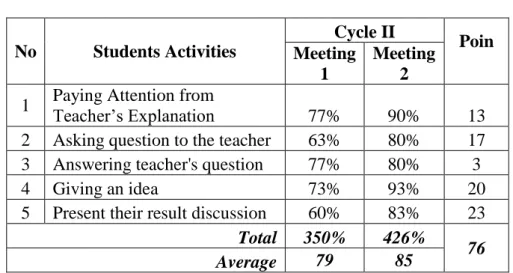
The Indicators of students’ activities that observed are:
1. The students pay attention the teacher explanation.
2. The students asking to the teacher.
3. The students answer the teacher question.
4. The students’ active to giving an idea.
5. The students can present their paper (result of discussion) in front of class
3. Observation
The Observation instrument in this research is the picture activity of researcher and students as the object during teaching learning process was begin. This picture taken from the first meeting until the end meeting on even of cycle.
4. Field Note
Field note was the last activity after giving treatment during the process. The field note instrument in this phase was giving by the collaborator who looking for all activity from the researcher during teaching learning process was begin. The model of field note instrument can be seen as follow: