AN UNDERGRADUATE THESIS
AN ERROR ANALYSIS ON THE USAGE OF SIMPLE PAST TENSE IN WRITING RECOUNT TEXT AT THE TENTH GRADERS OF
SMAN 1 RAMAN UTARA
By:
EFIT NURMANIA
STUDENT NUMBER 0845037
Tarbiyah Department
English Education Study Program
STATE ISLAMIC COLLEGE (STAIN) OF JURAI SIWO METRO
1433 H/2012 M
AN ERROR ANALYSIS ON THE USAGE OF SIMPLE PAST TENSE IN WRITING RECOUNT TEXT AT THE TENTH GRADERS OF
SMAN 1 RAMAN UTARA
Presented as a Partial fulfillment of the Requirements For the Degree of Sarjana Pendidikan Islam (S.Pd.I)
In English Education Study Program
By:
EFIT NURMANIA STUDENT NUMBER 0845037
Tarbiyah Department English Education Study Program
Sponsor : Drs. Kuryani Utih, M.Pd Co-sponsor : J. Sutarjo, M.Pd
STATE ISLAMIC COLLEGE (STAIN) JURAI SIWO METRO
1433 H / 2012 M
AN ERROR ANALYSIS ON THE USAGE OF SIMPLE PAST TENSE IN WRITING RECOUNT TEXT AT THE TENTH GRADERS OF
SMA N 1 RAMAN UTARA ABSTRACT
By:
EFIT NURMANIA
Everyone who learns a language produce error. The error occurring in the process of learning a foreign language should be considered as natural process. There are many purposes in studying students’ error that could be an important feedback for learners themselves. On the other hand, analyzing students’ error, the teacher not only can detect the students’ difficulty in learning the target language, but also can determine the effectiveness of certain method in teaching.
In this study, the writer formulated the problem such as: What error on the usage of simple past tense in writing recount text are made by the tenth graders of SMAN 1 Raman Utara?. The objective of study was to identify and classify the error on the usage of simple past tense in writing recount text at the tenth graders of SMAN 1 Raman Utara.
A qualitative descriptive was used to approach the data. The writer took 27 students of the tenth graders of SMAN 1 Raman Utara as her purposive sample. The data were collected by observation, test, interview and documentaion. Next, concerning to the process of researching, firstly, the writer observed the SMAN 1 Raman Utara and documented the data related to the school profile and also arranged the research instrument. Secondly, the writer entered on the class to give the students writing test of recount text. An error analysis was classified into 4 parts: error of omission, error of addition, error of misformation, and error of disorder.
The result of the analysis shows that: The error in writing recount text made by the tenth graders of SMAN 1 Raman Utara of 27 students are error of omission and disorder is the highest proportion 23 students (85,2%). It is followed by error of addition 11 students (40,7%), and the last error is error of misformation 4 students (14,8%).
The conclusion, the most error found in error of omission and error of disorder. Next, it is hoped that the teacher would make use of these results in their teaching learning process in order to minimize the students’ error.
AN ERROR ANALYSIS ON THE USAGE OF SIMPLE PAST TENSE IN WRITING RECOUNT TEXT AT THE TENTH GRADERS OF
SMA N 1 RAMAN UTARA ABSTRAK
Oleh:
EFIT NURMANIA
Setiap orang yang belajar bahasa menghasilkan kesalahan. Kesalahan yang terjadi dalam proses pembelajaran bahasa asing harus dianggap sebagai proses alami. Ada berbagai tujuan dalam mempelajari kesalahan siswa yang bisa menjadi umpan balik yang penting bagi peserta didik sendiri. Di sisi lain, menganalisis kesalahan siswa, guru tidak hanya bisa mendeteksi kesulitan siswa dalam belajar bahasa target, tetapi juga dapat menentukan efektivitas metode tertentu dalam mengajar.
Dalam penelitian ini, penulis merumuskan masalah sebagai berikut: Apa kesalahan pada penggunaan simple past tense dalam menulis recount text yang dibuat oleh siswa kelas X SMAN 1 Raman Utara?. Tujuan penelitian ini adalah untuk mengidentifikasikan dan mengklasifikasikan kesalahan pada penggunaan simple past tense dalam menulis recount text pada siswa kelas X SMAN 1 Raman Utara
Pendeskripsian data dilakukan penulis secara kualitatif deskriptif. Penulis mengambil 27 siswa dari kelas X SMAN 1 Raman Utara sebagai sampel purposive nya. Data-data yang digunakan dikumpulkan dengan metode observasi, wawancara, tes, dan dokumentasi.
Selanjutnya, kronologi penelitian ini adalah sebagai berikut: Pertama, penulis mengobservasi SMAN 1 Raman Utara dan melakukan dokumentasi data terkait dengan profil sekolah dan siswa serta menyusun instrumen penelitian. Kedua, penulis masuk ke dalam kelas X memberikan tes tertulis recount text. Analisis kesalahan diklasifikasikan dalam 4 bagian, yakni error of omission, error of addition, error of misformation, dan error of disorder.
Hasil analisis menunjukkan bahwa: Kesalahan dalam penulisan recount text yang dibuat oleh siswa kelas X SMAN 1 Raman Utara dari 27 siswa adalah error of omission dan error of disorder merupakan tingkat tertinggi 23 siswa (85,2%). Hal ini diikuti oleh error of addition 11 siswa (40,7%), dan kesalahan terakhir adalah error of misformation 4 siswa (14,8%).
Kesimpulannya, kesalahan terbanyak terdapat pada error of omission dan error of disorder. Selanjutnya, diharapkan guru akan memanfaatkan hasil ini dalam proses belajar mengajar mereka untuk meminimalkan kesalahan siswa.
STATEMENT OF RESEARCH ORIGINALITY
The undersigned:
Name : Efit Nurmania
Student Number : 0845037
Study Program : English Education Study Program (PBI)
Department : Tarbiyah
States that undergraduate thesis is originally the result of the writer research in exception of certain parts which are accepted from the bibliography mentioned.
Metro, 10 Desember 2012
The writer
Efit Nurmania St.N. 0845037
MOTTO
َنوُنِم ْؤُي ٍم ْوَقِل ًةَم ْحَر َو ىًدُه ٍمْلِع َلَع ُهاَنْل َّصَف ٍباَتِكِب ْمُهاَنْئ ِج ْدَقَل َو ٰ عِلْمٍ هُدًى وَرَحْمَةً لِقَوْمٍ يُؤْمِنُونَى
“And verily We have brought them a holy Quran which We expounded with knowledge, a guidance and a mercy for a people who believe”
(Al-A’raaf:52)
ACKNOWLEDGEMENT
Praise and thanks to Allah the lord of the world, who always blesses us and give us his mercies. May peace and salutation be upon our beloved Prophet Muhammad SAW, his family and also his companions. Allah has given His gift to the writer so she could finish he research proposal entitled “An Error Analysis on the Usage of Simple Past Tense in Writing Recount Text at the Tenth Graders of SMAN 1 Raman Utara”. This research was presented as a partial fulfillment of the requirement for the degree of Sarjana Pendidikan Islam (S.Pd.I) in English Education Study Program in STAIN Jurai Siwo Metro.
Regarding to the undergraduated thesis, the writer couldn’t stay alone, there were many persons who contributed their meaningful hands in accomplishing this undergraduated thesis that the writer couldn’t mention one by one. His great thank goes to the principles of STAIN Jurai Siwo Metro Prof. Dr. Edi Kusnadi, M.Pd, Muhtar Hadi, S.Ag, M.Si as the First vice Principle, Dr. Zaenal Abidin, M.Ag the Second vice Principle, Drs. Hemlan Elhany, M.Ag as the Third vice Principle, and H. Husnul Fatarib, Ph.D as the Fourth vice Principle, Drs. M. Hariplish, MA as The Head of Tarbiyah Departement, and Dedi Irwansyah, M.Hum as The Head of English Education Study Program who has given chance to held this research. Then, the writer would like to extend his gratitude to the sponsor Drs. Kuryani Utih, M.Pd and Co-sponsor J. Sutarjo, M.Pd who have constantly given their endorsement, time, and guidance so that the writer could finish the research.
Next, May Allah SWT gives them His better reward for their spending time to support and guide during the undergraduated thesis writing process. The writer also gives thanks to his parents and all family who have given a big motivation and spirit, so the writer could finish this research.
In line with those meaningful persons. The writer also would eargly like to express his thanks to the honorable lectures of english education study program, who helped him to make understand about knowledge. The students of english education study program who became good partners in studying english. The writer will not let himself forget to appreciate his beloved friends of english education programm especially “C class of 2008” who always accompany him in facing a plenty problems of learning english.
Finally, as human being, the writer completely realize that this undergraduated thesis still richly needs many corrections. The writer do apologies for all mistakes he has made in writing and presentation items. All constructive coments and suggestions are extremely welcomed to lighten up the quality of this undergrduated thesis. Hopefully thus undergraduated thesis can be a meaningful benefit of the writers especially and for our campus and all readers generally.
Metro, 10 Desember 2012
The writer,
Efit Nurmania St.N.0845037
TABLE OF CONTENTS
COVER ... i
TITTLE PAGE... ii
ABSTRACT... iii
NOTA DINAS... v
APPROVAL PAGE... vi
RETIFICATION PAGE... vii
STATEMENT OF RESEARCH ORIGINALITY... viii
MOTTO... ix
DEDICATION PAGE... x
ACKNOWLEDGEMENT... xi
TABLE OF CONTENT ... xiii
THE LIST OF TABLE... xv
THE LIST OF FIGURE... xvi
CHAPTER I INTRODUCTION... A. Background of the Problem... 1
B. Focus of Study... 5
1. Limitation of The Problem... 5
2. Formulation of The Problem... 6
3. Objectives and Benefits of The Study... 6
C. Prior Research... 7
CHAPTER II THEORITICAL FRAMEWORK
A. Error Analysis... 9
B. Tenses... 13
1. The Form of Simple Past Tense... 14
2. The Use of Simple Past Tense... 16
3. Adverbial with the Simple Past Tense... 17
4. The Pattern of Simple Past... 19
C. Writing... 21
D. Recount Text... 23
CHAPTER III RESEARCH METHODOLOGY A. Type and Characteristic of Study ... 25
B. Data Resource ... 27
C. Data Collecting Technique... 28
1. Observation... 28
2. Test... 29
3. Interview... 30
4. Documentation... 31
D. Data Analyzing Technique... 31
E. Research Approach ... 32
CHAPTER IV RESULT OF THE RESEARCH A. General Description of Research Setting... 35
1. SMAN 1 Raman Utara... 35
2. Vision and Mission of SMAN 1 Raman Utara... 37
3. Target of the School... 38
4. The Organization Structure of SMAN 1 Raman Utara... 39
5. School Condition... 40
B. General Description of Research Data... 45
C. Analysis of The Data... 45
1. Identification of Errors... 46 2. Classification of Errors... 46 CHAPTER V CONCLUSION AND SUGGESTION
A. Conclusion... 52 B. Suggestion... 53
BIBLIOGRAPHY APPENDIXES
THE LIST OF TABLE
Table Page
1. Structure of using non-verb 20 2. School facilities 41
3. List of teacher and officer 42 4. Total of the students 44
5. The form error and right of error of omission (a) 47 6. The form error and right of error of omission (b) 48 7. The form error and right of error of addition (a) 49 8. The form error and right of error of addition (b) 49 9. The form error and right of error of disorder 50
10. The form error and right of error of Misformation (a) 51 11. The form error and right of error of Misformation (b) 51
THE LIST OF FIGURE
Figure Page
I. The score of pre survey 4
II. Analysis component of Miles and Huberman model 31 III. The organization structure of SMAN 1 Raman Utara 39 IV. The sketch of school area 40
CHAPTER I INTRODUCTION
A. Background of The Problem
Every country has own language to communicate. English as an
international language has an important role to develop science and technologies.
By using language, they can communicate between one another. It means that language is a mean of communication. As a starting-point, language may be thought of in broad terms as having many of the characteristics of a code.
In Indonesia, English is the first foreign language, which is taught and learnt from elementary school until university. However, in Senior High School, English is taught as the main subject. The main purpose of National Education of English is that students understand English communicatively. So the learners must be able to master the four language skills, such as speaking, listening, reading, and writing.
There are various skills in mastering of a language; receptive skill is listening (understanding the spoken language), reading (understanding the written language), and productive skills is speaking and writing. Among the four skills above, writing is the most difficult one because it requires demonstrating the control of a number of variables simultaneously. They are control of content, format, sentence structure, vocabulary, punctuation spelling, etc.
We see that teaching and learning English as a foreign language is not easy.
Most students still have difficulties in learning it. It is not surprising because some of the differences, which are found, between their native language and the language they are learning. It seems that in learning a language, when a learner finds some forms, meaning, and distribution of patterns that are functionally similar to his native language, he will learn the language easily because he only transfers the system of his mother tongue to his foreign language. But if the form, meaning, and distribution of the pattern are different in the two languages the learner will have difficulties.
One thing that usually makes it difficult to learn a foreign language correctly and acceptably is that one language has different system for another. We know that the system of English is different from Indonesia. It causes the Indonesian students find some difficulties in learning English. The difficulties can result in errors. We of course, should avoid misunderstanding in using the language in our communication. One of the ways to do successful communication is that we have to try not to make errors grammatically in our written sentences or speeches. Therefore, everyone needs to learn the grammar that is generally accepted and practiced by most people who speak the language.
There are many kinds of English grammar that is taught and learnt by the students. Simple past tense is one of the lessons in English grammar that is taught and learnt by the first year students, but it is still found errors in doing items of simple past tense. The error could be an important feedback for the learners themselves. By knowing
their errors, they will know the problems that they face and try to analyze their weaknesses.
It can be seen on pre survey result conducted on July 13, 2012. The researcher has conducted a pre survey in SMA N 1 Raman Utara at the tenth graders on the academic year of 2012/2013. The writer interviewed the students about on making recount paragraph, can be known that about 95% students has difficulties on making it.
The writer found that there are many students who still have many problems in writing skill such as control of content, form, grammar, vocabulary, punctuation, and spelling. Dealing with those, the writer would like to take one of the problems. In this case the writer would like to analyze students’ errors in writing especially on grammar.
Grammar deals with the organization or morphemic units into meaningful combination.
It cannot be denied that the use of language is governed by rules.
Besides that, the writer also asked the English teacher for the list of students’
score writing recount assignment. Below is score chart of students writing recount text assignment in the tenth graders of SMA N1 Raman Utara on the academic year of 2012/2013.
Figure.1. The Score of Writing Recount Text Assignment, at The Tenth Graders of SMA N 1 Raman Utara in the Academic Year of 2012/2013.
SCORE
1 2 3 4 5 6 7 8 9 10 11 12 13 14 15 16 17 18 19 20 21 22 23 24 25 26 27 28 29 30 0
10 20 30 40 50 60 70 80 90
NUMBER OF THE STUDENTS
Source: Daily score assignment result of English Teacher of SMA N1 Raman Utara
The chart above represents the students’ writing performance in writing recount text of tenth graders. Actually, the minimum score on that school was 65, and if not more than sixty five, the student will not pass on the subject. From this test, the writer got the score of the student they are: the student who gets the score 25-65 (low) is about 19. Score 70-75 (medium) are about 2 students. And 80-100 (high) is about 2 students. It means that 90, 62% the tenth graders got low score.
Based on the chart also can be concluded that, nineteen from thirty students have low score in writing recount text. It means that about 66% of students of SMA N 1 Raman utara have low score in recount text.
On the other hand, by analyzing student’s errors, the teachers cannot only detect the students’ difficulty in learning the target language, but can also
determine the effectiveness of certain method in teaching the language. Studies of errors can be applied only in speaking and writing. It cannot be applied in reading and listening. Errors in recount writing are chosen in this study. Recount is one of
the genre texts, which is taught at the tenth year students of senior high school.
The significant lexico-grammatical features of recount text use past tense so it matches with this study.
Based on the reason above the writer would like to choose the title “An Error Analysis on the Usage of Simple Past Tense in Writing Recount Text at the Tenth Graders of SMAN 1 Raman Utara”.
B. Focus of The Study
1. Limitation of The Problem
Limitation is very useful for the writer to determine the problem that will be analyzed. In this case, the writer just explains about an error analysis on the usage of simple past tense in writing recount text at the tenth graders of SMAN 1 Raman Utara in academic year 2012/2013.
2. Formulation of The Problem
Based on the background of the study above, there is problem that can be identified in this research. The writer formulated the problem such as:
What errors on the usage of simple past tense in writing recount text at the tenth graders of SMAN 1 Raman Utara?
3. Objective and Benefit of The Study
a. Objectives of the study
Based on the statement of the problem above the writer has some purposes are:
To identify and classify the errors on the usage of simple past tense in writing recount text at the tenth graders of SMAN 1 Raman Utara.
b. Benefits of Study
1) Theoretical benefit, the result of the study is expected able to give the positive contribution for the school and other to help in learning process of English.
2) Practical benefit, there will be at least three kinds of practical benefit; they are for the students, English teacher and researchers:
a) For the teachers
The result of this study is intended to become an input for them for the importance of giving more exercises about simple past tense and also can improve their teaching technique while teaching grammar.
b) For the students
The writer hopes the students will be able to improve their ability in writing especially on the usage of simple past tense in writing recount text.
c) For the researchers
This result can be used as a reference of our experience to teach English for the future and other consideration to investigate the problem in a writer field and further research
C. Prior Research
First of all, the previous research is a study about students’ errors in using simple present tense in descriptive text made by the eighth year students of SMP N 2 Brebes. The research was written by Ima Natria, from the English Department of language and arts faculty Semarang University. This study was conducted under the consideration that simple present tense plays an important role in writing a descriptive text. The problems of this study are what dominant errors in descriptive texts are made by the eighth year students of SMP N 2 Brebes and what possible causes of those errors are. The purposes of this study are to find out the dominant errors on simple present tense in descriptive texts and to find out the possible causes of those errors.
Then, the cluster proportional random sampling was used to collect the data proportionally to represent each of the group, so that they were all well represented. The samples were taken 15% from every class to collect the data. The instrument that was used is a written test consisting of an outline in writing a descriptive text. In analyzing the data, error analysis is used in which there are five steps; they are identifying the errors, classifying the errors, calculating the errors, putting the result in tables and the last step is drawing conclusion.
Finally, the result of the analysis shows that there were 10 types of errors.
They are omission of be, wrong form of be, double be, wrong use of singular and plural form, addition of be (before and after verb), omission of suffix -s/-es, wrong use of verb, wrong form of modal auxiliary, omission of verb, and wrong form of negative sentence. It is concluded that the dominant errors lies on the omission of suffix –s/-es from the verb of third person singular subjects in the students’
descriptive texts whose proportion of the errors is 24.65%. Based on the result of the research, it is suggested that the eighth year students of SMP N 2 Brebes should be given intensive exercises on the correct structure of simple present tense in their writing. It is quite necessary for the eighth year students and the teacher of SMP N 2 Brebes to be informed about the result of this study so that they can improve their teaching and learning process.
CHAPTER II
THEORITICAL FRAMEWORK
A. Error Analysis
In learning and using a foreign language, one of the most inhibiting factors is the fear of making mistakes or errors. The making of errors is a sign that students have not yet mastered the rules of the language being learned. To cope with this problem, one of the strategies widely used by linguist is error analysis. Error analysis is the study of students’ error which can be observed, analyzed, and
classified to reveal something of the system operating within the learners.1 Brown’s point of view implies that error analysis is useful for the teacher. Error analysis will show teachers some problems confronting the students. It is an advantage that error analysis may be tracked down to the importance of students’
errors.
In addition Corder also stated that an analysis of the learner’s error gives the teacher evidence of how a language is learned or acquired and the learner’s competence in the foreign language.2 The teacher will also gain information concerning learner’s difficulties at different levels. Such information is important for the planning of courses and the constructions of the teaching materials. In addition, it is necessary to discuss error analysis for teaching English as a foreign language. English teachers should know error analysis because it becomes a useful key to understand the process of foreign language acquisition. They should know how the target language is learnt or acquired and what the best strategy the learners employ in order to master the target language. By conducting a systematic study of error, they may improve their teaching method and attempt to find some answers or solutions to solve some problems faced by their students.
Finally, from the definition above, writer can conclude that error analysis is a methodology for investigating learners’ competence in acquiring a second
1 Brown Douglas, Principle of Language Learning and Teaching Fourth Edition, (New York:
Addision Wesley Longman Inc.2000), p.218
2 Ibid, p.217
language acquisition or a foreign language. It can be used to identify the possible mistakes or errors that are made by students.
According to Dulay, errors can be classified into some types. The types of errors are omission, addition, misformation, and disorder3.
1. Omission
These types of error are characterized by the absence of an item that must appear in a well-formed utterance. For example:
a. She is go to school. In this sentence the learner omits ing.
The correct form: She is going to school.
b. Last week I visit my grandfather. In this sentence the learner omits –ed.
The correct form: Last week I visited my grandfather.
2. Addition
Addition errors are characterized by the presence of an item, which must not appear in a well-formed utterance. There are three kinds of addition of errors: double marking, regularization and sample addition.
a. Double marking
An error in which a concept is expressed twice when the language requires its expression only one.
e.g.: Armand didn’t ate bread (incorrect) Armand didn’t eat bread. (Correct) b. Regularization
3 Dulay Heidi et al, Language Two, (New York: Oxford University Press, 1982), p.146
The students tend to apply the irregular rules to the regular ones. For example in forming the verb of past tense:
sing- singed, write- writed, bring- bringed c. Simple Addition
The errors of addition that do not belong to two above, are included in this category.
e.g.: The lions doesn’t live in the water 3. Misformation
Misformation errors are characterized by the use of the wrong form of the morpheme or structure.
a. Regularization Errors
It refers to the use regular marker for an irregular one.
e.g.: childs for children
The Childs are singing a song together. In this sentence a regular plural marker is used in a place of an irregular one. The correct sentence is the children are singing a song together.
b. Archi – forms
The students use one form of a certain class to represent all of the use in the class.
e.g.: - Give me that - Me eat banana
c. Alternating Form
The student exchanges the form freely (that for those, he for she, saw for seen, etc).
e.g.: - That dogs eat meat - Those cat eat fish - I seen her yesterday 4. Disorder
Disorder errors are characterized by the incorrect placement of a morpheme or a group of morpheme in an utterance. For example: what your uncle is buying. The correct sentence is what is your uncle buying?
B. Tenses
Andrea Decapua suggests that tense is the time of an event4. Tenses describe a verb form that shows the time of the actions5. Meaning to say that tenses is verb form that used in sentences that showing the time of the action in that sentences and also used to write or to speak. Likes when the students want to write a certain paragraph, the students must follow a rule of tenses, in the big line tenses may be further subdivided by three parts they are present, past, and future.6 Below, the writer just gave the explanation of the past tense theory and the example of its sentence.
4 Andrea DeCapua, Grammar for Teachers, (New York: College of New Rochelle, 2008), p.165
5 Anonym, Oxford Learner’s Pocket Dictionary New Edition, (New York: Oxford University Press, 2000), p.445
6 Ibid
Simple past tense
The simple past is used to describe completed past actions or events7.and also simple past tense used to talk about things that happened in stories8.example:
we went to the theater on Friday. In addition, the simple past indicates that an activity or situation began and ended at a particular time in the past9. Here the subject (we) do an action in the last time, or something which is finished, the characteristic of simple past tense is use a past participle or past from ends –ed in irregular verb.
On the other hand, there are some past form didn’t follow by –ed. For negative or interrogative, if the sentence is verbal, we need to add “did” auxiliary.
but in a nominal sentence, we need to add ”was, were”.
1. The Form of Simple Past Tense
There are two kinds of verb in simple past tense: regular verbs and irregular verbs10.
a. Form of the simple past tense with regular verb
Regular verb is formed the past verbs by adding (d/ed) to the infinite.
1) The regular past always ends in-d: Arrive / arrived
7 Ibid, p.174
8 Anne Seaton, Basic English Grammar, (United States: Saddleback publisher, 2007), p.98
9 Betty Schrampfer Azar, Fundamentals of English Grammar, Third Edition, (New Jersey: Pearson, 1992), p.27.
10 A.J.Thomas, A.V.Martinet, A Practical English Grammar,(New York: Oxford University Press, 1985), p.161
Verbs ending in-e add-d: e.g. phone / phoned, smile/smiled. This rule applies equally to agree, die, lie, invite, etc.
2) Verbs not ending in-e add –ed: e.g. ask/asked, clean/cleaned, follow/followed, kill/killed, visit/visited, etc.
3) Verb spells with a single letter followed by a single consonant letter double the consonant: beg/begged, rub/rubbed, stop/stopped, plan/planned, slip/slipped, etc.
4) In two-syllable verbs the final consonant is doubled when the last syllable contains a single vowel letter followed by a single consonant letter and is stressed: prefer/preferred, refer/referred. Compare: ‘benefit/
benefited, ‘differ/.differed and ‘profit/provided which are stressed on their first syllable and which therefore do not double their final consonant. In American English labeled, quarreled, signaled and traveled follow the rule. In British English labeled, quarreled, signaled and traveled are exceptions of the rule.
5) Verbs ending in” y” there are two rules to change. When there is a consonant before-y, the “y” changes to “i” before we add-ed: e.g. carry/
carried, deny/denied, fry/fried, try/tried. Compare: delay/delayed, obey/
obeyed, play/played, etc. which have a vowel before-y and therefore simply add-ed in the past.
b. Form of the Simple Past Tense with irregular Verbs.
Unlike regular verbs, irregular verbs (about 150 in all) do not have past form that can be predicted:
1) A small number of verbs have the same form in the present as in the past: e.g. cut/cut, hit/hit, put/put. It is important to remember, particularly with such verbs, that the third person does not change in the past: e.g. he shut (past): he shuts (presents).
2) The past form of most irregular verbs is different from the present:
bring/brought, catch/caught, keep/kept, leave/left, lose/lost.
2. The Use of Simple Past Tense11 a. Completed actions
We normally use the simple past tense to talk about events, actions or situations, which occurred in the pas and are now finished.
They may have happened recently: Sam phoned a moment ago.
Or in the distant past: He arrived in Palestine.
A time reference must be given: I had a word with Julian this morning Or must be understood from the context:
1) I saw Fred in town. (i.e. when I was there this morning) 2) I never met my grandfather. (i.e. he is dead)
11 A.J.Thomas, A.V.Martinet, A Practical English Grammar,(New York: Oxford University Press, 1985), p.161
When we use the simple past, we are usually concerned with when an action occurred, not with its duration (how long it lasted).
b. Past Habit
Like used to, the simple past can be used to describe past habits:
I smoked forty cigarettes a day
c. The immediate past
We can sometimes use the simple past without a time reference to describe something that happened a very short time ago:
1) Jimmy punched me in the stomach.
2) Did the telephone ring?
3) Who left the door open?
d. Polite Inquiries
The simple past does always refer to past time. It can also be used for polite inquires (particularly asking for favors) often with.
Verbs like hope think or wonder. Compare:
I wonder if you could give me a lift.
I wondered if you could give me a lift. (More tentative/polite)
3. Adverbials with the Simple Past Tense
The association of the Past Tense with adverbials that tell us when something happened is very important. Adverbials used with the past tense must refer to past (not present) time. This means that adverbials which link the present (before now, so far, till now, yet) are not used with past tenses.
Some adverbials like yesterday, last summer and combinations with ago are used only with past tenses: I saw Jane yesterday/last summer.
Ago, meaning 'back from now, can combine with a variety of expressions to refer to the past: e.g. two years ago; six months ago; ten minutes ago; a long time ago: I met Robert Parr many years ago in Pakistan.
The Simple Past is often used with when to ask and answer questions: When did you learn about it? - When I saw it in the papers.
When often points to a definite contrast with the present: I played football every day when I was a boy.
Other adverbials can be used with past tenses when they refer to past time, but can be used with other tenses as well: Adverbs:
a. I always liked Gloria.
b. I often saw her in Rome.
c. Did you ever meet Sonia?
d. I never met Sonia.
Adverbial/prepositional phrases:
a. We left at 4 o'clock/on Tuesday.
b. We had our holiday in July.
Adverbial clauses:
a. I waited till he arrived.
b.I met him when I was at college.
4. The Pattern of Simple Past
Simple past is used for describing acts that have already been concluded and whose exact time of occurrence is known12. Furthermore, simple past is used for retelling successive events. That is why it is commonly used in storytelling.
The simple past indicates that an activity or situation began and ended at a particular time in the past13.
a. Using Verb
1) In the positive form uses regular/irregular verb.
The form is the same for all persons. For example:
a) I visited my grandmother last week (regular verb) b) You bought some books three days ago (irregular verb)
12 Andrea DeCapua, Grammar for Teacher, (New York: Springer Street, 2008), p.174
13 Betty Schrampfer Azar, Understanding and Using English Grammar, Third Edition, (New York:
Pearson Education 10 Bank Street, 1999), p.27
S + V2
2) Use the conjugated helping verb ‘did not’ (didn’t) the base form of the verb t makes negatives.
The form is the same for all persons. For Example:
a) She did not visit me last week
b) They did not g to New York last year.
3) Use the conjugated helping verb ‘did’ subject the base form at the verb in question forms.
The form is the same for all persons. For Example:
a) Did she write a letter last night? (Yes/no question)
b) Where did you go last holiday? (WH-question)
Simple past uses some adverbials like yesterday, last…and…ago
Last… (Last month, Last year) …days ago (Two months ago, Ten minutes ago). Last month, I went to the Surabaya Zoo with my family.
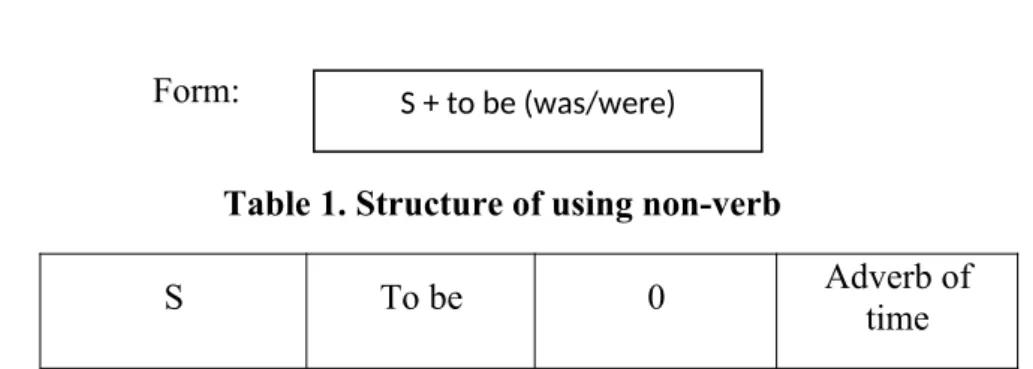
b. Using Non-Verb
Form:
Table 1. Structure of using non-verb
S To be 0 Adverb of
time S + did not + V1
did + S + V1
S + to be (was/were)
I She
He Name of person
Was In Malang Last holiday
You They
We
Were
D. Writing
Writing is the written productive language skill. It is an skill to convey information to a reader or a group of readers. It is realized by writer’s ability to apply the rules of the language she or he is writing to transfer the information she or he has in her or his mind.14 Also, Bryne (1979) added that it is neither easy nor spontaneous; it requires conscious mental effort. In conclusion, writing is not only just transforming our thought or idea in written form but also it relays to the process of monitoring any single word or feature that we have written and the process of rereading and revising our writing.
In addition, written products are often the result of thinking, drafting, and revising procedures that require specialized skills, skills are not every speaker develops naturally.15 Because most of speaking skill sometimes cannot be developed or enlarged as well as writing skill. The purposes for writing are to
14 Sanggam Siahaan, Issues in Linguistics, (Yogyakarta:Graha Ilmu, 2008), p.214
15 Brown H. Douglas, Teaching by Principles Second edition, (San Fransisco: Addision Wesley Longman Inc), p.335
express all of your ideas and thoughts, to provide information for your reader to persuade your reader to do something, and to create a literary work. Hence, there are many kinds of written product such as descriptive, persuasive, expositive, academic writing and many others. Depend on the aim of the writer in his writing.
In fact, there are some acts of writing which can be used as the basis for conceiving the meaning of writing. Those acts of writing are in line with the development of learning to write through which a student should pass. Writing involves more than just producing words and sentences.
Before writing, we should plan what we are going to write about and the purposes of the writing. After that, we can start to write. We may produce a number of writing (draft) and editing in order to get the good writing – that is the final draft. Writing involves some activities before, when we write, and after writing.
The activities before we write include exploring ideas which could be building vocabulary, interviewing someone, discussion, etc; and organizing ideas which could be ordering information in a paragraph, writing topic sentences, limiting information, using a time sequence, making an idea map, categorizing and making outline, summarizing ideas, writing titles, etc. When we write we should develop cohesion and style which includes connecting ideas, adding details, selecting the correct verb tense, selecting the correct tense, and writing the first draft.
This is not the end of writing. After we write the first draft we should edit and revise it. It could be the content, form, organization, cohesion and style, and grammar. In order to produce a good writing we should write more than just one draft. A good writing could be the fourth or fifth draft or even more.
E. Recount Text
Recount text or essay can be explained in several definitions. A writer stated that is the type of text which the contents report some event, accident, activity or someone experience.16 Recount is a reconstruction of something happened in the past. It is the unfolding sequence of events over time and the purpose is to tell what happened. Recounts begin with by telling the reader who was involved, what happened where this event took place and when it happened.
The sequence of event is then described in some sort of order, for instance a time order17.
The generic structure of a recount consists of three parts; they are the setting or orientation, events, and conclusion. The setting or orientation is the background information answering who, when, where and why. It is also where you give an outline of what you are writing about. Events are where you write about the things that happened and are identified and described in chronological
16 Otong Setiawan Djuharie, Essay Writing, (Bandung: Yrama Widya, 2009), p.125
17 A. Seaton “The Recount Genre”, http:// www.andrewseaton.com.au /grecount.htm. 25th June 2012
order. And the conclusion expresses a personal opinion regarding the events described. In other words this is where you bring your writing to a close by; saying how things went, saying what you felt about the things that happened and/or mentioning something which will or may happen later.
A recount has a title, which summarizes the text. Since recount tells about past experiences, it uses past tenses; such as simple past, past perfect, past
continuous, past perfect continuous tenses. A recount describes events, so plenty of use is made of verbs (action words), and of adverbs (describe or add more detail to verbs). And since it describes events in a chronological order, to describe the events words which link events in time can be used, such as next, later, when, then, after, before, first.
The lexico-grammatical features of recount are focus on specific
participants, use of past tense, use of material processes, circumstances of time and place, and focus on temporal sequence. According to the SMA N 1 Raman Utara syllabus, recount is being taught in the tenth year. The basic competence is the students can use various kinds of language, i.e.: either written or verbal in smooth and accurate transactional and monologue texts especially on the form of recount, narrative, procedure, report and news item.
CHAPTER III
RESEARCH METHODOLOGY
A. Type and Characteristic of Study
In this research, the researcher will use the descriptive qualitative method because depend on the purpose of the research. Actually, the purpose of the research observes the correlation of background, knowledge and factor that cause a problem of learning and problem of learning simple past tense. It can cause learning simple past tense is enthused by most of student in the school academic.
As can be seen from in the explanation above the writer considers using qualitative research to know the simple past tense competence and what make the simple past tense is difficult to learn on SMA N 1 Raman Utara.
In this case, the researcher considers the importance phenomena to be explored. It is because qualitative researcher is a research that explores a phenomenon by describing it with non-numeric language in the context and scientific paradigm.18Moreover, qualitative researcher is concerned with qualitative phenomenon, i.e., phenomena relating to or involving quality or kind19. Meaning to say that the qualitative is to know the quality that has been
18 Pusat Penelitian dan Pengabdian Kepada Masyarakat (P3M), Pedoman Penulisan Karya Ilmiah, (Metro: STAIN Jurai Siwo, 2010), p.21
19 C.R. Kothari, Research Methodology Method and Techniques, (India: New Age International Publisher, 1990), p.3
analysis. It is different from quantitative research which identically uses numeric language.
Qualitative research is fundamentally interpretive. This means that the writer makes an interpretation of the data. This includes developing a description of an individual or setting, analyzing the data for themes or categories, and finally making an interpretation or drawing conclusion about its meaning personally and theoretically, stating the lesson learned, and offering further questions to be asked (Walcott).20 Qualitative research takes place in the natural setting. The qualitative researcher often goes to the site (home, office) of the participant to conduct the research.21 Or it can be said that by qualitative research, the writer will have more chance to do his research in many places he wants.
In line with the terminology, the main topic of the research is an error analysis in the usage of simple past tense in writing recount text that has been tough in the tenth graders. The nature of this research is used to determine simple past tense competence students of SMAN 1 Raman Utara especially at the tenth graders on the academic year 2012/2013. It is natural research to find a new knowledge, a new generalization and new theory. And it also can be conducted to understand and explaining the phenomena of something
20 John W. Creswell, Research Design the second edition, (USA: Sage Publication, Inc. 2003). P.182
21 Ibid. p 181
Based on the explanations of qualitative research, it can be understood that truth research is supposed to discuss the new problem in order to become a new knowledge and a new theory based on phenomena related with the problem.
B. Data Resource
Previously the researcher considers the data resource before organize the research. In qualitative research there is no population as a data resource, but usually called social situation of three elements like as place, actors and activity.
Lincoln and Gulba stated that naturalistic sampling is very different from conventional sampling. Its purpose is to maximize information, not facilitate generalization.22 From the statements, the writer decided to get the data from purposive sample as the participants. It means that in determining sample, if the purpose is to maximizing the information. Then sampling is terminated when no new information is forth coming from newly sampled units; this redundancy is primary criterion.23
Consequently, the writer will choose 1 class consist of 27 students who will be the data resource in conducting the research (purposive sample).
They are the tenth graders of SMA N1 Raman Utara academic year 2012/2013.
22 Prof.Dr.Sugiyono, Metode Kuantitatif dan Kualitatif dan R & D, (Indonesia: CV.Alfabeta, 2009).
p.219
23 Ibid, p.220
C. Data Collecting Technique
In conducting the research, the writer chooses only one class at the tenth graders of SMAN 1 Raman Utara on the academic year 2012/2013. To take the data the writer needs some instruments; therefore, the writer offers instruments in collecting the data are as follow:
1. Observation
Observation means a technique or a method to collect a data with using all senses24.The observation method is the most commonly used method especially in studies relating to behavioral sciences. Observation becomes a scientific tool and the method of data collection for the researcher, when it serves a formulated research purpose, is systematically planned and recorded and is subjected to checks and controls on validity and reliability. Under the observation method, the information is sought by way of investigator’s own direct observation without asking from the respondent25.The main advantage of this method is that subjective bias is eliminated, if observation is done accurately.
Then, the information obtained under this method relates to what is currently happening; it is not complicated by either the past behavior or future intentions or attitudes. Thirdly, this method is independent of
24Suharsimi Arikunto, Prosedur Penelitian Suatu Pendekatan Praktik, (Jakarta: Rineka Cipta, 2006), p.156
25 C.R. Kothari, Op.cit, p.96
respondents’ willingness to respond and as such is relatively less demanding of active cooperation on the part of respondents as happens to be the case in the interview or the questionnaire method. This method is particularly suitable in studies which deal with subjects (i.e., respondents) who are not capable of giving verbal reports of their feelings for one reason or the other26.
In this case, the writer will organize the observation at the tenth graders of SMA N1 Raman Utara. The writer will observe the condition of the class when the learning process was running. And also he will observe the students’ characteristic and the condition of the class. This process is aimed to know the object more.
2. Test
In this research, the writer also will use test as the data collection instrument. Test is a set of stimulus presented to an individual in order to elicit responses on the basic which a numerical score can be assigned.27 Test is the sequence of question or statement that used to measure the skills, knowledge, intelligence, performance, and talent belong to individually or groups. In this case the researcher will gives the English written test to the students. The students will write the recount text using the simple past tense.
Finally, based on the test result, the researher can analyze the errors which
26 Ibid.
27 Edi kusnadi, Metodologi Penelitian,(Metro: Ramayana press & stain metro, 2008), p.91
made by the tenth graders of SMA N1 Raman Utara especially in using simple past tense.
3. Interview
Interview is purposeful dialogue; the aim of interview is to gain a going something about the people, occurrence, activity, organization, feeling, motivation, etc. The researcher organized face-to-face contact with participants. The method of collecting information through personal interviews is usually carried out in a structured way. As such we call the interviews as guided interview or structured interviews. Such interviews involve the use of a set of predetermined questions and of highly standardized techniques of recording. Thus, the interviewer in a structured interview follows a rigid procedure laid down, asking questions in a form and order prescribed.28
With face-to-face interviews only the researcher stands between the confidentiality of those studied and legal system. It is common to have contact information for sample members, but this should be kept separate from data records. Therefore, after doing the interview, the researcher should not open the result to the participants to keep that data legal. The contact information should be separated to make the participants not cheat. Based on explanation above, the writer interviewed the tenth graders about learning simple past tense. The researcher asked about the factors that makes the
28 C.R.Kothari, Op.cit, p.97
students difficulty in learning simple past tense. The students asked in spoken interview, and the others said on their writing comment.
4. Documentation
In a research, the researcher usually used more than one data collection method or instrument.29The researcher also will use documentation as the instrument, documentation is purposed to get the archive of the school such as organization structure and history of the school.
Furthermore, the researcher will use the documentation method to get detail information about the condition of the students, especially at the tenth graders of SMA N1 Raman Utara on the academic year 2012/2013.
D. Data Analyzing Technique
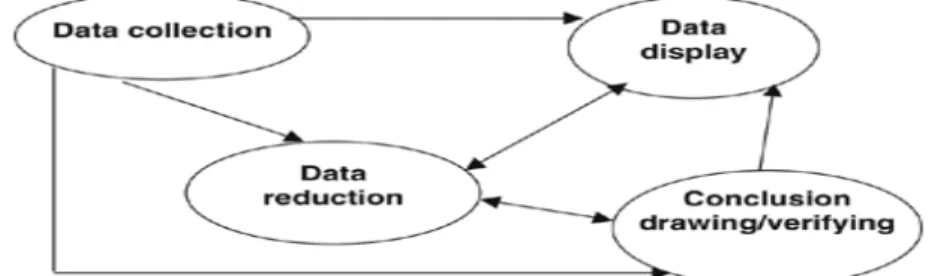
In the qualitative research, the process of data analysis can make sense out text and image data. The writer would apply Miles and Huberman Model to analyze his data. The steps can be explained as follow:
Figure II. Analysis Components of Miles and Huberman Model 30
29 Edi kusnadi, Op.cit, p.103
30 John W. Creswell, Op.cit, p. 15
Data analysis by Miles and Huberman model conducts the following steps:
1. Data collection is the step when the writer gather all data which are used to complete the research.
2. The writer reduces the data he had gotten by summarizing and choosing specific things.
3. To display the data, the researcher usually uses graphics, figures, or charts.
The display should be able to describe the content entire the data.
4. Lastly, the researcher verifies his research by making conclusion of data findings.
E. Research Approach
Case study is the method that the writer will apply in this research.
Because the writer aims at exploring the grammatical mistakes are commonly found on the usage of simple past tense in writing recount text. Through this research, the writer gives more information to the English teacher what kind of students’ errors in writing recount text. In addition, the cases are bounded by time and activity, and the writer collects detail information using a variety of data collection procedures over a sustained period of time (Stake, 1995).31
Moreover, Tellins (1997) indicated that case study data is collected by various approaches based on some sources. This research is considered as research methodology to describe a phenomenon totally32. It can be known that using
31 Ibid.
32 Ibid.
various data to gain the data based on different sources, can make the aspect of validity and reliability of the research more describing the reality of daily activities.
Because the writer used case study, the writer applied step by step procedures in gaining the result of the research. Then, the writer adopted the procedures generally as follows:
1. Determining focus of the research and formulating the questions.
The writer focuses to collect the data taken from test in writing recount text. The writer did not formulate the questions because the writer did not use interview to gain the result of data.
2. Determining the case, collecting and analyzing the data
After finishing gaining data, the writer determines the case that would be analyzed.
3. Supplying collecting data instrument
The writer plans to determine instrument to collect the data, format and document the data.
4. Evaluating and analyzing the data
The writer evaluates the data, before he analyzed and interpreted the data.
It was to ensure that data was complete.
5. Making report
The writer creates the report to simply the data. The report can be summary and formal.33
CHAPTER IV RESULT OF THE RESEARCH
A. General Description of Research Setting 1. SMA N1 Raman Utara
33 Ibid, p. 290
SMA N 1 Raman Utara has built on Raman Aji village, Raman Utara city, East Lampung. The location of SMA N 1 Raman Utara is very easy to visit because the position of SMA N 1 Raman Utara on first road. The far ranging area is 2 ha. This is the data of academic year of SMA N 1 Raman Utara as follows:
a. Academic year of 2004/2005 (the first built)
SMA N 1 Raman Utara has built on the year of September, 30, 2004.
It has formalized by Drs. Hi. Bahusin MS as the regent of East Lampung.
On the academic year of 2004/2005, SMA N 1 Raman Utara has consists from three class room and one office teacher. The total of the teachers are 12 teachers, 3 officers. The total of the students are 120 students from three classes. The leadership of SMA N 1 Raman Utara is Dra. Sulimasdiu.
b. Academic year of 2005/2006
On this year, total of the students are 272 students from 7 classes with the leadership is Dra. Sulimasdiu.
c. Academic year of 2006/2007
On the year of 2006/2007, total of the students are 385 from 10 classes. The leadership is Drs. Budi Rahayu, M.Pd.
d. Academic year of 2007/2008
On the year of 2007/2008, total of the students are 385 students from 11 classes. The leadership is still Drs. Budi Rahayu, M.Pd.
e. Academic year of 2008/2009
On the year of 2008/2009, total of the students are 362 students from 12 classes. The leadership is still Drs. Budi Rahayu, M.Pd.
f. Academic year of 2009/2010
On the year of 2009/2010, total of the students are 370 students from 12 classes. The leadership is Drs. Sutrisno.
g. Academic year of 2010/2011
On the year of 2010/2011, total of the students are 376 students from 12 classes. The leadership is still Drs. Sutrisno.
h. Academic year 2011/2012
On the year of 2011/2012, total of the students are 400 students from 13 classes. The leadership is Bambang Sulistiyono, S.Pd.
i. Academic year 2011/2012
On the year of 2011/2012, total of the students are 400 students from 13 classes. The leadership is Drs. Agus Sulastyo.
j. Academic year 2012/2013
On the year of 2012/2013, total of the students are 450 students from 15 classes. The leadership is Drs. Agus Sulastyo.
2. Vision and Mission of SMA N 1 Raman Utara a. Vision
As one of favorite Senior High School that always is chosen by many students who has been graduated from Junior High School, SMA N1 Raman Utara has vision and mission. Its vision is “discipline, achieved, polite and taqwa”, with indicators:
1) Achievement in teaching and learning process 2) Achievement in quality study
3) Achievement in human resourches achievements in infrasructure facility 4) Achievement in infrastructure facility completed
5) Achievement in school management 6) Achievement in raising financing 7) Achievement of assessment system.
b. Mission
1) Improving the effectiveness of active learning, innovative, creative, effective, and fun
2) Realizing the developmentnof educational curriculum adaptable unit level 3) Achieve competency standard achievement for thoroughness with minimal >
7.00 each subject
4) Raising human resourche teachers and reliable
5) To realize system reliable and valid assessment with the carrying capacity of information technology
6) Compliance with the development and management of facilities and standards
7) Realizing the management of the implementation of participator management by involving the entire school community
8) Realizing the aviability of financing education though cooperative relations comunities, agencies and government.
3. Target of the School:
a. The minimum percentage of the students be able to communicate in english are about 16%
b. The maximum percentage of the students who get remedial are 9%.
c. The maximum percentage of the undiscipline students in obey the rule are about 2 %.
d. The minimum percentage of the active students who follow the extra activity are 80 %.
e. The minimum percentage of the students who follow the sport activity are about 70 %.
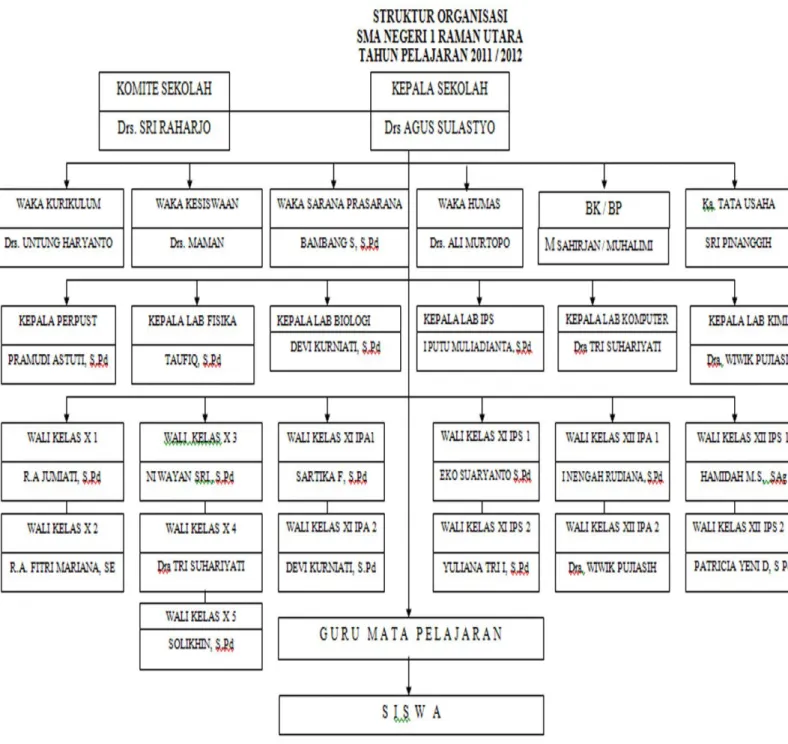
4. The Organization Structure of SMA N1 Raman Utara
Figure III. The Organization Structure of SMA N1 Raman Utara
Source: The school officer’s data of SMA N1 Raman Utara academic year 2011/2012
5. School Condition
Based on observation result in SMAN 1 Raman Utara, the writer would to explain the school condition of SMAN 1 Raman Utara as follow:
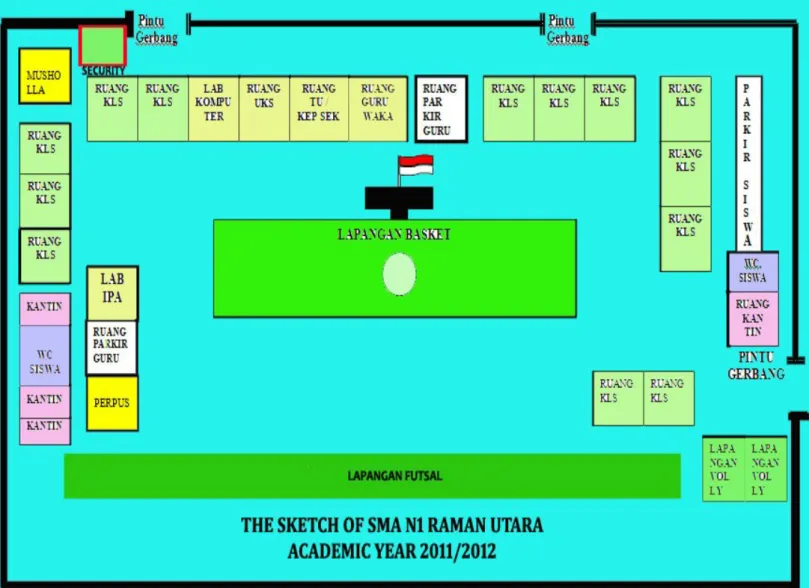
a. School Area
Figure IV. The Sketch of School Area
Source: the school officer’s data of SMA N1 Raman Utara academic year 2011/2012
b. Facilities
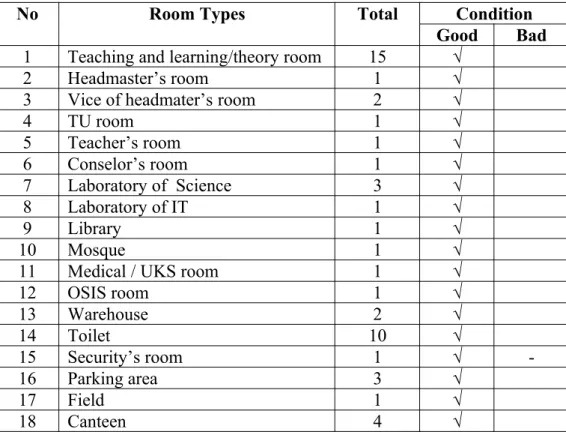
Looking from the observation result, below the list of facilities and school building of SMAN 1 Raman Utara can be explained as follow:
Table 2. School facilities of SMAN 1 Raman Utara East Lampung
No Room Types Total Condition
Good Bad 1 Teaching and learning/theory room 15 √
2 Headmaster’s room 1 √
3 Vice of headmater’s room 2 √
4 TU room 1 √
5 Teacher’s room 1 √
6 Conselor’s room 1 √
7 Laboratory of Science 3 √
8 Laboratory of IT 1 √
9 Library 1 √
10 Mosque 1 √
11 Medical / UKS room 1 √
12 OSIS room 1 √
13 Warehouse 2 √
14 Toilet 10 √
15 Security’s room 1 √ -
16 Parking area 3 √
17 Field 1 √
18 Canteen 4 √
Source: the school officer’s Data of SMA N1 Raman Utara Academic Year 2012/2013
Based on the data above, it can bee seen that the facilities of SMAN 1 Raman Utara are in the good condition. All of its facility are very important to developt the students’ achievement.
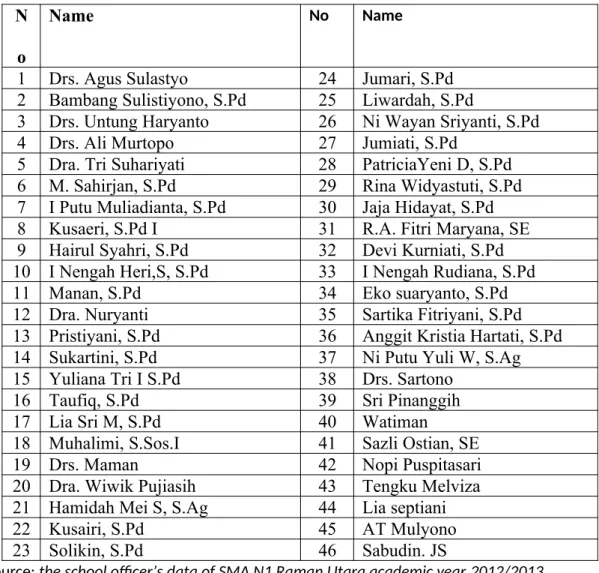
c. Teachers and Officers of SMAN 1 Raman Utara
Table 3. List of Teacher and Officer of SMAN 1 Raman Utara N
o
Name No Name
1 Drs. Agus Sulastyo 24 Jumari, S.Pd
2 Bambang Sulistiyono, S.Pd 25 Liwardah, S.Pd
3 Drs. Untung Haryanto 26 Ni Wayan Sriyanti, S.Pd
4 Drs. Ali Murtopo 27 Jumiati, S.Pd
5 Dra. Tri Suhariyati 28 PatriciaYeni D, S.Pd
6 M. Sahirjan, S.Pd 29 Rina Widyastuti, S.Pd
7 I Putu Muliadianta, S.Pd 30 Jaja Hidayat, S.Pd
8 Kusaeri, S.Pd I 31 R.A. Fitri Maryana, SE
9 Hairul Syahri, S.Pd 32 Devi Kurniati, S.Pd
10 I Nengah Heri,S, S.Pd 33 I Nengah Rudiana, S.Pd
11 Manan, S.Pd 34 Eko suaryanto, S.Pd
12 Dra. Nuryanti 35 Sartika Fitriyani, S.Pd
13 Pristiyani, S.Pd 36 Anggit Kristia Hartati, S.Pd
14 Sukartini, S.Pd 37 Ni Putu Yuli W, S.Ag
15 Yuliana Tri I S.Pd 38 Drs. Sartono
16 Taufiq, S.Pd 39 Sri Pinanggih
17 Lia Sri M, S.Pd 40 Watiman
18 Muhalimi, S.Sos.I 41 Sazli Ostian, SE
19 Drs. Maman 42 Nopi Puspitasari
20 Dra. Wiwik Pujiasih 43 Tengku Melviza
21 Hamidah Mei S, S.Ag 44 Lia septiani
22 Kusairi, S.Pd 45 AT Mulyono
23 Solikin, S.Pd 46 Sabudin. JS
Source: the school officer’s data of SMA N1 Raman Utara academic year 2012/2013
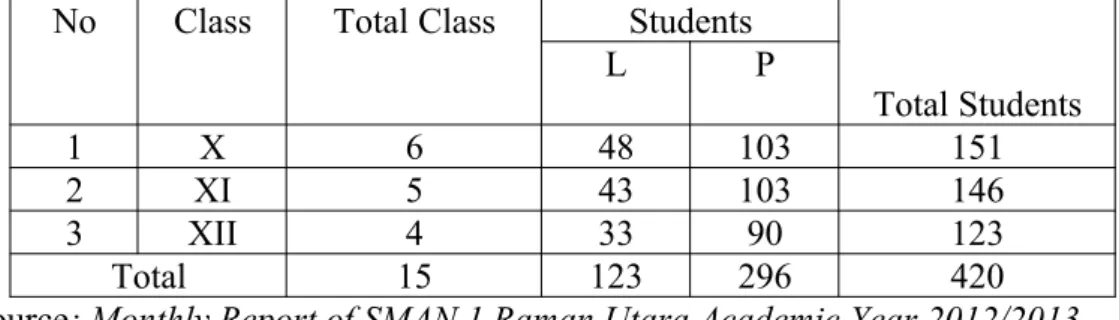
d. Total of The Students of SMA N1 Raman
Utara
SMA N1 Raman Utara has three levels; they are the tenth graders, the eleventh graders, and the twelfth graders. The tenth graders have 6 classes