DOI: 10.15294/ipsr.v7i3.40268 © 2022 Politik Indonesia: Indonesian Political Science Review
Received November 19, 2022; Revised December 19, 2022; Accepted December 26, 2022
An Exploratory Study of the Determinants of the Decision-Making Process of Local Government During the COVID-19 Pandemic in Indonesia
Agus Heruanto Hadna, Universitas Gadjah Mada, Indonesia*
Abstract
This study aims to answer how complex decision making is and what factors determine the decision making process in regions to manage the impact of the COVID-19 pandemic. This study uses the perspective of decision-making theory in crisis. However, this study is not intended to prove one specific theory. This study is an exploration type. It is intended to explore the practice of decision making in crises. The unit of analysis for this study is the highest officials, both executive and legislative, at the provincial and district levels, where it has been awarded as the best province in handling the COVID-19 pandemic. The total of respondents who completed the online questionnaire form were 45 percent of all DPRD members in the province and district; and 41 percent of provincial and district government officials. This study found new findings that executive leaders, rather than legislators, believed that pandemic-era decision-making was complex. The second new finding of this study is that the crisis has encouraged the emergence of transformational leadership. The last new finding is the consideration of the consequences of decision making that affect executive leaders in making decisions.
Other factors that determine the extent of the complexity of the decision-making identified are organizational and management capacity and government innovation capacity.
Keywords:
Decision making; Local government; Leadership; Executive and legislative; COVID-19 pandemic
INTRODUCTION
In March 2020, the WHO declared COVID-19 a global pandemic because this virus has been found in 114 countries worldwide and has claimed many lives.
The big challenge for every country then was to respond to the crisis with the right policies. This expectation is problematic because all countries face volatility, uncertainty, complexity, and ambiguity (VUCA). If the government of a country can respond to VUCA, it will most likely be able to overcome the effects of the crisis
caused by the COVID-19 pandemic. The experiences of several Asian countries below show how important speed and accuracy in decision making in a crisis are.
Vietnam, in January 2020, implemented a risk assessment, a national response plan, and other anticipatory policies with a multisectoral approach (health, transportation, defense and security, education, and economy) to manage the impact of this pandemic quickly, accurately, and transparently (Lee & Chen, 2007). South Korea has implemented its comprehensive approach to dealing with the pandemic, including the world's first drive-through
*Correspondence: Kabupaten Sleman, Daerah Istimewa Yogyakarta 55281 Indonesia
Email: [email protected]
screening centers, self-diagnosis, and community-based care centers (You, 2020); as well as implementing a public- private healthcare partnership scheme, collecting and distributing accurate data, implementing a flexible public health budget (You, 2020); cover the total costs of coronavirus testing, quarantine, and treatment for both Korean and non- Korean citizens (Korean Ministry of Health and Welfare, 2020). Singapore, Taiwan, and Hong Kong implemented policies restricting travel from mainland China. This is contrary to WHO instructions that travel bans are unnecessary (Barron, 2020). Singapore's well-designed economic incentive scheme, in collaboration with well- established domestic legislation and residents' confidence in scientific knowledge and political leadership. This policy is essential to achieve good results in handling the pandemic (Quah, 2021).
The lessons learned from the policies to handle the pandemic in Vietnam, South Korea, Singapore, Taiwan, and Hong Kong are the importance of acting quickly and appropriately through measurable programs that suppress the spread of the COVID-19 pandemic. Some of the literature that shows policy responses to handling the COVID-19 pandemic in several Asian countries above mainly only explains the policy steps taken by the governments of these countries. Only a few articles discuss what public officials consider when making decisions during the COVID-19 pandemic. Previous research has yet to link decision making with leadership, organizational and management capacity, and the organizational environment of government. The results
of previous studies in the context of the decision-making process in many crises concluded that the decision-making process was primarily determined by intuition (Klein, 2008; Mintzberg, 1990;
Burke & Miller, 1999; Khatri & Ng, 2000).
Therefore, the question that will be examined in this study is: What is the complexity of decision-making in the regions during the COVID-19 pandemic?
What factors determine the complexity of the decision-making process during the COVID-19 pandemic for policy makers of the executive and legislative branches in the regions?
This study takes cases in the health, economic, transportation and social assistance sectors. These four sectors were selected because they are the strategic sectors most directly affected by the COVID-19 pandemic. The questions in the questionnaire are made in general terms, so that they can be answered according to the perceptions of the executive and legislative leaders according to the functions and experiences of everyone in the institution.
This study is not intended to prove a theory but abductively tries to combine theory with an exploration of decision- making practices that have developed in the local public sector. This exploratory study helps to explore new findings related to decision-making in crises.
To answer this question, this study has been carried out in a province that has received an award from the central government as the best province to handle COVID-19 in 2020. Another reason is the uniqueness of this local government system, which combines aristocratic and democratic systems.
The benefit of this study is to study the behavior of public officials, both executive and legislative, when making decisions in a crisis. The considerations they take when deciding on a policy are interesting to study. In the end, this study is useful for the government in training public officials to make decisions in a crisis.
THEORETICAL PERSPECTIVES Decision-making processes in a crisis era Decision makers often need complete information (Simon, 1955). This decision- making model is known as bounded rationality (Simon, 1955). This model assumes that not all decision-makers have complete information, and optimal choices are not always needed (Simon in Chase et al., 1998). Several decision- making models categorized into this bounded rationality model include garbage can (Cohen, March, and Olsen, 1972), incremental (Lindbloom, 1959), political perspective (Pfeffer, 1981) and multiple streams (Kingdon, 1995; Hadna, 2021; Zohlnhöfer & Rüb, 2016).
This perspective of bounded rationality has inspired many studies of decision making in crises. Pearson and Clair (2008) concluded that the decision- making process in a crisis must be fast.
Decision makers must involve relevant stakeholders and improve in practice.
Several factors that significantly influence the decision-making process in a crisis include stress, time, and unknown (lack of) information (Das, 1980; Hadna, 2021).
The core elements that define a crisis are ambiguity, urgency, and a high stake of impeding individuals' ability to assess the quality of information and make decisions effectively (Pearson &
Clair, 2008). Therefore, Hadley et al.
(2011) explain that leaders in decision making must be able to map and assess the available information. Decisions taken are subject to tremendous personal psychological and physical demands.
Several previous studies have shown that the decision-making process in a crisis is irrational. Mintzberg (1990) explains that decision makers emphasize intuition-based decision making more.
Another researcher, Klein (2008), suggests that reliable decision-makers will rely on tacit knowledge to make the right decisions. Experience also allows them to make decisions according to the identification of the situation. Experience and knowledge provide the ability to analyze problems and implement solutions more quickly. Therefore, intuition-based decision making works effectively if people have tacit knowledge.
Other researchers conclude differently that the decision-making process in a crisis is carried out rationally and intuitively (Eisenhardt, 1990). Burke and Miller (1999) stated that in a crisis, decision makers tend to use intuition and, at the same time, analyze the situation rationally. Khatri & Ng (2000) proved that using intuition and rational together is possible in effective strategic decision- making.
Decision-making in crises is often closed, with poor performance and maladaptive behavior (Alpers, 2019;
Schippers & Rus, 2021). Crisis often results in decision-making practices prone to failure (Nutt, 2002). Boin &
Lodge (2016) show that decisions made in a crisis are subject to uncertainty and volatility. Very little time is available to
consult and agree with colleagues, superiors, and other stakeholders when making decisions.
Decision making in crises, as described above, is divided into complex and less complex decision categories. The complexity is identified from sources of information for decision-making. The sources of decisions come from the superior government, regulations, the media, and the public. The decision maker's response when there is a difference in data uncertainty is also an indication of the complexity of the decision. Another indicator is an assessment of the intensity of data use.
Complex decisions generally require valid data support. In addition, decision making also requires an assessment of the political situation. The political response when there is a difference of opinion between the executive and the legislature also determines the complexity of the decision. The factor of capacity of government institutions and management also contributes to the complexity of the decision. Another factor is the emergence of personal considerations, especially among leaders, when making decisions. Finally, the power relationships between policymakers, both personally and institutionally, contribute to the complexity of decisions.
Factors that Determine the Decision-Making Process in a Crisis
The description of decision making during the above crisis concludes that several determinant variables influence decision making. These variables are leadership style, sense of crisis from policymakers, organizational and
management capacity, and government organizational environment.
This study refers to three leadership styles: transformational, transactional, and laissez-faire.
Transformational leadership prepares the organization to face potential crises (Bass
& Avolio, 1990; Yukl, 2010). Transactional leadership chooses rewards as a strategy to influence subordinates through incentives. This type also uses SOPs as a standard to assess the performance of subordinates. Meanwhile, the practice of laissez-faire leadership tends to show an inability to make decisions and solve problems.
Leadership is an art rather than a science. This arises when they react to a crisis environment. Some leaders may need help to handle problems effectively in standard situations. However, they can make effective decisions during a crisis.
On the other hand, leaders are good at business as usual, but run into problems during the crisis.
Much of the literature explains why many people find it difficult to process and share information under stress and uncertainty (Reason, 1990;
Kahneman, 2010; Coates, 2012). The sense of crisis requires a well-trained method to process information and analyze alternative solutions with various consequences.
A leader with a sense of crisis is vital (Weick, 1988; Weick et al., 2005). The argument is that the crisis provides a stimulus that encourages organizational transformation for the better. The condition is that leaders must be able to interpret and understand crises (Levitt &
March, 1988; Huberman, 2001).
Managing a crisis requires a high level of skill and a spontaneous process (Waugh & Streib, 2006). The old way of preparing resources, procedures, and policies and relying on organizational structures is no longer considered adequate (Boal & Hooijberg, 2000). The crisis requires government organizations and management to adapt to the environment and actively innovate.
The existing theory emphasizes that organizations vulnerable to crises must build a willingness to overcome crises. The trick is to appoint a particular official responsible for the crisis and train and create several scenarios during the crisis (Al-Dabbagh, 2020). Crisis management theory provides a way for organizations to manage crises using a behavioral approach. It is intended to reduce complexity and chaos by identifying information about threats (Al- Dabbagh, 2020).
Policy makers make decisions and always pay attention to the organizational environment (Varma, 2019). The organizational environment forces policy makers to react to threats of unknown levels. Policy makers must make decisions under tremendous time pressure and enormous uncertainty.
Milliken (1987) defined uncertainty as an inability to predict something accurately because of the lack of knowledge of policymakers. According to Ordónez &
Benson (1997) and Soares et al. (2012), in uncertainty and high levels of emotion, policymakers and time pressure policymakers tend to rely on routine decision making. The inability to identify uncertainty encourages policy makers to
ignore information from important alternative sources. This has resulted in errors in interpreting the COVID-19 outbreak, so decisions are less than optimal and lead to harmful consequences (Berger et al., 2021; Chater, 2020).
DATA AND RESEARCH METHOD Data
This study is exploratory research with data collection techniques using quantitative methods. The reason is that the analysis unit for this study is the individual executive officers or the legislature. The population in this study was the leaders and members of the DPRD, as well as local government officials (head or secretary of agency) at the provincial and district levels. They were selected as respondents because they are decision makers. The study was carried out during the COVID-19 pandemic between July and October 2020. The respondents were randomly selected by filling out a questionnaire online (google form). The total of respondents who completed the online questionnaire form were 111 (45%) respondents from all DPRD leaders and members in provinces and districts; and 67 (41%) respondents from all local government officials (head or secretary of agency) at the echelon 2 level in provinces and districts (Table 1). The number of respondents from DPRD leaders and members of the province is 38 people and the district is 73 people. For echelon 2, the provincial officials are 36 people, and the district is 31 people.
Table 1: Data Respondent Executive (n=67)
Province (n=36); Districts (n=31) Legislative (n=111)
Province (n=38); Districts (n=73) Leaders (60%) Secretary/Assistant
(40%) Leaders (30%) Members (70%)
Agencies, Boards, Bureaus, Local- owned enterprises
Secretary of Agencies,
Secretary of Boards, Regional assistants
Legislative
leadership, the Honors
Committee,
Faction leaders, Commission
leaders
Most major
political parties
Source: primary data Research Methods
Dependent variable: The Complexity of the Decision-Making Process
The indicators of the complexity of the decision-making process are: 1) sources of information for decision-making; 2) response to data differences; 3).
Assessment of the intensity of data use; 4) Assessment of the political situation; 5) Response to differences of opinion with the executive/legislative; 6) Assessment of institutional and management capacity; 7) Personal considerations in making decisions; and 8) Power relations between decision-makers. The eight indicators are grouped into complex and less complex decision-making variables.
Independent variables
In the first group, the type of leadership variable consists of three dummy variables: transformational, transactional, and laissez-faire. These three models were adopted from Avolio & Bass (2004);
Bass (1985) by adjusting to the context of local government in Indonesia. The context is very hierarchical in government, regulation-minded, procedural, and aristocratic in character.
This variable is used to measure the character of executive and legislative leadership. Measurement results are further grouped into the three types of leadership.
The leadership type comes from several self-assessment variables (Avolio
& Bass, 2004; Trejo, 2014). The type of transformational leadership is a composite of variables: moral values and self-confidence, behavior to build trust for the environment, the ability to build organizational vision, intellectual capacity, and placement as a nurturing individual (Avolio & Bass, 2004; Trejo, 2014). The transactional leadership type is a composite of variables: the ability to appreciate subordinates according to their achievements, the ability to identify subordinate errors from the start and correct them based on SOPs, and the ability to take action against subordinates' mistakes based on SOPs (Avolio & Bass, 2004; Trejo, 2014). The type of laissez-faire leadership comprises a composite of variables: presence when problems arise and when needed, inability to make decisions, and how to respond when
problems arise (Avolio & Bass, 2004;
Trejo, 2014).
The self-assessment variables that comprise the leadership type composite also function as independent variables, with the leadership type as the dependent variable. The aim is to see the most influential character in forming the type of leadership from the legislature and executive in the province. The data was processed using the usual regression equation for each type of leadership. In this paper, the results of the leadership- type regression are not presented in detail. The data shown are the conclusions of three types of leadership and their correlation with the decision- making process. This study produces three types of leadership as independent variables to estimate the factors that influence the decision-making process in the handling of the COVID-19 pandemic in the province. Estimated using logistic binary regression.
The sense of crisis consists of two independent variables. The two dummy variables are perceptions of the COVID-
19 pandemic situation
(perception_situation) and organizational project priorities when the issue of the COVID-19 pandemic began to spread (response_initial).
The third group, the organizational environment, includes four independent variables. The dummy variables are uncertainty, time- money_pressure, consequences of decisions, and social_pressure. The importance of overcoming doubts measures the uncertainty factor, realizing that circumstances can change, immediately changing preferences when something goes wrong, realizing when
decisions lead to something that rarely or never happened before, knowing for sure everything about the decisions taken, and considering personal risks involved in decision making.
The second independent variable in the third group is time- money_pressure. This variable is a composite of the assessment of available time considerations in decision making, management of activities based on time targets, speed and accuracy in acting, budget relocation and refocusing, calculation of the positive and negative impacts of policy choices, and comparison of activity achievements with the time and budget targets issued.
Another independent variable in the third group is decision_consequences.
This dummy variable is a composite result of several variables: an assessment of the level of importance to predict the consequences of decisions, whether they have a prolonged impact, overcome negative consequences, and assume full responsibility for decisions related to the COVID-19 pandemic. The last independent variable in the third group is social pressure. The composite social_pressure variable is an assessment of whether it is necessary to prevent conflicts with other parties, confidence in making decisions without external pressure, ability to adapt to a changing environment, willingness to listen to other parties, especially the community, ensuring decisions are following applicable norms, and assessing the influence sociopolitical elements that influence decisions made regarding the COVID-19 pandemic.
The fourth group is the internal environment of the organization and
management. This variable consists of two independent variables. Both are organizational and management capacities and organizational and management innovation constraints. The organizational capacity and management variable is a composite of budget availability, human resource support, facility availability, and institutional relations between government units. The constraint_innovation variable is a composite of a short decision-making period, financial disbursement procedures, compliance with regulations from above, the number of project monitoring and evaluation reports that must be made, shyness with superiors, an
attitude of maintaining good relations with leaders of other institutions, financial audits from institutions financial controllers, employees who do not master digital technology and still have regular work patterns, lack of valid activity program achievement data, and lack of communication between institutions.
Data were analyzed using regression analysis techniques. Four large groups of variables produce 11 independent variables to estimate the factors that influence the decision-making process to handle the COVID-19 pandemic in the province. Estimated using logistic binary regression with the following regression equation formula:
Y = β0 + β1 X1 + β2 X2 + β3 X3 + β4 X4 +...+ β11 X11 + Ɛ Note:
Y : decision-making process β0 : intercept
β1 - β12 : skewness coefficient X1 : Transformational leadership X2 : Transactional leadership X3 : laissez-faire leadership
X4 : perception of the COVID-19 pandemic (perception_situation) X5 : project activity during the COVID-19 pandemic (early response) X6 : factor of uncertainty (uncertainty)
X7 : factor of time/money pressure (timemoney_pressure) X8 : factor of decision consequences (consequences_decision) X9 : factor of social and pressure (social_pressure)
X10 : organisation and management (capacity_organisational) X11 : innovation constraints of organization and management
(constraint_inovation) Ɛ : error-term
RESULTS
Decision-making process
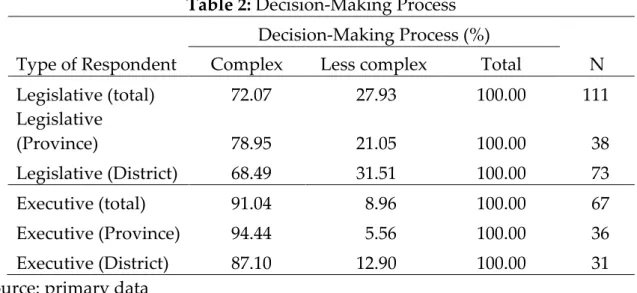
Table 2 concludes that the legislative and executive respondents agree that the decision-making process during the COVID-19 pandemic is in the complex
category. The average percentage of responses to the complexity of decision making is higher from provincial and district executives (91.04%) than from provincial and district legislatures (72.07%). This new finding concludes that
the executive’s job during the pandemic is much more demanding. They are the ones who are faced with new problems every day and need immediate decisions.
At the district level, some respondents responded that decision making is less complex than at the provincial level,
executive, and legislative. This is related to the centralization of policies to handle the COVID-19 pandemic in the hands of the central government. The position of the district is more like a pure implementer of the central policy.
Table 2: Decision-Making Process Type of Respondent
Decision-Making Process (%)
N Complex Less complex Total
Legislative (total) 72.07 27.93 100.00 111
Legislative
(Province) 78.95 21.05 100.00 38
Legislative (District) 68.49 31.51 100.00 73
Executive (total) 91.04 8.96 100.00 67
Executive (Province) 94.44 5.56 100.00 36
Executive (District) 87.10 12.90 100.00 31
Source: primary data
Factors Influencing Decision Making
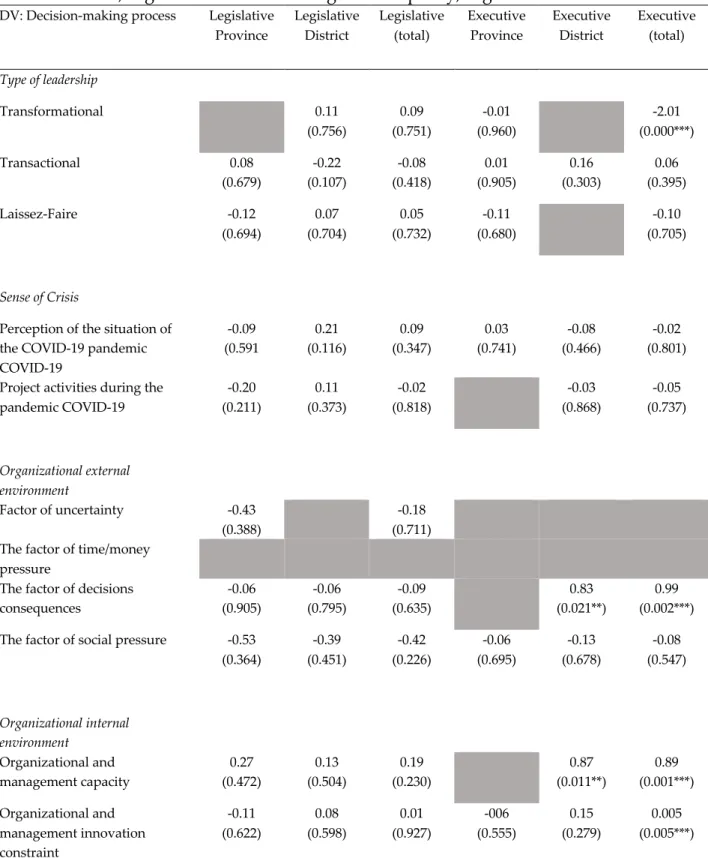
The regression results in Table 3 show that, at the provincial level, none of the independent variables significantly influence the complexity of the decision- making process of the legislature, province and district, as well as the combined provincial and district legislatures. In the executive respondent group, variations of independent variables affect the decision-making process between provincial officials, district officials, and a combination of the two. In the provincial government, all independent variables do not significantly influence decision making consideration. In district governments, the consequences of decisions, organizational capacity and management significantly affect the decision-making process of officials when managing the
impact of the COVID-19 pandemic with 95% confidence levels, respectively.
The results of the regression of the independent variable at the combined level of the district and provincial governments with the complexity of decision-making show a very significant relationship. Significant independent variables are transformational leadership variables, consequences in decision making, organizational and management capacity, and organizational and management innovation constraints. The relationship is at the 99% confidence level.
The executive leadership-type variable has little influence on the decision-making process. The effect of the leadership-type variable on the decision- making process was only found in the combination of two groups of
government institutions (provincial and district). The type of transformational leadership significantly influences the decision-making process with a confidence level of 99% if the calculated values of the two levels of government institutions are combined. The relationship is in the opposite direction.
The higher the transformational leadership capacity of a government official, the more capable the official is to reduce the complexity of the decision- making process. The regression results show the complexity of decision-making in those who do not have transformational leadership characteristics. In the legislative group, the regression results did not find the influence of the type of leadership on the complexity of decision making in the management of pandemics at the provincial and district levels or a combination of the two groups.
In the provincial legislative group, the provincial government, the district government, and a combination of the two government groups, the type of regression between transformational leadership and the character that reflects the type cannot be carried out. This is because the dummy results produced by each independent variable are predominantly or even entirely concentrated in one group.
The results of the regression of the consequences of the decision show that executive decision makers for complex
problems will consider the consequences.
At the district level, the effect of considering consequences is 0.83 times greater than that which does not consider the consequences of decisions. In the combination of district and provincial government levels, the effect of considering consequences is 0.99 times greater than that of those who do not consider the consequences of decisions.
Decision making results in better decisions because the group that considers the consequences of the decision considers each of them, especially the impact, and how to overcome it. District government officials should also consider organizational and management capacity variables when dealing with complex decision-making processes. According to respondents from the district government, the effect of organizational and management capacity is 0.89 times greater for complex decision making compared to those who do not consider organizational and management capacity. Finally, government officials who consider organizational and management innovation constraints can reduce the complexity of the problem by 0.005 times greater than the group of government officials who do not consider organizational and management innovation constraints. The three variables at the combined level of the provincial and district governments significantly affect the confidence level 99%.
Table 3. Regression results between decision-making process with leadership type, sense of crisis, organizational and management capacity, organizational environment
DV: Decision-making process Legislative Province
Legislative District
Legislative (total)
Executive Province
Executive District
Executive (total)
Type of leadership
Transformational 0.11
(0.756)
0.09 (0.751)
-0.01 (0.960)
-2.01 (0.000***)
Transactional 0.08
(0.679)
-0.22 (0.107)
-0.08 (0.418)
0.01 (0.905)
0.16 (0.303)
0.06 (0.395)
Laissez-Faire -0.12
(0.694)
0.07 (0.704)
0.05 (0.732)
-0.11 (0.680)
-0.10 (0.705)
Sense of Crisis
Perception of the situation of the COVID-19 pandemic COVID-19
-0.09 (0.591
0.21 (0.116)
0.09 (0.347)
0.03 (0.741)
-0.08 (0.466)
-0.02 (0.801)
Project activities during the pandemic COVID-19
-0.20 (0.211)
0.11 (0.373)
-0.02 (0.818)
-0.03 (0.868)
-0.05 (0.737)
Organizational external environment
Factor of uncertainty -0.43
(0.388)
-0.18 (0.711) The factor of time/money
pressure
The factor of decisions consequences
-0.06 (0.905)
-0.06 (0.795)
-0.09 (0.635)
0.83 (0.021**)
0.99 (0.002***) The factor of social pressure -0.53
(0.364)
-0.39 (0.451)
-0.42 (0.226)
-0.06 (0.695)
-0.13 (0.678)
-0.08 (0.547)
Organizational internal environment
Organizational and management capacity
0.27 (0.472)
0.13 (0.504)
0.19 (0.230)
0.87 (0.011**)
0.89 (0.001***) Organizational and
management innovation constraint
-0.11 (0.622)
0.08 (0.598)
0.01 (0.927)
-006 (0.555)
0.15 (0.279)
0.005 (0.005***)
Note:
*** = significance level 99%; ** = significance level 95%; * = significance level 90%
: Most/all the dummies are in one category, causing the regression not to be performed.
DOI: 10.15294/ipsr.v7i3.40268 © 2022 Politik Indonesia: Indonesian Political Science Review
Received November 19, 2022; Revised December 19, 2022; Accepted December 26, 2022
DISCUSSION
Complexity of decision-making
Data show that decision-making for managing the impact of the COVID-19 pandemic is a complex issue. Complexity is expressed by the group of executives who deal with emergency situations.
Emergency problems that must be responded to immediately are health problems that suppress fast and deadly spread. The government must quickly provide hospitals, medicines, and other medical equipment. At the same time, the government must overcome the problems of the community's economy, which has been disrupted due to the implementation of social restrictions. It is difficult to list who is affected and how severe the impact is. The social assistance sector also finds it difficult to distribute aid due to inaccurate data. Many scholars have explained the urgent role of data in times of crisis (Simon, 1955; Reason, 1990;
Kahneman, 2011; Coates, 2012; Pearson &
Clair, 1998; Hadna, 2021; Hadley et al., 2009). The government must reallocate the budget to address the economic and health impacts. Even the transportation sector, which is often a buffer for economic mobility, must stop and make it more challenging to solve problems. All decisions must be made by the executive immediately, while the legislature generally only plays a role in determining budget reallocation.
The finding is that fewer district government leaders perceive decision making during the COVID-19 pandemic as more complex. This relates to the division of authority between levels of government and the implications of this
type of policy being included in a national disaster. The system of distribution of authority between governments in Indonesia shows ambivalence. According to the law, regional autonomy lies in districts. However, the authority in decision-making practice is often at the government level above the district level.
The position of the district government is pure as a policy implementer. Thus, many officials within the district government at that time did not feel directly the difficulty of making decisions. In this case, the more central decision-making position is a consequence of the inclusion of the COVID-19 pandemic as a national disaster. Boal & Bryson (1988) argue that overcoming crises by relying on established organizational structures can be problematic.
Another analysis may be due to the standard behavior patterns of public officials in decision-making. Many bureaucrats carry out their duties according to their daily work routines.
This regular pattern affects their inability to respond quickly to decision-making due to changes in the organizational environment due to the very destructive COVID-19 pandemic. This finding is in line with the opinion of Ordónez &
Benson (1997); Boin, McConnell, & Hart (2009); and Soares et al. (2012), who confirmed that policymakers tend to rely on decision-making routines that are used daily because they face uncertainty, high levels of emotional stress, and time pressure. In other words, work routines have weakened their ability to respond quickly to decision making within their scope of work.
Factors Influencing Decision Making
This study has concluded that the variables that influence decision making are transformational leadership, consideration of consequences in decision making, organisational and management capacity, and organizational and management innovation capacity. All of these variables affect the executive group, which is a combination of district and provincial governments. The regression results show a significant relationship with a confidence level.
The data shows that the regression result between transformational leadership and decision making is negative. The higher the transformational leadership capacity of an executive officer, the more capable the officer is of managing the complexity of the decision- making process. The positive character of transformational leadership is in line with the opinion of Yukl (2009) that transformational leadership can prepare organizations to face potential crises. This transformational leadership can overcome crises because the seven characters in the executive have a significant effect on the formation of the transformational leadership type. The first character is the ability to act and make decisions in a way that can build respect for the constituents. The second characteristic is the ability to consider every decision's moral and ethical consequences. The following characteristics are the ability to identify different perspectives when solving problems, the ability to analyze problems from many different points of view, the ability to provide innovative solutions when solving a problem, the ability to
create a work environment that recognizes individual constituents and not just a tool of the organization, and the ability to provide space for constituents to develop themselves optimally.
A leader desperately needs these seven characters to resolve the impact of this COVID-19 pandemic crisis. The characteristics of successful transformational leadership are the ability to provide solutions quickly, provide a moral foundation, reward the target group, and encourage a conducive work environment to escape the crisis.
This leadership model will likely drive the province's success in making the right decisions to deal with the impact of the COVID-19 pandemic.
This study finds novelty in the presence of transformational leadership in crises. Their presence can reduce the complexity of decision-making that occurs in a crisis. The main characteristic of this leadership is that they are able to adapt to VUCA conditions by making decisions quickly and precisely. Leaders who experience this condition are those whose daily activities must face the dynamics of a crisis and generally come from the executive group.
Transactional and laissez-faire leadership types do not have a significant relationship with decision making in this area, both executive and legislative.
Transactional characters do not have a significant relationship. The reason is that officials may prefer to think creatively when managing the impact of the pandemic rather than focusing on decision-making errors because they need to follow applicable procedures.
This character is also not significant because leaders in crisis are flexible in
assessing employee performance based on performance standards. They realized that the problematic situation due to the pandemic had reduced the performance of their staff, especially since they were allowed to work from home (WfH). While laissez-faire is not significant because perhaps the main laissez-faire character is avoiding the decision-making process and is often absent when needed is not found in officials in this region.
The other finding that affects the decision-making process is the consideration of risk factors for leaders.
They often also consider how decisions affect relationships with superiors and political relationships with the legislature. Executive leaders tend to avoid decisions that have the potential to cause conflict with superiors because superiors have the right to assess the performance of their subordinates. They also avoid conflicts with the legislature, especially with regard to budget allocation decisions, because executive leaders consider it a waste of time and energy. These administrative and political risks influence the character of executive leaders when making decisions, and they tend to "safety play" to avoid conflict.
Transformational leadership characters are generally still burdened with risk factors in decision making, even though they can manage crises. Leaders who can incorporate a transformational approach and take risks in their decisions are those who can stay in positions in their government.
Organizational and management capacity is the third factor that has a significant relationship with complexity in decision making. This organizational
and management capacity is felt by executives in district governments and is increasingly felt when combined with provincial governments. In general, the capacity of local governments in Indonesia faces limited budget, human resources, facilities, coordination, and implementation problems. The higher the limited capacity of government institutions, the higher the complexity of decision-making.
Limited organizational and management capacity is a challenge for leaders of transformational character.
Transformational capacity is likely to be further tested when they can overcome the limitations of organization and management capacities. They must also be able to manage the conflict between innovative policy choices and the risk management decisions made.
The last regression result that shows significance is the variable of organizational and management capacity to develop innovation. The capacity of government institutions to innovate has been the most significant challenge in government in finding solutions. During the COVID-19 pandemic, the government was dealing with a health and economic crisis. At the same time, the government was also faced with the challenge of using digital technology to support tasks. This type of transformational leadership can take advantage of this crisis period as a starting point to develop digitalization in government. However, those still stuck with the leadership model with a laissez- faire character will face severe problems in resolving the crisis. They cannot take advantage of digital technology as a tool to solve public problems.
Unfortunately, the regression results of this study failed to find a relationship between the variables of the organizational external environment and the complexity of decision making. The external environment variables are time/money pressure, social pressure, and uncertainty. These variables are thought to influence, but this research has the constraint that most/all the dummies are in one category, causing the regression cannot be performed.
New findings for further research
This study found a new finding, differences between the executive and the legislature in responding to the impact of the COVID-19 pandemic. More executive leaders perceive decision-making to manage the impact of COVID-19 as a complex problem rather than the same perception from the legislature. This difference in perception is believed to be related to the different functions of the two government institutions. The legislature’s function is to budget and control, while the executive focuses on implementing policies. As implementers, they face the challenge of making decisions anytime during a pandemic.
However, politically, the two institutions play the same role as policymakers, so they should have the same perception of the crisis. Thus, the difference in the sense of crisis between the two institutions is suspected to be due to differences in government functions.
This study also finds novelty in the emergence of the transformational leadership character of executive leaders when handling crises. There are allegations that the VUCA has triggered public officials to be more creative in
making decisions according to public demands. They may feel morally shaken when their immediate family and community become victims of the crisis.
Crisis management requires the presence of a type of transformational leadership. Their presence is quite impressive because, so far, they are used to making decisions in business as usual.
They make decisions according to rigid and routine institutional procedures.
They are able to adapt to crisis situations by making decisions to manage the impact of the COVID-19 pandemic. This finding still needs to be examined more deeply, especially concerning the psychological perceptions of leaders about the crisis and how the superior government enforces the reward and punishment policies.
Another new finding that affects the decision-making process is the consideration of leaders to assess the extent of the consequences of decisions.
This variable is a new finding because it is believed to be the impact of the patrimonial type of Indonesian bureaucracy. The primary consideration for leaders is the personal risk factor for the extent to which the decision has consequences for the current position and future career.
Studies of bureaucrat behavior that consider risk factors in acting are generally studied in street-level bureaucrat studies, described by Lipsky (2010) and Tummers & Bekkers (2012).
The findings of this study are undoubtedly different from those of Lipsky and Tummers because the subjects of this study are decision makers at a higher level in local government. The similarity is that decision makers and
street-level bureaucrats consider the consequences of decisions. This finding does not contradict the findings on the existence of transformational leadership in overcoming crises. They appear to be transformative leaders, but their old traits are still carried over. They consider the consequences of what will happen to them when making a decision. This is a normal condition when leadership is in a transitional situation. Leaders often face the dilemma of continuing their current position and career in the future or choosing creative policies that are sometimes different from the prevailing regulations. However, in the end, the policy choice is appropriate to solve public problems.
These three new findings help to construct the proposition that executive leaders are generally more sensitive to crises. The crisis period encourages a transformational leadership type amongst executive leaders. However, they still face a dilemma between the courage to develop innovation and career sustainability in the future. This dilemma arises because the internal environment of the bureaucracy in Indonesia is still patrimonialism. These propositions still require further in-depth research through both quantitative and qualitative methods to prove their validity.
CONCLUSION
The COVID-19 pandemic as a crisis has created a cultural shock for public officials in making decisions. The pattern of decision-making that was previously business as usual has drastically changed to a pattern of policy-in-crises. Policy decisions in the public interest are complex and are felt by the executive
leadership rather than by the legislature.
The executive leadership is directly responsible for handling the pandemic.
The COVID-19 pandemic is a national disaster. The central government withdrew several local government affairs under the district's authority. This re-centralisation of authority has caused quite some leaders at the district level to feel that decisions to handle the pandemic are not as complex as imagined. Their position as implementers causes them to not have complete responsibility for the policy.
Differences between executive and legislature in responding to the impact of the COVID-19 pandemic are a new finding of this study. More executive leaders perceive decision making to manage the impact of the COVID-19 as complex decision-making rather than the same perception from the legislature. The difference in the sense of crisis between the officials of the two institutions is suspected to be due to differences in government functions.
Factors that determine the level of complexity of decision making are the type of leadership, consideration of consequences in decision-making, organizational and management capacity, and innovation capacity of government organizations. A new finding is the emergence of transformational leadership during the crisis era. Leaders with a transformational character have a higher chance of managing the complexity of decision making. However, leaders who are transformational type still often face obstacles. They face the dilemma of responding to the public interest or meeting the standards and values that
apply in their institutions. The higher the consequences of decisions, the higher the complexity of decision-making. Variable decision makers will consider the consequence of decision making, another new finding of this study. Another obstacle is the organizational and management capacity and the institutional capacity to develop innovations. The higher the organizational and management barriers and the lower the innovation capacity, the greater the complexity of decision- making. Leaders who have transformational leadership are generally able to overcome these obstacles.
The results of this study contribute to the idea that the presence of transformational leadership characters primarily determines the success of decision making in times of crisis. To create transformational leadership, the government must develop a critical and fast-thinking environment within government institutions. Executive leaders must have sufficient discretionary space and be free from rigid regulations because they do not foster the power of policy innovation. Another effort is to strengthen organizational and management capacity through mastery of digital technology to accommodate this transformational leader's innovation.
This study has limitations on the precision of variables and indicators to measure the decision-making process by public leaders. Further research should start with a qualitative study. In-depth information provided by decision makers at the local government level will be very helpful in designing appropriate research instruments. It is useful to study more
accurately the decision making to respond to the crisis.
ACKNOWLEDGMENT
The authors extend their gratitude to the Graduate School of Leadership and Policy Innovation, Universitas Gadjah Mada, for providing to use the data in this study.
REFERENCES
Al-Dabbagh, Z.S. (2020). The Role of Decision Maker in Crisis Management: A qualitative study using grounded theory (COVID-19 pandemic crisis as a model. Journal
of Public Affairs.
https://doi.org/10.1002/pa.2186 Alpers, I. (2019). Managing the
“Unknowns” Exploring the Nature of Uncertainty and its Effects on Strategic Decisions, University of St.
Gallen. https://doi.org/.1037//0033- 2909.I26.1.78
Avolio, B.J., & Bass, B.M. (2004).
Multifactor Leadership Questionnaire. Manual and Sampler Set (3rd ed.). Redwood City, CA:
Mindgarden.
http://dx.doi.org/10.1207/s1532754 xjprr1602_2
Barron, L., (2020). Coronavirus lessons from Singapore, Taiwan and Hong Kong. Time [online]. Retrieved from
https://time.com/5802293/coronavi rus-covid19-singapore-hong- kong-taiwan/
Bass, B.M. (1985). Leadership and Performance beyond Expectations.
New York: Free Press.
https://doi.org/10.1002/hrm.393025 0310
Bass B.M, & Avolio, B.J. (1990). The implications of transactional and transformational leadership for individual, team, and
organizational development.
Organizational Change and Development. (4)231-272. DOI:
10.19030/iber.v3i8.3715
Berger, L., Berger, N., Bosetti, V., Gilboa, I., Hansen, L. P., Jarvis, C., Marinacci, M., & Smith, R. D.
(2021). Rational policymaking during a pandemic. Proceedings of the National Academy of Sciences of the United States of America, 118(4), 1–7.
https://doi.org/10.1073/pnas.20127 04118
Boal, K.B. & Hooijberg, R. (2000). Strategic leadership research: moving on.
The Leadership Quarterly, 11(4), 515- 550.
file:///C:/Users/HP/Downloads/Str ategic_leadership_research_Movi ng_on.pdf.
Boin, A., & Lodge, M. (2016). Designing resilient institutions for
transboundary crisis
management: A time for public administration. Public
Administration, 94(2), 289–298.
DOI: 10.1111/padm.12264
Burke, L.A., & Miller, M.K. (1999). Taking the Mystery out of Intuitive Decision Making. The Academy of Management Executive, 13, 91-99.
https://doi.org/10.5465/ame.1999.2 570557
Chase, V.M., Hertwig, R., & Gigerenzer, G. (1998). Visions of rationality.
Trends in Cognitive Sciences, 2(6),
pp. 206–214.
https://pages.ucsd.edu/~mckenzie/
Chaseetal1998TiCS.pdf
Chater, N. (2020). Facing up to the uncertainties of COVID-19. Nature Human Behaviour, 4(5), 439.
https://doi.org/10.1038/s41562-020- 0865-2
Coates, J. (2012). The Hour Between Dog and Wolf: Risk Taking, Gut Feelings and the Biology of Boom and Bust.
Toronto: Random House Canada.
Cohen, M., March, J., & Olsen, J. (1972). A Garbage Can Model of Organizational Choice.
Administrative Science Quarterly, 17(1), 1-25. doi:10.2307/2392088 Das, H. (1980). Impact of Crisis Situations
on Organizational Decision- Making. Indian Journal of Industrial Relations, 16(2), 181–193.
http://www.jstor.org/stable/27768 607
Eisenhardt, K.M. (1990). Speed and strategic choice: How managers accelerate decision making.
California Management. Review. 32, 39–54.
https://doi.org/10.2307/41166616 Hadley, C., Pittinsky, T., Sommer, S., &
Zhu, W. (2011). Measuring the efficacy of leaders to assess information and make decisions in a crisis: The C-LEAD scale. The Leadership Quarterly, 22(4), 633–
648.
https://dash.harvard.edu/bitstrea m/handle/1/4448991/Pittinsky Measuring
Efficacy.pdf;jsessionid=6178D2544 F75B1FD1E0C83C6D159CA2A?se quence=1
Hadna, A.H. (2021). Policy Formulation During Pandemic COVID-19: New Evidence Multiple Streams
Theory, from Jogjakarta, Indonesia. Journal of Public Administration and Governance. Vol
11, No.3. URL:
https://doi.org/10.5296/jpag.v11i3.
18741
Huberman, G. (2001). Familiarity Breeds Investment. Review of Financial
Studies, 659-680.
https://doi.org/10.1093/rfs/14.3.659 Kahneman, D. (2010). Thinking, Fast and
Slow. Pearson Education Inc:
Upper Saddle River, NJ, USA.
http://dspace.vnbrims.org:13000/js pui/bitstream/123456789/2224/1/D aniel-Kahneman-Thinking-Fast- and-Slow-.pdf
Khatri, N., & Ng, H.A. (2000). The Role of Intuition in Strategic Decision Making. Human Relations. 53 (1);
ABI/INFORM Globalpg. 57.
https://arrow.tudublin.ie/cgi/view content.cgi?article=1005&context=
buschgracon
Kingdon, J.W. (1984). Agendas, alternatives, and public policies.
Boston :Little Brown.
https://doi.org/10.1002/pam.40500 50316
Klein, G. (2008). Naturalistic decision making. Human Factors, 50, 456–
460.
https://www.researchgate.net/pub lication/319770380_Naturalistic_d ecision_making
Korean Ministry of Health and Welfare.
(2020). COVID-19 patient treatment
and management.
http://ncov.mohw.go.kr/
baroView3.do?brdId=4&brdGubu n=43
Lee, J.D. and Chen, S.H. (2007). A study of the correlations model between
strategic leadership and business execution-an empirical research of top managers of small and medium enterprises in Taiwan.
Proceedings of the 13th Asia Pacific Management Conference. Australia, 1027-1032.
Levitt, B., & March, J.G. (1988).
Organizational Learning. Annual Review of Sociology. 14:1, 319-338.
https://doi.org/10.1146/annurev.so .14.080188.001535
Lindblom, C.W. (1959). The science of muddling through. Public Administration Review, 19(2), 79–88.
https://doi:10.2307/973677
Lipsky, M. (2010). Street-Level Bureaucracy: Dilemmas of the Individual in Public Services (Updated). New York: Russell
Sage Foundation.
https://doi.org/10.1177/0032329280 01000113
Milliken, F. J. (1987). Three Types of Perceived Uncertainty About the Environment : State, Effect, and Response Uncertainty. The Academy of Management Review,
12(1), 133–143.
https://doi.org/10.2307/257999 Mintzberg, H. (1990). The design school:
Reconsidering the basic premises of strategic management. Strategic Management Journal, 11(3), 171–195.
https://doi:10.1002/smj.4250110302 Nutt, P.C. (2002). Making Strategic
Choices. Journal of Management Studies.
https://doi.org/10.1111/1467- 6486.00283
Ordóñez, L., & Benson, L. (1997).
Decisions under Time Pressure:
How Time Constraint Affects
Risky Decision Making.
Organizational Behavior and Human Decision Processes, 71(2), 121–140.
https://doi.org/https://doi.org/10.1 006/obhd.1997.2717
Pearson, Ch.M., & Clair, J.A. (2008).
Reframing Crisis Management.
Crisis Management (Vol. 2, pp. 1- 24). Los Angeles: Sage Publications (1)
https://www.researchgate.net/pub lication/328429335.
Pfeffer, J. (1981). Power in Organisations.
Marshfield, MA: Pitman Publishing.
https://doi.org/10.4236/oalib.11070 52
Quah, D. (2021). Singapore's Policy Response to COVID-19: in Impact of COVID-19. Asian Economies and Policy Responses. 79-88. DOI:
10.1142/9789811229381_0012 Reason, J. (1990). Human Error.
Cambridge University Press, Cambridge.
https://doi.org/10.1017/CBO978113 9062367
Schippers, M.C., & Rus, D.C. (2021).
Optimizing Decision-Making Processes in Times of COVID-19:
Using Reflexivity to Counteract Information-Processing Failures.
Frontiers in Psychology, 12(June), 1–
14.
https://doi.org/10.3389/fpsyg.2021.
650525
Simon, H. (1955). A Behavioral Model of Rational Choice. The Quarterly Journal of Economics, 69(1), 99-118.
Retrieved February 27, 2021, from http://www.jstor.org/stable/18848 52
Soares, J. M., Sampaio, A., Ferreira, L. M.,
Santos, N. C., Marques, F., Palha, J.
A., Cerqueira, J. J., & Sousa, N.
(2012). Stress-induced changes in human decision-making are reversible. Translational Psychiatry, 2(May).
https://doi.org/10.1038/tp.2012.59 Trejo, J.M, et al,. (2014). Modelling
MLQ5X for Innovation and Value Creation. SSRN Electronic Journal.
DOI: 10.2139/ssrn.2390810
Tummers, L. & Bekkers, V. (2012).
Discretion and its effects:
Analyzing the experiences of street-level bureaucrats during policy implementation. A paper on EGPA Conference, Norway.
https://core.ac.uk/download/pdf/1 8517994.pdf
Varma, T. (2019). Understanding Decision Making During a Crisis:
An Axiomatic Model of Cognitive Decision Choices. International Journal of Business Communication,
56(2), 233–248.
https://doi.org/10.1177/2329488415 612477
Waugh, W.L., & Streib, G. (2006).
Collaboration and Leadership for Effective Emergency Management.
Public Administration Review. 66 (s1). DOI: 10.1111/j.1540- 6210.2006.00673.x
Weick, K. (1988). Enacted sense making in crisis situations. Journal of Management Studies, 25(4), 305.
https://doi.org/10.1111/j.1467- 6486.1988.tb00039.x
Weick, K., Sutcliffe, K., & Obstfeld, D.
(2005). Organizing and the process of sense making. Organization
Science, 16(4), 409.
http://dx.doi.org/10.1287/orsc.1050
.0133
You, J. (2020). Lessons from South Korea's COVID-19 Policy Response.
American Review of Public Administration. Vol. 50(6-7) 801- 808.
DOI:10.1177/0275074020943708 Yukl, G.A. (2010). Leadership in
Organizations. Pearson Education:
New Delhi, India.
http://www.mim.ac.mw/books/Le
adership in Organizations by Gary Yukl.pdf.No1fvHJjqGHg1Rgmjuyj D0oYNhx7MNeo
Zohlnhöfer, R., & Rüb, F.W., eds. (2016).
Decision Making under Ambiguity and Time Constraints. Assessing the Multiple-Streams Framework.
Colchester: ECPR Press. (ISBN 9781785521256).
https://www.sfu.ca/~howlett/docu ments/Pass 2005.pdf