They included studies of ceramic art, textile art, and shell art, and a paper tobacco pipe. It thus happens that the present paper, written in a limited section of the work, confined within narrow geoji'aphic limits, covers a small fragment of the field of native textiles. The failure of textile art to secure a prominent place in the field of archaeological evidence is due to the susceptibility of the products to decay.
These objects clearly indicate the practice of the art, but give little insight into the character of the products. The relations of the historic tribes to the ancient peoples of our continent, and to all accounts, ancient and modern, who built mounds and earthworks, are generally regarded as so intimate that no objection can be raised to the use of the accounts of the early explorers in clarification of the art to evidence such features.
PRODUCTS OF THE ART
WATTLE WORK
14 PREHISTORIC TEXTILE ART. [ETH.ANN.13 Butel-Duuiout also, iu describing the dwellings of the Natchez Butel-Duuiout also, iu describing the dwellings of the Natchez Indians of the lower Mississippi region, speaks softly of an Indian cabin "made of dried reeds tied to two other tins and interlaced placed opposite.”
HOLMES] USE OF WATTLED STRUCTURES. 15
BASKETRY
The complexion of all was very fair and white, without any admixture of the copper color. Almost any basket could be used on occasion to separate fine from coarse particles of food or other powdery substances, but special shapes were sometimes made for the purpose, with varying degrees of refinement to suit the material to be separated. They have a small basket for their Temmos, then again strike the large, old-fashioned part in the basket with their hand, receive the flowing red board of wood scraped to form with fire and shells.^.
Their old wheat, they are steep a night in hot water, and in the morning banquet- ingytina mortar, they use a small basket for the boulter or searser, and when. It is skillfully made from straight sticks of the length desired for the cradle, and finally they are cut in half and doubled to form the foot.
MATTING
VARIOUS USES OF MATTING. 19 in construction with those still in use among the tribes of the upper
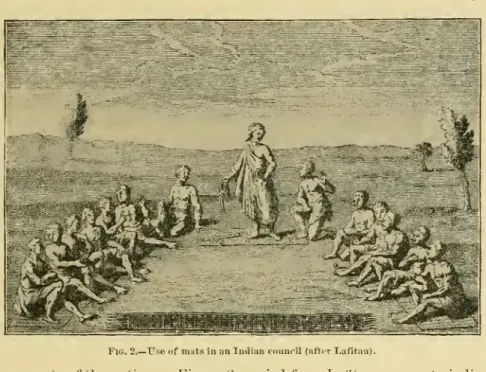
DelaPotherie illustrates their use as beds,' one end of the mat being rolled up for a pillow as shown in figure 3. The heavy row of threads or parts were held together next to by the intertwined threads placed far apart, a. Du Pratz thus mentions the use of dyes by the Louisiana Indians: "The women sometimes add to these furniture bed-mats woven of sugar-cane, dyed of 3 colors, which colors in the weaving formed in different figures." This is well illustrated.
When he is put in this condition, he is carried to the temple (for they have one also as Natchez) and placed in the place of his predecessor, who is taken from the place occupied, and placed with the bodies of the other chiefs at the bottom of the temple, where they are arranged one for others and stand erect like statues. They were first wrapped in a kind of blanket, said to be made of nettle fibers, then with dressed hides, and then in amat nearly 60 yards long.

PLIABLE FABRICS
For clothing and personal use there were cloaks, shawls and mantles to be worn over one or both shoulders or around the body, as described by Harlot, Smith, the Knight of Elvas, Du Pratz and others; there were skirts that were tied around the waist and pulled with an inserted cord or looped over a belt; there were belts, sashes, garters, shot pouches and bags. The following extracts are from Kalm and will serve to indicate the status of the art throughout the area.
HOLMES' SPINNING AND WEAVING. 23
24 PREHISTORIC TEXTILE ART. [eth axn.13 the thick interior is prepared, they are placed in the frame about six feet square, instead of the ship, pass through the string along the reed, having a large string through the mesh, which they move every second course of the thread. Thereisthatduepro])ortioii and so much wild variety by design, that a curious eye would indeed fall with pleasure and admiration. They also make cock-feather blankets with the long neck and breast feathers of that great fowl—they twist the inner edge of the feathers, a strong twine of hemp, or the inner bark of the mulberry tree, of size and strength. of a thick rope, so high, so high.
In the barbacos there were great quantities of clothing, shawls of thread, made of bark from trees and other feathers, white gray, vermilion and yellow, rich and proper for winter. 25 The city of Pacaha was conquered and the Spaniards clothed them - the city of Pacaha was conquered and the Spaniards clothed themselves with cloaks, robes and dresses made of these native cloths. Everywhere, woven shawls were a main feature of the natives' propitiatory gifts to the Spanish.
The extent of this manufacture of clothing by the Indians of the lower Mississippi is well shown in the account of the adventures of the expedition on the west side of the Mississippi at Aminoga. Native hemp and felts were used for rowing boats.' What a novel sight this first European fleet on the great river must have been, consisting of huge brigs propelled by natively made sails. When they were well bleached, they rolled them about the thickness of the thread, and wove them in the following manner: they set two stakes in the ground about half way round, and stretching a cord from one to the other, they fasten their bark threads double to this cord, between us. in a curios it is put on a mantle about a yard square with a wrought border around the edges. > - ' girl at the age of eight or teuputonal with petti- coat, which is made of threads of mulberry bark:^.
Then the corpse is taken from the house to the orchard of peach trees, where a new hurdle is taken to receive it, to which belong all the relations and nations to which the dead person belonged, besides some of other nations connected with them; all of whom sit on the ground on mats spread there for that purpose. The manufacture and use of nets by natives in various parts of the country have been recorded by early writers, some of whom have already been quoted. Their nets are made of nettle thread or of white wood, the bark of which they make into thread, by means of which they are strong and flexible.
HOLMES] GARMENTS OF FEATHERS. 27
In discotring on the dress of the native women of Louisiana, ButelDumont says that the young women wear.
FOSSIL FABRICS
HOLMES] PRESERVATION OF FABRICS. 29
There was also a bark wire landing net; a mockasin made from similar materials; A mat of the same material, encasing human bones, was found in saltpeter dirt, my feet beneath the surface. Mitchell, published by the Araericau Autiquarian Society, gives the following good description of the condition of the human remains and of the nature of their casings. The Bureau of Ethnology has recently been fortunate enough to have obtained a number of representative pieces of funerary tissue of the classes mentioned in the foregoing extracts, and descriptions of these in some detail will illustrate the art as practiced by the early inhabitants of the middle parts of the country sufficiently illustrate.
HOLMES] FABRICS FROM CAVES. 31 about midway between tlie creek bed and the slightly overhaugiug ledge
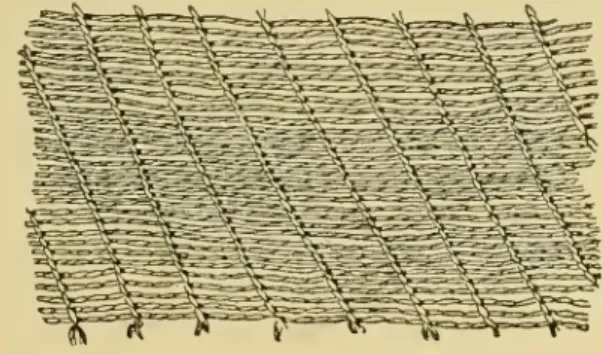
A detailed examination of the border is given in ligure 6, where the vertical row of threads is pulled apart to show more clearly the mode of combination. The women in warm weather have only a half (if linihoiirg, with which they are covered; they smear this cloth over the body, and are well clothed from. When the girls reach the age of eight or nine years, they are clothed from the waist to the ankles with a fringe of threads of mulberry bark, attached to a ribbon.
BOLUE6] STYLES OF WEAVING. 33
As to impart to the curious investigator of modern times a complete knowledge of their weavers' art, the friends of the dead have with the body not only the material worn during life, but a number of looms of the freedom from which the substances are probably made, transferred. A small but very instructive group of grave goods is preserved in the National Museum. Almost all the articles are fragmentary, but the fiber is wonderfully preserved and the original colors are as I fresh when the burial was taken. ])side but yesterday.
There is an edge of open work, bounded by a plaited band, as shown in Figure 8, and the method of weaving is identical to that in that Figure.
EOLMESJ TWINED STYLE OP WEAVING. 35
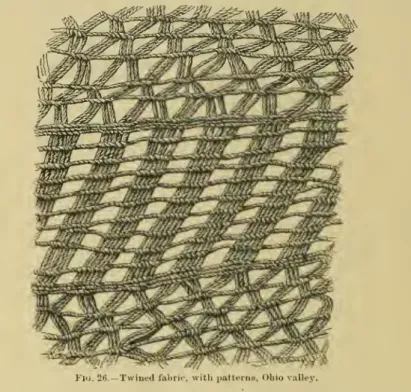
36 PREHISTORIC TEXTILE ART. [eth.ann.13 . which are open and reticulate, and sometimes the pairs of soft woven strands are cut far apart, as shown in several of the illustrations given in this paper. Specimens preserved in this way are obtained from a large area, including the Ohio and a large portion of the Mississippi valleys. The weave on a and rabbit of the plaited style and, although occurring 800 miles apart, is identical in every respect.. very closely woven and has the appearance of simple interlacing.
It has from Fm. io._Fini, ,i.sciy wc.ven tlurty-five tofortystrandstotheiuch.audlooks .. clolh pre.servetl by contact .,.. r • . with copper beads. similar to coarse, twined goods. Henry B. Howland found in a mound near Alton, Illinois, two kinds of cloth, preserved by couract with a copper ornament representing a tortoise shell; they are described as follows. Fitting snugly over the outer surface of the copper shell is first fitted a woven cloth of vegetable fibres, similar in its general character to the outer mat above described, but of a stronger and better preserved fibre, apparently more like that which forms the woven coating of the Davenport- forms axes.
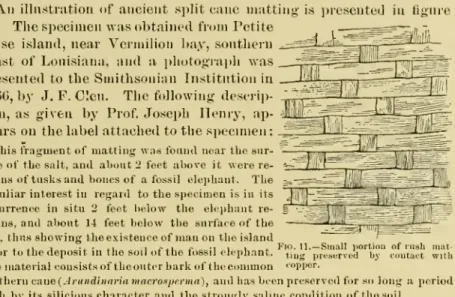
Peoiliar interest in connection with the specimen of its occurrence in situ 2 feet below the remains of the elephant and about 14 feet below the surface of the earth, thus indicating the existence of man on the island. It was a common practice among the aborigines to use woven. fabrics in the construction and decoration of clay vessels. There is not a single state within the Mississippian Atlantic which does not furnish an example of the preservation of impressions of native fabrics in pottery.
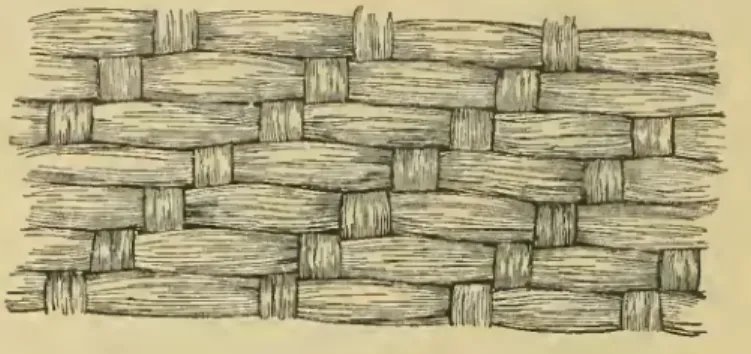
A somewhat extended study of the subject was published in the Third Annual Report of the Bureau of Ethnology, and illustrations of nearly all styles of weaving were given. 38 PREHISTORIC TEXTILE ART. [ETH.ANN.13 immediate investigations, ;i nnniber of minor inaccuracies of analysis and continued investigation, a few minor errors of analysis and drawing occur in that paper, but they are of such minor importance that detailed correction is unnecessary. It appears that traces of fabrics woven in the simple interlaced style appear to be quite rare, although it is difficult, from my clay])) to distinguish this from other forms when the threads are closely touched.
FABRIC-IMPRESSED POTTERY. 39
40 PREHISTORIC TEXTILE ART. [BTB ANN.13 form, obtained from a small fragment of pottery found in Polk County, form, obtained from a small fragment of pottery found in Polk County, Tennessee, is native to Figure 16. 16 – Twisted cloth of ancient pottery, Tennessee. . firmly, so that the open net-like effect is retained even under load during long-term continued use. It will be noticed that the wires of the web are spaced at regular intervals, while those of the woofer are spaced irregularly.
The print, of which this is only a part, indicates that the substance used in shaping the vessel was significantly deformed at the time. applied to the soft clay. The example in Figure 20 is printed on a fragment of Arkansas clay, with a decorative border created by looping the cords. The interesting specimen, illustrated in Figure 22, was obtained from a small fragment of pottery found in Ripley County, Missouri.
HOLUES] TWINED FABRICS. 43 combination of the two series of strands clearly indicates tlie type of
ETH.ANN.13 has already been described, but is viewed in such a way as to include two of the already described, but is viewed in such a way as to include two of the opposite series instead of one, each next pair of warp threads takes up alternating pairs of weft threads.
HOLMES] WHAT THE ART TEACHES. ' 45