Design and
Developntent Research
This page intentionally left blank
Design and
Developtnent Research
Methods, Strategies, and Issues
Rita C. Richey Wayne State University
James D. Klein
Arizona State University
Director of Editorial: Lane Akers Editorial Assistant: Anthony Messina Cover Design: Kathryn Houghtaling-Lacey
Full-Service Compositor: MidAtlantic Books and Journals, Inc.
This bwk was typeset in 10.5/12 pt Goudy Old Style, Italic, Bold, and Bold Italic.
Headings were typeset in Nueva Bold Extended and Nueva Roman Bold.
Copyright © 2007 by Lawrence Erlbaum Associates, Inc.
All rights reserved. No part of this book may be reproduced in any form, by photostat, microform, retrieval system, or any other means, without prior written permission of the publisher.
First published by
Lawrence Erlbaum Associates, Inc., Publishers 10 Industrial Avenue
Mahwah, New Jersey 07430 www.erlbaum.com
Reprinted 2009 by Routledge Routledge
Taylor & Francis Group 270 Madison Avenue New York. NY 10016
Transferred to Digital Printing 2010
Routledge
Taylor & Francis Group 2 Park Square
Milton Park. Abingdon Oxon OX14 4RN
CIP information for this volume can be obtained by contacting the Library of Congress.
ISBN 978-0-8058-5731-3-0-8058-5731-1 (case) ISBN 978-0-8058-5732-0-O-8058-5732-X (paper) ISBN 978-1-4106-1692-0-\-4106-1692-4 (ebook) Publisher's Note
The publisher has gone to great lengths to ensure the quality of this reprint but points out that some imperfections in the original may be apparent.
rorCharlie
My partner in the best parts of life and
Allison and Matt Michelle and Andy
May their partnerships be as special as ours
For ]ayne, Mary, and Leslie
Who make me realize the important things in life
This page intentionally left blank
Contents
List of Tables xiii List of Figures xiv Preface xv
Acknowledgments xix
1 An Overview of Design and Development Research 1 The Need for Design and Development Research 2
Design and Development as a Science • The Design and Development Knowledge Base and Its Foundations • Design and DevelolJment Research and the Advancement of the Field
The Scope of Design and Development Research 7
Research on Product and Tool Design and Development • Research on Design and Development Models • The Outcomes of Product and Tool Research and Model Research • The Unique Role of Design and Development Research
Looking Ahead 14
2 Identifying Design and Development Research Problems 15 Guidelines for Selecting a Research Problem 15
vii
vIii DESIGN AND DEVELOPMENT RESEARCII
Sources of Design and Development Research Problems 16 Problems from the Workplace • Problems Related to
Emerging Technology • Problems Related to Design and Development Theory
Using the Literature to Identify and Refine a Research Problem 25 The Role of Literature in Problem Identification • Sources for
a Literature Review in Design and Development
Focusing the Design and Development Research Problem 29 Transforming Research Problems into Research Questions • Determining the Parameters of the Study
Looking Ahead 32
A Checklist for Identifying and Focusing the Problem of a Design and Development Study 33
3 Design and Development Research Methodology 35 The Nature of Research Design 36
Establishing Validity • Facilitating Notions of Causality • Facilitating Generalization and Interpretation • Anticipating and Avoiding Problems • Components of a Research Design
The Characteristics of Design and Development Research Methodology 39
Commonly Used Design and Development Research Methods and Strategies • Mixed and Multiple Methods Research Matching Research Methods and Questions 42
Classifying Design and Development Research Goals • Matching Research Purposes and Methods
Looking Ahead 45
A Checklist for Matching Design and Development Research Questions and Methods 46
Contents
4 Product and Tool Research: Methods and Strategies 47 Strategies of Product Development Research 48
A Representative Mixed Met/wds Case Study • A Representative Multiple Qualitative Methods Study
Strategies of Program Development Research A Representative Program Evaluation Study
Strategies for Research on Design and Development Phases 52 A Representative Mixed Methods Study of Formative Evaluation • A Representative Multiple Quantitative Methods Study
of Integrated Evaluation
Strategies for Research on Tool Development and Use 54 A Representative Tool Development Case Study • A Representative Tool Use Study
A Summary of Product and Tool Research Designs 57 Unique Product and Tool Research Design Concerns 61
Researcher-Participant Dual Roles • Research in a Natural Work Environment
Looking Ahead 63
A Checklist for Addressing Common Concerns of Product and Tool Research Design 64 5 Model Research: Methods and Strategies 65
Strategies of Model Development Research 66 A Representative Multiple Qualitative Methods Study • A Representative Mixed Methods Study
Strategies of Model Validation Research 67
A Representative Expert Review Study • A Representative Usability Documentation Study • A Representative Investigation of Component Variables • A Representative Field-Evaluation Study •
A ReJ)resentative Controlled Testing Study
ix
x DESIGN AND DEVELOPMENT RESEARCH
Strategies of Model Use Research
n
A Representative Expertise Study Using Think-Aloud Strategies • A Representative Designer Decision-Making Study Using In-Depth Interviews • A Representative Qualitative Study of Conditions Impacting Model Use
A Summary of Model Research Designs 75 Unique Model Research Design Concerns 78
Working with Recall Data • Research in Multiple Natural Work Environments • Distinguishing Participant Characteristics Looking Ahead 81
A Checklist for Addressing Common Concerns of Model Research Design 82
6 Selecting Participants and Settings 83 Selecting the Setting of the Study 84
Types of Settings and Their Characteristics • Matching Settings
to Research Questions • Practical Issues in Setting Selection Selecting the Participants of the Study 87
Types of Participants • Sampling Participants Participant and Setting Solutions from the Design and Development Literature 90
Participants and Settings in Product and Tool Research • Participants and Settings in Model Research
Ethical Consideration for the Protection of Participants 94 Getting Approval to Conduct Research
Consent • Avoiding Coercion • and Ensuring Anonymity
Looking Ahead 96
• Obtaining Informed Maintaining Confidentiality
A Checklist for Selecting Participants and Settings in a Design and Development Study 97
C(lntent~
7 Collecting Design and Development Research Data 99 Critical Design and Development Research Data 100
Profile Data • Context Data • In-Progress Project Data • Try-Out Data
Data Collection Instruments 106 Work Logs
Protocols
• Surveys and Questionnaires
• Observation Guides
•
InterviewTechnology-Based Data Collection Strategies 117 Web-Based Data Collection • Software-Based Data Collection • Laboratory-Based Data Collection Data Collection Issues 123
Ensuring Data Integrity • Establishing Appropriate Data Sets Looking Ahead 125
A Checklist for Collecting Data in a Design and Development Study 126
8 Interpreting Design and Development Findings 127 The Contributions of Design and Development Research 127
Expanding the Design and Development Knowledge Base • Creating the Foundations for Design and Development Theory • Creating the Foundations for Future Research
Interpreting Product and Tool Research Findings 132 Lessons Learned about Product and Tool Design and Development Processes • Lessons Learned about Product and Tool Use Interpreting Model Research Findings 135
Understanding Model Development Findings • Understanding Model Validation Findings • Understanding Model Use Findings
Interpretation Issues 139
Generalizations and Project-Specific Data • The Impact of Organizational Concerns
xi
xii DESIGN AND DEVELOPMENT RESEARCH
Looking Ahead 142
A Checklist for Interpreting Findings of Design and Development Research 143
9 The Status and Future of Design and Development Research 145 The Expansion of Design and Development Research 146
Alternative Approaches to Design and Development Research • New Opportunities for Design and Development Research
Conditions that Facilitate Design and Development Research 151 Dissatisfaction with Existing Research Orientations • Knowledge of the Innovation • Availability of Resources
Conclusions 153
Glossary of Terms 155 References 161 Author Index 173 Subject Index 177
Tables
1-1 Representative Clusters of Design and Development Research 1-2 The Varying Outcomes of Design and Development Research 2-1 Journals Relating to Design and Development Research
3-1 Common Methods Employed in Design and Development Research 3-2 Representative Matches between Purposes, Methods and Types of
Design and Development Research
4-1 Representative Research Design Techniques Used in Product and Tool Research
5-1 Representative Research Design Techniques Used in Model Research 6-1 Settings of Design and Development Applications
6-2 Setting Elements that Impact Design and Development Research 6-3 Common Participants in Design and Development Studies 7-1 Critical Profile Data in Design and Development Research 7-2 Critical Context Data in Design and Development Research 7-3 Critical In-Progress Data in Design and Development Research
7-4
Critical Try-Out Data in Design and Development Research 7-5 Design and Development Data Accessible via Technology 7-6 Sample Hardware and Software Specifications for a Basic Designand Development Research Laboratory
8-1 Product and Tool Design and Development Process Conclusions and Supporting Data
8-2 Product and Tool Use Conclusions and Supporting Data 8-3 Model Development Conclusions and Supporting Data 8-4 Model Validation Conclusions and Supporting Data 8-5 Model Use Conclusions and Supporting Data
xiii
Figures
1-1 The IOD Knowledge Base
1-2 The Research and Theory Foundations of the Design and Development Knowledge Base
2-1 Narrowing the Research Topic
7-1 An Overview of Data Collection Tools Used in McKenney (2002) 7-2 Basic Designer/Developer Work Log for In-Progress Projects 7-3 Task-Oriented DesignerIDeveloper Work Log for Past Projects 7-4 Sample Designer Characteristic Survey
7-5 Sample Product Evaluation Survey 7-6 Sample Designer Interview Questions
7-7 A Critical Incident Interview Protocol With Probes
7-8 Sample Classroom Observation Checklist from Ottevanger (2000) 7-9 Sample Open-Ended Observation Instrument
8-1 Expanding the Designer and Design Processes Knowledge Base Through Design and Development Research Findings
xiv
Preface
This book is intended for scholars who are interested in planning and con- ducting design and development research. It is written for experienced re- searchers, as well as those who are preparing to become researchers. We made two main assumptions about our audience while writing this book. First, you should be familiar with concepts and principles related to research design and methods. The book is intended to supplement a standard research methods text, not replace it. Second, you should have knowledge related to processes and models of design and development.
THE EVOLUTION OF DESIGN AND DEVELOPMENT RESEARCH
Many examples of design and development research can be found in the liter- ature spanning up to four decades. In recent years, however, there has been renewed interest in this research orientation and the benefits it offers the field.
Furthermore, notions of design and development research continue to evolve.
We are defining design and development research here as
the systematic study of design, development and evaluation processes with the aim of establishing an empirical basis for the creation of instructional and non- instructional products and tools and new or enhanced models that govern their development.
Our current thinking about this type of research has changed in two ways.
Readers familiar with our earlier work will note the use of the term "design and development research" in this book. Previously, we used the term "develop- mental research" to describe this approach (Richey, Klein, & Nelson, 2004;
Richey & Klein, 2005; Richey & Nelson, 1996; Seels & Richey, 1994). Dis- xv
xvi DESIGN AND DEVELOPMENT RESEARCII
cuss ions with colleagues and students suggest, however, that the word "devel- opmental" creates confusion since it refers to many other areas of study, such as human development, international development, organizational develop- ment, and staff development.
Furthermore, over the years, the term "development" has been ambiguous to many in the field and has generated considerable discussion regarding its meaning. This debate has focused typically upon the distinctions between in- structional design and instructional development. In defining the domains of the field, Seels and Richey (1994) viewed design as the planning phase in which specifications are constructed, and development as the production phase in which the design specifications are actualized. Others broadly define each of the terms so that they have similar meanings. For example, Briggs (1977) defined instructional design as "the entire process of analysis of learning needs and goals and the development of a delivery system to meet the needs;
includes development of instructional materials and activities; and tryout and revision of all instruction and learner assessment activities." In this interpre- tation, design is the more generic term, encompassing both planning and pro- duction. In contrast, Smaldino, Russell, Heinich, and Molenda (2005) define instructional development as "the process of analyzing needs, determining what content must be mastered, establishing educational goals, designing materials to reach the objectives, and trying out and revising the program in terms of learner achievement" (p. 386). To many in the field, this is a definition of the instructional systems design (ISD) process.
We purposely use the term design and development throughout this book because together they have a broad meaning especially in the research context.
The focus of a design and development study can be on front-end analysis, planning, production, and/or evaluation. This approach can also center on the design and development of products and tools or on the development, validation and use of design and development models. In essence, this is the study of design and development processes as opposed to performing them.
Another change in our thinking relates to the field's traditional emphasis on instructional interventions. While many of the examples of design and devel- opment research do focus on instructional products, tools and models, our def- inition includes the study of both instructional and non-instructional inter- ventions. This is in keeping with expanded definitions of the field that encompass notions of performance improvement and non-instructional inter- ventions (Reiser, 2002).
OVERVIEW OF THE BOOK
Throughout this book, we have included an explanation of the methods and strategies appropriate for design and development research. We also discuss
Pre/uC'e xvii issues and problems that design and development researchers often confront when planning and conducting a study. Procedural explanations are supported by a wide variety of examples of research studies from the literature and by samples of actual research tools. We provide checklists to assist you in planning and conducting each phase of a design and development study. An extensive reference list and a glossary of terms are also included. Below we describe the nine chapters that make up the main body of the book.
Chapter 1, ''An Overview of Design and Development Research," examines why this type of research is important to advance the knowledge base of the field and offers a rationale for further studies of this type. The scope of design and development research is examined, and its two categories-product and tool studies and model studies-are defined.
Chapter 2, "Identifying Design and Development Research Problems," pro- vides practical guidelines for how to select and evaluate a research topic and problem to study. Sources of design and development research problems are discussed, including the workplace, emerging technology, and theory. Several sources of design and development literature are also provided. The chapter closes with an explanation of how to transform a research problem into a ques- tion and establish the parameters of a design and development study.
Chapter 3, "Design and Development Research Methodology," explores the nature of research design and describes some general concerns that should be addressed in any research project. Concerns such as validity, generalizability, and causality are discussed. The methods and strategies commonly employed in design and development research studies are described. Suggestions for how to match research questions to methods are also provided.
Chapter 4, "Product and Tool Research: Methods and Strategies," exam- ines the research design strategies used in representative studies of this type.
Several in-depth examples are provided to illustrate how to plan research stud- ies related to product and program development, the various phases of design and development, and the development and use of tools. The chapter ends with a discussion of two issues that should be addressed when conducting product and tool research: (a) avoiding bias when researchers assume participant roles and (b) recognizing the influence of work environment characteristics.
Chapter 5, "Model Research: Methods and Strategies," focuses on the de- sign of studies of the development, validation, and use of design and develop- ment models. Numerous detailed examples are used to show how to plan and conduct this type of design and development research. Issues such as working with recall data, conducting research in multiple natural work settings, and distinguishing participant characteristics are discussed.
Chapter 6, "Selecting Participants and Settings," explores issues related to who will participate in the design and development research project and where the study will be conducted. Several examples of participants and settings that have been examined in actual design and development studies, and brief
xviii DESIGN AND DEVELOPMENT RESEARCH
analyses of techniques that have been employed are provided. Ethical consid- erations for the protection of participants such as obtaining informed con- sent, avoiding coercion, and maintaining confidentiality and anonymity are also discussed.
Chapter 7, "Collecting Data in Design and Development Research," ex- amines the critical types of information that are often gathered in a design and development study. These include profile data, context data, in-progress project data, and try-out data. Commonly used data collection tools such as work logs, surveys, questionnaires, interview protocols, and observation guides are described, as is the use of technology for data collection. Sample instru- ments are provided. In addition, iss~es related to ensuring data integrity are discussed.
Chapter 8, "Interpreting Design and Development Findings," examines how results from these studies can be used to expand the knowledge base and cre- ate a foundation for theory and future research. The major types of conclusions that can be made by design and development researchers, as well as the key types of data that are used to support these conclusions, are discussed.
Chapter 9, "The Status and Future of Design and Development Research,"
explores the manner in which design and development research is expanding, as well as the conditions that facilitate such growth. This chapter includes a description of design-based research and formative research, two alternative approaches that can be used to address problems similar to those dealt with by design and development researchers. Finally, we speculate on the future design and development research pertaining to technology, work place issues and theory.
This is a book of methods, strategies and issues related to design and devel- opment research. We have tried to provide concrete direction for those em- barking on such projects, as well as stimulate future thinking about this type of endeavor. Hopefully, this book will increase your understanding of design and development research, and motivate you to tackle such a project yoursel£
Rita C. Richey Detroit, Michigan
James D. Klein Tempe, Arizona
Acknowledgntents
We want to recognize the many people who have supported us in this project and in the advancement of design and development research. Bob Reiser has been a great proponent of this research for many years. His public advocacy and private encouragement have meant a great deal to both of us. He has car- ried on the support Barb Seels and Wait Dick gave to this topic in the early years of our work. Monica Tracey became an adherent of design and develop- ment research first as a doctoral student, and now as a faculty member. She regularly spreads the word and has served us especially in terms of her feedback and reviews of this manuscript. Likewise, Kathryn Ley has enthusiastically pro- moted this research through conference presentations and repeated calls of
"So when's the book going to be done?" Finally, Susan McKenney has been a great help to the preparation of this book. She has shared much of her own work with us and provided insights into her experiences with design and de- velopment research.
Some of the best assessments of this book throughout its development have come from the students at Wayne State University and Arizona State Univer- sity. They have read chapters (often not by choice), critiqued them, and told us what helps and what doesn't, always with great clarity.
There has also been a level of support from the Erlbaum group that we greatly appreciate. Both Lori Kelly and Lane Akers have been behind this pro- ject from the beginning. They have secured wonderful reviewers who provided direction for us throughout the writing process, and Lane has been particularly helpful as we reach the end of the journey.
Finally, we want to acknowledge Bill Winn's contributions to the research in this field. We hope that this book will help advance the high standards that he set for us.
xix
This page intentionally left blank
1
An Overview of Design and
Developntent Research
This book is about how to plan and conduct design and development research.
These methods are also known as developmental or development research (Richey, Klein, & Nelson, 2004; Seels & Richey, 1994; van den Akker, 1999).
Design and development research seeks to create knowledge grounded in data systematically derived from practice. We define this type of research as:
the systematic study of design, development and evaluation processes with the aim of establishing an empirical basis for the creation of instructional and non- instructional products and tools and new or enhanced models that govern their development.
This is a pragmatic type of research that offers a way to test theory and to validate practice that has been perpetuated essentially through unchallenged tradition. In addition, it is a way to establish new procedures, techniques, and tools based upon a methodical analysis of specific cases.
The design and development of instructional products and programs is con- sidered by many to be the heart of the instructional design and technology (lOT) field. Practitioners in the field typically follow well-established system- atic models and procedures to design and develop instructional and non-
2
2 DESIGN AND DEVELOPMENT RESEARCH
instructional interventions. These approaches are advocated (and have been used) in a wide range of education and training environments. They include a set of common characteristics, including a focus on measurable goals and outcomes derived through an initial analysis phase, the selection of content and strategies that match these goals, a process of routinely evaluating the products prior to finalizing the project, and the assessment of the learning and performance outcomes (Gustafson & Branch, 2002; Seels & Glasgow, 1998).1 The practice of design and development is to a great extent empirical by na- ture. Design models parallel the scientific problem-solving processes. It would not be unreasonable, then, to assume that design and development processes themselves would have robust empirical support. However, historically there has been a paucity of research on our models, tools, and products.
THE NEED FOR DESIGN AND DEVELOPMENT RESEARCH
Over the last five decades, many scholars have called for research to strengthen the fundamental knowledge base of the IDT field. In 1953, Finn as- serted that the audio-visual field suffered from a dominance of "gadgeteering"
that reflected a "poverty of thought" (p. 13) and suggested that research would help professionalize the field. A decade later, Markle (1967) called for the de- velopment of empirically grounded instructional materials through systematic testing procedures. In 1984, Heinich stressed the importance of field-based research to inform practice. More recently, Richey (1997) suggested that "our practice is not sufficiently informed by research and that our research is not sufficiently attuned to practice" (p. 91).
Design and Developtnent as a Science
Opinions on the role of research on design and development often depend on one's conception of what it actually is. We take the position that design and de- velopment is a science. As a science it should be bound by understandings built upon replicated empirical research. Our models and procedures should be validated. The solutions to our problems should be supported by data. This, however, is not a universally accepted position.
1 Readers who arc not familiar with instructional design and development should consult some of the standard references to gain further knowledge of the field. These books include The Systematic Design of Instruction by Dick, Carey, and Carey (2005), Designing Effective Instruction by Morrison, Ross, and !(cmp, (2006), and Instructional Design by Smith and Ragan, (2005).
An Overview o('I)esign and O/,velopmenlllesean'h 3
Oavies (1981) first presented the question of whether this field was an art, a craft or a science, opting for the artistic orientation. He viewed design and development as a holistic process, one that cannot be simply analyzed and dissected. It is a view that emphasizes the systemic over the systematic.
Others have also explored the essential nature of the field. For example, Visscher-Voerman and Gustafson's (2004) study of practicing instructional designers shows that some designers follow an instrumental design paradigm that is rooted in the natural sciences. This approach is akin to the traditional instructional systems design model (ISO). Others employ an artistic para- digm. This approach is one that eschews scientific methods and "dissolves the borders between the domains of the sciences and the arts" (p. 83).
Cl ark and Estes (1998) view many of the solutions to educational prob- lems as craft. They define craft as skills that are based upon "fortunate acci- dents, personal experience, insights ... revised through trial and error" (p. 6).
As an alternative, they advocate following a technology orientation in which problems are addressed through the use of scientific theory.
Like Clark and Estes, we approach design and development (and, in turn, research on it) with the assumption that science and empiricism provide a more effective and reliable route to disciplinary integrity than depending on artistic tactics and craft-based solutions. We believe that our field has not suf- ficiently employed scientific methods to facilitate our understanding of design and development processes. The need for research is especially critical with re- spect to the models and processes employed by designers and developers. Few models, design strategies, and tools employed in practice have been empirically tested and validated. This is the gap that design and development research seeks to address.
The Design and Developtnent Knowledge Base and Its Foundations
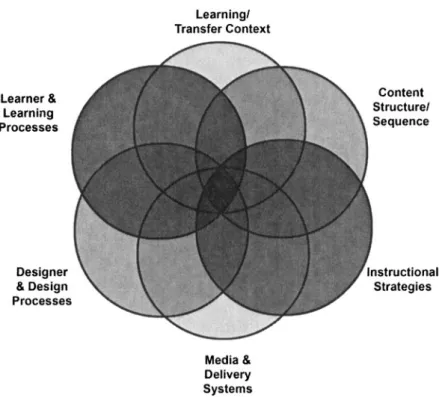
The field, of course, is not devoid of research. A large and comprehensive base of knowledge informs our work. From our perspective, the design and development knowledge base has six major components. These six facets focus on the different elements of the design and development enterprise: (a) learn- ers and how they learn, (b) the context in which learning and performance oc- cur, (c) the nature of content and how it is sequenced, (d) the instructional strategies and activities employed, (e) the media and delivery systems used, and lastly,
(0
the designers themselves and the processes they use. Figure 1-1 portrays the overlapping elements of this knowledge base.This knowledge base has been shaped over the years by a combination of the foundational research and theory of other disciplines as well as the research and theory unique to instructional design and development. There are three
4
Learner &
Learning Processes
Designer
& Design Processes
DESIGN ANI) DEVELOPMENT RESEARCII
Learningl Transfer Context
Media &
Delivery Systems
FIGURE 1-1. The !DD knowledge base.
Content Structurel
Instructional Strategies
key lines of research and theory that have had the most influence on the de- sign and development knowledge base. These are
• Psychological and learning theory and research.
• Instructional theory and teaching-learning research.
• Communication theory and message design research.
Psychological and learning theory and research provides the dominant foundations for knowledge and practice pertaining to: (a) the learner and the learning process, (b) the learning and transfer context, and (c) instructional strategies. Instructional design (ID) is intimately tied to human learning and today is being extended to organizational learning. Originally, behavioral ex- planations of the learning process were dominant in instructional design.
While there is still some evidence of behavioral thinking, cognitive principles are often followed when devising strategies that facilitate motivation for learn-
An Overview ofiJesi~/n and IJeve/opment Research 5
ing, as well as the understanding, retention, and use of learned information.
And today, there is a great deal of interest in the view that "(1) learning is an active process of constructing rather than acquiring knowledge and (2) in- struction is a process of supporting that construction rather than communica- tion of knowledge" (DuffY & Cunningham, 1996, p. 171). In this orientation emphasis is placed upon the social context of learning, collaboration, and learner control.
Next, instructional theory and teaching-learning research provides the foundations for knowledge and practice pertaining to (a) content structure and sequence, (b) instructional strategies, and (c) media and delivery systems.
While instructional theory is necessarily prescriptive in nature, it is typically in- tertwined with the orientation of a particular learning theory.
Most strategies for presenting instruction are rooted in instructional theory (Reigeluth, 1983; Richey, 1986). One example of a theory of instruction is Gagne's (1985) Events of Instruction. This theory suggests a particular sequence of instructional activities that can be incorporated into a lesson to facilitate learning and transfer. Constructivist orientations to learning, which avoid the
"presentation" of content in favor of students controlling their own learning activities, also rely upon instructional theories and teaching-learning research.
The vast majority of design and development approaches assume that in- struction should vary depending upon the type of learning task being ad- dressed. Another important design decision, the selection of media and deliv- ery systems, is typically guided by instructional principles, such as those relating to facilitating learner involvement in "real-world" activities. Currently, the growing use of distance education methodologies is stimulating teaching- learning research in this area, and this work should be of increasing importance to designers and developers.
Lastly, communications theory and message design research has provided the major foundations for knowledge and practice pertaining to media and delivery systems. When combined with the principles of information process- ing and perception, communication theory tenets and message-design princi- ples guide page layout, screen design, graphics, and visual design. Research rel- evant to gaining and controlling attention has been of particular importance to the design and development field.
Traditionally, this type of research and theory has been crucial to all media design. Today, its major impact is on the development of interactive, computer- based media and Web design. In all cases, however, this type of research is fundamental to the study and applications of visual thinking, visual learning, and visual communication.
While psychological research, teaching-learning research and message-design research all have implications for design and development, this body of litera-
6 DESIGN AND DEVELOPMENT RESEARCI I
ture does not fully address the last component of the 100 knowledge base:
the designer and design processes. It does not explain, for example, the role of the designer or the context in which design and development takes place.
It does not explain designer problem-solving processes. It does not speak to the
ultimate value of ID models, or of ways of reducing design cycle time, or of the most effective and efficient ways of using learning objects when designing instruction using advanced technologies. Design and development research is the primary source of such knowledge, but, unfortunately, there is only a lim- ited amount of this type of research. Our position is that this shortage ulti- mately impedes not only design and development practice, but scholarship in the field as well.
Design and Developtnent Research and the Advancetnent of the Field
Instructional design, and hence its practice, can be seen in two ways: (a) the design of particular lessons, products, or programs, and (b) the implementa- tion and management of the overall design process. The former is guided by design principles for selecting and sequencing instructional strategies that are richly supported by learning theory and teaching-learning research (Ragan
& Smith, 2004). The latter is typically guided by instructional system design
(ISO) models which have not been tested to a great extent using research.
Historically, ISO models were devised as an application of General Systems Theory (Banathy, 1968), but systems theory derived its support from deduc- tive logic rather than empirical research. This pattern continues today with respect not only to new design and development models, but also for newly devised approaches to producing instruction and other interventions utilizing advanced technologies. This meager research base, in turn, makes it impos- sible for scholars to construct sound and comprehensive design and develop- ment theory.
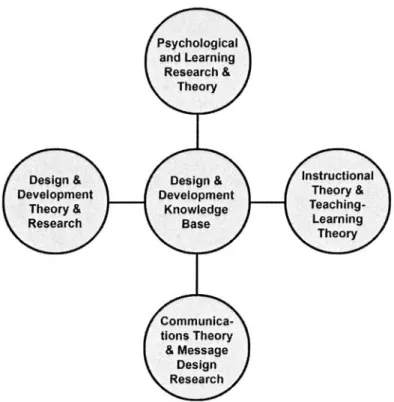
We posit that design and development research will not only enhance our knowledge base, but will also provide the empirical basis for the construction of a comprehensive theory of design and development. This will give the field a fourth theory base, supplementing the understandings we have already ac- quired from psychological and learning theory, instructional and teaching- learning theory, and communication and message-design theory. The research and theory foundations of the design and development knowledge base would then be as shown in Figure 1-2.
This research and theory is as vital to the advancement of design and de- velopment practice as it is to the scholarly advancement of the field.
An Overview o('lJesigl1 ami J)eve/ofJment Ileseanh 7
FIGURE 1-2. The research and theory foundations of the design and development knowledge base.
THE SCOPE OF DESIGN AND DEVELOPMENT RESEARCH
Design and development research covers a wide spectrum of activities and interests. In its simplest form, it could be either
• The study of the process and impact of specific design and development efforts.
• The study of the design and development process as a whole, or of par- ticular process components.
Such research can involve a situation in which someone is studying the design and development work of others. However, it can also involve a situation in which someone is performing design and development activities and studying
An Overview o('lJesigl1 ami J)eve/ofJment Ileseanh
DHlon&
Development Theory &
Research
Psychological and learning RHearch &
Theory
DHlgn&
Development Knowledge
Base
Communica- tions Theory
& Message Design Research
Instructional Theory &
Teaching"
Learning Theory
7
FIGURE 1-2. The research and theory foundations of the design and development knowledge base.
THE SCOPE OF DESIGN AND DEVELOPMENT RESEARCH
Design and development research covers a wide spectrum of activities and interests. In its simplest form, it could be either
• The study of the process and impact of specific design and development efforts.
• The study of the design and development process as a whole, or of par- ticular process components.
Such research can involve a situation in which someone is studying the design and development work of others. However, it can also involve a situation in which someone is performing design and development activities and studying
8 DESIGN AND DEVELOPMENT RESEARCH
the process at the same time. In either case, there is a distinction between doing design and development and studying the processes.
Understanding the nature of this research is a matter of understanding the range of problems to which it can be applied. It is also a process of recogniz- ing those research interests and endeavors that are not a part of this orienta- tion. Design and development research, as with all research endeavors, leads to knowledge production, a more complete understanding of the field, and the ability to make predictions. Design and development research accom- plishes these goals through two large categories of research projects:
• Product and tool research.
• Model research.
Understanding these categories can facilitate an appreciation of the breadth and depth of design and development research.
Within each of these two major types of design and development research various lines of inquiry have emerged over the years. Table 1-1 shows many of these lines of study.
Clearly these research clusters are not all that exist or that could fit within the two major divisions of design and development research. They do, how-
TABLE 1-1.
Representative Clusters of Design and Development Research Design & Development Research
Product & Tool Research Comprehensive Design and
Development Projects
• Instructional Products & Programs
• Non-instruction Products & Programs Specific Project Phases
• Analysis
• Design
• Development
• Evaluation
Design & Development Tools
• Tool Development
• Tool Use
Model Research Model Development
• Comprehensive Model Development
• Development of Model Component Processes Model Validation
• Internal Validation of Model Components
• External Validation of Model Impact Model Use
• Study of Conditions Impacting Model Use
• Designer Decision-Making Research
• Designer Expertise &
Characteristics Research
An Overview of/Jesign and IJevelopment Reseanh 9
ever, show the broad scope of research that is encompassed within the do- main of design and development research. We will now summarize the kinds of studies that fit within the two types of design and development research- product and tool research and model research.
Research on Product and Tool Design and Development
The most straightforward design and development research falls into the first category: research conducted during the design and development of a prod- uct or tool. Often the entire design and development process is documented.
Some research, however, concentrates on one aspect of design and develop- ment only (such as production) or de-emphasizes some phases (such as needs assessment). Many recent studies focus on the design and development of technology-based instruction. In this research there is a tendency to combine the task of doing design and development and studying the processes.
Product and tool research typically involves situations in which the design and development process used in a particular situation is described, analyzed, and a final product is evaluated. Oriscoll (1984) used the term "systems-based evaluation" to describe a similar research paradigm, while van den Akker (1999) labeled it as "formative research." van den Akker further defines this as "research activities performed during the entire development process of a specific inter- vention, from exploratory studies through (formative and summative) evalua- tion studies" (p. 6). We previously referred to this category of design and devel- opment research as Type 1 developmental studies (Richey, Klein, & Nelson, 2004).
Product development research. Product studies originate with the design and development of an instructional or non-instructional product or program.
They demonstrate a range of design and development principles available to practitioners. Frequently, the entire design and development process is docu- mented. Consistent with predominant practice in the field, the procedures em- ployed usually follow the tenets of ISO, encompassing front-end analysis through evaluation. For example, Hirumi, Savenye, and Alien (1994) describe the analysis, design, and development of an interactive videodisc exhibit in a natural history museum. Furthermore, a field evaluation was conducted to examine visitors' use of the videodisc by focusing on "the program's ability to attract and hold viewers' attention, and visitors' interaction with the program"
(p. 51). This study provides evidence that ISO processes can be adapted to informal educational settings.
Other studies emphasize a particular design and development phase, such as needs assessment or evaluation. For example, Klein et al. (2000) report on a needs assessment conducted to determine the optimal instructional content
10 DESIGN AND DEVELOPMENT RESEARCI I
and delivery method for an introductory course in educational technology. The results of the needs assessment were used to revise an existing course. Fischer, Savenye, and Sullivan (2002) report on the evaluation of a computer-based training course for an online financial and purchasing system. The purpose of the study was to evaluate the effectiveness of the training and to identify ap- propriate revisions to incorporate into the program.
Tool development research. Instructional designers use a variety of tools in the course of a project. These tools range from paper-based job aids to elec- tronic performance support systems (EPSS). In recent years there has been an effort to develop computer-based tools intended to automate many design and development processes. These include tools for identifying and structuring content, for selecting strategies for learners, and for authoring instructional programs (Li & Merrill, 1991; Merrill & Li, 1989). Design and development research can focus on the development and the efficacy of these tools.
For example, Nieveen and van den Akker (1999) reported on the devel- opment and evaluation of five prototypes of a computer system to support de- signers during formative evaluation. This study exemplifies tool development research; it includes a careful and extensive documentation of the phases of ISO-needs analysis, design, development, and formative evaluation of several prototypes of a performance support tool. Another example of a tool study is Preese and Foshay's (1999) research on the development, quality assurance, and impact of a set of object-oriented authoring tools. This study has not only project-specific conclusions, but it also identifies lessons that can apply to other large-scale CBT development projects. These two studies show how re- search techniques have been employed to study the development and valida- tion of tools for instructional designers.
Recent research has also focused on non-instructional tools. For example, Nguyen (2005) described a needs assessment conducted to determine the types of EPSS that training professionals and end users think are valuable to fa- cilitate performance. In addition, Nguyen, Klein, and Sullivan (2005) con- ducted an experiment in which employees at a manufacturing company com- pleted a procedural task and received support from either an intrinsic, extrinsic, or external EPSS or received no support. The authors suggest how to improve user performance by integrating support with work tasks. Thus, con- clusions are aimed at designers.
Research on Design
and Developll1.ent: Models
The second type of design and development research pertains to studies of the development, validation, and use of design and development models.
All Overview of'/Jesigl1 ul1d IJeve/opmel1t Ilesean'h 11
These studies focus on the models and processes themselves, rather than their demonstration. While it is possible to conduct model research in conjunction with the development of a product or program, most model studies concen- trate on previously developed instruction, and consequently are not project- specific. Model research may address the validity or effectiveness of an existing or newly constructed development model, process, or technique. In addition, these studies often seek to identify and describe the conditions that facilitate successful design and development.
Model research is the most generalized of design and development research.
The ultimate object of this research is the production of new knowledge, of- ten in the form of a new (or an enhanced) design or development model. This research may emphasize comprehensive models or particular design techniques or processes. It commonly examines design and development as it is practiced in the workplace. In this section, we will describe a number of studies to clar- ify the nature of model research.
Model development research. One genre of design and development research results in the development of new or enhanced models to guide the ID process. For example, Spec tor, Muraida, and Marlino (1992) proposed an enhanced ISO model for use in courseware authoring, which is grounded in cognitive theory. This use of the model was then described and evaluated in a military training environment. Another example is Carliner's (1998) natural- istic study of design practices in a museum setting in which an enhanced model of instructional design for informal learning in museums was proposed as an outcome of the research. Finally, Plass and Salisbury (2002) described and evaluated a design model for a Web-based knowledge management system.
This model includes not only the initial development of the knowledge man- agement system, but provides for further development and maintenance to accommodate changing needs.
The newly developed models, however, need not relate to the entire de- sign and development process. Some studies focus only on a part of the process.
For example, Forsyth (1998) addressed only the development of a train-the- trainer model and she concentrated on one particular setting, non-profit com- munity-based training environments. Her data describes the specific steps completed when following her model, the time allocated to each phase of the model and the lessons learned throughout.
Model validation research. Model construction, however, is only one of the researchable issues that can be addressed with a design and development study. Today, many recognize that ID models should be substantiated by sys- tematic validation rather than relying primarily on user testimonials as evi- dence of their effectiveness (Gustafson & Branch, 2002). ID model validation
12 DESIGN AND DEVELOPMENT RESEARCH
is an empirical process that demonstrates the effectiveness of a model's use in the workplace or provides support for the various components of the model itself (Richey, 2005). This is an important type of design and development research.
Often model validation efforts are combined with model development re- search. One such example is that of Sleezer (1991) who developed and vali- dated a Performance Analysis for Training (PAT) Model using expert review methods. She used experts in training needs assessment to evaluate the con- tent and face validity of the PAT model. This is an example of an internal val- idation study, a validation of the components and processes of an ID model.
Studies such as these focus upon the integrity of the model and its use.
There are also external validation studies that confirm the model not by verifying its components, but by documenting the impact of the model's use.
These studies address the instructional products produced by following the model, and the impact of these products on learners, clients, and organizations.
In many respects, these studies can be seen as summative or confirmative eval- uations of the model. For example, a few studies have validated the ARCS Model of Motivational Design (Keller, 1987) by studying the impact of the var- ious model components (e.g., attention, relevance, confidence, and satisfac- tion) on achievement (Brolin, Milheim, & Viechnicki, 1993-94; Means, Jonassen, & Dwyer, 1997; Small & Gluck, 1994).
Model use research. It is not unusual for model validation studies to ad- dress usability issues; however, there is another group of design and develop- ment studies that address these processes by concentrating on their use. These studies may focus on the conditions that affect model use in an effort to iden- tify the impact of the various design and development environments. Other model use studies focus on the designers themselves in an effort to under- stand the design and development process as it is actually performed.
Several studies can serve as examples of these model use foci. Roytek (2000) conducted an extensive examination of two design projects that employed rapid prototyping procedures in an effort to determine which contextual fac- tors influence project success. The instructional support factor was most closely related to the work of the designers and developers. In another study, Spec tor, Muraido, and Marlino (1992) examined the variables that affect the ability of designers to effectively author computer-based instruction.
Rowland's (1992) comprehensive study of the use of design models serves as an example of both designer decision-making research and research on designer characteristics. Four expert and four novice designers were given a task to design instruction for an industrial setting involving training employees to operate two hypothetical machines. The thoughts designers had while com- pleting the task were coded and analyzed. The results of this study describe
An Overview of/Jesigl1 and IJevelol1mel1t Research 13
how design processes actually work and compare the differences between how experts and novices design instruction.
The Outcontes of Product and Tool Research and Model Research
In the contemporary orientation toward research, most accept the premise that research can have a broader function than the creation of generalizable state- ments oflaw; context-specific studies also are valued. Design and development research encompasses studies with conclusions that are both generalizahle and contextually specific. This reflects the fact that product and tool research typically involves studies that describe and analyze the design and develop- ment processes used in particular projects, and are thus to a great extent con- text-bound. Model research studies, on the other hand, are oriented toward a general analysis of design and development processes. These studies tend to be more generalizable than product studies. Table 1-2 portrays the relationships between the two major types of design and development research.
All of these studies, however, can provide some direction to others in the field, even those whose conclusions are derived from particular projects and contexts. The "lessons learned" from these studies can apply to those who are confronting similar design and development projects. Model studies may gen- erate new or enhanced models available for general use, but not all have such a comprehensive goal. They may explain the way in which existing models are used; they may account for success and failures of model use.
Emphasis
Outcome
TABLE 1-2.
The Varying Outcomes of Design and Development Research
Design & Development Research Product & Tool Research
Study of specific product or tool design and development projects
Lessons learned from developing specific products and analyzing the conditions which facilitate their use
Context-Specific Conclusions
Model Research Study of model development,
validation or use
New design and development procedures or models, and conditions which facilitate their use
Generalized Conclusions
14 DESIGN AND DEVELOPMENT RESEARCII
The Unique Role of Design and Developntent Research
Design and development research-both product and tool research and model research-covers a broad array of design and development issues. It spans all phases of the design and development process, the various education and training settings in which designers work, and encompasses all design philoso- phies and orientations. Unlike most other research efforts, design and devel- opment research is in a position to substantially expand the theory base of ID by reaching beyond the traditional foundations of teaching and learning re- search. Design and development researchers are also in a position to directly impact the work of practitioners, especially because of the propensity of these researchers to situate their studies in natural work settings and to address the pressing problems of the workplace. These researchers value the importance of learning and performance, but also view the designer as a key element in the design and development process. In many respects, design and development research serves as an important link between theory and practice.
LOOKING AHEAD
We have provided an overview of design and development research in this chapter. We indicated why this type of research is important and offered a ra- tionale for further studies of this type. We also focused on what design and development research is by defining its scope and its categories, but we have not yet discussed how to conduct design and development research. In the next chapter, we will begin to tackle these procedures by focusing on how to iden- tify a research problem for a design and development study. We will examine the sources, characteristics, and parameters of problems that relate to con- ducting design and development research.
References
Adamski, A. J. (1998). The development of a systems design model for job performance aids: A qualitative developmental study (Doctoral dissertation, Wayne State University, 1998). Dissertation Abstracts International-A, 59(03), 789.
Albero-Andres, M. (1983). The use of the Agency for Instructional Television instructional development model in the design, production, and evaluation of the series of Give and Take (Doctoral dissertation, Indiana University, 1982). Dissertation Abstracts International-A, 43(11), 3489.
Alessi, S. M. (1988). Learning interactive videodisc development: A case study. Journal of Instructional Development, 11 (2), 2–7.
Armstrong, A. (2003). Instructional design in the real world: A view from the trenches.
Hershey, PA: The Idea Group.
Aukerman, M. E. (1987). Effectiveness of an interactive video approach for CPR recertification of registered nurses (Doctoral dissertation, University of Pittsburgh, 1986).
Dissertation Abstracts InternationalA, 47(06), 1979.
Baker, E. L. (1973). The technology of instructional development. In R. M. W. Travers (Ed.), Second handbook of research on teaching (pp. 245–285). Chicago: Rand McNally &
Company.
Banathy, B. H. (1968). Instructional systems. Palo Alto, CA: Fearon Publishers.
Beauchamp, M. (1991). The validation of an integrative model of student affect variables and instructional systems design (Doctoral dissertation, Wayne State University, 1990).
Dissertation Abstracts International-A, 51 (6), 1885.
Berg, B. L. (2004). Qualitative research methods for the social sciences (5th ed.). Boston, MA: Pearson Education, Inc.
Bichelmeyer, B. (2004). Rapid prototyping. In A. Kovalchick & K. Dawson (Eds.), Education and technology: An encyclopedia, Volume 2J-Z (pp. 483–489). Santa Barbara, CA: ABC CLIO.
Bracht, G. H. , & Glass, G. V. (1968). The external validity of experiments. American Educational Research journal, 5, 437–474.
Brady, H. E. , & Collier, D. (Eds.). (2004). Rethinking social inquiry: Diverse tools, shared standards. Lanham, MD: Rowman & Littlefield Publishers, Inc.
Brewer, J. , & Hunter, A. (2006). Foundations of multimethod research: Synthesizing styles.
Thousand Oaks, CA: Sage Publications.
Briggs, L. J. (Ed.). (1977). Instructional design: Principles and applications. Englewood Cliffs, NJ: Educational Technology Publications.
Broderick, M. (1963). Logic and scientific method in research on teaching. In N. L. Gage (Ed.), Handbook of research on teaching (pp. 44–93). Chicago: Rand McNally & Company.
Brolin, R. M. , Milheim, W. D. , & Viechnicki, K. J. (1993–94). The development of a model for the design of motivational adult instruction in higher education. Journal of Educational Technology Systems, 22(1), 3–17.
Brown, A. L. (1992). Design experiments: Theoretical and methodological challenges in creating complex interventions in classroom settings. Journal of the Learning Sciences, 2, 141–178.
Cambre, M. A. (1979). The development of formative evaluation procedures for instructional film and television: The first fifty years (Doctoral dissertation, Indiana University, 1978).
Dissertation Abstracts International-A, 39(7), 3995.
Campbell, D. T. , & Stanley, J. C. (1963). Experimental and quasi-experimental designs for research. In N. L. Gage (Ed.), Handbook of research on teaching (pp. 171–246). Chicago:
Rand McNally & Company.
Carliner, S. (1998). How designers make decisions: A descriptive model of instructional design for informal learning in museums. Performance Improvement Quarterly, 11(2), 72–92.
Carr-Chellman, A. , Cuyar, C. , & Breman, J. (1998). Userdesign: A case application in health care training. Educational Technology Research and Development, 46(4), 97–114.
Chase, C. A. (2003). The effects of gender differences and levels of expertise on instructional design (Doctoral dissertation, Wayne State University, 2002). Dissertation Abstracts
International-A, 63(11), 3815.