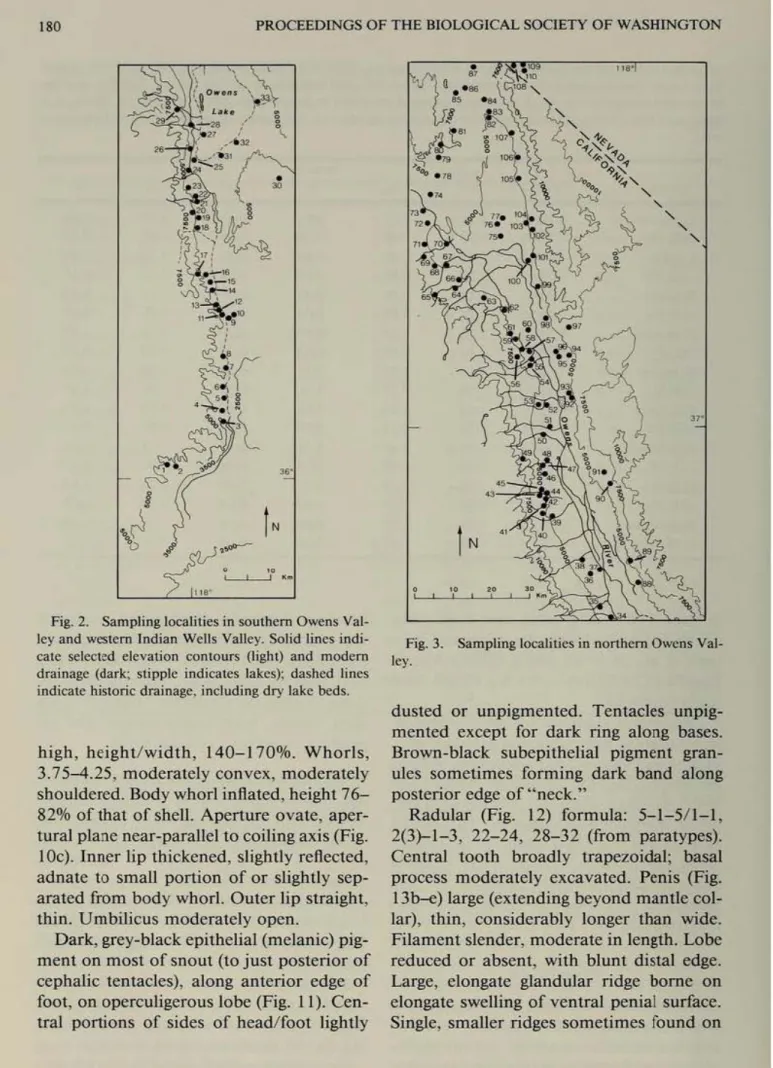
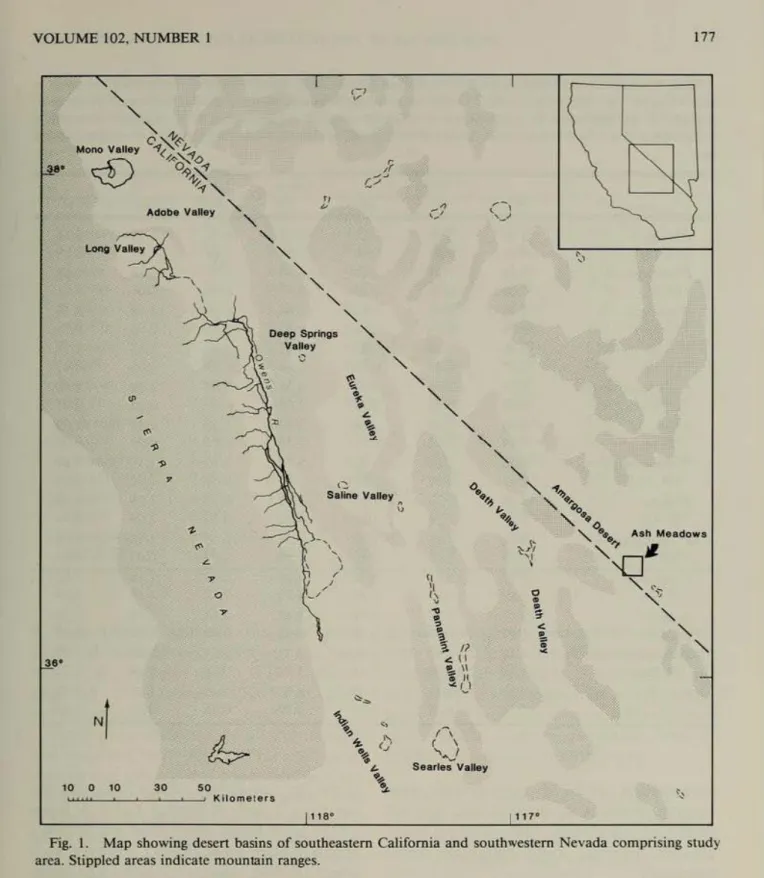
Discriminant analyzes using shell morphometric data confirmed the distinctness of nine new species described here, such as: Pyrgulopsis aardahli, P. Of the 22 snails known from the Death Valley System, 17 have highly localized distributions, with endemic fauna concentrated in Owens Valley. Death Valley and Meadows of Ashes. 1985-1987 survey of many remaining portions of the System, including waters in Mono, Adobe, Long, Owens, Indian Wells, Panamint, and Death Valleys; Amargosa River Drainage; and some areas adjacent to the above (Fig. I).
34; PROCEEDINGS OF THE BIOLOGICAL SOCIETY OF WASHINGTON Table l.-<tled shell paramclC1"S for Py,gu/ops,s sp«in. In order to facilitate comparisons, these parameters were also obtained from the entire set of sheJls Ash Meadows spring snails used in an earlier morphometric study (which involved generating a subse t of the above parameters using a somewhat different methodology; Hershler. Inner lip thickened, slightly mirrored, contributed to small portion of or slightly separated from body wreath.
Dark, grey-black and epithelial (melanic) pigment in most of snout (to rear of cephalic tentacles), along anterior edge of leg. In the internal thickness, reflected above, it joins a small field or that is strongly separated from the rotation of the body. Subcpilhelial pigment dark, gray-black with filamen filling llenglh al m051 1 0 ti p distal as well as parts of remaining penis d istal (Fig. JS b).
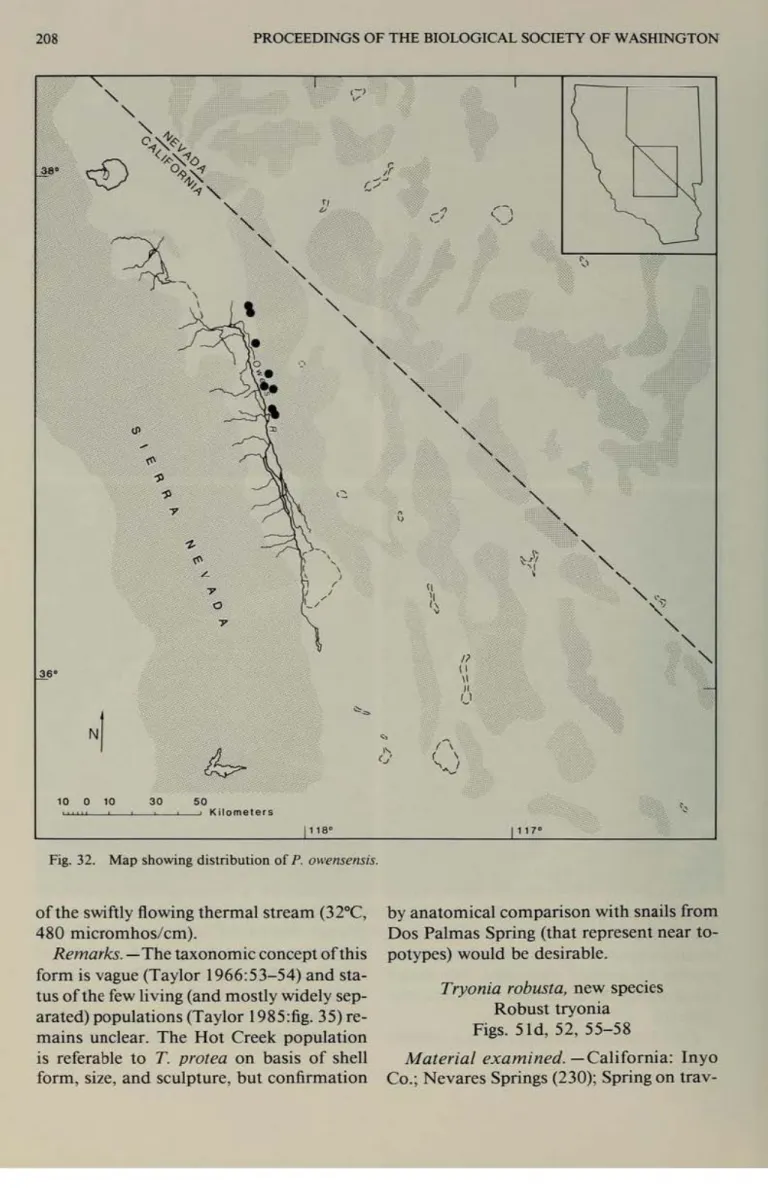
Distribution and Habitat.— Found along slopes of White and Inyo Mountains cast side of Q..'s Valley (Fig. 32).
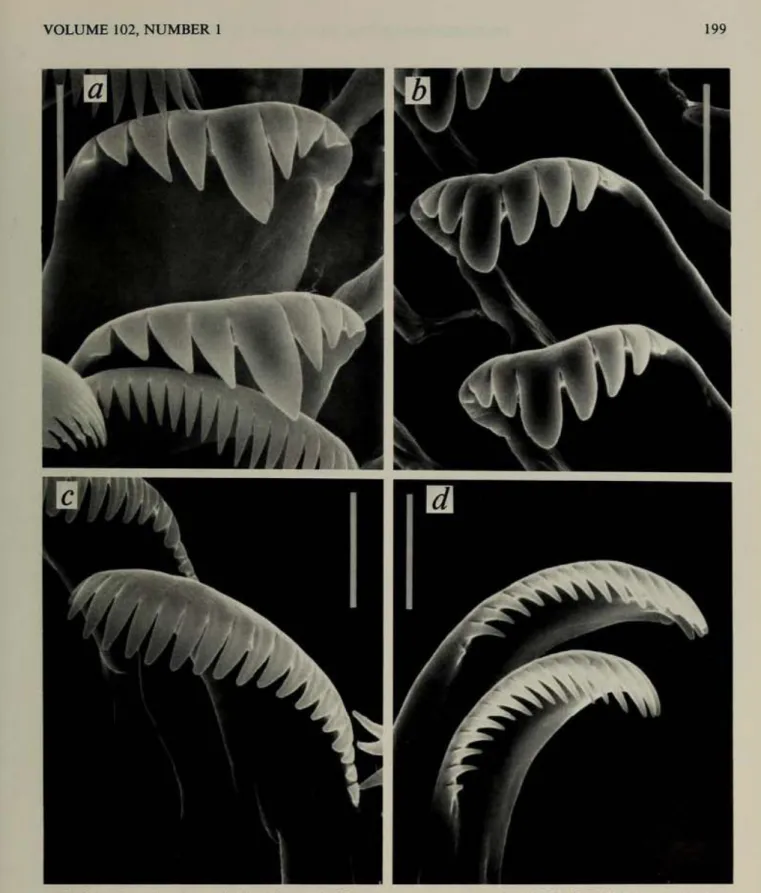
Outer lip straight, thin; apertural plane slightly tilted relative to whorl axis (Fig. 37 b). Dark, gray-black epithelial pigment on most of the snout (except pt distal tip), proximal portion of cephalic tentacles, a long anterior and posterior discs of "neck," part or a ll of opercu liger lobe. Pigment on central portions of sides of neck absent to dark (sub-epithelial pigment group dense in area).

VOLUME 1 02. NUMBER 1
Inner lip slightly thickened, usually only slightly raised, or adnal part 10 or slightly separated from whorl of body. Dark gray-black epithelial pigment on snout, proximal pinnae, and peripheral pinnae of sides of head/leg. Entire head/leg often very dark, central port ions of sides of head/ FOOL usua lly with dense da rk groups, subep itelial pigmenl gran-. relatively square in shape; basal process well excavated.
Lobe slightly shorter than the filament, wide, often wider distally. Usually distributed as follows: I) elongated ridge along the edge of the lobe; 2) similar, pedunculated margin on ventral surface, just pro)!.imal to lobe;. Modifications of the above include the addition of a few small ridges on the central dorsal surface, addition of a single small ridge (sometimes pedunculated) on the ventral surface, apparent fragmentation of ridges (in particular I. marl often covers apical whorls, with the shell is sometimes almost completely covered.
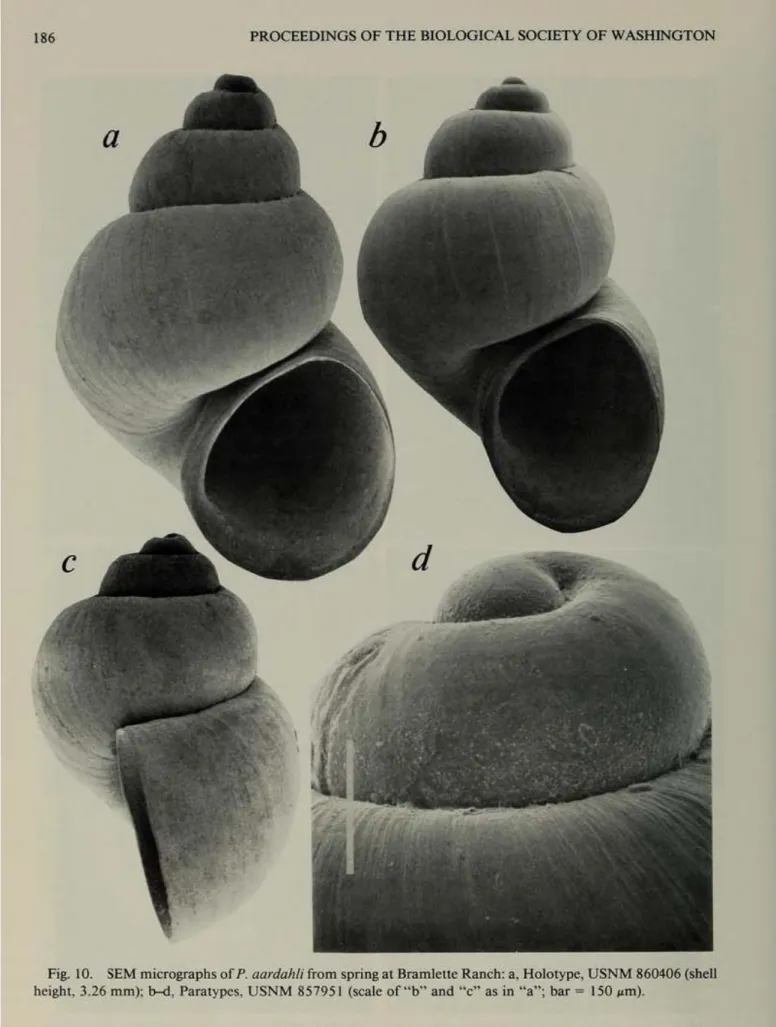
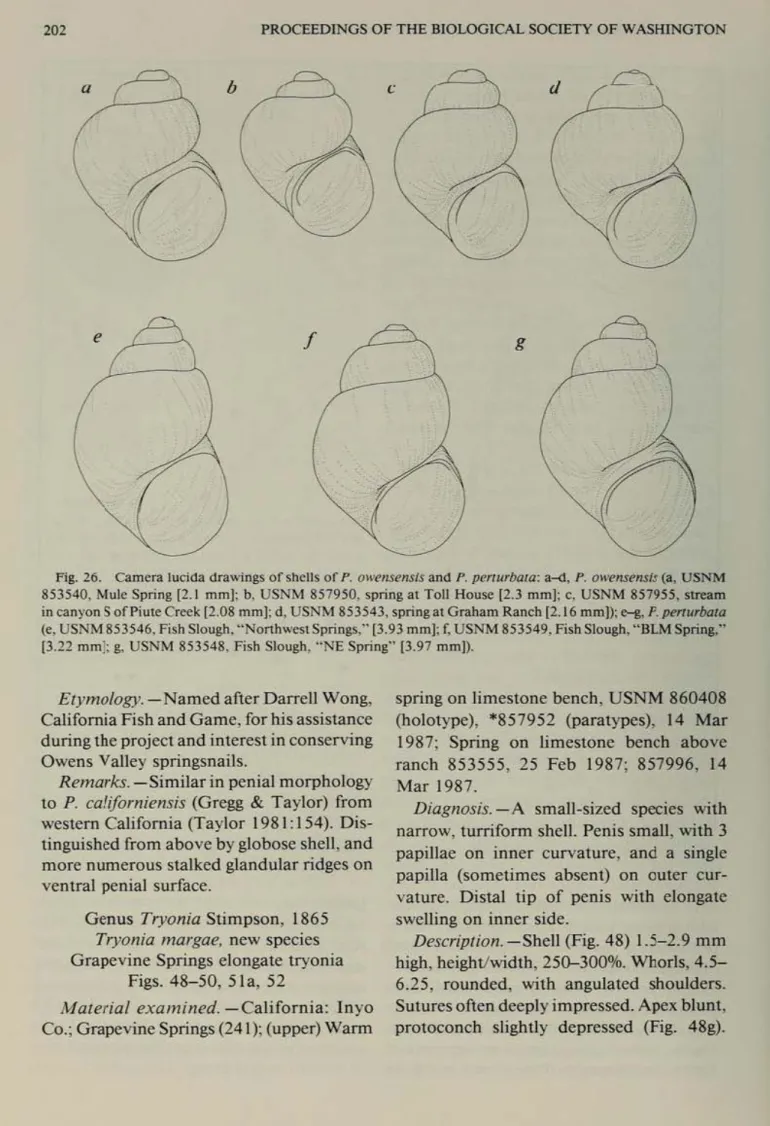
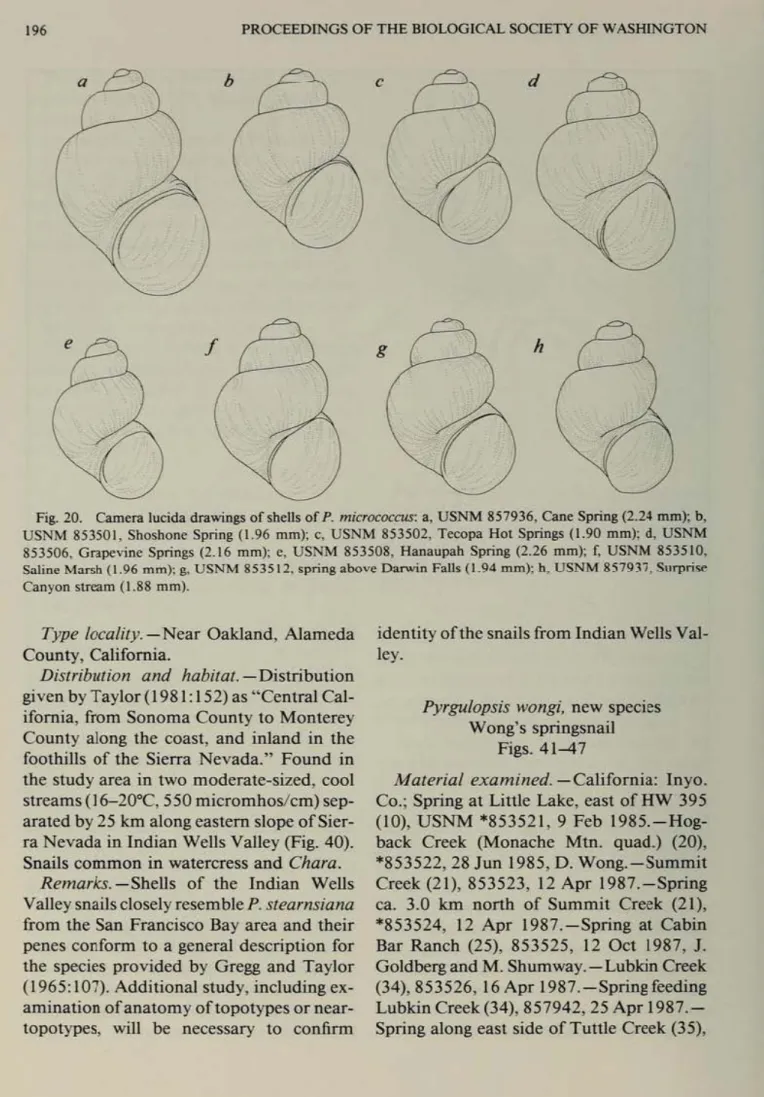
Inner lip well reflexed, slightly thickened, up to 10 or slightly separated from whorl of body. T 2 without smaller pillae positioned along distal half at inner margin; A similar small papilla is usually found near the base. The habitat consists of upper stream positions of shallow H owene ove r traverti ne streams (Fig. 8b), in which snails were moderately common.
02, NUMBER 1
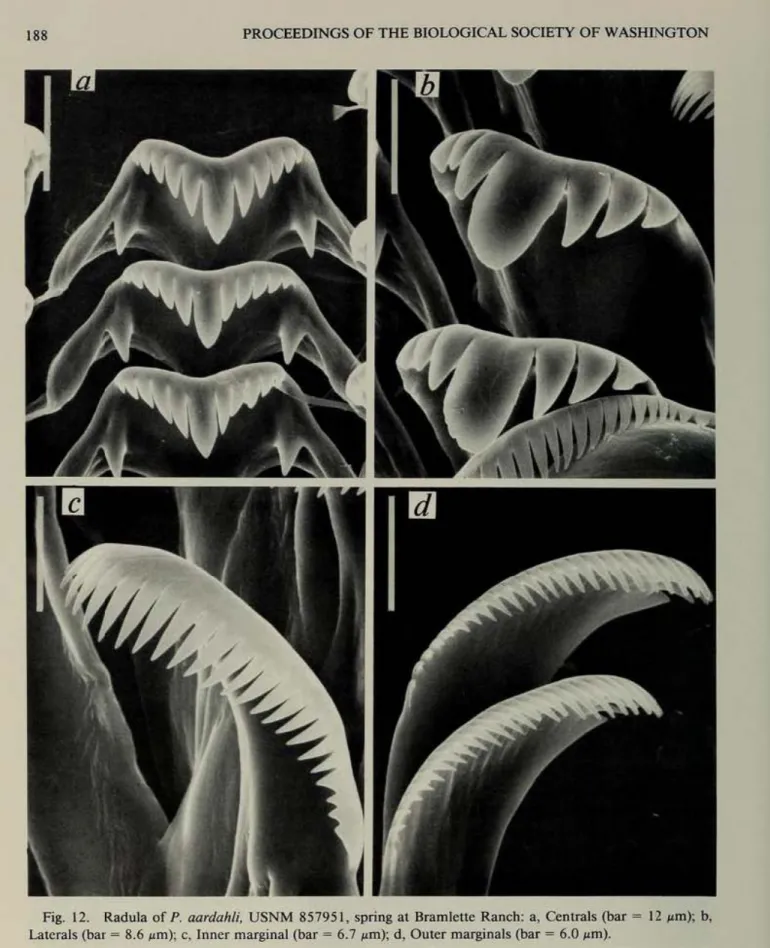
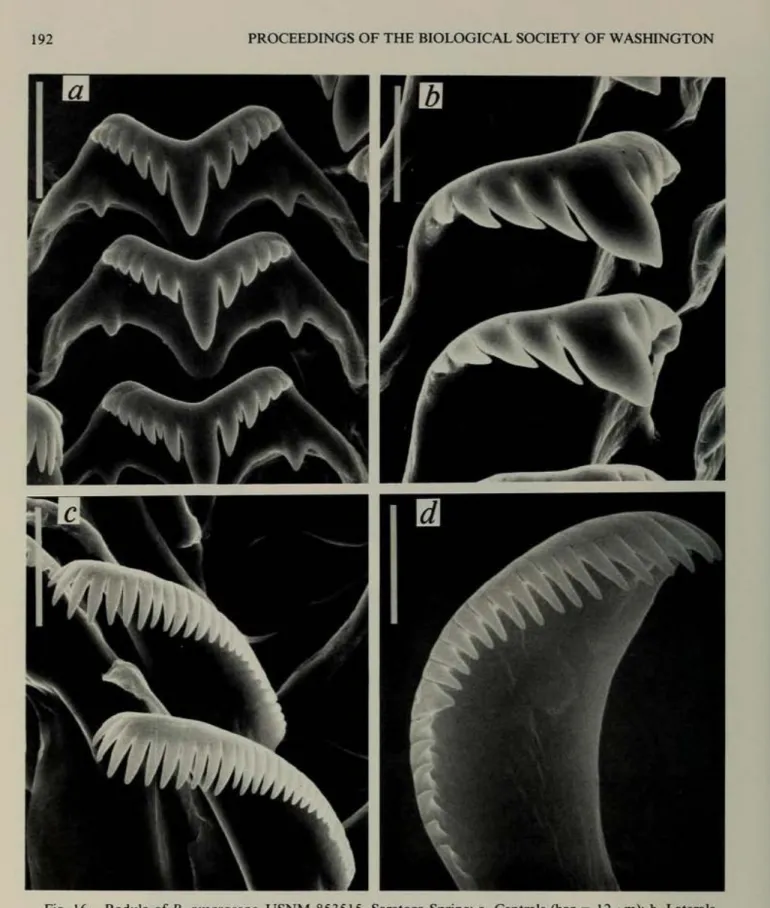
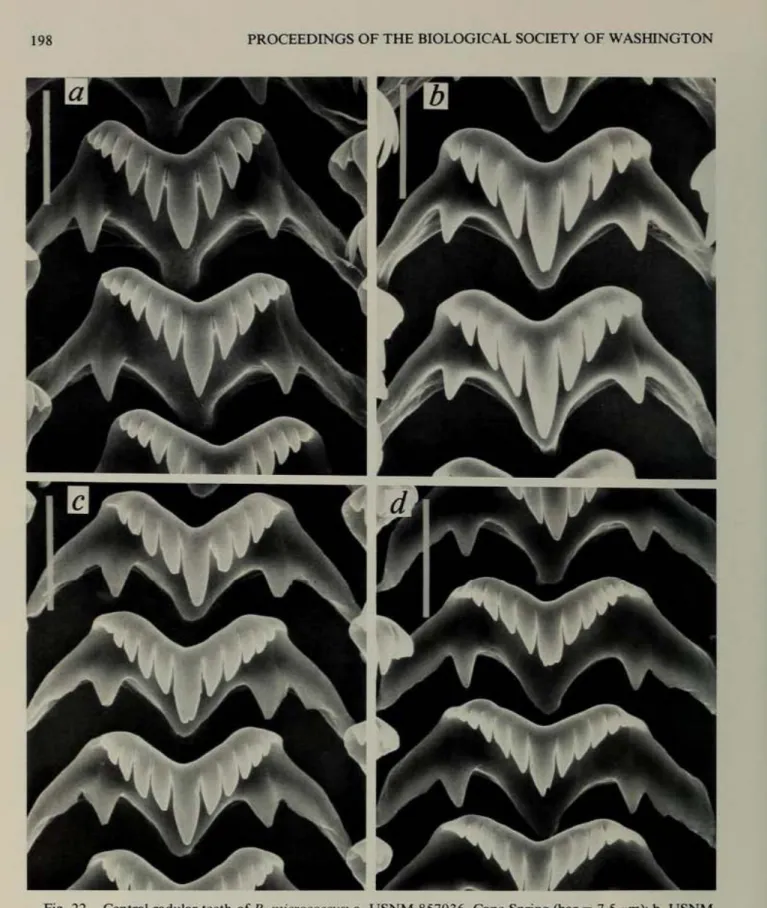
Opening almost ovoid, sometimes sharply curved upwards; opening surface slightly tilted relative to the spiral axis. Brownish-black melanic pigment, dark on the muzzle and posterior margin of the neck, variable on the central parts of the sides of the head/foot; subepithelial pigment granules are prominent in the latter. Cenlral has a relatively square shape; central cusps elongated, basal cusps small, basal process strongly excavated.
Distribution and habilal.-Found at Nc-vares and Travertine S springs at the base of the Funeral Mountai ns in central eastern Death Valley (Fig. 52). Penis large, with one papilla on the outer curvature and 2 papillae on the inner curvature. Aper ure oval, aper ural surface is slightly inclined relative to the axis of rotation.
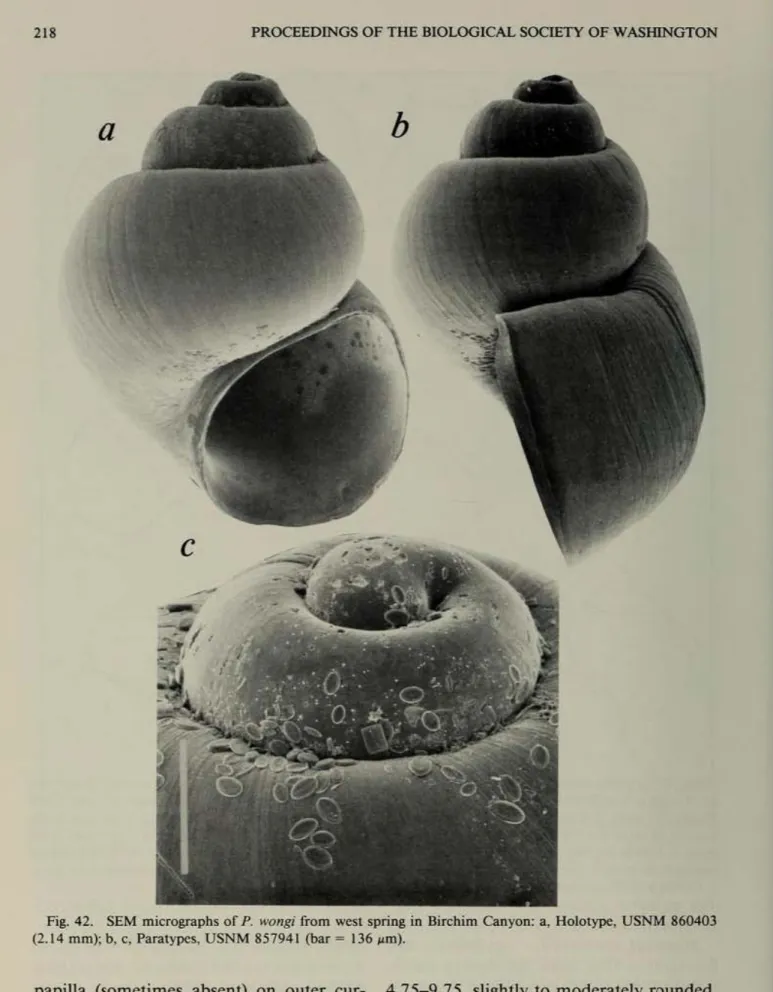
Inner lip thin, only very slightly reflected, adjoining or slightly separated from the body whorl. Protoconcern mon ized with a series of shon, predominantly spiral stripes (Fig. 5ge). Teleoconch with weakly developed spiral lines, pan icula r y on upper whorls.
Head/foot and intestinal spiral usually uniformly covered with dark brown epithelium. Etym%gy. - Named for Peter Rowlands, Resources Management Division, National Park Service, Death Valley, for his efforts in both supporting this research and preserving local aquatic gastropods at the Monument. The inner lip is thin, only slightly reflected, closely adjoining or slightly separated from the body whorl.
Inner curvature with two small papillae located on the inner side of the curved llrc near the tip, and a larger basal papilla. Dorsal penis variably pigmented by brown epithelial melanin, with especially dark covering on basal penis and papillae.
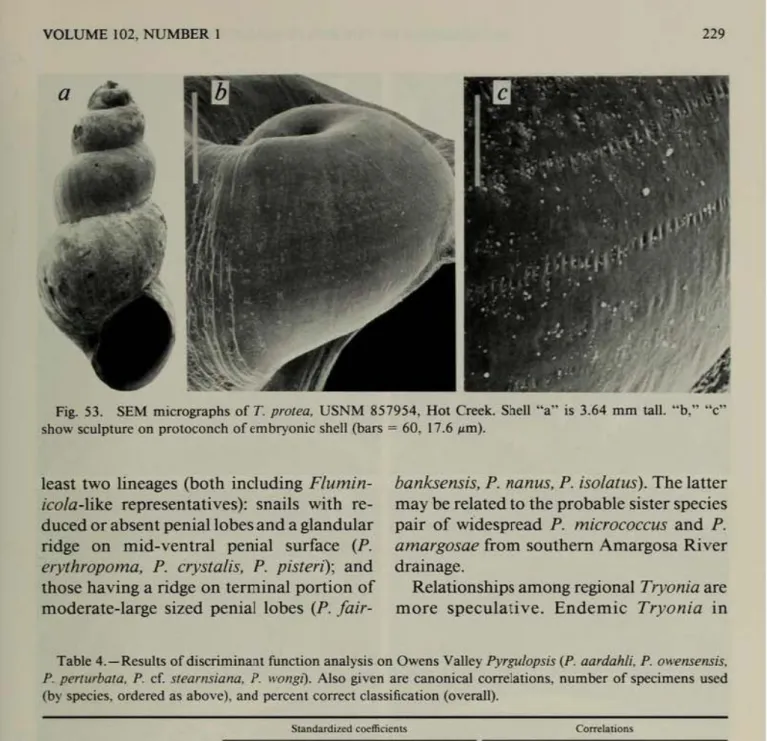
The pigment of the epithelium is usually dark brown. black on muzzle and sides of head/leg, with lighter covering on central port of latter. Populations from the lower Amargosa River are clearly assigned to T. I"ariegala based on shell, radular, and penial characteristics. Discriminant analyzes were performed on each of the three relative groups from the given port ions of the study area: a) P. amar· .. gosae and P. micrococcus. very similar form with connected areas; b) Pyrgulopsis fa u-na from the O'ens Valley (P. aardahli, p, owensensis , P. perturbata, P. cf. stearnsiana, P. . wongl): and c) small T ryonia spp., including those from northern Death Valley (T. . salina, T. rowlandsi, T. margae ) and ash trees (T. ericae, T. elala).
Modern drainage in the Death Valley area includes Owens, Amargosa, and Mojave Riven, the lane two of which are dry along most of their courses.

The pluvial waters of the Death System provided water continuity (at the same time. The presence of a site on isolated bases is completely created or destroyed by volcanic activity (See, Adobe Valleys, respect. <: actively), or those that have been well connected (Saline Valley, French ma n A at (Ca ne Spri ng); . H ubbs and Miller 1948) or associated with snail-free areas (Dee p Springs Valley, which either the pl uvial lake drains into Eureka Vall ey; Miler 1928) testifies to the importance of factors other than Late Pleistocene rainfall systems in the effective mode of dispersal of snails in the region. A detailed zoogeographical analysis incorporating the above considerations will be provided after the completion of the survey of resources of the remaining parts of the Death System.
The fieldwork in the Dealh Valley area was supported by the Smithsonian Institution Research Opportunity Fund (ROF), Wildlife Conservation International of the New York Zoological Sociely, and contracts awarded by the US Amounl and the timing of laIC Cenozoic uplift and tilt of the central Sierra Nevada, quarters of June Lake DiSirict and of all ulhiacnetic silicate minerals in the United Kingdom of Pleis:ocene Lake Tecopa, in the province.
Pleistocene lakes in the Great Basin.-United States Geological Survey Miscellaneous Geological Data Map 1_416. Natural History of Living Fishes in the Death Valley System, Los An8eles County Museum of Natural History. Repon on land and fn:shwater shells collected in California and Nevada by the Death Valley E~pedilion, including some ad· . ditional spc<:ies obtained by Dr. C. Han Mer. riam and helpers in the pans of the southern,.'eastern United States.- Non-American fauna.
VOLUME 1 02. NUMBER I