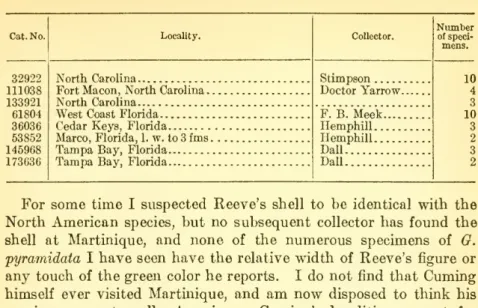
I follow the latter authors in separating the Mediterranean from the North Atlantic form, though I have not sufficient material to enable meto form a decisive opinion of my own. 273 the lower valve is shallow with a central elevation bearing in front two irregular appressed scars, the posterior scars like those of the upper valve.
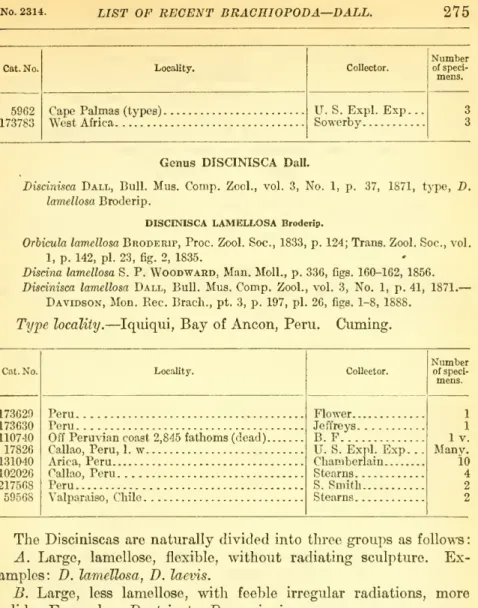
Small, with regular radiating sculpture, not lamellose, solid
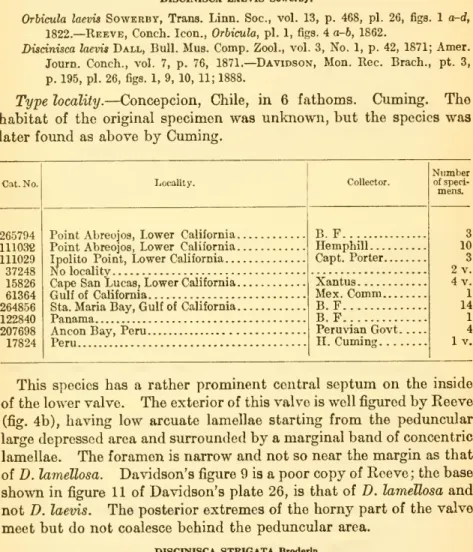
Type location. — Concepcion, Chile, in 6 fathoms. habitat of the original specimen was unknown, but the species was. later found as above by Cuming. The posterior extremes of the horny portion of the valve meet but do not coalesce behind the peduncular region.
278 PROCEEDINGS OF
B. Adams
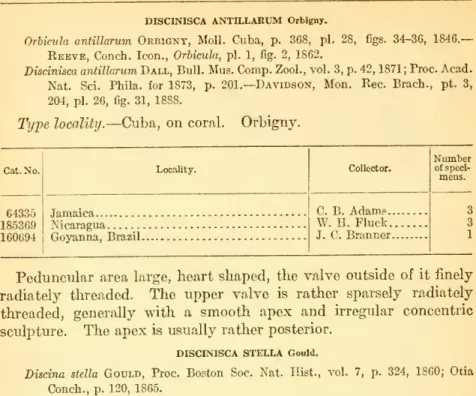
Upper valve irregular, almost without radial sculpture; Pale yellow; lower valve with very large heart-shaped peduncular area with sparse, widely separated, fine radial threads outside. Shell of variable color, generally pale straw color, the surface of the upper valve with fine radial threads finely meshed.
280 PROCEEDINGS OF
The type of the genus is therefore TJiecidea papillata (Schlotheim) from the Cretaceous of Maastricht. This differs from Lacazella mainly in the simpler arrangement of the brachia and their supports.

NATIONAL MUSEUM
288 PROCEEDINGS OF NATIONAL MUSEUM
Shell transparent gray, thin, rounded triangular, attenuate posteriorly, widest near anterior margin of valves, anterior margin straight without trace of flexure; surface shiny, with faint ascending and subtle radial striations visible only under magnification; pedicel valve.
292 PROCEEDINGS OF
Both valves are more or less concave medially, with the sulcation, if you can call it that, being 'opposite'. It is much less apparent in specimens from colder water.
294 MUSEUM
296 MUSEUM
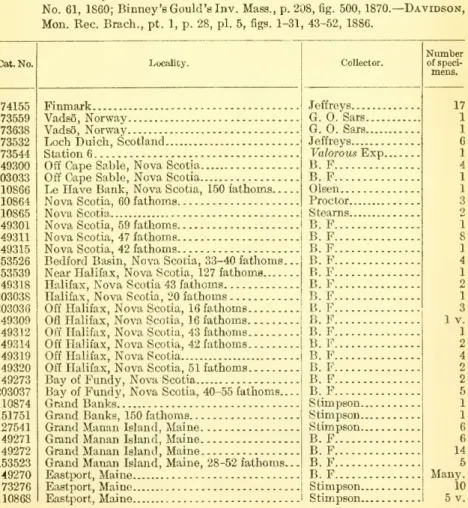
297 The earliest name for the Mediterranean form is emarginata of Risso, and the bilobed form is not characteristic of Mediterranean specimens. Cashe'sLedge, Maine, 52-90 fathoms Cashe's Ledge, Maine, 27 fathoms Cashe's Ledge, Maine, 110 fathoms Cashe's Ledge, Maine, 40 fathoms Cashe's Ledge, Maine, 92 fathoms CascoBay, Maine. OffCape Ann,Massachusetts, 18fathoms OffCapeAnn,Massachusetts,32fathoms OffCapeAnn,Massachusetts,53fathoms OffCape Ann,Massachusetts,40fathoms OffCapeAnn,Massachusetts,19fathoms OffCape Ann,Massachusetts,38fathoms Glou Cester,Massachusetts.
Off Salem, Massachusetts, 33fathoms OffSalem, Massachusetts, 20fathoms OffSalem, Massachusetts, 50fathoms Empty OffSalem, Massachusetts, 19^fathoms OffSalem, Massachusetts, 26fathoms OffSalem, Massachusetts, 36fathoms OffSalem, Massachusetts, 48fathoms OffSalem, Massachusetts, 48fathoms. means Off GeorgesBanks, Massachusetts, 99 fathoms. This species undergoes (commensal?) growth of a sponge which when young looks like a normal pubescence, as in T.
302 NATIONAL MUSEUM
304 PROCEEDINGS OF THE NATIONAL MUSEUM. described under the last type, loop narrow, compressed, rather long, with a strong median fold; genital sinuses about half the length of the valve, densely vermicular, wide behind, narrower in front with two or three lateral branches, the two series separated by at least half the width of the valve. Shell length 31; width 24, diameter 19 mm. Tyj^e Locality.— Cebu, Philippine Islands, in 310 fathoms, U. Goto Islands, Japan, 181fathoms OffHonshu Islands, Japan, 125fathoms OffYokohama, Japan. This species was taken under the label "T. japonica" and it is likely that the new specimens were confused with that species. which is of the retusa type, while the current species leans towards T.
Sibuku Bay, Borneo, 292 fathoms Sibuku Bay, Borneo, 292 fathoms Sibuku Bay, Borneo, 347 fathoms Sihingan Island, Borneo, 305 fathoms OffSibutuIsland, Borneo, 175 fathoms OffSibutn Island, 2Sibutn Islands, 2Sibutn Islands, 9Soffao Island, 25Fathoms 2fathoms Philippine Islands, Philippine Islands, Philippine Islands Islands, Philippines Islands, Philippine Islands, Philippine Islands,. It was a great surprise to find this beautiful species described from Japan living in the deep waters of the Pacific coast, together with the presence of T.

308 OF MUSEUM
Blake Henderson Henderson Henderson Henderson Henderson Henderson Henderson Henderson Henderson Henderson Henderson Henderson Henderson Henderson Henderson Henderson Henderson Henderson Henderson.
310 NATIONAL MUSEUM
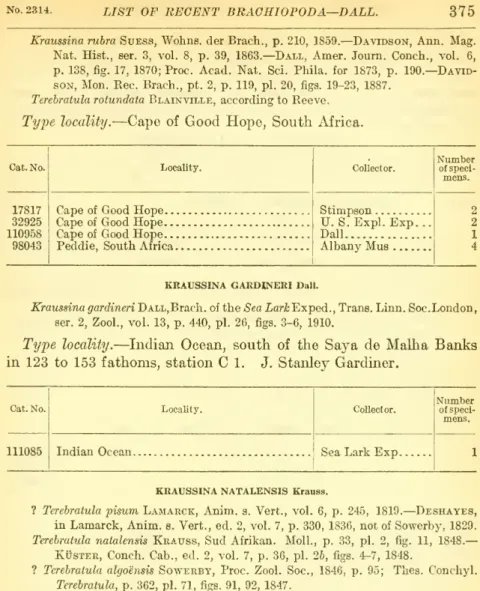
LIST OF RECENT BRACHIOPODA-DALL. several authors in a general sense later, but except in the case of the Museum Calonnianum, they are all after Megerle. The Museum Calonnianum has been rejected as a source of valid nomenclature. by the International Committee on Nomenclature, but in any case it did not originally include the name Gryphus, which did exist in some places. later date was written in some copies to replace Lacinia. The distinctive character of this species, which also occurs in the Italian Tertiary, has been confirmed by Blochmann.
Shell rounded triangular, widest at the anterior do-d, smooth except for concentric growth lines, not folded; beak high, curved and conspicuous with a large enth-e foramen, the deltidial plates small and narrow, fused; hinge margin thickened, longer than the short stout teeth, anterior margin smooth, muscular impressions indistinct; brachial valve less inflated, tooth plates broad, the bases slightly transversely striated, the loop short, rather broad, the lower portion with a median deep sulcus behind and a corresponding projection in front, the crura short and obtuse; the plates are separated towards the apex where there is a prominent callus which serves as a cardinal process; the leading edge of the valves is almost straight.

314 NATIONAL MUSEUM
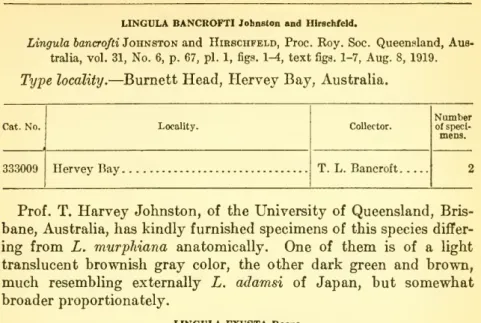
Type locality.— Off the coast of Setubal, Portugal near the mouth of the Tagus River, in 500 to 600 meters; SavilleKent. Older specimens show three short marked furrows separated by muscular impressions which are more or less raised, on the foot valve, and in senile specimens these are quite deep. There has been some doubt expressed as to the identity of the above specimens with the species excavated at Kerguelen, notwithstanding their agreement in external features.
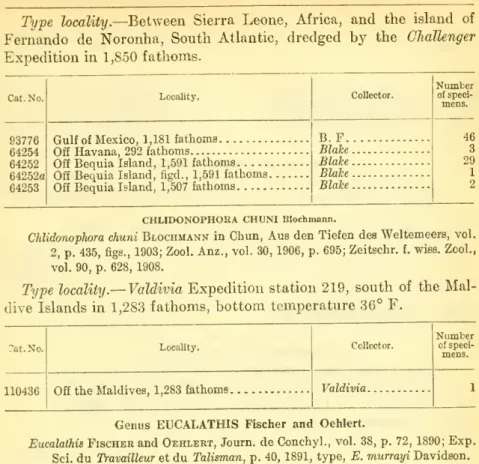
I confess that I am doubtful myself, and propose for the species, if it proves to be a distinct name, Gryphus martinicensis, taking as the type the specimen numbered 64255. Type locality.—Because Davidson seems to have among those which he enumerates in Challenger's report, did not select any particular locality, I selected station 299, off Valparaiso, Chile, at 2160 fathoms, gray mud, bottom temperature 34°F.
322 PROCEEDINGS OF
Type locality.— Valdivia Expedition Station 219, south of Maldive Islands in 1283 fathoms, bottom temperature 36°F. Most specimens show no loop, but I opened a few larger ones that had a clear loop with the lower edge attached to the flap. The more northerly specimens of this species show usually radial threads, rarely somewhat complex, but a large proportion of those from the southern coast of the Mediterranean are more or less distinctly granular, the granules, especially those situated laterally near the bill, sometimes produced into short dots, simple .
The genus MuMfeldtia is characterized, among other things, in that the peduncular foramen is normally confined to the beak valve, as in most Terebratellidae, the extension of the foramen to the brachial valve being due to wear and to that extent abnormal; Most figures indicate that the foramen affects the upper valve, but this is abnormal.
336 PROCEEDINGS OF THE
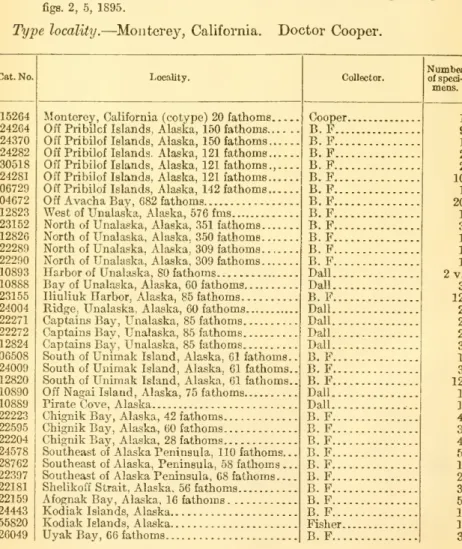
On examination of the loop I am forced to the conclusion that the details do not correspond to the type genus Kingena as depicted from the original fossil, but that there really is no material difference between the loop of alcocki and Frenulma sanguinolenia. Type locality.— North coast of Maui Island, Hawaiian Islands, in 143 to 178 fathoms, rocky bottom, temperature 60°.8F., at Bureau of Fisheries Station 4079. Paul.KodiakIsland Port Etches, Alaska, 8fathoms Port Etches, Alaska, 18fathoms Port Etches, Alaska, 15fathoms Port Etches, Alaska, 15fathoms Port Althorp, Alaska, 16fathoms Sitka, Alaska, 1.w.
This species resembles in color the variety rubescens of T.transversa, but is much inflated, sometimes white, with a red color only on the ribs, but can be immediately distinguished from all forms of transversa by the fact that the mesial fold is directly opposite is to that of any of the other species. The sulcus is located in the pedicel valve, while it is located in the transverse in the brachial valve. After a study of the variations in application observed in these and other species of terebrateloids of the North Pacific, I conclude that too high a systematic value has been attached by some excellent students of the Brachiopoda to the various modifications, at least in this group. .

342 PROCEEDINGS OF
In both, the flattened areas on the outer sides of the deltidium are broad and conspicuous.
344 PROCEEDINGS OF
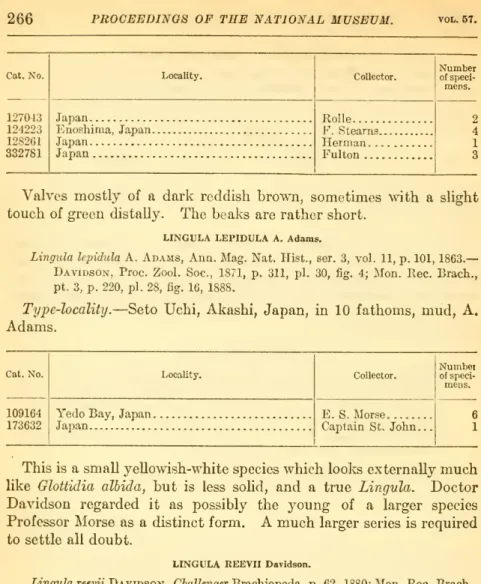
Stearns
LIST OF RECENT BRACHIOPODA – DALL.. 345 4 millimeters long, forming the inner borders of the muscle scars. This beautiful species grows to be almost the largest of the recent brachiopods and is one of the most regular in shape. In color it ranges from an overcast pink color to the miniata Gould variety.
The teeth are strong, the supports in adults are reduced to a pointed depression in the callus mass.
346 PROCEEDINGS OF
G. Cooper
There is an extremely faint sign of convex undulation on the anterior margin of the pedicel valve. Davidson that it is for comparison, and succumbed to the opinion of Mr. rubellus, or as he later concluded about L. 354 PROCEEDINGS OF THE NATIONAL MUSEUM. This, like other Ballina species, has a pedicle valve with a depression mesially ending in a protractive arch of the anterior margin, and two more or less obvious depressions in the brachial valve with a low convexity medially between them or, like this.
Davidson's figures lla-c appear to be taken from a specimen of the variety and figures 12 and 13 from the typical form of the species. It differs from Eudesia by its incomplete foramen and broad hinge area, and from both by the heavily coarse structure of the shell.
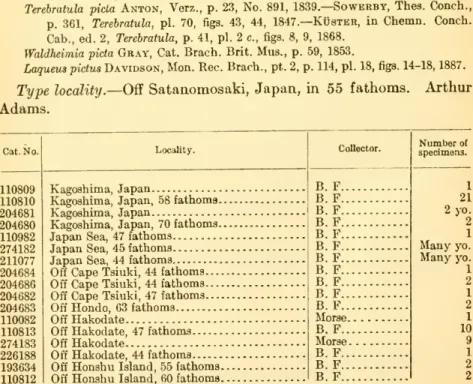
362 NATIONAL MUSEUM
This is followed by T.lenticnlaris Deshayes, in which the loop becomes free from the septum much sooner, the beak is lower and the insensible deposits in the adult, though exactly analogous to those of the fossil, are less abundant and crude; and finally the present species in which the beaks are still lower and in some old specimens the foramen is not completely closed, the loop becomes free from the septum at a still earlier stage, and the cardinalia never attains the callosed condition of its predecessors , I deduce from this. that T
366 PROCEEDINGS OF
I have some hesitation in referring this species to Camjxiges because of the struts in the stem valve (which Hedley does not refer to and which are probably absent in C.furcifera), the divided cardinal plate and the protruding spurs of the lower part of the valve . the loop. In 1891 I stated the probable relationships of the several small Magasella species then known, and to that statement not much can be added even now. I have given my opinion under the heading of the genus as to the distinctive character of this species, and that seems to me to be the case.
370 NATIONAL MUSEUM
The brachial valve usually has a prominent square cardinal process; a concave platform with a median ridge, supported by a strong but low septum, extending to about the middle of the valve, which is retractively strongly unidentate in some individuals, not conspicuously in others, while others have numerous additional minor forms. The pedicel valve has a short beak with a large incomplete foramen, a barely perceptible median ridge inside, without dental buttresses, and there are four slender genital sinuses, the inner pair widely separated, simple, bifurcate at extreme ends; outer pair with five or six lateral branches on outer side. It has a small frilled main process, a concave platform supported medially by a strong low septum extending to the middle of the valve, a loop well represented by my figure of 1870; genital sinuses are.
373 widely spaced, one on each side, arcuate, with five or six short, forked, lateral, outer branches.