One problem is that amphipods are quite small in the tropics M. L. 462 PROCEEDINGS OF THE NATIONAL MUSEUM vol. Deviations also occur rather more frequently in the species of these genera in colder waters than in other genera observed by the author.

470 PROCEEDINGS OF THE NATIONAL MUSEUM
472 PROCEEDINGS OF THE NATIONAL MUSEUM
MARINE AMPHIPODA IN MICRONESIA — BARNARD 473 Table 3.^ Dominant amphipod genera in the Tropics, with number of species
83-E-l, algal outwash, old raised reef remnant at the combination of outer and inner reefs, reef south of Falarik Islet, intertidal, September 29. 139-C-2, washing of coral lines and other algae, western reef between Elangalap Isle and northern tip of Falarik Islet, depth 6 inches to 3 feet, October 20.

486 PROCEEDINGS OF THE NATIONAL MUSEUM
Relationship: This anamix is unusual in the shape and ornamentation of the head, the long fourth palpal joint of the maxilhped, the widely spread palm of gnathopod 2 dissected into large teeth, and the apically bifid claw of gnathopod 2. Instead of small denticles on the dactyl of gnathopod 1, the second specimen from Station 465 C 1/4 small, short attachment.
MARINE AMPHIPODA IN MICRONESIA — BARNARD 489 The specimen from station 177-G-5 bears small setae, not teeth
490 PROCEEDINGS OF THE NATIONAL MUSEUM
MARINE AMPHIPODA IN MICRONESIA — BARNARD 491 not serrate on inner edge, article 7 very short; article 6 of second
This new strain shows similarity to L.L. furina Savigny van Schellenberg, 1928) in the structure of the gnathopodal palm, but differs from gnathopod 1 by the short dactyl.
MARINE AMPHIPODA IN MICRONESIA — BARNARD 493
Relationship: This is closely related to Pseudomoera Schellenberg (1929), the unique type of which is P. It differs from Paramoera Miers by the weak inner plate located on maxilla 1 and the well-developed inner lobes of the lower lip, and from Djerboa Chcvreux by the absence of an accessory claw in pereopods 1-5 and non-linear gnathopods. Descriptive Notes: Eyes rather large and black, with sides of head broadly rounded in front, not incised; small pulpit; upper Serrated top; pereopods 1 and 2 with a large distal spine.
Paraceradocusmicramphopus Stebbing (1910a) should be transferred to the genus Metaceradocus Chevreux (1925), in which it forms the third species.

496 PROCEEDINGS OF THE NATIONAL MUSEUM
Diagnosis in a female: Eyes large, black; accessory flagellum consisting of two articles with a minute third; pereopods 1-2 with two large curved distal spines on sixth articles, article 7 with distal claw barely distinguishable, but provided with 3-minute stelules; posterior edge of tliird.
MARINE AMPHIPODA IN MICRONESIA — BARNARD 499
In particular, the new species differs only in the fact that Reid stated that the telsonic spines were apical, while in the present species they are considerably subapical. Bate (1862) simply copied Dana's original description and a figure, then continued on a later page to describe Moera [sic] pectenicrus with the type locality of New Guinea. In 1911, Chevreux described and calculated specimens from Algeria that matched Dana's species because of the same simplicity; However, Algeria is still far away.

502 PROCEEDINGS OF THE NATIONAL MUSEUM
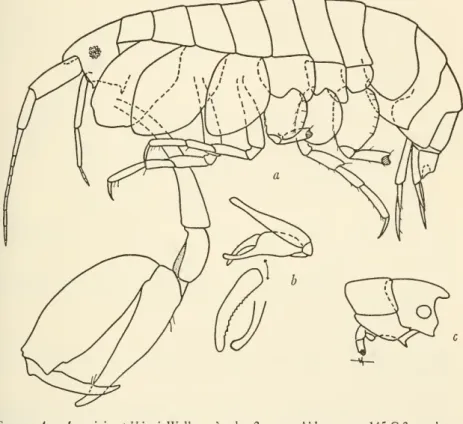
Remarks: This species is more variable and it has been difficult to resolve the impression that not all listed materials belong to this species. The well-developed third pleonalepimeron takes the form of figure 12 A, with a straight shield and a small, almost raised tooth in the lower corner. Younger males, still with the correct nathopodal configuration, may have the lower corner rounded - quadrate, with or without a notch in the lower corner, as figured by Schellenberg (1938a).
Remarks: The male athandi is more typical of the classic figures of this species (Sars, 1895, p. 183) than the material reported by J.
504 PROCEEDINGS OF THE NATIONAL MUSEUM
MARINE AMPHIPODA IN MICRONESIA — BARNARD 505 from Ceradocopsis Schellenberg (1926) by the indistinct palm of
The material at hand is particularly difficult to identify because of the lack of large series of material from a single locality and because most of the specimens are immature. Few of these specimens are mature and apparently the metamorphosis of the palmar configuration into the mature sculpture goes through several stages in both males and females and all the initial stages are similar. All specimens of Maera quadrimana in the Reish collections have strong basal articles on the last 3 pairs of pereopods, which is a confusing exception to Schellenberg's otherwise neat separation of.
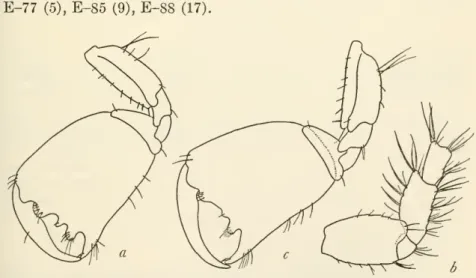
Adult males with 3 palmar teeth on blackfoot 2, young males, females and juveniles with smooth palms, with short incisor teeth .M.quadrimana Adult males with one blunt palmar tooth on pygmypod 2, young males, females and juveniles have smooth palms with long de-. Description: Eyes rather large, subreniform, ommatidia not tightly compressed; joint 6 of one male kid 2 (Fig. 16^) rather slender but very massive, palm almost transverse but short, defined by strong teeth bearing a large spine, palm with 2 or 3 teeth; second male of another pygmypod (Fig. 16;) (usually left) very small, similar shape, but palms without teeth defining and bearing several large spines, joint 7 not strongly curved at base; gerontic females having dwarfs similar to males (Figs. 16a, /); second adult female having both other pygmypods, like small gerontic females (Fig. 16e); smaller but still adult females having both other pygmypods small, but palm barely distinct from posterior margin of article 6 (Fig. 16m); finally an aberrant form was found (Fig. IQi) with joint 6 of gnathopod 2 being stouter, the palm formed into about 7 small even teeth, and the fingers swollen near it.
508 PROCEEDINGS OF THE NATIONAL MUSEUM
In doing so, one is immediately struck by the similarity between this description and the redescription of Alaera othonides Walker by Pirlot (1936). Chiltoji's (1916) description seems to fit Wallver's better than Sheard's, so we are left with the possibility that the telson varies to such extremes. Barnard (1916) described but did not find a specimen of Adaera mastersi from South Africa, a gnathopod he had rather strong and acute palmar teeth, especially with a distinct defining tooth; the other gnathopod was smaller, with the palm.
The variability seen in the present material necessitates the suggestion that Alaera mastersi and M. One can inspect the drawings of Sheard and Pirlot and still find minute differences in the gnathopodal palms between M.
MARINE AMPHIPODA IN MICRONESIA — BARNARD 511 Maera othonopsis Schellenberg
Remarks: The juvenile specimen of 141-D-3 is referred to this species on the basis of the slender second articles of pereopods 3–5, the lower corners of which are quadrate (Schellenberg 1938a, figure 21g).
MARINE AMPHIPODA IN MICRONESIA — BARNARD 513
Superficially it appears to be in the Gammaridae or Photidae, but has other characteristics of the superfamily Talitroidea (including Hyalidae). The antennae are those of the Gammaridae; the lateral cephalic lobe and its notch are those of Gammaridae; the mandible is that of Talitroidea; the lower lip is that of the Photidae and Aoridae; both pairs of maxillae differ from those of any of the three named. If the species had a mandibular palp, I would place the genus in the Photidae, but this would obscure its special characters, such as the lobe notch and the very slender maxillae, which resemble Gam-.
Description: Article 2 of antenna 1 as long as article 1, article 3 two-thirds as long as article 2, accessory flagellum stout, short, composed of a long article tipping with a short one; antenna 1 many.
MARINE AMPHIPODA IN MICRONESIA — BARNARD 515
The genus Parallorchestes Shoemaker (1941) is not a synonym of Parhyale, as followed by Bulycheva (1957); in fact, according to its division of Talitridae into three families, Talitridae, Hyalidae and Hyalellidae, the genus Parallorchestes due to the possession of a biarticulate first jaw palp should be removed from the genus Parhyale to Hyalidae to Talitridae. The genus Neobule, poorly described and undiscovered since its description by HasweU (1879a) cannot yet be assigned to either. The main features of specific morphological variation lie in the length of the antennae, the stoutness of antenna 2, the shapes of the gnathopods, and the presence or absence of stout striated spines on the sixth articles of pereopods 1–5.
Another problem is whether the shapes of the first two coxae have always been determined correctly, for some species have coxae with small posterior lobes or processes and others do not. Article 6 of pereopods 1–5 with a long strongly striated distal spine inner margin, spine larger than neighboring spines 11 Article 6 of pereopods 1–5 with short or slender, usually unstriated distal spine on inner margin, not larger than other spines 21.
MARINE AMPHIPODA IN MICRONESIA — BARNARD 519 Hyale antares Oliveira (1953): only the female is known; it
It is likely that these males are one age younger than the adults estimated by Chevreux, but the life history needs to be studied to confirm this. Because the apparent young male has a second gnathopod similar to that of any young Hyale such as H.
MARINE AMPHIPODA IN MICRONESIA — BARNARD 521
522 PROCEEDINGS OF THE NATIONAL MUSEUM
MARINE AMPHIPODA IN MICRONESIA — BARNARD 523
524 PROCEEDINGS OF THE NATIONAL MUSEUM
IN MICRONESIA 525 The species is figured again herein to give all the mouthparts in
Distal front corner of joint 2 on gnathopod 2 with attachment 19 Distal front corner of joint 2 on gnathopod 2 has no protrusion ..20. 7th gnathopod joint 1 internal projection, ventrum of pereon with 4 large and 2 small posteriorly projecting teeth L.audbettius 7th gnathopod joint 1 without internal projection, ventrum of pereon with 2.
528 PROCEEDINGS OF THE NATIONAL MUSEUM
MARINE AAIPHIPODA IN MICRONESIA — BARNARD 529
530 PROCEEDINGS OF THE NATIONAL MUSEUM
Eurystheusatlanticus bears a strongly produced lateral head lobe with a lageniform eye, the lower part of the lateral lobe filling the eye and the neck reaching upwards towards the top of the head. Since that time, both species have been frequently recorded and several more figures have been published, but the interpretations have lost much of the original interspecific concepts of the genus. The head lobes of the present specimens are clearly distinct from those of E. atlanticus and E. later as described by Stebbing, but closely approximate Pillai's head figure.
The condition of Audulla could be interpreted as a roughly defined tooth with a medial depression, qualitatively little different from some of the following species: Eurystheus Una, E. Una are distinctly similar to Audulla; therefore, only the power of the second flagellum of the antenna remains as a.
534 PROCEEDINGS OF THE NATIONAL MUSEUM
MARINE AMPHIPODA IN MICRONESIA — BARNARD 535 specimen had lagenifomi eyes; Chilton (1921) reported nearly oval
536 PROCEEDINGS OF THE NATIONAL MUSEUM
538 PROCEEDINGS OF THE NATIONAL MUSEUM
This relationship, involving gnathopods, head and eyes, further points to the artificiality of the arrangement made by J.L. Barnard and the difficulty of separating several photid genera. Because of the eye structure, this species can easily be confused with Eurystheusafer (Stebbing 1888), but the palm of the other gnathopod. Gnathopod1 largerthangnathopod2 Paragrubia Gnathopod1smallerthangnathopod2 Cymadusa According to this key, Ampithoe megaloprotopus Stebbing (1906, p. . 633) should be transferred to Exampithoe.
Barnard (1955) from the Hawaiian Islands is actually this species because of the poorly setose gnathopods; Barnard's figures of the apparent young man correspond to the cobbler's (1935, fig.
MARINE AIMPHIPODA IN MICRONESIA BARNARD 541 Genus Paragrubia Chevreux
542 PROCEEDINGS OF THE NATIONAL MUSEUM
Comments: It is doubtful whether this species is a Phonexes, because the telson lacks the hooks seen in P. It could prove that the telson is the only qualitative feature that distinguishes Pleonexes from Ampithoe due to its dilation. It is at present almost impossible to get any idea of this genus and the limits of variation within a species, as shown in the following discussion and J.
544 PROCEEDINGS OF THE NATIONAL MUSEUM
MARINE AMPHIPODA IN MICRONESIA — BARNARD 545
Contributions to the Crustacean Fauna of South Africa, 11: Further additions to the Tanaidacea, Isopoda and Amphipoda, together with keys to the identification of the marine and freshwater species hitherto recorded. Catalog of specimens of amphipod crustaceans in the collection of the British Museum, iv + 399 pp., pis. Catalog of the Australian Stem and Sessile Crustacea, Australian Museum, Sydney, xxiv + 324 pp. plus Addenda et Corrigenda), 4pis.
Report on the Amphipoda (Gammaridea and Caprellidea) of the coast of tropical West Africa. Studisuicrostacei anfipodi,8: GlianfipodimarinidelMuseoCivicodi StoriaNaturaledi Genovaa) Glianfipodidel Mediterranea. Amphipoda: A description of the Crustacea of Norway with brief descriptions and figures of all the species, vol.