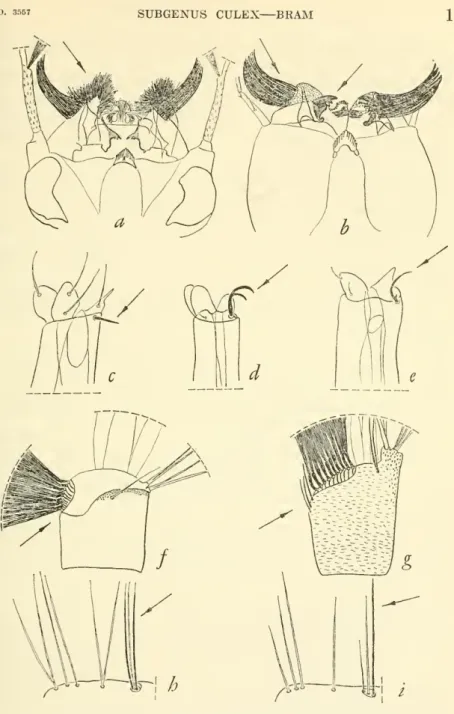
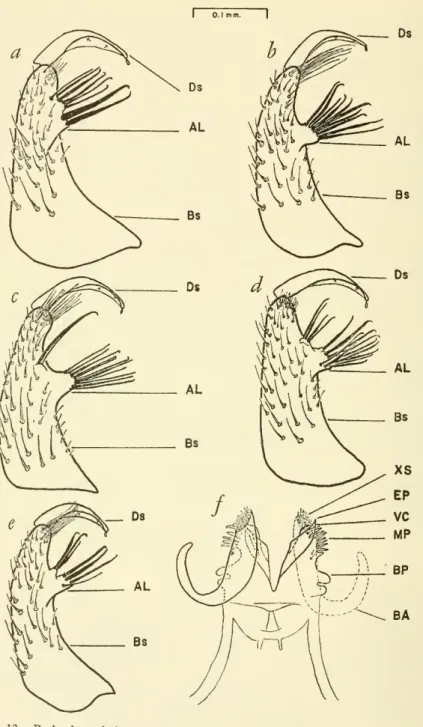
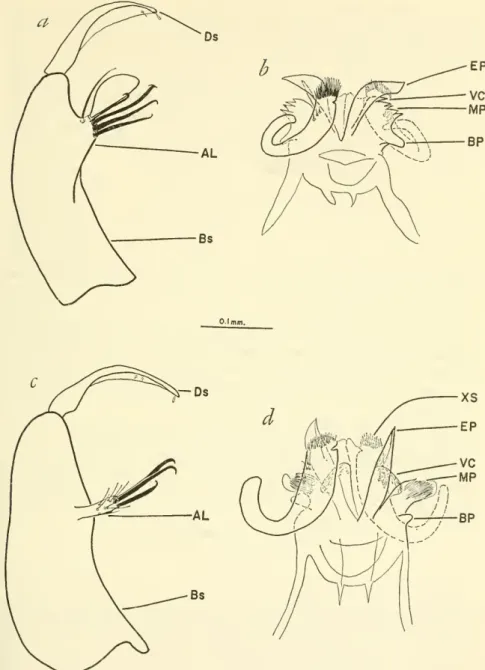
Only three species of the subgenus, restuans, salinarius and tarsalis, are indigenous to the Nearctic region. The following discussion discusses zoogeographic patterns of the subgenus Culex in the New World.
NO. 3557 SUBGENUS CULEX — BRAM H
5 (4) Apical lobe of basal style bearing two obtuse and one hooked bar, as well as additional setae; apical third of dististyle minute.
NO. 3557 SUBGENUS CULEX — BRAM 13
Hooked appendages on apical lobe of basistyle not unusually strong, slightly curved; median process of mesosoma completely.
NO. 35B7 SUBGENUS CULEX — BRAM 15
Apical lobe of the basal style with one obtuse rod, two hook rods, a hook seta, astraightseta, andleaf mauesensis. External process of the mesosoma normal in size and normally chitinized; hooked accessory seta on the apical lobe of the basal style a. 57) Individual teeth of the median process slightly curved, robust, and.
SUBGENUS CULEX — BRAM 17
USNM 407
Apical flare of air tube absent or, if present, straight and without basal tooth (fig. 2c). The subgenus Aedinus possesses a gently curved apical hair on the air tube, which may have a small spiny base near the base (fig. 2e).
SUBGENUS CULEX — BRAM 19
Postclypeal head hairs 4 short, single; pecten confined to basal. fourth of the siphon salinarius. 34 Upper and lower frontal head hairs 5 and 6 more siphonal tufts strong, normal length 35 Siphonal tufts very short and weak foliaceus 35. 34) Upper frontal head hairs 5 four-branched, lower frontal head hairs 6. Upper frontal head hairs 5 triple, lower frontal head hairs.
NO. 3567 SUBGENUS CULEX — BRAM 21 Culex scutatus was originally described as a member of the subgenus
Pecten with about 10 teeth in basal third of siphon; each tooth with several spines along ventral margin. Appendages of apical lobe as follows: basal rod stout and slightly fixed at apex; Median bar longer and wider than basal bar, ending in anapical hook;
SUBGENUS CULEX — BRAM 25
26 PROCEEDINGS OF THE NATIONAL MUSEUM
NO. 3557 SUBGENUS CULEX — BRAM 27
The appendages of the apical lobe are as follows: basal rod strong, sharp and curved at the apical tip;. Ventral cornu dentiform, slightly larger than and close to the teeth of the median process.
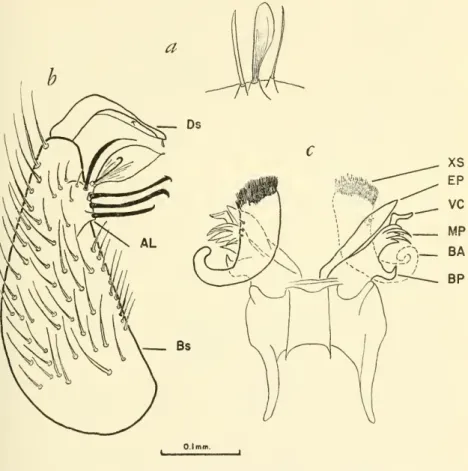
USNM RB62 554
Sincenotype specunenofCulex (Culex) articularis Philippi, 1865 exists (Stoneetal., 1959), aneotypeis hereby designated in accordance with article 75 of the International Code of Zoological Nomenclature (1961) in order to stabilize the nomenclator-. Male terminalia: basal style conical, slightly longer than twice the basal width; clothed with fine setae in addition to normal, long setae pattern.
SUBGENUS CULEX — BRAM 31
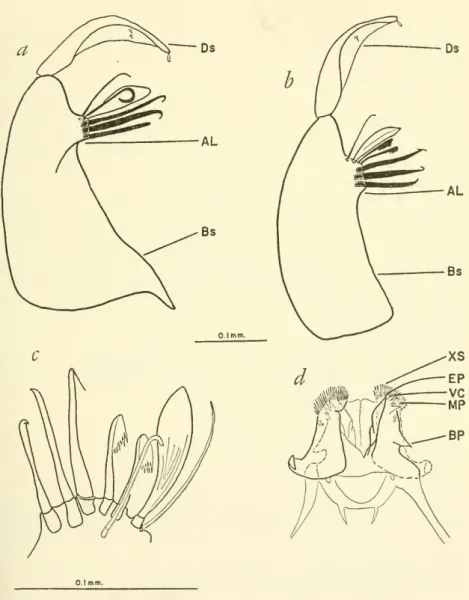
Ventral cornu dentiform, equal in size and shape to the teeth of the median process. Appendages of the apical lobe as follows: three straight, thin bars of subequal length, followed by about 10 straight, narrow setae; nolea is present.

SUBGENUS CULEX — BRAM 41
Culex chidesteri is similar to C nigripalpus in possessing broad, spatulate spines on the lateral margins of the tenth sternite; it is sunshine for Cpens in that it possesses both large, rounded and rugulose. Male terminaha: Basistyle conical, slightly longer than twice the basal width; clothed with fine setae in addition to normal, long setae pattern. External process broad and ciu-ved so as to be directed to a lateral point; not reaching the ventral cornu.
NO- 3557 SUBGENUS CULEX — BRAM 43
Larva: Antenna fusiform, glabrous; antennal bundle short, double, located approximately in the middle of the antenna. Pectene with about 10 long, pointed setae on basal half of siphon; basal teeth with one or two fine teeth. The main distinguishing features were the arrangement of appendages on the parietal lobe of the basistyle. and the length of the apical processes on the basistyle.
SUBGENUS CULEX — BRAM 47
IN THE CULEX CORONATOR COMPLEX
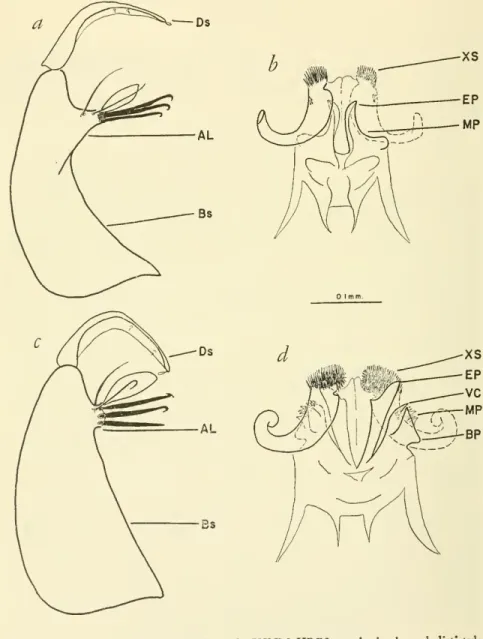
Culex coronator differs from other members of the complex by the arrangement and number of appendages on the apical lobe of the basistyle. Appendages of the apical lobe as follows: two or three unequal, strong rods, which are slightly curved at the apex; a group of five to 13 unequal, slightly curved setae distal to the rods; leaf absent. Siphonal index 8.0 to 9.0; four double siphonal tufts placed on the siphon beyond the pectin; a crown of prominent spines is present at the apex of the siphon.
NO. 3557 SUBGENUS CULEX — BEAM 49
Head lobe appendage as follows: bars absent; agroup of about 10 subequal, gently curved setae evenly distributed on lobe; a small distad tubercle of the apical lobe possessing one or two. Apical lobe of base prominent, divided into a large proximal lobe and a small distal tubercle; also clothed with thin setae. Systematics. - Appendages on the apical lobe of the base distinguish this species from other members of the complex.
52 PROCEEDESTGS OF THE NATIONAL MUSEUM
Apical lobe of the basistyle prominent, divided into a large, proximal lobe and a small distal tubercle; also clothed with fine setae. The ventral cornu, although similar in shape to that of other members of the complex, is considerably longer than. Appendages of the apical lobe as follows: one short, very broad bar and two long prominent hook bars at the end of the apical lobe; several unequal, hooked setae along the rods; leaf absent.
SUBGENUS CULEX — BRAM 55
Pectene with numerous teeth on basal third to two-fifths of siphon; each tooth with two to six. Widespread. – This species appears to be more northerly distributed than its close relative, Culex bidens. Systematics.— The most characteristic feature of Culex diplophyllum is the presence of two separate leaves on the apical lobe.
58 PROCEEDINGS OF THE NATIONAL MUSEUM
Pectine restricted to the basal third of the siphon, followed by four multiple tufts and a single seta before the apex. Basal process sharply pointed distally, sharply bent so that it should be directed posteriorly; reach, atmosphere, to the middle of the median process. Pecten with about 13 teeth on basal third of siphon; each tooth \with coarse barbs on one side.
SUBGENUS CULEX — BRAM 61
Pecten with 11 to 20 teeth on basal fourth of siphon; each tooth with three to four coarse barbs on one side. Appendages of the apical lobe as follows: three subequal hooks: small, bluntly rounded leaf: narrow, slightly curved seta. It is distinguished from Culex diplophyllum by not having annulations on the apical third of the dististyles.
SUBGENUS CULEX — ^BRAM 65
Larva: Antennal tufts located in a constriction near the outer part; . basal three-quarters of antennal shaft sparsely spiculate. Pecten with 10 to 14 teeth on basal third of siphon; most of the teeth with three lateral barbs, the teeth progressively further apart. Apical lobe of the basal style expanded into a thumb-tin projection, ending in a strong, obtuse, obtuse, apical rod and with three to four straight accessory setae;.
SUBGENUS CULEX — BRAM 67
Mentura with about 20 teeth; apical tooth wider and longer than lateral teeth; subbasal lateral teeth longer than other lateral teeth. 3557 SUBGENUS CULEX — BRAM 69 with about 17 teeth; apical tooth distinctly wider and longer with about 17 teeth; apical tooth distinctly wider and longer than lateral teeth. Postclypeal head hairs 4 short, single; Upper and lower hairs of frontal head 5 and 6 long, triple; hairs before antenna 7 long, multiple.
70 PROCEEDINGS OF THE NATIONAL MUSEUM
Male terminalia: Basistyle conical, slightly longer than twice the basal width; covered with fine setae in addition to the normal, long setae pattern. Pect with about seven teeth, confined to basal third of siphon; the apical tooth is considerably separated from the rest of the pecten. Appendages of the apical lobe as follows: basal root strong, straight and bluntly rounded; the central bar is more robust and longer than the basal bar and with a prominent hook at the tip; apical bar longer than median bar and hook;.
SUBGENUS CULEX — BRAM 73
Appendages of the apical lobe as follows: basal rod strong, straight and slightly curved at the apex; Ventral cornu dentiform, very similar in size and shape to the teeth of the median. Appendages of the apical lobe as follows: basal rod strong, slightly curved at the apex; middle rod longer and wider than the basal rod, and terminally strongly hooked;
SUBGENUS CULEX — BRAM
Ventral cornu dentiform, very similar in size and shape to the teeth of the median process. Each observation consists of the number of teeth on one side of the mesosoma only. Although there is a general arrangement of appendages on the apical lobe of the basistyle, this species is easily distinguished from.
82 PROCEEDINGS OF THE NATIONAL MUSEUM
GEOGRAPHICAL VARIATION IN THE NUMBER OF MESOSOMAL TEETH
SUBGENUS CULEX — BRAM 83
Pecten with about 12 teeth on the basal third of the siphon; each tooth with coarse barbs on one side.
SUBGENUS CULEX — BEAM 85
Mentum with about 23 open teeth; apical tooth longer and wider than lateral teeth. Pecten with nine to 15 teeth on basal fourth of siphon; each tooth with two to six thick spines on one side. It differs from other members, however, in the number and conformation of the appendages on the apical lobe of the base and in the structures of the mesosome.
NO- 3557 SUBGENUS CULEX — BRAM 87
88 PROCEEDINGS OF THE NATIONAL MUSEUM vol. 120 . pointed spines; basal leg of moderate length, strongly curved; two. Systematics.— The male terminals show that this is a rather generalized species, but the parietal lobe characters of the basistyle. The appendages of the apical lobe are as follows: basal rod strong, straight and blunt; the median rod is longer and wider than the basal rod and is visibly hooked; apical club longer than mid-club but not as broad, also conspicuously hooked at end; leaf of moderate size, ovate; two additional bristles present, one distinctly hooked at the end, the other as long as the leaf, slightly curved and pointed.
SUBGENUS CULEX — BRAM 89
90 PROCEEDINGS OF THE NATIONAL MUSEUM vol. with about 17 teeth; the apical tooth broader and larger than the lateral teeth; lateral teeth gradually becoming smaller apically. Since taxonomic characters used in this study are strictly morphological, all members of the complex wWl are grouped under the broad designation, C. However, the male terminalia of members of the complex can be easily distinguished from other species of the subgenus by the characteristic number and.
NO. 3557 SUBGENUS CULEX — BRAJVI 91
It is characteristic in the appendages on the apical lobe of the basistyle and in the conformation of structures of themasome. Appendages of the apical lobe as follows: basal rod strong, slightly curved at apex; median and apical bars subequal, broader and longer than the basal bar and prominently hooked distally; leaf. Pecten with 10 to 16 teeth on basal fourth of siphon; each tooth with two to five coarse spines on one side.
NO. 3557 SUBGENUS CULEX — BRAM 97
Male terminalia: Basic style conical, slightly longer than twice the basal width: lined with fine hairs in addition to the normal, long setal pattern. Dististyle thick at base, wider along inner margin to near midline where it narrows abruptly, scimitar-like in unsclerotized area adjacent to ragged edge of sclerotized integument: distal third slender to apex and provided with minute rings along the top. Male terminalia: Basic style conical, slightly longer than twice the basal width; lined with fine hairs in addition to the normal, long setal pattern.

NO. 3557 SUBGENUS CULEX — BRAM 101
102 PROCEEDINGS OF THE NATIONAL MUSEUM
Male termina: basistyle conical, about twice as long as basal width; clothed with fine setae in addition to the normal, long setal pattern. Appendages of apical lobe as follows: basal rod stout, straight and pointed; median bar wider and longer than basal bar and ending in a smooth hook;. Mentum with about 23 teeth; apical tooth wider and longer than lateral teeth; subbasal lateral teeth longer than other lateral teeth.
SUBGENUS CULEX — BRAM 105
Appendages of the apical lobe as follows: basal, median and apical rods unequal in length, very fine, pointed and gently curved terminally; beyond the apical bar are three or four fine, straight and pointed appendages;. Pecten with about 16 teeth on basal fourth of siphon; each tooth with rough spines on one side. Pecten with 10 to 15 teeth on basal third of siphon; each tooth with one to five coarse spines on one side.
108 PROCEEDINGS OF THE NATIONAL MUSEUM
NO- 3557 SUBGENUS CULEX — BRAM 109
NO. 3557 SUBGENUS CULEX — BRAM HI
SUBGENUS CULEX — BRAM 113 CovA Garcia, P
Nine new species of Neotropical Culex, eight from Panama and one from Honduras (Diptera, Culicidae).
NO- 3557 SUBGENUS CULEX — BRAM 115
116 PROCEEDINGS OF THE NATIONAL MUSEUM VOL. 120
SUBGENUS CULEX — BEAM 117 Table 1
118 PROCEEDINGS OF THE NATIONAL MUSEUM
SUBGENUS CULEX — BEAM 119Table 2.—Terminology used to describe structures of the mesosome in Culex Table 2.—Terminology used to describe structures of the mesosome in Culex (Culex) (*=variation of the term in the examined paper.). In the key to species based on the larva, C.Jernandezi wanted the key to the vicinity of the dome 16; however, features of the chaetotaxy, especially the stellate thoracic and abdominal setae, are quite distinctive.
122 PROCEEDINGS OF THE NATIONAL MUSEUM