Vol. XVII, pp. 21-50
March
10, 1904PROCEEDINGS
OFTHE
BIOLOGICAL SOCIETY OF WASHINGTON
A REVISION OF THE NORTH AMERICAN MAINLAND
SPECIES OF MYIARCHUS.
BY
E.W. NELSON.
The
present papercovers all of the speciesand
subspecies of MyiarcJuisknown
to occur on themainland
ofNorth America
north of theIsthmus ofPanama.
In additionI have included the birds ofCozumel
Island nearthe coast of Yucatan, and the Tres Marias Islands off the-coast of Tepic, western Mexico.The
recently accumulated material in this group, especially theMexican
series in the BiologicalSurvey
collection, serves tothrow much
lightupon
the characters, relationshipsand
distribution of several obscurelyknown
species. In addition to the large series of specimens available in the Biological Sur- vey and NationalMuseum
collections,Mr. William
Brewsterand Mr. Outram Bangs have
kindlysentme
materialfrom
their collections that has been of great value in iilling gapsand
enablingme
to reach definite conclusions insome
otherwise ob- scure questions.The genus Myiarchus
appears to reach its greatest develop-ment
in theAmerican
tropics, including theWest
Indies, with a limitednumber
offorms
ranging wellup
into temperateNorth
Amei-ica.These most
northerly representatives of the genus are cinerascenswhich
I'eaches the northern border of theUpper Sonoran
zoneon
the west coast in Oregon,and
crmitus 3—PBGC. Biol. Soc.Wash. Vol. XVII, 1904. (21)22
Nelson — North American
MainlaiidMyiarchiis.which
crosses the Transition zoneof easternAmerica
to south- ernCanada and New
Brunswick.M.
hncrenceiand
its sub- species is themost
widely distributed of theNorth American
species,
with
abreeding range extendingfrom
theIsthmus
ofPanama
to southernArizona and
the Tres Marias IsLands.The
sj^ecies of
most
limited distribution is probablyM.
yucatanen-sis,
found
only on the peninsula ofYucatan and
onCozumel
Island.The North American
species of 3Ii/iarchus appear tohave
butonemoult
a year and this occurs immediately following the breeding season,from August
toSeptember
orperhaps October.The
birds aremuch
darker ormore
richly colored for a short period following the assumption of thenew plumage
than atany
other period. This extreme intensity of coloration quickly passes into a duller conditionwhich
continues with but littlechange through
the winter months. In spring the colors grad- ually fade orbecome
bleachedby
the sun until in the breeding season the original shades of greenish, olive and gray of theback and
theyellow of the under parts are almost lost in thedingy browns and
yellows of the frayed plumage.The
upperparts especially bleach toa
dingy
grayishbrown
so nearly alike in several species that there is but little color difference be-tween summer
specimens, and identification of birds in this conditiondepends
largely on sizeand
tailpattern. This condi- tionbecomes most marked
in species living under the brilliantsun of theLower Sonoran and Arid
Tropical regionsand
ismuch
less noticeable inspecies like crinituswhich
live in regions of greaterhumidity and
cloudiness.The
general resemblance in colorbetween many
of the sub-species
and
evenbetween some
of the specieswould
render a description of faded spring orsummer
birds misleading in the apparent uniformity of coloration, while themost
richly colored conditionthat isfound
immediatelyafter themoult
inlate
summer
orfall is so evanescentthat itcan scarcely stand to represent theaverage characters.For
this reason in the fol-lowing
descriptions I have taken,when
available, theunworn
winter birdswhich
represent the typical colors of the various species f^om, soonafter the fallmoult
until thewear and
fading of the springand summer
begin to destroy the distinctive shadesofcolor. Ihave
designatedthis asthe 'fresh'plumage. InN'elson
— North American
Ifainland3fyiarchus. 23some
specimensthe winter condition of the colors remains until late in spring or early suTiiiner, but ordinarily they aremuch
faded at this season.The
sexes are alike in color, but the fe-males are usually smaller than the males,as
shewn by
the meas- urenients.In
most
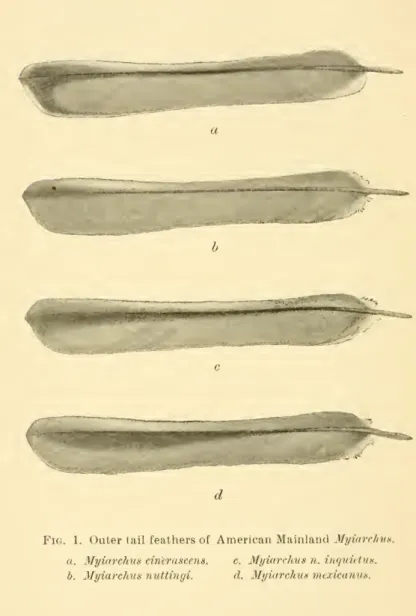
of the ]Miblished descriptions of the rufous-tailed species described in the present paper, little or no range of va- riation in distribution of thedusky
pattern on the tail feathers has been mentioned. This has given the erroneous impression that thesemarkings
are rather constantand
has ledto the iden- tification of female individuals of cinerascensfrom
Arizona as 'nuttingi.By
the examination of severalhundred
specimens of the various species it hasbeen
demonstrated thatthedusky
pat- tern on the innerwebs
of the outer tail feathers (and toa simi- lardegree on the inner tail feathers) of cinerascens, mexicanus,crinittis,
and
nuttingi with their subsijecieshave
awide
range of variation in extent,though
usually preserving a character-istic outline, although attimes this also disappears.
Thus we have
thedusky
area practicallygone
on the innerweb
of the outer tail feather ofsome
of the females of cinerascens, pi^-ducing
a pattern exactly as in nuttingi.One
specimen of otherwise typical cinerascensfrom Guanajuato
has thedusky
line alongthe shaft as in typical inquietus,
and
a specimen of nutti)igifrom Honduras
has thedusky
shaft line of inquietus.M.
crinitusmay
ormay
nothave
adusky
shaftline on innerweb, while inmexicanMS
this line varies greatly in width.The
rufous borderto innerwebs
of tail feathers inyiicatanensis also variesmuch
inwidth and may
ormay
not be present on the outer feather.The
considerableamount
of individual varia- tion thusshown
renders it difficult tomake
akey
that is ser- viceable in identifyingmore
than average specimens ofsome
species.
In the cases of cinerascens
and
nuttingi the differences in dimensions are decisiveand
almost equally diagonosticbetween
thesetwo and
inquietus.The
firstplumage
of theyoung
inall of the species is char- acterizedby
amuch
greateramount
ofrufouson
thewings and
tail than in the adult. This is especially
marked
on thetail, inwhich
the characteristicdusky
pattern of the adult is not ap- parent.The
extension of the rufouson
thetail usually includes24 Nelson
— North American Mainland Myiarchus.
I
m
IIIji—
qwiNwifciww*!a
^'WlIII '
IwM^i—<—i3*w
<z
Fig. 1. Outertailfeathersof American MainlandMyiarchus.
a. Myiarchuscinerascens. c. Myiarchusn. inquietus.
b. Myiarchusnuttingi. d. Myiarchusmexicanus.
Nelson
— North American Mainland Myiardms.
25 both middleand
outer pair of feathersand
effects a generalized pattern.Even
theyoung
ofM.
nigrlcepswhich
is without rufous in the adultplumage
has it stronglymarked
on thewings
and tail of the young.Among
the greatnumber
of winter specimensexamined
I have notfound
a single individual in this tirstplumage, so itappearsthatthe
young
moultthisplumage
within ashort timeand assume
the dress of the adult.It is with
some
hesitation that Iadd
furtherto the discussion concerningthe application of Kaup's Tyraiinula mexicuiiaand
T. cooperi, a matter
which
has already been the subject ofmuch
difference of opinion; but the case appears to be still unsettled,
and my
notesmay
helptoward
its definitedetermination.In theProceedings of the Zoological Society of
London
for 1851, p. 51,Kaup
describedtwo
species of Myiarclius in such a briefand
unsatisfactorymanner
that the application of hisnames
has given rise tomuch
controversy.From
recent study of the matterit appears tome
that Prof. Bairdwas
right in his disposal of thenames
(Birds ofNorth
America, 1858, p.180)
and
that their present useby American
ornithologists iswrong. The
matter cannot be absolutely settled until Kaup's types are examined, but the present evidence in support of Prof. Baird's conclusions are of interest.He
recognizedKaup's
error inapplying Nuttall'sMusicapa
cooperi{^Tyran- nula
cooperiKaup,
asynonym
of Nuttallo^'nis borealis), to aMyiarchus, and
then proceeded tomake
anew
use of thename
(loc. cit.), describingin detail as
Myiarchvn
cooperi aspecimenfrom "Mexico"
(No. 9100U.
S. NationalMuseum).
Baird's type is still in theMuseum
collectionand
is the l)irdfrom
easternMexico and
theRio Grande
Valleycommonly known
toornithologists as
Myiarnhus mexicanus
mexicamis. In case, as I believe, the lattername
belongs elsewhere, then Baird'sname
cooperi
becomes
available for thisspecies. Baird identified
Kaup's Tyrannula mexicana
as Lawrence'sTyrannula
cineras- cens(Ann.
Lye. Nat. Hist. N. Y., V., Sept. 1851, p. 121)and
gave
itpriority over the lattername
on the strength of the dates onwhich
thetwo
paperswere
read;Kaup's
paper having beenreadon February U,
1851and
Lawrence's in September, 1851.According
to Sclater (P. Z. S., 1893, p. 439) the part of the Proceedings of the Zoological Society containingKaujj's26 JVelson
— North American Mainland Myiarchus.
paper
was
not actually published until October 28, 1852, while theAmerican
Journal of Sciencesand
Arts, 2d Series, XIII,No.
38, p. 303 forMaich,
1852, contains a notice ofLawrence's paper, thus giving cinerasceus at least sixmonths
priority.The
reasons for believing thatKaup's
?nexicana is thesame
as cinerascens are as follows: Kauj) states that the type of T.mexicana was
sentfrom Mexico by Mr. Wollweber
butmen-
tionsno
definite locality.Mr. Wollweber
sent various birds to theDarmstadt Museum
in addition to the type of mexicana,among which were
the types ofPltangus
derhiaimaand
Pariis wollweberi both ofwhich were
recordedfrom
Zacatecas. Ihave
seen no other localitymentioned
forany
ofWollweber's
specimensand
it is not unreasonable to suppose the type of tnexicanacame from
thesame
district. Zacatecas lies on the west side of theMexican
tableland remotefrom
the range of the so-calledM. mexicanus
mexicaiius of eastern Mexico, but within the range of cinerascenswhich
iscommon
in parts of this State.Furthermore Kaup,
in hisdescription of T. c(Wj')eri, says,"with
shorterwings
thanmexicanus
but with longer bill like crinita, throatand
over breast light gray,"and
mentions thebroad black stripe along innerweb
of outer tail feathers, all ofwhich
applies to the birdwe now
callmexicanus. In the description ofmexicana
he says, "breast lightash-gray;above
lighter,"which
is certainly applicable to cinerascens. Meas-urements
of a large series of the birdwe now
callmexicanus and
of cinerascensshow
that a considerable percentage of males of cineras'ce7ishave
longerwings
thanmany
of thespecimens of ''mexicanus''''
from
eastern Mexico, while the dif- ferencesbetween
the size of billand
colormentioned by Kaup
are exactly applicable to these
two
birds. It is true thatMr.
Sclater
compared Kaup's
type ofmexicana with
certain speci-mens
in the BritishMuseum and found them
to be similarand
that theywere
thesame
as Baird'sM.
cooperi (fideRidgway,
Proc. Biol. Soc.Wash.,
II, pp. 90-91); but in the Biologia II, p. 91, Salvinand Godman,
apparently with thesame
specimens beforethem which
Sclaterfound
to be similar toKaup's
typeand pronounced
to be thesame
asM.
cooperi Baird,come
to ex- actly the opposite conclusionand pronounce
these specimens to represent cinerascens,and
statethat Baird'sconclusions asgivenabove
regardingthe application ofKaup's names were
correct.JVelson
— North American
Mainldiul Myuirchus. 27The
autliors of the Bioiogia however, in plaee oJ' usingBaird'sname
c()oj)iri unite the ))ii(ls of eastern and westernMexico
underKidgway's
mai/ister,which
is a distinct subspeciesfrom
cooperi and siiould not be confused with either of Kaup'sl)irds.
Tiiecolor terms in this paper are based on
Mr. Kidgway's
'Nomenchiture,'and
allmeasurements
are given in millimeters.1 have again to thank
Mr. Robert Kidgway and
Dr. Chas.W. Richmond,
of the NationalMuseum,
for their continuedcourtesies.
KEY TO SPECIES AND SUBSPECIES.
Bill rounded, with depthatangle of gonys nearly or quite equal to widthat sameplace (subgenusMyuirclmts)
Wing
andtail featherswithoutrufousorcinnainonareaoneitherweb;crownolivebrown; backgreenisholive - jxinameuffisp. 29.
AVing and tailfeatherswith distinctrufous or cinnamon area on one orboth webs
Inner webof outer tail feather visually entirely rufous (except in somespecimensanarrow dusky linealongshaft mainly near tip)
Bill small and proportionately slender (exposed culmen usually
lessthan 19
mm.)
Size small, wing usuallylessthan S6
mm.
- nuttingi p. 37.Size larger, wingusually more than than 93
mm.
(9 'sin part) cinerascens p. 33.Billstoutandproportionallyheavy (exposed culmenusuallymore
than 19mm.) .
Undersideof neck and breast pale ashy gray bruchyurusp. 40.
Undersideof neckand breastdark gray
Exposed culmennotover 20
mm.
- - crinitus p. 29.Exposed culmenover 20
mm.
- - residuui< p. 30.Inner webof outertail feather partly- orwholly dusky-
Inner
web
of outertail featherwhollydusky yucatanensisp. 41, Innerweb
of outertall featherpartly'duskyInner
web
of outer tail feather with well defined dusky band alongshaft, rufous along innerborderto tipBilllongand heavy(usually 20
mm.
or over); dusky band on innerweb
of outer tailfeather usually broadestin mid- dle.Size smaller, wingusuallylessthan105
mm.
mexicanujsp. 31.Sizelarger, wingusuallymorethan 105
mm.
magisterp. 33.Billsmall and slender, exposed culmen usually less than 18
mm.:
dusky band on innerweb
of outer tail feather broadeiiinggradually frombase, widestat tip28
Nelson— North American Mainland
Myiarchtis.Innerwebsof tailfeathersmainlyrufous ingtiietusp. 38.
Inner
web
of tail feathersmainlydusky yucntunensisp. 41.Inner
web
of outer tailfeather usually entirelyrufous on basal two-thirds, with outer third more or less broadly tipped withduskyBill smaller, slenderer; color darker - cinerascens p. 33.
Bill larger, broader; colorpaler - - pertinax\>. ^Q.
Bill flattenedwith depthatangleofgonys decidedlylessthan widthat
same place (subgenus Onychapterus)
Tail feathers usuallydistinctly edged on oneorbothwebswith rufous orcinnamon
Tailfeathersdistinctlyedged on both webs withrufous orcinnamon Crownconspicuously darker than back (blackorblackish)
Crownsootyblack
...
- nigricupillus p. 44.Crownclove brown
....
lawrencei_p. 42.Crown appreciably darker than back(usuallybetweenolive and
sepiabrown)
...
- querulus p. 47.Tail feathers not at all or but slightly edged oninnerwebswith rufous orcinnamon
Back greenishorgreenisholivaceoiis
Backgreenish, crown intensely black - bangsi p. 45.
Backgreenish olivaceous, crownbistrebrown
platyrhynclius p. 45.
Backgrayish olivaceousorhairbrown
Back grayish olivaceous; inner webs of tail feathers usually not edged with rufous - - oUrascemp. 48.
Backhairbrown; inner webs of tail feathers usually slightly edged withrufous - - - tresmaricep. 49.
Tail feathers notedged oneitherwebwith rufous; no rufous edgings onwings; crowndullblack - - - nigricepsp. 49.
DESCRIPTIONS OF SPECIES AND SUBSPECIES.
Genus
Myiarchus
Cabanis.1845. MyiarcJms Cabanis, in Tschudi, Fauna Peruana, Aves, 1845, p.
152.
Type
MuscicapaferaxGmelin.Typical Myiarchus ischaracterizedby aroundedand proportionately deepbill; thedepthatangleof thegonys nearly or quite equaling its width at the same place. It includes the majority of the species in thispaper, viz., M.ferox panainensis, M. crinitus, M. c. residims, M.mex- icanus, M. m.magister, M. cinerascens. M. c.-pertinax, M, nuttingi, M. n.
inquietus,M. brachyurus, andM. yucatanensis.
Nelson
—
Ni»'t/i AintricauMainhoid
M(jhirchus. 29Myiarchus
ferox panamensis (Lawrence).PANAMA
FLYCATCHER.1800. Myiarr.hus panamindii Lawrence, Ann. Lye. Nat. Hist. N. Y.
VII,p. 284. May, 18G0.
Type locality.
—
Lion Hill, Panama. Type in AmericanMuseum
of Natural History (Lawrencecollection).Breedingrange.
— From
nearly or quitetothe southern borderofCosta Rica (specimens examined from David, Chiriqui) throughPanama
(including-San Miguel Island) intonorthernColumbia at least to Santa Marta. Not migratory.
Zonaldintributiun.
— Humid
Tropical.Subuperific character^.
—
hsLVger than ferox; upper parts paler, more greenisholive.•Deiscriptionoffreshplumage.
—
Crownolive,usually alittledarker than back butoften thesame color: back greenish olive; upper tail coverts vary fromhairbrown tobroccoli brown; tail coverts and outer webs of tail feathersedged with drabor Isabella color; outer
web
of outer tail feather hairbrownordrab, distinctly palerthan inner web: i-estof tail feathers plain dusky, slightly paler at tip; wing coverts, edges of secondaries and tertials hair brown (palest on tertials) andcommonly
tingedwithslightshadeof greenish; chin, throat and breast, ash gray;
abdomen
and undertailcoverts sulphur yellow.Meaxurement-f.
—
Averages of seven adult males fromPanama
and Chiriqui; Wing, 93.1 (87-9(3); tail, 90.3 (85-93); culmen, 19.1 (18-20);tarsus, 23.4 (22.5-24.5).
Averages of five adult females from
Panama
and Chiriqui: Wing, 91 (89-93); tail, 89 (87-91); culmen, 19.4 (18-21); tarsus,23.7(23-24.5)..GeneralNoten.
— My
iareJiusferoxwasdescribed from Cayenne, Guiana, and thefew specimensathand fromthatandadjacentsectionsofSouth Americaappeartoshowthatitissmallerwithasmallerbill than pana- mensis, and theupper parts browner and less greenish. liirds from Chiriquiaveragealittlelargerthan thosefrom Panama.The
series in theBangsCollectionfrom San Miguel Island, Panama,are not distin- guishable frommainland birdsinthesameconditionofplumage. Like M. «tVy«cc;wthe present species is South American andonly enters the area included within thelimits of this paperat the northern extremity ofitsrange. Ithas no nearrelative inNorthAmerica.Myiarchus
crinitus(Linnieus).GREAT CRESTED FLYCATCHER.
1766. MuscicapacrinitaLinnaeus, Syst. Nat., I, 12thed., p.325. Based on the Muscicapa cristata, ventre luteo of Catesby, Car. I, p. 52, t. 52.
Typelocality.—Csiteshysays "ItbreedsinCarolinaandVirginia" and
30 Nelson
— North American Mainland
MyiarcJms.gives no more definite type locality; but as in tlie caseof most of Catesby's speciestiieCarolina birdsprobablyserved for his description.
Breeding range.
—
Throughout eastern North America fromNew
Brunswick and Manitoba south to northern Florida and to Bexar County, Texas.
Migratesthrougheastern andsouthernMexicoandCentralAmericato
Panama
andtheSanta MartaMountains in Colombia.Zonaldifttrihution.
—
Upper andlower AustralandTran.sition(inbreed- ingseason).Specific characters.
—
Size large; under side of neck and breast rather darkolive-gray; backdistinctly (/reems/t olive; innerweb
of outer tail feathermainlyorentirely rufous.Description offres/i plumage.
— Top
of head olive with a brownish shade;back greenisholive;upper tailcoverts hairbrownmargined with tawny-ochraceous; wing coverts pale grayish drab, sometimes tinged withgreenish yellow; tertialsedged withdullgrayish white, sometimes tinged with greenish yellow: basal part of outer web of all butouter primary edged with deepcinnamon rufous; outer webs of tail feathers thinlymargined onbasalhalfwith tawnyochraceous; innerwebsoftail feathers, except middlepair, mainlyor entirelybright cinnamon-rufous (almost orange-rufous) with a more or less distinctbut narrowlineofduskyalongshaftin themajorityofspecimens; chin, throatandbreast olivegray; abdomenand undertailcoverts clear brightyellow
—
betweennaplesyellowandsulphur yellowofRidgway.
Description of young in first phmiage.
—
Crown dull olivaceous-sepia brown; back dingygreenisholive; uppertailcoverts hairbrownbroadly borderedandtippedwith russet-cinnamon; tailas in adultbut withinner webs of middle pair of tail feathers mainly cinnamon-rufous; wing covertslight buffycinnamon; primariesandsecondariesnarrowlyedged with cinnamon-rufous; tertials bordered with dull yellowish white, slightlytinged with buffycinnamon; chin, throat and breast french gray; abdomenandundertailcovertsprimroseyellow.Myiarchus
crinitus residuus Howe.FLORIDA GEEAT CRESTED FLYCATCHER.
1901. Myiarchus crinitus residuus Howe, Cont. N.
Am.
Orn., I, p. 30.May
21, 1902.Type locality.
—
Ishtopoga Lake, Florida.Type
No. 1233, adult male, Howe-Shattuck Collection.Breedingrange.
—
PeninsularpartofFlorida. Probablynot migratory.Zonaldistribution.
—
Lower Austral.Subspecific characters.
— Wing
averages a little shorter andbillmuch
largerthan inM. crinitus.
N^elson
—
A^ort/t A))U'Hcan M(ti)il(i)id]\lyiarvlins. 31 COMPARATIVE AVERAGE MEASUREMENTS OF MYIARCHUS CRINITUS ANDM.CRINITUS RESIDUUS.
Name
32 JV^elson
— North American Mainland
Myiarchus.Mexicoh\Mr. "Wolhveber but nodeflnite localitymentioned.
Breedingrnnc,e,
— From
theRioGrandeValley insouthern Texas, south along thetropical andsubtropical partsof eas'ern Mexico to Yucatan, Cozumel Island, Belize, northeasternGuatemala, and Honduras(Ceiba).Migratory onlyinnorthernpartofitsran^e.
Zonaldistribution
—
LowerSonoran, Arid andHumid
Tropical.Specific characters.
—
Crownolive;back brownisholive; wings and tail (onboth websl strongly margined withrufous.De.-icription offrexh plumnge.
—
Topofheadolivewithagreenish shade, feathers indistinctly streaked withdarkercenters; backdullbrownish olive, slightlygrayerthan crown; backofneckslightlygrayerthanback, forming an indistinct collar;uppertailcovertsdingyraw-umberbrown, sometimes edged with dull rusty; wingcoverts broadlyedged with dull brownishwhite:terlialsedged withwhite, tingedwithpalegreenish; pri- maries, exceptfirst,edged alongmiddle with dark rufous; chin, throat andbreast ashygray, palestonchin; abdomen and und^r tail coverts deep primrose yellow sometimesslightlywashedwith gray(especially inYucatanandCozumelspecimens):outerwebof outer tail feather'vary- ing from plain drab to lightermoregrayish brown: inner
web
ofout^r featherwithabandofdusky alongshaftfrom near base to tip, Usually a littlebroader in middlewhere itoccupies from one-fifth to 'over one- half the width of web;- other tail feathers, except •middle pair, similar, butdusky banddecreasingtoward middleoftail.-'
Measurements.
—
Avera'ges ofseventeen adult males from northeastern Mexico: Wing, 102.4(98-106)rtail, 95.4 (90-98); culmen, 21.3 (20-23V; tar-sus, 23.5 (22.5-25;. '
' ,.
Averagesof fiveadultfemales from northeastern Mexico: Wing, 95.7
(94-98); tail, 90(88-91);culmen, 19.9 (19^21.5); tarsus, 22.'4 (21-23).
GeneralNotes.
—
Inwornorfaded plumagemuch
ofthe greenishAvaiah on upperparts is lost and ^the coloration'fclosely resemWes that ofmagister. Specimensfrom the StateofVera Cruz average larger thah those from the Rio Grande while thbse from Yucatan and Cozumel Island aresmaller than from any other part of their range, Cozumel birds are also slightly darker thanthose fromelsewhere. This form reaches thebordersof,the tableland alongrivervalleysbutdoes not in- habit the tableland proper. Its range comes in contactwiththat of magister only throughthelowgapinthe elevated continental areaatthe Isthmus of Tehuantepec.
A
large proportion of specimens have the dusky line along shaft on innerweb
of outer tail feather appreciably broadest inthemiddleandnarrowing toward each end, butin some in- dividuals it is nearly the same -nMdth most of'
its length-andinafew casesbecomes alittlebroader nearthe tip. :
A
typical specimen in the Bangs Collection taken by Mr.W. W.
Brown, January 16, 1902, atCeiba,Honduras, isthesouthernmostrecord of thisspecieswith which I
am
familiar.' This w^as perhaps a winter straggler.Nelson — North American Mainland Myiarchus.
33Myiarchus mexfcanus
magi^ter Ridgway.ARIZONACRESTED FLYCATCHER.
1884. Myidrchus mexicanus magisterRidgway, Proc. Biol.Soc. Wash.,
II, p. 90.
Type locality.
— Camp
Lowell, near Tucson, Arizona. Type No.86,005, adult male, U.S. National Museum.
Brccdi/if/ range.
— From
northwesternChihuahuaand southern Arizona through western Mexicoat least to the border of Chiapas.A
partial winter migration of northern birds extends as far as Guatemala, but theyare residentthroughouta large partof theirrange.Zonaldutribiition.
—
LowerSonoranand AridTropical.Snb.specificcharacters.
—
Generallysimilartoandinsome casesdifficult to distingviishincolorationfrompale orfaded specimensoftrue mexicanus, but upper parts averaging grayer and less greenish; throat andbreast slightly paler ashy, andabdomen
a trifleclearerorbrighter yellow; size averages decidelvlarger.Descriptionoffirst plumage.
—
Crown light sealbrown; back darkhair brown; uppertailcoverts, broad bordertoouter webs and most of the inner webs of tail feathers dull, dark cinnamon rufous; lesser wing coverts tipped andtertialsedged with palevinaceous-bvitf; greaterwingcovert's, secondariesandprimariesbroadlyedged withdullrusty rufous, palerthanonborders oftailfeathers; chiri, throat and' breast pearlgray becomingdarkestonbreast; abdomen and vmdertail coverts paleprim- roseyellow.
Measvrements.
—
Averages of twenty-three adult males: Wing, 108.9(103-114); tail, 100.3 (93-106); culmen, 23.2(22-25); tarsus, 25.4 (24.5-26).
Averages of fifteen adult females: Wing, 106.7 (100-110); tail, 98.1 (9'4-I02);cuimen, 23 (22-25);'tarsus, 25.1 (24-26).
General Notes,—Su,eisthe only character by which magister can be distifig^iished in a great majority of cases. . Specimens from thetype
reg.ioflinsouthernArizopa-^-re considerably larger than thosefrom the moresoutherly partof theirrange. Am.on^theseriesfrom varioussec-
tions of the range, the one from theTresMariasIsland^averagesthe smalTes'tthusparalleling therelativelysmallersizeoftheseriesof typi- cal me.r.icunushova Cozumellsland,offthe coastof
^Y^catan.
The
typesof"both "cooperiyandmagister, are largerthan averagebir(|.sof theforms theyrepresent.
Myiarchus
cinerascens(Lawrence).ASH-THROATED FLYCATCHER.
1851. Tyrannula cinerascens Lawrence, Ann. Lye. Nat. Hist.N. Y., V, p. 121. September, 1851.
Tyjyelocality.
—
Western Texas.Breedingrange.
— From
the Dalles,Oregon, Cheyenne, Wyoming, and34 N'elson
—
JVorthAmerican Mainland
3Iyiarchus.central southern Texas south to northern Lower California, central Sonora andat least toZacatecas on the southern part of the Mexican tableland.
ir7«^'v/YOi^e.
—
MigratesoverallofLowerCalifornia and the rest of Mexico (except the southeastern tropical parts) at least to Guate- mala.Zonaldistribution.
—
L^pperandlower Sonoran.Specific clinracters.
—
Upperpartsgrayishbrown: crown a littledarker thanback; innerwebsoftail feathers mainlyrufousbuttipped moreor lessbroadly withduskyonouterfeather.Description offresh phimage.
— Top
of head grayish bistre brown, iisually alittle darkerthanback;back darkhairbrown, becomingpaler andgrayer inworn plumage; backofnecksometimespaleror moreashy than back; uppertailcovertsdark hairbrown, sometimes edged slightly with rawumber
or russet (never in worn specimens); wing coverts and tertials broadly, and secondaries narrowly edged with grayish white; primaries (except first) edged with rufous; primaries, secondaries, tertials andtop of tail feathersclove brown, palestonter- tials; underparts from chin over breastandwash over fore-part of ab-domen
pale cinereous gray, becoming whitish in fadedplumage; abdo-men
and undertailcoverts primrose yellow(becomingwhitishinfaded plumage);basal half or three-fourthsof outerweb
of outer tail feather distinctly whitish, latter color replaced on distal end by dusky line borderingshaft andwidening toward endoffeatherin proportionto ex- tent of same color on innerweb
of feather; innerweb
ofouter feather cinnamonrufous frombasetomiddleoffeather,the rufous replaced along shaftatvaryingdistancesbeyond thistowithinone-fifthoflength from tipbyduskylinegraduallybroadeningtoincludeentire tipand sometimes extending back as narrow border some distance along inner side of feather; extent of dusky tip varies from narrow borderto halfaninch or more; tips of other tail feathers except middle pair with similar patternbutamountofduskydecreasinginward.Female.
—
Duskyoninnerweb
ofoutertail feather not rarelyrestricted tonarrowwedge shaped line along shaft on terminal part of feathermuch
as in M.nuttingi;but such birds are readily distinguishable by theirmuch
greater size.Young infirst plumage(Pecos River, northwest of Comstock, Tex., August 1, 1902).
— Top
ofhead dull rustybrown; back dull hair brown;uppertailcovertsandtailmainlylightcinnamonrufous, includingmiddle pairoffeathers; outer
web
ofouter featherpaler,excepttip;narrowdusky shaftlinesondistalthirdofall tailfeathersand broaddusky band along basal two-thirdsofshaftexcept on middle pair; vinderparts pale ashy whitishtobreast: abdomenand undertailcoverts yellowish white.Measurements.
—
Averages of ten adult males from western Texas:Wing, 101.5 (99-103); tail, 95.2 (93-98); culmen, 18.9 (17.5-20); tarsus, 23.7(23-24).
Averagesoftenadult femalesfrom western Texas: Wing, 94.7(91-98);
tail, 87.9(82-93); culmen, 17.9 (16.5-19); tarsus, 22.7 (21-24).
Kelson
—
JS^orthAmerican Mainland
3IyiarcJnis. 35 GeneralNotes.—In"The Auk"
forOctober, 1892,p. 394, wasrecorded thesupposed occurrencein Arizona of Mi/iarehiis ni/ttiiigi based upon three specimcMis, all femalos. in the biological Survey collection—
onefrom Rillito Creek, near Tucson, one from Oracle, and another from Prescott. After a detailed study of the large series ofMyiarchitucine- i-iiKCcnsand its near relatives in the Biological Survey and National
Museum
collections, ithasbecomeevident thatall the supposed speci-mens of Jf. nuttingi from the UnitedStates arereallyfemalesof cine- I'dscens.
The
errorinidentificationarose fromthe previouslyunknown
factthataconsiderable percentageofthefemalesofcinera.v:en/ihavethe dusky area restricted at the tips of the inner webs of the outertail feathers, sometimes being almostentirelyabsent and thus producingthe exacttailpatternof nuttingi.
Myiarchiis nuttingi is a
much
smaller speciesthanc««€rrt«c£'«sand isrepresentedintheNational
Museum
collection bythe type only. There aretwospecimensin the BiologicalSurveycollection,one from Nenton, Guatemala, and one from Ocozucuautla, Chiapas, thelatterprobablythe mostnortherly actual record forthespecies.The
broadarea lying be- tween the breeding range of M. cinerascensand thatof 31. nuttingiis occupiedasshownbelow by 31. nuttingi inquietus (Salvinand Godman).I have carefully measured a series of J/, cinerancens from the type region inwestern Texas, another from southern Arizona, another from northern California and Oregon, and still another of winter migrants from southernMexico andnorthernGuatemala and the averages show
closeuniformityinsizethroughoutitsrange.
The
size,when
compari- son ismade
between specimens of the same sex, issomuch
greaterin cinerascens that the speciesmay
beatoncedistinguishedfromnuttingibythischaracteralone.
The
identification of specimens of cinerascens as tiuttingi \\&sduQto the almost precise similarity of the patterns of color on the outer tailfeathersbetweenthesespecimens and the type of nuttingi.On
ex- amination of the series of cinerascens at hand I find thatamong
113 males there isnot a single specimen that lacks adefinitedusky tip to tlie outer tail feather, although sometimes reduced toanarrowdusky border.On
the other liandamong
60specimensof females, 15 of them showed a marked reduction of the dusky at tip of innerweb
ofouter tail feather and a corresponding extension of the rufous. Several of these, in additionto tlae three specimens cited from Arizona, have the dusky so reduced on this feather thattherufous covers practicallyall of the innerweb
to the tip as in nuttingi. These were taken on the Santa Cruz River west ofthePatagonia Mountains,Arizona, atOwens
lake, Inyo County, andMountainSpring, San Diego County, California, Alpine,
mouth
ofNuecesRiverandBoquillas, Texas. Others with the duskymuch
reduced and forming merely a slender wedge-shaped line next thevane onthe terminal partofthe featherwere taken at Baird.California, Santa Cruz River, Arizona, and a winter specimen at Mazatlan, Sinaloa,Mexico. Everygradationisshowninthis series be- tween the pattern on the outer tailfeather of typical cinerascensand
36 JVelson
— Korth American Mainland Myiarchus.
71uttingihut they areall females, typically cinerascensin s\zeandgeneral coloration, and occursporadically practicallythroughout the range of thespecies.
From
thefrequencyof this variationofthefemalesitap- pears that thereisatendency towardthe extensionof the rufous at the expense of the dusky tip of the outer tail featheramong
them whichis not sharedequally by the males. While this variation appears to have no geographicalsignificance, yet itevidently, judging from the specimens examined, occursmostfrequently insouthern Arizona. All ofthe 105 males examined have the tip of the outer tail feathersuf- ficiently typicaltoenableonetoidentifythembythischaracterwithout trouble, although there is considerable variation in the extentofthe dusky onthetip. In some cases the feather is entirely rufous onthe inner
web
towithinone-fifth ofitslengthfrom thetip, wherethedusky beginsnext thevaneand broadensrapidly intoanarrowbandoccupying thetip ofthe featherand sometimes extendingdown
a little along the inner border. Inother eases thedusky beginsatvaryingdistances along the shaft to within one-third of its length from the baseand extends outward in a gradually widening line to occupy the terminal5 to 15 millimeters of the feather andmay
ormay
notextendback along the inneredgeofthe feathersometimesnearlyorquitehalfwayto the base.When
the dusky extends back along the inneredgeofthe feather the outer end of the rufous on this vane forms anarrowingpointon the middleoftheweb. Inotherspecimensitis cut squarely off bythein- wardextensionofthedusky neartheendofthefeather. Thisvariationoccvirsthroughouttherangeofthespecies.
Myiarchus nuttingi inquietus(Salvinand
Godman)
replaces M. cineras- cens to thesouthin Mexico, andthemftteria'l 'aihisifid appears to show thattheyare distinct species....>.::;q ''
Myiarchiistinerascens pertinax(Baird).
"
•> N!r
CAPE ST.LUCAS FLYCATCHER.
'J.J i-"U
1859. Myiarchuspertinax Baird, Proc. Acad. Nat. Sci. .Phila., 1859, p.
303. !s
V
: -i'^i-i . 'rM- tt.!.-:;?'! '':.Typelocality.
—
Cape St. Lucas, '^oWer Cfflllfbrhia. T^ypeNo. 12,944, U. S. NationalMuseum.Breedingrange.
—
Cape regidVi of'Lower Calfornia north at least to Pichilinque Bay. ^N6'^'nlYgratofy..'"' " ''
Zonaldistribution.
—
AridI'ropical andborderofLower'Sonoran. , ,,Suhspecific characters.
—
Simi'ikr to cinerascens "but grayer, above' and morewhitishbelow; sii;esmaller; billlarger. ,Descriptvdn of firWplumage.
—
Crownwarm
sepia brown; back hair brown; up^er Wil' Coverts'dull cinnamon rufous; middle pair of tail, . if.
feathers strongly margined with same;outerwebsof rest oftailfeatliers exceptouter onB^similariytflal'gined; xmV€v w"eb ofoiilerfejtthe'rwfiilisn
Nelson
— XoHh American Mainland My
iarchus. 37 onbasal halfand becomingdrabondistal third; innerwebs of all but middlepairplain cinnamonrufousexceptfora slenderdusky linealong shaftsneartips; wing-coverts lipped withwhitish and narrowly edged withdull cinnamon; terlials edged with whitish; secondaries broadly edged withcinnamon shading into broad edgings of light cinnamon rufousonprimaries; chin,throatand breast pale pearl gray.;abdomen
and under tailcovertswhite withthe faintesttingeofyellowish.MeamremenU.
—
Averages of three adult males; wing, 94,0; tail, 89.3;culmen, 19.6; tarsus,23.3.
GeneralNotes.
—
Thereissome difficulty indistingtiishingspecimensof pertinaxfrom faded onesof cinerascens,butthe largerbillotpertinaxanditssmallersizeare usuallysufficiently markedto distinguishthem. In fairlyfreshplumagepertiihaxisdistinctlygrayer ontheupperparts.
The
exactlimitsbetweenthe rangesofthetwoforms is still undetermined.
Myiarchus
nuttingiRidgway.nutting's flycatchek.
1882. Myiarchus nuttingi Ridgway, Proc.U. S. NationalMuseum, V, p. 394.
Type locality.—Ld, Palma, Costa Rica. Type No. 87,391, U. S.
National Museum.
Breedingrange.
—
Costa Rica (La Palma): Honduras (on Nicaraguan boundary 180milesfrom PacificCoast); Guatemala (Nenton); Mexico (Ocozucuautla, Chiapas). Notmigratory.Zonaldistribution.
—
AridandSemi-Arid Tropical.Specific characters.
—
Sizesmall, wingnotover 88mm.
;backratherlight olivaceousbrown;inner
web
ofoutertailfeather usually almost wholly rufous.Description offreshplumage.
—
Crown olive brownwithslightlydarker shaftlines,andbordersoffeatherswithashadeof bistre brown; back varying from slightly grayish to yellowish olive, usually with less greenish than in brachyurus; upper tail coverts darkbroccolibrown shadedandslightly edged with dark raw umber; wing covertsandter- tials broadly edged with dingy brownish white, palest on tertials;primariesedged with cTarkrusty; outer
web
ofouter tail feather light drab; innerweb
usually plain rufousexcepta fine line of dusky along shaftneartip, but sometimes withduskyline along shaftmuch
as in inquietus,-cYixn,neckand breast dull gray, palest on throat;abdomen
andundertailcoverts betweenprimrose and sulphur yellow. Upper- partsofwornspecimens, likethe type, are dull grayish,olivebrown.Measurements.
—
Averagesoftwo adultmales: Wing,86.5(85-88);tail, 84 (81-87);culmen, 17.2 (17-17.5); tarsus, 22 (21-23).Adult female(onespecimen): Wing,,85;tail, 84;culmen, 17;tarsus, 22.
General notes.
—
This species has a close general resemblance to38 JVelson
— North Americmi Mainland
Myiarchns.hrachyuriisandapparentlyoccupiesaboutthesamerange, forbothhave been taken along thePacificcoast region from Costa Rica to Chiapas, Mexico. Itssmallersize, lessgreenish upperparts and slightly darker underpartsarethemaincharacters.
The
small billof nuttingi at once distinguishes itamong
the specimens of bracJiyiirus at hand. In the original description of mittingi the specimens cited as belongingto that species, with the exception ofthetype, allproved tobelong toan- other species whichMr. Ridgway afterwards described as bracliyvms, thus leaving the type the unique representative of nvttivgi in the NationalMuseum
collection untiltwoothers were secured by Mr. Gold-man
and myself in Chiapas and Guatemala. Through the lack ofdefiniteknowledgeof justwhat nuttingirepresented, quitea
number
of erroneouscitations of thisspecieshave been made, and itsrange unwar- rantablyextendedfarbeyond itsreal limits. Attention iscalled tothis inthe notesupon M. ciner<tscens.A
specimen in the Bangscollection, taken ontheboundaryline be- tweenNicaragua and Honduras, 180miles fromthePacific coast, differsfromtypical birdsinhavinga wellmarked duskylinealong the shafton the inner
web
ofouter tail feather, andlessconspicuouslythesameon othertailfeathers, as intypicalinqidetns.The
sizeand color,however, show that this is nuttingi, and these tail markings merely duetoin- dividual variation.Myiarchus
nuttingiinquietus (Salvin and Godman).godman'sflycatcher.
1889. Myiarchus inquietus Salvin and Godman, Biol. Cent.-Am., II, p. 88. March, 1889.
Type locality.
—
Acahuizotla*, Guerrero, Mexico. Type in BritishMuseum.
Breedingrange.
—
Arid tropical and subtropical partsof southwestern Mexicofrom centralwesternChihuahuaand southern SonoratoIsthmus ofTehuantepec andinlandto southern Puebla.No
definite migration, butstraysinwinterto Guatemala.Specimens examined from: Sonora (Nacosari, Alamos); Chihuahua
(Batopilas,Hacienda SanRafael, ElCarmen,Durasno);Sinaloa(Culiacan):
Durango,(Chacala);Tepic(Acaponeta);Zacatecas(San JuanCapistrano);
Jalisco(LaBarca);Michoacan(LaSalada,Zamora);Morelos.(Yecapixtla); Puebla (Tehuacan); Guerrero (Acahuizotla, Dos Arroyos, El Rincon, Acapulo, Papayo, El Naranjo, La Lagunilla, Rio Balsas): Oaxaca (Huilotepec, Tehuantepec City, Santa <