15.1 Introduction
The main purpose of this chapter is to explain how to determine the initial carrying value of PPE and to explain and account for the normal movements in PPE that occur during an accounting period.
CHAPTER 15
Property, plant and equipment (PPE)
Objectives
By the end of this chapter, you should be able to:
● explain the meaning of PPE and determine its initial carrying value;
● account for subsequent expenditure on PPE that has already been recognised;
● explain the meaning of depreciation and compute the depreciation charge for a period;
● account for PPE measured under the revaluation model;
● explain the meaning of impairment;
● compute and account for an impairment loss;
● explain the criteria that must be satisfied before an asset is classified as held for sale and account for such assets;
● explain the accounting treatment of government grants for the purchase of PPE;
● identify an investment property and explain the alternative accounting treatment of such properties;
● explain the impact of alternative methods of accounting for PPE on key accounting ratios.
15.2 PPE – concepts and the relevant IASs and IFRSs
For PPE the accounting treatment is based on the accruals or matching concepts, under which expenditure is capitalised until it is charged as depreciation against revenue in the periods in which benefit is gained from its use. Thus, if an item is purchased that has an economic life of two years, so that it will be used over two accounting periods to help earn profit for the entity, then the cost of that asset should be apportioned in some way between the two accounting periods.
However, this does not take into account the problems surrounding PPE accounting and depreciation, which have so far given rise to six relevant international accounting standards.
We will consider these problems in this chapter and cover the following:
IAS 16 and IAS 23:
● What is PPE (IAS 16)?
● How is the cost of PPE determined (IAS 16 and IAS 23)?
● How is depreciation of PPE computed (IAS 16)?
● What are the regulations regarding carrying PPE at revalued amounts (IAS 16)?
Other relevant international accounting standards and pronouncements:
● How should grants receivable towards the purchase of PPE be dealt with (IAS 20)?
● Are there ever circumstances in which PPE should not be depreciated (IAS 40)?
● What is impairment and how does this affect the carrying value of PPE (IAS 36)?
● What are the key changes made by the IASB concerning the disposal of non-current assets (IFRS 5)?
15.3 What is PPE?
IAS 16 Property,Plant and Equipment1defines PPE as tangible assets that are:
(a) held by an entity for use in the production or supply of goods and services, for rental to others, or for administrative purposes; and
(b) expected to be used during more than one period.
It is clear from the definition that PPE will normally be included in the non-current assets section of the statement of financial position.
15.3.1 Problems that may arise
Problems may arise in relation to the interpretation of the definition and in relation to the application of the materiality concept.
The definitions give rise to some areas of practical difficulty. For example, an asset that has previously been held for use in the production or supply of goods or services but is now going to be sold should, under the provisions of IFRS 5, be classified separately on the statement of financial position as an asset ‘held for sale’.
Differing accounting treatments arise if there are different assessments of materiality. This may result in the same expenditure being reported as an asset in the statement of financial position of one company and as an expense in the statement of comprehensive income of another company. In the accounts of a self-employed carpenter, a kit of hand tools that, with careful maintenance, will last many years will, quite rightly, be shown as PPE. Similar assets used by the maintenance department in a large factory will, in all probability, be treated as
‘loose tools’ and written off as acquired.
Many entities have de minimispolicies, whereby only items exceeding a certain value are treated as PPE; items below the cut-off amount will be expensed through the statement of comprehensive income.
For example, the MAN 2003 Annual Report stated in its accounting policies:
Tangible assets are depreciated according to the straight-line method over their estimated useful lives. Low-value items (defined as assets at cost of a410 or less) are fully written off in the year of purchase.
15.4 How is the cost of PPE determined?
15.4.1 Components of cost2
According to IAS 16, the cost of an item of PPE comprises its purchase price, including import duties and non-refundable purchase taxes, plus any directly attributable costs of bringing the asset to working condition for its intended use. Examples of such directly attributable costs include:
(a) the costs of site preparation;
(b) initial delivery and handling costs;
(c) installation costs;
(d) professional fees such as for architects and engineers;
(e) the estimated cost of dismantling and removing the asset and restoring the site, to the extent that it is recognised as a provision under IAS 37 Provisions,Contingent Liabilities and Contingent Assets.
Administration and other general overhead costs are not a component of the cost of PPE unless they can be directly attributed to the acquisition of the asset or bringing it to its work- ing condition. Similarly, start up and similar pre-production costs do not form part of the cost of an asset unless they are necessary to bring the asset to its working condition.
15.4.2 Self-constructed assets3
The cost of a self-constructed asset is determined using the same principles as for an acquired asset. If the asset is made available for sale by the entity in the normal course of business then the cost of the asset is usually the same as the cost of producing the asset for sale. This cost would usually be determined under the principles set out in IAS 2 Inventories.
The normal profit that an enterprise would make if selling the self-constructed asset would not be recognised in ‘cost’ if the asset were retained within the entity. Following similar principles, where one group company constructs an asset that is used as PPE by another group company, any profit on sale is eliminated in determining the initial carrying value of the asset in the consolidated accounts (this will also clearly affect the calculation of depreciation).
If an item of PPE is exchanged in whole or in part for a dissimilar item of PPE then the cost of such an item is the fair value of the asset received. This is equivalent to the fair value of the asset given up, adjusted for any cash or cash equivalents transferred or received.
15.4.3 Capitalisation of borrowing costs
Where an asset takes a substantial period of time to get ready for its intended use or sale then the entity may incur significant borrowing costs in the preparation period. Under the accruals basis of accounting there is an argument that such costs should be included as a directly attributable cost of construction. IAS 23 Borrowing Costswas issued to deal with this issue.
IAS 23 states that borrowing costs that are directly attributable to the acquisition, con- struction or production of a ‘qualifying asset’ should be included in the cost of that asset.4 A ‘qualifying asset’ is one that necessarily takes a substantial period of time to get ready for its intended use or sale.
Borrowing costs that would have been avoided if the expenditure on the qualifying asset had not been undertaken are eligible for capitalisation under IAS 23. Where the funds are borrowed specifically for the purpose of obtaining a qualifying asset then the borrowing costs that are eligible for capitalisation are those incurred on the borrowing during the period less any investment income on the temporary investment of those borrowings. Where the funds are borrowed generally and used for the purpose of obtaining a qualifying asset then the entity should use a capitalisation rate to determine the borrowing costs that may be capitalised. This rate should be the weighted average of the borrowing costs applicable to the entity, other than borrowings made specifically for the purpose of obtaining a qualifying asset. Capitalisation should commence when:
● expenditures for the asset are being incurred;
● borrowing costs are being incurred;
● activities that are necessary to prepare the asset for its intended use or sale are in progress.
When substantially all the activities necessary to prepare the qualifying asset for its intended use or sale are complete then capitalisation should cease.
One of the key future priorities of the IASB is to converge IFRFS with GAAP in the USA.
The equivalent US statement, SFAS 34, also requires capitalisation in relevant cases.
Borrowing costs treatment in the UK
The UK standard that deals with this issue is FRS 15 Tangible Fixed Assets. FRS 15 makes the capitalisation of borrowing costs optional, rather than compulsory. FRS 15 requires that the policy be applied consistently however. This used to be the treatment under IAS 23 before that standard was revised in 2007.
15.4.4 Subsequent expenditure
Subsequent expenditure relating to an item of PPE that has already been recognised should normally be recognised as an expense in the period in which it is incurred. The excep- tion to this general rule is where it is probable that future economic benefits in excess of the originally assessed standard of performance of the existing asset will, as a result of the expenditure, flow to the entity. In these circumstances, the expenditure should be added to the carrying value of the existing asset. Examples of expenditure that might fall to be treated in this way include:
● modification of an item of plant to extend its useful life, including an increase in its capacity;
● upgrading machine parts to achieve a substantial improvement in the quality of output;
● adoption of new production processes enabling a substantial reduction in previously assessed operating costs.
Conversely, expenditure that restores, rather than increases, the originally assessed standard of performance of an asset is written off as an expense in the period incurred.
Some assets have components that require replacement at regular intervals. Two examples of such components would be the lining of a furnace and the roof of a building. IAS 16 states5that, provided such components have readily ascertainable costs, they should be accounted for as separate assets because they have useful lives different from the items of PPE to which they relate. This means that when such components are replaced they are accounted for as an asset disposal and acquisition of a new asset.
15.5 What is depreciation?
IAS 16 defines depreciation6as the systematic allocation of the depreciable amount of an asset over its life. The depreciable amount is the cost of an asset or other amount substituted for cost in the financial statements, less its residual value.
Note that this definition places an emphasis on the consumption in a particular account- ing period rather than an average over the asset’s life. We will consider two aspects of the definition: the measure of wearing out; and the useful economic life.
15.5.1 Allocation of depreciable amount
Depreciation is a measure of wearing out that is calculated annually and charged as an expense against profits. Under the ‘matching concept’, the depreciable amount of the asset is allocated over its productive life.
It is important to make clear what depreciation is not:
● It is not ‘saving up for a new one’; it is not setting funds aside for the replacement of the existing asset at the end of its life; it is the matching of cost to revenue. The effect is to reduce the profit available for distribution, but this is not accompanied by the setting aside of cash of an equal amount to ensure that liquid funds are available at the end of the asset’s life.
● It is not ‘a way of showing the real value of assets on the statement of financial position’
by reducing the cost figure to a realisable value.
We emphasise what depreciation is notbecause both of these ideas are commonly held by non-accountant users of accounts; it is as well to realise these possible misconceptions when interpreting accounts for non-accountants.
Depreciation is currently conceived as a charge for funds already expended, and thus it cannot be considered as the setting aside of funds to meet future expenditure. If we consider it in terms of capital maintenance, then we can see that it results in the maintenance of the initial invested monetary capital of the company. It is concerned with the allocation of that expenditure over a period of time, without having regard for the valueof the asset at any intermediate period of its life.
Where an asset has been revalued the depreciation is based on the revalued amount. This is because the revalued amount has replaced cost (less residual value) as the depreciable amount.
15.5.2 Useful life
IAS 16 defines this as:
(a) the period of time over which an asset is expected to be used by an entity; or
(b) the number of production or similar units expected to be obtained from the asset by an entity.7
The IAS 16 definition is based on the premise that almost all assets have a finite useful economic life. This may be true in principle, but it is incredibly difficult in real life to arrive at an average economic life that can be applied to even a single class of assets, e.g. plant. This is evidenced by the accounting policy in the ICI 2005 Annual Report which states:
Depreciation and amortization
The Group’s policy is to write-off the book value of property, plant and equipment, excluding land, and intangible assets and goodwill to their residual value evenly over
their estimated remaining lives. Residual values are reviewed on an annual basis.
Reviews are made annually of the estimated remaining lives of individual productive assets, taking account of commercial and technological obsolescence as well as normal wear and tear. Under this policy, the total lives approximate to 32 years for buildings and 14 years for land and equipment and 3 to 5 years for computer software.
In addition to the practical difficulty of estimating economic lives, there are also excep- tions where nil depreciation is charged. Two common exceptions found in the accounts of UK companies relate to freehold land and certain types of property.
15.5.3 Freehold land
Freehold land (but not the buildings thereon) is considered to have an infinite life unless it is held simply for the extraction of minerals, etc. Thus land held for the purpose of, say, mining coal or quarrying gravel will be dealt with for accounting purposes as a coal or gravel deposit. Consequently, although the land may have an infinite life, the deposits will have an economic life only as long as they can be profitably extracted. If the cost of extraction exceeds the potential profit from extraction and sale, the economic life of the quarry has ended. When assessing depreciation for a commercial company, we are concerned only with these private costs and benefits, and not with public costs and benefits which might lead to the quarry being kept open.
The following extract from the Goldfields 2006 Annual Report illustrates accounting policies for land and mining assets.
Land
Land is shown at cost and is not depreciated.
Amortisation and depreciation of mining assets
Amortisation is determined to give a fair and systematic charge in the statement of comprehensive income taking into account the nature of a particular ore body and the method of mining that ore body. To achieve this the following calculation methods are used:
● Mining assets, including mine development and infrastructure costs, mine plant facilities and evaluation costs, are amortised over the lives of the mines using the units-of-production method, based on estimated proved and probable ore reserves above infrastructure.
● Where it is anticipated that the mine life will significantly exceed the proved and probable reserves, the mine life is estimated using a methodology that takes account of current exploration information to assess the likely recoverable gold from a particular area. Such estimates are used only for the level of confidence in the assessment and the probability of conversion to reserves.
● At certain of the group’s operations, the calculation of amortisation takes into account future costs which will be incurred to develop all the proved and probable ore reserves.
● Proved and probable ore reserves reflect estimated quantities of economically recoverable reserves, which can be recovered in future from known mineral deposits.
Certain mining plant and equipment included in mine development and infrastructure are depreciated on a straight-line basis over their estimated useful lives.
Mineral and surface rights
Mineral and surface rights are recorded at cost of acquisition. When there is little likelihood of a mineral right being exploited, or the value of mineral rights have diminished below cost, a write-down is effected against income in the period that such determination is made.
Few jurisdictions have comprehensive accounting standards for extractive activities. IFRS 6 – Exploration for and Evaluation of Mineral Resources– is an interim measure pending a more comprehensive view by the ASB in future. IFRS 6 allows an entity to develop an accounting policy for exploration and evaluation assets without considering the consistency of the policy with the IASB framework. This may mean that for an interim period accounting policies might permit the recognition of both current and non-current assets that do not meet the criteria laid down in the IASB Framework. This is considered by some commentators to be unduly permissive. Indeed, about the only firm requirement IFRS 6 can be said to contain is the requirement to test exploration and evaluation assets for impairment whenever a change in facts and circumstances suggests that impairment exists.
15.5.4 Certain types of property
In some jurisdictions certain types of property, e.g. hotels, have not been subject to annual depreciation charges. The rationale for this treatment is that in certain cases regular refurbishment expenditure on such properties is necessary because of their key function within the business. This regular refurbishment expenditure, it is alleged, makes the useful economic lives of such properties infinite, thus removing the need for depreciation.
An example is provided by this extract from the Accounting Policies in the 2003 Annual Report of Punch Taverns plc.
Depreciation – Leased estate
It is the Group’s policy to maintain the properties comprising the licensed estate in such a condition that the residual values of the properties, based on prices prevailing at the time of acquisition or subsequent revaluation, are at least equal to their book values.
The primary responsibility for the maintenance of such properties, ensuring that they remain in sound operational condition, is normally that of the lessee as required by their lease contracts with the Group. Having regard to this, it is the opinion of the Directors that depreciation of any such property as required by the Companies Act 1985 and generally accepted accounting practice would not be material . . . An annual impairment review is carried out on all properties in accordance with FRS 11 and FRS 15.
IAS 16 does not appear to support non-depreciation of PPE other than freehold land in any circumstances. Paragraph 58 of IAS 16 states:
Land and buildings are separable assets and are accounted for separately, even when they are acquired together. With some exceptions, such as quarries and sites used for landfill, land has an unlimited useful life and is therefore not depreciated. Buildings have a limited useful life and are therefore depreciable assets. An increase in the value of the land on which the building stands does not affect the determination of the depreciable amount of the building.
The accounting policy of Punch Taverns plc has since been changed and the following appears in the 2006 Annual Report:
Licensed properties, unlicensed properties and owner-occupied properties 50 years or the life of the lease if shorter.
15.6 What are the constituents in the depreciation formula?
In order to calculate depreciation it is necessary to determine three factors:
1 cost (or revalued amount if the company is following a revaluation policy);
2 economic life;
3 residual value.
A simple example is the calculation of the depreciation charge for a company that has acquired an asset on 1 January 20X1 for £1,000 with an estimated economic life of four years and an estimated residual value of £200. Applying a straight-line depreciation policy, the charge would be £200 per year using the formula of:
= =£200 per annum
We can see that the charge of £200 is influenced in all cases by the definition of cost; the estimate of the residual value; the estimate of the economic life; and the management decision on depreciation policy.
In addition, if the asset were to be revalued at the end of the second year to £900, then the depreciation for 20X3 and 20X4 would be recalculated using the revised valuation figure. Assuming that the residual value remained unchanged, the depreciation for 20X3 would be:
= =£350 per annum
15.7 How is the useful life of an asset determined?
The IAS 16 definition of useful life is given in section 15.5.2 above. This is not necessarily the total life expectancy of the asset. Most assets become less economically and technologic- ally efficient as they grow older. For this reason, assets may well cease to have an economic life long before their working life is over. It is the responsibility of the preparers of accounts to estimate the economic life of all assets.
It is conventional for entities to consider the economic lives of assets by class or category, e.g. buildings, plant, office equipment, or motor vehicles. However, this is not necessarily appropriate, since the level of activity demanded by different users may differ. For example, compare two motor cars owned by a business: one is used by the national sales manager, covering 100,000 miles per annum visiting clients; the other is used by the accountant to drive from home to work and occasionally the bank, covering perhaps one-tenth of the mileage.
In practice, the useful economic life would be determined by reference to factors such as repair costs, the cost and availability of replacements, and the comparative cash flows of existing and alternative assets. The problem of optimal replacement lives is a normal financial management problem; its significance in financial reporting is that the assumptions used within the financial management decision may provide evidence of the expected economic life.
15.7.1 Other factors affecting the useful life figure
We can see that there are technical factors affecting the estimated economic life figure.
In addition, other factors have prompted companies to set estimated lives that have no
£900 −£200 2 Revalued asset −Estimated residual value
Estimated economic life
£1,000 −£200 4 Cost −Estimated residual value
Estimated economic life
relationship to the active productive life of the asset. One such factor is the wish of manage- ment to take into account the effect of inflation. This led some companies to reduce the estimated economic life, so that a higher charge was made against profits during the early period of the asset’s life to compensate for the inflationary effect on the cost of replacement.
The total charge will be the same, but the timing is advanced. This does not result in the retention of funds necessary to replace; but it does reflect the fact that there is at present no coherent policy for dealing with inflation in the published accounts – consequently, companies resort to ad hocmeasures that frustrate efforts to make accounts uniform and comparable. Ad hocmeasures such as these have prompted changes in the standards.
15.8 Residual value
IAS 16 defines residual value as the net amount which an entity expects to obtain for an asset at the end of its useful life after deducting the expected costs of disposal. Where PPE is carried at cost, the residual value is initially estimated at the date of acquisition. In subsequent periods the estimate of residual value is revised, the revision being based on conditions prevailing at each statement of financial position date. Such revisions have an effect on future depreciation charges.
Besides inflation, residual values can be affected by changes in technology and market conditions. For example, during the period 1980 –90 the cost of small business computers fell dramatically in both real and monetary terms, with a considerable impact on the residual (or second-hand) value of existing equipment.
15.9 Calculation of depreciation
Having determined the key factors in the computation, we are left with the problem of how to allocate that cost between accounting periods. For example, with an asset having an economic life of five years:
£
Asset cost 11,000
Estimated residual value
(no significant change anticipated over useful economic life) 1,000
Depreciable amount 10,000
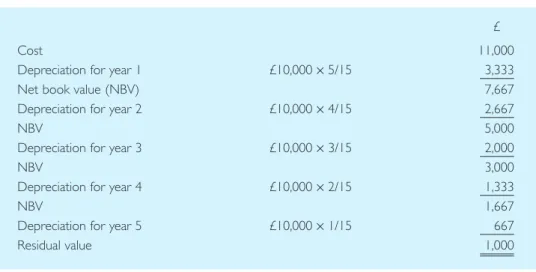
How should the depreciable amount be charged to the statement of comprehensive income over the five years? IAS 16 tells us that it should be allocated on a systematic basis and the depreciation method used should reflect as fairly as possible the pattern in which the asset’s economic benefits are consumed. The two most popular methods are straight-line, in which the depreciation is charged evenly over the useful life, and diminishing balance, where depreciation is calculated annually on the net written-down amount. In the case above, the calculations would be as in Figure 15.1.
Note that, although the diminishing balance is generally expressed in terms of a percent- age, this percentage is arrived at by inserting the economic life into the formula as n; the 38% reflects the expected economic life of five years. As we change the life, so we change the percentage that is applied. The normal rate applied to vehicles is 25% diminishing balance; if we apply that to the cost and residual value in our example, we can see that we would be assuming an economic life of eight years. It is a useful test when using reducing balance percentages to refer back to the underlying assumptions.
We can see that the end result is the same. Thus, £10,000 has been charged against income, but with a dramatically different pattern of statement of comprehensive income charges. The charge for straight-line depreciation in the first year is less than half that for reducing balance.
15.9.1 Arguments in favour of the straight-line method
The method is simple to calculate. However, in these days of calculators and computers this seems a particularly facile argument, particularly when one considers the materiality of the figures.
15.9.2 Arguments in favour of the diminishing balance method
First, the charge reflects the efficiency and maintenance costs of the asset. When new, an asset is operating at its maximum efficiency, which falls as it nears the end of its life. This may be countered by the comment that in year 1 there may be ‘teething troubles’ with new equipment, which, while probably covered by a supplier’s guarantee, will hamper efficiency.
Secondly, the pattern of diminishing balance depreciation gives a net book amount that approximates to second-hand values. For example, with motor cars the initial fall in value is very high.
15.9.3 Other methods of depreciating
Besides straight-line and diminishing balance, there are a number of other methods of depreciating, such as the sum of the units method, the machine-hour method and the annuity method. We will consider these briefly.
Sum of the units method
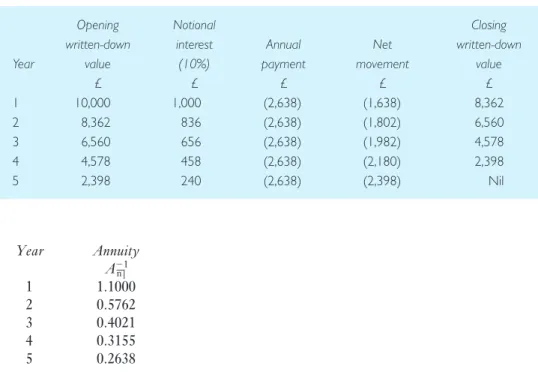
A compromise between straight-line and reducing balance that is popular in the USA is the sum of the units method. The calculation based on the information in Figure 15.1 is now shown in Figure 15.2. This has the advantage that, unlike diminishing balance, it is simple to obtain the exact residual amount (zero if appropriate), while giving the pattern of high initial charge shown by the diminishing balance approach.
Machine-hour method
The machine-hour system is based on an estimate of the asset’s service potential. The eco- nomic life is measured not in accounting periods but in working hours, and the depreciation is allocated in the proportion of the actual hours worked to the potential total hours avail- able. This method is commonly employed in aviation, where aircraft are depreciated on the basis of flying hours.
Annuity method
With the annuity method, the asset, or rather the amount of capital representing the asset, is regarded as being capable of earning a fixed rate of interest. The sacrifice incurred in using the asset within the business is therefore two-fold: the loss arising from the exhaustion of the service potential of the asset; and the interest forgone by using the funds invested in the business to purchase the fixed asset. With the help of annuity tables, a calculation shows what equal amounts of depreciation, written off over the estimated life of the asset, will reduce the book value to nil, after debiting interest to the asset account on the diminishing
amount of funds that are assumed to be invested in the business at that time, as represented by the value of the asset.
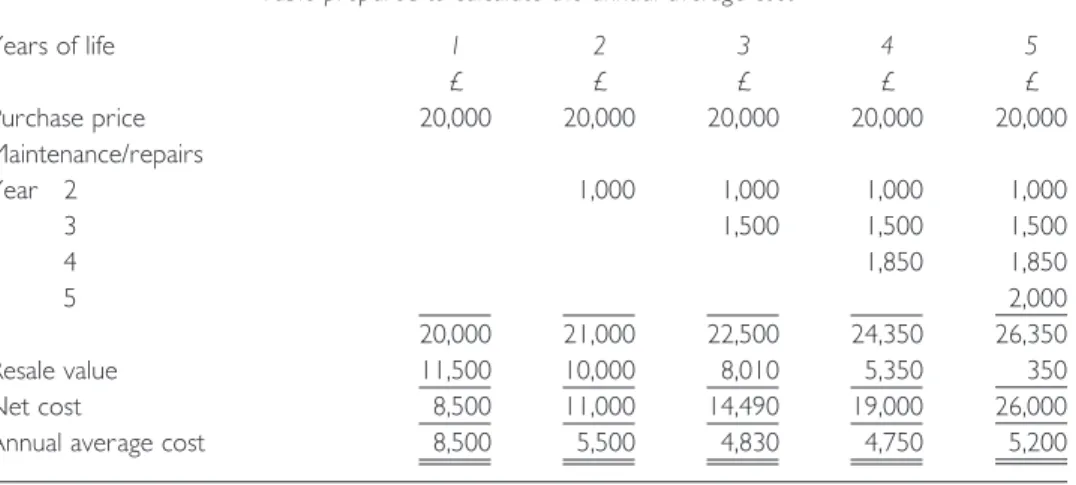
Figure 15.3 contains an illustration based on the treatment of a five-year lease which cost the company a premium of £10,000 on 1 January year 1. It shows how the total depreciation charge is computed. Each year the charge for depreciation in the statement of comprehen- sive income is the equivalent annual amount that is required to repay the investment over the five-year period at a rate of interest of 10% less the notional interest available on the remainder of the invested funds.
An extract from the annuity tables to obtain the annual equivalent factor for year 5 and assuming a rate of interest of 10% would show:
Figure 15.1 Effect of different depreciation methods
Figure 15.2 Sum of the units method
Year Annuity An–|1
1 1.1000
2 0.5762
3 0.4021
4 0.3155
5 0.2638
Therefore, at a rate of interest of 10% five annual payments to repay an investor of £10,000 would each be £2,638.
A variation of this system involves the investment of a sum equal to the net charge in fixed interest securities or an endowment policy, so as to build up a fund that will generate cash to replace the asset at the end of its life.
This last system has significant weaknesses. It is based on the misconception that depreci- ation is ‘saving up for a new one’, whereas in reality depreciation is charging against profits funds already expended. It is also dangerous in a time of inflation, since it may lead manage- ment not to maintain the capital of the entity adequately, in which case they may not be able to replace the assets at their new (inflated) prices.
The annuity method, with its increasing net charge to income, does tend to take infla- tionary factors into account, but it must be noted that the totalnet profit and loss charge only adds up to the cost of the asset.
15.9.4 Which method should be used?
The answer to this seemingly simple question is ‘it depends’. On the matter of depreciation IAS 16 is designed primarily to force a fair charge for the use of assets into the statement of comprehensive income each year, so that the earnings reflect a true and fair view.
Straight-line is most suitable for assets such as leases which have a definite fixed life. It is also considered most appropriate for assets with a short working life, although with motor cars the diminishing balance method is sometimes employed to match second-hand values.
Extraction industries (mining, oil wells, quarries, etc.) sometimes employ a variation on the machine-hour system, where depreciation is based on the amount extracted as a proportion of the estimated reserves.
Despite the theoretical attractiveness of other methods the straight-line method is, by a long way, the one in most common use by entities that prepare financial statements in accordance with IFRSs. Reasons for this are essentially pragmatic:
Figure 15.3 Annuity method
● It is the most straightforward to compute.
● In the light of the three additional subjective factors [cost (or revalued amount); residual value; useful life] that need to be estimated, any imperfections in the charge for depreci- ation caused by the choice of the straight-line method are not likely to be significant.
● It conforms to the accounting treatment adopted by peers. For example, one group reported that it currently used the reducing balance method but, as peer companies used the straight-line method, it decided to change and adopt that policy.
The following accounting policy note comes from the financial statements of BorsodChem Nyct, a Hungarian entity preparing financial statements in accordance with international accounting standards:
Freehold land is not depreciated. Depreciation is provided using the straight-line methods at rates calculated to write off the cost of the asset over its expected economic useful life. The rates used are as follows:
Buildings 2%
Machinery and other equipment 5–15%
Vehicles 15–20%
Computer equipment 33%
15.9.5 Impairment of assets
IAS 36 Impairment of Assets8deals with the problems of the measurement, recognition and presentation of material reductions in value of non-current assets both tangible and intangible.
Unless a review is specifically required by another IFRS non-current assets will be required to be reviewed for impairment only if there is some indication that impairment has occurred, e.g. slump in property market or expected future losses.
The IASB’s aim is to ensure that relevant assets are recorded at no more than recover- able amount. This is defined as being the higher of net selling price and value in use. Value in use is defined as the present value of future cash flows obtainable from the asset’s continued use using a discount ratethat is equivalent to the rate of return that the market would expect on an equally risky investment.
We will consider impairment of assets in more detail in section 15.11. However, this issue is also relevant to the computation of the depreciation charge. Paragraph 17 of IAS 36 states:
If there is an indication that an asset may be impaired this may indicate that the remaining useful life, the depreciation method, or the residual value for the asset need to be reviewed and adjusted under the IAS applicable to the asset, even if no impairment loss is recognised for the asset.
In the case of PPE the relevant IAS is IAS 16 and this indicates that an impairment review may well affect future depreciation charges in the statement of comprehensive income, even if no impairment loss is recognised.
15.10 Measurement subsequent to initial recognition
15.10.1 Choice of models
An entity needs to choose either the cost or the revaluation model as its accounting policy for an entire class of PPE. The cost model (definitely the most common) results in an asset being carried at cost less accumulated depreciation and any accumulated impairment losses.
15.10.2 The revaluation model
Under the revaluation model the asset is carried at revalued amount, being its fair value at the date of the revaluation less any subsequent accumulated depreciation and subsequent accumulated impairment losses. The fair value of an asset is defined in IAS 16 as ‘the amount for which an asset could be exchanged between knowledgeable and willing parties in an arm’s length transaction’. Thus fair value is basically market value. If a market value is not available, perhaps in the case of partly used specialised plant and equipment that is rarely bought and sold other than as new, then IAS 16 requires that revaluation be based on depreciated replacement cost.
EXAMPLE● An entity purchased an item of plant for £12,000 on 1 January 20X1. The plant was depreciated on a straight-line basis over its useful economic life, which was estimated at six years. On 1 January 20X3 the entity decided to revalue its plant. No fair value was available for the item of plant that had been purchased for £12,000 on 1 January 20X1 but the replacement cost of the plant at 1 January 20X3 was £21,000.
The carrying value of the plant immediately before the revaluation would have been:
● Cost £12,000
● Accumulated deprecation £4,000 [(£12,000/6) ×2]
● Written-down value £8,000.
Under the principles of IAS 16 the revalued amount would be £14,000 [£21,000 ×4/6].
This amount would be reflected in the financial statements either by:
● showing a revised gross figure of £14,000 and reversing out all the accumulated depreci- ation charged to date so as to give a carrying value of £14,000; or
● restating both the gross figure and the accumulated depreciation by the proportionate change in replacement cost. This would give a gross figure of £21,000, with accumulated depreciation restated at £7,000 to once again give a net carrying value of £14,000.
15.10.3 Detailed requirements regarding revaluations
The frequency of revaluations depends upon the movements in the fair values of those items of PPE being revalued. In jurisdictions where the rate of price changes is very significant revaluations may be necessary on an annual basis. In other jurisdictions revaluations every three or five years may well be sufficient.
Where an item of PPE is revalued then the entire class of PPE to which that asset belongs should be revalued.9A class of PPE is a grouping of assets of a similar nature and use in an entities operations. Examples would include:
● land;
● land and buildings;
● machinery.
This is an important provision because without it entities would be able to select which assets they revalued on the basis of best advantage to the financial statements. Revaluations will usually increase the carrying values of assets and equity and leave borrowings unchanged.
Therefore gearing (or leverage) ratios will be reduced. It is important that, if the revaluation route is chosen, assets are revalued on a rational basis.
The following is a further extract from the financial statements of Coil SA, a company incorporated in Belgium that prepares financial statements in euros in accordance with
international accounting standards: ‘Items of PPE are stated at historical cost modified by revaluation and are depreciated using the straight-line method over their estimated useful lives.’
15.10.4 Accounting for revaluations
When the carrying amount of an asset is increased as a result of a revaluation, the increase should be credited directly to other comprehensive income, being shown in equity under the heading of revaluation surplus. The only exception is where the gain reverses a revaluation decrease previously recognised as an expense relating to the same asset.
This means that, in the example we considered under section 15.10.2 above, the revalu- ation would lead to a credit of £6,000 (£14,000 −£8,000) to other comprehensive income.
If however the carrying amount of an asset is decreased as a result of a revaluation then the decrease should be recognised as an expense. The only exception is where that asset had previously been revalued. In those circumstances the loss on revaluation is charged against the revaluation surplus to the extent that the revaluation surplus contains an amount relating to the same asset.
EXAMPLE● An entity buys freehold land for £100,000 in year 1. The land is revalued to
£150,000 in year 3 and £90,000 in year 5. The land is not depreciated.
In year 3 a surplus of £50,000 [£150,000 −£100,000] is credited to equity under the heading ‘revaluation surplus’. In year 5 a deficit of £60,000 [£90,000 −£150,000] arises on the second revaluation. £50,000 of this deficit is deducted from the revaluation surplus and
£10,000 is charged as an expense. It is worth noting that £10,000 is the amount by which the year 5 carrying amount is lower than the original cost of the land.
Where an asset that has been revalued is sold then the revaluation surplus becomes realised.10It may be transferred to retained earnings when this happens but this transfer is not made through the statement of comprehensive income.
Turning again to our example in section 15.10.2, let us assume that the plant was sold on 1 January 20X5 for £5,000. The carrying amount of the asset in the financial statements immediately before the sale would be £7,000 [£14,000 − 2 × £3,500]. This means that a loss on sale of £2,000 would be taken to the statement of comprehensive income. The revaluation surplus of £6,000 would be transferred to retained earnings.
IAS 16 allows for the possibility that the revaluation surplus is transferred to retained earnings as the asset is depreciated. To turn once again to our example, we see that the revaluation on 1 January 20X3 increased the annual depreciation charge from £2,000 [£12,000/6] to £3,500 [£21,000/6]. Following revaluation an amount equivalent to the
‘excess depreciation’ may be transferred from the revaluation surplus to retained earnings as the asset is depreciated. This would lead in our example to a transfer of £1,500 each year.
Clearly if this occurs then the revaluation surplus that is transferred to retained earnings on sale is £3,000 [£6,000 −(2 ×£1,500)].
15.11 IAS 36 Impairment of Assets
15.11.1 IAS 36 approach
IAS 36 sets out the principles and methodology for accounting for impairments of non- current assets and goodwill. Where possible, individual non-current assets should be individually tested for impairment. However, where cash flows do not arise from the use of a single non-current asset, impairment is measured for the smallest group of assets which
generates income that is largely independent of the company’s other income streams. This smallest group is referred to as a cash generating unit (CGU).
Impairment of an asset, or CGU (if assets are grouped), occurs when:
● the carrying amount of an asset or CGU is greater than its recoverable amount; where
● carrying amount is the depreciated historical cost (or depreciated revalued amount);
● recoverable amount is the higher of net selling price and value in use; where
– net selling price is the amount at which an asset could be disposed of, less any direct selling costs; and
– value in use is the present value of the future cash flows obtainable as a result of an asset’s continued use, including those resulting from its ultimate disposal.
When impairment occurs, a revised carrying amountis calculated for the statement of financial position as follows:
It is not always necessary to go through the potentially time-consuming process of com- puting the value in use of an asset. If the net selling price can be shown to be higher than the existing carrying value then the asset cannot possibly be impaired and no further action is necessary. However this is not always the case for non-current assets and a number of assets (e.g. goodwill) cannot be sold so several value in use computations are inevitable.
The revised carrying amount is then depreciated over the remaining useful economic life.
15.11.2 Dividing activities into CGUs
In order to carry out an impairment review it is necessary to decide how to divide activities into CGUs. There is no single answer to this – it is extremely judgemental, e.g. if the com- pany has multi-retail sites, the cost of preparing detailed cash flow forecasts for each site could favour grouping.
The risk of grouping is that poorly performing operations might be concealed within a CGU and it would be necessary to consider whether there were any commercial reasons for breaking a CGU into smaller constituents, e.g. if a location was experiencing its own unique difficulties such as local competition or inability to obtain planning permission to expand to a more profitable size.
15.11.3 Indications of impairment
A review for impairment is required when there is an indication that an impairment has actually occurred. The following are indicators of impairment:
● External indicators:
– a fall in the market value of the asset;
– material adverse changes in regulatory environment;
– material adverse changes in markets;
– material long-term increases in market rates of return used for discounting.
● Internal indicators:
– material changes in operations;
– major reorganisation;
– loss of key personnel;
– loss or net cash outflow from operating activities if this is expected to continue or is a continuation of a loss-making situation.
If there is such an indication, it is necessary to determine the depreciated historical cost of a single asset, or the net assets employed if a CGU, and compare this with the net realisable value and value in use.
ICI stated in its 2005 Annual Report:
No depreciation has been provided on land. Impairment reviews are performed where there is an indication of potential impairment. If the carrying value of an asset exceeds the higher of the discounted estimated cash flows from the asset and net realizable value of the asset the resulting impairment is charged to the statement of comprehensive income.
15.11.4 Value in use calculation
Value in use is arrived at by estimating and discounting the income stream. The income streams:
● are likely to follow the way in which management monitors and makes decisions about continuing or closing the different lines of business;
● may often be identified by reference to major products or services;
● should be based on reasonable and supportable assumptions;
● should be consistent with the most up-to-date budgets and plans that have been formally approved by management:
– if for a period beyond that covered by formal budgets and plans should, unless there are exceptional circumstances, assume a steady or declining growth rate;11
● should be projected cash flows unadjusted for risk, discounted at a rate of return expected from a similarly risky investment or should be projected risk-adjusted pre-tax cash flows discounted at a risk-free rate.
The discount rateshould be:
● calculated on a pre-tax basis;
● an estimate of the rate that the market would expect on an equally risky investment excluding the effects of any risk for which the cash flows have been adjusted:12
– increased to reflect the way the market would assess the specific risks associated with the projected cash flows;
– reduced to a risk-free rate if the cash flows have been adjusted for risk.
The following illustration is from the Roche Holdings Ltd 2003 Annual Report:
When the recoverable amount of an asset, being the higher of its net selling price and its value in use, is less than the carrying amount, then the carrying amount is reduced to its recoverable amount. This reduction is reported in the statement of comprehensive income as an impairment loss. Value in use is calculated using estimated cash flows,
generally over a five-year period, with extrapolating projections for subsequent years.
These are discounted using an appropriate long-term pre-tax interest rate. When an impairment arises the useful life of the asset in question is reviewed and, if necessary, the future depreciation/amortisation charge is amended.
15.11.5 Treatment of impairment losses
If the carrying value exceeds the higher of net selling price and value in use, then an impair- ment loss has occurred. The accounting treatment of such a loss is as follows:
Asset not previously revalued
An impairment loss should be recognised in the statement of comprehensive income in the year in which the impairment arises.
Asset previously revalued
An impairment loss on a revalued asset is effectively treated as a revaluation deficit. As we have already seen, this means that the decrease should be recognised as an expense. The only exception is where that asset had previously been revalued. In those circumstances the loss on revaluation is charged against the revaluation surplus to the extent that the revaluation surplus contains an amount relating to the same asset.
Allocation of impairment losses
Where an impairment loss arises, the loss should ideally be set against the specific asset to which it relates. Where the loss cannot be identified as relating to a specific asset, it should be apportioned within the CGU to reduce the most subjective values first, as follows:
● first, to reduce any goodwill within the CGU;
● then to the unit’s other assets, allocated on a pro rata basis;
● however, no individual asset should be reduced below the higher of:
– its net selling price (if determinable);
– its value in use (if determinable);
– zero.
The following is an example showing the allocation of an impairment loss.
EXAMPLE●A cash generating unit contains the following assets:
£
Goodwill 70,000
Intangible assets 10,000
PPE 100,000
Inventory 40,000
Receivables 30,000
250,000
The unit is reviewed for impairment due to the existence of indicators and the recoverable amount is estimated at £150,000. The PPE includes a property with a carrying amount of
£60,000 and a market value of £75,000. The net realisable value of the inventory is greater than its carrying values and none of the receivables is considered doubtful.
The table below shows the allocation of the impairment loss
Pre-impairment Impairment Post-impairment
£ £ £
Goodwill 70,000 (70,000) Nil
Intangible assets 10,000 (6,000) 4,000
PPE 100,000 (24,000) 76,000
Inventory 40,000 Nil 40,000
Receivables 30,000 Nil 30,000
250,000 (100,000) 150,000
Notes to table:
1 The impairment loss is first allocated against goodwill. After this has been done £30,000 (£100,000 −£70,000) remains to be allocated.
2 No impairment loss can be allocated to the property, inventory or receivables because these assets have a recoverable amount that is higher than their carrying value.
3 The remaining impairment loss is allocated pro-rata to the intangible assets (carrying amount £10,000) and the plant (carrying amount £40,000 (£100,000 −£60,000)).
Restoration of past impairment losses
Past impairment losses in respect of an asset other than goodwill may be restored where the recoverable amount increases due to an improvement in economic conditions or a change in use of the asset. Such a restoration should be reflected in the statement of comprehensive income to the extent of the original impairment previously charged to the statement of com- prehensive income, adjusting for depreciation which would have been charged otherwise in the intervening period.
15.11.6 Illustration of data required for an impairment review
Pronto SA has a product line producing wooden models of athletes for export. The carrying amount of the net assets employed on the line as at 31 December 20X3 was £114,500. The scrap value of the net assets at 31 December 20X6 is estimated to be £5,000.
There is an indication that the export market will be adversely affected in 20X6 by com- petition from plastic toy manufacturers. This means that the net assets employed to produce this product might have been impaired.
The finance director estimated the net realisable value of the net assets at 31 December 20X3 to be £70,000. The value in use is now calculated to check if it is higher or lower than
£70,000. If it is higher it will be compared with the carrying amount to see if impairment has occurred; if it is lower the net realisable value will be compared with the carrying amount.
Pronto SA has prepared budgets for the years ended 31 December 20X4, 20X5 and 20X6.
The assumptions underlying the budgets are as follows:
Unit costs and revenue:
£
Selling price 10.00
Buying in cost (4.00)
Production cost: material, labour, overhead (0.75) Head office overheads apportioned (0.25)
Cash inflow per model 5.00
Estimated sales volumes:
20X3 20X4 20X5 20X6
Estimated at 31 December 20X2 6,000 8,000 11,000 14,000
Revised estimate at 31 December 20X3 — 8,000 11,000 4,000 Determining the discount rate to be used:
20X4 20X5 20X6
The rate obtainable elsewhere at the
same level of risk is 10% 10% 10%
The discount factors to be applied to each year are then calculated using cost of capital discount rates as follows:
20X4 1/1.1 =0.909
20X5 1/(1.1)2 =0.826 20X6 1/(1.1)3 =0.751
15.11.7 Illustrating calculation of value in use
Before calculating value in use, it is necessary to ensure that the assumptions underlying the budgets are reasonable, e.g. is the selling price likely to be affected by competition in 20X6 in addition to loss of market? Is the selling price in 20X5 likely to be affected? Is the estimate of scrap value reasonably accurate? How sensitive is value in use to the scrap value?
Is it valid to assume that the cash flows will occur at year-ends? How accurate is the cost of capital? Will components making up the income stream, e.g. sales, materials, labour be subject to different rates of inflation?
Assuming that no adjustment is required to the budgeted figures provided above, the estimated income streams are discounted using the normal DCF approach as follows:
20X4 20X5 20X6
Sales (models) 8,000 11,000 4,000
Income per model £5 £5 £5
Income stream (£) 40,000 55,000 20,000
Estimated scrap proceeds 5,000
Cash flows to be discounted 40,000 55,000 25,000
Discounted (using cost of capital factors) 0.909 0.826 0.751
Present value 36,360 45,430 18,775
Value in use ==£100,565
15.11.8 Illustration determining the revisedcarrying amount
If the carrying amount at the statement of financial position date exceeds net realisable value and value in use, it is revised to an amount which is the higher of net realisable value and value in use. For Pronto SA:
£ Carrying amount as at 31 December 20X3 114,500
Net realisable value 70,000
Value in use 100,565
Revised carrying amount 100,565
15.12 IFRS 5 Non-Current Assets Held for Sale and Discontinued Operations
IFRS 5 sets out requirements for the classification, measurement and presentation of non-current assets held for sale. The requirements which replaced IAS 35 Discontinuing Operationswere discussed in Chapter 8. The IFRS is the result of the joint short-term project to resolve differences between IFRSs and US GAAP.
Classification as ‘held for sale’
The IFRS (para. 6) classifies a non-current asset as ‘held for sale’ if its carrying amount will be recovered principally through a sale transaction rather than through continuing use. The criteria for classification as ‘held for sale’ are:
● the asset must be available for immediate sale in its present condition; and
● its sale must be highly probable.
The criteria for a sale to be highly probable are:
● the appropriate level of management must be committed to a plan to sell the asset;
● an active programme to locate a buyer and complete the plan must have been initiated;
● the asset must be actively marketed for sale at a price that is reasonable in relation to its current fair value;
● the sale should be expected to qualify for recognition as a completed sale within one year from the date of classification unless the delay is caused by events or circumstances beyond the entity’s control and there is sufficient evidence that the entity remains committed to its plan to sell the asset; and
● actions required to complete the plan should indicate that it is unlikely that significant changes to the plan will be made or that the plan will be withdrawn.
Measurement and presentation of assets held for sale The IFRS requires that assets ‘held for sale’ should:
● be measured at the lower of carrying amount and fair valueless costs to sell;
● not continue to be depreciated; and
● be presented separately on the face of the statement of financial position.
The following additional disclosures are required in the notes in the period in which a non-current asset has been either classified as held for sale or sold:
● a description of the non-current asset;
● a description of the facts and circumstances of the sale;
● the expected manner and timing of that disposal;
● the gain or loss if not separately presented on the face of the statement of comprehensive income; and
● the caption in the statement of comprehensive income that includes that gain or loss.
15.13 Disclosure requirements
For each class of PPE the financial statements need to disclose:
● the measurement bases used for determining the gross carrying amount;
● the depreciation methods used;
● the useful lives or the depreciation rates used;
● the gross carrying amount and the accumulated depreciation (aggregated with accumulated impairment losses) at the beginning and end of the period;
● a reconciliation of the carrying amount at the beginning and end of the period.
The style employed by British Sky Broadcasting Group Plc in its 2003 accounts is almost universally employed for this:
Tangible fixed assets (or PPE) The movements in the year were as follows:
Freehold Short Equipment, Assets in Total land and leasehold fixtures and course of
buildings improvements fittings construction
£m £m £m £m
Group Cost
Beginning of year 37.9 83.3 554.4 29.9 705.5
Additions 0.4 3.2 73.0 24.8 101.4
Disposals — — (10.9) — (10.9)
Transfers — — 25.8 (25.8) —
End of year 38.3 86.5 642.3 28.9 796.0
Freehold Short Equipment, Assets in Total land and leasehold fixtures and course of
buildings improvements fittings construction
£m £m £m £m
Depreciation
Beginning of year 6.0 43.3 313.2 — 362.5
Charge 2.3 4.0 91.6 — 97.9
Disposals — — (10.6) — (10.6)
End of year 8.3 47.3 394.2 — 449.8
Net book value
Beginning of year 31.9 40.0 241.2 29.9 343.0
End of year 30.0 39.2 248.1 28.9 346.2
Additionally the financial statements should disclose:
● the existence and amounts of restrictions on title, and PPE pledged as security for liabilities;
● the accounting policy for the estimated costs of restoring the site of items of PPE;
● the amount of expenditures on account of PPE in the course of construction;
● the amount of commitments for the acquisition of PPE.
15.14 Government grants towards the cost of PPE
The accounting treatment of government grants is covered by IAS 20. The basis of the standard is the accruals concept, which requires the matching of cost and revenue so as to recognise both in the statements of comprehensive income of the periods to which they
relate. This should, of course, be tempered with the prudence concept, which requires that revenue is not anticipated. Therefore, in the light of the complex conditions usually attached to grants, credit should not be taken until receipt is assured.
Similarly, there may be a right to recover the grant wholly or partially in the event of a breach of conditions, and on that basis these conditions should be regularly reviewed and, if necessary, provision made.
Should the tax treatment of a grant differ from the accounting treatment, then the effect of this would be accounted for in accordance with IAS 12Income Taxes.
IAS 20
Government grants should be recognised in the statement of comprehensive income so as to match the expenditure towards which they are intended to contribute. If this is retrospective, they should be recognised in the period in which they became receivable.
Grants in respect of PPE should be recognised over the useful economic lives of those assets, thus matching the depreciation or amortisation.
IAS 20 outlines two acceptable methods of presenting grants relating to assets in the statement of financial position:
(a) The first method sets up the grant as deferred income, which is recognised as income on a systematic and rational basis over the useful life of the asset.
EXAMPLE● An entity purchased a machine for £60,000 and received a grant of £20,000 towards its purchase. The machine is depreciated over four years.
The ‘deferred income method’ would result in an initial carrying amount for the machine of £60,000 and a deferred income credit of £20,000. In the first year of use of the plant the depreciation charge would be £15,000. £5,000 of the deferred income would be recognised as a credit in the statement of comprehensive income, making the net charge
£10,000. At the end of the first year the carrying amount of the plant would be £45,000 and the deferred income included in the statement of financial position would be £15,000.
The following is an extract from the 2006 Go-Ahead Annual Report:
Government grants
Government grants are recognised at their fair value where there is reasonable assurance that the grant will be received and all attaching conditions will be complied with. When the grant relates to an expense item, it is recognised in the statement of comprehensive income over the period necessary to match on a systematic basis to the costs that it is intended to compensate. Where the grant relates to a non-current asset, value is credited to a deferred income account and is released to the statement of comprehensive income over the expected useful life of the relevant asset.
(b) The second method deducts the grant in arriving at the carrying amount of the relevant asset. If we were to apply this method to the above example then the initial carrying amount of the asset would be £40,000. The depreciation charged in the first year would be £10,000. This is the same as the net charge to income under the ‘deferred credit’
method. The closing carrying amount of the plant would be £30,000. This is of course the carrying amount under the ‘deferred income method’ (£45,000) less the closing deferred income under the ‘deferred income method’ (£15,000).
The following extract is from the 2006 Annual Report of A & J Muklow plc:
Capital grants
Capital grants received relating to the building or refurbishing of investment properties are deducted from the cost of the relevant property. Revenue grants are deducted from the related expenditure.
The IASB is currently considering drafting an amended standard on government grants.
Among the reasons for the Board amending IAS 20 were the following:
● The recognition requirements of IAS 20 often result in accounting that is inconsistent with the Framework, in particular the recognition of a deferred credit when the entity has no liability, e.g. the following is an extract from the SSL International plc Annual Report:
Grant income
Capital grants are shown in other creditors within the statement of financial position and released to match the depreciation charge on associated assets.
● IAS 20 contains numerous options. Apart from reducing the comparability of financial statements, the options in IAS 20 can result in understatement of the assets controlled by the entity and do not provide the most relevant information to users of financial statements.
In the near future there is the prospect of the IASB issuing a revised standard which requires entities to recognise grants as income as soon as their receipt becomes uncondi- tional. This is consistent with the specific requirements for the recognition of grants relating to agricultural activity laid down in IAS 41 Agriculture. This matter is discussed in more detail in Chapter 18.
15.15 Investment properties
While IAS 16 requires all PPEs to be subjected to a systematic depreciation charge, this may be considered inappropriate for properties held as assets but not employed in the normal activities of the entity, rather being held as investments. For such properties a more relevant treatment is to take account of the current market value of the property. The accounting treatment is set out in IAS 40 Investment Property.
Such properties may be held either as a main activity (e.g. by a property investment company) or by a company whose main activity is not the holding of such properties. In each case the accounting treatment is similar.
Definition of an investment property13
For the purposes of the statement, an investment property is property held (by the owner or by the lessee under a finance lease) to earn rentals or capital appreciation or both.
Investment property does notinclude:
(a) property held for use in the production or supply of goods or services or for adminis- trative purposes (dealt with in IAS 16);
(b) property held for sale in the ordinary course of business (dealt with in IAS 2);
(c) an interest held by a lessee under an operating lease, even if the interest was a long-term interest acquired in exchange for a large up-front payment (dealt with in IAS 17);
(d) forests and similar regenerative natural resources (dealt with in IAS 41 Agriculture);
and
(e) mineral rights, the exploration for and development of minerals, oil, natural gas and similar non-regenerative natural resources (dealt with in project on Extractive Industries).
Accounting models
Under IAS 40, an entity must choose either:
● a fair value model: investment property should be measured at fair value and changes in fair value should be recognised in the statement of comprehensive income; or
● a cost model (the same as the benchmark treatment in IAS 16 Property, Plant and Equipment):
investment property should be measured at depreciated cost (less any accumulated impair- ment losses). An entity that chooses the cost model should disclose the fair value of its investment property.
An entity should apply the model chosen to all its investment property. A change from one model to the other model should be made only if the change will result in a more appropriate presentation. The standard states that this is highly unlikely to be the case for a change from the fair value model to the cost model.
In exceptional cases, there is clear evidence when an entity that has chosen the fair value model first acquires an investment property (or when an existing property first becomes investment property following the completion of construction or development, or after a change in use) that the entity will not be able to determine the fair value of the investment property reliably on a continuing basis. In such cases, the entity measures that investment property using the benchmark treatment in IAS 16 until the disposal of the investment property. The residual value of the investment property should be assumed to be zero. The entity measures all its other investment property at fair value.
15.16 Effect of accounting policy for PPE on the interpretation of the financial statements
A number of difficulties exist when attempting to carry out inter-firm comparisons using the external information that is available to a shareholder.
15.16.1 Effect of inflation on the carrying value of the asset
The most serious difficulty is the effect of inflation, which makes the charges based on histor- ical cost inadequate. Companies have followed various practices to take account of inflation.
None of these is as effective as an acceptable surrogate for index adjustment using specific asset indices on a systematic annual basis: this is the only way to ensure uniformity and comparability of the cost/valuation figure upon which the depreciation charge is based.
The method that is currently allowable under IAS 16 is to revalue the assets. This is a partial answer, but it results in lack of comparability of ratios such as gearing, or leverage.
15.16.2 Effect of revaluation on ratios
The rules of double entry require that when an asset is revalued the ‘profit’ (or, exceptionally,
‘loss’) must be credited somewhere. As it is not a ‘realised’ profit, it would not be appro- priate to credit the statement of comprehensive income, so a ‘revaluation reserve’ must be created. As the asset is depreciated, this reserve may be realised to income; similarly, when an asset is ultimately disposed of, any residue relevant to that asset may be taken into income.
One significant by-product of revaluing assets is the effect on gearing. The revaluation reserve, while not distributable, forms part of the shareholders’ funds and thus improves the