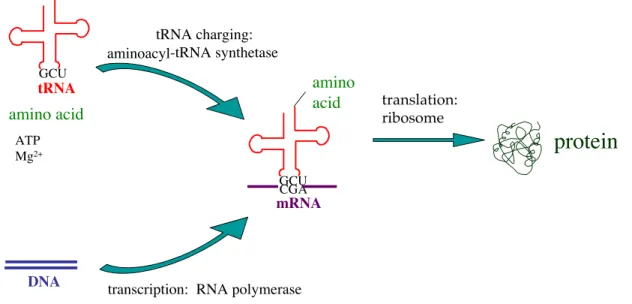
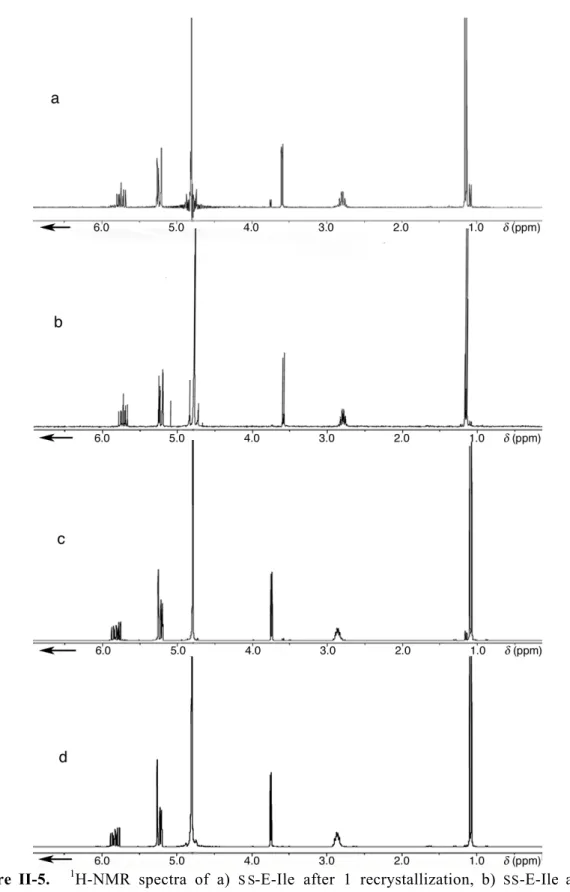
The aim of this thesis work was to expand the set of amino acids available for incorporation into proteins in vivo and to explore applications of the new chemistries and physical properties provided by the new analogues. The incorporation of non-canonical amino acids allows the introduction of new functionality into proteins, creating the potential for new material properties or interesting post-translational modifications.
3 I.1 Protein Biosynthesis
4 amino acid charged to the tRNA. The selectivity of this process for the
5 produced both in vitro [14] and in vivo [15]. The majority of the burden of
6 Early work in the Tirrell laboratory demonstrated the ability to
7 Although in vivo synthesis of protein polymers has been shown to be a
Many groups have since used this technology for site-specific incorporation to study protein structure and function. For example, Pollitt and colleagues have used site-specific incorporation in vitro to encapsulate an aspartic acid side chain of a protein (p21ras) as its o-nitrobenzyl ester, allowing them to photochemically control its interaction with a protein partner (p120-GAP) [36].

10 [37], and use of unnatural nucleosides iso-C and iso-G enabled the Hecht
Through directed evolution of aaRSs that show high specificity towards a non-canonical amino acid [49], they have created E. Kwon and colleagues have described a system that exploits the degeneracy of the genetic code to "reassign" the phenylalanine wobble codon UUU to the non-canonical amino acid 2-naphylalanine [55].

14 I.4 Thesis Objective
15 to accommodate larger amino acids. Films of the azide-containing aECMs
16 I.5 References
Tang Y, Tirrell DA: Biosynthesis of a highly stable hexafluoroleucine-containing coiled-coil protein in an engineered bacterial host. Tang Y, Tirrell DA: Reduction of the editing activity of Escherichia coli leucyl-tRNA synthetase allows incorporation of novel amino acids into proteins in vivo.
21 incorporation of an unnatural amino acid into proteins in
SS-E-Ile was incorporated into the test protein mouse dihydrofolate reductase (mDHFR) in place of isoleucine with a degree of substitution of up to 72%, whereas SR-E-Ile showed no convincing evidence of translational activity. In vitro ATP-PPi exchange assays show that SS-E-Ile is activated by isoleucyl-tRNA synthetase (IleRS) at a rate comparable to isoleucine;.
2 II.2 Introduction
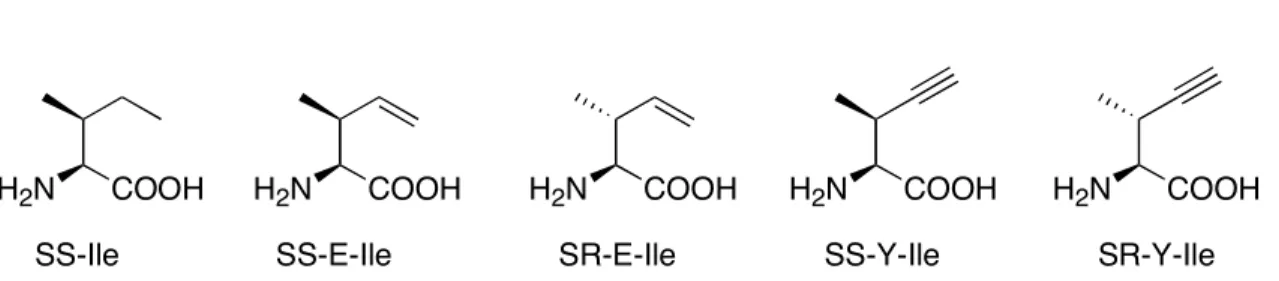
The kinetics of activation of SS and SR-E-Ile by IleRS were also determined in vitro through ATP/PPi exchange. SS- and SR-E-Ile were prepared according to Figure II-2; the stereochemistry at the β-carbon of the final product was controlled by choosing either cis- or trans-crotyl alcohol as the starting material (Figure II-3).
6 solvent was evaporated, and the crude product was purified by flash
7 The stirred solution was cooled to –20 °C and 26 mL (41.6 mmol) 1.6 M n-
After an additional 30 minutes of reaction, 20 mL of cold water was carefully added to stop the reaction. The lithium diisopropylamide solution was then cooled to -70 °C and a solution of 2 g (7.5 mmol) of diphenylmethylene glycine ethyl ester in 3 mL of THF was slowly added.

10 temperature and stirred for an additional 3 hours. The solvent was removed
11 ATP-PP i exchange assays were performed as previously described
12 into aliquots, to which were added water (negative control), L-isoleucine
13 hydroxycinnamic acid, and analyzed by MALDI-TOF mass spectrometry on
15 acids were further purified by multiple recrystallizations to give SS -E-Ile (d.e
16 II.4.2 Analogue incorporation
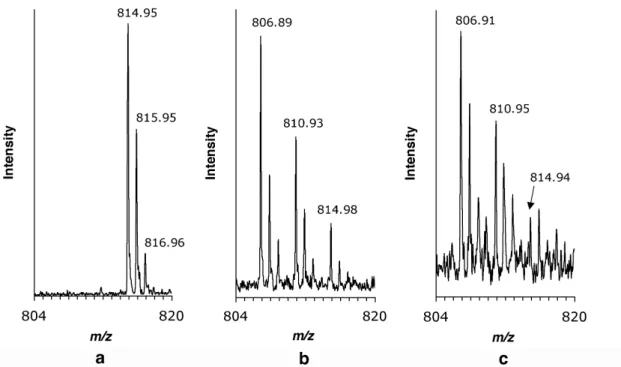
In cultures supplemented with SS-E-Ile (d.e. = 95 %), SDS-PAGE and Western blotting again show that the target protein is expressed in amounts comparable to the positive control (Ile); in contrast, cultures supplemented with SR-E-Ile (d.e. = 98 %) yielded significantly less protein (Figure II-9). TOF mass spectra of tryptic fragments of mDHFR produced in medium supplemented with SS-E-Ile (d.e. = 95%) show signals shifted by the expected mass difference of -2 for each isoleucine residue in the peptide (Figure II- 10). A + indicates induction of mDHFR expression; expression was not induced in lane 2. TOF spectra of tryptic fragments of mDHFR produced in medium supplemented with a) Ile, b) SS-E-Ile, and c) SR-E-Ile.
A lesser degree of incorporation of an unsaturated amino acid is also evident in proteins produced in culture supplemented with c) SR-E-Ile (i.e. = 98%).
19 spectra of fragments of target protein expressed in medium containing SR -E-
To determine the extent of ss-E-Ile uptake, we prepared mDHFR in cultures supplemented with different levels of the analog. SDS-PAGE and Western blotting of the total cellular protein produced in cultures supplemented with increasing concentrations of once recrystallized SS-E-Ile (i.e. = 68%) indicate increasing levels of expression of the target protein (Figure II-12). Integration of 1H NMR spectra of mDHFR produced in large-scale expressions in medium supplemented with 25 mg/l or 125 mg/l.

21 II.4.3 Kinetics of Activation of E-Ile by IleRS
After cellular uptake and activation, the analog must bypass regulatory pathways that normally limit tRNA mis-acylation. The SS analogs tested in this study appear to bypass the IleRS editing mechanism, possibly because they are too large to fit into the editing site. Our results show that IleRS is sensitive to the stereochemistry at the β-carbon of E-Ile; only the SS-isomer of the isoleucine analog is incorporated into the protein at a measurable rate and is activated by IleRS ~100-fold faster than SR-E-Ile.
However, our data do not rule out the possibility that discrimination between SS and SR analogues does not occur in.
23 the synthetic active site of IleRS but rather during some other translational
24 II.6 References
Ibba M, Hennecke H: Relaxing the substrate specificity of an aminoacyl transfer RNA synthetase allows in vitro and in vivo synthesis of proteins containing unnatural amino acids. Jakubowski H, Fersht AR: Alternative routes for processing of unrelated amino acids by aminoacyl-transfer Rna synthetases. Flossdorf J, Kula MR: Ultracentrifuge studies of the binding of aliphatic amino acids to isoleucyl-transfer RNA synthetase from Escherichia-Coli Mre 600.
Flossdorf J, Pratorius HJ, Kula MR: Influence of side chain structure of aliphatic amino acids on binding to isoleucyl transfer RNA synthetase of.
2 III.2 Introduction
Each protein has three cassettes of a cell-binding domain interspersed with an elastin-like domain. Protein CS5 contains the authentic CS5 binding domain[11] while SC5 contains a negative control, scrambled domain. Depending on the specific medical application, e.g. drug delivery or tissue regeneration, the success of implanted biomaterials will depend on optimizing the in vivo degradation properties.
HLE preferentially cleaves at small, hydrophobic amino acids, and previous work in our laboratory has shown that HLE preferentially cleaves at isoleucine in the CS5 protein.
4 degradation properties of this engineered protein by replacing isoleucine with
The solution was extracted with ether (3 x 50 mL) and the ether was dried over sodium sulfate and evaporated in vacuo. The methanol was evaporated and the residue was dissolved in 100 ml of 0.1 N HCl and applied to an ion exchange column (Dowex 50WX4-100, Sigma). Purified proteins CS5-F and SC5-F were incubated with trypsin (50 mM ammonium bicarbonate buffer, overnight, room temperature).
The LCST of CS5 and CS5-F proteins was measured at 10 mg/ml in phosphate-buffered saline (PBS), pH 7.4, by increasing the temperature at a rate of 30 °C/h and measuring the percent transmission (measured in volts) at 300 nm on an Aviv model 62DS spectrophotometer (Lakewood, NJ).
8 each time point. Control curves run in parallel indicated a linear relationship
9 adsorbed protein substrates in 96-well plates and incubated for 30 min. A
10 protein from 10 L batch fermentations. Further optimization is required to
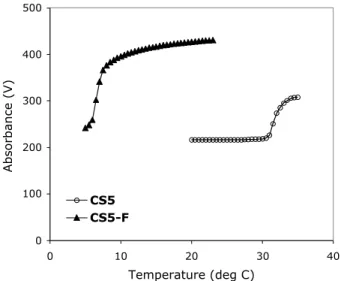
As discussed above, proteins with elastin-like domains are known to exhibit a reverse temperature transition that is influenced by the identity of the amino acid in the Z position. Relative to the most abundant pentapeptide repeat in bovine and porcine elastin, VPGVG [36, 37], the LCST is decreased when the amino acid occupying the Z position is more hydrophobic than valine and increased when Z is more hydrophilic. As expected, the introduction of the highly hydrophobic amino acid 5TFI into the Z position of the elastin-like domain results in a decrease in the LCST by more than 20°C (Figure III-3).
Replacement of 82% of the isoleucine residues in CS5 with a fluorinated amino acid (CS5-F) lowers the LCST by 20°C, as evidenced by the turbidity of a 10 mg/ml solution in PBS, pH 7.4.
12 Therefore, the LCST of elastin-like proteins can be tuned by incorporation
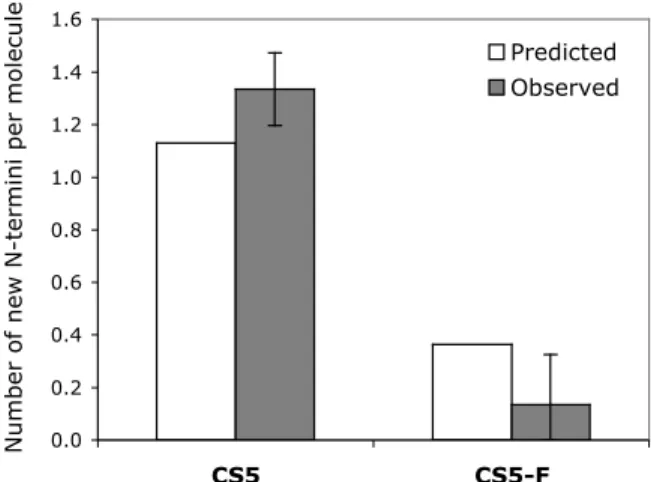
HLE degradation of CS5-F produces 90% less new N-termini per original molecule than CS5 after 4 h of reaction. No full-length CS5 was observed after 6 h, while almost half of CS5-F is still intact. We also investigated the ability of the fluorinated proteins CS5-F and SC5-F to promote cell adhesion.
We wanted to confirm that sequence-specific HUVEC adhesion would not be compromised by significant fluorination of the elastin-like regions.
16 protein while also altering the thermodynamic phase behavior. The ability
17 III.5 Supporting information
18 III.6 References
Di Zio K, Tirrell DA: Mechanical properties of artificial protein matrices designed to control cell and tissue behavior. Nowatzki PJ, Tirrell DA: Physical properties of artificial extracellular matrix protein films prepared by isocyanate cross-linking. Liu JC, Heilshorn SC, Tirrell DA: Comparative cellular response to artificial extracellular matrix proteins containing RGD and CS5 cell binding domains.
Tamura T, Yamaoka T, Kunugi S, Panitch A, Tirrell DA: Effects of temperature and pressure on the aggregation properties of an engineered elastin model polypeptide in aqueous solution.
2 IV.2 Introduction
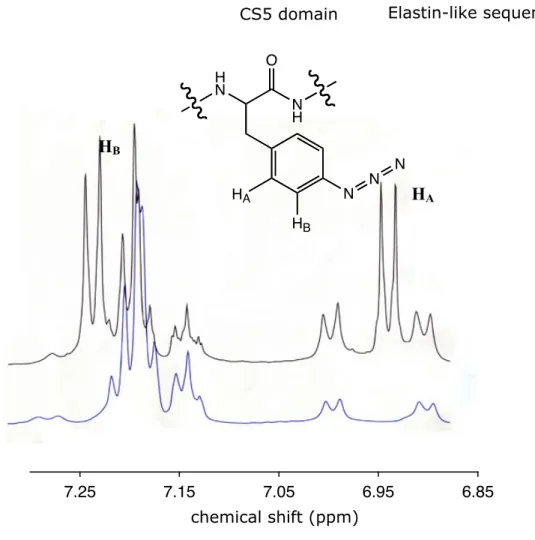
Large-scale production of aECM-N3 protein was accomplished through specific incorporation of pN3Phe residues into E. Characterization of azide decomposition by infrared spectroscopy and cross-photo mechanical films. a) FT-IR spectrum of aECM-N3 films as a function of irradiation time in the asymmetric stretching region of aryl azide. Fluorescent immunolabeling with anti-T7-tag IgG antibodies revealed that the aECM protein was localized only within the irradiated areas of the model (Figure IV-4a).
Phase contrast images of the chrome mask used in photopatterns (left panels) compared to fluorescence microscopy images of the protein patterns (right panels).
20 Cross-Linking. Proceedings of the National Academy of Sciences of
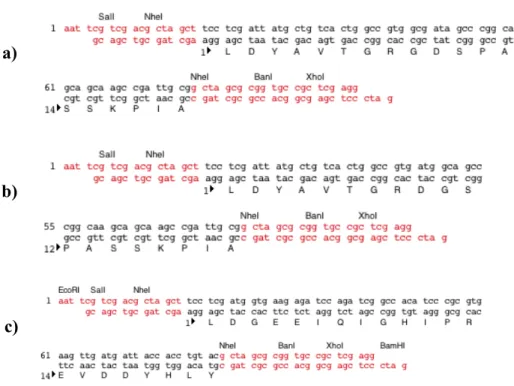
The sequence of the aECM-F protein we studied (Figure V-1) contained elastin-like repeats to provide structural integrity, regular Phe residues within the elastin-like regions as sites of cross-linking, and repeats of a cell adhesive sequence (CS5) derived from the IIICS region of fibronectin that is known to adhere endothelial cells, but does not. We wanted to create an expression strain harboring a plasmid copy of the artificial gene for the RGD-containing version of the aECM protein that we used previously. The cell-binding domain regions were excised from the pUC19-SC5, pUC19-RGD, or pUC19-RDG vectors with EcoRI/BamHI.
Sequencing revealed a second Xho I site in pET28cyl-phes* between the Sph I binding site and the start of the phes* gene.
7 heated to near boiling for 2 to 3 minutes. The solution was allowed to cool
8 culture using a MaxiPrep Kit (Qiagen) and digested at 37°C overnight with
9 competent cells. A colony was isolated that harbored a plasmid designated
10 Excising the 375-bp band from the agarose gel and ligating the
11 V.5 Conclusions
GCTCGA ctt akt cga gaa gct t CAT GTG GTG GTG GTG GTG GTG GTG GTG ACC CAT TTG CTG TCC ACC AGT CAT GCT CGC CAT gGTATATCTCTTCTTAAAGTAAAACAAATTATTTCTAGAGGGGAATTGTGTGTGTGTGTGATGATGATGATGATGATGATGATGATGATGATGATGATGATGATGATGATGATGATGATGATTAGATGATGATGATGATGATGATGATGATGATGATGATGATGATGATGATGATGATGATGATGATGATGATGATGATGATGATGATGATGATGATTAGATGATGATGATGATGATGATGATGATGATGATGATGATGATGATGATGATGATGATGATGATGATGATGATGATGT TCTCGATCCTCTACGCCGGACGCATCGT GGCCGGCATCACCGGCGCCACAGGTGCGGTTGCTGGCGCCTATATCGCCGACATCACCGATGGGGAAGATCGGGCTCG CCACTTCGGGGCTCATGAGCGCTTGTTGTGGGGGCGC TTGGGCGCCAT. CGAGCT gaa tga gct ctt cga a GTA CAC CAC CAC CAC CAC CAC CAC TGG GTA AAC GAC AGG TGG TCA GTA CGA GCG GTA cCATATAGAGGAAGGAATTTCAATTTGTTTAAATAGATCTCCCCTTAACATA GGCGAGTAGATCTCCCCTTAACAATA ATGCGGCCTGCGTAGCA CCGGCCGTAGTGGCCGCGGGTGTCCACGCCAACGACCGCGGATATAGCGCTGTAGTGGCTACCCCTTCTAGCCCCGAGC GGTGAAGCCCCCGAGTACTCGCGAACAAAGCCGCACCCATACCACGCCAACGACCGCGGATATAGCGCTGTAGTGGCTACCCCTTCTAGCCCGAGC GGTGAAGCCCGAGTACTCGCGAACAAAGCCGCACCCATACCACCGCACCGACCGACCGCGACCAGACCGACCGACCGACGACCGACCGACCGACCGACCGACGACCGACCGACGACGACCGCGCGCGCGCGCGACCGACCGACCGACGACG. ADN-ja pentamer u lidh me vektor pEC2-SC5 që ishte tretur me Ban I dhe defosforiluar me CIP, për të dhënë pEC2-SC5-ELF5.
The entire ligation mixture was transformed into competent JM109 cells; colonies examined revealed a strain containing pEC2-SC5-ELF6.