I would like to thank members of the Bercaw group, especially Bryan Coughlin, for helping with sample preparation and allowing the physical chemist to use their vacuum lines and dry boxes. In this self-consistent treatment, the chemical exchange rate is expressed in terms of the correlation function of the operator connecting space and rotation.
Introduction
Historical Review
Early observations of the "nuclear spin coupling" were made using spin-echo6 and steady-state7 (field-sweep) magnetic resonance techniques. A form of the spin coupling interaction had previously been discovered in the NMR of protons in solids.
Origins of the Chemical Shift and Spin-Spin Coupling
Isotropic spin coupling must arise from a non-zero-averaged interaction with the motion of the entire molecule. As with the usual chemical shift mechanism, any temperature dependence of the scalar bonds would result from the change in the intermediate electron distribution.
Outline
The effects of nuclear motion within the electronic ground state are often of secondary importance. The weakness of the accepted derivations prompted the development of an alternative hypothesis, the JKW (Jones, Kurur, Weitekamp) hypothesis, how to calculate the stochastic mean NMR frequency.
Quantum-Mechanical Tunnelling in Transition Metal Hydrides
Introduction
Experimental History of the Transition Metal Hydrides
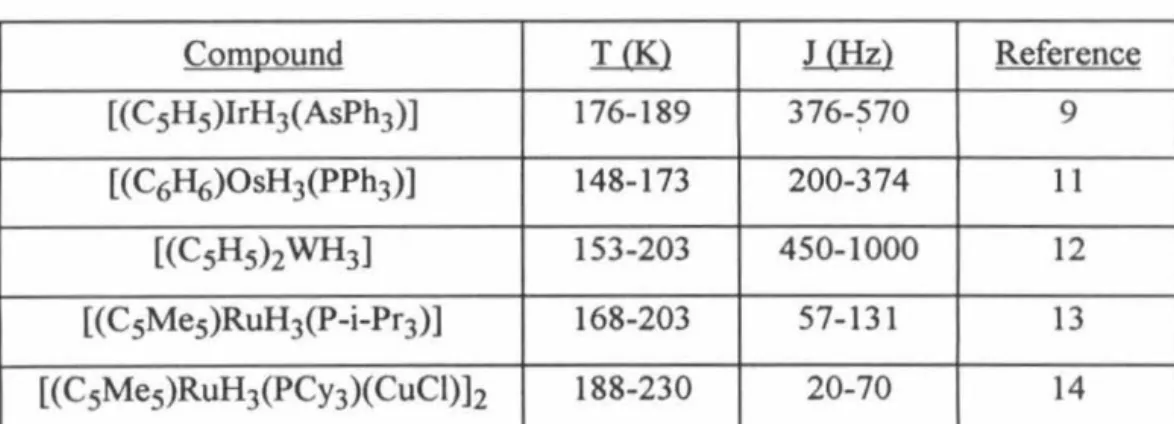
The isolation of these complexes led researchers to propose the existence of "trihydrogen" ligands for certain transition metal trihydrides.9 Such bonding pictures soon appeared in explanations of the anomalous NMR spectra of certain metal hydrides. Such proposals are difficult to quantify and cannot account for the magnitude or temperature dependence of the couplings, or for the observed constancy of the chemical shift with temperature.
The Symmetrization Postulate of Quantum Mechanics
The symmetrization postulate provided the explanation for a mystery that had been known for many years before the advent of quantum mechanics. The H2 system, consisting of two spin-1/2 protons, must have an overall antisymmetric wave function according to the symmetrization postulate in exchange for the proton labels.
IPP)
Quantum-Mechanical Tunnelling
Questions about the role of the symmetrization postulate in mediating the unusual NMR behavior raised the possibility that quantum mechanical tunneling was an important mechanism in the hydrides. The first experimental observation of quantum mechanical tunneling was the field-assisted emission of electrons by metals.
The Metal Hydrides
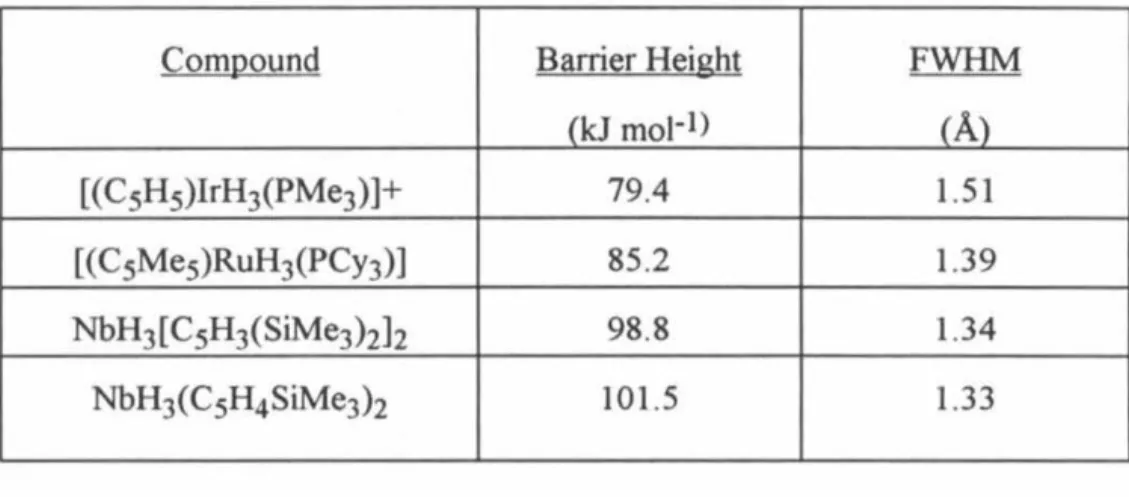
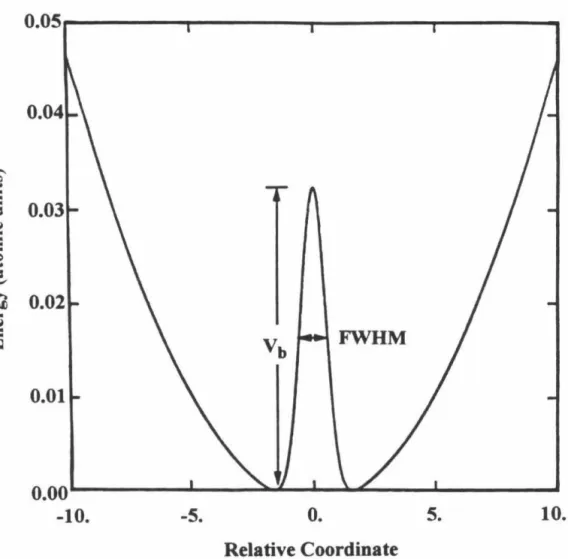
The wave function of the lower state in each pair is aligned (symmetric) with respect to the exchange of the spatial coordinates of the particles and the upper one is unaligned (antisymmetric). The barrier height and barrier width parameters that yielded the best fit for each of the compounds.
Conclusions
One might then hope that exchange couplings will become reliable indicators of features of the nuclear potential that are not sensitively probed by mean nuclear position or vibrational frequencies. Should this prove to be a dominant effect, the interpretation of the temperature dependence of the exchange coupling may prove to be more subtle than outlined here.
Tunnelling Effects on NMR Lineshapes
- Introduction
- Chemical Exchange Effects in NMR
- Q uantum-Mechanical Tunnelling and Chemical Exchange
- Spin Dynamics of Tunnelling and Chemical Exchange
- Spatial Dynamics of Tunnelling and Chemical Exchange
- Results and Summary
In the current approach, the interaction representation used only removes the average Larnor frequency of the two locations. Both models contain simplifications that do not apply in the case of the metal hydrides. The chemical exchange rate calculation due to tunnel split fluctuations can now be calculated.
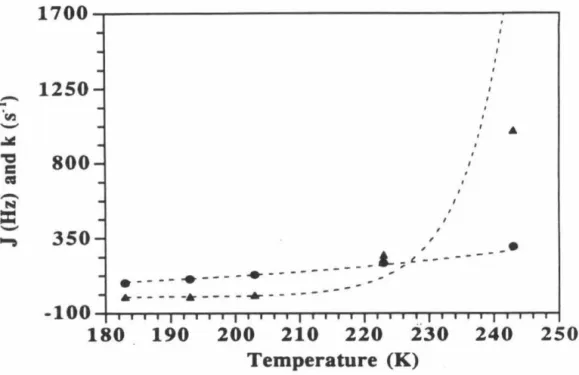
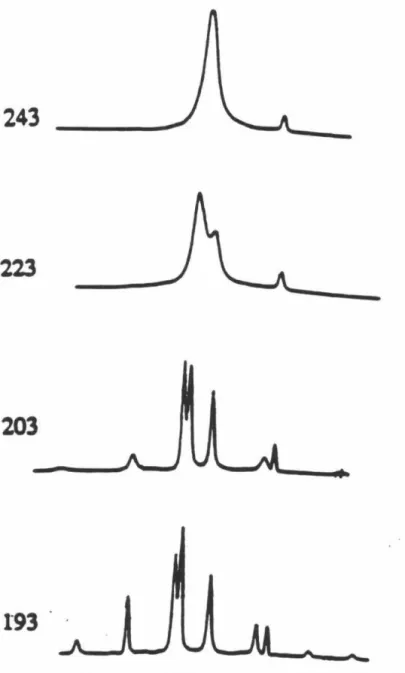
A symmetric double well fits the data of Arliguie eta/ for Cp*RuH3[P(CHMe2)3].25 The barrier height found for the double well fitting the temperature-dependent tunneling fissions is 6.8 kJ moJ-1. 1/T for the classically determined exchange rate yields an Arrhenius activation energy for exchange of 50 kJ moJ-1. From Figure 3.3 it can be easily seen that the temperature increase for the exchange rate is much sharper than that for the average scalar coupling.
Other treatments that neglect the quantum mechanical behavior of these metal hydrides when calculating chemical exchange effects fail to present a self-consistent physical model for the intramolecular particle exchange. This similarity emphasizes the fundamental differences between the present treatment and previous treatments of chemical exchange. The results presented place quantum mechanical chemical exchange in the broader class of problems involving the fluctuation-dissipation theorem.
Stochastic Averaging in Magnetic Resonance
Introduction
The Traditional Stochastic Average
This expression thus converges with previous prescriptions where averages were taken over classical configurations of the nuclear positions. The weighted average of any spatial state is independent of the spin state, since the spin energies are ignored in the Boltzmann weightings. The neglect of spin energies could be justified if transitions between spatial states are strictly concerted for all spin states, a dynamics in the factorization of.
An Alternative Stochastic Average
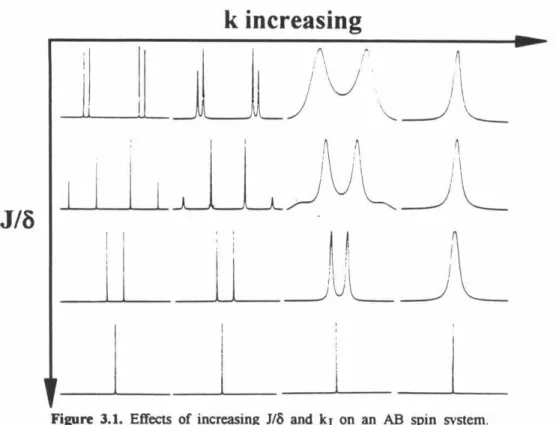
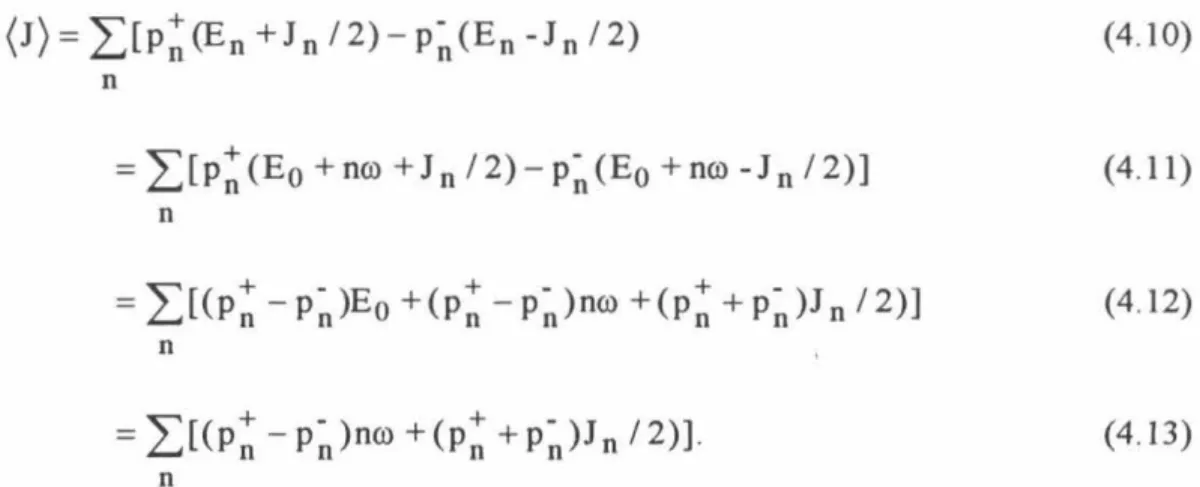
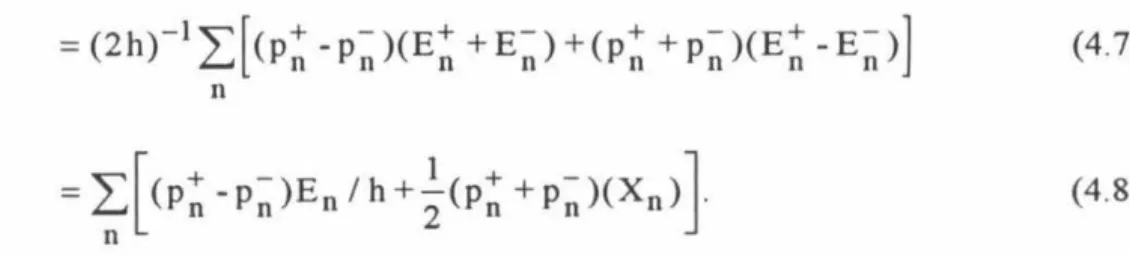
The average of the spin parameter J is written as the difference between the average energies of states with a spin energy term of + J/2 and those with a spin energy term of -112. An alternative approach to formulating an expression for a new form of the mean spin parameter uses a weakly coupled high-field AB spin system. The conceptual and quantitative differences between the new formulation and the traditional formulation of the mean spin parameters led to an investigation of systems that could definitively confirm one or the other formulation.
Other Expressions of Temperature-Dependent Spin Parameters
The outputs of these approaches are the coefficients of the expansion in J() and potential energy surface parameters that provide good fits to the data. These approaches have been used for the calculation of the temperature dependence of parameters in the slow-exchange regime where spin parameters can show the effects of the molecule being in a specific conformer such as a rotational pendulum. Small temperature dependencies like this can be measured in the slow exchange regime and included in the other forms of the stochastic average.
Discussion
In most cases, the number of unknowns is such that the form of the stochastic mean cannot be verified, but valuable information could be obtained if the correct form was known. This work clearly shows that the question needs to be reopened and is the first step in revisiting the experimental basis of Eq. Exactly the same question of how to calculate the stochastic average also arises in the (ab initio) theoretical calculation of the measurable spin Hamiltonian from the expected values of the underlying molecular eigenstates, which are almost never long-lived enough to be measured individually by magnetic resonance.
Introduction
Systems for which slow-exchange data are not available are often modeled with approximate forms of temperature-dependent parameters, such as the temperature-dependent Karplus equations reviewed in Chapter 4. Even in systems where the slow-exchange parameters are available, the traditional form of the stochastic mean often makes predictions dramatically different from the observed fast-exchange values. Some experimental considerations cited as possible causes for these failures are temperature-dependent behavior of the X0 and solvent-solute interactions.
Experimental Features of Test Systems
The state dependence of conformer spin Hamiltonians and free energy differences must be measured in the slow exchange region to allow extrapolation through the fast exchange region. This is often the main source of uncertainty due to the small temperature range corresponding to slow exchange. When this difference exceeds -103 cal moi-l, the sensitivity will usually prevent observation of the slow exchange spectrum of the smaller conformer.
Tunnelling Trihydrides
Two values of the phosphorus hydride coupling in Ir(C5Me5)(PMe3)H3 are observed at low temp. In studies of the fac and merisomers of IrH3(PEt2Ph)3 and IrH3(PPh3)3, 2JpH(cis) and 2JpH(trans) were found to have opposite signs, 9 thereby establishing that 2JpH(trans) is positive. The fact that the X spectrum is asymmetric with respect to the sign of JAB has been used to study the AB2X system of m-dinitrobenzene.

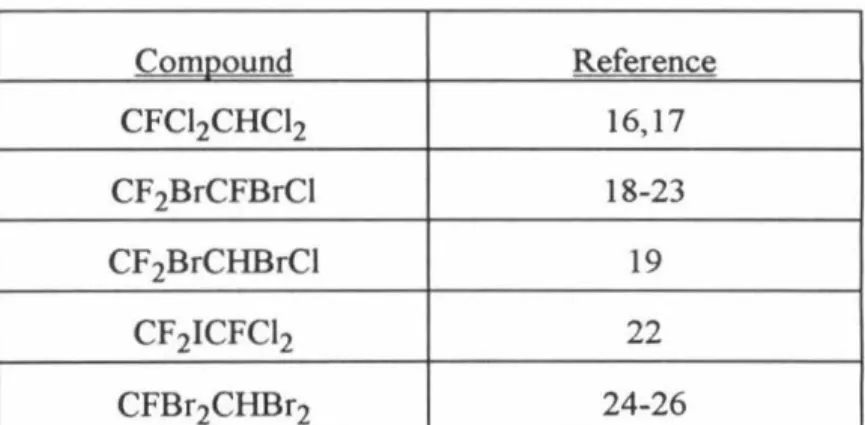
Rotational Isomers of Substituted Ethanes
Simulations of the fast exchange values for the average scalar coupling can still be performed. The temperature dependence of the slow exchange parameters is large enough to dominate the fast exchange behavior of the mean parameter. The temperature dependencies of the slow-exchange chemical shifts presented in Table 5.5 were linearly extrapolated and included in the fast-exchange calculations.
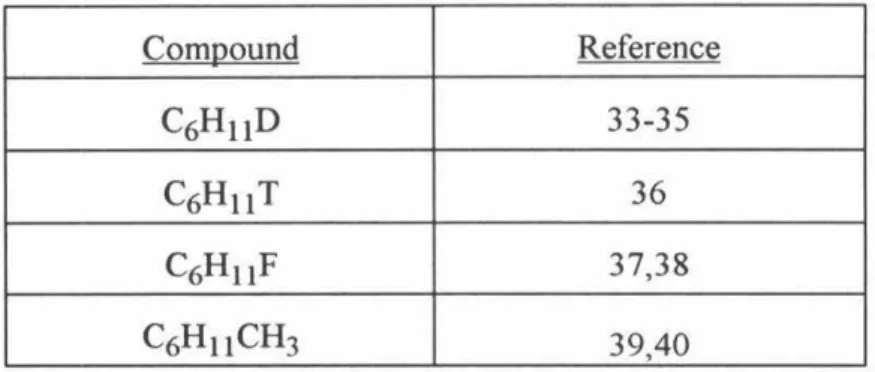
Isomers of Cyclic Compounds
This difference could allow the traditional mean to take on a wider range of values in a given parameter space, but such behavior would not necessarily reflect the correctness of the traditional form. The temperature-dependent spin parameters observed in CF2BrCFCIBr, which were not included in the calculations presented in Table 5.6, support the argument that the success of the traditional formulation for these data sets may be purely coincidental. The reported 37.38 .1G298 (axial-equatorial) values are 180 cal mol-l for C6H11F, 340 cal moi-l for C6H11Cl, and 270 cal moi-l for C6H11Br (all pure samples). The free energy difference for C6H11F shows a large dependence on the solvent, ranging from 90 cal moi-l in nitrobenzene to 200 cal moi-l in acetic acid)7,38 Relatively large, solvent-dependent free energy differences between the conformers are expected, which differ in polarity as much as the axial and equatorial forms of halocyclohexanes.
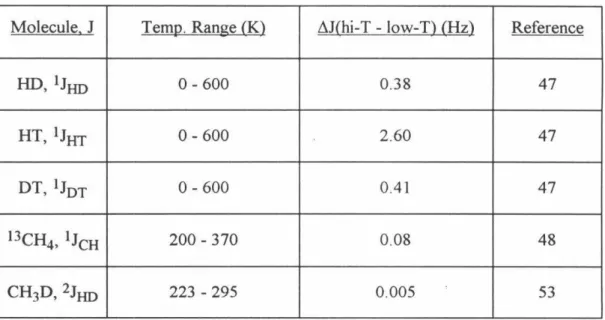
Isotopomers of Hydrogen, Methane, HF, and CH3F
Currently, measuring the spin parameters in each individual molecular eigenstate is not experimentally possible. The latter contribution is likely responsible for most of the solvent dependence of ~Gae for fluorocyclohexane. The dependence of cyclohexanes on solvents can be compared to the dependence of substituted ethanes.
Improved Accuracy by Field Cycling
The importance of resonant molecular collisions in creating the conformational averaging that occurs on the time scale of the NMR experiment could invalidate the entire concept of single molecule statistical mechanics as being sufficient for the problem. Studies of the effects of solute concentration on the averaging process are currently under consideration. Off-road cycling trials would make it possible to examine the latter question independently of the former.
Conclusions
The following is the complete treatment of the AB spin system using Redfield relaxation theory, as discussed in Chapter 3. The level shift operator basis is formed by the bras and kets of the singlet/triplet spin state basis. The following is a calculation of the effects of large, fluctuating spin parameters on zero-quantum transitions.
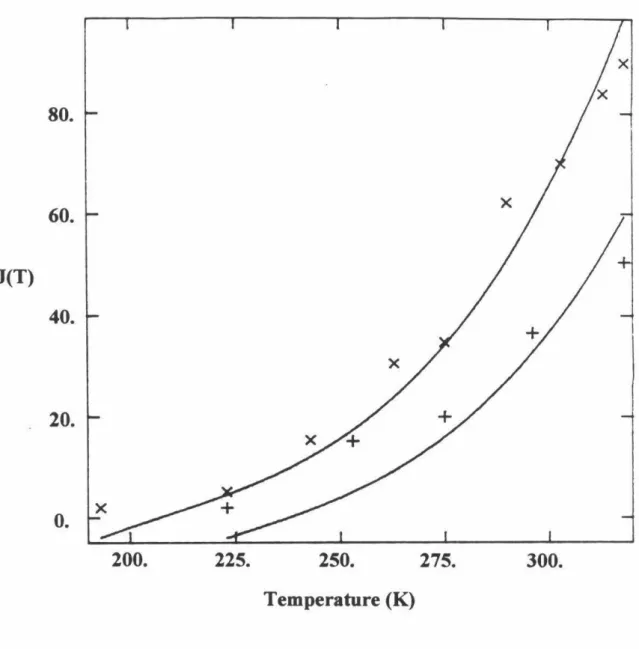
![Figure 2.2. The theoretical fits (lines) to the experimental values of the temperature-dependent scalar couplings in [(C 5 H 5 )IrH 3 (PMe 3 )]+](https://thumb-ap.123doks.com/thumbv2/123dok/10403166.0/33.856.133.763.193.818/figure-theoretical-experimental-values-temperature-dependent-scalar-couplings.webp)