The Reliability of Corporate Quarterly Financial Reports in Malaysia: Post-MASB 26 Evidence
Ku Nor Izah Ku Ismail (Corresponding author) College of Business, University of Utara Malaysia
06010 Sintok, Kedah, Malaysia
Tel: +604-9283906 E-mail: [email protected] Shamsul Nahar Abdullah
Department of Accounting and Finance Faculty of Management and Economics
University of Malaysia Terengganu,21030 Kuala Terengganu, Terengganu, Malaysia
Tel: +609-6683137 E-mail: [email protected] Abstract
This study examines the reliability of the quarterly reports of Malaysian listed companies after the Malaysian Accounting Standard Board (MASB) issued a standard on interim reporting, MASB 26 Interim Reporting in 2002. MASB 26 requires companies to adopt the discrete method in reporting most of the transactions. In particular, this study focuses on the reporting of exceptional items (EIs) in the quarterly reports, and is an extension of the study conducted in 2001 by Ku Ismail and Chandler (2005). This paper argues that the reports are more likely to be reliable if the discrete method is practiced. If the discrete method is applied, companies are less likely to defer the reporting of EIs to the final quarter, and thus, the incidence of EIs in all the four quarters is equally likely (i.e. not being lumped in the fourth quarter as a tool to “settle-up”). An examination of the 2003 quarterly reports of 91 companies reveals that half of the incidence of EIs is reported in the final quarter. The percentage is not significantly lower than those of the previous study. This indicates that MASB 26 fails to enhance the reliability of the quarterly reports as far as the EIs are concerned. In addition, this study indicates that the EIs reported in the fourth quarter are more likely to be negative than positive. Further, we find that companies that defer the recognition of EIs are more likely to be those listed on the Second Board rather than on the Main Board of Bursa Malaysia. With the recent convergence of accounting standards whereby many countries have adopted FRSs in totality, including a standard on interim reporting, the present research findings act as a basis for similar research in other emerging economies.
Keywords: Quarterly reports, MASB 26, Reliability of interim reports, Earnings management, Exceptional items.
JEL Classification: M41
1. Introduction
Various stock exchanges around the world, including Bursa Malaysia (previously known as the Kuala Lumpur Stock Exchange) have required interim financial reporting to ensure users receive more timely information. Interim financial reports help to reduce uncertainties, enhance investors‟ confidence, and improve users‟ decisions. In recent years, a number of stock exchanges have required more frequent reporting by imposing quarterly reports instead of half-yearly reports. A similar trend is also observed in Malaysia with Bursa Malaysia having required all listed companies to issue quarterly reports since 1999. This was one of the measures taken following the Asian financial crisis of 1997/1998 in an effort to reduce uncertainty and restore investors‟ confidence through timelier information.
In the Unites States of America (US), requirements to issue quarterly reports were introduced in 1970 when companies were required by the Securities and Exchange Commission (SEC) to publish quarterly income reports on Form 10Q. Following that, in 1973, the American Institute of Certified Public Accountants (AICPA) issued Accounting Principles Board (APB) Opinion 28 (Interim Financial Reporting). Numerous empirical studies have since been carried out which show that quarterly reports are useful to users; for example, they have been found to improve earnings forecasts (Fortin et al., 1997; Allen et al., 1999) and are associated with adjustments in stock prices (Kiger, 1972; Foster, 1977; Balsam et al., 2002). However, cases of accounting irregularities, such as those that involved Enron, Worldcom and Tyco International, cast doubt on the ability of quarterly reports in enabling the detection of fraudulent accounting practices at the earliest stage possible. Studies have also shown that companies manage their quarterly reports, thus rendering them unreliable (e.g. Givoly and Ronen, 1981; Kinney and Trezevant, 1997; Nigrini, 2005). It is generally believed that the use of the integral method rather than the discrete method of reporting, in addition to the fact that quarterly reports are not independently audited, provides more opportunities for companies to manage quarterly earnings in the US. Even though the use of the integral method is appropriate in some cases, the method requires a lot more judgment and estimates compared to the discrete method. Thus, the tendency for earnings management is more likely under the integral method than under the discrete method. Although APB Opinion 28 adopts both the discrete and integral methods (depending on the type of transactions), the latter is more dominant.
The integral method, as recommended in the US, regards a quarterly report as one of the reporting cycles in the full financial year reporting cycle. Bartsch (1989), for instance, notes that:
“Under this perspective, deferrals, accruals and estimates reported in each interim statement reflect the accountant‟s belief of what is likely to transpire relative to the results of operations for the entire year. Essentially, interim-period allocations are components of interim accounting reports prepared by the integral method”.
As opposed to the integral method, the discrete method treats each interim period as an accounting period distinct from the annual cycle. Under this method, deferrals, accruals and estimates at the end of each interim period should be determined by the principles that apply to the annual periods. The transactions reported in the interim period should reflect the economic activity of that particular quarter independent of the other quarters, rather than outcomes based on forecasts of the operations of the forthcoming year. The discrete view rests on the premise that when an annual period is both a discrete accounting period and a segment of the total life of an enterprise, the interim period should likewise be considered as both a discrete accounting period and a fraction of an annual period (Malaysian Accounting Standards Board (MASB)[1], 2000). Taken together, the sum of the interim figures must equal the annual figures, as reported in the full year‟s financial statements.
In applying the integral approach, APB 28 requires a specific cost that benefits more than one interim period, such as a major annual repair, to be appropriately apportioned and charged to each interim period. In another example, an inventory loss from a market price decline is not to be recognized at interim dates if the decline is expected to be restored before the end of the fiscal year. Under the discrete approach (as adopted by MASB 26, for example), the cost that benefits more than one interim period is not to be anticipated or deferred. Instead, the expense is fully recognized in the period in which it is incurred. As for inventory loss from a market price decline, MASB 26 requires recognition of the loss at the interim date. The above examples show that the use of judgment and estimation in determining the amount to be charged to a particular interim period is particularly prevalent under the integral method.
Thus, the integral method is subject to more earnings manipulation.
Given the nature of the integral method, Hussey and Woolfe (1994) contend that errors and manipulation would be more likely to occur, resulting in unreliable information in individual interim reports. In addition, because under- or over-allocations are more likely to occur under the integral approach, this could cause distortion of results in subsequent interim periods.
Thus, given this nature, information in the quarterly reports prepared using the discrete method is argued to be more reliable than that prepared using the integral approach. Based on this assertion, the Malaysian Accounting Standards Board‟s Standard 26 (MASB 26 Interim Financial Reporting, which was subsequently renamed as Financial Reporting Standard (FRS) 134) requires the use of the discrete method rather than the integral method in reporting most items.
One approach to determine the reliability of the quarterly reports is by observing the reporting of exceptional items (EIs; often referred to as unusual or infrequent items, but not both) that affect the income statement (see for example Ku Ismail and Chandler, 2005; and Kinney and Trezevant, 1997). MASB 26 requires companies to disclose among others, “the nature and amount of items affecting assets, liabilities, equity, net income or flows that are unusual because of their nature, risk and incidence” (MASB 26, paragraph 16). These items are often referred to as exceptional items. For the purpose of this study, we restrict our
definition of exceptional items to those that affect the net income. They include, among others, the write-down of inventories or its reversal, recognition of a loss from the impairment of assets or its reversal, loss or gain on disposal of investments and property, plant and equipment, and the reversal of any provisions for the costs of restructuring. We argue that companies are less likely to adopt the discrete method if EIs are deferred to the final quarter. It is argued that the quarterly reports are more likely to be unreliable if companies defer the reporting of EIs to the fourth quarter. Hence, deferment is more likely to occur when a company reports more exceptional items in the fourth quarter than in any other quarter. The deferment of EIs to the final quarter is intended to smooth the quarterly earnings of the previous three quarters if the EIs in the fourth quarters are negative than if the EIs in the fourth quarter is positive.
In the Malaysian context, Ku Ismail and Chandler (2005) are skeptical about the reliability of the quarterly reports. This is because they find more exceptional itemsbeing recognized in the fourth quarter than in any other quarters. This led the authors to believe that companies purposely defer the recognition of EIs to the final quarter of the year. Therefore, they postulate that managers use EIs to manage quarterly reports. This prediction seems to be supported as they found that the EIs reported in the fourth quarter are more likely to be negative. This indicates that quarterly earnings of the other three quarters are likely being overstated and management delays bad news by overstating interim earnings through the postponement of the release of unfavorable news to the final quarter.
The above study was conducted in 2001 when MASB 26 was at its draft stage. Companies then had the choice of adopting either the integral or the discrete method of reporting.
Therefore, the practice of deferring of EIs to the final quarter and the pervasiveness of negative adjustments in the fourth quarters found by Ku Ismail and Chandler (2005) was not surprising. MASB 26 was issued as a standard by the MASB in 2002 and was made effective on 1 July 2002. The standard requires companies to adopt the discrete method in reporting most of their transactions rather than the integral method of reporting. Compliance with MASB 26, specifically with the application of the discrete method, would enhance the reliability of the quarterly reports.
Given that companies are now required to observe MASB 26 (now FRS 134) which adopts the discrete view of reporting, this paper seeks to revisit the study by Ku Ismail and Chandler (2005). First, this study seeks to determine if the reliability of the quarterly reports is enhanced after the issuance of MASB 26, as far as the reporting of EIs is concerned. There will be reasons to believe that the reliability of the quarterly reports is enhanced if the practice of deferring the reporting of EIs to the final quarter is significantly reduced. Second, this study will observe if the reports of the first three quarterly reports are overstated. In other words, it will observe if companies defer the reporting of negative EIs to the final quarter.
In addition, this study investigates whether the pattern of a firm‟s ownership explains the decision to defer the reporting of EIs to the final quarter. The motivation to examine this variable is due to the fact that the ownership pattern of Malaysian firms is unique compared
to the ownership patterns of firms in developed countries. The shareholdings of companies in Malaysia tend to be closely-held rather than widely dispersed. We base on management entrenchment theory, information argument and agency theory in explaining the association between the reliability of quarterly reports and ownership structure. Management entrenchment theory (see for example, Wetson, 1979) argues that high management interest is more likely to be associated with unreliable financial information because the controlling owner of the firm decides on the accounting policies and the amount of disclosure. Consistent with management entrenchment, information argument believes that concentration of ownership enables companies to limit the amount of disclosure to the public. This is done to protect the information from being known to competitors or to avoid unwanted political or social scrutiny (Fan and Wong, 2002). Agency theory, on the other hand, argues that low management interest leads to greater manipulation of accounts due to the misalignment of the interests of management and owners (Warfield et al., 1995). Finally, company characteristics, which have been examined previously in voluntary disclosure-based studies (namely size, profitability, leverage and listing status of a company), are also included to determine if they influence the practice of reporting EIs in quarterly reports.
The remainder of this paper is organized as follows. In the next section, this paper provides a review of relevant studies. Following that we present the research methods and hypothesis development. The findings of the study will be presented next. Finally, we will provide our conclusions.
2. Previous Studies
2.1 Earnings Management and Interim Reporting
The ambiguity of accounting standards and the adoption of the integral method (as opposed to the discrete method), among others, contribute to the potential for abuse in the reporting of interim information (Mendelhall et al., 1988; Doran, 1995; National Commission on Fraudulent Financial Reporting, 1987). For instance, interim reporting failures in the US contributed greatly to the Dot.com bubble of 1999/2000. The discretion available and the application of the integral method as proposed in APB Opinion 28 often lead to the practice of earnings management among firms in the US, in which the fourth quarter "settling-up"
effect is often observed. A fourth quarter “settling-up” occurs when management has under- or over-estimated the interim earnings and subsequently makes use of the fourth quarter to absorb the corrections or misstatements made in the previous three quarters.
A number of studies have examined the extent of earnings management in interim reports.
Givoly (1974), as cited by Givoly and Ronen (1981), observes that the standard deviation of the fourth quarter‟s income of US companies significantly exceeds that of the first three quarters. The findings thus suggest that not all quarterly data are equally reliable and it is argued that managers make year-end accounting adjustments in an attempt to smooth annual income numbers. The finding is supported by Givoly and Ronen (1981) and Fried et al.
(1987). The latter find large write-offs are observed in the fourth quarter.
Subsequent research studies by Kinney and McDaniel (1989) and Doran (1995) reveal that earnings originally reported in the first three quarters are overstated. This is especially the case for companies that are relatively small, less profitable, highly geared, laggard in growth, and given qualified audit opinions (Kinney and McDaniel, 1989). In other words, financially weak firms are more likely to window dress their quarterly reports than their financially strong counterparts. Doran (1995) supports the notion that management may have incentives to overstate interim earnings by delaying bad news and, where the integral method is adopted, they may make optimistic full year estimates for interim reporting purposes. In Canada, Fortin et al. (1997) reveal that fourth quarter net income accounts for the highest percentage of the annual net income. This suggests that management makes major adjustments in the fourth quarter. The authors thus conclude that adjustments are made because either their estimates are not accurate or that they purposely manage the interim income such that the annual income looks more favorable. However, it is often difficult to equate motive and intent with actions. In some cases, preparers may be overly optimistic rather than having the intent to deceive.
Kinney and Trezevant (1997) provide additional evidence that „special items‟ are used to manage earnings and more of these items are recognized in the fourth quarter than in any other quarter. This finding provides support for the notion that earnings reported in the fourth quarter differ significantly from earnings reported in earlier quarters. Considering that there is evidence that special items are used to manage income, the results imply that earnings reported in the fourth quarter might be subjected to more manipulation than earnings reported in other quarters. As discusses earlier, the same evidence was found in respect to Malaysia by Ku Ismail and Chandler (2005).
2.2 Ownership Structure and Financial Reporting
The issue of ownership structure emerges with the issuance of shares to the public who may hold insignificant amounts of shares in a firm. If many shareholders hold shares and there is no ultimate shareholder with controlling power, the ownership pattern is said to be widely dispersed. On the other hand, when there is an ultimate shareholder with controlling power and the shares are held by few shareholders, the ownership is argued to be closely-held.
Interest in the pattern of ownership arises because of the separation of control and decisions, with management dominating the latter role.
The pattern of companies‟ shareholdings in Malaysia is argued to be closely-held (Fatimah, 2001; Abdullah and Mohd-Nasir, 2004). Abdullah and Mohd-Nasir (2004) show that the top 20 shareholders of the Bursa Malaysia Main Board companies account for, on average, 73 percent of a firm‟s traded shares. In an earlier study, Abdullah (2002) reveals that the average shareholding of a firm‟s largest shareholder was about 37 percent in the year before the 1997 Asian financial crisis. This ownership pattern could lead to the interests of controlling shareholders being pursued aggressively at the expense of the non-controlling shareholders.
To ensure that the interests of a firm‟s non-controlling shareholders are protected, a sufficient number of independent representations on the board are required. To this end, the Malaysian Code on Corporate Governance (Finance Committee on Corporate Governance, 2001) stipulates that when a company has a significant shareholder on the board, in addition to requiring the company to have one-third of the board members being independent, the board should include a sufficient number of directors that can fairly represent the investment of shareholders other than the significant shareholder.
Management interest and the quality of earnings are related as shown, for instance, by Warfield et al. (1995). They find that the extent of shareholding by management positively influences the informativeness of earnings, as indicated by the earnings response coefficient (ERC). Their argument is that when the level of management ownership is low, contracts would be written to constrain management‟s opportunistic behaviors. Since the contracts rely on the accounting numbers, the accounting numbers which are purported to constrain management‟s opportunistic behaviors are capable of being manipulated. This is because management still has the discretion in choosing accounting methods which in turn would reduce earnings informativeness. However, in a study in Malaysia by Abdullah (1999), such evidence is not supported where the ERC is found to be insignificant. Subsequent studies in Malaysia (Abdullah, 2002; Abdullah et al., 2004) also fail to document evidence on the impact of the extent of management interest on the level of accounting disclosure and the choice of accounting methods for goodwill, respectively.
In examining earnings informativeness of companies from seven countries in East Asia, including Malaysia, Fan and Wong (2002) contend that the power of the controlling shareholders in these countries is even more profound where the controlling owners can exert more power than their equity shareholdings due to the complicated ownership structure arising from cross-holdings. Consistent with their contention, they document that the informativeness of earnings is reduced with the increase in ownership concentration. They argue that concentration of ownership leads to agency conflicts between controlling owners and outside shareholders. This results in the controlling owners being perceived by the public to report accounting information for their own purposes rather than for the information of other users. This perception causes other outside shareholders to lose confidence in the reported earnings.
3. Hypothesis
3.1 Reliability of the quarterly reports
Quarterly reports are argued to be unreliable when companies delay the reporting of accounting items to the final quarter or use the final quarter as a “settling-up” period.
“Settling-up” can be detected by examining the reporting of EIs in each of the four quarterly reports. The incidence of „settling up‟ is expected to be present if the incidence of EIs reported in the fourth quarter is greater than that reported in any other quarters. In this respect,
for each company under study, the proportion of the incidence of EIs in each quarter to the total incidence of EIs reported in all quarters is calculated. The incidence of reporting negative EIs are also observed. If more negative adjustments rather than positive adjustments are made at the end of the year, there is an indication that earnings of the earlier quarters are more likely to be overstated than understated.
Based on the belief that companies are more likely to adopt the discrete method of reporting after the issuance of MASB 26, we hypothesize that companies tend not to delay the reporting of EIs to the fourth quarter. In addition, we hypothesize that the first three quarterly reports are not overstated. We thus form our hypotheses as follows:
H1: The incidence of EIs reported in each of the four quarters is equally likely, and
H2: The incidence of negative and positive EIs reported in the fourth quarter is equally likely.
Subsequently, the current findings would be compared with that of Ku Ismail and Chandler (2005) to determine if the reliability of the quarterly reports improves after the implementation of MASB 26. A substantial reduction in the proportion of EIs being recognized in the final quarter implies that the reliability of the quarterly reports improves after the issuance of MASB 26.
3.2 EIs and Ownership Structure
The relationship between the reliability of quarterly reports and ownership structure could be explained from the perspectives of management entrenchment theory, information argument and agency theory. Management entrenchment theory (Weston, 1979; Morck et al., 1988; Fan and Wong, 2002) argues that high management interest leads to high likelihood of unreliable financial information. The controlling owner of the firm effectively decides “… the accounting reporting policies” (Fan and Wong, 2002: 403) which could lead to low quality accounting information. This incentive is primarily driven by the controlling owner‟s motive to hold up the firm‟s non-controlling shareholders (Fan and Wong, 2002). Thus, the manipulation is achieved by deferring the disclosure of the EIs to mislead the firm‟s non-controlling shareholders. The non-controlling shareholders do not have access to the information about the firm other than the published information, i.e. quarterly reports.
Likewise, information argument also sees the influence of a firm‟s controlling shareholders on the flow and the amount of information to be made available to the public (i.e. the non-controlling shareholders). The concentration of ownership enables companies to limit the amount of disclosure to the public (Fan and Wong, 2002), especially of proprietary-type information. This is done to protect the information from being known to competitors or to avoid unwanted political or social scrutiny (Fan and Wong, 2002).
Agency theory, on the other hand, would predict the relationship between the deferment of EIs and management interest to be negative (Jensen and Meckling, 1976). This is due to the
misalignment of the interests of management and owners. Agency theory argues that in order to align the interests of management who often hold negligible shares in the firm, contracts are written, such as bonus plans and debt covenants. These contracts, which rely on the accounting numbers, are written to constrain the anticipated opportunistic behaviors of managers. Due to flexibility, managers have a wide discretion in applying the accounting standards. Thus, despite the presence of contracts, low management interest often leads to the manipulation of accounts because management has the flexibility in choosing the set of accounting policies (Warfield et al., 1995). Managers also have such flexibility when preparing quarterly reports; thus the flexibility leads to the quarterly reports being less informative (Warfield et al., 1995). In order to effectively mitigate agency problem, it is argued that managers should hold significant amount of shares so that their interest and those of other shareholders converge. The higher the management interest, the more informative will be the accounting information because of less manipulation. The relationship, nevertheless, is not monotonic - the relationship between firm value and management ownership is positive at the lower levels and negative at higher levels (e.g. Morck et al., 1988;
McConnell and Servaes, 1990). Therefore, agency theory is in conflict with management entrenchment theory and information argument. Further, the evidence provided by Fan and Wong (2002), in which Malaysian companies are included in their sample, reveals that the informativeness of earnings is significantly lower when voting rights (i.e. control) of the ultimate shareholder are high. This evidence appears to be consistent with management entrenchment theory and the information argument, but inconsistent with agency theory.
Previous studies in Malaysia (e.g. Abdullah et al., 2002) also fail to confirm the importance of agency theory in explaining management‟s income smoothing incentives. The ownership pattern in Malaysia, which is closely held, as opposed to a widely-dispersed ownership pattern in the US and where agency theory was first developed, contributes to evidence not supporting agency theory.
Based on the evidence of Fan and Wong (2002), and in line with information theory and management entrenchment theory, this study hypothesizes that the concentration of ownership by management is positively associated with the deferment of EIs to the final quarter. Concentration of ownership is observed from two perspectives – management interest and family ownership. Management interest is measured by the percentage of shares owned by management. As for family ownership, companies are classified into family controlled and non-family controlled. The classification is achieved by examining the composition of the board of directors. If the family of the substantial shareholder dominates the board of directors, the firm is said to be family-controlled[2]. A firm is deemed to be dominated by the family of a substantial shareholder if the family represents at least thirty percent of the board of directors. A value of “1” is given if the firm is family-controlled and a value of “0” if it is not family-controlled. Based on the above discussion, the following hypotheses are tested:
H3: Companies with higher concentration of ownership by management are more likely to defer EIs to the final quarter.
H4: Family-controlled firms are more likely to defer the reporting of EIs to the final quarter.
3.3 EIs and Other Firm Characteristics
We further predict that the deferment of EIs to the final quarter is associated with size, profitability, leverage and board listing status of a company. Ettredge et al. (1994) provide evidence that size is negatively associated with the extent of adjustments made in the fourth quarter, and Kinney and McDaniel (1989) show that size of a company is negatively associated with the number of errors found in the quarterly reports.
Reports of smaller firms are argued to contain more errors than are those of larger firms.
Kinney and McDaniel (1989) offer two reasons why smaller companies are expected to have more errors. First, larger firms are more likely to have internal audit teams whose activities might reduce the incidence of errors in quarterly reports. Smaller firms, on the other hand, would be more likely to depend on external auditors for error detection. Second, size has often been associated with the quality of internal control of a firm. Larger firms are expected to have better internal controls than smaller firms.
Kinney and McDaniel (1989) contend that financially troubled firms are more likely to
“window dress” in an attempt to hide their financial problems. They hypothesize and find that profitability of a company is negatively associated with the number of errors found in the quarterly reports. In addition, they also conjecture that leverage is positively related to the number of errors. This is because the higher the ratio of debt to total assets, the higher the risk of failure. Kinney and McDaniel (1989) provide evidence to support their contention.
Additionally, one distinctive feature of the Bursa Malaysia is that it has two boards: the Main Board and the Second Board. Companies in the two boards are differentiated by the number of shares being traded on the exchange. Both Main Board and Second Board companies are subjected to the same listing requirements imposed by the Bursa Malaysia. However, given the exposure in the capital markets by the number of shares traded, the Main Board firms are predicted to be followed more closely by analysts than the Second Board firms. Trading of shares of the Second Board firms is usually less active than for the Main Board firms.
Because the Main Board companies are more likely to be scrutinized by analysts, and any manipulation is more likely to be detected, we expect that they are less likely to manipulate their quarterly reports compared to those of the Second Board. Thus, the deferment of EIs is more likely among the Second Board companies than those of the Main Board firms. Hence, the hypotheses are as follows:
H5: Smaller companies are more likely to defer the reporting of EIs to the final quarter.
H6: Less profitable companies are more likely to defer the reporting of EIs to the final quarter.
H7: Higher leveraged companies are more likely to defer the reporting of EIs to the final quarter.
H8: Second Board companies are more likely to defer the reporting of EIs to the final quarter.
We measure firm size by the total assets of a company, a measure used in a large number of studies (for example Hossain and Adams, 1995; Schadewitz and Blevins, 1998). Although there are various measures of profitability (such as return on assets, EPS and net income), this study measures profitability by the profit margin of a company, that is, the ratio of net income to sales.
Various measures of leverage have been adopted in the literature, depending on the objective of the analysis (Rajan and Zingales, 1995). Leverage could be measured in terms of book value (for example, the ratio of the book value of total liabilities to book value of total assets, or the ratio of book value of debt to book value of equity) or market value (for example, the ratio of market value of debt to market value of equity). This study measures leverage in terms of the ratio of debt to total assets, as employed by Courtis (1979) and Chow and Wong-Boren (1987).
4. Research Methods
4.1 Sample and Data Analysis
Sample companies for this study were those listed on the Bursa Malaysia as of 31 December 2002 with financial year-ends falling on 31 December. Companies with other year-ends were not included to avoid non-uniformity and seasonality problems. Companies listed under the finance, trust and closed-end fund categories were also excluded from the sample because they have to comply with additional requirements with respect to financial reporting. We finally had 410 companies in the sampling frame. Quarterly reports for the year 2003 of these 410 companies were subsequently scrutinized for the reporting of EIs. Out of these, only 91 companies (22 percent) reported EIs in at least one of the 2003 quarterly reports, and are thus included as sample firms in this study. Of the 91 companies, 69 were listed on the Main Board and 22 were traded on the Second Board.
This study adopts the method employed by Kinney and Trezevant (1997), Ettredge et al.
(2000) and Ku Ismail and Chandler (2005). To examine the reliability of the quarterly reports, first the incidence of exceptional items reported in each of the four quarterly reports is observed. Although some of the EIs reported in the final quarter are genuine, the quarterly reports of a company are more likely to be unreliable (or less likely to adopt the discrete method) if more exceptional items are found in the final quarter than in any of the first three quarterly reports. This is because we expect that a company which reports more EIs in the final quarter has a greater tendency to purposely defer the reporting of EIs compared to a company that has an equal or a lesser incidence of EIs in the final quarter. Deferment is less likely if the EIs are equally reported in each of the four quarterly reports. Although the
relationship between deferment and the choice of reporting approach could not be justified in this study, based on previous literature we believe that companies that defer are less likely to adopt the discrete approach of reporting as required by MASB 26 in recording most of the EIs.
Second, we also expect that a report is less likely to be reliable if the first three quarterly earnings are likely to be overstated or if there is a tendency for companies to delay bad news.
A company is more likely to overstate its first three quarterly earnings if more negative EIs are reported in the final quarter than in the first three quarters.
To test the hypotheses related to management ownership and other firm characteristics, the following logistic regression model is used:
DEFER = α + β1FmOwn + β2MgOwn + β3Size+ β4Profit + β5Lev + β6Board + ε (1) Where,
DEFER = „1‟ if the incidence of 4th quarter EI is greater than in any other quarters, otherwise „0‟,
MgOwn = percentage of management ownership, FmOwn = percentage of family ownership,
Size = size of a company, measured by natural log of total assets, Profit = profitability, measured by profit margin,
Lev = leverage, measured by ratio of debt to total assets,
Board = „1‟ if listed on the Main Board of Bursa Malaysia, and „0‟ if listed on the Second Board, and
ε = error term.
5. Results and Discussion
Table 1 presents the reporting of EIs in the quarterly reports. In comparing the pattern of reporting between pre- and post-MASB 26, Table 1 also reproduces the findings from Ku Ismail and Chandler (2005). It is shown that 44 out of 91 companies (i.e. 48.4 percent) reported more incidence of EIs in the fourth quarter than in any other individual quarters and 34 of these companies (37.4 percent) report greater incidence of EIs in the final quarter than in the first three quarterly reports combined. In an earlier study by Ku Ismail and Chandler (2005), the incidence rates were 56.1 percent and 42.1 percent, respectively. Hence, the present results imply that the tendency for companies to defer the reporting of EIs to the final quarter has decreased following the implementation of MASB 26. However, the Chi-square results shown in Table 2 reveal that the percentage drop is not significant. This implies that the implementation of MASB 26 has not been able to ensure the use of the discrete method.
Thus, this evidence casts doubt on the ability of MASB 26 to enhance the reliability of the quarterly reports, as far as the reporting of EIs is concerned.
Table 1. Reporting of EIs in the quarterly reports
Yes
No
Ku Ismail and Chandler (2005)
Yes No
Freq % Freq % Freq % Freq %
Companies reporting incidence of EIs in the 4th quarter more than in
any other quarter 44 48.4 47 51.6 64 56.1 50 43.9
Companies reporting incidence of EIs in the 4th quarter more than in the
first three quarters combined 34 37.4 57 62.6 48 42.1 66 57.9
Table 2. Incidences of EIs in the 4th quarter: Pre- and post-MASB 26 periods
Present study (post-MASB26)
Ku Ismail and Chandler (2005) (pre-MASB26)
Sub-totals
Companies reporting incidence of EIs in the 4th quarter more than in any other quarter
48.4% 56.1%
104.5%
48.6%* 55.8%*
Companies reporting incidence of EIs in the 4th quarter more than in the first three quarters combined
37.4% 42.1%
79.5%
37.1%* 42.4%*
Sub-totals 85.8% 48.2% 184%
*Expected value
χ2 = 0.00698, the critical value is χ2=3.84 (d.f = 1, α=0.05)
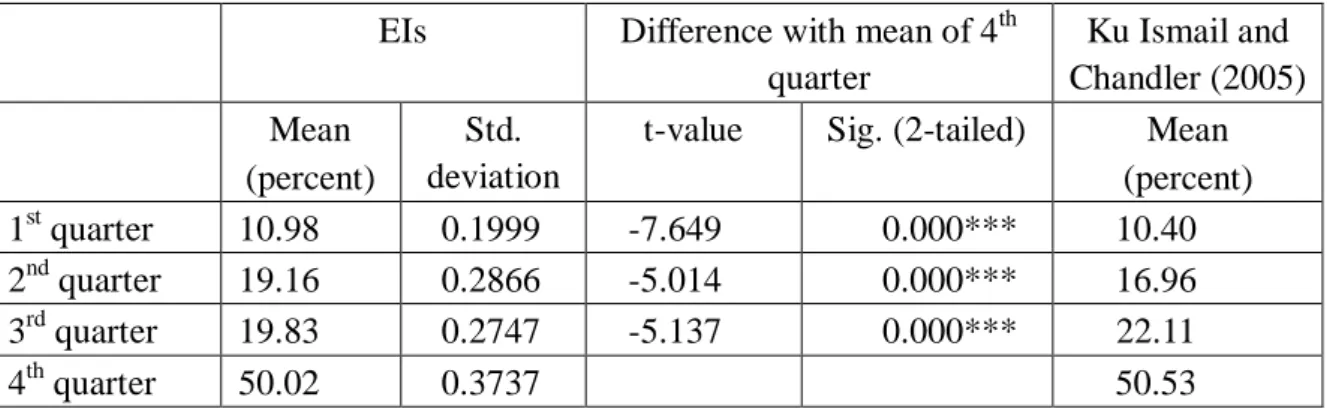
Table 3 reports the overall mean proportion of the incidence of EIs reported in each quarter.
In the first quarter, the lowest proportion (10.98 percent) of EIs was reported and the value increased as the quarters moved towards year-end, with the fourth quarter reporting the highest proportion (50.02 percent). Results of paired t-tests on the equality of means shown in Table 3 indicate that the proportion of the incidence of EIs reported in the fourth quarter is significantly higher than for each of the other quarters. The finding is consistent with that of Ku Ismail and Chandler (2005) - see the last column of Table 3 for comparison. This suggests
that the tendency for companies to defer the reporting of EIs to the final quarter still prevails even after the issuance of MASB 26, which reinforces the findings in Table 1.
Table 3. Proportion of the incidence of EIs in each quarter
EIs Difference with mean of 4th quarter
Ku Ismail and Chandler (2005) Mean
(percent)
Std.
deviation
t-value Sig. (2-tailed) Mean (percent)
1st quarter 10.98 0.1999 -7.649 0.000*** 10.40
2nd quarter 19.16 0.2866 -5.014 0.000*** 16.96
3rd quarter 19.83 0.2747 -5.137 0.000*** 22.11
4th quarter 50.02 0.3737 50.53
***Significant at the 0.01 level
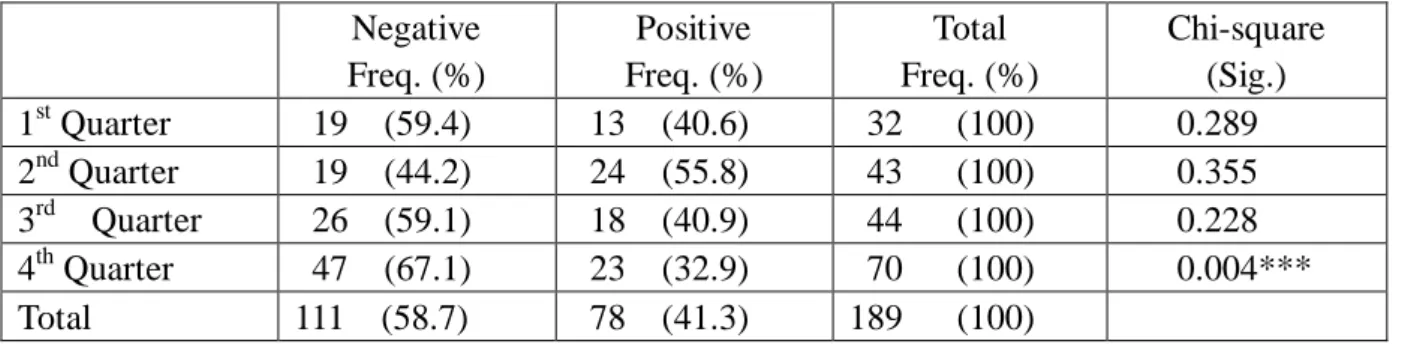
The signs of the EIs reported in each quarter, that is, whether they are positive or negative in nature, are reported in Table 4. The results in Table 4 show that during the fourth quarter, the number of negative EIs (67.1 percent) outnumbers positive EIs (32.9 percent) significantly.
Because our evidence shows that more negative adjustments rather than positive adjustments are made at the end of the year, this provides an indication that earnings of the earlier quarters are more likely to be overstated than understated. The findings fail to support our hypothesis (H2) that earnings of the first three quarters are not likely to be overstated. The findings are consistent with those of Doran (1995) and Ku Ismail and Chandler (2005) who reveal that quarterly earnings for the first three quarters are overstated. Thus, the notion that management may overstate interim earnings by delaying the release of negative information until the final quarter still occurs despite the move made by the MASB to require the application of the discrete method. Thus, the reliability of earnings in the quarterly reports is questionable. Although the actual motivation as to why companies delay the reporting of EIs to the final quarter is not addressed in this study, there are reasons to believe that managers make use of EIs in the quarterly reports as a tool to manage earnings. Results may also imply that companies are either ignorant or lacks the knowledge on how to apply the discrete method in reporting EIs. In ensuring that the discrete method is fully complied with, serious efforts should be taken by the regulators to provide management and preparers with a better understanding of the method. It may take some time for companies to fully apply the method.
Table 4. The signs of EIs reported in each quarter Negative
Freq. (%)
Positive Freq. (%)
Total Freq. (%)
Chi-square (Sig.) 1st Quarter 19 (59.4) 13 (40.6) 32 (100) 0.289 2nd Quarter 19 (44.2) 24 (55.8) 43 (100) 0.355 3rd Quarter 26 (59.1) 18 (40.9) 44 (100) 0.228 4th Quarter 47 (67.1) 23 (32.9) 70 (100) 0.004***
Total 111 (58.7) 78 (41.3) 189 (100)
*** Significant at the 0.01 level
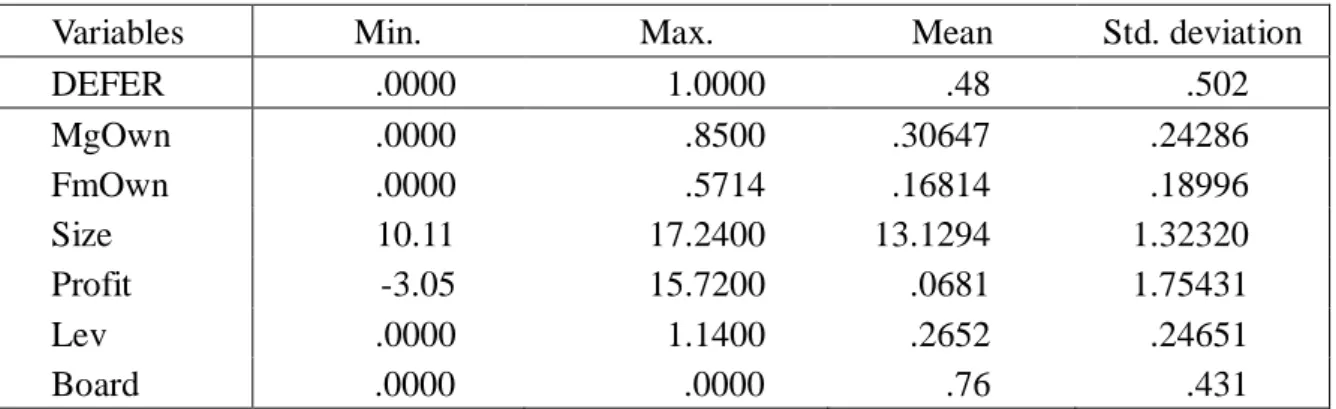
Table 5 presents the descriptive statistics of the variables used in the regression model. The results presented in Table 5 confirm the pattern of firm ownerships in Malaysia, which are closely-held (e.g. Fatimah, 2001; Abdullah and Mohd-Nasir, 2004). For instance, the average managerial ownership is 30 percent and family ownership is 17 percent. It is a relatively common practice in Asian countries, especially in Malaysia, to appoint family members as top management of companies.
Table 5. Descriptive statistics
Variables Min. Max. Mean Std. deviation
DEFER .0000 1.0000 .48 .502
MgOwn .0000 .8500 .30647 .24286 FmOwn .0000 .5714 .16814 .18996 Size 10.11 17.2400 13.1294 1.32320 Profit -3.05 15.7200 .0681 1.75431 Lev .0000 1.1400 .2652 .24651 Board .0000 .0000 .76 .431 Table 6 presents results from correlation analysis. It is shown that two correlation coefficients are deemed to be high – those for management and family ownerships (0.430), and organisation size and listing board (0.508). However, according to Cooper and Schindler (1998), high correlations are acceptable so long as they are not greater than 0.8. Based on this argument, the high correlation coefficients (i.e. 0.430 and 0.508) as shown in Table 6 are within the acceptable range and therefore do not affect the explanatory power of these independent variables (i.e. MgOwn, FmOwn, Board, and Size) on the dependent variable.
Table 6. Correlation analysis
MgOwn FmOwn Size Profit Lev Board
DEFER -.054 -.040 -.105 -.093 .055 -.275***
(.609) (.709) (.330) (.389) (.612) (.008)
MgOwn .430*** -.147 -.125 .008 -.056
(.000) (.170) (.246) (.944) (.598)
FmOwn -.187 -.065 -.040 -.111
(.081) (.545) (.708) (.295)
Size -.168 .110 .508***
(.118) (.306) (.000)
Profit -.163 .090
(.130) (.403)
Lev -.301***
(.004)
***Significant at the 0.01 level (2-tailed).
Table 6 also shows that board listing is significantly associated with the deferment of EIs.
Second Board companies are more likely to defer the reporting of EIs compared to the Main Board companies. Other variables seem not to influence the reporting of EIs.
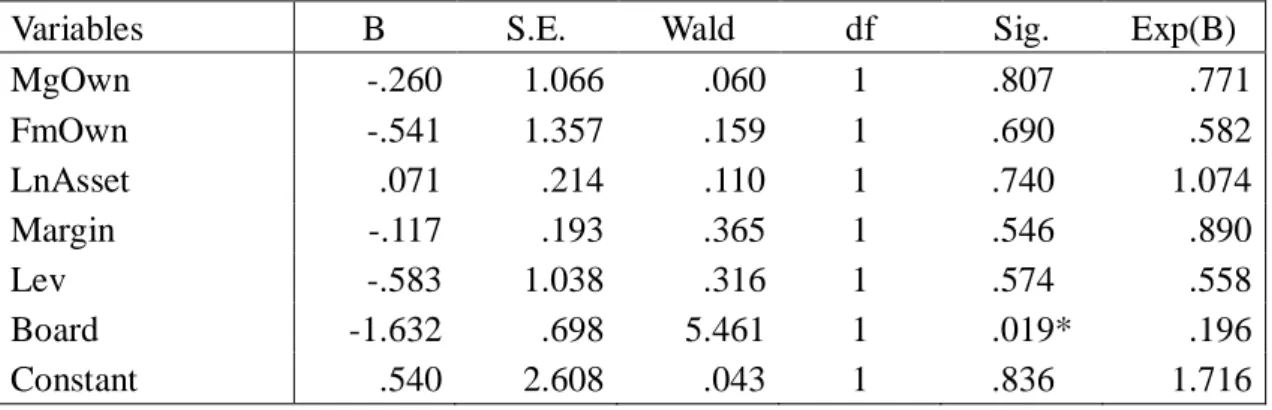
Results from logistic regression analysis are presented in Table 7. Consistent with the findings from the univariate analysis, the regression results reveal that Second Board companies are more likely to defer the reporting of EIs to the fourth quarter than those of the Main Board. This is consistent with our prediction that Main Board companies, which are more likely to be followed by analysts, are less likely to manage earnings, as compared to firms on the Second Board. The incentive for not managing quarterly earnings through the deferment of EIs by the Main Board firms is expected to be attributable to the firms‟ desire to avoid negative publicity from analysts.
Table 7. Logistic regression results
Variables B S.E. Wald df Sig. Exp(B)
MgOwn -.260 1.066 .060 1 .807 .771
FmOwn -.541 1.357 .159 1 .690 .582
LnAsset .071 .214 .110 1 .740 1.074
Margin -.117 .193 .365 1 .546 .890
Lev -.583 1.038 .316 1 .574 .558
Board -1.632 .698 5.461 1 .019* .196
Constant .540 2.608 .043 1 .836 1.716
* Significant at the 0.05 level Cox & Snell R Square = 0.095 Nagelkerke R Square = 0.127
In sum, our findings provide no evidence to support the hypotheses that the tendency to defer the recognition of EIs to the fourth quarter is associated with ownership structure, size, profitability, or leverage of a company. These findings thus fail to support the earlier evidence by Ettredge et al. (1994), Kinney and McDaniel (1989), and Fan and Wong (2002). However, the findings are not surprising as inconsistent findings have been documented in an earlier study by Abdullah et al. (2002) who failed to find evidence of an association between the incidence of income smoothing (through EI disclosures) and management interests, firm size, and leverage. Similar findings were also produced by Abdullah et al. (2004) when investigating income manipulation through goodwill, and by Abdullah and Mohd-Nasir (2004) in a study on accrual management. Thus, earnings management may not be significantly motivated by the firm‟s size, leverage and management ownership.
6. Conclusion
The issue of the reliability of quarterly reports arises because firms are not required to have them audited by independent auditors, and in some countries (for example the U.S) the integral method is preferred over the discrete method. Thus, earnings could be managed to suit management‟s objectives. In Malaysia, MASB 26 requires the use of the discrete method in reporting most of the items in the quarterly reports. Extending the study by Ku Ismail and Chandler (2005), this study aims at determining whether the reliability of the quarterly reports improved following the issuance of MASB 26. This is accomplished by examining the reporting of EIs in the quarterly reports. We predict that if the discrete method is employed, the incidence of EIs is equally likely in all quarters and the quarterly reports are said to be reliable. In other words, if MASB 26 is observed as far as the use of the discrete method is concerned, it is predicted that companies would be less likely to defer the reporting of EIs to the final quarter.
This study reveals that almost half of the sampled companies reported EIs in the fourth quarter of 2003 than in any other earlier quarters of that year. Even though the number of occurrences has declined from that of the 2001 survey by Ku Ismail and Chandler (2005), the decline is not significant. Similar to the previous study, the proportion of the incidence of EIs being reported in the fourth quarter is significantly higher than for each of the earlier three quarters of the year. This may indicate that the discrete method has not been fully practiced by companies and MASB 26 has not been able to ensure the reliability of the quarterly reports as far as EIs are concerned. It is also observed that negative EIs significantly outnumber positive EIs in the fourth quarter. Therefore, there is a tendency that management apparently delays the reporting of bad news or overstates the first three quarterly earnings.
Our findings further reveal that Bursa Malaysia Second Board companies are more likely to engage in fourth quarter “settling-up” compared to the Main Board companies. This implies that the former are less likely to adopt the discrete method, and the quarterly reports of these
companies are therefore less likely to be reliable. However, there is no evidence of association between the reliability of the quarterly reports and management ownership, size, profitability and leverage of a company.
The findings of this study bring to light the issue of the reliability of quarterly financial reports. The issue should be of interest to researchers, financial reporting regulators, users and preparers of the reports. The main objective of quarterly reports is to provide users with reliable and timelier information. However, manipulation of quarterly reports via EI adjustments in the fourth quarter by some companies defeats the purpose of quarterly reports.
Thus, to help enhance the quality and usefulness of quarterly reports, companies should take the initiative to observe MASB 26 (now FRS 134) more closely, and at the same time, the monitoring mechanisms of the regulatory bodies should be strengthened. Investors should treat quarterly earnings with caution because the latter may be overstated as negative EIs are more likely to be deferred to the final quarter.
This study opens up avenues for future research on quarterly reporting, not only in Malaysia, but also in other emerging economies. Based on our findings, deferment of EIs to the final quarter, particularly negative EIs, does exist. Thus, this could lead to quarterly reports being less reliable and less useful. Further research could be carried out to determine whether this is indeed the case. This could be achieved, perhaps, by using methods other than EI adjustments.
With the recent divergence of global accounting standards whereby many countries have adopted FRSs in totality, including a standard on interim reporting, the present research findings act as a basis for similar research in other emerging economies. This would facilitate comparisons of evidence among emerging economies whose legal and cultural environments are similar to Malaysia.
NOTES
1 With effect from 1 January 2006, accounting standards in Malaysia are referred to as Financial Reporting Standards (FRSs). The Standard on Interim Reporting is subsequently known as FRS 134. Since the contents of FRS134 are similar to MASB 26, the effective date of FRS 134 was brought back to 1 July 2002, which was the effective date for MASB 26.
2 In the Directors‟ Profile section of the annual reports, the names of directors were examined.
As a matter of good practice, each director is required to make a disclosure whether s/he has any family relationship with any other director(s) or any other substantial shareholder(s) of the Group.
Acknowledgement
The authors gratefully acknowledge Universiti Utara Malaysia for funding this research.
References
Abdullah, S.N. (1999). The Role of Corporate Governance and Ownership Structure on
Accounting Earnings Quality, Unpublished Ph.D Thesis, Universiti Utara Malaysia, 1999.
Abdullah, S.N. (2002). Board of directors‟ independence among listed companies in an emerging economy. Utara Management Review, 3(2), 27-46.
Abdullah, S.N. (2004). Board composition, CEO duality and performance among Malaysian listed companies. Corporate Governance: The International Journal of Business in Society, 4(4), 47-61.
Abdullah, S.N., Ku Ismail, K.N & Lode, N.A. (2002). Disclosure of extraordinary items and income smoothing behaviour in Malaysia. Jurnal Pengurusan, 21, 59-77.
Abdullah, S.N., Ahmad, J.H. & Ishak, R.(2004). Accounting treatment for goodwill among Malaysian Main Board listed companies: the case of MAS 6. Malaysian Accounting Review, 3(1), 103-122.
Abdullah, S.N. & Mohd-Nasir, N. (2004). Accrual management and the roles of boards of directors and audit committees among Malaysian listed companies: evidence during the Asian Financial Crisis. IIUM Journal of Economics & Management, 12(1), 49-80.
Al-Darayseh, M. & Brown, J.F.Jr. (1992). Annual and quarterly financial data: accuracy of investment decision. Journal of Applied Business Research, 8(2), 20-24.
Allen, A., Cho, J.Y. & Jung, K. (1999). Cross country examination of characteristics and determinants of analysts' forecast errors. The Mid-Atlantic Journal of Business, 35(2&3), 119-133.
Balsam, S., Bartov, E. & Marquardt, C. (2002). Accruals management, investor sophistication, and equity valuation: Evidence from 10-Q Filings, Journal of Accounting Research, 40(4), 987-1012.
Bartsch, R. (1989). Interim financial reporting under SAS 96 (Statement of Accounting Standards). The CPA Journal Online, August, [WWW] <http://www.nysscpa.
org/cpajournal/old/07734718.htm>
Chow, C.W. & Wong-Boren, A. (1987). Voluntary financial disclosure by Mexican corporations. The Accounting Review, 62 (3), 533-541.
Cooper, D.R. & Schindler, P.S. (1998). Business Research Methods. 7th Edition, McGraw-Hill, Singapore.
Courtis, J.K. (1979). Annual report disclosure in New Zealand: analysis of selected corporate
attributes. New England Accounting Research Study No. 8.
Doran, D.T. (1995). Earnings performance and interim reporting. Journal of Applied Business Research, 11(1), 67 -72.
Ettredge, M., Simon, D., Smith D. & Stone, M. (1994). Why do companies purchase timely quarterly reviews? Journal of Accounting and Economics, 18, 131-155.
Ettredge, M., Simon, D., Smith D. & Stone, M. (2000). The effect of the external accountant‟s review on the timing of adjustments to quarterly earnings. Journal of Accounting Research, 38(1), 195-207.
Fan, J.P.H & Wong, T.J. (2002). Corporate ownership structure and the informativeness of accounting earnings in East Asia. Journal of Accounting and Economics, 33, 401-425.
Fatimah, A.B. (2001). Corporate Governance in Financially Troubled Companies. Paper Presented at Seminar on Corporate Governance: Issues and Challenges, Universiti Utara Malaysia, 10 June.
Finance Committee on Corporate Governance (2001). Malaysian Code on Corporate Governance, Securities Commission, Kuala Lumpur.
Finance Committee on Corporate Governance (2001). Malaysian Code on Corporate Governance (Revised 2007), Securities Commission, Kuala Lumpur.
Fonfeder, R. and Fabozzi, F.J. (1984). Interim review and the quality of interim report numbers. Review of Business and Economic Research, 19(2), 24-34.
Fortin, J., L. Martel and Trudeau, R. (1997). Quarters to spare?. CA Magazine, October, 21-23.
Foster, G. (1977). Quarterly accounting data: time-series properties and predictive-ability results. The Accounting Review, 52(1), 1-21.
Fried, D., Schiff, M. & Sondhi, A. (1987). Surprise writeoffs – financial reporting, disclosure and analysis. Report of the National Commission on Fraudulent Financial Reporting, October, 103-104.
Givoly, D. & Ronen, J. (1981). „Smoothing‟ manifestations in fourth quarter results of operations: some empirical evidence. ABACUS, 17(2), 174-193.
Hossain, M. & Adams, M. (1995). An empirical study of voluntary financial disclosure by
Australian listed companies. Akauntan Nasional, July, 12-14.
Hussey, R. & Woolfe, S. (1994). Interim statements and preliminary profit announcements.
The Research Board Monograph Series, ICAEW, London.
Jensen, M. & Meckling, W. (1976). Theory of the firm: managerial behavior, agency cost and ownership structure. Journal of Financial Economics, 3(4), 305-360.
Kiger, J.E. (1972). An empirical investigation of NYSE volume and price reactions to the announcement of quarterly earnings. Journal of Accounting Research, 10, 113-128.
Kinney, M. & Trezevant, R. (1997). The use of special items to manage earnings and perceptions. The Journal of Financial Statement Analysis, 3(1), 45-53.
Kinney, W.R., Jr. & McDaniel, L.S. (1989). Characteristics of firms correcting previously reported quarterly earnings. Journal of Accounting and Economics, 11, 71-93.
Ku Ismail. K.N. & Chandler, R. (2005). The reporting of exceptional items in the quarterly financial reports of companies in Malaysia. IIUM Journal of Economics and Management, 13(2), 167 – 188.
Malaysian Accounting Standards Board (MASB). (2000). Interim Financial Reporting, MASB Statement of Principles 2, MASB, Kuala Lumpur.
McConnell, J.J. & Servaes, H. (1990). Additional evidence on equity ownership and corporate value. Journal of Financial Economics, 27, 595-612.
Mendelhall, R.R., Nichols, W.D. & Palepu, K.G. (1988). Bad news and differential market reactions to announcements of earlier-quarters versus fourth-quarter earnings: discussion.
Journal of Accounting Research, 26 (Supplement), 63-90.
Morck, R., Shleifer, A. & Vishny, R.W. (1988). Management ownership and market valuation:
an empirical analysis. Journal of Financial Economics, 20, 293-315.
National Commission on Fraudulent Financial Reporting. (1987). Report of the National Commission on Fraudulent Financial Reporting, October, AICPA, New York.
Nigrini, M.J. (2005). An Assessment of the Change in the Incidence of Earnings Management Around the Enron-Andersen Episode. Review of Accounting & Finance, 4(1), 92-110.
Rajan, R.G. & Zingales, L. (1995). What do we know about capital structure? Some evidence from international data. Journal of Finance, 50, 1421-1460.
Schadewitz, H.J. & Blevins, D.R. (1998). Major determinants of interim disclosures in an emerging market, American Business Review, 16(1), 41-55.
Schiff, M. (1978). Accounting Reporting Problems – Interim Reporting, Financial Executives Research Foundation, New York.
Warfield, T.D., Wild, .J & Wild. K.L. (1995). Managerial ownership, accounting choices and informativeness of earnings‟, Journal of Accounting and Economics, 20(1), 61-91.
Weston, J.F. (1979). The tender takeover, Mergers and Acquisition, 74-82.