Religiosity, Social And Psychological Factors On Purchase Decisions And Consumer Loyalty
Rosnaini Daga1* and Andi Jenni Indriakati2
1*Institut Bisnis dan Keuangan Nitro, Makassar City, South Sulawesi, Indonesia
2Universitas Lamappapolenro
Email Address:
[email protected]*, [email protected]
*Corresponding Author
Abstract: The purpose of this study was to determine and analyze the factors of religiosity, psychological factors on purchasing decisions and loyalty. The method used in this study is a quantitative research method in the form of a cross section. The population in this study are Marketplace users who live in Makassar and have purchased Muslim clothing products, especially in the Shopee application. This study uses a sampling technique with purposive sampling which is part of a non-probability sampling technique. The sample obtained from the calculation results amounted to 100 respondents who were deemed sufficient to represent the population. The data analysis technique used in this research is the Structural Equation Model (SEM). The results showed that religiosity and psychological factors directly had a positive and significant effect on purchasing decisions. Meanwhile, social factors have a positive and insignificant effect on purchasing decisions. Religiosity, Social Factors and Psychological Factors have a positive and significant effect on loyalty. Purchase Decision has a positive and significant effect on Loyalty. Religiosity and Social Factors and Psychological Factors through Purchase Decisions have a positive and significant effect on Loyalty. The results of this study can also be used for marketing in motivating consumers to make purchasing decisions. This indicator is the strongest indicator of consumer psychology in deciding the purchase of Muslim clothing and always considers increasing customer loyalty based on religiosity so that customers are committed to continue to be loyal in purchasing Muslim clothing. And can be a reference for further researchers to develop research instruments used in this study.
Keywords: Religiosity; Social Factors; Psychological Factors; Purchasing Decisions;
Loyalty.
Abstrak: Tujuan dari penelitian ini yaitu untuk mengetahui dan menganalisis Pengaruh Religiusitas, Faktor Sosial, Faktor Psikologi Terhadap Keputusan Pembelian Dan Loyalitas.
Metode yang digunakan dalam penelitian ini adalah metode penelitian kuantitatif dalam bentuk cross section. Populasi pada penelitian ini yaitu pengguna Marketplace yang berdomisili di Makassar dan telah melakukan pembelian produk busana muslim khususnya pada aplikasi Shopee. Penelitian ini menggunakan teknik pengambilan sampel dengan purposive sampling yang merupakan bagian dari teknik nonprobability sampling. Sampel yang diperoleh dari hasil perhitungan berjumlah 100 responden yang dirasa cukup mewakili populasi tersebut. Teknik analisis data yang digunakan dalam penelitian ini adalah Model Persamaan Structural Equation Model (SEM). Hasil penelitian menunjukkan bahwa
Religiusitas dan Faktor Psikologi langsung berpengaruh positif dan signifikan terhadap Keputusan Pembelian. Sedangkan Faktor Sosial berpengaruh positif dan tidak signifikan terhadap Keputusan Pembelian. Religiusitas, Faktor Sosial dan Faktor Psikologi berpengaruh positif dan signifikan terhadap loyalitas. Keputusan Pembelian berpengaruh positif dan signifikan terhadap Loyalitas. Religiusitas dan Faktor Sosial dan Faktor Psikologi melalui Keputusan Pembelian berpengaruh positif dan signifikan terhadap Loyalitas. Hasil penelitian ini juga dapat digunakan untuk pihak marketing dalam memotivasi konsumen dalam memutuskan pembelian mengingat indicator ini merupakan indicator terkuat yang membangun faktor psikologi konsumen dalam memutuskan pembelian busana muslimah serta selalu mempertimbangkan untuk meningkatkan loyalitas pelanggan dengan berbasis pada religiusitas agar pelanggan berkomitmen untuk terus loyal dalam melakukan pembelian busana muslimah. Serta dapat menjadi rujukan bagi peneliti selanjutnya guna mengembangkan instrument penelitian yang digunakan dalam penelitian ini.
Kata Kunci: Religiusitas; Faktor Sosial; Faktor Psikologi; Keputusan Pembelian;
Loyalitas.
INTRODUCTION
Global markets study diversity among consumers, producers, marketers, retailers, advertising media, cultures and customs. However, although the diversity applies, there are also various similarities. Segmenting buyers based on these similarities will allow marketers to design marketing strategies that can be used to identify their target consumers (Luthfianto and Suprihhadi, 2017). The phenomenon of the development of Muslim fashion in Indonesia can be seen in everyday life, where the trend of using the hijab among the Muslim community is increasing. Hijab is an Arabic word which means barrier. In some Arabic- speaking countries and Western countries, the word hijab more often refers to the headscarf worn by Muslim women. However, in Islamic scholarship, the hijab is more appropriate to refer to proper dress procedures by religious guidance (Nisa and Rudianto, 2017). The increasing trend of using Muslim clothing affects traders where there is an increase in sales of Muslim clothing. This increase can make merchants form new marketing strategies by paying attention to the loyalty of consumers who come to shop. In the use of Muslim clothing, consumer loyalty can be formed if someone has a high level of religiosity because Muslim clothing is related to the principles of sharia in Islam.
Everything you want will be made more accessible with the internet as one of the supporters of technological development. In practice, this can be felt by the public quickly shopping for necessities without any direct interaction between buyers and sellers. Online shopping is pretty time-efficient, so it is often used as an alternative. Creating a Marketplace as a digital shopping platform can benefit all parties. The more sophisticated a technology, the more widely applied lifestyles in life. Technological developments will always be presented with the emergence of various prevailing trends. Lifestyle can change a person's attitude in responding to existing trends. Problems that occur especially among Muslim women, Muslim clothing that meets the provisions of Islamic law is often ignored. This
phenomenon is caused by the trend of modern nuanced Muslim clothing that has become the community's choice. This is quite a concern, especially for Muslim women in terms of how to dress so as not to deviate from the actual concept of Muslim clothing just because it follows trends.
In particular, consumer loyalty cannot be formed quickly; it takes a long time to form consumer loyalty, especially in Muslim clothing. If what you get is in line with expectations, the buying process will continue to repeat itself. For entrepreneurs, the most important thing is how the processes and mechanisms achieve customer loyalty. To realize customer loyalty, what entrepreneurs need is to create customer satisfaction as a basis. Apart from religiosity and social factors, the use of Muslim clothing can also be influenced by psychological factors. This factor comes from within a person caused by a person's motivation, learning, and experience.
Along with the development of the times and looking at the territorial area of Indonesia, nowadays, many communities are present as the embodiment of self-reflection.
From the community for culture, and ethnicity, to the community for lifestyle and fashion style. In addition, there is also a modern Muslim fashion community, "Hijabers", who quickly created a new hijab trend in Indonesia (Rima, 2012).
(Hidayat's, 2020) shows that the religiosity variable positively affects purchasing decisions. However, in a study conducted by (Fauzia et al., 2019), it was shown that the religiosity variable had no significant effect on buying interest. (Arba'ati, 2016) and (Chusnah, 2016), in their research, show that the religiosity variable has a significant positive effect on loyalty. (Puspita et al., 2017) stated that social factors have a significant effect on loyalty. Furthermore, research conducted by (Fauzi et al., 2017; Heri and Taufiq, 2017; Veterinawati, 2013) states that social factors and psychological factors significantly affect purchasing decisions. However, (Dewanto et al., 2018) research show that social factors do not affect purchasing decisions.
This research is a development of previous research conducted by (Khan, 2015) entitled The Effect of Religiosity and Satisfaction on Customer Loyalty in Islamic Banks in Surabaya with Service Quality Antecedents. However, in this study, the researcher added the dependent variable, namely customer loyalty, which could be another aspect that needed to be investigated and used social factors and psychological factors as independent variables. In addition, this research was conducted on Marketplace consumers who live in Makassar and have made purchases of Muslim clothing products, especially on the Shopee application. While the benefits of this research are expected to contribute to the field of science and can be a reference for further researchers.
THEORITICAL REVIEW
Religiosity comes from the word region (religion). Religiosity is devotion to religion and piety; the strong man may not be decisive but has a very high consciousness. According to (Taslim, 2018), the meaning of religion comes from the word ad-din, which means law or law. Then in Arabic, this word contains the meaning of mastering, subjugating, obeying, debt, recompense, and habit. At the same time, the word religion (Latin) or relegate means collecting and reading. Religiosity means showing the religious aspect that the individual has lived in the heart, which means how far the knowledge is, how strong is the belief, and
how much is the implementation of worship and rules, as well as the appreciation of the religion he adheres to in social forms and activities that are the embodiment of worship. It can be concluded that religiosity is defined as a condition that exists within a person that encourages him to behave, act, and act according to the teachings of the religion he adheres to.
Religiosity is one of the values in character education described by the Ministry of National Education (2010) as respectful attitudes and behaviour in carrying out the teachings of the religion adhered to, tolerant of the implementation of worship of other religions, and living in harmony with adherents of other religions. (An-Nada, 2018) formulated that religion is a symbol system that instils a strong, deep, and long-lasting spirit and motivation in humans by creating general conceptions of existence and wrapping these conceptions in such a way. So that the atmosphere and motivation seem very real. Religious meaning is a symbol of individual belief in the creator. One's understanding of religion determines one's behaviour. Therefore, religion also functions as social control in society.
The religiosity variable will be directly related to the Loyalty variable. To see the extent to which religiosity can affect loyalty. According to research conducted by (Khotimah, 2018), the religiosity variable partially has a positive and significant effect on customer loyalty. Apart from religiosity, social and psychological factors will also be dependent on loyalty. (Hidayat's 2020) showed that individual religiosity tests positively and significantly affect purchasing decisions. Meanwhile, social factors and psychological factors in (Yuriska et al., 2014) research, social factors and psychological factors have a significant effect on purchasing decisions. Testing of social factors and psychological factors on purchasing decisions refers to research conducted by (Yuriska et al., 2014) which shows that social factors, personal factors, psychological factors, and cultural factors have a positive and significant impact on purchasing decisions.
Social factors are a group of people who closely consider equality in status or community rewards who continuously socialize formally and informally (Azis, 2018).
Social factors are people who can influence individual behaviour in carrying out an action based on habits.
Consumer factors strongly influence consumer decision making as individuals.
(Veterinawati, 2013) suggests that consumer purchasing decisions or choices are influenced by four main psychological factors: motivation, perception, attitude, and learning.
(Andespa, 2017) says that the individual's internal dynamics are essential for everyone, although not visible to others.
Purchasing decisions are individual activities that are directly involved in making decisions to purchase products offered by sellers. Understanding the purchase decision (Taslim, 2018) is the stage in the buyer's decision-making process where consumers buy.
Decision making is an individual activity that is directly involved in obtaining and using the goods and services offered. According to (Bachkirov, 2019), To understand how consumers make purchasing decisions, marketers must identify who makes and inputs buying decisions. These people can be initiators, influencers, decision-makers, buyers, or users.
Loyal means loyal, or loyalty can be interpreted as loyalty. This loyalty is taken without coercion but arises from self-consciousness in the past. Efforts made to create consumer satisfaction are more likely to influence consumer attitudes. At the same time, the concept of consumer loyalty explains more about buyers' behaviour. The commitment that
accompanies repeated purchases is when consumers do not want to switch even though the product or service is scarce in the market and consumers voluntarily recommend the product or service to colleagues, family or other consumers.
According to (Taslim, 2018), "Consumer loyalty is consumer loyalty to companies, brands and products. (Khan, 2015) defines loyalty as a favourable attitude towards a brand that is presented in consistent purchases over time. Loyal customers are assets for the company; this can be seen based on its characteristics. Therefore, consumer loyalty can be relied on to predict future growth for a company.
(Yao et al., 2019) identified three dimensions of loyalty: attitude, behavioural loyalty, and a composite combining attitude and behaviour loyalty. The behavioural dimension considers that loyalty as a consistent and repeated purchase behaviour, while the attitude dimension is closely related to a sense of loyalty and involvement with customers.
(Mandhachitara and Poolthong, 2011) also argue that the research objective in the composite measure is more appropriate because it finds both attitude and behavioural dimensions, which are the main influences on the primary decision making of customers.
In economic activities, especially the purchase of a product, religiosity is also accompanied by an interest in buying goods, so avoiding illicit goods is a driving force for purchasing decisions (Nurrachmi and Setiawan, 2020). High awareness in carrying out religious orders (Bukhari et al., 2019; Nora and Minarti, 2016). The Theory of Reasoned attitudes towards the behavior (attitude toward the behavior) and subjective norms (subjective norm) in the form of beliefs about the consequences of carrying out his behavior and the normative expectations of the relevant referred person. It means that a person's behavior can be explained by considering his beliefs. Since a person's beliefs represent the information they obtain about themselves and the world around them, this information mainly determines behavior. Consumers generally like products that carry religious symbols, so many businesspeople use religious symbols in their marketing strategies.
Previous research was conducted by (Amalia, 2019; Iriani, 2019). The results showed that religiosity affects Muslim consumers in the decision making.
H1: Religiosity affects purchasing decisions.
Changes in consumer behavior patterns are influenced by several factors, including personal factors and social factors; in line with the theory of Phillip Kotler and Kevin Lane Keller in marketing, several factors influence changes in people's behavior patterns in consuming goods and services, including personal factors and social factors (Jariah, 2012).
Consumer behavior is also influenced by social factors such as reference groups, families, and social roles and status. The reference group has a direct or indirect influence on the attitudes and behavior of a person of social class, sometimes in the form of a caste system in which members of different castes for a specific role can change their caste membership, including in the purchase of a product. Social factors in the relationship with friends, family, and parents influence purchasing decisions. The higher the relationship with friends, family, and parents, the higher the consumer's decision to make a purchase. Previous research (Andira et al., 2021; Hafidz, 2018) showed that social factors influence purchasing decisions.
H2: Social factors influence purchasing decisions.
The psychological factor is part of the influence of the environment in which it lives and lives at present without neglecting the influence of the past or its anticipation of the future (Badjamal et al., 2021). Psychological factors include motivation, perception, knowledge, beliefs, and attitudes. The more knowledge possessed, the high confidence in the product, and the firmness of attitude and clarity of motivation in meeting its needs, the greater its role in the decision process of purchasing a product. Within the framework of the theory of reasoned action, attitudes are transformed indirectly in the form of open behavior through the intercession of a psychological process called intention. Therefore, it can be concluded that intention is a psychological process between attitude and behavior (Mahyarni, 2013). Previous research (Misman et al., 2021; Bahari and Ashoer, 2018) found that psychological factors influence purchasing decisions.
H3: Psychological factors influence purchasing decisions.
The discussion of the definition of religiosity shows that religiosity is closely related to customer attitudes and behavior (Mathras et al., 2016). (Fishbein and Ajzen, 2010) states that an attitude is the sum of influences that support or oppose an object. They state that trust represents an individual's information about an object. This means that religiosity can change a person's behavior to be loyal to what they think is right. Previous research conducted by (Abror et al., 2020; Abu-Alhaija et al., 2019) research results show that religiosity has an influence on loyalty.
H4: Religiosity affects loyalty.
Individuals determining their choice to remain loyal to a product/service will actively seek information about other people's opinions about a product/service/brand as consideration for themselves (Oktavianti et al., 2021). Social Cognitive Theory by Albert Bandura affirms that the change of human behavior involves the learning process not only through the experiences he feels directly but also through his observation of others in the context of social interaction (Littlejohn et al., 2017). Positive affective and social experiences represent a more defensible path to customer loyalty (Liu-Thompkins et al., 2022). Previous research was conducted by (Rosanto, 2022; Agustianti, 2018) Social affects loyalty.
H5: Social factors affect loyalty.
Loyal consumers express their liking for the brand and then use it. Brand loyalty will lead to brand commitment, namely the emotional and psychological closeness of consumers to a product. Psychological factors are all aspects that can image or move an individual based on measures of motivation, perception, learning, and attitudes in each of their behaviors (Rosanto, 2022). In the theory of reasoned action, attitudes are transformed indirectly in the form of open behavior through the intercession of a psychological process called intention. The stimulus-response is the starting point for understanding consumer
behavior. Consumer awareness is based on marketing stimuli and a unique socializing environment in which a group of psychological processes is united with specific consumer characteristics. This results in a decision-making process that ultimately comes to the final decision of the purchase. Previous research (Yuriska and Sukirno, 2014; Bahari and Ashoer, 2018) shows that psychological factors affect loyalty.
H6: Psychological factors affect loyalty.
Loyal or loyal customers are customers who are very satisfied with the choice of certain products and services from the company, so they are enthusiastic to say positive things about the product and the service they receive from others (Tugiso et al., 2016). A customer who purchases will form a loyal or disloyal behavior. This depends on how the customer perceives the product that has been purchased. If the customer feels positive about the product purchased, the customer will be loyal. Meanwhile, if the customer experiences a negative perception of the product purchased, the customer will be disloyal and switch to another product. Previous research (Kinasih and Usman, 2021; Munandar, 2019) showed that Purchase decisions affect loyalty.
H7: Purchase decisions affect loyalty.
A person Since a person's beliefs represent the information they obtain about themselves and the world around them; this means that behavior is mainly determined by this information (Andini, 2021). Consumers generally like products that carry religious symbols, so many businesspeople use religious symbols in their marketing strategies. The discussion of the definition of religiosity shows that religiosity is closely related to customer attitudes and behavior (Mathras et al., 2016, Khalil et al., 2012). A customer who purchases will form a loyal or disloyal behavior. This depends on how the customer perceives the product that has been purchased (Dachi, 2020). If the customer feels optimistic about the product purchased, the customer will be loyal. Meanwhile, if the customer experiences a negative perception of the product purchased, the customer will be disloyal and switch to another product. Previous research (Amalia, 2019) showed that religiosity affects Muslim consumers in decision-making (Abror et al., 2020). The results showed that religiosity influences loyalty (Kinasih and Usman, 2021) and that Purchase decisions affect loyalty.
H8: Religiosity affects loyalty through purchasing decisions.
Individuals determining their choice to remain loyal to a product/service will actively seek information about other people's opinions about a product/service/brand as consideration for themselves (Oktavianti et al., 2021). In the Theory of Planned Behavior, Subjective Norms are influenced by normative beliefs, namely beliefs about expectations held by individuals who carry out behaviors toward the views of others to accept and motivate the behavior showed (La Barbera and Ajze, 2020). So, Subjective Norms are a person's perception of social influence in shaping certain behaviors. A person can be affected or unaffected by social pressures. Previous research conducted by (Hafidz, 2018).
The results showed that social factors influence purchasing decisions; (Agustianti, 2018)
and Social influence on loyalty; (Munandar, 2019) research results show that Purchase decisions affect loyalty.
H9: Social factors influence loyalty through purchasing decisions.
Psycholgis is an internal state of everyone will and when performing an action that is influenced by factors of motivation, perception, knowledge, beliefs and attitudes (Rafiz et al., 2016). Based on the description above, it is known that perception is one of the sub- factors of psychology which are factors that affect consumer behavior (Syafirah et al., 2017).
Furthermore, a customer who has made a purchase will form a loyal or disloyal behavior.
This depends on how the customer perceives the product that has been purchased. If the customer feels positive for the product purchased, the customer will be loyal. Meanwhile, if the customer experiences a negative perception of the product purchased, the customer will be disloyal and switch to another product (Dachi, 2020).
H10: Psychological factors affect loyalty through purchasing decisions.
METHODS
The psychologist is an internal state of everyone's will and when performing an action that is influenced by motivation, perception, knowledge, beliefs, and attitudes (Rafiz et al., 2016). Based on the description above, it is known that perception is one of the sub-factors of psychology which are factors that affect consumer behavior (Syafirah et al., 2017).
Furthermore, a customer who has made a purchase will form a loyal or disloyal behavior.
This depends on how the customer perceives the product that has been purchased. If the customer feels optimistic about the product purchased, the customer will be loyal.
Meanwhile, if the customer experiences a negative perception of the product purchased, the customer will be disloyal and switch to another product (Dachi, 2020).
The operational definition of a variable is defined as a clue that explains to the researcher that deals with the disclosure of the variable more concretely. This study used three types of variables, namely exogenous variables, intervening variables, and endogenous variables. This study has four exogenous variables: Religiosity, Social Factors, and Psychological Factors. The intervening variable is Buying decision, and the endogenous variable is Loyalty.
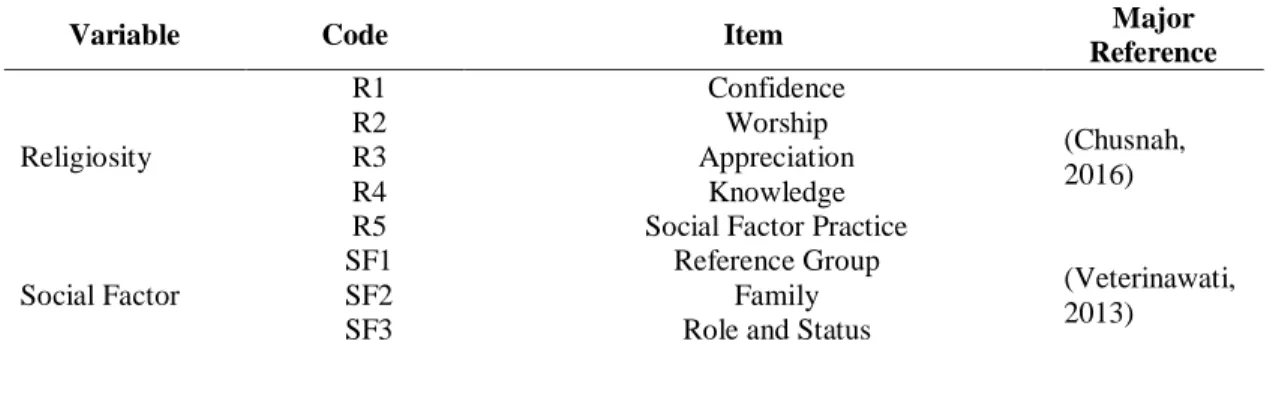
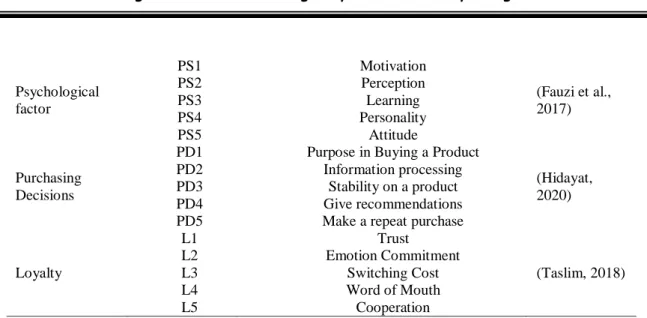
Table 1. Variables / Item Measurement
Variable Code Item Major
Reference
Religiosity
R1 R2 R3 R4 R5
Confidence Worship Appreciation
Knowledge Social Factor Practice
(Chusnah, 2016)
Social Factor
SF1 SF2 SF3
Reference Group Family Role and Status
(Veterinawati, 2013)
Psychological factor
PS1 PS2 PS3 PS4 PS5
Motivation Perception Learning Personality
Attitude
(Fauzi et al., 2017)
Purchasing Decisions
PD1 PD2 PD3 PD4 PD5
Purpose in Buying a Product Information processing
Stability on a product Give recommendations Make a repeat purchase
(Hidayat, 2020)
Loyalty
L1 L2 L3 L4 L5
Trust Emotion Commitment
Switching Cost Word of Mouth Cooperation
(Taslim, 2018)
RESULTS
Respondents in this study came from Marketplace users who live in Makassar and have purchased Muslim clothing products. The data collected describes the characteristics of respondents based on the dominant position, which is 33 students or 33 percent, while the lowest nine people or 12 percent are other. Many respondents were aged 17 to 25 years, as many as 43 people or 43 percent, and the least were aged 50 to 58 years, as many as three or 3 percent. Based on the number of visits, the majority have visited more than three and the rest less than three.
Table 2. Characteristics of Respondents
Variable Measurement N Percent
Position Student 33 33
Employee 31 31
Self-employed 27 27
Other 9 12
Age 17-25 43 43
25-33 31 31
33-40 18 18
40-50 5 5
50-58 3 3
Number of visits Less than 3 26 26
Bigger 3 74 74
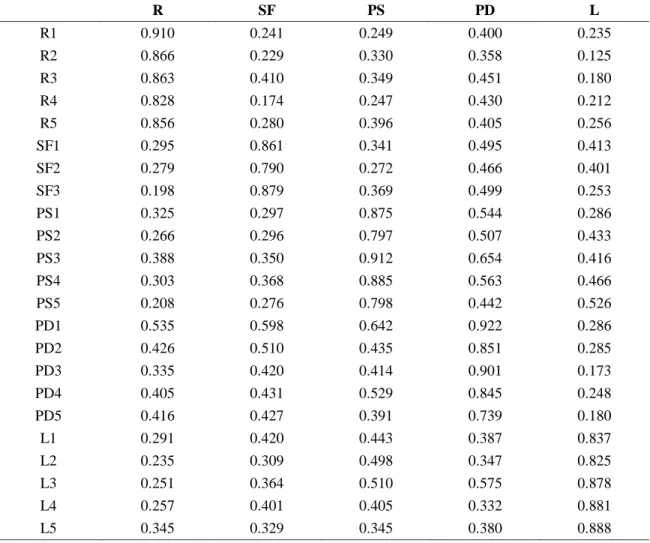
The outer model test results in table 3 show that all the instruments used in this study have met the exterior model testing requirements. To test the validity of this study, the researcher used discriminant validity by looking at the cross-loading value of the contract measurement. The cross-loading value indicates the magnitude of the correlation between each contract and its indicators and indicators of other block contractors. A measurement model has a good discriminant validity if the correlation between the agreement and the hand is higher than the correlation with indicators from other block contractors.
Table 3. Discriminant Validity
R SF PS PD L
R1 0.910 0.241 0.249 0.400 0.235
R2 0.866 0.229 0.330 0.358 0.125
R3 0.863 0.410 0.349 0.451 0.180
R4 0.828 0.174 0.247 0.430 0.212
R5 0.856 0.280 0.396 0.405 0.256
SF1 0.295 0.861 0.341 0.495 0.413
SF2 0.279 0.790 0.272 0.466 0.401
SF3 0.198 0.879 0.369 0.499 0.253
PS1 0.325 0.297 0.875 0.544 0.286
PS2 0.266 0.296 0.797 0.507 0.433
PS3 0.388 0.350 0.912 0.654 0.416
PS4 0.303 0.368 0.885 0.563 0.466
PS5 0.208 0.276 0.798 0.442 0.526
PD1 0.535 0.598 0.642 0.922 0.286
PD2 0.426 0.510 0.435 0.851 0.285
PD3 0.335 0.420 0.414 0.901 0.173
PD4 0.405 0.431 0.529 0.845 0.248
PD5 0.416 0.427 0.391 0.739 0.180
L1 0.291 0.420 0.443 0.387 0.837
L2 0.235 0.309 0.498 0.347 0.825
L3 0.251 0.364 0.510 0.575 0.878
L4 0.257 0.401 0.405 0.332 0.881
L5 0.345 0.329 0.345 0.380 0.888
Source: processed data, PLS 3.0 (2022)
Based on the data presented in table 3, each indicator in the research variable has the most significant cross-loading value on the variables it forms compared to the cross-loading value on other variables. Based on these results, it can be stated that the indicators used in this study have good discriminant validity in compiling their respective variables.
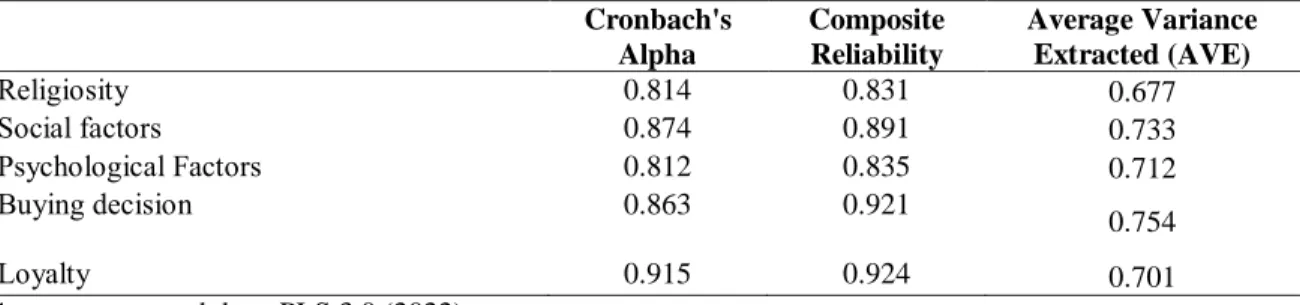
The criteria for validity and reliability can also be seen from the reliability value of a construct and the Average Variance Extracted (AVE) value of each construct. The construct has high reliability if the value is 0.700 and the AVE is above 0.500. Table 4 will present the importance of Cronbach's Alpha, Composite Reliability, and AVE for all variables.
Table 4. Construct Reliability and Validity
Cronbach's
Alpha
Composite Reliability
Average Variance Extracted (AVE)
Religiosity 0.814 0.831 0.677
Social factors 0.874 0.891 0.733
Psychological Factors 0.812 0.835 0.712
Buying decision 0.863 0.921
0.754
Loyalty 0.915 0.924 0.701
Source: processed data, PLS 3.0 (2022)
Based on the data presented in table 4, The AVE value of all variables in this study is more than 0.500. Thus, it can be stated that each variable has good discriminant validity.
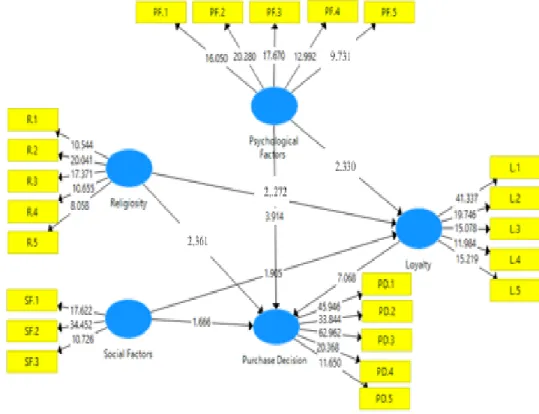
Composite reliability value of all research variables more than 0.700. These results indicate that each variable has met composite reliability, so it can be concluded that all variables have a high level of reliability. Furthermore, the Cronbach alpha value of each research variable is more than 0.700. Thus, these results can indicate that each research variable has met the requirements of the Cronbach alpha value, so it can be concluded that all variables have a high level of reliability. Figure 1 below presents the results of the testing Inner Model using PLS.
Figure 1. SEM Model Test Using Smart PLS
Source: Output PLS, 2022
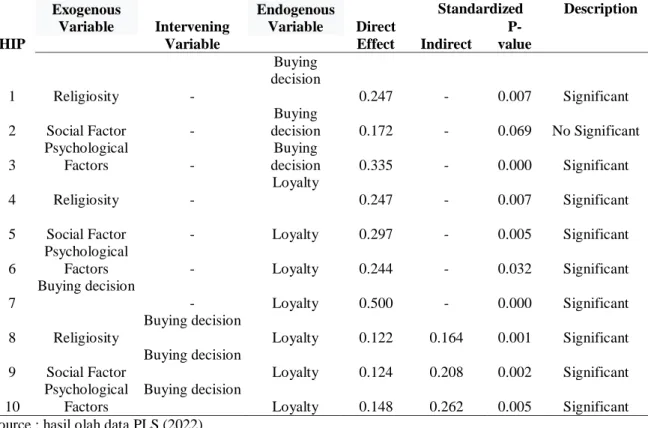
Testing the proposed hypothesis is done by the structural model (inner model) by looking at the path coefficients that show the parameter coefficients. The statistical significance value of t can be seen in table 5.
Table 5. Direct Effect Hypothesis Testing, Indirect Effect and Total Effect
HIP
Exogenous
Variable Intervening Variable
Endogenous
Variable Direct Effect
Standardized Description Indirect
P- value
1 Religiosity -
Buying decision
0.247 - 0.007 Significant 2 Social Factor -
Buying
decision 0.172 - 0.069 No Significant 3
Psychological
Factors -
Buying
decision 0.335 - 0.000 Significant
4 Religiosity -
Loyalty
0.247 - 0.007 Significant
5 Social Factor - Loyalty 0.297 - 0.005 Significant
6
Psychological
Factors - Loyalty 0.244 - 0.032 Significant
7
Buying decision
- Loyalty 0.500 - 0.000 Significant
8 Religiosity
Buying decision
Loyalty 0.122 0.164 0.001 Significant 9 Social Factor
Buying decision
Loyalty 0.124 0.208 0.002 Significant 10
Psychological Factors
Buying decision
Loyalty 0.148 0.262 0.005 Significant Source : hasil olah data PLS (2022)
Two paths do not significantly affect the whole model, and the other eight paths have a significant effect. The whole path has a positive effect. Religiosity directly has a positive and significant effect on purchasing decisions with a p-value as big as 0.007 smaller 0.05 and a direct influence value of 0.247. Thus, the hypothesis that religiosity has a positive and significant effect on purchasing decisions is accepted. Social factors have a positive and significant influence on purchasing decisions with a p-value as big as 0.069 bigger 0.050 and a direct influence value of 0.172. Thus, the second hypothesis, which states that social factors positively affect purchasing decisions, is rejected. Psychological factors positively influence purchasing decisions with a p-value as big as 0.000 smaller 0.050 and a direct influence value of 0.335. Thus, the third hypothesis, which states that psychological factors positively affect purchasing decisions, is accepted. Religiosity has a positive and significant effect on loyalty with a p-value as big as 0.000 smaller 0.050, and the direct influence value is 0.247.
Thus the fourth hypothesis, which states that religiosity has a positive and significant effect on loyalty, is accepted. Social factors have a positive but not significant effect on loyalty with a p-value as big as 0.005 smaller 0.050 and a direct influence value of 0.297.
Thus, the fifth hypothesis, which states that social factors positively and significantly affect
loyalty, is accepted. Psychological factors have a positive and significant influence on loyalty with a p-value as big as 0.032 smaller 0.050 and a direct influence value of 0.244.
Thus, the sixth hypothesis, which states that psychological factors positively and significantly affect loyalty, is accepted. Purchase decisions have a positive and significant influence on loyalty with a p-value as big as 0.000 smaller 0.050 and a direct influence value of 0.500. Thus, the seventh hypothesis, which states that purchasing decisions positively affect loyalty, is accepted.
Religiosity has a positive and significant influence on loyalty through purchasing decisions with a p-value as big as 0.001 with an indirect influence value of 0.164. Thus, the eighth hypothesis, which states that religiosity has a positive and significant effect on loyalty through purchasing decisions, is accepted. Social factors have a positive and significant influence on loyalty through purchasing decisions with p-value as big as 0.002 smaller 0.050 with an indirect influence value of 0.208. Thus, the ninth hypothesis, which states that social factors positively and significantly affect loyalty through purchasing decisions, is accepted.
Psychological factors positively and significantly influence loyalty through purchasing decisions with p-value as big as 0.005 smaller 0.050 with an indirect influence value of 0.262. Thus, the tenth hypothesis, which states that psychological factors positively and significantly affect loyalty through purchasing decisions, is accepted.
DISCUSSION
The Effect of Religiosity on Purchase Decisions. The results of hypothesis testing indicate that religiosity has a positive and significant influence on purchasing decisions. The significant effect that occurs is the result of the contribution that the religiosity variable becomes a variable that affects the realization of purchasing decisions. This shows that the higher a person's religiosity, the higher his decision to buy Muslim clothing. If we look further based on the indicator of the religiosity variable, we can see that the aspect of belief has the highest value. In the context of daily life, a person's religiosity can be seen how far they practice aspects of their beliefs both in personal life and in social life. (Fauzia et al., 2019) formulated that religion is a symbol system that instils a strong, deep, and long-lasting spirit and motivation in humans by creating general conceptions of existence and wrapping these conceptions in such away. In such a way that the atmosphere and motivation seem very real. Religious meaning is a symbol of individual belief in the creator. One's understanding of religion determines one's behaviour. Therefore, religion also functions as social control in society. As we know that religion in Islam is not only manifested in the form of ritual worship but also other activities. As a comprehensive system, Islam encourages its adherents to be religious, both in thinking, acting and acting; it must be based on the principle of surrender and total devotion to Allah, when, where and under any circumstances. This research is supported by research conducted by (Hidayat, 2020). His research found that religiosity has a positive and significant effect on the purchase of clothing. The similarity lies in the exogenous variable studied, namely religiosity. While the difference lies in the indicators used, the analytical tools used, the object under study, and the sample size used. The results of the study (Isa et al., 2020) and (Wulandari, 2021) found that religiosity had a positive effect on purchasing decisions. A person who becomes a follower of religion will be guided by the teachings of his religion when acting, one of which
is in consuming goods and services to meet the needs of his life. The religious teachings will influence one consumer's perceptions, motivations, attitudes, and behaviour they adhere to. Commitment to carrying out religious teachings can be seen in their behaviour in deciding to make a purchase (Fitria and Artanti, 2020).
Effect of Social Factors on Purchase Decisions. The results of hypothesis testing indicate that social factors have a positive and insignificant effect on purchasing decisions. This becomes a basis if social factors will not always influence purchasing decisions, especially in buying Muslim clothing. So that purchasing decisions on Muslim clothing can be influenced by factors other than social factors. Dimensions of social factors, namely social factors, are the reference group. Reference groups play an essential role for consumers in determining whether or not to buy a product. This group has a direct or indirect influence on a person. Humans as social beings will always socialize with many people so that in their journey, a human will meet and meet a group that can influence them in making decisions.
Reference groups are all groups that directly or indirectly influence the person referred to as a member. The results of this study support previous research by (Sujani, 2017; Hudani, 2020; Somantri and Larasati, 2020), which state that social factors do not have a significant influence on purchasing decisions. The purchasing decisions of Muslim fashion consumers in the marketplace, especially in Shope, are not influenced by environmental factors around the respondents, such as friends and family. However, the respondents have their own decisions and determine what model of clothing they want to buy according to their wishes, not others, and they are also not concerned with the role and their status in making a purchase. The results of this study are different from those of (Yuriska et al., 2014;
Shelviana et al., 2019) found that social factors had a significant effect on purchasing decisions. This shows that consumer behaviour is influenced by social factors such as family or friends. Reference groups affect consumer attitudes and behaviour. Someone with broader social factors will undoubtedly get much influence in making purchasing decisions.
The Effect of Psychological Factors on Purchase Decisions. The results of hypothesis testing indicate that psychological factors have a positive and significant influence on purchasing decisions. It means that if the psychological factor variable increases, the purchasing decision will also increase. If we look at the results of the questionnaire distribution of research on social factors, motivation is the most powerful indicator.
According to (Dharmmesta and Handoko, 2012), motivation is a driving force in a person who forces them to act. In the context of Muslim dress, motivation is needed to apply the practice of religious values to run well. Every Muslim or Muslim woman needs the motivation to be consistent with their life choices. Motivation will encourage someone always to do something. Herzberg developed a two-factor theory that distinguishes dissatisfaction/dissatisfier (factors that cause dissatisfaction) from satisfaction/satisfiers (factors that cause satisfaction). The absence of a dissatisfier is not enough to motivate buyers. There must be a satisfier. This theory has two implications. First, the seller should do his best to avoid dissatisfaction. Second, the seller must identify each of the utmost satisfaction or purchase motivators in the market and then supply them. According to (Hasibuan, 2012), motivation is a stimulus, the desire to move one's willingness to work.
Several factors influence motivation, namely personal encouragement and social
encouragement. The results of this study support the research conducted previously by (Yuriska et al., 2014; Dewanto et al., 2018) that psychological factors influence purchasing decisions. What distinguishes this research from previous research is the number of respondents and the analytical tools used, and the objects used are very different, so the characteristics of the respondents are also different.
The Effect of Religiosity on Loyalty. The hypothesis test results show that religiosity has a positive and significant effect on loyalty. In the discussion about religiosity on loyalty, based on the statistical analysis results seen from the frequency distribution of respondents' answers, the mean value shown in the outstanding category means that the indicators of each dimension that build religiosity are all good about loyalty it has a significant effect. From these results, it can be said that a person's loyalty to using Muslim clothing is influenced by the extent to which a person's level of religiosity is. Someone with a high level of religious understanding tends to act and behave based on religious concepts inherent in a person. The concept of consumer loyalty explains consumer behaviour more. In the view of Islam, how to dress, especially for Muslim women, is regulated by the Qur'an and the hadith of the Prophet Muhammad, so as a Muslim woman, of course, she must dress according to religious rules or regulations. This study supports the research conducted by (Khotimah, 2018; Arba'ati, 2016), who stated that religiosity had a positive and significant effect on loyalty. At the same time, this research does not support the research conducted by (Chusnah, 2016), which states that religiosity has no positive and significant effect on loyalty. The similarities of this study with previous studies are in line with that the exogenous variables used are religiosity and loyalty. At the same time, the difference is the analytical tool used, the number of respondents, and the object of research.
The Effect of Social Factors on Loyalty. The results of hypothesis testing indicate that social factors have a positive and significant influence on loyalty. Based on the statistical analysis results seen from the frequency distribution of respondents' answers, the mean value indicated in the outstanding category means that the indicators of each dimension that build social factors are all good; loyalty has a significant effect. These results are supported by (Puspita et al., 2017; Widyartono and Sardjono, 2020) found that social factors significantly affected loyalty. The role is an activity that a person expects to be carried out concerning the people around him. At the same time, status is the general recognition of society according to the role played. Humans' role and social status in the social environment will not necessarily give a picture that someone will be loyal to a product. This is because the higher the role and social status of a person, the consumption pattern will change.
The Effect of Psychological Factors on Loyalty. The results of hypothesis testing indicate that psychological factors have a positive and significant influence on loyalty. This means that if the psychological factors perceived by consumers increase, it will increase consumer loyalty. In the discussion of psychological factors on loyalty, based on the statistical analysis results seen from the distribution of the frequency of respondents' answers, the mean value shown is categorized as very important. This means that the indicators of each dimension that build psychological factors are critical. Psychological factors are part of the influence of the environment in which he lives and lives at present without ignoring the influence of
the past or his anticipation of the future. Psychological factors include motivation, perception, knowledge, beliefs and attitudes. The more knowledge possessed, the firmer the belief in the product, and the firmness of attitude and clarity of motivation in meeting their needs for a product, the greater the loyalty of consumers. The motivation in everyone directs a person to find ways to satisfy his needs. At first, a person tries to satisfy the most critical need, if it is satisfied, then that need is no longer a motivator, and then the person will try to satisfy the other most crucial need. Perception is how people select, organize and interpret information to form a meaningful picture of the world. A motivated person is ready to act.
How the person acts is influenced by his perception of the situation. Through action and learning, people will gain beliefs and attitudes. Both of these, in time, can influence buying behaviour. Beliefs are descriptive thoughts that a person has about something. Beliefs are based on actual knowledge, opinions or beliefs and may or may not raise emotions. The results of this study support (Mantauv's, 2013) finding that psychological factors significantly affect loyalty. Psychological factors determine and reflect how consumers are loyal to a particular product.
The Effect of Purchase Decisions on Loyalty. The hypothesis test results show that purchasing decisions have a positive and significant effect on loyalty. This indicates that a positive influence occurs because all indicators of purchasing decisions are very supportive in creating customer loyalty. The significant effect that occurs is the result of the contribution that the purchasing decision variable is a variable that affects the realization of loyalty. Alternatively, it can also be said that a good purchase decision determines the level of loyalty. The positive and significant direct effect of purchasing decisions on loyalty indicates that trust, emotional commitment, switching costs, word of mouth and cooperation are needed to create customer loyalty. Loyal customers will not do much consideration when making a purchase decision. The results of this study also support research that has been carried out by (Susdiarto, 2013; Krisnawati, 2017). The similarity of this research with previous research is in terms of exogenous variables, which are loyalty and purchase decisions. Where are purchasing decisions as a mediating variable? Consumer behaviour is a person's activity in buying and using goods or services; consumer decisions are motives or impulses that arise against something where buyers make purchases due to needs and desires.
The influence of religiosity on loyalty through purchasing decisions. The results of hypothesis testing show that religiosity has a positive influence, not a direct and significant impact on consumer loyalty through purchasing decisions. By looking at the results above, it can be concluded that the indicators used in religiosity strongly support the creation of consumer loyalty and indicators that build consumer purchasing decisions. Sources support the creation of loyalty. In addition, the analysis results indicate that the sample used is sufficient to represent the existing population so that it can influence the significance stage to the significant stage. (Chusnah, 2016) formulated that religion is a symbol system that instils intense and profound. Long-lasting enthusiasm and motivation in humans create general conceptions of existence and wrap these conceptions so that the atmosphere and motivation seem very real. Consumers who understand religiosity have high loyalty to decide to buy Muslim clothing.
The Effect of Social Factors on Loyalty through Purchase Decisions. Based on the hypothesis testing results, social factors have an indirect and significant favourable influence on consumer loyalty through purchasing decisions. This indicates that the indicator variables that build social factors include: reference groups, family, and roles and status support indicators that build loyalty through purchasing decisions. Significant effect concluded that the sample used in this study met the criteria to represent the population.
Regarding the characteristics of respondents from social factors, most of the Muslimah clothing consumers in the marketplace are influenced by the family environment and work environment. The influence on this variable is shown by the number of consumers who decide to buy one of them because they follow co-workers and family members.
Respondents and consumers decided to purchase because of the positive testimonials submitted to their families and co-workers. From the results of the exposure above and from the study results, it was found that social factors had an indirect and significant effect on loyalty through purchasing decisions. The results of this study were not found in previous studies. This research examines how social factor variables can influence loyalty through purchasing decisions. Previous research only examines the influence of social factors on purchasing decisions, social factors on loyalty and purchasing decisions on loyalty. So it can be said that this ninth hypothesis is a new finding.
The Effect of Psychological Factors on Loyalty through Purchase Decisions. Based on the results of hypothesis testing, psychological factors have an indirect positive influence on consumer loyalty through purchasing decisions that have a significant effect. The occurrence of a positive influence indirectly indicates that all indicators of psychological factors consisting of motivation, perception, learning, personality and attitudes can influence consumer loyalty, but purchasing decisions are not able to influence significantly;
this can be due to the number of samples used not being able to represent the population, which exists. Seeing the positive influence of psychological factors on loyalty indicates that the indicators used can be used as a medium to build consumer memory in building product loyalty. Customer loyalty can be formed when the customer feels the reality of the product or company. So, in order for customers to feel a positive emotional connection and bond, business people should focus on enhancing the positive customer experience and the company's products and services. From the results of the exposure above and from the study results, it was found that psychological factors had an indirect and significant effect on loyalty through purchasing decisions. The results of this study were not found in previous studies. This research examines how psychological factors can influence loyalty through purchasing decisions. Previous research only examines the influence of psychological factors on purchasing decisions, psychological factors on loyalty and purchasing decisions on loyalty. So it can be said that this ninth hypothesis is a new finding.
CONCLUSION
The study's findings indicate that religiosity and psychological factors directly and significantly influence purchasing decisions. Similarly, social factors have a positive but negligible impact on purchasing decisions. Positive and significant effects of religiosity, social factors, and psychological factors on loyalty exist. Purchase Decision has a significant and positive impact on Loyalty. Through Purchase Decisions, religiosity, social factors, and psychological factors positively and significantly affect loyalty.
It is suggested that the marketing party should be able to pay attention to consumer motivation in deciding to purchase because this indicator is the strongest indicator that builds consumer psychological factors in deciding to purchase Muslim clothing and always considers increasing customer loyalty based on religiosity so that customers are committed to remaining loyal in purchasing clothing. Muslim. In addition, marketing communication activities must be conducted continuously so that the products offered on the modern market, particularly in Muslim fashion stores, are easily remembered by consumers to foster brand loyalty. In addition, it can serve as a guide for future researchers developing the research instruments used in this study.
REFERENCES
Abror, A., Patrisia, D., Engriani, Y., Evanita, S., Yasri, Y. and Dastgir, S. (2020). "Service Quality, Religiosity, Customer Satisfaction, Customer Engagement And Islamic Bank’s Customer Loyalty", Journal of Islamic Marketing, 11(6), 1691-1705.
https://doi.org/10.1108/JIMA-03-2019-0044.
Abu-Alhaija, A.S., Raja Yusof, R.N., Hashim, H. and Jaharuddin, N. (2019). "The Influence Of Religious Orientation On Viewers’ Loyalty Towards Satellite TV Channels: The Case Of Muslim Viewers", Journal of Islamic Marketing, 10(4), 1196-1218.
https://doi.org/10.1108/JIMA-01-2018-0008.
Agustianti, I. (2018). Analisis Faktor yang Mempengaruhi Loyalitas Pelanggan Asuransi Kesehatan di Jakarta. Jurnal Pendidikan Ekonomi Dan Bisnis (JPEB), 6(1), 72-81.
https://doi.org/10.21009/JPEB.006.1.8.
Amalia, F. (2019). The Role Of Religiosity On Halal Product Purchasing Decision Case Study: Wardah Cosmetics. Journal of Digital Marketing and Halal Industry, 1(1), 19- 24. https://doi.org/10.21580/jdmhi.2019.1.1.4774.
Amalia, F. (2019). The Role Of Religiosity On Halal Product Purchasing Decision Case Study: Wardah Cosmetics. Journal of Digital Marketing and Halal Industry, 1(1), 19- 24. https://doi.org/10.21580/jdmhi.2019.1.1.4774.
Andespa, R. (2017). Pengaruh Faktor Psikologis Terhadap Minat Menabung Nasabah Di Bank Syariah. Jurnal Kajian Ekonomi Islam, 2(2).
Andini, V. (2021). Pengaruh Labelisasi Halal Terhadap Keputusan Pembelian Dengan Religiusitas Sebagai Variabel Intervening Pada Usaha Pempek Di Kota Palembang.
Forbiswira Forum Bisnis Dan Kewirausahaan, 10(2), 137-148.
https://doi.org/10.35957/forbiswira.v10i2.804.
Andira, P., Rusyidi, M., & Maulana, C. Z. (2021). Pengaruh Kualitas Produk, Faktor Pribadi, dan Faktor Sosialterhadap Keputusan Pembelian Konsumen. Syntax Literate;
Jurnal Ilmiah Indonesia, 6(4), 1951-1960. http://dx.doi.org/10.36418/syntax- literate.v6i4.2548.
An-Nada, Z. (2018). Pengaruh Tingkat Religiusitas Dan Label Halal Pada Produk Makanan Kemasan Terhadap Keputusan Pembelian Konsumen Muslim (Studi pada Masyarakat Muslim di Perumahan Bekasi Elok 1, Desa Jejalen Jaya, Tambun Utara, Bekasi, Jawa Barat). UIN Syarif Hidayatullah.
Arba’ati, A. R. (2016). Pengaruh Religiusitas, Motivasi Dan Persepsi Nilai Terhadap Loyalitas Nasabah Dalam Menggunakan Produk Bank Syariah. Iain Salatiga.
Asih, P. S., Rawi, R. D. P., & Rahayu, A. (2021). Analisis Faktor-Faktor Yang Mempengaruhi Keputusan Pembelian Produk Fastfood KFC Di Kota Sorong (Studi Kasus Mega Mall Kota Sorong). Jurnal Ilmiah PERKUSI, 1(3), 352-356.
http://dx.doi.org/10.32493/j.perkusi.v1i3.11143.
Azis, A. (2018). Pengaruh Faktor Pribadi dan Faktor Sosial terhadap Keputusan Pembelian Konsumen di Alfamart. Universitas Islam Negeri Alauddin Makassar.
Bachkirov, A. A. (2019), Towards A Better Understanding Of Organizational Buying Behavior Across Cultures: Empirical Evidence From The Arabian Gulf", Journal of Business & Industrial Marketing, 34(7), 1521-1532. https://doi.org/10.1108/JBIM- 12-2017-0323.
Badjamal, F. A., Salim, F. U., Marjun, A. A., & Abadiyah, A. K. (2021). Pengaruh Psikologis Konsumen, Promosi Dan Grup Referensi Terhadap Keputusan Pembelian Pada Stasiun Pengisian Bahan Bakar Umum (Spbu) Kota Palu. Jurnal Ekonomi Trend, 9(2), 23-29. https://doi.org/10.31970/trend.v9i2.215.
Bahari, A. F., & Ashoer, M. (2018). Pengaruh Budaya, Sosial, Pribadi Dan Psikologis Terhadap Keputusan Pembelian Konsumen Ekowisata. Jurnal Minds: Manajemen Ide dan Inspirasi, 5(1), 68-78. https://doi.org/10.24252/minds.v5i1.4839.
Bukhari, S. F. H., Woodside, F. M., Hassan, R., Shaikh, A. L., Hussain, S., & Mazhar, W.
(2019). Is Religiosity An Important Consideration In Muslim Consumer Behavior:
Exploratory Study In The Context Of Western Imported Food In Pakistan. Journal of Islamic Marketing, 10(4), 1288–1307. https://doi.org/10.1108/JIMA-01-2018-0006.
Chusnah, N. (2016). Pengaruh Religiusitas, Kualitas Pelayanan Dan Kepuasan Nasabah Terhadap Loyalitas Nasabah Bank Muamalat Indonesia Cabang Pembantu Magelang. Institut Agama Islam Negeri (IAIN).
Dachi, A. (2020). Inovasi Produk Terhadap Keputusan Pembelian Dan Dampaknya Terhadap Loyalitas Pelanggan: Studi Pengguna Mobil Toyota Calya di Kota Bogor dan Bekasi. JSHP: Jurnal Sosial Humaniora dan Pendidikan, 4(2), 120-129.
https://doi.org/10.32487/jshp.v4i2.843.
Dewanto, A. C., Mandagie, S., & Moniharapon, Y. (2018). Pengaruh Budaya, Sosial, Pribadi, Dan Psikologis Terhadap Keputusan Pembelian Sepeda Motor Yamaha (Studi Pada Mahasiswa Fakultas Ekonomi Dan Bisnis Universitas Sam Ratulangi
Manado). Jurnal EMBA, 6(3), 1878 – 1887.
https://doi.org/https://doi.org/10.35794/emba.v6i3.20705.
Dharmmesta, B. S., & Handoko, T. H. (2012). Manajemen Pemasaran Analisis Perilaku Konsumen, Edisi Pertama. Penerbit: BPFE, Yogyakarta.
Fauzi, P. A., Qomari, N., & Negoro, B. K. (2017). Pengaruh Faktor Sosial, Pribadi Dan Psikologis Terhadap Keputusan Pembelian Produk Minuman Kukubima Ener-G Di Ud. Bangun Jaya Food Sidoarjo. Jurnal Manajemen Branchmark, 3(3), 971–984.
Fauzia, D. R. S., Pangestuti, E., & Bafadhal, A. S. (2019). Pengaruh religiusitas, sertifikasi halal, bahan produk terhadap minat beli dan keputusan pembelian. Jurnal Administrasi Bisnis, 66(1), 37–46.
Fitria, S., & Artanti, Y. (2020). Pengaruh Religiusitas dan Kelompok Referensi terhadap Keputusan Pembelian. BISNIS: Jurnal Bisnis Dan Manajemen Islam, 8(1), 37–48.
Hafidz, M. (2018). Pengaruh Faktor Budaya Dan Faktor Sosial Terhadap Keputusan Pembelian Pada PT. Prudential Life Assurance. Jurnal Mandiri: Ilmu Pengetahuan, Seni, Dan Teknologi, 2(2), 245 - 260. https://doi.org/10.33753/mandiri.v2i2.42.
Hasibuan, M. S. P. (2012). Manajemen Sumber Daya Manusia; -Cet. 16 Jakarta: PT. Bumi Aksara.
Heri, A. P., & Taufiq, W. (2017). Analisis Manajemen Risiko Pembiayaan Gadai Emas Studi Kasus Bank Syariah Mandiri Kantor Cabang Solo Baru. IAIN Surakarta.
Hidayat, S. K. N. (2020). Pengaruh Harga, Gaya Hidup, Religiusitas, Dan Norma Subyektif Terhadap Keputusan Pembelian Pakaian Muslim (Studi Kasus Pada Konsumen Refa’z Hijab). Institut Agama Islam Negeri Pekalongan.
Hudani, A. (2020). Pengaruh Faktor Budaya, Faktor Social, Dan Faktor Pribadi Terhadap Keputusan Pembelian. Entrepreneurship Bisnis Manajemen Akuntansi (E-BISMA), 1(2), 99–107.
Iriani, S. S. (2019). The Effect Of Religiosity On The Purchasing Decision Of Halal Labeled Food Product. East African Scholars J Econ Bus Manag, 2(10), 621-628. DOI:
10.36349/easjebm.2019.v02i10.005.
Isa, M., Lubis, H. A., & Lubis, I. S. (2020). Pengaruh Religiusitas dan Lokasi Terhadap Keputusan Pembelian Konsumen Pada Rahmat Syariah Swalayan City Walk Padangsidimpuan. Jesya (Jurnal Ekonomi Dan Ekonomi Syariah), 3(1), 1–15.
Jariah, A. (2012). Analisis Faktor-Faktor Pribadi Yang Mempengaruhi Keputusan Pembelian Sepeda Motor Yamaha Di Lumajang. Wiga: Jurnal Penelitian Ilmu Ekonomi, 2(2), 1-18. Jariah, A. (2012). Analisis Faktor-Faktor Pribadi Yang Mempengaruhi Keputusan Pembelian Sepeda Motor Yamaha Di Lumajang. Wiga:
Jurnal Penelitian Ilmu Ekonomi, 2(2), 1-18. https://doi.org/10.30741/wiga.v2i2.65.
Khan, M. A. (2015). Pengaruh Religiusitas Dan Kepuasan Terhadap Loyalitas Nasabah Bank Syariah Di Surabaya Dengan Anteseden Kualitas Layanan. Sekolah Tinggi Ilmu Ekonomi Perbanas Program Pasca Sarjana Magister Management Surabaya.
Khotimah, N. (2018). Pengaruh Religiusitas, Kepercayaan, Citra Perusahaan Dan Sistem Bagi Hasil Terhadap Minat Nasabah Menabung Dan Loyalitas Di Bank Syariah Mandiri (Studi Kasus Pada Nasabah Bank Syariah Mandiri Gresik). Jurnal Ilmu Ekonomi & Manajemen, 5(01), 37–48.
Kinasih, S., & Usman, O. (2021). Effect of Service Quality, Product Quality, and Purchase Decisions on Go-Food Customer Loyalty. Product Quality, and Purchase Decisions on Go-Food Customer Loyalty (January 16, 2021).
https://dx.doi.org/10.2139/ssrn.3767960.
Krisnawati, N. D. D. M. (2017). Pengaruh Kualitas Produk, Harga Dan Pelayanan terhadap Loyalitas Konsumen. 14.
La Barbera, F., & Ajzen, I. (2020). Control Interactions In The Theory Of Planned Behavior:
Rethinking The Role Of Subjective Norm. Europe's Journal of Psychology, 16(3), 401. https://doi.org/10.5964%2Fejop.v16i3.2056.
Liu-Thompkins, Y., Khoshghadam, L., Shoushtari, A. A., & Zal, S. (2022). What Drives Retailer Loyalty? A Meta-Analysis Of The Role Of Cognitive, Affective, And Social Factors Across Five Decades. Journal of Retailing, 98(1), 92-110.
https://doi.org/10.1016/j.jretai.2022.02.005.
Luthfianto, D., & Suprihhadi, H. (2017). Pengaruh Kualitas Layanan Dan Gaya Hidup Terhadap Keputusan Pembelian Café Jalan Korea. Jurnal Ilmu Dan Riset Manajemen, 6(2).
Mahyarni, M (2013). Theory Of Reasoned Action Dan Theory Of Planned Behavior (Sebuah Kajian Historis Tentang Perilaku). Jurnal El-Riyasah, 4(1), 13–23.
http://dx.doi.org/10.24014/jel.v4i1.17.
Mantauv, C. S. (2013). Pengaruh Faktor Psikologi dan Nilai terhadap Loyalitas Nasabah dengan Kepuasan sebagai Variabel Intervening (Studi Kasus: Bank Nagari Cabang UTAMA Padang). Jurnal Apresiasi Ekonomi, 1(1), 41–52.
Maroah, S., & Ulfa, M. (2021). Pengaruh Faktor-Faktor Budaya, Sosial, Personal, dan Psikologis Terhadap Keputusan Pembelian Produk Olahan Ikan Laut. Improvement:
Jurnal Manajemen dan Bisnis, 1(2), 126-135.
http://dx.doi.org/10.30651/imp.v1i2.9796.
Mathras, D., Cohen, A. B., Mandel, N., & Mick, D. G. (2016). The Effects Of Religion On Consumer Behavior: A Conceptual Framework And Research Agenda. Journal of Consumer Psychology, 26(2), 298–311. https://doi.org/10.1016/j.jcps.2015.08.001.
Misman, S. F. B., Suhaimi, N. A. B. M., & Alwi, A. B. (2021). Factors Influencing Consumers’ Purchasing Decisions Towards Pomelo Fruits (Citrus Grandis) In Johor, Malaysia. Jurnal Manajemen & Agribisnis, 18(2), 113-113.
https://doi.org/10.17358/jma.18.2.113.
Munandar, D. (2019). The Effect Of Perceived Quality And Brand Image On Lifebuoy Soap Purchase Decisions That Have An Impact On Consumer Loyalty (Case Study of Lifebuoy Soap Consumers in Bandung). Jurnal Ad'ministrare, 6(2), 265-272.
https://doi.org/10.26858/ja.v6i2.35213.
Nisa, K., & Rudianto. (2017). Trend Fashion Hijab Terhadap Konsep Diri Hijabers Komunitas Hijab Medan. Jurnal Interaksi, 1(1), 105–117. DOI:
http://dx.doi.org/10.30596%2Finteraksi.v1i1.882.
Nora, L., & Minarti, N. S. (2017). The Role Of Religiosity, Lifestyle, Attitude Asdeterminant Purchase Intention. IMC 2016 Proceedings, 1(1).
https://jurnal.umj.ac.id/index.php/IMC/article/view/1172.
Nurrachmi, I., & Setiawan, S. (2020). Pengaruh Religiusitas, Kepercayaan, dan Kepuasan terhadap Keputusan Pembelian Ulang Produk Halal. IQTISHADIA Jurnal Ekonomi &
Perbankan Syariah, 7(2), 126-137. https://doi.org/10.19105/iqtishadia.v7i2.3521.
Oktavianti, D. R., Pradekso, T., & Setyabudi, D. (2021). Hubungan Aktivitas Komunikasi Electronic Word Of Mouth dan Citra Merek dengan Loyalitas Pelanggan IndiHome.
Interaksi Online, 9(4), 96-105. https://ejournal3.undip.ac.id/index.php/interaksi- online/article/view/31895.