Confusing communication with performance and behavior Mismanagement of reputation: Lessons from the financial crisis case study: Reputation be Damned. Case Study: Stay True to Who You Pitch and Win New Business Ethics in Public Relations Consulting Sidebar: ICCO Stockholm Charter Resources for further study.
PREFACE
It covers each of the major disciplines in the field of corporate and organizational communication, bridging real-world practice with communication theory and history. Each of the chapters begins with a true anecdote that reflects the essence of the chapter.
ACKNOWLEDGMENTS
I would like to thank those who helped me with the specific content of the book. Elizabeth Jacques did much of the fact-checking and research for the first edition, some of which remains reflected in this edition.
ABOUT THE AUTHORS
Fred is president of Logos Consulting Group and executive director of The Logos Institute for Crisis Management & Executive Leadership. He is a frequent guest lecturer at the Wharton School of Business, University of Pennsylvania, USA.
ABOUT THE CONTRIBUTORS
Today, he is a widely respected educator and president of the PRSA Foundation, which is committed to promoting ethnic and racial diversity in the public relations profession. She graduated from the University of North Carolina at Charlotte, received a master's degree in education from Converse College, and received her MBA from Wake Forest.
CHAPTER
REPUTATION MANAGEMENT
The big PR agencies and some of the big consultancies also list "reputation management" in their portfolio of offerings, but they usually stop at measurement or analysis. The business scandals of the early years of the twenty-first century showed how important it is to build and protect reputation.
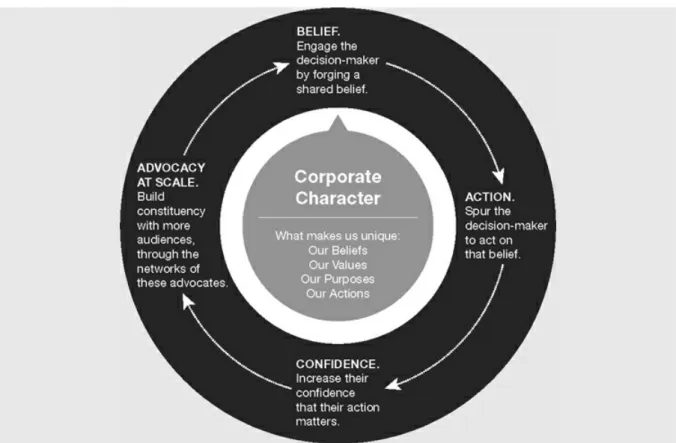
EXPERT PERSPECTIVES: CORPORATE CHARACTER
Over the course of a few weeks in the late summer of 2009, for example, four Americans engaged in unusual public behavior: tennis great Serena Williams threatened and verbally assaulted a U.S. umpire. At the same time, in other countries, emerging leaders in business, government, nonprofits, universities, and religions have continued to demonstrate that inappropriate, even vile, behavior seems to know no bounds.
THE HEART OF A DYNAMIC APPROACH TO COMMUNICATION AND REPUTATION
Open; Kanye West jumped on stage at the MTV Video Music Awards to wrest the microphone from one artist because he thought another deserved the VMA; Michael Jordan revived decades-old interpersonal feuds at his induction into the Basketball Hall of Fame; and Congressman Joe Wilson of North Carolina shouted, "You're lying" when the U.S. A reputation is built on performance, behavior and communication, and it can generally only be repaired by working on all three aspects.
MANAGEMENT
Lehman Brothers was one of the oldest and most respected investment banks in the United States. An exchange of emails disclosed by the House Oversight Committee reveals one major cause of the collapse.
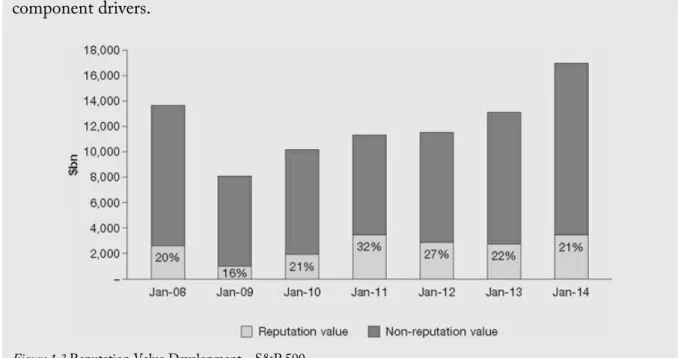
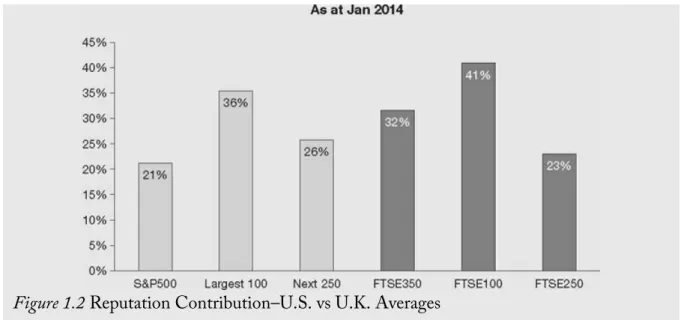
EXPERT PERSPECTIVES: THE ECONOMIC CASE FOR CORPORATE REPUTATION MANAGEMENT
- Data definition and capture
- Econometric analysis
- Individual company outputs
- Market behavior
"Interrogation" of the model facilitates the creation of a combination of reputation metrics for each of the companies under analysis. Finally, armed with a detailed explanation of the individual reputational assets of a cross-section of the U.S.
Learnings—The Evidence for Reputation Value
In Kurt Eichenwald's Conspiracy of Fools, Enron CEO Kenneth Lay proclaims to his public relations officer Mark Palmer, not long before the company's collapse, "The reason we can't right the ship is because we don't do a good job of trading . with the press."12 In other words, Lay saw a communication problem, not a performance or behavior problem. Pushmi-pullyu is a syndrome that explains the generation-old lament of corporate and organizational communicators about their lack of a "seat at the table." The reason that this has been a problem, of course, is that too often an organization develops an ill-considered product or attitude, or takes such action and then asks the communications group to justify it.The solution to the struggle represented by the Pushmi-pullyu metaphor – the solution to the push and pull of substance and communication – is to get the entire organization to behave and communicate as one.
With American consumers leading the way—fueled by government policies that encouraged homeownership with or without the ability to pay—the cycle of binge lending and spending spread around the world.
CASE STUDY: REPUTATION BE DAMNED
- Know and honor your organization’s intrinsic identity
- Know and honor your constituents
- Build the safeguards strong and durable, for they are the infrastructure of a strong reputation
- Beware the conflict of interest, for it can mortally wound your organization
- Beware of the “CEO Disease,” because there is no treatment for it
- Beware of organizational myopia, for it will obscure the long-term view
- Be slow to forgive an action or inaction that hurts reputation
- Do not lie
- Dance with the one that “brung” you
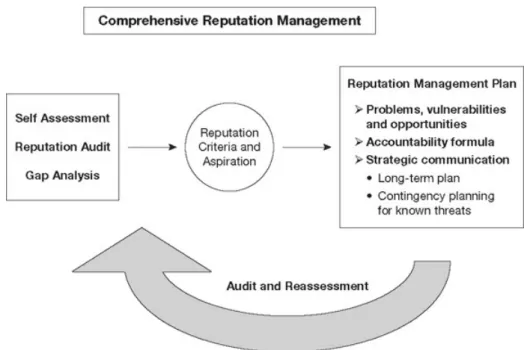
- Reputation is an asset and must be managed like other assets
It explains the factors that influence the level of such risks and then examines how a company can adequately quantify and control them." The authors of this paper maintain that contrary to the views. This paper considers how the company's reputation is most affected by an organization's actions over a successful (or otherwise) public relations campaign and how a communications strategy can best influence reputation." The paper determined that it is important to measure and manage reputation by constituency. Corporate Reputation Review, "The Concept and Measurement of Corporate Reputation ...," de la Fuente Sabate et al., Winter 2003.
In the best of worlds, they agreed—a quixotic goal of sorts, but one worth pursuing—the organization's reputation equals its brand.
EXPERT PERSPECTIVES: EVERYBODY’S GOT BRAND
Once you lose integrity," said John Haldeman of his role in the Watergate scandal, "the rest is easy." Put more positively, an organization's reputation will be directly related to its authenticity. The Authenticity Factor (Af) - Authors' Response to Ray Jordan's Challenge – is the indicator of how well an organization (or person) lives up to its inherent identity.Alsop, Ronald J., The 18 Immutable Laws of Corporate Reputation, A Wall Street Journal Book, New York: Free Press, 2004.
Schultz, Majken, et al., The Expressive Organization: Linking Identity, Reputation and the Corporate Brand, London: Oxford University Press, 2000.
ETHICS AND
COMMUNICATION
- Observance
- Integrity
- Dialogue
- Transparency
- Conflict
- Confidentiality
- Accuracy
- Falsehood
- Deception
- Disclosure
- Profit
- Remuneration
- Inducement
- Influence
- Competitors
- Poaching
- Employment
- Colleagues
Ethics consists of behaviors typically performed by an individual and collectively by a group of individuals. Bernays called for a code of ethics to govern the behavior of the emerging public relations profession. In the very description of the choices made by the practitioner, Bernays presented some of the ethical challenges facing public relations practitioners in the twenty-first century.
The International Public Relations Association (IPRA) Code of Conduct is intended to serve as normative standards for communicators working in all countries and markets of the world.
EXPERT PERSPECTIVES: ETHICS AND SOCIAL MEDIA
More on the IPRA Code of Conduct and IPRA can be found at http://www.ipra.o‐. These three association codes of ethics describe, each in their own way, normative standards of behavior for professional communicators worldwide. These three association codes of ethics describe, each in their own way, normative standards of behavior for professional communicators worldwide.
Although the specific provisions only apply directly to members of the respective organizations, they create a framework for understanding appropriate standards of conduct for all professional communicators.
CASE STUDY: NUCLEAR MELTDOWN AND CREDIBILITY
Most ethical questions related to communication practice involve trustworthiness in one way or another. In particular, much of the criticism seems to conflate criticism of corporate communications and public relations practice with criticism of journalists' reliance on PR work product. But much of their criticism seems to conflate criticism of corporate communications and public relations practice with criticism of journalists' reliance on PR work product.
One of the counterarguments to the suggestion that press releases are by their very nature.
CASE STUDY: CHINA’S HIGH-SPEED TRAIN CRASH
PRSA's new Code of Ethics for Members specifically requires the identification of the ultimate beneficiary of any front group. Another company that went bankrupt in the aftermath of the Enron scandal was Enron's auditor, Arthur Andersen. The nature of the caucus and its relationship with H & K and CFK is critical.
The significance of the baby incubator story in the larger propaganda campaign against Saddam Hussein and for the war option cannot be underestimated.
ETHICAL COMMUNICATION BEST PRACTICES
Translating this into modern vocabulary, we can create a matrix that helps us understand the ethical use of professional communication: Thus, a modern professional communicator can base his or her professional judgment on the degree to which he or she promotes statements that are true and useful. his or her client. As a general principle, a professional communicator does not promote statements that are damaging (with the possible exception of disclosure in the investment markets, which may require such communication). Unethical communication is about making statements that are helpful, regardless of whether those statements are true or false.
The ethical practice of professional communication is one in which the professional communicator deliberately seeks to promote only true and useful statements, avoids false statements, and cares about the difference.
RESOURCES FOR FURTHER STUDY
The Center advised the Public Relations Society of America on its revision of the PRSA Member Code of Ethics. The IABC can be found at http://www.iabc.com; His Code of Ethics for Professional Communicators can be found at http://www.iabc.com/about/code.htm. IPRA can be found at http://www.ipra.org; Its various Codes and Cards can be found at http://ipra.‐.
The PRSA Member Code of Ethics can be found at http://prsa.org/About/ethics/index.asp?ident=eth1.
QUESTIONS FOR FURTHER DISCUSSION
NOTES
TEPCO, Credibility, and the Japanese Crisis: JapanFocus,” The Asia-Pacific Journal: Japan Focus, n.p., March 16, 2011, http://www.japanfocus.org/events/view/52. Clifford Coonan, “China Blames Fatal Train Crash on 54 Officials,” The Independent, Independent Digital News and Media, December 29, 2011, http://www.independent.co.uk/news/world/asia/china-blames-fatal -traincrash-at-54-officials-6282476.html. Michael Wines and Sharon LaFraniere, “Despite Train Crash Facts, Blogs Erode China's Censorship,” The New York Times, July 28, 2011, http://www.nytimes.com world/asia/29china.html?pagewanted=all&_r = 0.
Bernays and the Birth of Public Relations (New York: Owl Books, 1998), p. Code of Ethics for PRSA Members, approved by the PRSA Meeting, October 2000, p. Code of Ethics for PRSA Members, p. IABC Code of Ethics for Professional Communicators.
MEDIA
RELATIONS
A Fifth Model: The Rise of the Media Clover Leaf. A new communications model has been created in the public relations industry to illustrate how the media
Often people in media relations are afraid of the media because they are intimidated by the prestige of the institution. A large part of the media relations person's job is to find out what the journalist's perspective is. X (a senior officer in the organization) resigned." The fact is that, as the spokesperson knows, Ms.
Advice to media relations practitioners: Beware of the good hype as well as the bad.