Abstract: 195words; Main Text: 7187 words; References: 33; Tables: 4; Figures: 2
Abstract: 195words; Main Text: 7187 words; References: 33; Tables: 4; Figures: 2
1
Abstract: 195words; Main Text: 7187 words; References: 33; Tables: 4; Figures: 2
MANUSCRIPT TO REVIEW
2
Discrepancy Of the Law on Disaster Emergency In Indonesia: In Search Of An Integrated 3
Law 4
[information redacted to maintain the integrity of the review process]
5 6
Abstract 7
The Determination of Disaster Emergency Status is a critical factor in handling Covid-19 in 8
Indonesia. It legally provides adequate access to the Government to reduce legal bureaucracy 9
and facilitate access to expedite the handling of Covid-19 in times of emergency. However it 10
has faced difficulties in its application as it has no explicit reference to existed emergency 11
related disaster laws. This article investigates such discrepancy in terms of the meaning of 12
emergency within the legal framework in Indonesia. It utilizes doctrinal method to explore six 13
various related laws to disaster emergency and analyze their discrepancy which has adversely 14
impact to Covid-19 handling management. The term disaster emergencies under six related 15
laws to disaster has different legal ideas, posing difficulties in their execution, particularly the 16
lack of standard rules, centralistic, and lack of enforcement power in the field. Contribution:
17
This paper significantly displays the normative issues of disaster emergency determination and 18
its status in different six disaster related laws, and provide an alternative to mainstream and 19
amend the Infectious Disease Outbreak Law as an integrated law for ensuring legal certainty, 20
benefit, and fairness for the people in handling potential pandemic in Indonesia in years to 21
come.
22
23
Keywords: Covid-19, Management, Disaster Emergency, Law, Indonesia.
24
Comment [A1]: Write an abstract of this article based on :
1. The research objectives (academic gaps) in the article.
2. Methods used in the research 3. The findings
elaborate the above 3 points in no more than 250 words
Comment [A2]: The academic contribution of this article has not been clearly stated. For example, the legal model offered in this article is used as a reference for the future.
Abstract: 195words; Main Text: 7187 words; References: 33; Tables: 4; Figures: 2
Introduction 25
26
Since Covid-19 emerged in China and was declared a pandemic by the World Health 27
Organization (WHO 2020) on March 11, 2020, 228 countries have been affected, with 5,821,004 28
deaths and 412,351,279 infections, while Indonesia has been infected in 33 provinces and 29
territories. 4,966,046 persons were infected and 145,622 died in 365 districts/cities 30
(Covid19.go.id 2021). The Government of Indonesia's primary response to Covid-19 has been to 31
convert the natural disaster into a legal event with a process for evaluating the status of a disaster 32
emergency (the disaster management Act, ss. 1-18).
33 34
Indonesia already has Law No. 4 of 1984 on Infectious Disease Outbreaks (WPM LAW), which 35
should serve as the primary legal framework for dealing with the Covid-19 outbreak. However, 36
this Law is insufficient. Since 2012, the Law has been academically drafted for alterations or 37
revisions for various reasons. One is out of step with current developments, particularly in 38
technology and rapid transit.
39 40
The Government determined the Covid-19 disaster's emergency status using Law No. 6 of 2018 41
on Health Quarantine (UUKK), an article regulating Public Health Emergencies, and Law No. 24 42
of 2007 on Disaster Management contains the legal notion of Disaster Emergency Status.
43 44
The international disaster management approach separates disaster management into three 45
stages: 1) pre-disaster, 2) emergency response, and 3) post-disaster. These stages do not indicate 46
a dichotomy between them, but rather that they are interrelated. What is critical is that this level 47
requires delegation to the Government to take swift action in a disaster emergency. This stage is 48
a normal cycle in the international disaster management system. While there are numerous 49
implementation variants around the international globe, what is critical is that disaster and its 50
management are a connected series, not a series of isolated incidents.
51 52
The stages will employ uncommon or conventional legislation compared to disaster management 53
during the pre-and post-disaster phases. In an emergency system, each declaration of an 54
emergency allows the Government to disregard several fundamental principles, including 55
Comment [A3]: What to describe in the introduction are undesirable conditions (emergency, riots) or others that occur during a pandemic, so it is necessary to formulate rules / laws related to the theme written about
Abstract: 195words; Main Text: 7187 words; References: 33; Tables: 4; Figures: 2
restrictions on the Constitution's articles of independence and freedom, suspension of human 56
rights, and violations of the Law governing the procurement of goods and services for crisis 57
management of an emergency nature. This article explores the concept and regulation of 58
Indonesia's Disaster Emergency Law and its implementation throughout the Covid 19 period.
59 60
Method 61
62
The approach used is doctrinal, which is assessed discrepancy of law concerning emergency 63
disaster laws through legal principles, standards, statutory rules, court decisions, agreements, and 64
doctrines (teachings). Additionally, historical aspect of emergency status imposition in Indonesia 65
also refers to track the full understanding of the concept.
66 67
Results and discussion 68
69
Defining of Disaster Emergency 70
71
The Law on Disaster Emergencies originated from and was incorporated into staatsnoodrechs or 72
countries in a state of emergency or danger, but through its development, most notably following 73
the enactment of the UUPB's Law Number 24 of 2007 concerning Disasters, the stipulation of 74
disaster emergencies has developed its legal conception and Law in a medical emergency 75
(Sihombing 1996a).
76 77
Since 1945, the Indonesian legal system has used three distinct phrases to refer to emergencies: a 78
state of danger, a compelling exigency, and a state of emergency. Asshidqie (2007:97) argued 79
that the premise or principle of declaring a state of emergency is a constitutional prerogative 80
granted to the State to limit human rights to expedite recovery and impose temporary limits to 81
overcome catastrophic problems and restore normal conditions. Because the constitution vests 82
this enormous authority in the legislature, the Law also establishes limitations or conditions on 83
when that authority may be employed, such as a time limit or the stipulation of circumstances 84
during a situation of danger or emergency. The regulation's objective is to balance unbridled 85
Comment [A4]: Elaborate more detail.
Comment [A5]: 1. The description of Disaster Emergency should be paired directly with the emergency in the health sector which is the focus of the study.
2. What has the Indonesian government done related to the focus of your study?
3. Your opinions about what has been done 4. What do you propose?
The above points must be CLEAR in the RESULT and DISCUSSION description.
Abstract: 195words; Main Text: 7187 words; References: 33; Tables: 4; Figures: 2
authority and quantifiable constraints, following the principle of balance legislation (evenwichts 86
theory) (Asshidqie 2007a).
87 88
According to the Theory of the Law of Equilibrium, danger conditions are abnormal conditions;
89
therefore, legal remedies must also be abnormal and extraordinary; in normal circumstances, the 90
authorities' actions are illegal or against the law; however, when abnormal conditions return to 91
normal, the rulers' actions become valid and justifiable (Sihombing 1996:2). The appropriate 92
criteria for defining the emergency must be detailed not only in the Constitution but also in 93
special regulations. The Indonesian Constitutional Council has established what may be uttered 94
during a state of emergency (Simamora 2010:58-70).
95 96
An emergency is a period of chaos that must be regulated normally to avoid multiple legal 97
interpretations in dealing with the situation; consequently, it is necessary to regulate the 98
mechanisms and procedures that allow the State to function according to the wishes of the State 99
as compiled during regular times and the Constitution. Because an emergency has the potential 100
to give rise to unconstitutional political interpretations, multiple interpretations to define a 101
situation that is easily classified as an emergency, and the potential to give birth to a dictatorship.
102
Sembiring has attempted to formulate several requirements, including the following: First, the 103
existence of the State's highest interest, namely the State's highest interest, for the State's 104
existence, which is jeopardized in an emergency (het hoogste staatsbelang - het bestaan zelf van 105
de staat - stond on het spel en was afhankelijk van het al of niet maken der getroffen regeling) 106
Second, it is critical to enact emergency measures to balance out aberrant conditions ( deze 107
regeling noodzakelijk was). Third, the Emergency Law's validity is transitory (provosoir), or it 108
must be swiftly restored to normal conditions, but the temporary term is not specified. Fourth, 109
Parliament cannot convene in the event of an emergency but must participate at the appropriate 110
time (Sihombing 1996b).
111 112
Asshiddiqie (2006) uses the term staatsnoodrecht to refer to a country's legal system during a 113
state of emergency. He argues that many statemakers and legal systems consider the State to be 114
in a normal state, and thus many laws are drafted in normal circumstances, even if the State may 115
be in an abnormal state. Or an emergency is also quite possible; this abnormality or emergency 116
Abstract: 195words; Main Text: 7187 words; References: 33; Tables: 4; Figures: 2
might be triggered by political situations both within and outside the country, social conditions 117
such as conflict and civil war, or natural calamities. Since 1945, the Indonesian legal system has 118
used three distinct phrases to refer to emergencies: a state of danger, a compelling exigency, and 119
a state of emergency.
120 121
According to Article 22 of the 1945 Constitution, "in the event of a compelling emergency, the 122
President has the authority to prescribe government regulations in lieu of law and must gain 123
agreement from the House of Representatives in the subsequent trial." The Republic of United 124
States of Indonesia's (RIS) Constitution also governs emergencies and hazards; however, the RIS 125
Constitution defines them as "a state of war (article 127), an urgent emergency (article 96), and a 126
condition of danger (article 129) (DPRRI 1950:1-47)."
127
Abstract: 195words; Main Text: 7187 words; References: 33; Tables: 4; Figures: 2
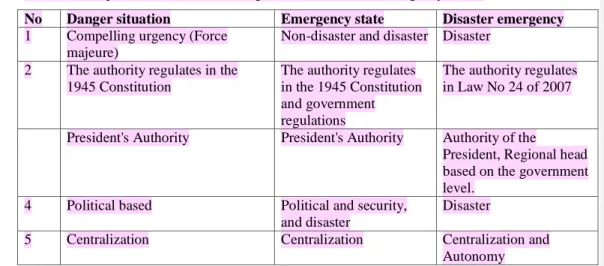
Table 1. Comparison of Hazards, Emergencies and Disaster Emergency Status 128
No Danger situation Emergency state Disaster emergency 1 Compelling urgency (Force
majeure)
Non-disaster and disaster Disaster 2 The authority regulates in the
1945 Constitution
The authority regulates in the 1945 Constitution and government regulations
The authority regulates in Law No 24 of 2007
President's Authority President's Authority Authority of the
President, Regional head based on the government level.
4 Political based Political and security, and disaster
Disaster
5 Centralization Centralization Centralization and
Autonomy 129
Abstract: 195words; Main Text: 7187 words; References: 33; Tables: 4; Figures: 2
The three systems of the decision have various legal processes in "a condition of danger" and 130
"emergency", which will be fully under the power of the President as head of State per the spirit 131
of centralization and unification. Meanwhile, "state of emergency and disaster level" or "status of 132
disaster emergency" becomes a tiered authority following the spirit of decentralization and 133
autonomy.
134 135
Situations of Danger and Emergencies.
136 137
Article 12 of the 1945 Constitution states that "The President declares a state of danger. The 138
circumstances and effects of a state danger are regulated by legislation." The Law that has been 139
utilized to define a state of danger thus far is the Law Number 74 of 1957 on the repeal of 140
"Regeling Po De Staat Van Oorlog En Beleg" and the enactment of "State of Danger".
141 142
Article 1 paragraph (1) states that The President, on the recommendation of the Council 143
of Ministers, may declare the entire territory or a portion of the territory of Indonesia in a state of 144
danger with a state of emergency or a state of war if security or Law and order in the entire 145
territory or a portion of the territory of Indonesia are threatened by rebellions, riots, or natural 146
disasters that are feared to be insurmountable by tools.
147 148
Ihsanuddin (2022:1-9) stipulates that the Government does not use the term "state of danger"
149
concerning Covid-19, even though the Government has contemplated using this legal tool for 150
short-term Covid-19 prevention. There is a reason why experts believe that using the term "civil 151
emergency" to prevent Covid-19 is inappropriate for two reasons: first, it conjures up images of 152
authoritarian regimes, and second, it avoids state legal responsibilities because the problem of 153
restricting people's movements can be addressed through Act No. 3 of 2018 with regards to 154
quarantine (Dzulfikar & Susanti 2022: 19-22).
155 156
A Compelling Exigency 157
158
The Constitution makes no express provision for disasters, much fewer epidemics. The 159
Indonesian Constitution only provides for a "compelling exigency" process, which according to 160
Comment [A6]: This subchapter should be integrated with the concept of emergency in the health sector. Focus on the topic you are writing about.
Abstract: 195words; Main Text: 7187 words; References: 33; Tables: 4; Figures: 2
article 22 of Indonesian constitution 1945 the President may issue a Government Regulation in 161
Lieu of Law (PERPPU) and must receive approval from the DPR. However, if there be no such 162
approval, these government regulations shall be revoked. 1945 Constitution does not specify 163
what constitutes a coercive urgency that endangers the State.
164 165
The Republic of Indonesia Constitutional Court's Decision number 138/PUU-VII/2009 166
establishes three elements for compelling urgency, namely:
167 168
1) the existence of urgent circumstances impairing or endangering national interests.
169
2) There is a legal void or insufficient legal protection.
170
3) The DPR's implementation of the law-making process through the legislative mechanism.
171 172
This has been demonstrated by the Government's response to the Covid-19 outbreak, namely the 173
issuing of Government Regulation in Lieu of Law of the Republic of Indonesia Number 1 of 174
2020 concerning State Financial Policy and Financial System Stability for Handling the Covid- 175
19 Pandemic and/or In Facing Threats That Endanger the Economy, which focuses on three 176
areas: 1) handling Covid-19, 2) the state financial system and economy, and 3) state financial 177
stability (Effendi 2020: 67-79).
178 179
The Development of Disaster Emergency Law in Indonesia 180
181
Indonesia's Disaster Emergency Law was enacted following the passage of Law No. 24 of 2007 182
on Disaster Management (UUPB). The UUPB was founded and heavily affected by the 183
December 26, 2004 earthquake and tsunami in Aceh. Prior to the UUPB, disaster management in 184
Indonesia lacked a strong legal foundation; disaster management was considered a minor 185
component of the health, environment, and other systems (Dadek et al. 2020:13).
186 187
At the time of independence, various laws managing crises or risks existed, which influenced the 188
Law on disaster emergency development. Numerous regulations include the Law No. 6 of 1946 189
on Dangerous Conditions, Law of the Republic of Indonesia No. 74 of 1957 (74/1957) on the 190
Abstract: 195words; Main Text: 7187 words; References: 33; Tables: 4; Figures: 2
repeal of the "Regling Po De Staat Van Oorlog En Beleg" and the Determination of Dangerous 191
Conditions, and Government regulation No. 23 of 1959.
192 193
Disaster and Health Emergency Designation 194
195
Dadek et al (2021:23-42) argued that since independence, the Government has issued several 196
decrees regarding the status of a disaster emergency. The issuance of the disaster emergency is 197
intended as a legal basis that the Government takes over the disaster management, not as a legal 198
basis to be regulated in stages and to provide legal breadth and authority to facilitate the handling 199
of the emergency. Since the issuance of the UUPB, the concept of disaster emergency law has 200
become clear and has legal certainty, but until now, it is still constrained by the mechanism and 201
its benchmarks. After independence, the Government of Indonesia issued several legal 202
regulations regarding the determination of a national disaster emergency status, including:
203
Presidential Decree No. 254/1966 concerning the Annual Disaster Eruption of Mount Awu in 204
Sangir Talaud Regency/North Sulawesi, Presidential Decree in response to the Aceh Earthquake 205
and Tsunami which; Presidential Decree No. 371 of 1961 declaring the eruption of Mount 206
Merapi; Presidential Decree No. 1992 on the Determination of Natural Disasters in Flores; and 207
Presidential Decree No. 12 of 2020 concerning the Determination of Non-Natural Disasters for 208
the Spread of Corona Virus Disease 2019 as a National Disaster.
209 210
Diverse Concept of Disaster Emergency in Indonesia 211
212
The concept of Law (genuine legal concepts) is defined as "a constructive and systematic 213
concept used to understand a Rule of Law (e.g., the concepts of rights, obligations, legal 214
relations, legal institutions, engagements, marriages, inheritance and buying, and selling) 215
(Wignjosoebroto 1974:89-98).
216 217
Outbreak Area 218
219
Although the WPM LAW utilizes the phrase "plague area," there is no legal definition of what 220
constitutes an "outbreak area." The legal definition of an outbreak area is contained in the 221
Abstract: 195words; Main Text: 7187 words; References: 33; Tables: 4; Figures: 2
Republic of Indonesia's Government Regulation No. 40 of 1991 on the Control of Infectious 222
Disease Outbreaks, which defines an outbreak area as "a region deemed to be infected with an 223
epidemic." Additionally, this Government regulation identifies the legal definition of an 224
Extraordinary Event (KLB), which is "the emergence or increase in the incidence of illness/death 225
that is epidemiologically significant in a particular area during a specified time period, and is a 226
situation that can result in an outbreak" (Indonesian Government 1991, s.1).
227 228
Although very few criminal acts are committed, the WPM Law provides that "Anyone who 229
intentionally obstructs the implementation of epidemic control will face a maximum sentence of 230
one year in prison and/or a maximum fine of Rp. 1,000,000 (one million rupiah)." Then, 231
"Anyone who, by negligence, obstructs the implementation of epidemic control is subject to a 232
maximum sentence of six (six) months in prison and/or a maximum fine of Rp. 500,000 (five 233
hundred thousand rupiahs)." The primary issue is that there is no specific legal definition of 234
willful obstruction; WPM LAW has already defined what constitutes a crime and a violation 235
based on the perpetrator's intent, whether intentional or just indulgent.
236 237
Emergencies, Outbreaks, Eruptions, or Extraordinary Events (KLB) Based on Laws of 238
Health 239
240
Law of the Republic of Indonesia Number 36 Year 2009 concerning Health use three legal 241
terms: Emergency, Outbreak, Eruption, or Extraordinary Events. Numerous chapters explain the 242
concept of a state of emergency is deficient in terms of the rule requiring health facilities to 243
prioritize emergency patients (threatening) life or disability, the prohibition of refusing patients, 244
as well as the obligation of the Government to provide drugs and source power, and the facilities' 245
time of emergency until post-emergency. Neither do health care professionals have the right to 246
sue for negligence during a state of emergency.
247 248
Additionally, the UUK controls efforts to prevent and respond to outbreaks, particularly their 249
health or medical consequences. The Government has the authority under Article 36, paragraph 1 250
to "declare a region to be in a state of the epidemic, eruption, or unusual occurrence (KLB)." The 251
UUK only regulates what the Government, public sector, and private sector must do in an 252
Abstract: 195words; Main Text: 7187 words; References: 33; Tables: 4; Figures: 2
emergency and post-disaster situation; it does not regulate who declares an emergency, how the 253
mechanism is implemented, or what facilities can be obtained to expedite the situation, except 254
for the procurement of medications on the basis of legal concepts.
255 256
Public Health Emergency 257
258
The Republic of Indonesia's Public Health Emergency Law, No. 6 of 2018 on Health Quarantine 259
defines a Public Health Emergency as "an extraordinary event marked by the spread of infectious 260
diseases and/or events caused by nuclear radiation, biological pollution, chemical contamination, 261
bioterrorism, or food that poses a health hazard and has the potential to spread across regions or 262
countries. " This draft is used as the basis for executing quarantine and sealing the country's 263
borders, and it is the Central Government's authority. This requires that the sort of disease that 264
will cause a public health emergency be determined and that this determination takes into 265
account the social and economic consequences. Indeed, Public Health Emergencies have a high 266
association with regional quarantine and Large-Scale Social Restrictions (PSBB) and regulated 267
criminal sanctions.
268 269
Legal Concepts in Emergencies According to UUPB.
270 271
The Law of the Republic of Indonesia No. 24 of 2007 on Disaster Management (UUPB), is 272
currently being discussed for revision for a variety of reasons. The administration has drafted an 273
academic paper but has not yet placed it in the National Prolega (DPRRI 2019a). The UUPB has 274
clearly defined the stages of a disaster, including pre-disaster, disaster emergency, and post- 275
disaster, as well as the necessary activities. Although the UUPB regulates the legal system for 276
assessing disaster emergencies, the UUPB remains vulnerable to physical disasters.
277 278
Numerous The UUPB's notion of disaster emergency law is as follows:
279 280
a. Disaster emergency response can be defined as an immediate or direct response to a 281
disaster that has occurred and is characterized by physical handling actions.
282
Abstract: 195words; Main Text: 7187 words; References: 33; Tables: 4; Figures: 2
b. Disaster Emergency Assistance is defined as "an endeavor to address fundamental 283
requirements during times of disaster.
284
c. A disaster emergency is "a state determined by the government for a specified amount of 285
time-based on the advice of the agency charged with disaster response.
286 287
The definition of disaster emergency status remains geared around disaster management 288
institutions, in this case, BNPB/BPBD. The activities include the following: (a) rapid and precise 289
assessment of the location, the extent of damage, and available resources; (b) determination of 290
the emergency status of a disaster; (c) rescue and evacuation of disaster-affected communities;
291
(d) provision of basic necessities; (e) protection of vulnerable groups; and (f) immediate 292
recovery of vital infrastructure and facilities (DPRRI 2019b).
293 294
What are the legal advantages of declaring a disaster emergency? According to UUPB, 295
BNPB/BPBD has easy access to the following capabilities: (1) mobilization of human resources;
296
(2) equipment deployment; (3) logistics deployment; (4) immigration, excise, and quarantine; (5) 297
licensing; (6) procurement of goods/services; (7) management and accountability of money 298
and/or goods; (8) rescue; and (9) command to command the sector/institution.
299 300
While the UUPB's concept of Disaster Emergency is adequate, it does not provide legal certainty 301
for dealing with epidemic disasters, particularly Covid-19, because it is still too focused on 302
physical disasters, particularly emergency response activities, and thus cannot be used to 303
implement law enforcement processes or health protocols, particularly quarantine activities.
304 305
Emergency Concept in PERPPU No. 1 of 2020.
306 307
Government Regulation In Lieu Of Law of The Republic of Indonesia No. 1 Of 2020 308
Concerning State Financial Policy and Financial System Stability to Control Corona Virus 309
Disease 2019 (Covid-19) Pandemic And/or In Response to Dangerous Threats to The National 310
Economy And/or The Stability of The Financial System was issued with reasons that already met 311
the criteria of "compelling exigency." That is:
312
Abstract: 195words; Main Text: 7187 words; References: 33; Tables: 4; Figures: 2
1) The spread of Corona Virus Disease 2019 (COVID-19) has become a pandemic and has 313
entered Indonesia and has had a very large impact; that the implications of the Corona 314
Virus Disease 2019 pandemic are a slowdown in national economic growth, 315
2) It has led to a decline in the economy, state revenues, and increased spending, especially 316
in handling health and the national economy.
317
3) Deteriorating state financial system;
318 319
This diversity cannot be separated from the legal politics of the Indonesian Government, which 320
has not been systematical, integrated, and based on the ability to formulate laws intellectually.
321
Syahriza Alkohir Anggoro quoted Natsir as saying that rechtpolitiek is "a political action of the 322
Government through law based on the principles of the Rule of Law and the principle of 323
democracy" (Anggoro 2019:77-86).
324 325
The UUPD's Concept of Disaster Emergency Law 326
327
The following matters are addressed in Law No. 23 of 2014 on disaster and disaster emergencies:
328 329
1) Emergency funds are those that may be included in the APBN but are only distributed 330
following a calamity. Emergency funding can also be included in the APBD, and 331
disasters are a common basis for APBD adjustments.
332
2) The UUPD defines "emergency situation" in its explication of Article 316, which 333
establishes the conditions for an "emergency situation" that fits at least the following 334
criteria:
335
a) It is not a routine activity of the Regional Government and cannot be forecasted in 336
advance;
337
b) is not expected to occur regularly;
338
c) is beyond the Regional Government's control and influence; and 339
d) has a major impact on the budget for emergency recovery.
340 341
Disaster Emergency and Legal certainty 342
343
Abstract: 195words; Main Text: 7187 words; References: 33; Tables: 4; Figures: 2
Certainty is an inherent characteristic of Law, particularly positive and written legal norms.
344
Without the value of certainty, Law loses its meaning because it can no longer be used to govern 345
everyone's behavior (Wantu 2007:19). Certainty is referred to as one of Law's objectives. Legal 346
certainty is described as the clarity of standards to the point where they can be utilized as a guide 347
for those who are regulated (Leawoods 2000:489–515).
348 349
Gustav Radbruch (2000:489-515) a well-regarded intellectual person in the field of legal 350
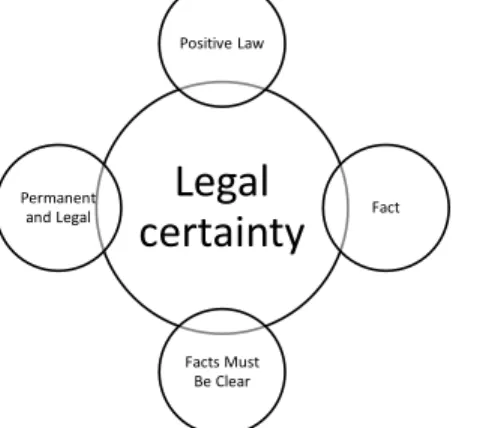
certainty, stated that legal certainty must satisfy four critical and fundamental requirements 351
connected to the definition of legal certainty:
352 353
1) The Law is positive, meaning it is written.
354
2) Laws are factual in the sense that they are founded on reality.
355
3) Facts must be succinctly stated, avoiding ambiguity in interpretation, and simple to apply 356
and implement.
357
4) Positive Law is impervious to change, implying that it must be fixed in the mechanism of 358
formation and the authorized institution with the authority to modify.
359
Abstract: 195words; Main Text: 7187 words; References: 33; Tables: 4; Figures: 2
360
Figure 1. The Four Elements of Legal Certainty by Gustav Radbruch 361
Legal certainty
Positive Law
Fact
Facts Must Be Clear Permanent
and Legal
Abstract: 195words; Main Text: 7187 words; References: 33; Tables: 4; Figures: 2
Legal certainty is greatly impacted by positivism's flow, in which the validity of legislation is 362
determined by objective legal principles that are fully divorced from morality. A law is deemed 363
invalid if it fails to satisfy these standards of pure Law.
364
Abstract: 195words; Main Text: 7187 words; References: 33; Tables: 4; Figures: 2
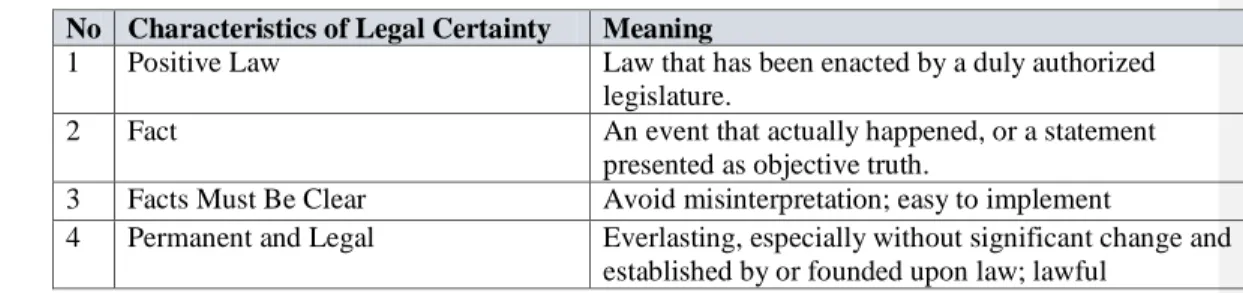
Table 2. Legal Technical Explanation Characteristics of Legal Certainty 365
No Characteristics of Legal Certainty Meaning
1 Positive Law Law that has been enacted by a duly authorized legislature.
2 Fact An event that actually happened, or a statement
presented as objective truth.
3 Facts Must Be Clear Avoid misinterpretation; easy to implement
4 Permanent and Legal Everlasting, especially without significant change and established by or founded upon law; lawful
366
Abstract: 195words; Main Text: 7187 words; References: 33; Tables: 4; Figures: 2
Lon Fuller (1971:76) established eight criteria that Law must meet; if they are not met, the Law 367
ceases to be Law; in other words, there must be legal certainty. The following are the eight 368
principles:
369 370
1) A legal system composed of regulations that are not reliant on erroneous judgments in 371
certain instances;
372
2) The regulation is made public;
373
3) Not retroactive, as this would jeopardize the system's integrity;
374
4) Formulated in a way that the general public understands;
375
5) There should be no regulations that contradict one another;
376
6) Must not demand more than is feasible;
377
7) Should not be regularly altered;
378
8) Regulations must be consistent with their day-to-day implementation.
379 380
There must be consistency between rules and their execution. Legal certainty ensures that the 381
Law is correctly applied and requires legal arrangements in legislation to be formed by 382
competent and authorized legal parties to ensure that they have a legal basis and are genuinely 383
obeyed and operate (Zainal 2012:45).
384 385
Legal certainty is defined in Utrecht in two ways: (1) the existence of general legal rules that 386
inform individuals about what actions may or may not be taken, and (2) legal security for 387
individuals against government arbitrariness because the existence of general rules informs 388
individuals about what the State may charge or do to them (Syahrani 1999:23). Raharjo 389
(2006:134) stated that while legal certainty has developed into a form of philosophy in legal life, 390
other processes, notably psychological and political processes, are required for legal certainty to 391
exist. Socio-historically, the issue of legal certainty arose along with the capitalist economy's 392
production structure. Legal certainty is essentially Law that is derived from and reflects society's 393
culture through fostering cooperation between the State and the public in orienting and 394
comprehending the legal system (Naufal et al 2014:104).
395 396
Abstract: 195words; Main Text: 7187 words; References: 33; Tables: 4; Figures: 2
The principle of ignorantia iuris neminem excusat translates as "an individual's ignorance of the 397
law does not excuse." This principle mandates that everyone is presumed to be aware of the Law 398
upon its publication in the official gazette or state news 399
400
What occurred at this precise moment is now addressing the Covid-19 outbreak. The law 401
enforcement process has been ineffective in restricting the spread of Covid-19 because the 402
present Law is insufficient to provide legal clarity for the legal mechanism. Even though the 403
regulation of positive Laws for epidemic control in Indonesia began during the Dutch colonial 404
period, the regulation of epidemics remains relatively easy, even when compared to the colonial 405
period's regulation (Rasjidi 19990:47).
406 407
Two types of legal construction arrangements continue to be a difficulty or legal concern in 408
Indonesia's disaster management system (Hairi 2020:2-3):
409 410
1) Lack of a strong constitutional foundation in the face of a highly lethal and rapidly 411
spreading epidemic such as Covid-19, for example, what if there is a disaster emergency 412
for years until 2024, and presidential and regional elections cannot be held due to 413
insufficient funding, and legislative elections must be postponed, who will hold power in 414
the head of State if their term of office expires during the absence of elections? The 415
Legislative Election and Presidential Election are scheduled for February 21, 2024, and 416
the Regional Head Election or Pilkada is concurrently scheduled for November 27, 2024 417
(Syaiful 2021). Is it possible to tackle the problem using the PERPPU mechanism and the 418
pressing urgency as a proxy for the level of danger? If PERPPU is used, what about the 419
President's power limits? Because the supreme legal principle is "Salus populi suprema 420
lex esto," which prioritizes the public's protection. In general, infectious disease 421
eradication in Indonesia is accomplished by the following activities: early detection, 422
patient identification, treatment, eradication of the illness's source, immunity efforts 423
(immunization), and public education (Hasibuan 2020:28).
424
2) Statutory regulations originate as a result of the duality of legal groups and are relatively 425
basic, whereas the resulting challenges range from state policy issues to criminal law 426
enforcement. In general, infectious disease eradication in Indonesia is accomplished by 427
Abstract: 195words; Main Text: 7187 words; References: 33; Tables: 4; Figures: 2
the following activities: early detection, patient identification, treatment, eradication of 428
the illness's source, immunity efforts (immunization), and public education.
429 430
Attempts at transformation The UUPB is currently grappling with institutional challenges;
431
funding, institutional and community participation, and measures to firmly enforce health norms 432
have not been discussed (Ministry of Social Affairs RI 2020).
433
Abstract: 195words; Main Text: 7187 words; References: 33; Tables: 4; Figures: 2
434
Figure 2. Indonesia's Legal Framework for Plague Disaster Management 435
Abstract: 195words; Main Text: 7187 words; References: 33; Tables: 4; Figures: 2
Djasmani (2011a: 366-368) argued in his book that according to some experts, the role of Law as 436
a tool for social engineering cannot operate in Indonesia since, from the Government's 437
perspective, legislation remains essentially a regulation or set of regulations enacted by a 438
legislative body. Legislation is enacted to assist the Government in carrying out its development 439
mission. The formation of the Rule of Law from this vantage point is not based on the values of a 440
plural society. The Rule of Law is created only from a deductive perspective (deductive logic 441
based on the civil law legal system's legacy). Law as a tool for social engineering will be 442
successful if the Rule of Law is developed with consideration for the customary Law that 443
develops in society. The Government must create space for the growth of customary Law, 444
integrate it into the national legal system, and make it the ideals upon which national Law is 445
based). Pound's position contrasts with the School of History, which maintains that Law grows 446
and develops in lockstep with a habit-driven society (Djasmani 2011b: 366-368).
447 448
Rosco Pound emphasizes the importance of the Government carrying out two distinct features of 449
government activity which are: Administrative Aspects and Legal Aspects. This component 450
assesses a government's capacity to pick a broad hierarchy of individuals to do specific service 451
jobs within the job and take the necessary actions to guarantee that the work is performed and to 452
make corrections or modifications when circumstances change on a daily basis. This activity was 453
critical in primitive society and accounted for the majority of government action. Under 454
contemporary society's complicated and advanced conditions, this activity is insufficient unless 455
stringent legal controls temper it.
456 457
Aspects of Legislation Formation It must ensure legal certainty throughout the process of law 458
enforcement. Indonesia already has an integrated legal framework for disaster management, 459
including organizations that serve as the primary implementers, but not for coping with disease 460
outbreaks, particularly in the aftermath of the Covid-19 epidemic. After thirteen years of 461
operation (2007-2020), UUPB discovered numerous issues, including ambiguous and 462
overlapping legal definitions, authority to declare disasters, disaster level, lack of formal Law, 463
looting, and various other issues.
464 465
Abstract: 195words; Main Text: 7187 words; References: 33; Tables: 4; Figures: 2
The UUPB is the primary legal framework governing Indonesia's disaster management system;
466
additionally, all laws in the Republic of Indonesia, if any, that regulate disaster issues are disaster 467
laws, including those governing diseases and the environment. Life and even fisheries Laws are 468
included in the disaster law system since they regulate in a state of force majeure.
469 470
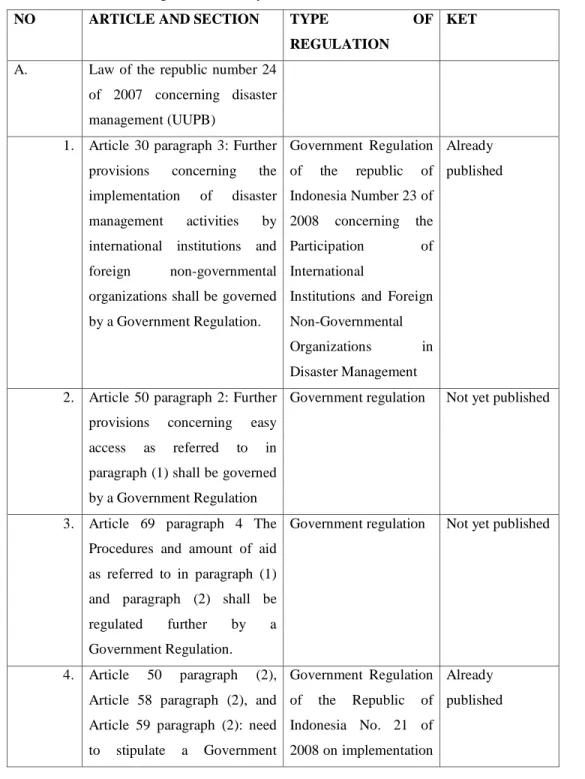
In Indonesia, a law always requires implementing regulations, such as the UUPB, which requires 471
six PPs and two Presidential Regulations, but the Presidential Decree on the mechanism for 472
determining disaster emergencies has not yet been issued, despite the fact that decrees, 473
particularly for regional heads, continue to be issued.
474
Abstract: 195words; Main Text: 7187 words; References: 33; Tables: 4; Figures: 2
Table 3. Government Regulations Already and Not Issued Based on UUPB 475
NO ARTICLE AND SECTION TYPE OF
REGULATION
KET
A. Law of the republic number 24 of 2007 concerning disaster management (UUPB)
1. Article 30 paragraph 3: Further provisions concerning the implementation of disaster management activities by international institutions and foreign non-governmental organizations shall be governed by a Government Regulation.
Government Regulation of the republic of Indonesia Number 23 of 2008 concerning the Participation of International
Institutions and Foreign Non-Governmental Organizations in Disaster Management
Already published
2. Article 50 paragraph 2: Further provisions concerning easy access as referred to in paragraph (1) shall be governed by a Government Regulation
Government regulation Not yet published
3. Article 69 paragraph 4 The Procedures and amount of aid as referred to in paragraph (1) and paragraph (2) shall be regulated further by a Government Regulation.
Government regulation Not yet published
4. Article 50 paragraph (2), Article 58 paragraph (2), and Article 59 paragraph (2): need to stipulate a Government
Government Regulation of the Republic of Indonesia No. 21 of 2008 on implementation
Already published
Abstract: 195words; Main Text: 7187 words; References: 33; Tables: 4; Figures: 2
NO ARTICLE AND SECTION TYPE OF
REGULATION
KET
Regulation concerning the Implementation of Disaster Management.
of disaster control.
5. Article 63: Further provisions
concerning disaster
management funds handling mechanism as referred to in Article 60 to Article 62 shall be governed by a Government Regulation.
Government Regulation of the Republic of Indonesia No. 22/2008 concerning disaster aid
financing and
management.
Already published
6. Article 7 paragraph 3: Further provisions concerning decision on disaster status and level as referred to in paragraph (2) shall be stipulated by a Presidential Regulation
Presidential Decree Not yet published
7. Article 17 Further provisions concerning the establishment, functions, tasks, organizational structure, and working arrangement of National Disaster Management Agency.
shall be stipulated by a Presidential Regulation.
Regulation of president of republic of Indonesia no 8 of 2008 concerning national disaster management agency which was later amended by Regulation of president of Republic of Indonesia Number 1 of 2019 concerning National Disaster Management Agency
Already published
476
Abstract: 195words; Main Text: 7187 words; References: 33; Tables: 4; Figures: 2
The general provisions of Law No. 6 of 2018 on quarantine state the following:
477 478
"A public health emergency is a rare occurrence in which infectious illnesses and/or events are 479
transmitted as a result of nuclear radiation, biological pollution, chemical contamination, 480
bioterrorism, or food that constitutes a health threat and has the potential to spread across regions 481
or countries."
482 483
In article 10, The Central Government establishes and terminates the " Public Health Emergency.
484
" What is the difference between declaring a disaster and declaring an emergency? In point 10 of 485
the UUPB's general provisions, it is stated that:
486 487
"A disaster emergency response is a series of activities carried out immediately following a 488
disaster to address the disaster's adverse effects, which may include the rescue and evacuation of 489
victims and property, the provision of basic needs, the protection and management of refugees, 490
and the rescue and restoration of infrastructure and facilities‖.
491 492
While emergencies differ in terms of the procedures that must be followed, the definition of what 493
constitutes an emergency, and the breadth of action authorized by the responsible authority, each 494
permit a flexible range of powers and measures necessary to contain a pandemic. Grogan (2020) 495
lists four fundamental components of a constitutional provision authorizing the creation of a state 496
of emergency: (1) the criteria for its declaration; (2) transfer of authority; (3) limitations on their 497
usage; and (4) measures for legislative or judicial oversight. For instance, the Constitution may 498
compel Parliament to approve legislation authorizing the declaration of a state of emergency 499
either prior to or within a specified time period following the declaration (Molloy 2020:10).
500 501
The executive branch of power may declare a state of emergency in one of two ways. First, a 502
state of emergency is triggered by revolt or conflict. Second is the State of emergency triggered 503
by a public health threat. In such circumstances, David Davis observed, "the government has all 504
the powers provided to it by the Constitution that are essential to maintain its existence." 2 This 505
demonstrates that the bearer of government power, in the Indonesian context, the President—- 506
generally has the authority to exclude normal/ordinary laws through the enactment of emergency 507
Abstract: 195words; Main Text: 7187 words; References: 33; Tables: 4; Figures: 2
legislation. If it takes the form specified, then the President may take a range of actions, 508
including declaring a state of emergency in the first context (Chandranegara 2021:45-70).
509 510
Incorporation of Disaster Emergency Law in the Management of Covid-19 511
512
On January 28, 2020, the Head of the National Disaster Management Agency (BNPB) issued the 513
Decree of the Head of BNPB RI Number 09 of 2020 concerning the Determination of the Status 514
of Certain Disaster Emergency Situations in Indonesia Due to Corona Virus Disease (BNPB 515
2018:19). On February 29, 2020, the BNPB issued another Decree of the Head of the BNPB RI 516
Number 13 Year 2020 regarding the Extension of the Status of Certain Emergency Disasters Due 517
to Corona Virus Disease Outbreaks in Indonesia (BNPB 2020:1-2). This Decree of the Head of 518
BNPB is based on Presidential Regulation Number 17 of 2018 concerning Disaster Management 519
in Certain Circumstances, which states in consideration of letter b that:
520 521
―That in certain circumstances where the status of a Disaster emergency has not been determined 522
or has ended and/or has not been extended, but action is required or is still required to reduce 523
disaster risk and its wider impact, it is necessary to assign assignments and authorities to BNPB 524
to can carry out disaster management operations‖.
525 526
Article 1 defines Certain Circumstances as "a situation in which the status of a Disaster 527
Emergency has not been created or has ended and/or has not been prolonged, but action is 528
required or continues to be required to mitigate the Disaster Risk and its broader consequences."
529 530
The head of the BNPB's choice is to "violate the law," this is because the Head of BNPB's 531
decision is not a determination of national status because, according to the UUPB, the State 532
alone has the authority to declare a state of emergency, in this case, the President, local 533
governments, and the governors and regents/mayors. Second, while the Presidential Regulation 534
does not regulate the determination of "certain status," it does regulate the "handling of certain 535
circumstances" in which "emergency status" has not been determined or has been determined but 536
has expired. Thus, the Presidential Regulation does not control the BNPB's jurisdiction to decide 537
the State of a particular emergency but rather authorizes the BNPB to continue or initiate its 538
Abstract: 195words; Main Text: 7187 words; References: 33; Tables: 4; Figures: 2
activity prior to determining whether or not the disaster emergency has been identified and 539
established or ended.
540 541
Laws relating to disasters are laws in the sense that their contents are incorporated into 542
heteronomous Law, including the UUPB. The Government enacted Law No. 24 of 2007 on 543
Disaster Preparedness and Management (UUPB) as a manifestation of Indonesia's vulnerability 544
as a disaster supermarket. The UUPB has also altered the paradigm of thinking about a disaster, 545
which was initially viewed as an accident caused by an individual's misfortune, then evolved into 546
the responsibility and role of the Government alone, and has now evolved into the responsibility 547
of a variety of parties, including the private sector and the community. This paradigm shift is 548
motivated, in part, by an appreciation for the critical nature of multi-stakeholder disaster 549
management.
550 551
With regards to disaster laws and policies, the UUPB mandates the issuance of six additional or 552
implementing regulations, namely six Government Regulations (PP) and two Presidential 553
Regulations (Perpres). According to Article 84 of the UUPB, the implementing regulations shall 554
be issued no later than six months after the UUPB is promulgated.
555 556
Among a number of implementing regulations, the determination of disaster emergency status 557
has not been issued. The Presidential Regulation establishing disaster emergency status is critical 558
because it establishes the legal certainty necessary for the legal structure for disaster 559
management. The designation of a disaster emergency has ramifications for the expenditure of 560
public funds, the use of public facilities, and deviations from regular rules, particularly in 561
procurement. The disaster emergency designation has numerous legal implications, including a 562
concept in which a decree can supersede the applicable Law.
563 564
On March 31, 2020, the President also declared Indonesia a Public Health Emergency in 565
accordance with Presidential Decree No. 11 of 2020 Determination of a COVID-19 Public 566
Health Emergency, which identifies COVID-19 as a disease capable of causing a Public Health 567
Emergency and requires implementation in Indonesia. Additionally, On April 14, 2020, the 568
President of the Republic of Indonesia declared the Covid-19 outbreak a national disaster 569
Abstract: 195words; Main Text: 7187 words; References: 33; Tables: 4; Figures: 2
through Presidential Decree No. 12 of 2020, which includes the decision to designate Covid-19 570
as a national disaster after considering the WHO's decision to classify it as a pandemic and 571
providing guidelines for regional heads to pay attention to national policies (BNPB 2016:15).
572 573
Both of these Presidential Decrees have their own legal basis, namely Presidential Decree No. 11 574
of 2020 concerning Public Health Emergency, which is based on Article 10 of the UUKK and 575
serves as the basis for implementing regional quarantine with the President determining which is 576
based on the centralization principle. Meanwhile, Disaster Emergency is defined to ensure that 577
the Regional Head and President are not constrained, for example, in the procurement of goods 578
under regular legislation and special legislative actions to ensure the seamless handling of 579
disaster emergencies. The UUPB, which appoints regional and State heads based on the principle 580
of regional autonomy, directs this Disaster Emergency.
581 582
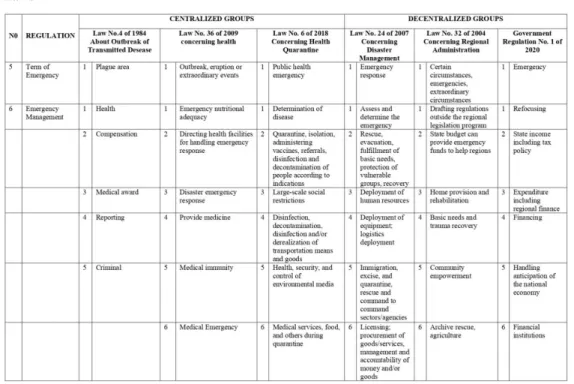
Towards a Legally Certainty Outbreak Emergency Law 583
584
The distinctions of regulations must be reconciled as the starting point for developing a legal 585
framework of disaster management in general and specifically for dealing with epidemics of the 586
magnitude of Covid 19. Comparing different positive legal systems can contribute to the 587
formation of a fundamental notion describing a new legal concept (Asshiddiqie 2006:11).
588
Abstract: 195words; Main Text: 7187 words; References: 33; Tables: 4; Figures: 2
Table 4. Differences in the Concept of Disaster Emergency Law in the Six Disaster-Related 589
Laws 590
591
Abstract: 195words; Main Text: 7187 words; References: 33; Tables: 4; Figures: 2
The Indonesian Government must enhance the Law on Infectious Disease Outbreaks to ensure 592
that it meets all legal requirements, particularly in the event of a pandemic outbreak of the 593
magnitude of Covid-19, which has a profound effect on the nation, State, and society. The 594
emergency law contained in the WPM Law should be developed in accordance with the legal 595
certainty standards. Several drafts of the Law in dispute include the following:
596 597
Outbreak Emergency Response 598
599
This Outbreak Emergency Response is a terminology that crystalizes many terminologies such as 600
outbreak area, extraordinary event, public health emergency, etc. The legal idea proposed is 601
Epidemic Emergency Status, a development of Disaster Emergency Status, which continues to 602
apply, particularly in the case of non-epidemic calamities. Outbreak Emergency Response is a 603
series of activities conducted immediately following the prevention and occurrence of outbreaks 604
to address the outbreak's adverse effects. These activities include assessment and research, 605
outbreak prevention and management, medical treatment and quarantine, as well as economic 606
and social impacts. Furthermore, Epidemic emergency aid is a coordinated effort to address 607
medical requirements, economic resilience, and social vulnerability in the event of an outbreak.
608 609
Outbreak Emergency Status 610
611
Defining an Epidemic when the status of an Outbreak Emergency is declared is critical to 612
establishing a line of demarcation. In accordance with international law principles, numerous 613
ease of access and laws will be implemented to expedite the process of epidemic containment.
614
The Government determines this status for a specified period of time based on the research 615
conducted by the Agency charged with public health.
616 617
Plague Management Implementation.
618 619
The implementation of epidemic control includes:
620 621
Abstract: 195words; Main Text: 7187 words; References: 33; Tables: 4; Figures: 2
a. rapid and precise epidemiological assessment of the major basic disease types to pinpoint 622
the outbreak's geographic location;
623
b. determination of the outbreak's emergency status;
624
c. prevention;
625
d. medical treatment of those affected by the epidemic;
626
e. Compliance with Health Protocols;
627
f. Restrictions;
628
g. Quarantine, Territory Quarantine, and Lockdown;
629
h. Satisfaction of fundamental regional quarantine and lockdown requirements;
630
i. Immunization;
631
j. Economic management;
632
k. Social impact management;
633
l. Handling of the body, and 634
m. Other countermeasures 635
636
Appointment Executor 637
638
The Government determines the epidemic's emergency level in accordance with the magnitude 639
of the outbreak calamity. The President is responsible for declaring an emergency in the event of 640
a pandemic outbreak; the governor is responsible for declaring an emergency at the provincial 641
level, and the regent/mayor is responsible for declaring an emergency at the district/city level.
642 643
Legal Ease during Outbreak Emergency Status 644
645
In the event of an epidemic emergency, the President and Regional Heads have easy access to 646
mobilizing human resources; deploying medical equipment; deploying logistics for the purposes 647
of quarantine, regional quarantine, and locking; immigration control and licensing; procuring 648
goods/services for medical, economic, and social needs; and managing and accounting for 649
money and/or goods. Whoever intentionally obstructs the implementation of epidemic control 650
must be identified, including violations of quarantine, regional quarantine, and locking, as well 651
Abstract: 195words; Main Text: 7187 words; References: 33; Tables: 4; Figures: 2
as the criminal sanctions system, which includes easy confinement and fines, but is based on 652
legal certainty, benefit, and justice.
653 654
Conclusion 655
656
The Disaster Emergency Law in Indonesia has been initiated since Dutch colonial time to state 657
the country is in emergency. Disaster is one of the factors that contribute to the establishment of 658
a state of emergency as self-contained, particularly since the UUPB 2007 was established. The 659
concept of disaster emergency law in the Indonesian legal system is extremely diverse and 660
widespread, adversely impacting the enforcement of Covid-19 emergency regulation. Emergency 661
law has been used in the non-uniform principles, a violation of the principle of autonomy, a lack 662
of legal certainty regarding the enforcement of health protocols, and a legal breakthrough in the 663
disaster emergency concept system during the Covid-19 response.
664 665
This paper found that the WPM Law should be utilized in dealing with the Covid-19 outbreak, 666
particularly in the context of handling emergencies. Currently this law is rarely employed in 667
associating with legal regime of Covid-19 prevention.
668 669
It is advisable to revising the Law on Infectious Disease Outbreaks to increase legal clarity, 670
benefit, and justice and provide a punishment under the principles of the Rule of Law. the 671
concept of epidemic emergency response must be self-contained and comprehensive in terms of 672
objectives, legal certainty regarding actions and access, and the authority of heads of State and 673
regions to declare epidemic emergencies in consistent with other emergency arrangements.
674
Special quarantine preparations for epidemic emergencies must be properly controlled under the 675
new WPM Law, involving the police and, in some cases, the military forces.
676
Abstract: 195words; Main Text: 7187 words; References: 33; Tables: 4; Figures: 2
Acknowledgement statement 677
[information redacted to maintain the integrity of the review process]
678
Competing interests 679
[information redacted to maintain the integrity of the review process]
680
Author contributions 681
[information redacted to maintain the integrity of the review process]
682
Funding 683
[information redacted to maintain the integrity of the review process]
684
Data availability 685
[information redacted to maintain the integrity of the review process]
686
Disclaimer 687
[information redacted to maintain the integrity of the review process]
688
Ethical Consideration 689
[information redacted to maintain the integrity of the review process]
690
Abstract: 195words; Main Text: 7187 words; References: 33; Tables: 4; Figures: 2
Bibliography 691
692
Anggoro, S.A., 2019, 'Legal Politics: Looking for Some Explanations', Journal of Law 693
Cakrawala 10(1), 77–86. https://doi.org/10.26905/idjch.v10i1.2871 694
Effendi, B., 2020, 'Introduction To The State Of Emergency In Facing Community Health 695
Emergency', Administrative Transformation 10 (1), 67–79. http://jta.lan.go.id 696
/index.php/jta/article/view/150 697
BNPB, 2011, 'National Agency for Disaster Management', Journal of Disaster Management,19 698
Chandranegara, I. S., 2021, 'Comparative Judicial Emergency Due to the Covid-19 Pandemic', 699
Ius Quia Iustum, 45–70. https://doi.org/10.20885/iustum.vol28.iss1.art3 700
Djasmani, H.Y., 2011, 'Law as a Social Engineering Tool in Legal Practice in Indonesia', Legal 701
Issues 40.3 (2011), 365–74. https://doi.org/10.14710/mmh.40.3.2011.365-374 702
House of Respresentative of Indonesia Republic (DPRRI), 2019, Academic Draft Of Law Design 703
Concerning Disaster Management, Indonesia.
704
Dzulfikar, L.T & Susanti, B. 2020, 'Why Civil Emergency Shouldn't Be a Scenario Choice in 705
Handling COVID-19', The Conversation, 19–22 706
Wantu, F.M., 2007, 'Antonomics in Law Enforcement', Law Court, 9.
707
Fuller, L.L., 1971, The Morality of Law. New Havenz, Yale University Press, Yale.
708
Sihombing, H. (ed), 1996. Emergency Constitutional Law in Indonesia, Djambatan, Jakarta.
709
Ihsanuddin., 2020, 'Covid-19 Civil Emergency Discourse and the Use of the Soekarno Era 710
Perppu', Kompas, viewed from
711
https://nasional.kompas.com/read/2020/03/31/10324101/wacana-darurat-sipil-covid-19- 712
dan-digunakannya-perppu-era-soekarno?page=1 713
Asshiddiqie, J & Safa'at, M.A., 2006, Hans Kelsen's Theory of Law , Indonesian Constitutional 714
Court, Secretariat General & Registrar of the Republic of Indonesia Constitutional Court, 715
Jakarta.
716
Asshidqie, J., 2007, Emergency Constitutional Law, Rajawali Press, Jakarta.
717
Ministry of Social Affairs RI, 2020, The Government's View on the Final Countermeasures Bill, 718
Ministry of Social Affairs, Jakarta.
719
Leawoods, H, 2000, 'Gustav Radbruch: An Extraordinary Legal Philosopher', Washington 720
University Journal of Law & Policy 2(1), 489–515.
721