Bulletins are either octavo or quarto in size, depending on the needs of the presentation. Proposed classification.- On the basis of the species examined,. the following categories can be easily distinguished between living. However, it seems undesirable to submerge the identity of the numerically small and morphologically.
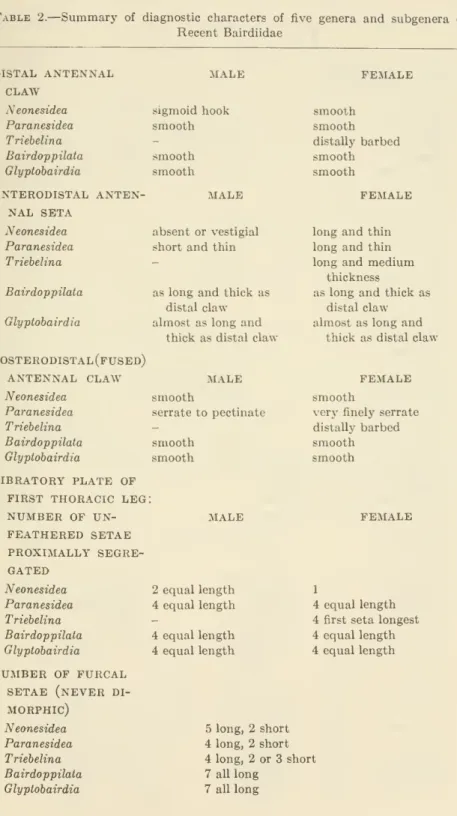
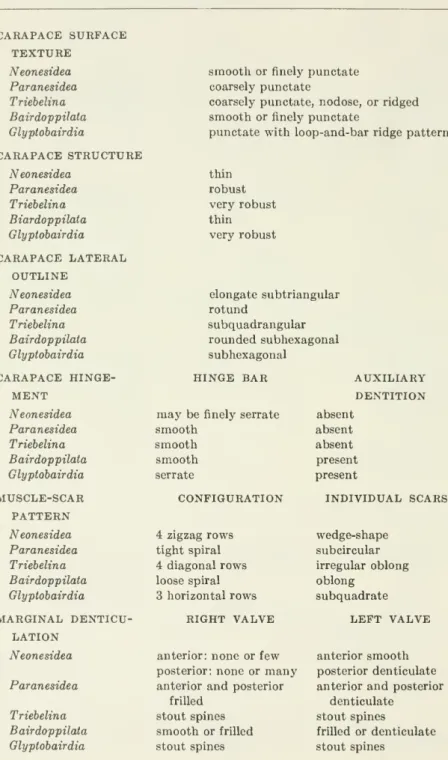
A brief comparison of the essential anatomical features of these five genera and subgenera of Bairdiinae is presented in Table 2.
DISTAL ANTENNAL
The most fruitful source of living material for this study was in the collections of the US Biology, International Indian Ocean Expedition program, which included three types of collections: (1) Author's coastal collections from coastal and reef environments around Nosy Be, Madagascar; (2) collections, mainly by dredging, from cruises 7-9 of the RV Anton Bruun in the Mozambique Channel; (3) collections from various participants on islands visited during these cruises. Due to the large number of specimens and species involved, the shallow-water subfossil assemblages are included in these collections. Eltanin, mainly in Antarctic waters; collections from the Anton Bruun's cruise 11 in the southeast Pacific; and U.S. collections
Fish Commission Steamer Albatross in many parts of the world, especially the Gulf of Mexico and southeast Pacific Ocean.
STATION LOCALITIES
10 U.S. NATIONAL
14 U.S. NATIONAL MUSEUM BULLETIN 29 5
For a few of the species described here, the entire anatomy is illustrated, both to demonstrate the general consistency of structure from species to species, and to provide a sampling of the possible variation in structures not usually considered diagnostic. not be considered. TriebelinaschulziHartmann, 1964 Bairdiacorpulejita Miiller, 1894 Bairdiadecipiens Miiller, 1894 Bairdiadinochelata Kornicker, 1961 Bairdiafrequens Miiller, 1894 Bairdiacf.frequens, Keys, 1964 Triemaneerson and Collofina germaneerson. Although the species is certainly an aerial diidostracod and, according to the structure of the copulatory organs and carapaceut line, probably belongs to this first generic group of species as diagnosed above, the many errors prohibit identification of this form with any one of the several species of this general form known to inhabit the Bay of.
Another category may be added either here or within the Paranesidea for such species as Bairdia serrata Miiller, 1894, Bairdia roquebrunensis Rome, 1942, and "Genus Uncertain species 1" in this paper, which combine appendage characters of the Neonesidea with the marginal spinosity and a high outline of a P dor a domed edge. .

22 U.S. NATIONAL MUSEUM BULLETIN 295
REVISION OF RECENT BAIRDHDAE 23
Diagnosis.-Carapace small, elongated and effective; anterior margin of right valve minutely serrated, left valve smooth; the rear. margin of right valve smooth, of left valve denticulate. Affinities.—The shape of the carapace and the pattern of muscle scarring are those of the group in which N. REVISION OF THE REVISION BAIRDIIDAE 35 Diagnosis.—Carapace strongly compressed, with the exterior conspicuously punctate; posteroventral margin of left valve toothed, others apparently smooth; anterodorsal and posterodorsal margins very slightly concave, posterior end slightly caudate.
Affinities.— The carapaces of the Ifalic Atoll specimens are indistinguishable from those of the Indian Ocean localities, although some minor differences are apparent in the male connectives.

42 U.S. NATIONAL MUSEUM BULLETIN 29 5
S. NATIONAL MUSEUM BULLETIN 295, PLATE 1
S. NATIONAL MUSEUM BULLETIN 295, PLATE 2
46 U.S. NATIONAL MUSEUM BULLETIN 2 95
Type locality.— Nosy Be, Madagascar, sample 446 (washes of uniform algae at low tide on the beach at Antsakoabe). Habitat.— Nosy Be, sporadically encountered in a wide variety of epifaunal niches in shallow water, crawling on algae, dead coral fragments, live coral and sponges, in reef and back-reef zones. Subfossil distribution.— Nosy Be, abundant and almost ubiquitous in shallow sediments, especially reef-derived sands.. Affinities.—This is an extremely common morphological type and forms with similar shields and is found in most shallow-water tropical assemblages.
Affinities.— Although it may seem unlikely that a form so widespread should not have been described before, I can find none. Affinities.— Carapace very similar in shape, size, and punctate surface to P. algicola, new species, but not so tall, left valve without steeply arched dorsal margin, without furrowed fracture slope. between the marginal and medial areas. Affinities.— The carapace closely resembles B. {Bairdoppilata) cratericola, new species, but lacks the bairdoppilatan hinge and has a more exaggerated caudal process.
Affinities. The appendage and sexual characteristics (except for the smoothly pointed antennal claw) are consistent with Neo-. Affinities. The anatomy of the soft part is very similar to that of Paranesidea, which also has a robust asymmetric carapace with marginal spines and a pointed surface on the outside. The antenna features (smooth, fused claw and thickened anterodistal seta) represent an approximation of the characteristic antenna features of Bairdoppilata. Affinities. —BairdiatuberculataBr&dy, 1880[—Bairdia rhomboidea Brady, 1867 (not Kirkby)] has a similar rhombic shape, but the exterior is completely reticulate, without lateral spines; the species was.
Muscle scar pattern consists of 8 subcircular to subquadrate scars arranged in three horizontal to arch well separated rows, scars from dorsal or ventral rows tending to be divided for a total of 10 scars. Affinities.— Reported species of Bairdoppilata range from Lower Cretaceous to Recent; the type species is Miocene.

70 U.S. NATIONAL MUSEUM BULLETIN 295
However, specimens identified by Benson and Coleman as B. triangulata Edwards from nearby stations in Florida Bay and ... on the west coast of Florida are very similar in shape and size. B. carinata Kornicker is larger and has more widely spaced pinnae, but the carapace shape, opaque pattern, and copulatory organ are the same as the Florida Bay specimens. Habitat.— Abundant in almost all reef epifauna niches, mainly on live corals, sponges, alcyonaria and Millepores, also on algae and dead coral fragments.
72 U.S. NATIONAL MUSEUM BULLETIN 295
74 U.S. NATIONAL MUSEUM BULLETIN 295
Apparently this is the result of an injury; however, it confirms the close homologous relationship between antennae and thoracic legs suggested by the often identical configuration of spines or other details of the distal termination and consistent relative proportions of podomeredium sizes. Copulatory organ ^^'distal lobe roughly triangular in outline, bearing no setae or other projections. Three valves and an entire carapace, all baked, on slide Challenger 140, cat British Museum (Natural History).
The telectotype specimen is more angularly arched than the paratype, and its hinge is not seen. A male living in Eltanin station 1345; a male and a female and an empty nursery in Eltan 418; 25 subfossil specimens at Eltanin stations subfossil specimens from GIL 615, South Africa.

MUSEUM BULLETIN 295
Caribbean Sea, Mississippi Delta, east of Rio de Janeiro and Mozam-. Affinities.—This extremely numerous and widespread population likely includes more than one species and/or subspecies, but I can currently find no reproducible criteria by which to establish consistent subgroups. Some differences are evident in the length and position of the posterior caudal extension, as well as in the length and slope of the dorsomedial part of the right valve and the dorsal curvature of the left valve. The identification as Bairdiahirsuta Brady is based on the similarity of rare and poorly preserved specimens from Albatros sites in the southeast Pacific to the lectotype specimen from this same region.
The Bairdoppilatan identity is based on soft parts of females collected in the Gulf of Mexico and on barely visible Bairdoppilatan hinge teeth of subfossil specimens from this region. Affinities.- External shape identical to Neonesidea species 2. The completely smooth external and angular lateral outline is unlike most other species of Bairdoppilata, which. the cleariv belongs on the basis of hinge teeth set. Affinities.— Despite the similarity in the carapace contours and the proximity of this station to Nosy Be, Madagascar, this form cannot be identified ^nth B .
Affinities.—Glyptobairdia has been considered for some years a subjective synonym of Triebelina, but is technically available. This. In the Bahamas and Bermuda collections, B. G.) coronata is characteristic of coral reefs and not of the calmer lagoonal or backwater environments. Affinities.-Samples of the Tulear population are larger and higher than those from St.
Recorded in the present study from 11 stations in the south-central part of the Mozambique Channel, at depths ranging from 400 to 3750 meters and mostly below 1190 meters. Affinities. The specimen presented by Key (1954) is slightly less elongated and more curved at the back. Anton Bruun's specimens are identical in shape to the Challenger lectotype.

MUSEUM BULLETIN 29 5
For the USNS Eltanin, whose cruises in the Southeast Pacific and Antarctica have contributed valuable collections of abyssal and Antarctic ostracods. Diagnosis.—Carapace nearly equal, moderately inflated, outlines as described for Bairdiajolini Brady, adductor musculature divided; narrow molten rim zone with abundant straight radial pore channels. 1, 3 and 5 shorter, seta 6 shortest; copulatory organ oval in outline with broadly curved copulatory tube and long flexible extension.

REVISION OF RECENT BAIRDHDAE 95
Of variant A, 2 living females (?) at Anton Bruun stations 368C and 416A; probably some subfossil specimens included in the counts for the typical form.

100 U.S. NATIONAL MUSEUM BULLETIN 29 5
REVISION OF RECENT BAIRDHDAE 101
The appendages of the two living specimens, here called variant A, appear to be fully mature, although no genitalia are discernible.
104 U.S. NATIONAL MUSEUM BULLETIN 2 95
106 U.S. NATIONAL MUSEUM BULLETIN 29 5
108 XJ-S. NATIONAL MUSEUM BULLETIN 295
Affinities.—Despite the extreme differences in lateral outline and compression of the dorsal margin of the left valve, the consistency with which these two morphological forms occur together in the same specimens suggests a relationship between them that can best be explained as sexual dimorphism. However, the lateral outline of the latter is more rounded; it is also more robust. Affinities. The structure of the genital lobe is unlike any other described; the morphology of the second appendage is similar to that of Z.
This is especially visible in the shortened proportions and the loss of certain podomeres and bristles of the antennae and thoracic legs. The widening of the fused marginal zone with increasing carapace compression is a trend that also occurs in certain species of Propontocypris (Schedopontocypris) and especially in Propontocypris (Ekpontocypris) Maddocks, as well as in many Paradoxostomatidae; in the latter case the appendage structure is also deceptively simple. Affinities. This shape is perhaps slightly more curved dorsally than that proposed by Brady.
Benson, who collected these and other particularly interesting ostracods from Walterson Shoal (under unusual hardships, including two broken ribs) during his participation in voyage 7 of the Anton Bruun, International Indian Ocean Expedition. Affinities.—While the rectilinear outline and abundant short, straight radial pore canals give this species some resemblance to Zabythocypris, the equal size and moderate inflation of the valves suggest that it is better placed in the more flexibly defined category of Anchistrocheles. Contribution to the study of Ostracoda, with special reference to the Tertiary and Cretaceous microfauna of the Caribbean region, 125 pp., 18 pis.
A monograph of the marine and freshwater Ostracoda of the North Atlantic and North-West Europe. Distribution patterns of living and subfossil podocopid ostracods in the Nosy Be area, northern Madagascar.