http://www.soolconference.org/?act=board&bbs_code=program&bbs_mode=view&bbs_seq=30
Rice Farming and History of Making Traditional Indonesian Alcoholic Beverage
Ida Bagus Wayan Gunama*, Nyoman Semadi Antaraa, I Dewa Gede Mayun Permanab, I Nengah Sujayac
a Department of Agroindustrial Technology, Faculty of Agricultural Technology, Udayana University, Badung 80361, Bali Indonesia
b Department of Food Science and Technology, Faculty of Agricultural Technology, Udayana University, Badung, 80361, Bali Indonesia
c School of Public Health, Faculty of Medicine, Jl. PB Sudirman, Denpasar Bali 80114, Indonesia
ABSTRACT
Rice is the most important agricultural products in Indonesia, with over 200 million people relying on it as a staple food. The rice production has been fully supported by improved infrastructure, supply of seeds, fertilizers, research and development as well as government regulations in pricing. Its vulnerability to climate change requires adaptation strategies for irrigation, biotechnology, and cultivar selection. Recent forms of agricultural policy in Indonesia include the deployment and implementation of environmentally friendly technologies, with the aim to reduce the use of chemicals. The agricultural irrigation system that has existed since ancient times and is still relevant today is the Subak irrigation system;
this system is able to maintain the existence of agricultural water and environmental sustainability. Rice production in Indonesia continues to increase from year to year and it reached 81.38 million tons in 2017, including glutinous rice. With the increase in population, the need for rice also increases both for food consumption and as raw materials for the food and non-food industries, as well as other forms of consumption. With the food self-sufficiency program, rice production will continue to be improved. Glutinous rice, both black and white, is widely used as a raw material for the production of alcoholic beverages (rice wine).
Traditional alcoholic beverages are ancient art products that are found naturally. They become parts of human culture, tradition, and civilization as an integral part of many ceremonies, symbolism in rituals, and celebrations. Some of the traditional rice wine products in Indonesia such as brem, arak, and tuak were originally made for ceremonial/ritual and celebrations purposes but developed into a favorite drink and even have become a promising commercial product. Therefore, knowledge of fermentation technology, selection of raw materials, and a starter culture will provide better product quality. This can reduce losses and increase sales, so it is becoming a good source of revenue for the household, industry, state, and national levels.
Furthermore, improvements in product performance, promotion, and marketing will have a positive impact on the development of alcoholic beverages with rice as the raw material in the future.
Keywords: Rice farming, subak, alcoholic beverage, rice wine.
______________
* Corresponding author, Jl. Ida Bagus Oka, No 9, Denpasar, 80114, Bali, Indonesia.
E-mail address: [email protected]
Ida Bagus Wayan Gunam, Nyoman Semadi Antara, I Dewa Gede Mayun Permana, I Nengah Sujaya
Faculty of Agriculture Technology
UDAYANA UNIVERSITY Bali, INDONESIA
Rice Farming and History of Making
Traditional Indonesian Alcoholic Beverage
OUTLINE OF PRESENTATION
Introduction
History of traditional
Indonesian alcoholic beverage
Making of traditional
Indonesian alcoholic beverages Conclusion
Rice farming in Indonesia
UDAYANA UNIVERSITY
Bali Island
INTRODUCTION
Indonesia is an archipelagic country that is widespread from 17,500 islands, with a population of 265,015,000 (BPS, 2018).With a diverse tropical environment and plentiful annual precipitation.
The volcanic origin of the archipelago provided vast areas of fertile soils which support both dense tropical rainforest and agriculture.
Rice is the most important staple food in Indonesia, with over 200 million people relying on rice as a staple food
Indonesia ranks 3rd in the world in regards to total rice production but has also been the world’s 7th largest rice importer over the past 5 years (USDA, 2012).
Concurrently, domestic rice consumption has been increasing each year as a result of dietary changes associated with population growth and economic development, making Indonesia a leading global rice
consumer (USDA, 2015).
Owing to the perennial shortfall of rice production, food security and the pursuit of national rice self-sufficiency have become predominant
concerns of the Indonesian government.
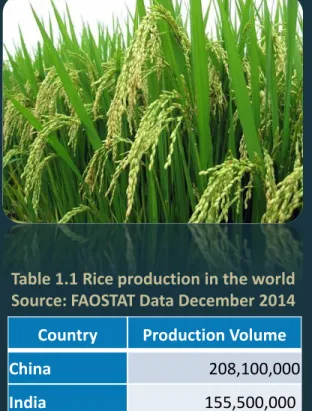
Country Production Volume
China 208,100,000
India 155,500,000
Indonesia 70,600,000
Bangladesh 52,400,000
Vietnam 44,900,000
World 741,500,000
Table 1.1 Rice production in the world Source: FAOSTAT Data December 2014
Rice production &
consumption in Indonesia
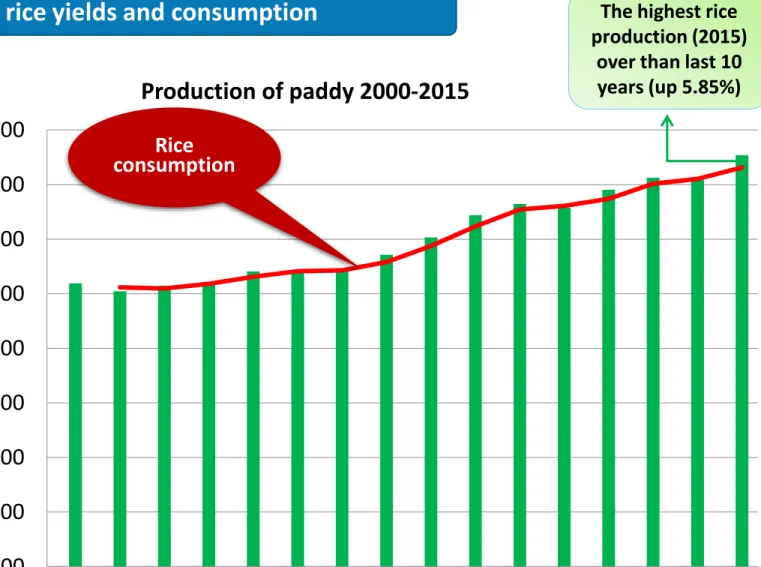
Historical rice yields and consumption
0,00 10.000.000,00 20.000.000,00 30.000.000,00 40.000.000,00 50.000.000,00 60.000.000,00 70.000.000,00 80.000.000,00
2000200120022003200420052006200720082009201020112012201320142015
Tons
Years
Production of paddy 2000-2015
The highest rice production (2015)
over than last 10 years (up 5.85%)
Source: BPS (2015)
Note: 2015 Data is second Forecast Figure (ARAM II)
Fig. 1.2 Production of paddy (2000-2015)
Rice consumption
Rice farming methods &
product
development
To increase paddy production the Indonesian Government has carried out various efforts including increasing budgets, increasing human resources, providing fertilizer, developing integrated pest control, developing more productive and environmentally friendly farming methods, developing local and new varieties.
Climate change-resistant farming methods: Green Revolution, The System of Rice Intensification (SRI), and one of the old ways that are still relevant today is the Subak irrigation system.
In addition to increasing rice production (including glutinous rice), post-harvest handling, processing, and marketing of products are also being developed.
Traditional food and beverages that develop in the community,
including fermented products, need to get the attention of all parties.
Fermented traditional drinks (alcoholic beverages) used in the past
are used as a means of religious ceremonies / rituals, symbolism,
celebrations, and finally become a favorite beverage that can be
commercialized.
Rice farming in Indonesia
Rice farming area
History of rice farming in Indonesia
Almost all islands in the Indonesian archipelago can be planted with rice, but the most are in Java, Sumatera, Sulawesi and Bali-Nusra. The total area of rice in Indonesia is 13.39 million Ha (Kementrian Pertanian, 2015).
Total agricultural land in 2010 was estimated by the Indonesian government (BPS) at roughly 22 percent of the total land area in the country.
SRI in the field it is able to increase rice production significantly, provide good product quality, and achieve a high level of plant independence (Purwasasmita and Sutaryat, 2018).
The “Green Revolution,” wherein new high-yielding cultivars were developed along with improved farming systems to significantly increase cropping intensity and yield (USDA, 2012).
SUBAK a traditional irrigation system (Lansing, 2007).
Farming Methods
International Rice Research Institute (IRRI) scientists indicate that rice was first introduced to Indonesia in about 1500BC, and has been under continuous
cultivation for the past 3,500 years. Rice is by far the most important food crop grown in Indonesia today (USDA, 2012).
Rice farming in Indonesia
The System of Rice Intensification (SRI)
SRI is an evolving set of practices, principles, and philosophies aimed at increasing the productivity of irrigated rice by changing the management of plants, soil, water and nutrients.
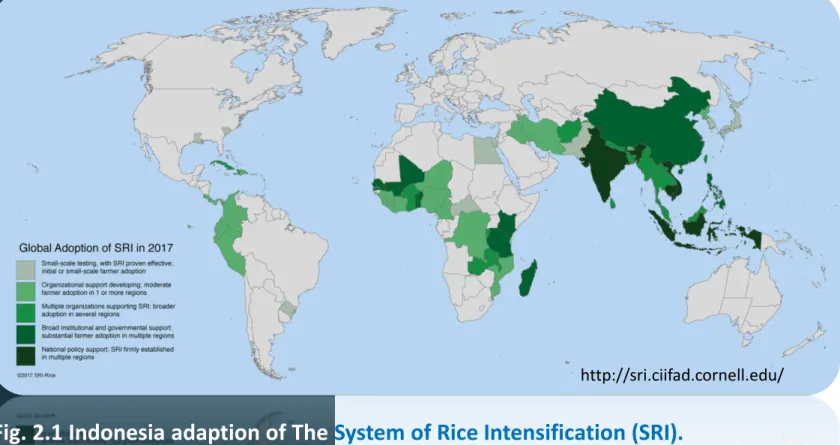
To increase Indonesia's productivity also has implemented The System of Rice Intensification (SRI) (Fig. 2.1). To succeed, still need a lot of
adjustments and improvements.
http://sri.ciifad.cornell.edu/
Fig. 2.1 Indonesia adaption of The System of Rice Intensification (SRI).
Varieties
New varieties have been developed that are adaptive to certain agroecosystems (BB Padi, 2017). Besides that the government is also still developing local varieties such as glutinous rice, brown rice, black rice that have certain advantages.
This is a sample text.
Enter your text here
This is a sample text.
Enter your text here
This is a sample text.
Enter your text here
This is a sample text. Enter your text here. This is a sample text.
Enter your text here. This is a sample text. Enter your text here.
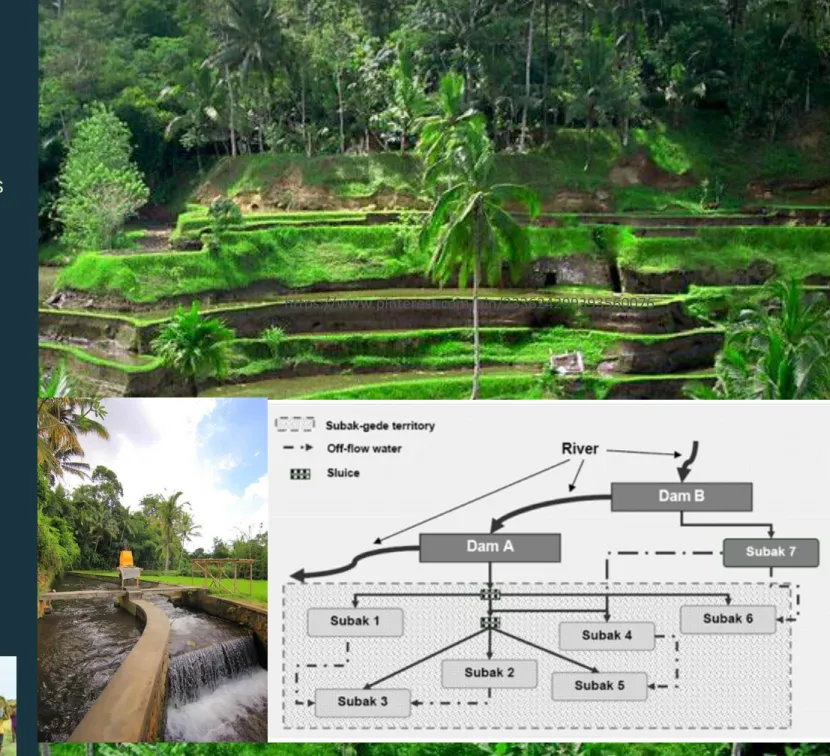
SUBAK is one of the rice farming irrigation systems in Indonesia
• Bali is in some ways typical of other agricultural areas in the region, but it is also a special case because of its distinctive economic and cultural environment dominated by tourism. In this environment, farmers are doubly marginalized. At the same time the island offers them unique market opportunities for premium and organic produce (MacRae, 2011).
• Subak is a traditional local organization concerned primarily with irrigation and the ritual aspects of rice production.
• The agricultural irrigation system that have existed since ancient times and still relevant today (Lansing, 1987).
• This system able to maintain the existence of agricultural water and environmental sustainability (Yuliana, et al. 2017)
Fig. 2.2 Examples of Subak Gede Spatial Schemes (Lorenzen (2006)
https://www.pinterest.com/pin/233624299393560076
Subak model
In 1987, J. Stephen Lansing cooperate with farmers in Bali has redeveloped in the irrigation system/Subak irrigation becomes more effective. That way he can prove how the effectiveness and importance of Subak irrigation method in Bali.Of the regions investigated in Indonesia, rice production in Bali has been the most efficient (Mariyono, 2014).
Since 2012 has become the UN recognized World Cultural Heritage for Education, Knowledge and Culture (UNESCO) (Kompas.com, 2012)
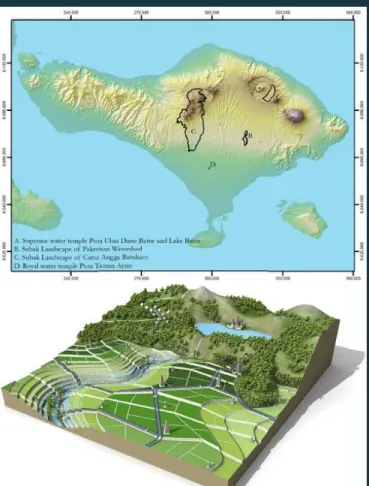
The determination as a World Cultural Heritage was welcomed by the government and the people of Bali. According to the filing, Subak in Bali which has an area of approximately 20,000 ha, consisting of a water control system that is in 5 districts of Badung, Bangli, Buleleng, Gianyar and
Tabanan.
Subak model: The components of Subak is covering the forests that protect water supplies, landscapes of terraced rice fields that are connected by a system of canals, tunnels and dams, villages, temples of various sizes
indicating the importance of water resources or water flowing through the temple declined irrigating water control system.
Fig. 2.3 the main water source of subakin Bali Source: UNESCO official website
https://www.pinterest.com/pin/495044184016685570/
Subak
Landcape
Figure 2.4. Landscape of traditional paddy terasering by Subak integrated system (Subak Jatiluwih). Paddy is cultivated near the river and hill at Petanu village.
http://berwisatadunia.blogspot.com/2016/02/
jatiluwih-obyek-wisata-pemandangan.html
https://www.goodnewsfromindonesia.id/2012/05/27/subak-the- unique-balinese-rice-farming-culture-designated-unesco-world-heritage
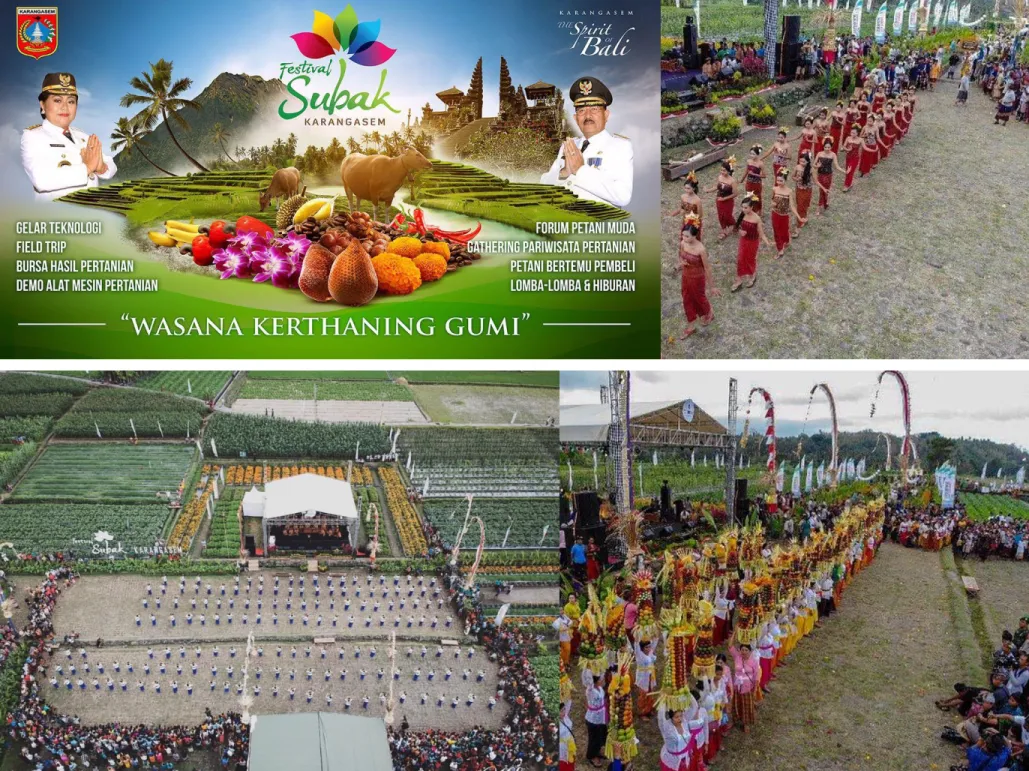
Subak Festival
Figure 2.5. 2nd Subak Festival at Bugbug, Karangasem
Regency, Bali.
History of Indonesian food and traditional fermented alcoholic beverage
• In the past, along with the coming of civilization from India to Indonesia, there were many traditions which were carried along such as in terms of farming, postharvest handling, processing of agricultural products and traditions in religious rituals, celebrations, etc.
• The religious text of the Vedas (Rig Veda) mentions at least one alcoholic beverage that might be related to wine (ura) is a type of rice wine fermented with honey (Sing et al.,2012).
• About wine there are also at the Prambanan Temple reliefs, Borobudur Temple & other temples.
Fig. 3.2 A. Prambanan Temple Relief; B. The ceremony of Tawur Agung at Prambanan Temple.
Fig. 3.1a The religious text
Fig. 3.1b The religious text (Lontar/palm leaves)
http://www.pictame.co m /tag/tetabuhan
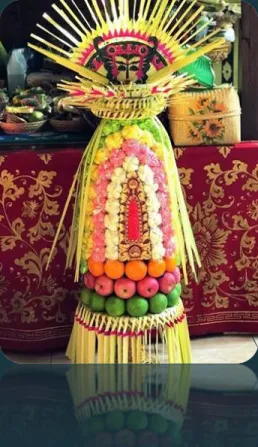
Indonesians, especially Balinese, carry out the religious ceremonies in the form of offerings as a thank you for the success of harvesting agricultural products at certain times.
Hinduism people praying with Banten offerings are not only dedicated to the gods alone, for the Balinese also prepare offerings for the demons (bhūtas) to whom are given meat and alcoholic beverages.
Bantens consist of several meals, fruits and other food, which are then placed on one or more dishes.
Places the bantens for the Gods on high altars whereas he puts those for the Demons on the ground.
Before and after praying with offering, the “tetabuhan”
(Tuak, Arak, Brem and Plain Water) are usually sprinkled.
History of Indonesian
food and traditional
fermented alcoholic
beverage
“BANTEN” as Balinese offering
http://www.booking-bali- villas.com/bali/bahasa-bali/
Fig. 3.6 The people bring offerings (banten) to the temple Fig. 3.4 Canang sari
Fig. 3.5 Segehan with tape ketan& brem
Brem Tape ketan
Praying
with metabuhan
Fig. 3.8 Canang and segehan equipped with tuak, arak, brem and water (for buta kala)
Fig. 3.7 A. containers for Tuak, Arak, Brem, and Water, B. When used in worship
http://www.pictame.com/tag/tetabuhan https://iias.asia/the-
newsletter/article/unholy-brew-alcohol- pre-islamic-java
Fig. 3.9 Alcoholic beverage containers for a daily ritual
Brem Arak Water Tuak
Food products and alcoholic beverages used in religious
ceremonies, festivals and celebrations,
etc.
Fig. 3.10 A. Shrine in Rice Field; B. Performing religious rituals in the rice fields. (https://loisandgeorge2012.wordpress.com/tag/balinese-ceremonies/)
http://www.mantrahindu.com/hari- soma-ribek-dan-kutukan-dewi-sri/
Fig. 3.11 Some Ribek: a religious ceremonies in barns or rice storage areas.
Tuak, Arak, &
Brem in Bali as a means of
religious ceremonies
Now it has
developed into a favorite drink and even becomes an international drink
Since ancient times, local alcoholic drinks have been developed by indigenous people in the archipelago. Some panels in the 9th century of Borobudur Temple depicted drink sellers, small shops, and there were panels that depicted a building with people drinking (maybe alcoholic drinks), dancing and having fun, as if describing a tavern or inn.
Initially alcoholic drinks were made for Hinduism ceremonies both in India, Indonesia including in Bali. Tuak, Arak and Brem are needed for tabuhan wasps (offerings) to the gods and
“butha kala” .
Brem, Arak and Tuak are popular drinks on the island of Bali
which are predominantly Hindu. Brem is a brownish liquor with
5-14% alcohol. This product is exported to Japan and China.
The tradition of drinking
alcoholic
beverages in the past
Wooden palm wine container lid from Bali. This lid is placed on the top of a Bamboo container. Early 20th century
http://www.karlssonandwickman.com/tribal-art- page-2/stbkfhfj1gk3oy5omaynamhr5chlp0
https://nusantara.news/nitik- tradisi-leluhur-minum-tuak- bala-ngombe-tuban/
Fig. 3.13 Balinese Tuak(palm wine) container lid
Fig. 3.12 the tradition of dringking tuak
Fermented
glutinous rice and palm juices
Table 4.1. Ethnic fermented alcoholic beverages of Indonesia
Regulation of Alcoholic Beverages in Indonesia:
Classified alcoholic beverages in Indonesia in three
categories. Drinks having an alcohol percentage less than 5% (A class), 5%–20% (B class) and more than 20% (C class).
Foods/Product name
Substrates/ Mayor ingredien
Nature and uses
Microorganisms Regions of consumption in Indonesia
References Appearance
Brem (angur beras / rice wine)
Glutinous rice, Cassava
Ritual Snack, Beverages
Rz. oryzae , M. rouxii , A. oryzae, S. cerevisiae , A. aceti Mucor indicus Candida
Central of Java, Bali, Lombok
Basuki (1977), Saono et al.
(1984), Aryanta (2000 ) Sujaya et al., 2004)
Dark brown liquid sour, alcoholic
Sopi Juice of plant (Arenga pinnata)
Ritual Beverages
S. cerevisiae, Flores, Maluku, dan Indonesia bagian timur lainnya
https://www.idntimes.com/travel /tips/francisca-christy/7-
minuman-tradisional-beralkohol- 1/full
Clear liquid
Tuak (Toddy) Juice of plant;
Glutinous rice
Ritual Beverages
S. cerevisiae, C. tropicalis
North Sumatra, Nusa Tenggara Borneo, Bali, Lombok
Hermansyah et al. (2015) Turbid drink Sour, sweet liquid, Ballo Juice of Nypa
fruticans(Nipah), Arenga piñata, Borassus flabellifer (lontar), rice
Beverages, celebration
S. cerevisiae Sulawesi Selatan, Toraja, Hermansyah et al. (2015) Turbid drink Sour, sweet liquid,
Arak (samsu), Cap Tikus
Juice of plant;
Glutinous rice, gula merah
Beverages, Ritual
S. cerevisiae, C. tropicalis
Java, Bali, Lombok, Nusa Tenggara, Sulawesi, Minahasa
https://www.idntimes.com/travel /tips/francisca-christy/7-
minuman-tradisional-beralkohol- 1/full
Clear liquid
CiuBekonang /CiuBanyumas Spirit,
Cane sugar,
Palm sugar, omplong, tape singkong, water
Beverage, celebration
S. cerevisiae Sukoharjo,
Banyumas (Central of Java)
https://sportourism.id/explore/m engintip-tradisi-pembuatan-ciu- di-desa-bekonang
Clear liquid alcoholic
Alcoholic rice paste: Tape &
Brem cake
Glutinous rice snack A. rouxii, E.
burtonii, E.
fenulinger,
Java, Sumatera, Bali Lee and Lee (2002), Owens (2015) Sweet/sour alcoholic paste
4.1 RICE WINE
Rice Alcoholic Fermentation Starters
Table 4.2 The constituent component of ragi tape
Component Amount
(% of Rice)
Rice 100
Garlic 0.50-18.70
White pepper 0.05-6.20
Galangal 2.50-50.00
Red chili 0.25-6.20
Cinnamon 0.05-3.50
Black pepper 0.30-2.50
Fennel 2.50-3.00
Sugar cane juices 1.00-12.50
Lime 2.50
Coconut water 50.00
Making
Ragi & Tape Ketan
Fig. 4.1 Flow charts for the preparation of solid-fermented starters (Nuraida, 2016) RAGI
Addition of Ragipowder
Sun or air dry Rice flour
Mold into disks or flattened balls
Mix to make a thick dough Mix
Traditions in the conventional handling, preservation and application of starter cultures
Powdered or ground spices (pepper, chili, cinnamon,
garlic, galangal)
Cool Roast
Water
Coconut water or sugar cane juice
Place on a bamboo tray lined with banana leaf, cover with banana leaf
Incubate, room temperature (25-30◦C), 2-3 d
Raw materials of RICE WINE production
Composition of Glutinous Rice:
• Carbohydrate : 79.4% : 78%
• Protein : 6.7% : 7%
• Fat : 0.7% : 0.7%
• Ca : 0.012% : 0.010%
• Fe : 0.008% : 0.001%
• P : 0.148% : 0.148%
• Vitamin B : 0.0002%:
• Water content : 12%
Ragi tape:
Weighs ± 3 g round flat shape, 1 pieces for 1 kg glutinous rice
Ragi tape
Black glutinous rice(O. sativa L.) White glutinous rice
(Oryza sativa glutinosa)
Additonal ingredient:
• Water
• Marinade
• Nutrient/ Mineral source
Fig. 4.2 Materials for making rice wine
Various
brands of ragi tape
Fig. 4.3 Ragi tape brand
Ragi Tape is a dry starter: (much ragi is sold without any brand name)
Ragi is off-white in color & shaped into small disks or flattened balls about 2-3 cm in diameter.
Ragi tape is made from: Rice starch, garlic, chili, white pepper, fennel, etc.
Place: Cianjur, Cirebon, Solo, etc. (Java island).
Used for:
Making sticky tape and cassava tape: it tastes sweet, fragrant and tastes good
For Japanese ant feed: Japanese ants can be used as medicine when the Japanese ants are fed ragi tape
Microbiology of Ragi Tape
Microbiology of ragi
Microbial
Group Genera/Species References Genera/Species
Bacteria References
Molds Amylomyces rouxii Ko (1972); Ardhana & Fleet (1989)
Bacillus coagulans Ardhana & Fleet (1989)
Rhizopussp. Ko (1972) B. Brevis Ardhana & Fleet (1989)
Mucorsp. Ko (1972) B. stearothermophillus Ardhana & Fleet (1989)
Mucor circinelloides Saonoet al., (1974) Acetobactersp. Ardhana & Fleet (1989) M. rouxii Saonoet al., (1974) Pediococcus pentosaceus Sujayaet al., (2002)
M. javanicus Saonoet al., (1974) Wisellaspp. Sujayaet al., (2002)
R. oryzae Saonoet al., (1974) Lactobacillus spp. Sujayaet al., (2010) Fusariumsp. Saonoet al., (1974) Enterococcus spp. Sujayaet al., (2010)
Yeasts Endomycopsis Ko (1972) Clostridium perfringens Sujayaet al., (2010) Saccharomycopsissp. Ko (1972); Saonoet al. (74)
Asterotremella humicola Saonoet al., (1974) Candida sp. Saonoet al., (1974) C. guilliermondii Saonoet al., (1974) C. japinica
(F. capsuligenum)
Saonoet al., (1974)
C. intermedia Saonoet al., (1974) C. parapsilosis Saonoet al., (1974)
C. solani Saonoet al., (1974)
C. pelliculosa.
C. anomala
Saonoet al., (1974);
Ardhana & Fleet (1989)
Table 4.3 Microbiology of ragi tape
Flow chart of
“tape ketan”
production
• Tape ketan is a traditional Indonesian fermented food that is produced across Indonesia.
• Two types of tape ketan:
black & white); with
Pandanus amarylifolius, etc.)
Fig. 4.4 Flow chart for the manufacture of Indonesian tape ketan (Saono et. al. 1986;
Nuraida & Owens, 2015)
Powdered Ragi
Mix
Incubated at room T (48-72 h) Glutinous
rice
Tape Ketan
Steamed, 30 min Soaked, 25-30◦C, 1 h
Cooled to room temperature
Washed Put in container,
cover with banana leaf
Microbiology
of Tape Ketan
Microbial
group Genera/Species References
Molds Amylomyces rouxii (R. arrhizus)
Djien (1972); Cronk et al. (1977):
Ardhana & Fleet (1989) (Amylolitic) Yeast Hyphopichia burtonii
(Endomycopsis burtonii)
Cronket al. (1977):
Saccharomycopsis fibuligera (Endomycopsis fibuligera)
Djien (1972);
Candida beverwijkiae (C. pellicullosa)
Ardhana & Fleet (1989)
(as the dominant yeast in tape, amylolitic)
S. cerevisiae Ardhana & Fleet (1989)
Wickerhamomyces anomalus (Hansenula anomala)
Ardhana & Fleet (1989) (intolerant of high ethanol)
Bacteria - -
Table 4.5 Microbiology of tape ketan
4.2 BREM
The microbial ecology of tape fermentation
• Brem products are of two types: solid and liquid (lots of solid brem are produced in Java; liquid brem are produced in Bali and Lombok Island)
• Solid and liquid brem are made beginning with tape ketan fermentation (solid brem: white sticky rice; liquid brem: white and black sticky rice).
• Solid brem of fermented liquid is then cooked until a semi-viscous liquid is obtained and dried. Liquid brem:
second fermented with S. cerevisiae, aging and bottled.
• Saccharification of starch and sugar fermentation
occur simultaneously (parallel) due to the presence of Aspergillus, Rhizopus and other amylolytic fungal
species, Saccharomyces cerevisiae and other yeasts.
Solid Brem
Liquid Brem
Fig. 4.5 Brem products
Manufacturing Brem
Fig. 4.6 Flow chart of
Brem Bali production BREM BALI
Pressed
Cooked brem Glutinous rice
Blending
Packing Labelling
Bottling and labelling Fermented
(in box)
Maturation (aging) Cooked /
steamed
Cooled
Filtration
Storage
Distribution Washed and
soaked
Powdered Ragi
❖ The microorganisms found in ragi tape include the fungi Rhizopus, Mucor and Amylomyces, the yeasts Saccharomycopsis fibligera and Pichia
anomala, and various lactic acid bacteria
(Holzapfel, 2002), although the predominant species in brem is Saccharomyces cerevisiae, which possesses high fermentation activity (Sujaya et al., 2004).
❖ The S. cerevisiae strains were divided into four types based on the pattern of chromosomal DNA binding, and each type produced brem with
different organic acids and volatile compounds when used as single strains (Sujaya et al., 2004).
Microbiology:
Brem
Fig. 4.8 Flow chart of ARAK production
Fermentation I
ARAK BALI
Ragi tape
Pressing
Distillation White
Glutinous rice
Aging, Adjusted &
redistilled
Packaging Labelling Filling &
Bottling
Fermentation stage II
Collected
Storage Washed and
soaked
Cooked / Steamed
Distribution
4.3 ARAK
(White glutinous rice)
Yeast Cooling
Rice-based
"ARAK"
products:
Dewi Sri, Pura, Nikki, Tiga Bintang, Legong, Jablay, etc .
Fig. 4.9 Various arak brands
Traditional
ARAK production (palm juices)
Fig. 4.10 Flow chart for the Traditional Indonesian arak based palm juices
ARAK
(35-40% alcohol)
Palm juices
Fermentation at room temperature with “lau”
(coconut fibers) ,3-4 d
Filtration
Distillation Collected
https://travel.kompas.com/read/2014/09/23/201100027/M elihat.Cara.Pembuatan.Arak.Bali.di.Karangasem
De’Awais a coconut palm- based Balinese Arak.
http://nowbali.co.id/the- indigenous-balinese-arak/
4.4 TUAK
(Fermented palm juices)
Palm juices
Spontaneous fermentation at room temperature with lau(Coconut fibers) (4-6 h)
Filtration
Fresh TUAK
Collected (Sweet palm wine)TUAK
https://denpasarkota.go.id/baca-datang- kunjungi/149/Obat-Diabetes-Alamikoma- Coba-Tuak-Jaka-Manis
https://bali.antaranews.com/berita /129654/tuak-manis-dari-desa- munduk-bestala-buleleng https://www.twgram.me/tag/tuakman
islegenda/
Pasteurization
Fig. 4.11 Tuak production
Their vulnerability to climate change requires adaptation strategies for irrigation and cultivars selection.
The recent forms of agricultural policy in Indonesia, which include the deployment and implementation of environmentally friendly technologies such as the SRI system, with the aim to reduce the use of chemicals.
The Subak irrigation system still able to maintain the existence of agricultural water and environmental sustainability.
The Indonesian government should use two approaches at both ends of the chain to achieve rice self-sufficiency. On the one hand, encouraging farmers to increase their production by stimulating technological
innovation and by providing subsidized fertilizer. At the other end, the government tried to curb the consumption of people's rice.
Some of the traditional rice wine products in Indonesia such as arak,
brem, and tuak were originally made for ceremonial, ritual symbolism and celebrations but developed into a favorite drink and even became a
promising commercial product.
Knowledge of fermentation technology, selection of raw materials, starter culture, will provide better product quality and will be a positive impact on the development of alcoholic beverage.
Conclusion
http://www.mantrahindu.com/tag/tumpek-uduh/
Ida Bagus Wayan Gunam E-mail: [email protected] HP: +62-82147246756