Innovation of Vocational Technology Education
Available online at http://ejournal.upi.edu/index.php/invotec
Science mapping analysis: Women's perspective in engineering and education
Bella Az Zahra Krisnoputri, Ade Gafar Abdullah*, Didin Wahyudin
Department of Electrical Engineering Education, Universitas Pendidikan Indonesia, Indonesia
ARTICLE INFO ABSTRACT
Article history:
Received: 30 June 2023
Received in revised form: 22 July 2023 Accepted 31 August 2023
Available online: 31 August 2023
Keywords: women in engineering; education;
science mapping analysis
Authors email: [email protected]
Entering the 21st centuries, women in engineering are still severely under-represented both in the field of education and the industrial sector. This under-representation can be seen in work environment, people behavior, entrance education and many more that are not yet exposed. Thus, this topic has become a concern and emergence for the public and academics and inspired them to conduct research in women in engineering. This research aims to provide a manual on emerging trends of women in engineering related studies using science mapping analysis method and investigate the current state of the art of women in engineering. Data collection for science mapping analysis using the Scopus database search without limitation on the year of publication regarding women in engineering. This research uses VOSViewer software as a tool to help visualize the data that had been downloaded from Scopus database. Results and discussions based on the research shows that the research publication about women in engineering for the last three decades continues to increase. Followed by the United States as the most contributed and cited country in scientific publication, then Layne P. and Bougue B. as the most contributed authors and widely quoted by other authors, for the most trustworthy sources there is Journal of Engineering Education, and based on the most quoted affiliation is Virginia Polytechnic Institute and State University, then for the most discussed topic is STEM, intersectionality, and science based on co-occurrence analysis. Thus, the research can give a bigger picture of the development of women in engineering for future research.
1. Introduction
Women in engineering are still severely under-represented, both in the education and industrial sector (Mlambo & Mabokela, 2017). The emergence of this topic has become a concern for the public and academics which has then inspired a stream of research over the last four decades (Buse et al., 2017). The women under-representation in this profession is especially evident in the engineering stream where in engineering work still exist a patriarchal norm that prevent young women from entering and completing their engineering degrees (Dutta, 2017). Meanwhile, according to development experts’ disciplines of science, technology, engineering, and mathematics, STEM
are essential vehicles for the developing a nation (Mlambo & Mabokela, 2017). Entering the era of the 21st century where gender equality in education and industry has been put forward, women can take part in the country’s development. Many have attempted to promote technical education and careers to young women, but the field is still a male-dominated academic discipline both quantitatively and culturally (Barnard et al., 2012).
This is not a limitation for women to pursue education and careers in engineering, although the tendency to choose this field is still gender biased (Barnard et al., 2012). Specific findings of cultural experts point out the fact that by upon taking up engineering careers young women are encouraged.
The encouragement comes from the family which allows forming perceptions about careers in engineering, leading which to the survival of women in engineering (Dutta, 2017). In addition, a strong sense of self-efficacy is one of the critical indicators to the persistence and perseverance of women in this field. If women do not believe in their abilities, it will affect their achievement (Moridnejad et al., 2020). Research shows that mastery experience can be a very influential developer of self-efficacy (Andrews, 2018). Responding to the two support factors above, it can be a consideration to see the ability of women directly involved in the engineering field without thinking about the gender bias that is generally still inherent in the engineering environment (Ettinger et al., 2019).
Despite the significant and varied efforts over the past few decades to increase women's participation in engineering, another view is that men continue to outnumber women in this field (Wilson & VanAntwerp, 2021). Because women are still seen as under-represented, several other reasons besides gender bias are an unfriendly work environment. For example, in industry women face two challenges: first, because their gender does not match the typical image of an engineer;
and second, if they get a high position like a manager they are not considered to be in accordance with the typical image of a manager (Schmitt, 2021). Then in education, research reveals that women seem to gain more aid and support from faculty and staff than their fellow male counterparts.
Reinforcing the stereotypical view in term of 'technical' jobs, women are believed less competent than men (Powell et al., 2012).
Therefore, this paper aims to provide manual on emerging trends of women in engineering related studies using science mapping analysis method and investigate the current state of the art of women in engineering. This research also was conducted base on Scopus database to asses publication sources, articles, journals, authors, countries and institutions, research areas, and the most cited themes about women in engineering. Thus, this research will provide information about the evolution of women in engineering as well as provide an overview of the network mapping to better understand the link of each journal or articles related to the topic that will be useful for further research. Alas, it is expected that by getting information about women in engineering others will be more aware about the issues related to this topic.
Based on the background that has been described previously, the following research questions will be the focus on:
RQ1: How is the development of women's participation in engineering from year to year based on publications in the Scopus database?
RQ2: How is the visualization map of women in engineering network based on co-authorship analysis with the analysis unit of co-authorship countries, affiliations, and authors?
RQ3: How is the women in engineering network visualization map based on citation analysis with the analysis unit of citation countries, authors, and source?
scientific research and to show the cognitive architecture of an academic field (Santana & Cobo, 2020). This research will attempt to analyse the interactions between scientific publications, researchers, citation, and keywords through co-authorship, citation, co-citation, and co-occurrence from the Scopus database. Science mapping using co-authorship to identify the social interactions or relationship among authors, citation is to identify publications that cites another, co-citation is to identify the relationship among cited publications, and co-occurrence is to identify the existence of future relationships among topics and relationships among publications (Donthu et al., 2021). This research is a publication study sourced from Scopus database without any limitation of year and types of publication. For relevant sampling, the writer used the keywords “Women in Engineering”.
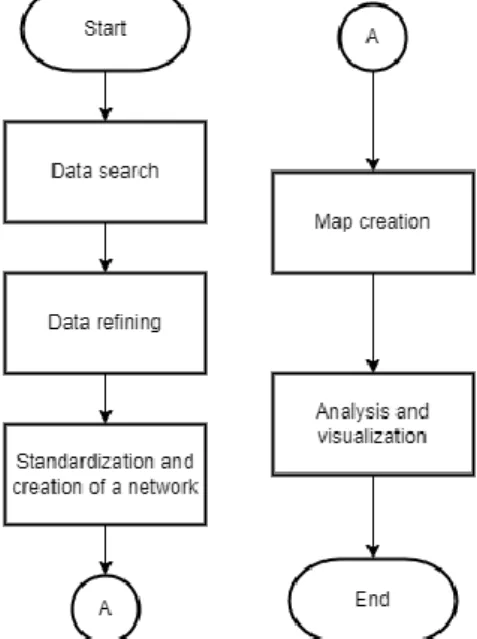
Then from the collected data downloaded in a coma separated value (CSV) file format, research samples are taken in the form of titles, year of publication, author keywords, index keywords, abstract, references, publisher, language, document type and source. A total of 826 data were retrieved on this research. This research was carried out through some steps according to Santana and Cobo (2020) to assist the implementation of research until a conclusion is reached. Based on that, the research procedures could be seen in the Figure 1.
Figure 1 Research Procedure Flow Chart
Based on Figure 1, in the data research stage, documents were retrieved from the Scopus database (www.scopus.com). This research includes all the articles and reviews published on Scopus in the field of women in engineering without any limitation of years. The corresponding keywords were obtained with the assistance of thesis supervisors, following with the observing keywords from the most relevant articles. In the data refining stage, data were scanned to identify incorrect, duplicate, or misspelled items. In the standardization and creation of the network stage, using the co-occurrence network in the application data is filtered to delete non-representative items.
In the map creation stage, the network was created based on bibliographic data that had been scanned using Open Refine application based-web and using VOSViewer algorithms to obtain science map and its clusters. In the analysis and visualization stage, the data that has been processed in the application will display the corresponding map about authors, countries, keywords, citation, and year of publication from women in engineering topics.
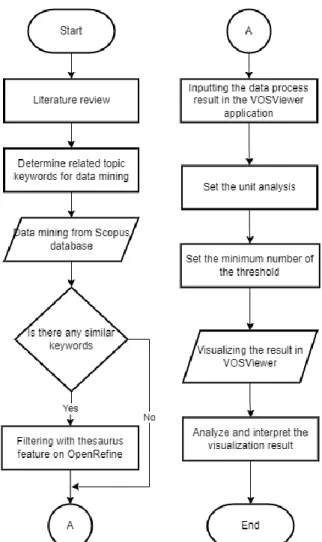
There are some steps carried out for collecting the data. To illustrate, Figure 2 shows the flow diagram.
Figure 2 Data Collection Process Flowchart
Based on Figure 2, can be described the process of data collection for further analysis as shown below.
1. Data mining was conducted on 3rd of February 2022 from Scopus database with inputting the corresponding keywords related to the topic.
TITLE-ABS-KEY ("Wom?n engineering" OR "wom?n engineer" AND “education” )
Result of the mining, 826 English manuscript data were retrieved and downloaded with the following format file comma separated value (CSV) without any limitation of year publication.
2. Processing and filtering were conducted to combine keywords that have the same or similar keywords that have been obtained from Scopus database from the author keyword and index keyword to one keyword only. This process was done by using the thesaurus feature in the OpenRefine web-based application.
3. The results of data processing from OpenRefine were inputted into the VOSViewer software to view the results of the visualization research mapping of the co-authorship, co-citation, citation analysis, and co-occurrence.
4. The results of visualizing were a collection of keywords, name of author, author’s country of origin,
3. Results and Discussion
In the section, the author will determine the result from the 826 datasets retrieved from Scopus database. The results provide the aspects based on the following constructed research questions:
3.1. Publication Trend Analysis
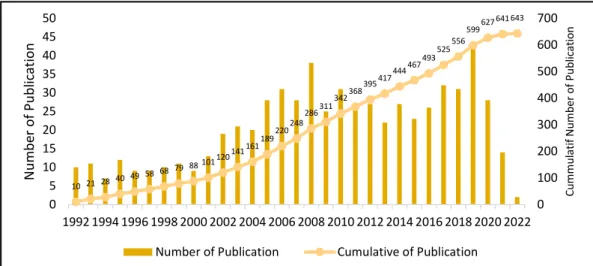
Scientific publication in the field of women in engineering studies behalf of academia show a great interest, presenting documents from 1992 to 2022 with a total 643 documents.
Figure 3 Publication Development Trend Chart
This analysis is presented into three periods: the first period from 1992 until 2001, second period from 2002 until 2011, and third period from 2012 until 2022. During the first periods shows a fluctuating chart, with the average publication 10 works per year. The most publication shows in 2001 with 13 publications and the least publication shows in 1994 with 7 publications. In 1992 until 2001, the publication discussed the impact of women's education in the field of engineering, gender identity, and women's experience in engineering. The second period shows an increasing publication from the last period, with the average publication 30 works per year. With the most publications in 2008 with 38 publications and the least in 2002 with 19 publications. In 2002 until 2011, the publication discussed how to attract and encourage girls to engineering, also making engineering appealing for girls. The last period did not publish any significant works, with the average publication 28 works per year. With the most publications in 2019 with 43 publications and the least in 2022 with 2 publications because it's still an ongoing research publication
3.2. Co-Authorship Analysis
3.2.1. Co-Authorship Analysis Countries
The various contributions made it possible to link the knowledge and skills of research and their institutions (Nobanee et al., 2021). A threshold of at least three documents and five citations per country was established; from 105 countries, 21 countries reached the established threshold.
10 21 28 4049 58 68 7988 101120141161189220248
286311342368395417444467493525556
599627 641 643
0 100 200 300 400 500 600 700
0 5 10 15 20 25 30 35 40 45 50
1992 1994 1996 1998 2000 2002 2004 2006 2008 2010 2012 2014 2016 2018 2020 2022
Cummulatif Number of Publication
Number of Publication
Number of Publication Cumulative of Publication
Figure 4 Visualization Map of Co-Authorship Analysis Countries
Figure 4 shows 20 countries and 19 links (relationship between countries) with a relationship strength of 27, grouped in 11 clusters differentiated by colours. The top twenty countries were presented according to total number documents of publication about women in engineering and are shown in a bar graph in Figure 5. The United States are the most productive countries in the terms of contributions with 386 documents. This evident is seen that the United State become the second country who established an engineering school, but did not admit women both in school or engineering societies. Numerous of women engineer did not get a formal education until post World War II and women need to fight for their rights (Layne, 2009). Therefore, numerous researchers from these countries rise these issues. Followed by the United Kingdom with 32 documents and Australia with 17 documents. While the least contributed countries, Belgium, Ireland, Netherlands, Russian Federation, Singapore, and Sweden only contributed with 3 documents.
The United States show the most cited country with a total 3466 citations. The United Kingdom and Australia also shows a great number in term of citations that are 870 and 279 total citations. The number of publications is not always directly proportional to the number of citations in each country.
Like the least contributed countries even though only published 3 documents they show a quite number of citations, such as Netherlands and Singapore were cited 21 and 15 times. The United Stated also shows the highest international collaboration productivity with total link strength 24. While five countries Germany, Malaysia, Thailand, Netherlands, and the Russian Federation did not collaborate with other countries that contributed to the subject due to there are not any linkage between other countries that contributed in this topic.
Figure 5 Top 20 Contributed Countries Chart Based on Co-Authorship Analysis
3.2.2. Co – Authorship Analysis Affiliations
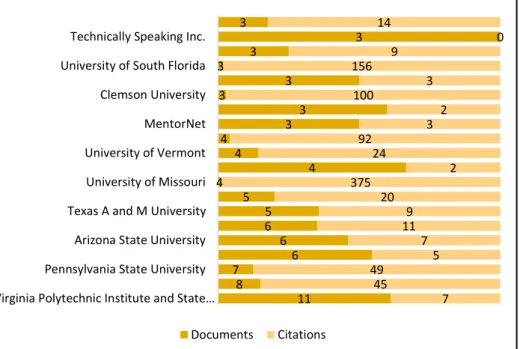
Using the software of VOSViewer and co-authorship analysis, top 20 affiliations were accumulated to observe the published documents of women in engineering under the entity of affiliations; with the minimum number of documents three and the minimum number of citations none, the results are presented in Figure 6. From 982 organizations, only 20 organizations who meet the threshold with 18 universities and 2 group mentorships contributed to this topic. With all the universities are dominated by the universities in The United States. Based on Figure 6, Virginia Polytechnic Institute and State University published the most documents with eleven documents.
Followed by Purdue University and Pennsylvania State University with eight and seven documents.
With others organizations contributed from seven until three documents.
Figure 6 Top 20 Contributed Organizations Chart Based on Co-Authorship Analysis
386 34
17 14
13 12 11
7 7
5 4 4
4 4
3 3 3
3 3
3
3466 870
279 276
26 16 48
40 88
10 18 34
8 30
13 9 21
5 15
5
United State United Kingdom Australia Canada Germany South Africa France India Turkey Brazil Greece Malaysia Mexico Thailand Belgium Ireland Netherlands Russian Federation Singapore Sweden
Documents Citations
11 8
7 6
6 6 5 5
4 4
4
4 3
3 3
3 3
3
3 3
7 45
49 5
7 11
9 20
375 2
24
92 3
2 100
3 156
9
0 14
Virginia Polytechnic Institute and State…
Pennsylvania State University Arizona State University Texas A and M University University of Missouri University of Vermont MentorNet Clemson University University of South Florida Technically Speaking Inc.
Documents Citations
3.2.3. Co – Authorship Analysis Authors
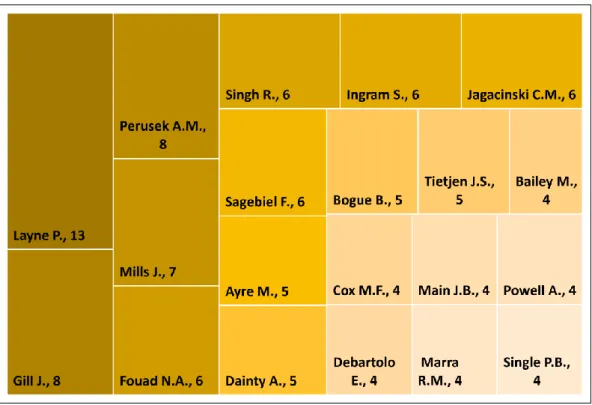
Conducting a co-authorship analysis with the sub-option authors was to generate the rank of top twenty authors who contributed in publishing documents in the topic of women in engineering.
The rank of authors was based on documents published with the minimum number of documents four and five minimum number of citations. From 1292 authors who contributed to publishing only 20 authors who meet the threshold. Based on Figure 7, the most potent author was Layne P. with 13 documents followed by Gill J. and Perusek A.M. with 8 documents and others with 7 until 4 documents. Documents Layne P. contributed mostly cover about women engineering leaders in academia, while Gill J. discussed about revisioning engineering profession, policy and diversity in engineering organization followed by Perusek A.M. cover about strategies for improving women in engineering in the field of academic.
Figure 7 Top 20 contributed authors tree map based on co-authorship analysis
3.3. Citation Analysis
3.3.1. Citation Analysis Countries
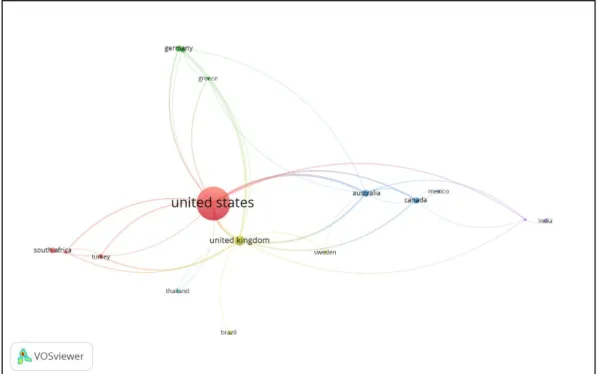
To generate the visualization domain network map research on countries related to the research, citation analysis was used. Figure 8 is a density of networking map which visually displays the citation of high frequency in women in engineering based on countries.
Figure 8 Visualization map of citation analysis countries
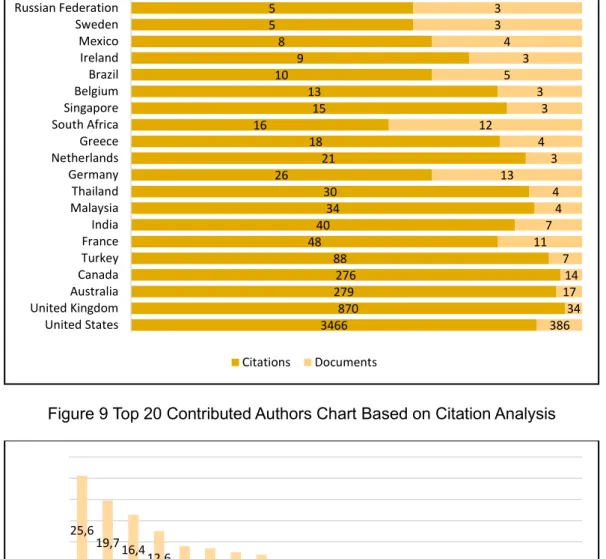
Data obtained from 105 countries, with the minimum number of documents of a country three and with the minimum number of citations of a country five. Resulting 21 countries meet the thresholds and 20 countries were displayed in Figure 8 and Figure 9. As shown in Figure 9, the top four countries are the United States, United Kingdom, Australia, and Canada. The United States occupies almost more than half of most cited papers and exhibits the largest density (also the reddest) in the map which indicates that the United States is indeed aware of the issues of women in engineering. The United States contributed 386 documents with total citations 3466, followed by the United Kingdom with 34 documents and total citations 870, and in third place Australia with 17 documents and total citations 279, and last Canada with 14 documents and 276 for total citations.
Other countries have varying total citations for each document they contributed. There is a large gap in total citations between the top four and other countries, after Canada the total citations decreased to 88 to 5 for all total documents per country. There are four countries that are not linked to each other in the map. The four countries are Belgium, Netherlands, Russian Federation, and Ireland. These countries did not link each other because they did not find any common ground discussed with other countries. But they show contributions too on this topic. These four countries contributed a total of 3 documents for each country, but vary in total citations. Based on data, the Netherlands lead with 21 citations, followed by Belgium with 13 citations, Ireland 9 citations, and last Russian Federation with 5 citations.
Then in Figure 10 presented countries citation impact, this result is gained by dividing the total number of citations by the total number of publications. Based on citation impact, there are a significant change in the rank of countries. The United Kingdom led followed by Canada, Australia, and Turkey. Meanwhile, The United State is in the fifth position. Drop down from the first place, this indicate that the total number of citations and document did not guarantee can give a big impact.
Figure 9 Top 20 Contributed Authors Chart Based on Citation Analysis
Figure 10 Countries Citation Impact
3.3.2. Citation Analysis Authors
Citation analysis in terms of author were conducted to objectively identify influential authors in an area and explore the link between citing and cited author and the publications containing the citation.
3466 870 279
276 88 48
40 34 30 26
21 18 16
15 13 10
9 8 5 5
386 34 17
14 7 11
7 4 4 13
3 4 12
3 3 5
3 4 3 3
United States United Kingdom Australia Canada Turkey France India Malaysia Thailand Germany Netherlands Greece South Africa Singapore Belgium Brazil Ireland Mexico Sweden Russian Federation
Citations Documents
25,619,716,4
12,6 9,0 8,5 7,5 7,0 5,7 5,0 4,5 4,4 4,3 3,0 2,0 2,0 2,0 1,7 1,7 1,3
Impact
Figure 11 Visualization Map of Citation Analysis Authors
Significant authors have researched the topic of women in engineering in education or industries; from database 1292 contributed to this topic. From the data top twenty authors were displayed, these authors meet the threshold with the minimum number of document four and minimum number citations five. Based on Figure 4.9, Bogue B., Marra R. M., Dainty A., and Powell A. are the top four authors with the most cited document. The range of cited documents from the top four authors are between 400 to 300 total citations and with only 5 to 4 documents. But Bogue B.
and Marra R. M. did not link a network to another author, while Dainty A. had a network link with Powell A..
Based on Figure 11 aside the top four, Fouad N.A., Singh R., Gill J., and Mills J. shows a big number of citations too. With total average citations between 200 until 100 and total average document between 8 until 6 documents. These authors contributed more documents than the top four. And as seen in Figure 10, there is a link network between Fouad N.A. and Singh R. that is marked with a blue bubble. The same as Gill J. and Mills J. they both have a linking network that is marked with a green bubble. These indicate that the two authors have so much in common.
Figure 12 Top 20 Contributed Authors Chart Based on Citation Analysis
3.3.3. Citation Analysis Sources
Using the citation analysis, top twenty sources were generated. This data was extracted from 239 sources; with the minimum number of documents four and the minimum number of citations one.
382 372 292 291 212 212 206 202 100 71 48 24 22 22 10
9 9 7 6 5
5 4 5 4 6 6 8 7 6 5 6 4 4 4 5
4 4 6 8 13
Bogue B.
Marra R. M.
Dainty A.
Powell A.
Fouad N.A.
Singh R.
Gill J.
Mills J.
Jagacinski C.M.
Ayre M.
Ingram S.
Single P.B.
Bailey M.
Debartolo E.
Tietjen J.S.
Cox M.F.
Main J.B.
Sagebiel F.
Perusek A.M.
Layne P.
Citations Documents
total 406 citations and 8 documents and last ASEE Annual Conference Proceedings with total citations 359 and with the most total document 172. Even the Journal of Engineering Education had the most citations, as shown in Figure 4.10 ASEE Annual Conference Proceedings marked as the biggest (green) bubble then others sources. These indicate ASEE Annual Conference Proceedings give an excellent contribution both in total citations and documents that they publish.
Other sources like ‘European Journal of Engineering Education’, ‘Journal of Women and Minorities in Science and Engineering’, ‘Journal of Vocational Behavior’, and ‘International Journal of Engineering Education’ still take part in this topic and give a quite performance with the total citations between 200 to 100 citations and total published documents between 19 to 6. All sources are linked together except for ‘IEEE Spectrum’, ‘IEEE Transaction on Education’, ‘Chemical Engineering Progress’, ‘International Symposium on Technology and Society’, ‘U.S. Woman Engineer’, and ‘IEEE Women in Engineering Magazine’ did not link a network to other sources. This indicates that the six sources did not find any common ground as the other sources.
Then in Figure 10 presented sources citation impact. Based on source citation impact, there are a significant change in the rank of sources. ‘Gender, Work, and Organization’ led the rank by giving a total 96.8 impact number. Followed by ‘Journal of Engineering Education’ and ‘Engineering Studies’. While, based on Figure 14 ‘ASEE Annual Conference Proceedings’ take the biggest density but according to citation impact this source did not give a big impact. Only 2.0 total citation impact number and drop down in the twelve positions. This indicate that even the total number of citation and documents are balanced it did not guarantee can give back a big impact in the field of women in engineering research.
Figure 14 Top 20 Contributed Sources Chart Based on Citation Analysis
831 581 406 359
218 210 199 121 82
68 57 32 32
26 18
8 7 3 3
1
14 6 8 172
19 15 6 14 35
4 6 5 83
13 13
5 5 4 23
4
Journal of Engineering Education Gender, Work and Organization Engineering Studies ASEE Annual Conference Proceedings European Journal of Engineering Education Journal of Women and Minorities in Science and…
Journal of Vocational Behavior International Journal of Engineering Education Proceedings - Frontiers in Education Conference Frontiers in Psychology Journal of Professional Issues in Engineering…
Leadership and Management in Engineering SWE Magazine IEEE Spectrum IEEE Transaction on Education Chemical Engineering Progress International Symposium on Technology and…
Engineering and Technology U.S. Woman Engineer IEEE Women in Engineering Magazine
Citations Documents
Figure 15 Journals Citation Impact
3.4. Co-Citation Analysis
3.4.1. Co – Citation Analysis Sources
Co – Citation This analysis was conducted to observe the journals that have been cited many times within the field of research with considering previous analyses. Using the VOSViewer software the most active and influential scientific sources for women in engineering were identified. A threshold of a minimum of 39 citations were established, which allowed 20 scientific sources to be considered. Figure 15 shows the top 20 scientific sources co-cited regarding women in engineering.
96,8 59,450,8
33,2 17,014,011,5 9,5 8,6 6,4 2,3 2,1 2,0 1,6 1,4 1,4 0,8 0,4 0,3 0,1
Impact
362 142
119 117 94
73 73 69 62
60 58 55
55 53
49 43
42 40 39
39
1575 1619
1025 655 981
603 573 632 730
597 157 472
352 451
331 387
334 335 465
214
Journal of Engineering Education Journal of Vocational Behavior Gender, Work and Organization Journal of Women and Minorities in Science and…
Journal of Counseling Psychology European Journal of Engineering Education Gender and Society Engineering Studies Journal of Applied Psychology Journal of Personality and Social Psychology Science International Journal of Engineering Education Social Studied of Science Sex Roles Women in Management Review Psychology of Women Quarterly American Sociological Review Gender and Education Academy of Management Journal Talking about Leaving
studies of science (55), women in management review (49), American sociological (42), and journal of gender and education (40). Cluster 2 (green), comprises 7 nodes headed by the journal of engineering education with most outstanding citation (362), women and minorities in science and engineering (117), personality and social psychology (60), science (58), sex roles (53), psychology of women quarterly (43), and talking about leaving (39). Cluster 3 (blue), consists of 4 nodes started by the journal of vocational behavior (142), counseling psychology (94), applied psychology (62), and academy of management journal (39).
Figure 17 Visualization Map of Co-citation Analysis Sources Analysis Authors
3.5. Co – Citation Analysis Authors
This study analysis emphasizes outstanding authors, which are linked using citation records.
The women in engineering Scopus database have 11,397 cited authors, with setting threshold at least 36 citations resulted 20 authors were presented. In Figure 18, the author's co-citations visualization map shows 4 clusters, 20 nodes, 180 links and total link strength of 6,549. The 20 most cited authors are presented in Figure 19.
Figure 18 Visualization map of co-citation analysis authors
Figure 19 Top 20 Contributed Authors Chart Based on Co-Citation Analysis
111 93
83 79
66 65
61 59
59 57
57 54 50
48 46 45 44 41
40 36
639 1236
857 1262
176 813
160 961
478 651
563 565 846
635 472 855 850 606
192 281
Faulkner, W.
Lent, R.W.
Bagilhole, B.
Gill, J.
Seymour, E.
Fouad, N.A.
Sagebiel, F.
Brown, S.D.
Bandura, A.
Powell, A.
Dainty, A.
Singh, R.
Mills, J.
Hackett, G.
Bilimoria, D.
Franzway, S.
Sharp, R.
Ayre, M.
Bogue, B.
Evetts, J.
Citations Total Link Strength
Cluster 2 (green), consist of 6 nodes where the most outstanding authors are Faulkner (111), Bagilhole (83), Sagebiel (61), Dainty (57), Powell (57), and Evetts (36). Based on Fig 4.15, Faulkner takes the first place of total co-citation and on Figure 4.14 this author has the biggest bubble then others. Faulkner mainly covers gender and culture in the engineering workplace. While Bagilhole, Dainty and Powell work together discussing consequences for gender equality and gender stereotypes among women engineering students. Then Sagebiel and Evetts covers gendered organizational engineering culture and women careers in engineering. Cluster 3 (blue), consists of 5 nodes started by Gill (79), Mills (50), Franzway (45), Sharp (44), and Ayre (41). These authors in cluster 3 have a reciprocal relationship, where Gill, Mills, and Ayre work together to cover the women belonging in engineering and on the other hand Gill, Mills have another published paper with Franzwy and Sharp. These four discuss women education and the engineering profession. Last cluster 4 (yellow), consists of 3 nodes, Fouad (65), Singh (54), Bilimoria (46).
3.6. Co – Occurrence Analysis Authors Keywords
One type of bibliometric analysis shows keywords and their connections, forming a network where those that appear most frequently in the field of study are displayed, and this allows one to examine concepts (keywords) and topics (grouped concepts) (Herrera-Franco et al., 2021).
Figure 20 Visualization map of co-occurrence
A total of 601 keywords were extracted, 47 meeting the threshold with the minimum number of occurrences of a keyword at least three times. Figure 20 visualizes these ten clusters, with 47 nodes, 234 links, and a total links strength of 495. It is found in Cluster 4 (yellow) as the most relevant word.
The most extensive research area according to the number of nodes is in Cluster 1 (red) that have a total eight (nodes) keywords with the largest node is occupied by engineering keyword (47), in this cluster the keywords are dominated by keywords related to education and social studies such as higher education, diversity, persistence, female, academia, faculty, and intersectionality.
The second research area is presented by Cluster 2 (green), that have a total seven (nodes) keywords with the largest node is occupied by gender (48), in this cluster the keywords are dominated by keyword related work and social studies such as women, careers, civil engineering, mentorship, information technology, and professional identity. The third research area is Cluster 3 (Blue), that have a total of six (nodes) keywords with the largest node is occupied by women engineers (24), in this cluster the corresponding keyword related to women engineers are archival collections, archives, oral histories, organizational culture, and society of women engineering. The
node is occupied by women in eengineering (30), in this cluster the corresponding keyword related to women in engineering are retention, engineering education, identity, culture, and engineering profession.
The fifth research area is Cluster 5 (purple), that have a total six (nodes) keywords with the largest node is occupied by STEM (12), in this cluster the other corresponding keyword related to STEM are mentoring, technology, minorities, education and science. The sixth research area is Cluster 6 (light blue), that have a total of 5 (nodes) keywords with the largest node occupied by leadership (6), in this cluster other corresponding keyword related to leadership are women engineering student, college student retention, Mexico, and sustainability. The seventh area is Cluster 7 (oranges), that have a total of three (nodes) keywords with the largest node occupied by eengineers (7), in this cluster others corresponding keywords elated to engineers are students and STEAM.
The eighth area is Cluster 8 (brown), that have a total of two (nodes) keywords with the largest node occupied by career development (4), in this cluster other corresponding keywords related to career development is gender differences. The ninth area is Cluster 9 (pink), that have a total a total of two (nodes) keywords with the largest node occupied by workplace culture (5), in this cluster other corresponding keywords related to workplace culture is masculinities. The tenth area is Cluster 10 (salem), that have a total of two (nodes) with the largest node occupied by self-efficacy (8), in this cluster other corresponding keywords related to self-efficacy is social cognitive career theory.
Based on Figure 21 an overlay map visualization from co-occurrence author’s keywords analysis for the last three decades about 826 publications were published with numerous author’s keywords. Breaking down to a detailed timeline based on the co-occurrence analysis, the first period from 1992 until 2001 the keywords that frequently appear are gender differences and career development. Then the second, from 2002 until 2011 the keywords that frequently appear are mentorship, diversity, and female. The third, from 2012 until 2022 the keywords that frequently appear are STEM, intersectionality, and science.
corresponds to the average year of publication and the size of the circle is proportional to the frequency of occurrence of keywords and the thickness of the connecting line shows the strength of the links between keywords. Blue circles indicate older research topics, green and yellow circles indicate newer research topics. Thus, in the last five years the latest keywords to appear regarding women in engineering are STEM, intersectionality, and science.
Science, technology, engineering, math or known as STEM is an acronym that was introduced in 2001 referring to the career field on those disciplines or curricula. Since in the early 2000s STEM plays an important part of the development of a country. Corresponding to that, numerous authors try to encourage people entering the field of STEM especially women. One types of research conducted by (Boedeker et al., 2015) stated that improving the learning environment along with establishing a new and contextual technique program will increase women participation in the field of STEM. This research was carried out using a problem-based-learning approach from two studies PhD in the same technical university. Followed by another research conducted by (McLoughlin, 2009) using a qualitative method suggests that more attention to Non-traditional Engineering Organized (NEO) students may be needed in recruiting high school women into engineering. In recruiting these students, the social aspect of engineering design should be emphasized, and recruiters should visit all advanced placement classes, not just STEM-oriented ones.
Intersectionality based on Oxford Dictionary is the network of connections between social categories such as race, class, and gender, especially when this may result in additional disadvantage or discrimination. In general intersectionality is how our social identities relate to racism or oppression. Numerous authors point out this issue and based on the overlay visualization, intersectionality is a popular keyword to discuss up until now. One of the research projects related to this keyword was conducted by (Hota et al., 2020). using an interview method, this author found out that women must work harder than men to prove their technical competence, their peers focus on their appearance compared to their work. Followed by (Andrews, 2018) using a systematic literature review method, this author stated that female students consistently report ill-treatment and block access at work. These experiences led them to have self-doubt and often caused them to question their future in engineering.
Science according to the Oxford Dictionary is knowledge about the structure and behaviour of the natural and physical world, based on facts that you can prove, for example by experiments. In these keywords, science refers to one of the study branches. Almost the same as STEM but in this section, it is more specific and orientated in the field of science. Based on the research and studies from other authors, there is a very clear distinction conducted in this research. From the method the past research uses a qualitative, interview, and systematic literature review method to retrieve the data. While in this paper this research is conducted using science mapping analysis, where the data retrieved are various and it’s simple to process the data due to the help of VOSViewer application.
Thus, this topic will still be a trend year by year to improve the participation and give a secure life for women in entering the engineering field both in education or industry.
4. Conclusion
This research presented the analysis result using science mapping analysis method with the topic women in engineering. Data that is used were journal articles published from the last three decades and were retrieved from the Scopus database. Using science mapping analysis, this research identifies the development of article publications, keywords that are widely used, and the most prominent countries in research of women in engineering. To answer the questions in the problem formulation that has been determined previously, the parameters used in this analysis are trend publication, co-authorship, co-occurrence, citation, and state of the art. After the analysis is complete, it can be concluded several things, namely:
1. The development of research publications on women in engineering over the last three decades in general shows a fluctuating graph. This indicates that publications on this topic depend on issues or problems experienced by women working in engineering in both education and industry from year to year. The more issues or problems that year, the number of publications will also increase either in that year or in the next few years and otherwise.
2. In the co-authorship analysis, there are three units of analysis used, namely the co-authorship countries, organizations, and authors analysis. Based on the analysis of co-authorship, the high number of publications is not always directly proportional to the number of citations received. This shows that the productivity of a country, organizations, and writers in publishing does not guarantee that they will become a lot of research references.
3. In the citation analysis, there are three units’ analysis used, namely the citation countries, authors, and sources analysis. Based on the citation analysis, the more total citations received by the countries, author, or source can be used as a reference that the scientific work is a reliable source in the field of research. Because many researchers use it as reference material for the upcoming research that they conduct.
4. In the co-citation analysis, there are two units’ analysis used, namely co-citation sources and authors analysis. Based on co-citation analysis, data were divided into clusters with higher similarity properties. This indicates whether sources or authors that are in the same cluster are sources that have a similar type of research concentration.
5. Based on co-occurrence analysis ten clusters were extracted from the data. Each cluster have keywords that stand out based on the most used author’s keyword in that cluster. Cluster four shows as the most relevant author’s keyword regarding this research. Thus, based on the overlay visualization, the keywords science, STEM, and intersectionality are keywords that are used in the last four years.
6. State-of-the-art results open many research opportunities for further researchers to publish women in engineering related to a new policy in higher education or industry, use of new learning strategies and media to attract young women in entering the field of engineering, assessment, and evaluation, even related to certain fields of science such as in the field of electrical engineering education. In addition to being a reference for further researchers, state of the art can also be used as a reference for the education and industry system of a country or organization in implementing and developing women in engineering in schools and industry in the research
References
Andrews, M. E. (2018). A systematic literature review of the impact of undergraduate work experiences on women in engineering. ASEE Annual Conference and Exposition, Conference Proceedings, 2018-June. https://doi.org/10.18260/1-2--29736
Barnard, S., Hassan, T., Bagilhole, B., & Dainty, A. (2012). ‘ They ’ re not girly girls ’: an exploration of quantitative and. European Journal OfEngineering Education, 37(2), 193–204.
Boedeker, P., Nite, S., Capraro, R. M., & Capraro, M. M. (2015). Women in STEM: The impact of STEM PBL implementation on performance, attrition, and course choice of women.
Proceedings - Frontiers in Education Conference, FIE, 2015(5), 425–437.
https://doi.org/10.1109/FIE.2015.7344178
Buse, K., Hill, C., & Benson, K. (2017). Establishing the research agenda for increasing the representation of women in engineering and computing. Frontiers in Psychology, 8(APR), 1–10. https://doi.org/10.3389/fpsyg.2017.00598
Donthu, N., Kumar, S., Mukherjee, D., Pandey, N., & Lim, W. M. (2021). How to conduct a bibliometric analysis: An overview and guidelines. Journal of Business Research, 133(March), 285–296.
https://doi.org/10.1016/j.jbusres.2021.04.070
Dutta, D. (2017). Cultural Barriers and Familial Resources for Negotiation of Engineering Careers Among Young Women: Relational Dialectics Theory in an Asian Perspective. Journal of
Layne, M. E. (2009). Women in Engineering Pioneers and Trailblazers. Virginia: ASCE Publications.
McLoughlin, L. A. (2009). Success, recruitment, and retention of academically elite women students without STEM backgrounds in US undergraduate engineering education. Engineering Studies, 1(2), 151–168. https://doi.org/10.1080/19378620902911592
Mlambo, Y. A., & Mabokela, R. O. (2017). ‘ It ’ s more flexible ’: persistence of women engineers in the academy. 3797. https://doi.org/10.1080/03043797.2016.1158790
Moridnejad, M., Cooper, J., Fox-Turnbull, W. H., & Kumari, S. (2020). A Review of Influencing Factors for Selection of Engineering Pathway for Women – A Case Study of Females Studying Engineering at Waikato Institute of Technology (Wintec), New Zealand. Proceedings of the Canadian Engineering Education Association (CEEA).
https://doi.org/10.24908/pceea.vi0.14186
Nobanee, H., Hamadi, F. Y. Al, Abdulaziz, F. A., Abukarsh, L. S., Alqahtani, A. F., Alsubaey, S. K., Alqahtani, S. M., & Almansoori, H. A. (2021). A bibliometric analysis of sustainability and risk management. Sustainability (Switzerland), 13(6), 1–16.
https://doi.org/10.3390/su13063277
Powell, A., Dainty, A., & Bagilhole, B. (2012). Gender stereotypes among women engineering and technology students in the UK: Lessons from career choice narratives. European Journal of Engineering Education, 37(6), 541–556. https://doi.org/10.1080/03043797.2012.724052 Santana, M., & Cobo, M. J. (2020). What is the future of work? A science mapping analysis.
European Management Journal, 38(6), 846–862. https://doi.org/10.1016/j.emj.2020.04.010 Schmitt, M. (2021). Women Engineers on Their Way to Leadership: The Role of Social Support Within Engineering Work Cultures. Engineering Studies, 13(1), 30–52.
https://doi.org/10.1080/19378629.2021.1882471
Wilson, D., & VanAntwerp, J. (2021). Left Out: A Review of Women’s Struggle to Develop a Sense
of Belonging in Engineering. SAGE Open, 11(3).
https://doi.org/10.1177/21582440211040791