315
© Springer International Publishing AG, part of Springer Nature 2019 A. M. Campón-Cerro et al. (eds.), Best Practices in Hospitality and Tourism Marketing and Management, Applying Quality of Life Research,
https://doi.org/10.1007/978-3-319-91692-7_16
Value for Time: Slowness, a Positive Way of Performing Tourism
Paola de Salvo, Viviana Calzati, and Stefano Soglia
Abstract Slowness involves a redefinition of existing touristic operations which are increasingly influenced by the tourist’s heightened sense of responsibility towards the environment and the search for a quality experience (Dickinson JE, Les Lumsdon: Slow travel and tourism. Earthscan, London, 2010, Fullagar S, Markwell K, Wilson E: Slow tourism. Experience and mobilities. Channel View Publications, Bristol, 2012). The new cultural and behavioral model of slowness implies a funda- mental change in the concept of the consumption of goods and services, with the concept of lifestyle being characterized by commitment, a strong sense of responsi- bility and the search for wellbeing in both life and work. The slow philosophy should not be interpreted as a temporary phenomenon, but rather as a life philoso- phy and a worldwide social movement that in recent years has characterized many socio-economic elements in local communities (Parkins W, Craig G: Slow living.
Berg, Oxford, 2006). The characterizing theme of the paper is that QoL, collective well-being, cultural enrichment and slowness could become competitive factors in local development policies with particular reference to minor territories. The aim of the present work is to analyse how some minor areas, which some studies have defined as “slow territories,” (Lancerini E: Territorio 34:9–15, 2005; Lanzani A:
Territorio 34:19–36, 2005; Calzati V: Territori lenti: nuove traiettorie di sviluppo.
In: Nocifora, E, de Salvo P, Calzati (eds), Territori lenti e turismo di qualità, pros- pettive innovative per lo sviluppo di un turismo sostenibile. Franco Angeli, Milano, pp 62–72, 2011; Calzati V, de Salvo P: Slow tourism: a new concept of sustainabil- ity, consumption and quality of life. In M. Clancy (ed), Slow tourism, food and
P. de Salvo
University of Perugia, Perugia, Italy e-mail: [email protected] V. Calzati
University of Bologna, Bologna, Italy e-mail: [email protected] S. Soglia (*)
University of Siena, Siena, Italy e-mail: [email protected]
cities: pace and the search for the good life. Routledge, London, 2012), are identifi- able as locations able to promote a tourism of diversified typologies which are dif- ficult to standardise (Savoja L: Turismo lento e turisti responsabili. Verso una nuova concezione di consume. In: Nocifora P, de Salvo E, Calzati V (eds), Territori lenti e turismo di qualità. Prospettive innovative per lo sviluppo di un turismo sostenibile.
Franco Angeli, Milano, pp 86–99, 2011) in line with the new tendencies of slow tourism. In fact, such territories are characterized by a high quality of life, an ele- vated attention to the environment and landscape, to art and quality local products as well as offering a hospitable local community. These qualities of such zones appear to indicate that they are more capable, than other areas, of instigating itiner- aries orientated to achieving touristic development of a high quality and a sustain- able nature. The paper presents a project of local touristic development carried out in Italy, in the Umbrian-Marche Apennine territory, with particular reference to Value for Time certification as applied to various accommodation structures in the territory. Value for Time identifies an area and the structures present in it, distin- guishing them from their competitors and is a synthesis of objective values, together with cognitive and emotional elements with reference to the territory. Value for Time certification considers four main areas: People, Administration, Sustainability and Territory and aims to establish a reputation, offering added value to all components of the area and enhancing its cultural, social and economic identity.
Keywords QBO · Slow tourism · Quality of life · Slowness and territory
16.1 Quality of Life and Slow Tourism
In the course of the last 10 years, research on the Quality of Life (shown below as QoL) has been asserted as an emerging theme in the study of social, behavioral, environmental and political sciences. QoL is considered to be the emanation of a movement in social indicators, whose origins are to be found in the economic and sociological environments. These movements are based on the consideration that traditional economic indicators (GDP and GNP etc.…) do not take into account, as forms of wellbeing, values such as culture, creativity, life satisfaction and happi- ness, therefore expressing a measure which is quite inadequate in the identification of authentic wellbeing (Layard 2005; Sirgy 2002). The growth of material wealth measured exclusively with monetary indicators penalizes other forms of social rich- ness (quality of life, good relationships, environmental quality, the democratic nature of institutions), highlighting that the wealth produced by economic systems cannot be reduced to only goods and services (Latouche 2007).
Recently, an intense debate has developed on the theme of wellbeing and the quality of life which, as well as giving birth to a new branch of economics (“happi- ness economics”), has also seen the contribution of sociologists (Baumann 2002;
Veenhoven et al. 1993) and psychologists (Argyle 1987; Kahneman et al. 2003) who have established the foundations of Hedonistic Psychology.
It must be stressed that, on the one hand, the interchangeable terms QoL and wellbeing are often used on the part of researchers who are involved in these thematic fields and, on the other, that no subjective or objective dimension of these terms actually exists.
For example, when researchers refer to a QoL or wellbeing, they tend to elude to an objective dimension. If the reference is to QoL and collective wellbeing, the indicators used for economic wellbeing will be, for example, the family income, for leisure time wellbeing the indicator will be the number of parks, for environmental wellbeing the level of CO2 emissions and for the wellbeing associated with health it will be life expectancy.
However, if the researchers are referring to a subjective aspect of QoL or wellbe- ing, they use specific psychological constructs of subjective wellbeing, such as, happiness, life satisfaction, perceived QoL and hedonistic wellbeing (Uysal et al.
2016). In fact, in the literature, numerous studies also demonstrate the importance of the identification and quantification of subjective indicators of wellbeing and the overall subjective nature of the perception of wellbeing generally (Biswas-Diener and Diener 2006; Diener and Suh 1997; Wilkinson and Marmot 2003). In recent years, the number of studies related to the quality of life and the subjective percep- tion of wellbeing have given rise to two different theoretical currents.
The first, attributable to the hedonistic perspective, analyzes the dimension of pleasure, intended as personal wellbeing (Kahneman et al. 1999) and refers princi- pally to emotional dimensions and to life satisfaction. The second approach is defined as eudemonic (Ryan and Deci 2001) which includes not only individual satisfaction but also the pathway of development towards integration into the sur- rounding environment (Nussbaum and Sen 1993). The term is often considered to be similar to “happiness”, but its semantic field is much broader: this implies a process of interaction between the wellbeing of the individual and that of the collec- tive, in such a way that individual happiness is realized in the social environment. In the eudemonic approach, wellbeing does not necessarily coincide with pleasure, but it underlines the importance of the human capacity to achieve objectives that are relevant to the individual and to society, the enhancement of these capacities and the freedom of the individual, of social responsibilities and the role of interpersonal relationships that favor both the individual and the community. It is highlighted that in the investigation of wellbeing, the principal difficulty of research is “the absence of a relationship, or in the better cases, of a weak relationship, between its subjec- tive and objective dimensions” (Kahn and Juster 2002, p. 629).
In this context, the value of tourism has also started concentrating more on non- economic indicators such as QoL, wellbeing and sustainability (Uysal et al. 2012).
In fact, the influence and the incision tourism can have in facilitating and supporting some of the political imperatives related to QoL, for example, sustainability, the value of community heritage and local culture as well as the protection and safe- guarding of cultural and natural resources is ever more evident.
New empirical studies and research have attempted to connect the behavior of the tourist to other life settings and of individual experiences to investigate in a more thorough way the consequences of touristic activity on others’ lives (Sirgy 2010;
Uysal et al. 2012). Despite researchers’ attention initially being given to the motiva- tion and the satisfaction of the tourist, more recently their interest has been principally orientated to understanding the effects that touristic experiences have on the psychological states of the tourist (Dann 2012; Pearce and Lee 2005). Past stud- ies were limited investigation to the possible connections between tourism and hap- piness, between subjective wellbeing and QoL and the factors that influence the relationship between tourism and QoL (Dolnicar et al. 2012). The positive effects of activities realized during leisure time have been more widely investigated (Adams et al. 2011; Kelley-Gillespie 2009; Iwasaki 2002, 2007; Iso-Ahola and Park 1996).
Effectively, the time dedicated to vacations proves to be significantly correlated to quality of life and a heightened sense of subjective wellbeing (Dolnicar et al.
2012, 2013; McCabe et al. 2010; Gilbert and Abdullah 2004; McConkey and Adams 2000; Hazel 2005; Neal et al. 2004). It is therefore evident that leisure time can be considered to be a long-term comprehensive experience which determines positive behavior towards life generally.
In this context, the implementation of slow tourism practices constitutes an ulte- rior opportunity to guarantee people’s wellbeing. This bond is also indicated in the Report Stiglitz et al. (2009) where, in the attempt to define different dimensions of social wellbeing, the strong relationship to leisure time is obvious.
16.2 Slow Tourism: Theoretical Approaches
Numerous studies have attempted to define slow tourism by individualizing its prin- ciples, ideas and behaviors (Babou and Callot 2009; Blanco 2011; Conway and Timms 2010; Di Clemente et al. 2015; Dickinson et al. 2010; Dickinson and Lumsdon 2010; Lumsdon and McGrath 2011; Matos 2004; Oh et al. 2016; Savoja 2011), although in the scientific literature one unified and commonly shared defini- tion still does not exist.
However, the various attempts at a conceptual systemization of slow tourism phenomenon do present common recurring conceptual areas, even though with vari- ous differentiated elements, which the authors summarize into three dimensions:
sustainability and environment, modality and experience (Table 16.1).
Table 16.1 The dimensions of slow tourism based on a review of the literature Dimension Literature
Sustainability/
environment
Blanco (2011), Babou and Callot (2009), Conway and Timms (2010, 2012), Dickinson and Lumsdon (2010), Lumsdon and Mcgrath (2011), Matos (2004), Savoja (2011), and UNWTO (2012)
Modality Babou and Callot (2009) and Lumsdon and McGrath (2011)
Experience Gardner (2009), Heitmann et al. (2011), Lumsdon and McGrath (2011), Nocifora (2011), and Zago (2012)
Source: Calzati and de Salvo (2017)
With reference to the dimension of sustainability and environment Conway and Timms (2010) connect slow tourism to the sustainability of development of Campbell (1996) in which in the noted triangle of sustainability three elements are identified: environment, economy and equity. The same authors underline how the objectives of slow tourism can be similar to other alternative practices to main- stream tourism, such as ecotourism, responsible tourism and community tourism (Conway and Timms 2012).
Blanco (2011) also identifies slow tourism, as a practical touristic alternative to traditional tourism, implicating and requiring responsibility on the behalf of all stakeholders in the tourist market determining a significant change in their behav- iors both in the economic field as well as in the cultural realm. In the same way, UNWTO (2012, 24) affirms that “Slow tourism allows a different set of exchanges and interactions from those available in the hurried contexts of mainstream tourism, offering economic benefits to the host and cultural benefits to the tourist”.
Attention is drawn to how, at a fundamental level, both slow tourism and other forms of alternative tourism must define development initiatives in which sustain- ability is implicit in their practices. In the past, Matos (2004) already asserted the importance of sustainable development as one of the pillars of slow tourism. The role of sustainability in slow tourism was investigated by Savoja (2011, 99) who defines “slow tourism as a quality touristic form if it satisfies, not only tourists, but all the stakeholders involved, through the appeal to selective forms of limiting con- sumption as occurs in all recognizable forms of sustainable tourism”. It also emerges how slowness in tourism corresponds to forms of limitation of consumption, limita- tions which are evident in the axiom the author refers to as “do fewer things but do them well” (Savoja 2011, 100). From Savoja’s studies it is highlighted how slow tourists are amongst the most capable of evaluating how to bear imposed limitations and are the most convinced by the importance of the search for quality in experiences.
In this context, the question of touristic sustainability, which Savoja (2011) defines as the “required capacity”, also comes to light in contrast to the well-known description of the “carrying capacity”, which slow tourism represents as sustainable but unsatisfactory to tourists.
In the development of a conceptual framework for slow travel Lumsdon and McGrath (2011) identify four cornerstones: slowness and the value of time, the destination and on-site activities, the means of transport and the voyage experience and the environmental ethic. The authors indicate the importance of the environ- mental ethic, but also slowness and the experience, as the elements which permit the conception of a journey in an alternative manner.
In fact, the slow tourist is defined as a hard or soft traveler based on the impor- tance given to the responsibility/sensitivity to environmental features in the organi- zation and planning of the journey; these typologies do not constitute two distinct characteristics but rather the extremes of a continuum. (Dickinson et al. 2010). In fact, the bond between tourism and slowness requires a redefinition of the practices and the habits of the actual tourists, which are ever more influenced by a new sense of the environmental responsibility of the traveler (Babou and Callot 2009).
With reference to the aspect of the means of transport in the relationship between tourism and slowness, the studies of Babou and Callot (2009) highlight how a slow tourist chooses mainly activities, destinations and forms of transport which permit them to limit the impact of the journey on society and on the environ- ment. As already pointed out, Lumsdon and McGrath (2011) also underline the importance of the means of transport considering it to be one of the four corner- stones of slow travel.
Finally, experience constitutes a further dimension through which one can under- stand slow tourism. Gardner (2009) sustains that the slow tourist represents one of the frames of mind of the traveler who attempts to utilize all the time necessary to discover the landscape and create relationships with the local community. Nocifora (2011) also defines slow tourism as touristic practice in which the scheduling of activities is more relaxed in order to facilitate the knowing/living/visiting of new locations through the construction of authentic relationships, giving value to the local space and rediscovering the relationship with others through mutual exchange.
The slow tourist represents a possible answer to the needs of the post-contemporary tourist.
Zago (2012) considers that in order to be considered as such, a slow tourism experience must satisfy contemporarily six dimensions: relationship, authenticity, sustainability, time, slowness and emotion which, for the author, constitute the so called “castle” model. Finally, Heitmann et al. (2011) sustains the significant prin- ciple of slow tourism is attributable to a different idea of the journey which is not characterized by the number and quantity of experiences but in the living of a few experiences of quality. Slow tourism for Heitmann is a touristic practice which respects local cultures, history, environment and the values of social responsibility valorizing diversity and the relationship between people (tourists with other tourists and with the local community).
16.3 Slowness and Territory
The slow philosophy revolution also brings with it the opportunity to construct a slow society, that is, a society which is more attentive to the quality of life, to the ethics of responsibility and the values of solidarity. The theme of slowness is accom- panied by various lifestyles, responsible consumption and a new idea of wellbeing, which may lead to the affirmation of a new humanism for a more supportive society.
A new manner to conceive of the consumption of goods and services and the quality of life, where commitment, a strong sense of responsibility and the research for wellbeing in life and in the workplace, makes slowness a new behavioral cultural model (Calzati 2016).
Other researchers have demonstrated that in Western society people have begun to exchange material values in favor of a new life style characterized by more time, less stress and a better balance in daily life (Schor 1998; Hamilton 2003). In fact,
“the beauty of the slow devolution is the counter-punch it could, in the long term,
inflict on the culture of speed” (Osbaldiston 2013, 6). Hidden behind the concept of slowness is a desire to take back the rhythms, the places, the tastes and the emotions that highlight and reinforce the quality and the identity of a territory. The valorization of local identity and the constant search for quality can become the instruments to contain the phenomenon of globalization, which presents places which are chang- ing rapidly and seem to be always less able to conserve their distinctive qualities (Knox 2005). Slowness does not refer merely to stillness (Bissell and Fuller 2011) but rather the creation of alternative locations, times, social contexts and experi- ences to counter the expectations of the daily life typical of fast, advanced, capital- istic society (Osbaldiston 2013; Presenza et al. 2015). The cittaslow movement:
opportunities and challenges for the governance of tourism destinations. In this con- text, relevance is given to the responsibility and awareness of the individual which becomes collective, creating actual, significant relationships between people, cul- ture, work, food and new touristic consumption (de Salvo 2011; Manella et al.
2017). In fact, in the growing relationship between tourism and slowness, actual touristic practices are increasingly influenced by a new sense of environmental responsibility on behalf of the tourist and in the search for experiences.
This new relationship between tourism and slowness establishes slow tourism as a touristic practice orientated to oppose the negative influences of popular mass tourism (de Salvo et al. 2013). This last phenomenon is characterized by the exten- sive development of structures and infrastructures motivated by a dominance of what are predominately economic interests, by a limited protection of environ- mental and social rights, by the dominance of highly seasonal use and the absence of shared responsibility in the benefits derived from the tourism practiced (Weaver 2000). Hence, slow tourism in port-modern culture is able to endorse the “genius loci”, the spirit of place, to establish active relationships with the local community promoting slower rhythms of life and the slower consumption of the touristic product within a vision of real, and not presumed, sustainability (Hall 2009, 2010), also orientated towards the battle against the loss of the uniqueness of location (Woehler 2004).
The connection, therefore, between slow tourism, the sustainability of tourism and the characteristics of the supply of touristic services in a territory is quite evi- dent. In fact, some territories have attempted to apply principles of sustainability or de-growth by orientating their development towards themes which address subjec- tive wellbeing, the quality of life of the community, the valorization of territorial identity and responsible tourism (Beeton 2006). In this new scenario, some territo- ries seem to be more adapted to slowness than others offering a tourism of a non- conformist quality, which is self-directed, self-motivated and difficult to standardize (Savoja 2011).
The identity, distinctiveness and specificity of such territories are difficult ele- ments to reproduce elsewhere, capable of characterizing these areas and of activat- ing trajectories of local development able to respond to the real demand for touristic consumption and for vacations which can be translated into an actual, unique style of consumption. These territories, described as “slow” (Lancerini 2005; Lanzani 2005; Beeton 2006; Calzati 2011) have a high quality of life, in their less frenetic
rhythm of life, in their harmonic relationship between tradition and innovation, in the care for their urban fabric and safeguarding of the environment providing the incentives for an indisputable and recognizable touristic value.
Moreover, these locations are characterized by a strong local identity, the pres- ence of typical local products of quality, a local hosting community and finally a model of hospitality composed of structures integrated into the local landscape. It is evident how “slow” territories can be places capable of achieving economic growth, social cohesion and environmental protection through the activation of pathways of sustainability able to define plausible, new courses for touristic development, through the assertion of alternative forms of tourism.
In conclusion, the theme of quality of life and quality of a territory and of its tourism is closely linked to the theme of slowness, a feature which already seems to have entered into the life style of post-modern society and to be a new challenge for the politics of future territorial development.
16.4 Results of the “District of Slowness: Methodology for the Certification of Slow Tourism in the Umbrian- Marche Apennine district” Project
The case study presents the results of the “District of Slowness: methodology for the certification of slow tourism in the Umbrian-Marche Apennine district” project released in Italy by the Cultural Association for the Development of the Umbrian- Marche Apennines,1 in partnership with local stakeholders. The territory under investigation with its hamlets rich with local history, the cultural, environmental and gastronomic heritage is characterized as being a place of “the good life”, for both the local community and for tourists. In consistency with that already pre- sented, the Umbrian-Marche Apennines area is considered a “slow” minor territory characterized by a low demographic density and a rural context in which the historical- artistic patrimony is not well known but is of significant quality. The hos- pitality model which characterizes this area is composed of structures integrated into the local landscape (bed and breakfast, farm stays, holiday homes) and the
1 The association “proposes to valorize, promote and develop, at both national and international level, the Umbrian-Marche Apennine territory, with particular attention being given to culture, craft activities, the sport and nature sectors, and to touristic and territorial development in the Provinces of Ancona, Pesaro-Urbino and Perugia and in the mountainous border zone of the Provincia di Macerata. In particular, cultural activities, in all their various manifestations, are called upon to present the best skills of the District’s territory and to draw attention to the area’s predicament, in order to relaunch the economy of the Umbrian-Marche mountain zone, utilizing every type of initiative that brings innovation, creativity and renovation to both its material and immaterial heritage, which is particularly rich. In order to achieve this result, the Association pro- poses to incentivize those touristic activities orientated towards so-called “slow tourism” which marries the reception of its locations to the relationship between visitor and host”. (art. 2 Statute of the Association)
cultural activities are orientated to a valorization of local agro-food products, and local history and identity.
Involving 30 public institutions which subscribed to the Association (18 councils from the Marche Region and 10 from Umbria, together with two Comunità Montane from the Marche) and 25 tourist sector businesses (hotels, farm stays and other receptive structures, other than accommodation, restaurants), the objective of the project was to identify a certification method for slow tourism defined as “Value for Time”, capable of attributing a “slow classification” to the touristic services both singular, and aggregated, from experiences through to events.
The slow classification was constructed with reference to four macro valuation areas and relative indicators to which points would be assigned that contribute to a final evaluation, based on which is attributed the certification. It is necessary to point out that the system of certification proposed is a process orientated to manage and improve the touristic services and the hospitality offered in a particular territory to the end of defining a touristic product capable of attracting the request for sus- tainable, slow, identifiable tourism of elevated quality.
16.4.1 P.A.S.T. Methodology
The “District of Slowness: methodology for the certification of slow tourism in the Umbrian-Marche Apennine district” project foresaw the elaboration of the method- ology defined as PAST finalized to evaluating the class of slowness in the receptive structures in the territory. Twenty five structures were visited with the purpose of issuing Value for Time certificates, 6 in the province of Perugia (Gubbio and Parco del Monte Cucco zones) and the remaining in the hinterland of the Marche region.
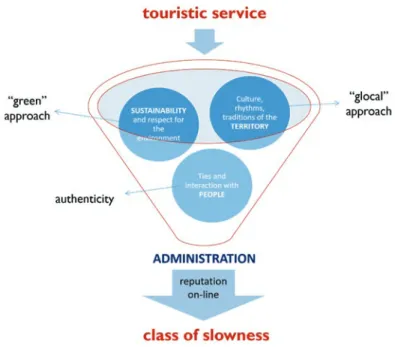
From a synthesis of the different elements which can characterize a touristic service such as sustainability, authenticity and the cultural heritage of the territory, four macro valuation areas were defined. For each macro-area indicators were iden- tified to which points were assigned which contributed to a final evaluation based on which is attributed the definitive certification of the Value for Time project. The four macro-areas are: People, Administration, Sustainability and Territory, summed up in the PAST acronym.
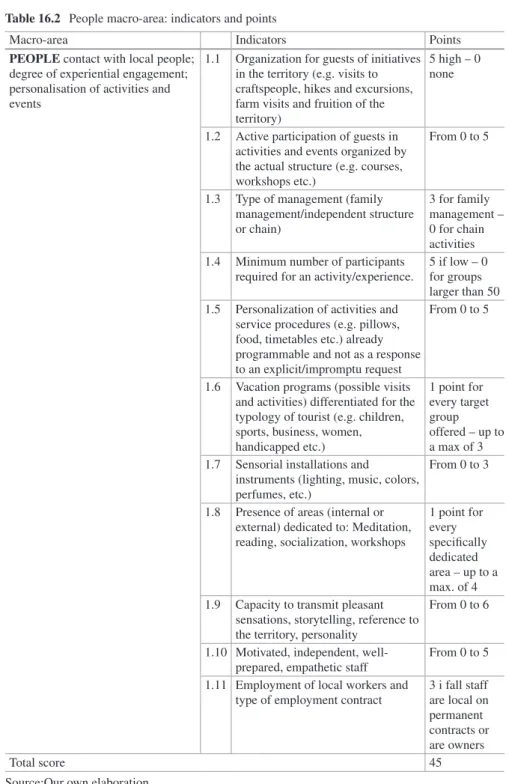
1. People: evaluates the contact with the local people, the degree of experientiality and the personalization of the activity
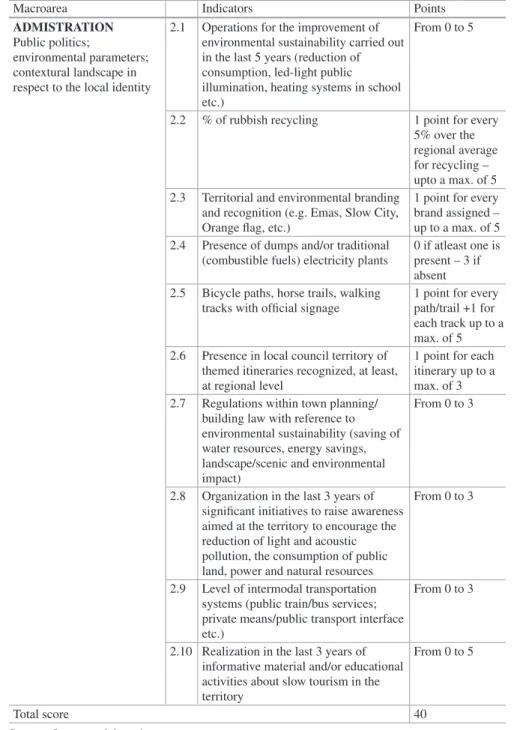
2. Administration: evaluates public politics; the environmental parameters; the scenic landscape context with respect to the local council area’s identity
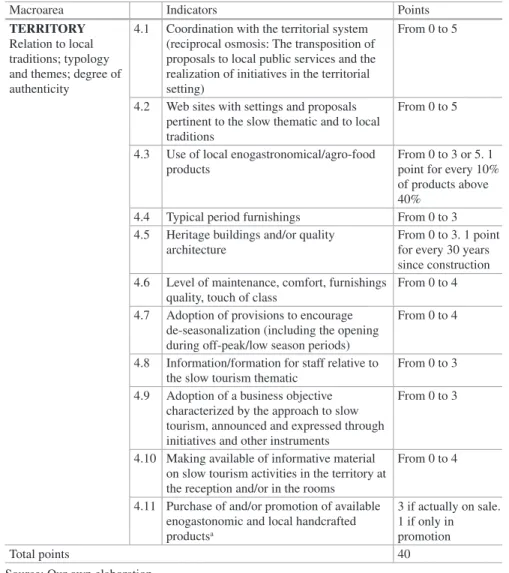
3. Sustainability: evaluates environmental, social and economic sustainability 4. Territory: evaluates the typology and the proposed touristic content, their coher-
ence with local traditions, as well as the authenticity of the touristic experience (Fig. 16.1)
The four macro-areas identify the actual characters of the “slow” supply and demand and where the relative indicators attempt to evaluate and measure the degree of slowness in a structure and a touristic service.
The innovative element of this certification consists in the ability to make refer- ence to a single component of the touristic offer of a territory, such as:
• Single service (e.g. receptive structure, restaurant, transport carrier etc.)
• Touristic service consortium (e.g. Package, card etc.) and a touristic experience (e.g. course, guided tour, etc.)
• Event (e.g. festival, competition, fair etc.)
The PAST methodology has actually been applied only to singular services, in particular to accommodation structures, but in the near future the experimental launch for its application also to combined touristic services, to experiences and to events will be carried out. The PAST method envisages a certification for increasing classes from C to A based on attributed points and also provides for periodic moni- toring of the parameters in order to assign a revised valuation and classification.
The PAST methodology, by starting with an analysis of the parameters used for other forms of certification assigned, for example, by the DEKRA certification company and by Slow tourism theoretical models, such as CASTLE theorised by Zago (2012), has envisaged the selection of 41 indicators.
In the methodology adopted, after having identified the four macro-areas, an initial selection of indicators and the assignment of a points scale from 1 to 5 or
Fig. 16.1 Scheme of the PAST methodological process for the definition of the “class of slow- ness”. (Source: Cultural Association for the Development of the Umbrian-Marche Apennines)
from 1 to 3 for each indicator were established. This first check list was then tested on a group of four touristic structures and successively a definitive version was drawn up, officially recognized by the Brand Management Commitee and registered in the regulations.
With reference to the first marco-area which is People, 11 indicators have been identified and relative point assignment indicated (Table 16.2).
Ten indicators have been identified with reference to the second macro-area Administration, (Table 16.3).
In reference to the third marco-area which is Sustainability nine indicators were selected (Table 16.4).
Finally, 11 indicators have been identified with reference to the fourth marco- area, Territory (Table 16.5).
Apart from these 41 indicators, two further variables were identified which assign a valuation from clients based on the perception of the quality of the structure and of the service.
1. Type of structure: types of accommodation have been classified on a decreasing decimal scale, from the “slowest” being assigned 10 points, such as“albergo diffuso”, to the fastest such as a hotel chain with a value of 0. With reference to dining facilities a decreasing scale of points from 1 to 5 have been ascribed, where the slow structure, with 5 points, offer the experience of “cooking with me” while a fast food restaurant is given the minimum score of 1 point (Table 16.6)
2. On-line reputation: value from 1 to 10 for accommodation structures and from 1 to 5 for restaurant activities, defined on the basis of the Travel Appeal Index,2 whose objective-indicator is the synthesis of all the opinions expressed about the touristic activity on blogs, social networks and rating sites (e.g., Trip Advisor, Holiday Check, booking.com etc.).
As a corrective factor to the rating assigned periodically by the expert evaluators of the 41 factors described above, intervention is also made by “web 3.0”, which through the judgements assigned by clients over a long period of time, allows a broader vision of the actual service supplied and that will tend increasingly to award
2 TAI – Travel Appeal Index, of the Italian Company Travel Appeal (www.travelappeal.com), expresses in terms of a percentage, the on-line reputation of an accommodation structure or restau- rant activity. The analysis carried out by Travel Appeal on an annual basis, to the ends of identify- ing the on-line reputation score has highlighted that, while the TAI over-all score of the thousands of structures analyzed in the Marche and Umbria Regions is 60.63%, the TAI score of the 23 accommodation structures (6 hotels and 16 other accommodation types) which requested slow tourism certification proved to be 50.85% (approximately 0.8% less than the regional average). It should be noted that the TAI score is expressed as a %. To make enable the calculation into the PAST methodology, the TAI scores for accommodation were transformed into decimal values, for the TAI for accommodation (TAI x 100, rounding to 0 decimal numbers), while for dining facilities the scores were converted to the 5 point scale. (TAI x 20, rounding to 0 decimal numbers)
Table 16.2 People macro-area: indicators and points
Macro-area Indicators Points
PEOPLE contact with local people;
degree of experiential engagement;
personalisation of activities and events
1.1 Organization for guests of initiatives in the territory (e.g. visits to craftspeople, hikes and excursions, farm visits and fruition of the territory)
5 high – 0 none
1.2 Active participation of guests in activities and events organized by the actual structure (e.g. courses, workshops etc.)
From 0 to 5
1.3 Type of management (family management/independent structure or chain)
3 for family management – 0 for chain activities 1.4 Minimum number of participants
required for an activity/experience.
5 if low – 0 for groups larger than 50 1.5 Personalization of activities and
service procedures (e.g. pillows, food, timetables etc.) already programmable and not as a response to an explicit/impromptu request
From 0 to 5
1.6 Vacation programs (possible visits and activities) differentiated for the typology of tourist (e.g. children, sports, business, women, handicapped etc.)
1 point for every target group offered – up to a max of 3 1.7 Sensorial installations and
instruments (lighting, music, colors, perfumes, etc.)
From 0 to 3
1.8 Presence of areas (internal or external) dedicated to: Meditation, reading, socialization, workshops
1 point for every specifically dedicated area – up to a max. of 4 1.9 Capacity to transmit pleasant
sensations, storytelling, reference to the territory, personality
From 0 to 6
1.10 Motivated, independent, well- prepared, empathetic staff
From 0 to 5 1.11 Employment of local workers and
type of employment contract
3 i fall staff are local on permanent contracts or are owners
Total score 45
Source:Our own elaboration
Table 16.3 Administration macro-area: indicators and points
Macroarea Indicators Points
ADMISTRATION Public politics;
environmental parameters;
contextural landscape in respect to the local identity
2.1 Operations for the improvement of environmental sustainability carried out in the last 5 years (reduction of consumption, led-light public illumination, heating systems in school etc.)
From 0 to 5
2.2 % of rubbish recycling 1 point for every 5% over the regional average for recycling – upto a max. of 5 2.3 Territorial and environmental branding
and recognition (e.g. Emas, Slow City, Orange flag, etc.)
1 point for every brand assigned – up to a max. of 5 2.4 Presence of dumps and/or traditional
(combustible fuels) electricity plants
0 if atleast one is present – 3 if absent 2.5 Bicycle paths, horse trails, walking
tracks with official signage
1 point for every path/trail +1 for each track up to a max. of 5 2.6 Presence in local council territory of
themed itineraries recognized, at least, at regional level
1 point for each itinerary up to a max. of 3 2.7 Regulations within town planning/
building law with reference to environmental sustainability (saving of water resources, energy savings, landscape/scenic and environmental impact)
From 0 to 3
2.8 Organization in the last 3 years of significant initiatives to raise awareness aimed at the territory to encourage the reduction of light and acoustic pollution, the consumption of public land, power and natural resources
From 0 to 3
2.9 Level of intermodal transportation systems (public train/bus services;
private means/public transport interface etc.)
From 0 to 3
2.10 Realization in the last 3 years of informative material and/or educational activities about slow tourism in the territory
From 0 to 5
Total score 40
Source: Our own elaboration
who is congruent with the promises made to their clientele, who are ever more demanding with respect to their motivations for the “slow” journey.
Some indicators prove to be characteristic not only of the PAST method, but also constitute a precise challenge for the structures holding a certificate, to better their
Table 16.4 Sustainability macro-area: indicators and points
Macro-area Indicators Points
SUSTAINABILITY:
environmental, social and economic
3.1 Affiliations and quality certification for services (Ospitalità Italiana, Ecolabel, etc.)
1 for each certification allocated up to a max. of 5 3.2 Heat saving systems or systems for
heat production from alternative energy sources (exterior insulation and finishing system, thermostats for heating regulation, pellet stoves, etc.)
1 point for each significant system utilised. Up to 4
3.3 Devices for the reduction of
environmental impact (e.g. measuring caps for detergents, biodegradable detergents, Ecolabel toilet paper, biodegradable plastic etc.)
1 point for each significant system utilised. Up to 4
3.4 Practicing of rubbish recycling 1 point for each material group (over 2) up to a max. of 4 points
3.5 Actions are taken to inform and encourage guests to recycle rubbish and save energy and water
From 0 to 3
3.6 Systems are in use to reduce the use of water (flow reduction valves, filtered drinking water in jugs, double flush systems installed in toilets, roof water catchment etc.)
From 0 to 4
3.7 Systems are in use to limit the waste of lighting energy (e.g. presence sensor controls, led lights or low energy consumption bulbs, timers, etc.)
From 0 to 4
3.8 Clients are encouraged and facilitated in the use of public transport or alternative means of transport to the car (e.g. electrical vehicles, bicycles etc.)
From 0 to 3
3.9 Alternative systems are in use for the generation of electricity (solar panels, windmills, biomass, etc.)
1 point for each significant system employed. Up to 4.
Total score 35
Source: Our own elaboration
actual offer with a view to the diversification and the personalization of their services.
16.4.2 Value for Time Certification
The certification proposed for the project has been defined as VALUE for TIME (abbreviated to VxT) and indicates the “class of slowness” assigned to the hospital- ity structure. With this term, which is easy to understand also for the international
Table 16.5 Territory macro-area: indicators and points
Macroarea Indicators Points
TERRITORY Relation to local traditions; typology and themes; degree of authenticity
4.1 Coordination with the territorial system (reciprocal osmosis: The transposition of proposals to local public services and the realization of initiatives in the territorial setting)
From 0 to 5
4.2 Web sites with settings and proposals pertinent to the slow thematic and to local traditions
From 0 to 5
4.3 Use of local enogastronomical/agro-food products
From 0 to 3 or 5. 1 point for every 10%
of products above 40%
4.4 Typical period furnishings From 0 to 3 4.5 Heritage buildings and/or quality
architecture
From 0 to 3. 1 point for every 30 years since construction 4.6 Level of maintenance, comfort, furnishings
quality, touch of class From 0 to 4
4.7 Adoption of provisions to encourage de-seasonalization (including the opening during off-peak/low season periods)
From 0 to 4
4.8 Information/formation for staff relative to the slow tourism thematic
From 0 to 3 4.9 Adoption of a business objective
characterized by the approach to slow tourism, announced and expressed through initiatives and other instruments
From 0 to 3
4.10 Making available of informative material on slow tourism activities in the territory at the reception and/or in the rooms
From 0 to 4
4.11 Purchase of and/or promotion of available enogastonomic and local handcrafted productsa
3 if actually on sale.
1 if only in promotion
Total points 40
Source: Our own elaboration
aThe term “local” refers to the territory in Umbro-Marche District
clientele, the intention is to elude to the concept value for money, typical of main- stream touristic consumerist practice in general and at the same time to refer to the reciprocal time for values, that is “to take the time for values” in relationships, authenticity and the territorial traditions, and in real slow practices, also including slow food.
VxT assigns the values A (gold), B (silver) or C (bronze) relative to the decreas- ing points gained.
A certification system is an important instrument in the process of the implemen- tation of quality for the touristic offer in a territory, in that it is aimed to award excel- lence but also to stimulate and give visibility to new touristic practices such as for example, slow tourism, allowing for a relative improvement.
Between August 2014 – March 2015 a team of assessors went to the various accommodation facilities on order to assign scores to the different indicators in the 4 macro-areas. Successively, the resulting check list was sent to the controlling body for the brand, which through the implementation of the valuation method, undertook to assign a final score attributing to each reception facility its relative
“slowness classification”.
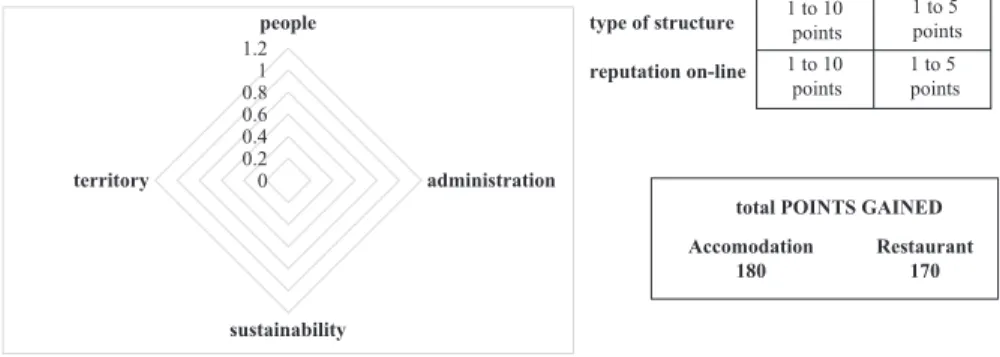
The final calculation is obtained using a total of the 41 evaluation indicators, together with the points derived from the typology of the structure and the on-line reputation, realized by means of an allocation scheme, which also generates a polar diagram with a synthesis of the score obtained in the single macro-areas of the PAST Method.3 (Fig. 16.2).
3 It should be observed that for the accommodation facilities the maximum number of points that may be assigned is 180, while for dining facilities it is 170. The minimum value was established by the Brand Management Committee based upon the pre-tests carried out on defining experimen- tal facilities.
Table 16.6 Point variability
by structure typology Typology Points
Accommodation Hotel chain 1
Tourist village 2
Standard hotel 3
Charme or historical hotel 4 Private room rental and camping 5
Small family hotel 6
Country house, historical residence 7
Farmstay 8
B&B 9
Albergo diffuso 10
Dining facilities Restaurant chain 1
Standard restaurant 2
Tavern, historical restaurant, typical trattoria
3
Farm stay restaurant 4
Cooking with me 5
Source: Our own elaboration
The VxT, as defined in the Branding Regulations, is subject to periodic modifi- cation in the case of a change in the check-list parameters, both for actions under- taken by the individual structures offering services, as well as for modifications to the territorial data base following choices carried out by local administrations (for example due to the opening of a thermal power plant or the increase in bicycle pathways). This highlights that the choices of local authorities and the strategies of private operators need to be jointly planned. In fact, in the application of some of the parameters provided for in the certification system, collective decisions acti- vated in a territory also influence the slowness ranking of a touristic subject or product undergoing evaluation. For example, if political decisions are adopted in favor of energy savings or the use of a “slow” transport means in a particular ter- ritory, a benefit is also registered in the factors which define the class of slowness of the hotel.
The Brand Management Committee supervises the application of the provisions made in the Regulations for branding and the evaluations to be made during the visits carried out by experts to ascertain certification. The Committee also has the function of attributing the VxT classification based on the score received.
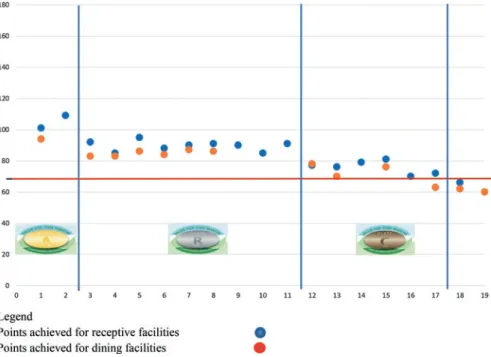
The first certificates were issued in November 2015 following the assignment of the scores given both for the accommodation and the dining facilities of each struc- ture. It should be noted that, of the 19 structures visited in the Marche, 12 offer both accommodation and dining facilities and therefore have two scores while the 6 solely receptive structures and the one structure with only dining facilities have been assigned a single score. Of these structures 2 have attained Class A, 9 Class B, 6 Class C and 2 were deemed ineligible due to not attaining the minimum score necessary to obtain a certificate (Graph 16.1).
The Brand Management Committee decided to also assign a Class C to structure n.17, despite the score obtained by the dining facilities being less than the minimum
0 0.2 0.4 0.6 0.8 1 1.2
people
administration
sustainability territory
type of structure 1 to 10 points
1 to 5 points reputation on-line 1 to 10
points
1 to 5 points
total POINTS GAINED Accomodation
180 Restaurant
170
Fig. 16.2 Synthesis of the scores relative to structure typology and on-line reputation, together with the total score and the polar diagram of the points for each single macro-area. (Source: Our own elaboration)
value of 70 points its reception facilities were assigned a higher-than-minimum score for accommodation.
In reference to the structures in Umbria, as yet it has not been possible to assign any Value for Time certification, due to the difficulty of designating points in macro- area A this being the task of local administrative bodies, which to date demonstrate buearocratic difficulties and long response times.
16.4.3 Lessons Learned
The project “District of Slowness: methodology for the certification of slow tourism in the Umbrian-Marche Apennine district” in line with the slowness framework, is integrated into a vision of local development that promotes subjective wellbeing, the quality of community life, the valorization of local territorial identity and responsible tourism. In this context the touristic activities are influenced by an increasing sense of the responsibility of the tourist towards the environment and the search for a quality experience. In fact, tourism which combines the hedonistic aspects of holidays together with an eudaimonistic ethic, based on quality hospitality and an attention to quality living, where the tourist plays an active role in the vacation through the application of a responsible approach, becomes a possible model for local development in which the theme of the quality of life has a central role. The
Graph 16.1 Distribution of VxT certifications by class assigned. (Source: Our own elaboration)
indicators identified by the PAST methodology result in being increasingly congru- ent with this new vision of local development.
For example the minimum number of participants required for the activity/expe- rience (Indicator 1.4) proposed to its guests by a structure results as being important in that it allows a guest to live an emotionally captivating and intensely real life experience. Moreover, in consistency with the philosophy of slow tourism, it is important to provide services that are able, not only to respond to the specific needs of tourists but also to permit the tourist to feel received as a guest and not merely as a client. The PAST Method, therefore, attributes importance to the activities and the processes built into program possibilities which personalize the services (e.g. pil- lows, food, timetables etc.) and not only as a response to an explicit/impromptu request (Indicator 1.5).
As previously pointed out, in slow touristic operations, the aspect of environ- mental sustainability performs a central role, which should also be assumed in local touristic development politics which need to be orientated towards creating a more sustainable socio-economic context. Therefore, the organization in the last 3 years of significant initiatives to raise awareness aimed at the territory in order to encour- age the reduction of light and acoustic pollution, the consumption of public land, power and natural resources (Indicator 2.8) becomes significant.
Moreover, sustainability (macro-area S) is strictly linked to the responsibility of choices made by the hospitality structures, which assume particular relevance with Indicator 3.3 Devices for the reduction of environmental impact (e.g. measuring caps for detergents, biodegradable detergents, Ecolabel toilet paper, biodegradable plastic etc.)
The ability of the territory to establish networks with the view to valorizing and promoting quality services and products is revealed by the adhesion to environmen- tal/quality branding/certification schemes.
Therefore, the presence of branding and territorial and environmental recogni- tion (Indicator 2.3) and the affiliations and quality certification of the service (Indicator 3.1) are considered to be bonus activities.
A marked alliance of the tourist with the territory is a particularity of slow tour- ism. The integration of and constructive dialogue between the various local socio- economic components proves to be important, indicating a coordination with the territorial system (reciprocal osmosis: the transposition of proposals to local public services and the realization of initiatives in the territorial setting) (Indicator 4.1) assuming a positive value.
Furthermore the PAST methodology highlights the importance of the collabora- tion between local administrations and tourist facilities which becomes of strategic importance in the planning and realization of tourism development politics at a local level. In fact, if the public stakeholder does not take an active part in the touristic development process, and therefore also in planning for slow tourism, the excellent quality of the private structures is insufficient if not integrated into a broader context of territorial quality. A possible appeal on behalf of private subjects for the furnish- ing of the data and information necessary to obtain certification, could give impetus to the response and the commitment of public institutions.
In closing, it should be underlined that the PAST Methodology could be experi- mented and adopted in other territories which identify slow tourism as a strategy for sustainable, local, touristic development capable of raising both competitivity and visibility.
References
Adams, K. B., Leibbrandt, S., & Moon, H. (2011). A critical review of the literature on social and leisure activity and wellbeing in later life. Ageing and Society, 31(04), 683–712.
Argyle, M. (1987). The psychology of happiness. London/New York: Methuen.
Babou, I., & Callot, P. (2009). Slow tourism, slow (r)evolution? Nouvelles mobilities touristiques.
Cahier Espaces, 100(56), 48–54.
Baumann, Z. (2002). La solitudine del cittadino globale. Milano: Feltrinelli.
Beeton, S. (2006). Community development through tourism. Collingwood: Landlinks Press.
Bissell, D., & Fuller, G. (2011). Stillness in a mobile world. New York: Taylor & Francis.
Biswas-Diener, R., & Diener, E. (2006). The subjective well-being of the homeless and lessons for happiness. Social Indicators Research, 76(2), 185–205.
Blanco, L. (2011). Una aproximacion al turismo slow. El turismo slow en las Cittaslow de Espana.
Investigaciones Turisticas, 1, 122–133.
Calzati, V. (2011). Territori lenti: nuove traiettorie di sviluppo. In E. Nocifora, P. de Salvo, &
Calzati (Eds.), Territori lenti e turismo di qualità, prospettive innovative per lo sviluppo di un turismo sostenibile (pp. 62–72). Milano: Franco Angeli.
Calzati, V. (2016). Nuove pratiche turistiche e slow tourism. Il caso della Valnerina in Umbria.
Milano: FrancoAngeli.
Calzati, V., & de Salvo, P. (Eds.). (2012). Le strategie per una valorizzazione sostenibile del ter- ritorio. Milano: Franco Angeli.
Calzati, V., & de Salvo, P. (2017). Slow tourism: A new concept of sustainability, consumption and quality of life. In M. Clancy (Ed.), Slow tourism, food and cities: Pace and the search for the good life. London: Routledge.
Campbell, S. (1996). Green cities, growing cities, just cities? Urban planning and the contra- dictions of sustainable development. Journal of the American Planning Association, 62(3), 296–312.
Conway, D., & Timms, B. (2010). Re-branding alternative tourism in the Caribbean: The case for slow tourism. Tourism and Hospitality Research, 10(4), 329–344.
Conway, D., & Timms, B. (2012). Slow tourism at the Caribbean’s. Geographical margins. Tourism Geographies, 14(3), 396–418.
Dann, G. M. S. (2012). Tourist motivation and quality-of-life: In search of the missing link. In M. Uysal, R. Perdue, & J. Sirgy (Eds.), Handbook of tourism and quality-of-life research:
Enhancing the lives of tourists and residents of host communities (pp. 233–245). Dordrecht:
Springer Science & Business Media.
de Salvo, P. (2011). Cittàslow: un modello alternativo di sviluppo urbano lento e sostenibile. In E. Nocifora, P. de Salvo, & V. Calzati (Eds.), Territori lenti e turismo di qualità. Prospettive innovative per lo sviluppo di un turismo sostenibile (pp. 47–58). Milano: Franco Angeli.
de Salvo, P., Clemente, E. D., & ManuelHernández-Mogollón, J. (2013). “Repellent” tourists versus “slow” tourists. The European Journal of Tourism Hospitality and Recreation, 4(2), 131–148.
Di Clemente, E., Hernández-Mogollón, J. M., de Salvo, P., & Campón-Cerro, A. M. (2015). Slow tourism: An alternative model for local and tourist development. In J. Mondéjar-Jiménez, G. Ferrari, M.-d.-V. Segarra-Oña, & A. Peiró-Signes (Eds.), Sustainable performance and tour- ism: A collection of tools and best practicesed (pp. 23–37). Chartridge: Books Oxford.
Dickinson, J. E., & Lumsdon, L. (2010). Slow travel and tourism. London: Earthscan.
Dickinson, J. E., Robbins, D., & Lumsdon, L. (2010). Holiday travel discourses and climate change. Journal of Transport Geography, 18(3), 482–489.
Diener, E., & Suh, E. (1997). Measuring quality of life: Economic, social, and subjective indica- tors. Social Indicators Research, 40, 189–216.
Dolnicar, S., Yanamandram, V., & Cliff, K. (2012). The contribution of vacations to quality of life.
Annals of Tourism Research, 39(1), 59–83.
Dolnicar, S., Lazarevski, K., & Yanamandram, V. (2013). Quality of life and tourism: A conceptual framework and novel segmentation base. Journal of Business Research, 66(6), 724–729.
Fullagar, S., Markwell, K., & Wilson, E. (2012). Slow tourism. Experience and Mobilities. Bristol:
Channel view Publications.
Gardner, N. (2009). A manifesto for slow travel. Hidden Europe Magazine, 25, 10–14.
Gilbert, D., & Abdullah, J. (2004). Holiday taking and the sense of well-being. Annals of Tourism Research, 31(1), 103–121.
Hall, C. M. (2009). Degrowing tourism: Descroissance, sustainable consumption and steady state tourism. Anatolia, 20(1), 46–61.
Hall, C. M. (2010). Changing paradigms and global change: From sustainable to steady-state tour- ism. Tourism Recreation Research, 35(2), 131–145.
Hamilton, C. (2003). Growth fetish. Sydney: Allen & Unwin.
Hazel, N. (2005). Holidays for children and families in need: An exploration of the research and policy contexts for social tourism in the UK. Children and Society, 19, 225–236.
Heitmann, S., Robinson, P., & Povey, G. (2011). Slow food, slow cities and slow tourism. In P. Robinson, S. Heitmann, & P. Dieke (Eds.), Research themes for tourism (pp. 114–127).
Oxford: CABI.
Iso-Ahola, S. E., & Park, C. J. (1996). Leisure-related social support and self-determination as buffers of stress-illness relationship. Journal of Leisure Research, 28, 169–187.
Iwasaki, Y. (2002). Testing independent and buffer models of the influence of leisure participation on stress-coping and adaptational outcomes. Journal of Park and Recreation Administration, 20, 90–129.
Iwasaki, Y. (2007). Leisure and quality of life in an international and multicultural context: What are major pathways linking leisure to quality of life? Social Indicators Research, 82(2), 33–264.
Kahn, R. L., & Juster, T. (2002). Well-being: Concepts and measures. Journal of Social Issues, 58, 627–644.
Kahneman, D., Edward, D., & Norbert, S. (1999). Well-being: The foundations of hedonic psychol- ogy. New York: Russell Sage Foundation.
Kahneman, D., David, K., & Tversky, A. (2003). Experienced utility and objective happiness: A moment-based approach. The Psychology of Economic Decisions, 1, 187–208.
Kelley-Gillespie, N. (2009). An integrated conceptual model of quality of life for older adults based on a synthesis of the literature. Applied Research in Quality of Life, 4, 259–282.
Knox, P. L. (2005). Creating ordinary places: Slow cities in a fast world. Journal of Urban Design, 10(1), 1–11.
Lancerini, E. (2005). Territori lenti: contributi per una nuova geografia dei paesaggi abitati italiani.
Territorio, 34, 9–15.
Lanzani, A. (2005). Geografie, paesaggi, pratiche dell’abitare e progetti di sviluppo. Territorio, 34, 19–36.
Latouche, S. (2007). La scommessa della decrescita. Milano: Feltrinelli.
Layard, R. (2005). Happiness: Lessons from a new science. London: Penguin.
Lumsdon, L., & McGrath, P. (2011). Developing a conceptual framework for slow travel: A grounded theory approach. Journal of Sustainable Tourism, 19(3), 265–279.
Manella, G., de Salvo, P., & Calzati, V. (2017). Verso modelli di governo urbano sostenibile e solidale:il caso Cittaslow in Emilia-Romagna. Sociologia Urbana e Rurale, 112, 117–130.
Matos, R. (2004). Can “slow tourism” bring new life to alpine regions? In W. Klaus & C. Mathies (Eds.), The tourism and leisure industry shaping the future (pp. 93–104). New York: Haworth Press.
McCabe, S., Joldersma, T., & Li, C. (2010). Understanding the benefits of social tourism: Linking participation to subjective well-being and quality of life. International Journal of Tourism Research, 12(6), 761–773.
McConkey, R., & Adams, L. (2000). Matching short break services for children with learning dis- abilities to family needs and preferences. Child: Care, Health and Development, 26, 429–443.
Neal, J. D., Sirgy, J., & Uysal, M. (2004). Measuring the effect of tourism services on travelers’
quality of life: Further validation. Social Indicators Research, 69(3), 243–277.
Nocifora, E. (2011). La costruzione sociale della qualità territoriale. Il turismo della lentezza come conquista del turista esparto. In E. Nocifora, P. de Salvo, & V. Calzati (Eds.), Territori lenti e turismo di qualità, prospettive innovative per lo sviluppo di un turismo sostenibile (pp. 6–30).
Milano: Franco Angeli.
Nussbaum, M., & Sen, A. (1993). The quality of life. Oxford: University Press.
Oh, H., George, A., & Seyhmus, B. (2016). Motivations and goals of slow tourism. Journal of Travel Research, 55(2), 205–219.
Osbaldiston, N. (2013). Culture of the slow. In Social deceleration in an accelerated world.
Hampshire: Palgrave Macmillan.
Parkins, W., & Craig, G. (2006). Slow living. Oxford: Berg.
Pearce, P. L., & Lee, U.-I. (2005). Developing the travel career approach to tourist motivation.
Journal of Travel Research, 43, 226–237.
Presenza, A., Tindara, A., & Roberto, M. (2015). The cittaslow movement: Opportunities and chal- lenges for the governance of tourism destinations. Tourism Planning & Development, 12(4), 479–488.
Ryan, R. M., & Deci, E. L. (2001). On happiness and human potentials: A review of research on hedonic and eudaimonic well-being. Annual Review of Psychology, 52, 14–166.
Savoja, L. (2011). Turismo lento e turisti responsabili. Verso una nuova concezione di consume.
In E. Nocifora, P. de Salvo, & V. Calzati (Eds.), Territori lenti e turismo di qualità. Prospettive innovative per lo sviluppo di un turismo sostenibile (pp. 86–99). Milano: Franco Angeli.
Schor, J. (1998). The overspent American: Why we want what we don’t need. New York: Harper, Perennial.
Sirgy, M. J. (2002). The psychology of quality of life. Dordrecht: Kluwer Academic.
Sirgy, M. J. (2010). Toward a quality-of-life theory of leisure travel satisfaction. Journal of Travel Research, 49, 246–260.
Stiglitz, J. E., Amartya, S., & Jean-Paul, F. 2009. Report by the Commission on the Measurement of Economic Performance and Social Progress, Paris.
UNWTO. (2012). Asia-Pacific Newsletter, Issue 27.
Uysal, M., Perdue, R., & Joseph Sirgy, M. (Eds.). (2012). Handbook of tourism and quality-of-life research: Enhancing the lives of tourists and residents of host communities. Berlin: Springer Science & Business Media.
Uysal, M., Joseph Sirgy, M., Woo, E., & Kim, H. L. (2016). Quality of life (QOL) and well-being research in tourism. Tourism Management, 53, 244–261.
Veenhoven, R., Ehrhardt, J., Ho, M. S. D., & de Vries, A. (1993). Happiness in nations: Subjective appreciation of life in 56 nations (pp. 1946–1992). Rotterdam: Erasmus University Press.
Weaver, D. B. (2000). A broad context model of destination development scenarios. Tourism Management, 21(3), 217–224.
Wilkinson, R. G., & Marmot, M. (2003). Social determinants of health: The solid facts.
Copenhagen: World Health Organization.
Woehler, K. (2004). The rediscovery of slowness, or leisure time as one’s own and as self- aggrandizement? In K. Weiermair & C. Mathies (Eds.), The tourism an leisure industry:
Shaping the future (pp. 83–92). New York/London/Oxford: The Hanwoth Hospitality Press.
Zago, M. (2012). Definire e operativizzare lo slow tourism: il modello Castle. In E. Nocifora, P.
de Salvo, & V. Calzati (Eds.), Territori lenti e turismo di qualità. Prospettive innovative per lo sviluppo di un turismo sostenibile (pp. 155–169). Milano: Franco Angeli.