It was excavated from the old village at Sevuokok (Gambell) at the northwest end of the. It is very similar to the specimens from Point Barrow and the East Cape described by Mathiassen.^ The centers of the circles are 4 mm.
NO. 14 PREHISTORIC ART OF ALASKAN ESKIMO — COLLINS II
In the same way, we will always look for any real similarities to the special art of the Northwest Coast. 14 PREHISTORIC ART OF ALASKA ESKIMO COLLINS I3Boas thinks that the eye of the Northwest Coast is development.
NO. 14 PREHISTORIC ART OF ALASKAN ESKIMO COLLINS I3 Boas regards the Northwest Coast eye as a development of the
It would be possible, I believe, to trace the development of the old Bering Sea art to the modern if we had no more than the objects. Fortunately, however, we now have additional data that shed light on a secondary stage of art development within the ancient Bering Sea culture.
THE PUNUK ISLAND AND CAPE KIALEGAK VILLAGE SITES The three small Punuk Islands lie four miles ofif the southeast end
NO. 14 PREHISTORIC ART OF ALASKAN ESKIMO — COLLINS 1
Likewise, no modern type of closed-cavity harpoon head was found, and the blades of the harpoons, lances, knives and axes were all slate. The artefacts from the lower levels of the later village and all the artefacts from the older site were of the type found in the old Punuk village.
NO. 14 PREHISTORIC ART OF ALASKAN ESKIMO COLLINS I7 spread and relationships of early Eskimo culture in the Bering Sea
14 PREHISTORIC ART OF ALASKA ESKIMO COLLINS I7distribution and relationships of early Eskimo culture in the Bering Sea. The depression at the top of the central post section and the bowl at the base are features that were also seen in the object on plate 6.
NO. 14 PREHISTORIC ART OF ALASKAN ESKIMO COLLINS IQ incised straight and slightly curving lines, single or in bands of from
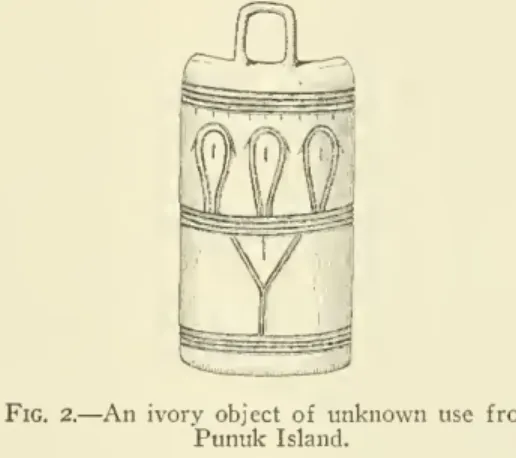
Shown below is an ivory drill case with a very tight decoration of lines, dots, circles and spurs. 14 PREHISTORIC ART OF ALASKA ESKIMO COLLINS 21accuracy of cutting and uniform depth and width Hnes,.
NO. 14 PREHISTORIC ART OF ALASKAN ESKIMO COLLINS 21 cision of the cutting and the uniform depth and width of the Hnes,
The ornament consists of lines and pillars, the latter being attached only to the curved lines which close the pattern on both sides. Within these are three pairs of straight lines meeting at acute angles, the lower edges coinciding with slight bulges along the sides.
NO. 14 PREHISTORIC ART OF ALASKAN ESKIMO — COLLINS 23
In between are slightly curved triangular figures enclosing a central point, the tops of which point outwards, with the exception of the first one to the right, which points back towards the centre. Although the lines follow the contour, the design is very similar to that of plate 13, g, except for the addition of long sharp traces attached to the pairs of short transverse lines. The well-defined curves, especially of the lower part of the body and the breasts, and the realistic treatment of the figure as a whole, produce an effect quite different from that seen in the simple and stiffly conventional dolls of the modern Eskimo from Alaska.
Even more important than the scarcity of carvings overall was the complete absence on Punuk of the pictographic art so characteristic of the modern Alaskan Eskimo. RELATIONSHIP OF PUNUK ART WITH THE COMLINEAR ART OF ANCIENT BERING SEA CULTURE.
RELATION OF THE PUNUK ART TO THE CURVILINEAR ART OF THE OLD BERING SEA CULTURE
NO. 14 PREHISTORIC ART OF ALASKAN ESKIMO COLLINS 2/
There is still a slight tendency to use the outline of the object to enhance the design, but not nearly to the extent of the older art. The same adherence to convention is seen in many of the other objects, resulting in a fixed mechanical style, which, although symmetrical and graceful in its simplicity, clearly lacks the elasticity and exuberance that characterize the finer products of the older Bering Sea culture as works . of real art. Although the carving and surface decoration of the older objects show great skill, there is no reason why they should not be regarded as the result of carving with stone tools.
The unvarying uniformity of depth and width of the circles shows plainly enough that they could only be produced with a very narrow, sharp, and smooth instrument. Reference has been made to the four iron fragments found in the upper levels of the Punuk midden and to the file marks on some of the artefacts.
NO. 14 PREHISTORIC ART OF ALASKAN ESKIMO — COLLINS 29 iron received may have been such prized possessions that they
14 PREHISTORIC ART OF ALASKAN ESKIMO — COLLINS 29iron received may have been such prized possessions that they .. like Gaml)ell and Kukuliak, are older, having successively passed through the stage when curvilinear art flourished, in that of the. However, Punuk Island and Cape Kialegak appear to have been settled at or near the end of the curvilinear period, the occupation continuing until recent years. This eastward movement would be consistent with the reasonable assumption that the first settlements of Siberian Eskimo on St.
The Lawrence site, where intensive and systematic excavations were carried out, found among several thousand specimens, including 141 decorated objects, only four examples of old curvilinear art and those fragmentary and water-coated; while at Gambell and Kukuliak casual Eskimo excavation has brought to light a considerable number of objects decorated in both styles. Lawrence can have no doubt; a greater number of specimens of the punuk sequilinear type have been found.
NO. 14 PREHISTORIC ART OF ALASKAN ESKIMO COLLINS 3
OBJECTS FROM PUNUK AND ST. LAWRENCE ISLANDS SHOWING MODERN DESIGNS
However, it is merely a simplification of these patterns, and not something distinct, for the lines and dots among Punuku's constant features. The various parts of the flanged needle excite the imagination of the artist; and a geometric element here or there. 14 PREHISTORIC ART OF THE ESKIMO-^COLLTNS ALASKAN 33and concluded that "Alaskan typology appears to be a very locally re- and concluded that "Alaskan typography appears to be a very limited local, distinctive form, which hardly has had its origin." On the other hand, he considered that the Alaskan type of human-shaped needle case was the prototype of the winged needle case of the East.
The upper parts of the Point Barrow specimens are extended like the Alaskan forms, although there are no distinct edges. It also seems that we have here a possible explanation of the origin of the Eskimos.
RELATION BETWEEN THE ANCIENT AND MODERN ART OF THE BERING SEA REGION
In contrast, the decorated objects of the Punuk period are generally characterized by a certain continuity of design. The spread of the circle and point design in Northwestern America has recently been studied by Dr. The extreme regularity of the circles speaks to the likelihood of using bits of different sizes.
The various elements involved in the composition of the designs of the old curvilinear Bering Sea art, the later Punuk stage and the. RELATIONSHIP OF THE OLD BERING SEA CULTURE WITH THE BIRNIRK CULTURE OF NORTHERN ALASKA AND THE.
RELATION OF THE OLD BERING SEA CULTURE TO THE BIRNIRK CULTURE OF NORTHERN ALASKA AND THE
The quantitative arrangement of such elements naturally gives an imperfect picture of real similarities and differences, due to the varying value of the elements treated and the necessity to limit them to the detached, objective elements of the art style that are separate from the total decorative scheme is considered. There is also another difficulty that minor changes and gradations, which are important to reveal the interrelationships of the various cultural stages, cannot be adequately expressed. Nevertheless, it serves to emphasize the point previously made, that the Punuk phase of the old Bering Sea culture, while.
Lawrence and the place it may have had in the sequence of ancient Eskimo cultures elsewhere cannot be determined until more information about northern Alaskan is available.
THULE CULTURE OF CANADA AND GREENLAND One of the most important problems that arises in connection with
NO. 14 PREHISTORIC ART OF ALASKAN ESKIMO COLLINS 4I to the Van Valin collection it is seen that the decorated artifacts from
Regarding the origin of the Thule culture and its relationship to other Eskimo groups, Mathiassen makes the following statement. In passing through the elements of the Thule culture, we have had occasion again and again to note the close connection which apparently exists between the finds of the central Thule Eskimos and certain groups of the western Eskimos, especially their most arctic sub-groups in Pt.Barrow and Eastern Siberia. The only question is whether the migration was from the central regions to the west or vice versa, whether the Thule culture originated in the central regions or the western regions.
Now the question is whether it did so during the Thule culture as well, or whether it is the opposite in the Central Eskimos. The Thule culture, with all its special whaling culture, originated somewhere in the western regions, in the Arctic region, where whales were plentiful and timber abundant, and it inadvertently leads us to the coasts of Alaska and Eastern Siberia north of the Bering Isthmus, regions to which the time for we had to turn in time to find parallels with the types from the central Eskimo finds.
NO. 14 PREHISTORIC ART OF ALASKAX ESKIMO — COLLIXS 43 Comparison of the decorated objects and harpoon heads of the
14 PREHISTORIC ART OF ALASKAX ESKIMO — COLLIXS 43Comparison of the decorated objects and harpoon heads. Decoration, when present on the Thule harpoon heads, is limited to plain Y-shaped figures around the line hole, with an occasional enlargement of the figure into a triangular hatched area (see Mathiassen, Vol. i, pis. i, 37,69, and 72). A further example of residual or decorative side blade grooves is found in the small harpoon head illustrated on Plate 20, f, excavated at Metlatavik, 35 miles north of the Bering Strait.
Lawrence or in Alaska had the deep patination that always characterizes ivory objects from the earliest Bering Sea period. Of the last-named features, the drilled holes around the sockets of the harpoon heads for attachment to the fore-shaft, the small pins at the point to hold the blade in place, and the ivory bird figures, may, like the realistic etchings, be of Eastern origin, and brought to Alaska by the late wave of migration.
NO. 14 PREHISTORIC ART OF ALASKAN ESKIMO COLLINS 45
The attempt to place the Thule culture as earlier than that represented at Birnirk or any other ancient Alaska site runs into the difficulty that certain characteristic features of the Thule culture are found only in Alaska as late developments or accretions. According to the available evidence, therefore, the Thule culture of the East appears to have been derived from the ancient Bering Sea culture after the latter had become firmly established on the islands and mainland of Alaska and Siberia around Bering Strait, eastward as far as Point Barrow, and westward possibly up to the Kolyma. The possibility is recognized, however, that certain later features in Alaska may have resulted from a westward or return migration or from less direct Thule contact after the original eastward movement of the Thule culture.
In the preceding overview we examined the art of the ancient Bering Sea culture, and the features that distinguish it from the later ones. Lawrence Island, and its relationship to that of the present-day Alaskan Eskimo and the extinct Thule culture of the East.
NO. 14 PREHISTORIC ART OF ALASKAN ESKIMO COLLINS 47 only resulted in showing that we must go much further back before
EXPLANATION OF PLATES
NO. 14 PREHISTORIC ART OF ALASKAN ESKIMO — COLLINS 49
NO. 14 PREHISTORIC ART OF ALASKAN ESKIMO COLLINS 5I
Excavation along the outer edges showed that it extended as deep as six feet below the present shoreline. Section of Punuk Island center at Sny B, with timber and whale bones from an old house at the bottom, now six feet below the reach of storm tides.