James Riordan is Professor and Head of the Department of Linguistics and International Studies at the University of Surrey. Hai Ren is a professor at Beijing University of Physical Education where he is also Director of the Center for Olympic Studies and is widely known. He is an executive member of the International Society for Comparative Physical Education and Sport.
The collection of volumes appearing in the book series illustrates the nature and extent of the variations.
Sport in China
The Chinese regulations from 1995 thus show some real concern on the part of the government. Sichuan, in the middle belt, hosted part of the 7th National Games in 1993, which was split between Beijing and Sichuan roughly 2:1. The first two categories will continue to receive help from the public as part of the image building process.
Source: Population Census Office of the State Council of China in Population Atlas of China (OUP, 1987).
Recreation and sport in Ancient China
During this period, the ideal of the noble warrior and the ethics of honor emerged. However, in the expansion of the Empire, bravery and ritual gave way to the serious business of conquering territory. Another form of the game was played by professional players and performed as an entertainment.
The influence of writers can be seen in the strengthening of intellectual games and refined physical activity.
The emergence of modern sport
For sports historians, there are interesting details about the game that prove its golf nature. It took them another forty years to conquer the Yangtze and the southern provinces. There is evidence that the emperor used wrestling as one of the tests for the recruitment and promotion of officers.
There is little evidence in the literature that the forms of military training during the Ming dynasty were very different from those of the Song. Another form followed Song dynasty rules with a goal in the center of the field of play and players divided into two teams. The Official History of the Ming Dynasty (Ming Sheh) was completed between 1679 and 1735 and contains 366 chapters.
One of the most interesting and spectacular developments in sports during the Qing Dynasty was the progress made in ice sports. In front of the Five-Dragon Pavilions, the water in the middle sea froze into ice in winter. P'ng and Donn (1979:14) describe the influence of boxing as a martial art, and the impact of the Shaolin monks.
The influence of the military on the development of Chinese sports and challenges was paramount. At the end of the Qing dynasty, large-scale changes were brought about by the influence of the Western invasion.
China in the modern world
Backwardness was exemplified in the crushing defeats of the Chinese army and navy in the Opium Wars and later by the Japanese in 1894. Favorable reforms included a radical reform of the state examination system and the establishment of a Ministry of Education in 1902. -official view of the world, sport was an activity for the lower classes.
Even the heads of the physical education departments at Chinese Colleges and the leaders of Chinese sports teams sent abroad were foreigners. However, little effort was made in the countryside, and the majority of the population continued to live in abject poverty. The ultimate goal was the triumph of the rural world, which was seen as the victim of foreign capital and the Chinese bourgeoisie.
A massive impetus was given to the development of sports in China and the Far East by the inauguration of the Olympic Games in the Far East. In the field of sports, the early influences of the missionary schools were reinforced by the establishment of sports cultures in the treaty ports and the gradual uptake of the sport by the Chinese bourgeoisie. Training the Body for China: Sports in the Moral Order of the People's Republic, Chicago: University of Chicago Press.
1991) 'The Changing Relationship between Sport and the State in the People's Republic of China', in Fernand Landry, Marc Landry and Magdelaine Yertes (eds) Sport: The Third Millennium, Proceedings of the National Symposium, Sainte-Foy: Les Presses de l' University Laval. Hsu Yi-hsiung (1975) 'Forming the Philosophy of Chinese Physical Education in National Military Education in the Early Twentieth Century', APCHPER Proceedings, Taipei, ROC, August.
Sport and physical education in school and university
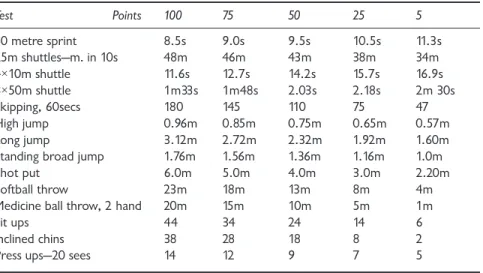
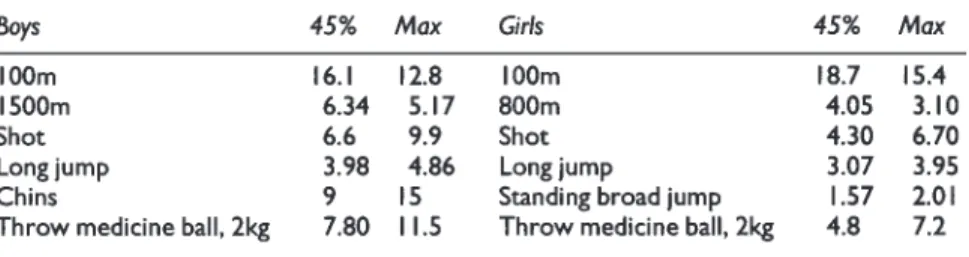
Of the rest, about 40 percent of students go on to senior middle school for three years, while the other 60 percent go to the vocational and technical schools (there are three or four variations of these schools, according to the specific occupation, profession or clerical work what they focus on). Teachers are expected to comply with national rules for physical education, and students are 'recipients' of the curriculum rather than partners in it. A score of 100 points in any or all of the three physical activities is then translated as ten points in the transfer test from junior to senior middle school.
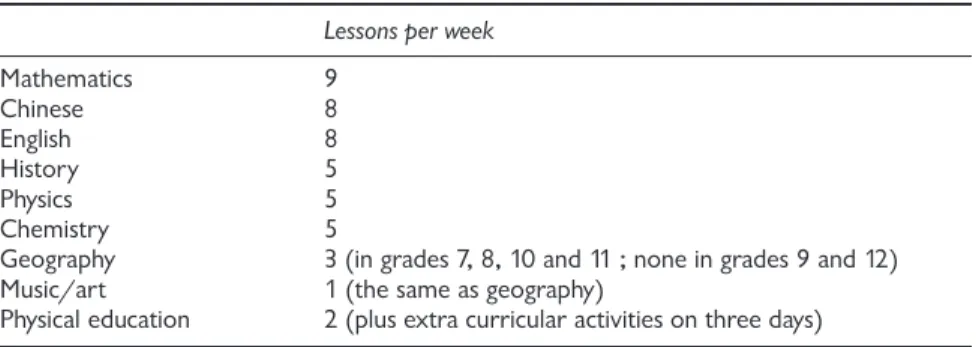
Likewise, there are schools where physical education, supported by the principal, contributes to the total education of the students. 1 Mass exercise for the whole school, either at the beginning of the school day or during morning break. Physical education on campus consists of the PE department (with 200 bachelor students, eight master's students and four PhD students in 1997), and the Sports Department, which handles the in-service education of the students in all the departments of the university.
In comparison, the sports department, which offers the basic two hours a week sports program for students in the other departments at the university, has 41 employees. Fu, 'A Comparison of the National and Provincial Institutes of Physical Culture in the People's Republic of China', in Wilcox, R.C. 16 The sporting needs of the elderly and disabled should be met by local authorities.
17 PE should be included in the school curriculum for the moral, intellectual and physical development of the students. 33 Conflicts and disagreements in sports competitions will be resolved by a division of sports judges, under the regulations and control of the Sports Commission.

Elite sport
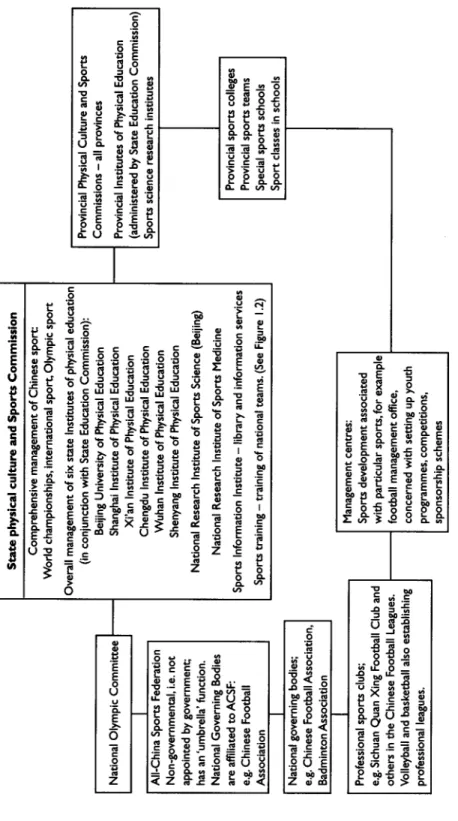
In 1984, Zhu Jianhua became the first Chinese athlete to win a medal at the Olympics. If the results of the Chinese team at the 1988 Olympics were relatively disappointing - five gold, eleven silver and twelve bronze medals - the results at the 1992 Barcelona Olympics reflected the continued progress of the sport at the elite level. The Tiyuguan Lu Sports School (Sports Hall Road) is a leisure time activity at the National Training Center, where the author worked with the national athletics team every day.
Leisure sports school students also compete in the national high school championships, which take place every four years. In the mid-1980s; this was the only sports school that selected its students from all over the country. In the closed hall, about 200 young athletes worked under the guidance of twenty athletic trainers.
In October 1986, the author visited the Henan Provincial Team Training Center in the provincial capital Zhengzhou. New water polo and diving pools - the latter built as a result of successes at the Barcelona Olympic Games - were under construction. Three members of the provincial women's team were currently competing in the World Weightlifting Championships held at the institute; the three athletes won a total of six gold medals.
In the 1984 Olympics, athletes from the NTC won four of the fifteen gold medals won by Chinese athletes. As a result, most of the athletes within the system are based in cities, especially those in the east.
Professional training
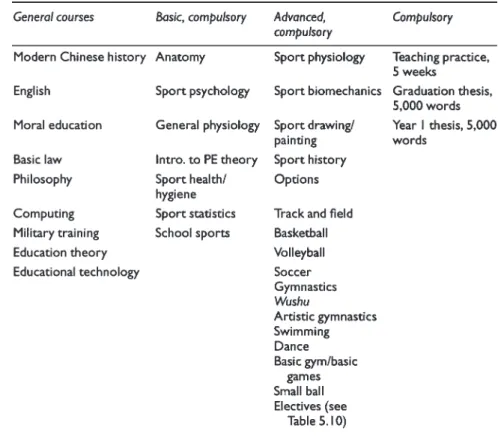
The sports department at the Nanjing Institute of Physical Education also delivers the full-time diploma course. Physical education institutions and universities that administer certificate education follow a common syllabus established by the CED. The organization of advanced level courses is delegated by the CED to a physical education institute specializing in sports.
The Ministry of Science and Education of the All-China Sports Federation is responsible for the training of physical education teachers. The institute takes care of the development of physical education teachers, coaches, sports managers and sports scientists. The institute also has a residential sports school and serves as a training site for Jiangsu Province team members, the only physical education institute to have this role.
As previously mentioned, WIPE is now one of the country's six major institutes of physical education, which operates under the jurisdiction of the All-China Sports Federation. The author visited the Department of Physical Education at Beijing Normal University (BNU) in April 1985. Possible fields of study include biomechanics, exercise physiology, history, theory of physical education, and athletics.
I was accompanied during my visit to the BNU by Mr Tian Jizong, Head of the Physical Education Department. Short-term in-service training courses are now organized by the Department of Sports Science and Physical Education of the All-China Sports Federation.
Chinese women and sport
The achievement was achieved almost entirely due to the success of Chinese women, which in China is called the flourishing of yin (feminine) and the withering of yang (masculine). A review of Chinese women's contribution to China's Olympic record between 1988 and 1992 confirms the achievements of Chinese women; this is a unique occurrence in Olympic history (see Table 8.1). An illustration of the comparative contribution of Chinese women to China's overall performance at the 1988 and 1992 Summer Olympics is given in Table 8.4.
As the following list indicates, the spectrum of Chinese women's success spans twenty-one sports. The Chinese women's team first won the World Cup in 1981 and retained it five times in a row, creating what many Chinese describe as the. Lou Dapeng, vice president of the Chinese Track and Field Federation, is reported to have said that 'it was our policy to concentrate on women's sports' (Macleod 1993:43).
In addition, other factors, such as tradition and religion, tend to militate against the promotion of women's sports. Wrestling by both men and women was a popular court entertainment, and the top women wrestlers became quite famous. This traditional involvement of women in combat sports helped to maintain women's active role in light of the introduction of Western sports with.
Female athletes also participated in the second martial arts festival in 1932, and at the seven national games in 1948, women's wrestling was an exhibition event. The same is true of Chinese women's bodybuilding participation: the first Chinese men's and women's bodybuilding championships were held in December 1994.