STABILITY OF SHARIAH-COMPLIANT STOCKS IN INDONESIA, MALAYSIA, AND GCC: THE ROLES OF MONETARY AND FISCAL POLICIES AND CONTAGION
Ooi Kok Loang
SEGi University, Malaysia, [email protected]
ABSTRACT
This study examines the roles of monetary and fiscal policies and contagion in the market stability of Indonesia, Malaysia, and the Gulf Cooperation Council countries during the pandemic and post-pandemic periods from 2020 to 2023. We find that fiscal policy measures, such as reserve requirements and the government expenditure-to- GDP ratio significantly increase the market volatility during the pandemic. As for monetary policy tools, while they had limited effectiveness during the pandemic, they regained significance in stabilizing the markets post-pandemic. We also find that the patterns of market contagion patterns tend to vary across countries, with Qatar and Bahrain showing changing levels of contagion while Saudi Arabia, UAE, Kuwait, and Oman consistently displaying moderate to high contagion, the results that are in line with the adage, “when the U.S. sneezes, the global economy has a cold”. The study’s implications for managers and policymakers in Muslim-majority countries include robust risk management and contingency planning due to higher market contagion in economically integrated economies. Additionally, the limited impact of conventional monetary policies during the pandemic highlights the need to explore alternative approaches to enhance market stability during economic downturns.
Keywords: Market stability, Market contagion, Monetary policy, Fiscal policy, Wavelet analysis.
JEL classification: G01; G15; E44; C33.
Article history:
Received : October 31, 2023 Revised : December 5, 2023 Accepted : February 29, 2024 Available online : March 28, 2024 https://doi.org/10.21098/jimf.v10i1.1899
I. INTRODUCTION
Islamic financial markets have emerged as significant players, commanding global attention owing to their distinctive principles and expanding influence within the international financial system. Countries such as Indonesia, Malaysia, and the Gulf Cooperation Council (GCC) have witnessed remarkable growth in Islamic stock markets. While various factors shape the performance of these markets, including monetary and fiscal policies, limited research has examined the specific impact of such policies on Islamic stocks, particularly against the backdrop of the COVID-19 pandemic (Haddad et al. 2020). As governments worldwide implement extraordinary monetary and fiscal measures to alleviate the pandemic’s economic consequences, a pressing need arises to scrutinise how these policies have influenced market stability within the Islamic stock markets of Indonesia, Malaysia, and GCC countries.
The COVID-19 pandemic has had profound implications for global economies, culminating in a tumultuous environment characterised by market upheaval, inflationary pressures, and economic sluggishness (Loang and Ahmad, 2023).
In response, Malaysia introduced measures, such as interest rate reductions orchestrated by Bank Negara Malaysia, alongside fiscal stimulus packages, such as PRIHATIN and PENJANA. Similarly, Indonesia responded with interest rate cuts facilitated by Bank Indonesia and fiscal stimulus programmes targeting social assistance and infrastructure development. In GCC countries, central banks implemented monetary easing measures, while governments unveiled fiscal stimulus packages to support sectors reeling from the pandemic’s impact (Shamsudheen et al., 2022). Although these policies aimed to stabilise economies and mitigate the adverse effects of the pandemic, knowledge gaps remain concerning their precise impact on addressing market chaos, particularly within the Islamic stock markets of these countries.
The COVID-19 pandemic has presented formidable challenges and complexities for global financial markets, with the Islamic stock markets in Indonesia, Malaysia, and GCC countries encountering distinctive hurdles necessitating tailored approaches. These markets, rooted in Islamic principles and governed by Shariah law, demand careful navigation to effectively address the pandemic’s implications. The unprecedented market volatility, precipitous declines in stock prices, and economic downturns experienced during the pandemic underscored the need to investigate the efficacy of monetary and fiscal policies in mitigating these challenges (Aliani et al., 2022). A primary research challenge lies in the scarcity of specific studies examining the impact of such policies on Islamic stock markets both during and after the pandemic. While an extensive body of literature explores the general effects of monetary and fiscal policies on market stability, there is a dearth of understanding regarding their nuanced implications within Islamic stock markets.
Moreover, adherence to Islamic principles presents additional complexities and challenges. Islamic finance prohibits interest-based transactions (riba) and investments in prohibited industries (haram). Consequently, formulating and implementing monetary and fiscal policies that adhere to these principles while effectively addressing the unique challenges posed by the pandemic requires meticulous consideration and evaluation. Furthermore, the unprecedented nature
of the pandemic and its far-reaching economic impact compound the complexities surrounding the effectiveness of monetary and fiscal policies (Alqahtani & Mayes, 2018). Policymakers face the daunting task of discerning the most appropriate policy measures to combat high inflation and invigorate economic activities in Islamic stock markets (Trabelsi, 2019). The uncertainties surrounding the efficacy of these policies in stabilising markets and facilitating post-pandemic recovery underscore the urgent need for empirical studies to provide invaluable insights into their impact and effectiveness.
The United States, as the epicentre of the pandemic’s economic impact, implemented a series of monetary and fiscal policies to mitigate the adverse effects on its financial markets and economy (Mezghani and Boujelbène, 2018). These policies have far-reaching implications and potential spillovers to other markets, including the Islamic stock markets in Indonesia, Malaysia, and GCC countries.
Nevertheless, the spillover effects of these policies on other markets, including the Islamic stock markets of Indonesia, Malaysia, and GCC countries, have not been extensively explored in existing studies. Consequently, there is a critical need to examine market contagion dynamics and assess the transmission of shocks from the World’s largest financial market to Muslim-majority countries.
Therefore, this study examines the impact of monetary and fiscal policies on Islamic stock market stability in Indonesia, Malaysia, and the GCC countries during and after the pandemic as well as the market contagion from the US to these markets. These countries are ranked as top Islamic countries in the Global Islamic Economy Indicator Score 2022, reflecting their strong presence in the global Islamic economy. Our analysis sheds light on how policy measures influence market stability as well as provides insights into the spillover effects from developed economies to Muslim-majority countries. The results of this study will not only enrich academic knowledge but also offer practical guidance to policymakers, investors, and market participants, assisting them in navigating the complexities posed by the pandemic and fostering sustainable growth within Islamic stock markets.
II. LITERATURE REVIEW 2.1. Fiscal and Monetary Policies
Fiscal policies refer to the use of government spending, taxation, and borrowing to influence economic objectives of a country. Decisions related to public expenditure on infrastructure, social programs, and public services, as well as taxation policies aimed at raising revenue, fall under the purview of fiscal authorities (Mezghani and Boujelbène, 2018). Extensive studies (e.g. Aloui et al., 2018; Yousaf et al., 2022) have examined the impact of fiscal policies on economic growth, unemployment, and income distribution. Scholars (e.g. Elsayed et al., 2023; Mohammed et al., 2020) have explored the role of fiscal policy in stimulating aggregate demand during economic expansions and providing countercyclical measures to mitigate economic downturns, such as during recessions.
By contrast, monetary policy is controlled by central banks and revolves around influencing money supply, interest rates, and credit conditions to achieve the desired macroeconomic objectives. Central banks employ various tools such
as open market operations, reserve requirements, and discount rates to implement monetary policy. The extensive literature on monetary policy has closely analysed its effectiveness in controlling inflation and stabilising the economy. Scholars (e.g.
Hassan et al., 2022; Saleem et al., 2021) have examined the impact of changes in interest rates and money supply on consumer spending, investment decisions, and economic activity. Moreover, previous studies (for example, Hengchao et al., 2021;
Delle Foglie & Panetta, 2020) have explored the interactions between monetary policy and financial markets, scrutinising how alterations in monetary conditions affect asset prices, capital flows, and financial stability.
In developed countries, such as the United States, fiscal policies often involve a mix of government spending on infrastructure, social programs, and public services alongside taxation policies to raise revenue. During economic downturns, these countries implement expansionary fiscal measures, such as stimulus packages and tax cuts, to stimulate aggregate demand and promote economic recovery.
Furthermore, their well-established financial systems and institutional capacity allow for the swift implementation and transmission of monetary policies. Central banks, such as the Federal Reserve, utilise interest rate adjustments and open market operations to control inflation and stabilise the economy.
In contrast, Muslim-majority countries, such as Indonesia, Malaysia, and the GCC nations, face distinct challenges due to adherence to Islamic principles and Shariah law. Ben Rejeb and Arfaoui (2019) argue that fiscal policies in these countries must conform to Islamic finance principles, prohibiting interest- based transactions (riba) and investments in prohibited industries (haram). This constraint requires policymakers to explore alternative policy instruments such as Islamic bonds (sukuk) and revenue-sharing arrangements to support infrastructure development and social programs. Moreover, Alqahtani and Mayes (2018) show that the impact of monetary and fiscal policy coordination on market stability in Muslim-majority countries can vary significantly. External shocks originating from developed countries’ financial markets, especially during global crises such as the COVID-19 pandemic, may have more pronounced effects on smaller and less diversified economies (Shamsudheen et al., 2022), and the volatility in their Islamic stock markets may be heightened.
The relationship and coordination between fiscal and monetary policies have been subjects of significant debate in the literature. Some scholars (e.g. Elsayed et al., 2023) advocate for coordinated policies, arguing that the joint action of fiscal and monetary authorities can lead to more effective and efficient outcomes in achieving macroeconomic objectives. This approach allows policymakers to use a combination of tools to address economic challenges and foster economic stability.
Nevertheless, other scholars (e.g. Donnelly, 2020) emphasise the importance of maintaining the independence of fiscal and monetary authorities to avoid potential conflicts and preserve long-term economic stability. This perspective contends that a clear delineation of roles is essential to ensuring the effectiveness of each policy tool.
The global financial crisis and the COVID-19 pandemic have provided unique opportunities to investigate the effectiveness of fiscal and monetary policies in addressing economic crises. Research gaps in the field of fiscal and monetary policies include the need for deeper investigations into the impact of
Islamic finance principles on fiscal strategies in Muslim-majority countries, the coordination and consequences of fiscal-monetary policy interactions in these nations, the heightened volatility in Islamic financial markets during global crises, and a comprehensive comparative analysis of policy responses between developed and Muslim-majority countries. Furthermore, understanding the long- term implications of unprecedented monetary and fiscal responses, assessing behavioural responses to monetary policy changes, and exploring the intricate relationship between fiscal policies and income distribution are critical areas for further enquiry. This study develops the following hypothesis:
Hypothesis 1: Monetary and fiscal policies significantly impact market stability in the Islamic stock markets of Indonesia, Malaysia, and the GCC countries during and after the COVID-19 pandemic.
Hypothesis 1(a): The impact of monetary and fiscal policies on market stability is stronger across Indonesia, Malaysia, and GCC countries during the post-COVID-19 pandemic.
2.2. Market Contagion and Financial Stability
Market contagion and financial stability are crucial concepts for understanding the interconnectedness and vulnerabilities of global financial markets. The literature (e.g. Hassan et al., 2020) on market contagion explores the transmission of shocks from one market to another and the potential spillover effects of these shocks.
Financial stability focuses on the health and resilience of the financial system, including the stability of financial institutions, markets, and the broader economy.
Studies on market contagion have examined the various channels through which shocks can spread across markets. These channels include trade and financial linkages and investor sentiment. Studies (e.g. Mezghani and Boujelbène, 2018) have found evidence of contagion during financial crises and periods of heightened market volatility, with the impact of shocks often magnified in interconnected markets. The COVID-19 pandemic and global financial crisis provide valuable opportunities to study contagion dynamics and understand how external shocks can disrupt markets and economies worldwide.
Studies have extensively explored how financial shocks originating in developed markets can be transmitted to emerging markets, including those with Islamic financial systems (Hassan et al., 2020). Strong trade and financial linkages between developed and emerging markets create channels for contagion of shocks, leading to heightened market volatility and disruptions. Studies (e.g. Bossman et al., 2022) have demonstrated that the transmission of shocks is particularly pronounced during global financial crises and economic downturns. Balli et al.
(2019) also argue that investors in Muslim-majority countries may seek refuge in Islamic financial products during contagion episodes, considering their alignment with Shariah principles. Nonetheless, Islamic financial markets’ smaller size and less developed nature may pose challenges to effectively managing contagion risks.
Financial stability is a crucial concern for policymakers and central banks, particularly during economic uncertainty. The literature (e.g. Khan et al., 2020;
Alqahtani and Mayes, 2018) on financial stability has emphasised the importance of robust regulatory frameworks and effective risk management practices to
safeguard the financial system from potential shocks. D’Orazio and Popoyan (2022) explore the role of central banks in promoting financial stability through prudential regulations, stress testing, and macroprudential policies. Moreover, research has delved into the impact of financial stability on economic growth, highlighting the critical link between a stable financial system and economic well- being (Chen et al., 2021).
Market contagion and financial stability are interconnected. During periods of market contagion, financial stability may be jeopardised as shock transmission amplifies risks and vulnerabilities in the financial system (Khalfaoui et al., 2023).
Conversely, a stable financial system can act as a buffer against contagion, mitigating the adverse effects of external shocks on markets and broader economies (Li et al.
2021). Understanding these interlinkages is vital for policymakers to formulate effective measures to enhance financial resilience and mitigate the impact of market contagion on financial stability.
Moreover, the literature explores the implications of market contagion and financial stability for different market participants, including investors, financial institutions, and policymakers. Research gaps in the context of market contagion and financial stability include the need for a more extensive analysis of the unique challenges faced by Islamic financial markets in managing contagion risks and safeguarding financial stability, especially considering their small size and distinctive principles. Hence, this study proposes the following hypothesis:
Hypothesis 2: There is significant market contagion from the United States to Islamic stock markets in Indonesia, Malaysia, and the GCC countries during and post-COVID-19 pandemic.
III. METHODOLOGY 3.1 Sampling and Data
The sample selection process involves identifying Shariah-compliant stocks listed on the stock exchanges of Indonesia (total: 541), Malaysia (total: 638), and GCC countries (Saudi Arabia: 137, United Arab Emirates (Abu Dhabi Securities Exchange): 126, Qatar: 47, Kuwait: 165, Oman: 107, Bahrain: 42). This study relies on the Shariah compliance criteria set by reputable Shariah advisory boards or authorities in each country to ensure consistency. These criteria typically exclude companies engaged in non-compliant activities such as conventional banking and financial services, alcohol, gambling, and other prohibited industries.
Indonesia, Malaysia, and the Gulf Cooperation Council countries are deliberately chosen for this study because of their prominence in the Global Islamic Economy. These countries, notable for their well-established Islamic finance sectors and adherence to stringent Shariah compliance criteria, offer a distinctive setting for scrutinizing the impact of monetary and fiscal policies on Shariah-compliant stocks. Moreover, despite their Islamic financial foundations, these regions concurrently employ certain conventional monetary instruments. Furthermore, their classification as emerging markets facilitates rigorous comparative analysis, enabling a deeper understanding of the varying policy responses and market dynamics across diverse economic contexts.
The pandemic period, from January 2020 to December 2021, covers the peak impact of the COVID-19 pandemic on global financial markets (Santoso
& Setyowati, 2023). The post-pandemic period, from January 2022 to June 2023, reflects the recovery and stabilisation phase as countries adapt to the new normal and implement policies to foster economic growth. We gather monthly data with total number of 24 months of observations in the pandemic period and 18 months of observations in the post-pandemic period. To examine the contagion of the US market, the New York Stock Exchange (NYSE) index return is a proxy for the US Market Return. All data are obtained from the Bloomberg Terminal and the S&P Capital IQ Database.
The motivation for this specific timeframe is based on several factors. Firstly, the COVID-19 pandemic is an unprecedented global event that disrupted economies and financial markets worldwide. The rapid spread of the virus and associated lockdowns have led to significant economic challenges, making it a special case that warrants examination. Secondly, governments and central banks implemented various monetary and fiscal measures in response to the pandemic.
Understanding the effectiveness of these policies during such a unique crisis can provide valuable insights into their real-world impact. Thirdly, financial markets experienced extreme volatility and uncertainty during the early stages of the pandemic. This presents an opportunity to study how policy measures influence market stability during highly uncertain periods. Additionally, as countries transitioned from crisis management to recovery, there is a need to assess how policies contribute to stabilising financial markets and promoting economic growth during this phase.
3.2. Monetary, Fiscal and Market Stability
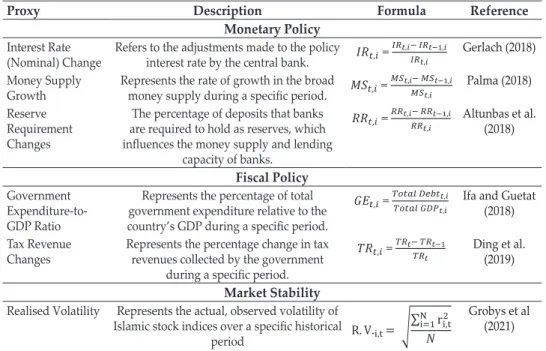
This study employs three measures to represent monetary policy. The first measure is the Nominal Interest Rate Change, which captures adjustments to the policy interest rate made by the central bank. The second measure is Money Supply Growth, which measures the growth rate of the broad money supply during a specific period. The third measure is Reserve Requirement Changes, representing the percentage change in reserve requirements set by the central bank. These proxies offer valuable insights into central banks’ efforts to manage inflation and stabilise the economy during and after the pandemic. Meanwhile, fiscal policy in this study is represented by two variables, namely, the percentage of total government expenditure relative to the country’s GDP and the percentage change in tax revenue collected by the government during a specific period. They provide essential insights into the government’s fiscal stance and the influence of tax policies on economic activities and market conditions.
Moreover, considering the profound impact of the COVID-19 pandemic, it is crucial to underscore the pandemic’s effect on these variables. The pandemic has led to unprecedented shifts in government expenditure patterns, with increased spending on healthcare, stimulus measures, and social support programs. Tax revenue changes have also significantly affected by economic disruptions and changes in tax policies aimed at mitigating the pandemic economic fallout.
Therefore, these fiscal proxies reflect the inherent dynamics of fiscal policies and extraordinary measures taken in response to the pandemic.
In the context of market stability, this study employs the realised volatility of Shariah-compliant stocks in Indonesia, Malaysia, and GCC countries as a proxy.
Realised volatility, a widely accepted measure of historical market volatility, captures the actual price fluctuations and variability of asset returns over a specific period. However, it is important to note that the COVID-19 pandemic has introduced substantial market turbulence, amplifying the importance of assessing how monetary and fiscal policies influence market stability during this period.
Table 1 summarizes the measurements of these variables, monetary policy, fiscal policy and market stability.
Table 1.
Proxies of Monetary, Fiscal Policies and Market Stability
Proxy Description Formula Reference
Monetary Policy Interest Rate
(Nominal) Change Refers to the adjustments made to the policy
interest rate by the central bank. Gerlach (2018) Money Supply
Growth Represents the rate of growth in the broad
money supply during a specific period. Palma (2018) Reserve
Requirement Changes
The percentage of deposits that banks are required to hold as reserves, which influences the money supply and lending
capacity of banks.
Altunbas et al.
(2018)
Fiscal Policy Government
Expenditure-to- GDP Ratio
Represents the percentage of total government expenditure relative to the country’s GDP during a specific period.
Ifa and Guetat (2018) Tax Revenue
Changes Represents the percentage change in tax revenues collected by the government
during a specific period.
Ding et al.
(2019) Market Stability
Realised Volatility Represents the actual, observed volatility of Islamic stock indices over a specific historical
period
Grobys et al (2021)
3.3. Panel Data Regression
This study employs panel data regression model to examine the impact of monetary and fiscal policies on Islamic market stability. Panel data regression allows data analysis across multiple periods and countries, capturing cross-sectional and time- series variations (Loang and Ahmad, 2023). As a widely used method in panel data, Pooled OLS provides efficient estimates by treating panel data as a single dataset, pooling information across countries and time periods. Panel data regression allows for data analysis across multiple periods and countries, capturing cross- sectional and time-series variations (Ascarya & Indra, 2022).
This study proposes control variables, including lagging (unemployment rates) and leading indicators (stock market performance). These variables capture past economic outcomes and future economic trends, thus enabling a comprehensive
analysis of the relationship between policy coordination and economic stability.
Therefore, the regressions are written as
where, MSi,t represents the market stability proxied by realised volatility, IRi,t represents the interest rate changes, MSi,t represents the money supply growth, RRi,t represents the reserve requirement, GEi,t represents the government expenditure- to-GDP ratio, TRi,t represents the tax revenue changes, URi,t represents the unemployment rate, and MRi,t represents the stock market returns.
3.4. US Market Contagion – Morlet Wavelet
Market contagion is the transmission of shocks from one financial market to another and is a crucial phenomenon to investigate in the context of the impact of the United States as the World’s largest economy on the Islamic stock markets in Indonesia, Malaysia, and the GCC countries during and after the COVID-19 pandemic. Whereas panel data regression typically focuses on capturing the average relationship between variables across different cross-sectional units and periods, wavelet analysis operates more granularly. It provides a time- frequency decomposition of data, enabling the detection of contagion effects at various scales and time intervals. This is particularly valuable for understanding contagion dynamics, as it allows us to pinpoint specific periods and frequency bands in which contagion is most pronounced, offering insights into the evolving nature of the phenomenon. Unlike panel data regression, which assumes constant relationships over time, wavelet analysis is well suited for examining the intricate and time-varying interactions between financial markets, making it a powerful tool for studying contagion in the context of the impact of the United States on Islamic stock markets during and after the COVID-19 pandemic. The Morlet Wavelet analysis assesses changes in the two markets regarding market contagion, with the contagion measured at the market level rather than at the individual stock level. Through its time-frequency decomposition, wavelet analysis provides a comprehensive representation of time-series data, enabling the identification of specific periods and frequency bands where contagion effects are most pronounced (Ftiti et al., 2015). This decomposition allows the detection of contagion at different scales and time intervals, which is essential for examining complex market interactions. Mathematically, the wavelets are defined as
(1)
where τ is the translation parameter; s is the dilation parameter; √ 1 s is a normalisation factor; and Ψτ,s (t) are elementary functions obtained by the decomposition of a time series through wavelet transformation and are derived (2)
from a time-localised mother wavelet ψ(t). The convolution of the continuous wavelet transformation (CWT) of a time x (t) series with respect to Ψ (t)is given by:
where* denotes the complex conjugate. To recover the original series x(t) from its wavelet transformation, the inverse wavelet transformation is represented as
(3)
Moreover, several interesting quantities could be captured within the wavelet domain. The measure of wavelet power spectrum that captures the relative contribution at each time and at each scale of the time series’ variance is defined as |Wx (τ,s)|2. The total variance of the series is obtained by integrating τ and s as follows:
(4)
Further, the measure of cross-wavelet spectrum that captures the covariance between two time series [say, x (t) and y (t)] in the time-frequency space [Wx (τ,s) and Wy (τ,s)] is given as:
(5)
The cross-wavelet spectrum is distinguished by its capacity to offer valuable insights into the co-movement of variables in terms of frequency and time. By examining the contour plot of the wavelet cross-spectrum, this study can identify specific time-frequency regions where the two series exhibit co-movement, along with the characteristics of their time and frequency variations of co-movement.
The data on the US market contagion are proxied by the NYSE market return during and after the pandemic.
(6)
IV. RESULTS AND DISCUSSION
4.1. Descriptive Statistic and Pearson Correlation Analysis Table 2.
Descriptive Statistics
Variable Mean Median Std.
Deviation Min Max
Pandemic Period
Interest Rate 0.050 0.049 0.010 0.030 0.070
Money Supply 0.041 0.047 0.023 0.004 0.165
Reserve
Requirement 0.150 0.152 0.015 0.120 0.180
Government
Expenditure-to-GDP 0.250 0.248 0.030 0.200 0.290
Tax Revenue 0.004 0.02 0.001 0.001 0.007
Market Stability 0.500 0.502 0.040 0.420 0.580
US Market Return 0.060 0.058 0.015 0.040 0.080
Post-Pandemic
Interest Rate 0.045 0.044 0.009 0.035 0.065
Money Supply 0.075 0.087 0.051 0.007 0.130
Reserve
Requirement 0.140 0.142 0.012 0.125 0.160
Government
Expenditure-to-GDP 0.280 0.275 0.025 0.250 0.310
Tax Revenue 0.131 0.134 0.042 0.001 0.053
Market Stability 0.520 0.518 0.035 0.480 0.560
US Market Return 0.055 0.053 0.012 0.045 0.075
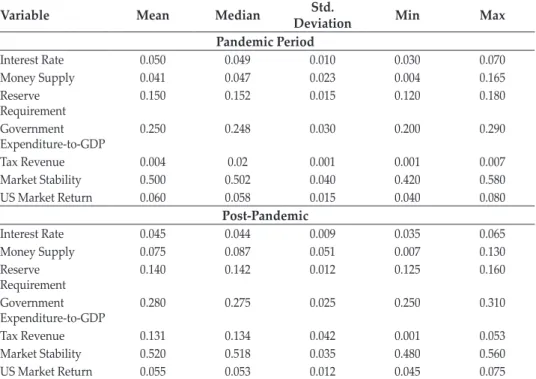
Table 2 presents descriptive statistics for key variables during the pandemic and post-pandemic periods. During the pandemic, interest rates remained stable, while money supply exhibited more fluctuations. Reserve requirements and government expenditure-to-GDP were consistent, but tax revenue had a narrow range. Market stability showed some turbulence, and US market returns mirrored volatility. In the post-pandemic period, interest rates slightly decreased, money supply rebounded, and reserve requirements remained stable. Government expenditure increased, and tax revenue exhibited a wider range. Market stability improved, and US market returns reflected ongoing economic dynamics.
Table 3 reveals key correlations during and after the pandemic. During the pandemic, interest rates negatively correlated with money supply (-0.350**) while market stability positively correlated with money supply (0.400***), and US market returns correlated moderately with market stability (0.482). Post-pandemic, similar patterns persisted with negative interest rate and money supply correlation (-0.320**), positive market stability and money supply correlation (0.410***), and moderate correlation between US market returns and market stability (0.490).
4.2. Monetary and Fiscal Policies on Market Stability
This study adopts panel data regressions to examine the impact of monetary and fiscal policies on market stability in Indonesia, Malaysia, and GCC countries. In this study, the selection the appropriate estimation method for panel data regression
Table 3.
Pearson Correlation Analysis Variables Interest Rate Money
Supply Reserve Requirement
Government Expenditure-
to-GDP
RevenueTax Market Stability
Market US Return Pandemic
Interest Rate 1.000 Money
Supply -0.350** 1.000 Reserve
Requirement 0.150 -0.120 1.000 Government
Expenditure-
to-GDP -0.200 0.250* -0.050 1.000
Tax Revenue 0.100 -0.300** 0.200 0.150 1.000**
Market
Stability -0.250 0.400*** 0.050 -0.100 -0.050 1.000 US Market
Return 0.183 0.381 0.024 0.004 0.005 0.482 1.000
Post-Pandemic Interest Rate 1.000
Money
Supply -0.320** 1.000 Reserve
Requirement 0.140 -0.130 1.000 Government
Expenditure-
to-GDP -0.210 0.260* -0.060 1.000
Tax Revenue 0.110 -0.310** 0.220 0.160 1.000**
Market
Stability -0.260 0.410*** 0.060 -0.110 -0.060 1.000
US Market
Return 0.190 0.391 0.025 0.005 0.006 0.490 1.000
Note: ***. **, * represent the significant levels at 1%, 5%, and 10%.
follows the approach proposed by Ascarya and Indra (2022). The Hausman test suggests the selection of the Fixed Effects (FE) model for GCC countries due to correlated unobserved individual-specific effects. For Indonesia and Malaysia, the Hausman test indicates that the Random Effects (RE) model is more appropriate as it shows no correlation between unobserved effects and independent variables.
Subsequently, to confirm these model choices, the Chow test for GCC countries and the LM test for Indonesia and Malaysia are conducted. The Chow test results for GCC countries indicate a structural break, further supporting the preference for the FE model. Similarly, the LM test results for Indonesia and Malaysia confirm the suitability of the RE model.
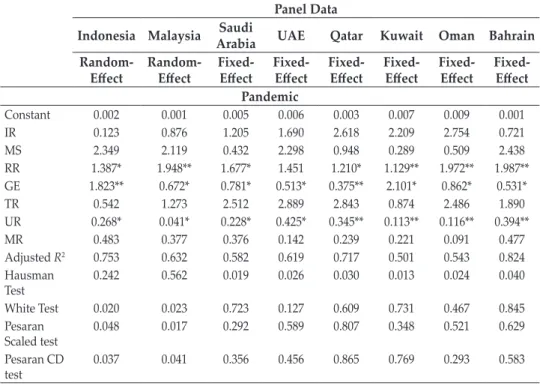
Table 4 presents the impact of monetary and fiscal policies on market stability, as proxied by realized volatility, during and post-pandemic. Amidst the pandemic, both the reserve requirement and Government Expenditure-to-GDP ratio exhibit statistically significant positive correlations with market stability across various significance levels (1%, 5%, and 10%). This suggests that heightened government expenditure has coincided with increased market volatility. Notably, the significant and positive correlation with the Reserve Requirement underscores the crucial role of regulating deposit reserves, thereby shaping market liquidity and bolstering investor confidence.
Table 4.
Monetary and Fiscal Policies on Market Stability Panel Data
Indonesia Malaysia Saudi Arabia UAE Qatar Kuwait Oman Bahrain Random-
Effect Random-
Effect Fixed-
Effect Fixed-
Effect Fixed-
Effect Fixed-
Effect Fixed-
Effect Fixed- Effect Pandemic
Constant 0.002 0.001 0.005 0.006 0.003 0.007 0.009 0.001
IR 0.123 0.876 1.205 1.690 2.618 2.209 2.754 0.721
MS 2.349 2.119 0.432 2.298 0.948 0.289 0.509 2.438
RR 1.387* 1.948** 1.677* 1.451 1.210* 1.129** 1.972** 1.987**
GE 1.823** 0.672* 0.781* 0.513* 0.375** 2.101* 0.862* 0.531*
TR 0.542 1.273 2.512 2.889 2.843 0.874 2.486 1.890
UR 0.268* 0.041* 0.228* 0.425* 0.345** 0.113** 0.116** 0.394**
MR 0.483 0.377 0.376 0.142 0.239 0.221 0.091 0.477
Adjusted R2 0.753 0.632 0.582 0.619 0.717 0.501 0.543 0.824
Hausman
Test 0.242 0.562 0.019 0.026 0.030 0.013 0.024 0.040
White Test 0.020 0.023 0.723 0.127 0.609 0.731 0.467 0.845
Pesaran
Scaled test 0.048 0.017 0.292 0.589 0.807 0.348 0.521 0.629
Pesaran CD
test 0.037 0.041 0.356 0.456 0.865 0.769 0.293 0.583
Panel Data
Indonesia Malaysia Saudi Arabia UAE Qatar Kuwait Oman Bahrain Random-
Effect Random-
Effect Fixed-
Effect Fixed-
Effect Fixed-
Effect Fixed-
Effect Fixed-
Effect Fixed- Effect Post-Pandemic
Constant 0.007 0.004** 0.005 0.006 0.013 0.014 0.007 0.012
IR 4.257** 2.451* 4.745* 2.749** 2.178* 1.287* 0.174* 3.751*
MS 2.623*** 0.848** 1.965* 0.267* 3.241** 1.653** 1.238** 0.791**
RR 3.912*** 1.135* 4.195* 3.617** 1.445** 0.874* 2.897** 4.821*
GE 1.509** 3.152* 2.396* 0.941** 3.604** 0.468** 4.501 0.383
TR 3.879 0.395 0.932 1.780 2.866 0.113 0.708 3.985
UR 0.534* 0.826** 0.421* 0.189* 0.924** 0.877* 0.465** 0.829*
MR 0.297 0.678 0.764 0.709 0.675 0.732 0.576 0.672
Adjusted R2 0.629 0.566 0.835 0.736 0.771 0.584 0.648 0.726
Hausman
Test 0.963 0.863 0.045 0.033 0.028 0.012 0.016 0.039
Chow Test - - 0.001 0.024 0.004 0.012 0.032 0.005
LM Test 0.037 0.041 - - - - - -
White Test 0.002 0.005 0.773 0.725 0.825 0.681 0.678 0.442
Pesaran
Scaled test 0.046 0.029 0.827 0.859 0.442 0.893 0.371 0.236
Pesaran CD
test 0.035 0.001 0.215 0.636 0.152 0.929 0.594 0.533
Note: ***. **, * represents the significant level at 1%, 5% and 10%. I.R. represents Interest Rate, MS represents money supply, R.R. represents reserve requirement, G.E. represents government expenditure, T.R. represents tax revenue, U.R. represents unemployment rate, and M.R. represents stock market returns.
Table 4.
Monetary and Fiscal Policies on Market Stability (Continued)
During the pandemic, the efficacy of conventional monetary policy tools, including interest rates and money supply, in influencing market stability is limited.
The insignificant impact of these variables suggests that the unprecedented nature of the crisis and its profound disruptions to financial markets may have rendered traditional monetary policy measures less effective during the pandemic. This raises critical questions regarding the suitability and effectiveness of conventional tools in addressing severe economic stress and market turmoil.
Similarly, the findings indicate that tax revenue, a crucial fiscal policy component, does not significantly influence market stability during the pandemic, at various significance levels (1%, 5%, and 10%). This empirical evidence suggests that the initial response to the crisis revolves primarily around expenditure measures, such as stimulus packages and safety nets, rather than revenue-oriented policies. This raises pertinent enquiries into the role of fiscal policy during crises and the optimal balance between revenue and expenditure.
As the post-pandemic period unfolded, monetary and fiscal policies exert a notable impact on market stability. During this period, the influences of interest rates and money supply on market stability turn statistically significant across the studied countries at various significance levels (1%, 5%, and 10%). This resurgence
in significance suggests that, as economies start recovering and financial conditions stabilised, traditional monetary policy instruments regain their effectiveness in shaping market stability. The positive relationship between the interest rate and market stability indicates that the market is more volatile after increasing the interest rate. This is because investors have more alternative investments than investing in stocks that generate stable and higher income, such as bonds.
Conversely, tax revenue continues to exhibit an insignificant impact on market stability after the pandemic at different significance levels (1%, 5%, and 10%).
Potential reasons for this lack of significance may include the time lag in the effects of tax measures implemented during the pandemic, such as tax cuts or deferrals, or the prevailing influence of other factors, such as the pace of economic recovery and the global economic environment. This highlights the need for further study of other factors that disrupt post-pandemic economic recovery, such as market contagion (Liu et al., 2022).
In sum, this study reveals significant relations between market stability and certain fiscal policy measures, specifically the reserve requirement and government expenditure-to-GDP ratio during the period. This suggests that fiscal policy interventions and regulatory measures played a crucial role in disrupting the stability of financial markets during times of severe economic distress. In the post-pandemic period, the significance of interest rates and money supply as monetary policy instruments increases across the countries studied. This resurgence in significance suggests that, as economies recover and financial conditions stabilised, traditional monetary policy tools regain their effectiveness in shaping market stability. These findings are consistent with those reported by D’Orazio and Popoyan (2022). This indicates that during the post-pandemic period, the impact of monetary policy on market stability strengthened.
4.3. Market Contagion using Wavelet Analysis
This study adopts the Morlet wavelet (continuous wavelet transformation) to examine the market contagion from the U.S. to Indonesia, Malaysia, and GCC countries. The Morlet wavelet is a continuous wavelet transform that offers time- frequency analysis, enabling this study to examine the phase interactions and co- movements between two time series in a localised and dynamic manner.
This study applies the wavelet-based measure of cohesion proposed by Rua and Lopes (2015). The empirical results of the market contagion between the United States and the Muslim-majority countries are illustrated in Figure. 1, highlighting the co-movement dynamics between the U.S. and major stock market players in the Muslim-majority countries, namely Indonesia, Malaysia, and GCC countries.
The empirical findings from the market contagion analysis present intriguing insights into the co-movement dynamics between the United States and the Islamic stock markets of Indonesia, Malaysia, and GCC countries. In Indonesia, the initial low level of market contagion during the pandemic period suggests that the Islamic stock market in Indonesia exhibits relative resilience to external shocks emanating from the United States. Nevertheless, the subsequent increase in market contagion in the post-pandemic era raises concerns about the potential vulnerability of Indonesia’s Islamic stock market to external spillovers as the global economy is gradually recovering.
Conversely, Malaysia’s Islamic stocks display moderate market contagion during the pandemic, indicating a relatively higher sensitivity to external shocks from the United States than from Indonesia. Nevertheless, the gradual decline in market contagion post-pandemic indicates a potential strengthening of Malaysia’s market resilience and the reduced influence of U.S. shocks. This observation could be attributed to Malaysia’s policy responses and economic recovery strategies, which might have bolstered the market’s ability to absorb external shock.
Among the GCC countries, Saudi Arabia, the UAE, Kuwait, and Oman exhibit consistent trends of moderate to high power of market contagion during both the pandemic and post-pandemic periods. This persistent contagion highlights the interconnectedness between these countries and the United States, suggesting that their Islamic stock markets are more susceptible to U.S. market fluctuations. It could also reflect the importance of global factors and economic ties in shaping the financial linkages between GCC countries and the United States.
0.250.51240.250.51240.250.5124 0.250.51240.250.51240.250.5124
(a) US vs Indonesia (b) US vs Malaysia
(c) US vs Saudi Arabia (d) US vs UAE
(e) US vs Qatar (f) US vs Kuwait
1.0 0.9 0.8 0.7 0.6
1.00 1.00 1.00 0.99
1.0 0.8 0.6 0.4 0.2 0.0
1.0 0.8 0.6 0.4 0.2 0.0 1.00 0.99 0.98 0.97 0.96 0.95 1.00 0.98 0.96 0.94 0.92
2021 2022 2023
2021 2022 2023 2021 2022 2023
2021 2022 2023 2021 2022 2023
2021 2022 2023
Figure 1.
Morlet Wavelet Analysis of Market Contagion
Journal of Islamic Monetary Economics and Finance, Vol. 10, Number 1, 2024 171
Qatar’s unique behaviour, with lower market contagion in the post-pandemic period than in the pandemic phase, could be attributed to various factors, including policy responses, changes in investor sentiment, and economic development in the region (Gunay and Can, 2022). The observed decrease in contagion might signify a shift in Qatar’s market dynamics and its ability to withstand external shocks during the post-pandemic recovery.
Similarly, Bahrain’s high power of market contagion during the pandemic, followed by a decrease in the post-pandemic period, suggests that the initial phase of the crisis has a more pronounced impact on Bahrain’s Islamic stock market.
This may be due to heightened uncertainty and investor reactions during the peak of the pandemic (Nguyen et al., 2022). Nonetheless, a subsequent reduction in contagion could indicate successful policy interventions or a more stable economic environment during the recovery phase.
In line with the well-known adage, “when the U.S. sneezes, the global economy has a cold,” the empirical evidence highlights the significance of U.S.
market dynamics and underscores the need for vigilance among policymakers
0.250.51240.250.51240.250.5124 0.250.51240.250.51240.250.5124
(c) US vs Saudi Arabia (d) US vs UAE
(e) US vs Qatar (f) US vs Kuwait
1.0 0.9 0.8 0.7 0.6
1.00 1.00 1.00 0.99
1.0 0.8 0.6 0.4 0.2 0.0
1.0 0.8 0.6 0.4 0.2 0.0 1.00 0.99 0.98 0.97 0.96 0.95 1.00 0.98 0.96 0.94 0.92
2021 2022 2023
2021 2022 2023 2021 2022 2023
2021 2022 2023 2021 2022 2023
2021 2022 2023
Note: The cohesion of Indonesia, Malaysia, and GCC stock markets and the U.S during the period 2020– 2023. A dark red colour (high power) signifies a perfect positive correlation, whereas a dark blue colour (low power) indicates a perfect negative correlation.
Figure 1.
Morlet Wavelet Analysis of Market Contagion (Continued)
0.250.5124 0.250.5124
(b) US vs Omar (b) US vs Bahrain
1.00 0.95 0.90 0.85
0.60 0.75 0.80
1.00 0.98 0.96 0.94 0.92
2021 2022 2023 2021 2022 2023
and market participants in Indonesia, Malaysia, and the GCC countries as the market contagion is mostly in high power for most Muslim-majority countries. The study’s results strongly support Hypothesis 2, which posits that there is indeed significant market contagion from the United States to the Islamic stock markets in Indonesia, Malaysia, and GCC countries during and after the pandemic. This is evidenced by the Morlet wavelet analysis, which demonstrates clear co-movement dynamics between these markets and the U.S., particularly in response to external shocks from the U.S.
V. CONCLUSION
This study investigates the impact of monetary and fiscal policies on market stability in Indonesia, Malaysia, and the GCC countries as well as market spill- overs from the US to these markets during and after the COVID-19 pandemic.
This study adopts a panel data regression approach to examine the relationship between monetary and fiscal policy variables and market stability during the pandemic period (January 2020 to December 2021) and the post-pandemic period (January 2022 to June 2023) and employs the Morlet wavelet, a continuous wavelet transformation, to analyse the phase interactions and co-movements between the return series of stock indexes in a localised and dynamic manner.
The findings of this study provide valuable insights into the role of monetary and fiscal policies in increasing market volatility during and after the COVID-19 pandemic in Indonesia, Malaysia, and the GCC countries. During the pandemic, this study reveals that the reserve requirement and Government Expenditure-to- GDP ratio are significantly correlated with realized volatility, indicating the fiscal policy measures and regulatory reserves disrupt the stability of financial markets amid economic distress. By contrast, conventional monetary policy tools, such as interest rates and money supply, exhibit limited significance during this period, suggesting their reduced effectiveness in influencing market stability in the face of unprecedented market disruptions caused by the pandemic.
In the post-pandemic period, the study finds that the influence of interest rates and money supply on market volatility regain statistical significance across the studied countries, implying the resurgence of traditional monetary policy effectiveness as economies recovered and financial conditions normalised.
This result is consistent with that reported by Bossman et al. (2022). However, the varying significance levels among countries underscore the importance of considering country-specific factors and economic conditions when formulating post-pandemic monetary policy strategies.
Regarding market contagion, this study reveals diverse patterns among countries. While Indonesia exhibits low contagion at the beginning of the pandemic, it experiences a gradual increase in the post-pandemic market contagion. Conversely, Malaysia show moderate contagion during the pandemic and it decreases in the post-pandemic period. Among the GCC countries, Saudi Arabia, the UAE, Kuwait, and Oman consistently display moderate to high market contagion throughout both periods, highlighting their susceptibility to U.S. market fluctuations. Qatar’s contagion is low in the post-pandemic period but high during the pandemic, indicating a shift in market dynamics. On the other hand, Bahrain
exhibits high contagion only during the pandemic, which diminishes to a low- to-moderate level in the post-pandemic phase. The varying patterns of market contagion can be attributed to countries’ levels of economic integration into the global financial system. This result is consistent with Hassan et al. (2020), who argue that the performance of developed countries has a significant spillover effect on emerging markets.
5.1. Theoretical, Managerial and Policy Implications
The study’s findings on market contagion in Muslim-majority countries during and post-pandemic have important theoretical implications. These results challenge the efficient market hypothesis (EMH) assumption, which posits that asset prices always fully reflect all available information. The varying degrees of market contagion suggest that market participants in these countries may not always process and react efficiently and rationally to information, leading to differential responses to external shocks.
For managers and policymakers in Muslim-majority countries, identifying higher contagion in more economically integrated economies underscores the need for prudent risk management and contingency planning to mitigate potential adverse impacts of external market shocks. Policymakers should carefully consider country-specific factors and policy responses to foster greater market stability during times of crisis. Additionally, the relatively limited impact of conventional monetary policy tools during the pandemic highlights the importance of exploring alternative and innovative monetary measures to enhance market stability during economic downturns. Policymakers must develop context-specific policy approaches considering each country’s unique economic conditions and financial linkages with the global market.
5.2. Limitations and Recommendations
This study has several limitations. Firstly, the sample size of Shariah-compliant stocks in certain markets, especially in some GCC countries, is relatively small, which may limit the representativeness and generalisability of the findings.
Furthermore, this study focuses on a specific period during and after the pandemic, potentially not capturing the complete spectrum of the long-term impacts of monetary and fiscal policies on market stability. The available data for the pandemic period is relatively short, covering only 1.5 years (2022 to June 2023). The reporting frequencies of most financial instruments necessitate the choice of monthly data collection. Future research should address the limitations of this study and extend the analysis to include a more comprehensive sample of Sharia-compliant stocks in all markets. A comparative analysis of different sectors should also be conducted, as the impact of the pandemic is different for each sector. Furthermore, future studies can examine the impact of the U.S on Muslim- majority countries before, during and after the pandemic to enhance the empirical evidence.
REFERENCES
Aliani, K., Al-kayed, L., & Boujlil, R. (2022). COVID-19 effect on Islamic vs.
conventional banks’ stock prices: Case of GCC countries. The Journal of Economic Asymmetries, 26(1), e00263.
Aloui, C., Jammazi, R., & Hamida, H. B. (2018). Multivariate co-movement between Islamic stock and bond markets among the GCC: A wavelet-based view. Computational Economics, 52(1), 603-626.
Alqahtani, F., & Mayes, D. G. (2018). Financial stability of Islamic banking and the global financial crisis: Evidence from the Gulf Cooperation Council. Economic Systems, 42(2), 346-360.
Altunbas, Y., Binici, M., & Gambacorta, L. (2018). Macroprudential policy and bank risk. Journal of International Money and Finance, 81(1), 203-220.
Ascarya, A. & Indra. (2022). Standard methodology for research in Islamic economics and finance. In Teaching and Research Methods for Islamic Economics and Finance (pp. 255-281). 2 Park Square, Milton Park, Abingdon, Oxon OX14 4RN: Routledge.
Balli, F., de Bruin, A., & Chowdhury, M. I. H. (2019). Spillovers and the determinants in Islamic equity markets. The North American Journal of Economics and Finance, 50(1), 101040.
Ben Rejeb, A., & Arfaoui, M. (2019). Do Islamic stock indexes outperform conventional stock indexes? A state space modeling approach. European Journal of Management and Business Economics, 28(3), 301-322.
Bossman, A., Junior, P. O., & Tiwari, A. K. (2022). Dynamic connectedness and spillovers between Islamic and conventional stock markets: time-and frequency-domain approach in COVID-19 era. Heliyon, 8(4), e09215.
Chen, Y., Kumara, E. K., & Sivakumar, V. (2021). Investigation of finance industry on risk awareness model and digital economic growth. Annals of Operations Research, 1, 326-338.
D’Orazio, P., & Popoyan, L. (2022). Realising central banks’ climate ambitions through financial stability mandates. Intereconomics, 57(2), 103-111.
Delle Foglie, A., & Panetta, I. C. (2020). Islamic stock market versus conventional:
Are Islamic investing a ‘safe haven’ for investors? A systematic literature review. Pacific-Basin Finance Journal, 64, 101435.
Ding, Y., McQuoid, A., & Karayalcin, C. (2019). Fiscal decentralisation, fiscal reform, and economic growth in china. China Economic Review, 53, 152-167.
Donnelly, S. (2020). Liberal economic nationalism, financial stability, and Commission leniency in Banking Union. In The Difficult Construction of European Banking Union (pp. 173-187). Routledge.
Elsayed, A. H., Naifar, N., & Nasreen, S. (2023). Financial stability and monetary policy reaction: Evidence from the GCC countries. The Quarterly Review of Economics and Finance, 87, 396-405.
Ftiti, Z., Tiwari, A., Belanès, A., & Guesmi, K. (2015). Tests of financial market contagion: Evolutionary cospectral analysis versus wavelet analysis. Computational Economics, 46(1), 575-611.
Gerlach, S. (2018). Interest rate setting by the ECB, 1999-2006: Words and deeds. Tenth issue (September 2007) of the International Journal of Central Banking.
Grobys, K., Junttila, J., Kolari, J. W., & Sapkota, N. (2021). On the stability of stablecoins. Journal of Empirical Finance, 64(1), 207-223.
Gunay, S., & Can, G. (2022). The source of financial contagion and spillovers:
An evaluation of the covid-19 pandemic and the global financial crisis. PloS one, 17(1), e0261835.
Haddad, H. B., Mezghani, I., & Al Dohaiman, M. (2020). Common shocks, common transmission mechanisms and time-varying connectedness among Dow Jones Islamic stock market indices and global risk factors. Economic Systems, 44(2), 100760.
Hassan, K., Hoque, A., Gasbarro, D., & Wong, W. K. (2020). Are Islamic stocks immune from financial crises? Evidence from contagion tests. International Review of Economics & Finance, 86(1), 919-948.
Hassan, M. K., Aliyu, S., Saiti, B., & Halim, Z. A. (2020). A review of Islamic stock market, growth and real-estate finance literature. International Journal of Emerging Markets, 16(7), 1259-1290.
Hassan, M. K., Djajadikerta, H. G., Choudhury, T., & Kamran, M. (2022). Safe havens in Islamic financial markets: COVID-19 versus GFC. Global Finance Journal, 54(1), 100643.
Hengchao, Z., Mohamad, A., & Hamid, Z. (2021). Are Islamic stock markets immune from contagion during the financial crisis?. Journal of Economic Cooperation & Development, 42(4), 53-78.
Ifa, A., & Guetat, I. (2018). Does public expenditure on education promote Tunisian and Moroccan GDP per capita? ARDL approach. The Journal of Finance and Data Science, 4(4), 234-246.
Khalfaoui, R., Mefteh-Wali, S., Dogan, B., & Ghosh, S. (2023). Extreme spillover effect of COVID-19 pandemic-related news and cryptocurrencies on green bond markets: A quantile connectedness analysis. International Review of Financial Analysis, 86(1), 102496.
Khan, M. I., Akhter, W., & Bhutta, U. (2020). Interest rate exposure and stocks returns during global financial crisis: Evidence from Islamic and conventional markets. Journal of Islamic Business and Management, 10(1), 131-147.
Li, Y., Zhuang, X., Wang, J., & Dong, Z. (2021). Analysis of the impact of COVID-19 pandemic on G20 stock markets. The North American Journal of Economics and Finance, 58, 101530.
Liu, Y., Wei, Y., Wang, Q., & Liu, Y. (2022). International stock market risk contagion during the COVID-19 pandemic. Finance Research Letters, 45, 102145.
Loang, O. K., & Ahmad, Z. (2023). Economic and political factors on herding in Islamic GCC stock markets during COVID-19 pandemic. International Journal of Islamic and Middle Eastern Finance and Management, 16(4), 819-834.
Loang, O. K., Ahmad, Z., & Naveenan, R. V. (2023). Non-performing loans, macroeconomic and bank-specific variables in Southeast Asia during COVID-19 pandemic. The Singapore Economic Review, 68(03), 941-961.
Mezghani, T., & Boujelbène, M. (2018). The contagion effect between the oil market, and the Islamic and conventional stock markets of the GCC country:
Behavioral explanation. International Journal of Islamic and Middle Eastern Finance and Management, 11(2), 157-181.