16
chapter sixteen
Strategic alliances and networks
The competitive realities of surviving and
prospering in the complex and rapidly changing business environment encourage teaming up with other companies. Co-operative strategic relationships among independent companies are escalating in importance.
David W. Cravens (1997)
Introduction
The environment in which businesses must go to market has changed radically in most sectors. We will consider the nature of this revolution and its profound implica- tions further in Chapter 19. For the moment we note that the new environment for business is increasingly characterised by:
l scarcer resources, literally, in the physical environment, and also in terms of the down-sized, leaner, strategically focused corporation;
l increased competition, frequently from new sources, new types of competitor and new technologies, at home and overseas;
l higher customer expectationsfor service and quality from more sophisticated and better informed customers, requiring high levels of expertise at the market level;
l pressures from strong distributors,like retailers in consumer goods marketing, to achieve ever-greater economies in supply-chain costs;
l high levels of customer concentration in many business-to-business markets, shifting power from seller to buyer;
l the onslaught of internationalisation of markets and competition, driven by such technological forces as the Internet;
l faster rates of change in markets and technologies, demanding higher levels and more rapid responsiveness in organisations; and
l more turbulent, unpredictable markets, where change is great in magnitude and very difficult to anticipate with any high degree of certainty.
Importantly, business environment changes of this kind, and the new business models they demand, have been associated with the evolution and growth of new organisational forms. Often these new types of organisational arrangements reverse the historical trends of aggregation and integration into large conventional struc- tures, in favour of disaggregation and devolution of functions:
Organizations of the future are likely to be vertically disaggregated: functions typically encompassed within a single organization will instead be performed in independent organizations. The functions of product design and development, manufacturing, and distribution . . . will be brought together and held in tempor- ary alignment by a variety of market mechanisms.
(Miles and Snow, 1984) The realignment of company resources with the demands of a new and more challenging business environment – characterising the 1990s and 2000s – has seen the widespread emergence of strategies of collaboration and partnership with other organisations as a key element of the process of going to market. While precise terminology does not exist, these new organisational forms and network arrange- ments have been variously termed marketing partnerships, strategic alliances and marketing networks (Cravens and Piercy, 2006).
In some interesting ways, the trend towards interorganisational collaboration in the route to market provides the other face of relationship marketing. While the priority of managing better the relationship with the customer remains, for a grow- ing number of companies this is accompanied by the need for efforts to be made in managing the relationship with the collaborator as well. These new collaborative and networked organisations are distinctive and different from conventional struc- tures. They are, for example:
characterized by flexibility, specialization, and an emphasis on relationship man- agement instead of market transactions . . . to respond quickly and flexibly to accelerating change in technology, competition and customer preferences.
(Webster, 1992)
It is important to recognise that in many industries the emergence of networks of collaborating organisations, linked by various forms of alliance, has become a dominant platform for strategic development. For example:
l It was estimated that by 2001 the top 500 global businesses had an average of 60 major strategic alliances each.
l At the end of the 1990s, it was reported that the number of US company alliances had grown by more than 25 per cent annually for the previous five years.
l In 1993, when Lou Gerstner took over as CEO, only 5 per cent of IBM’s sales outside personal computers were derived from alliances. By 2001, IBM was managing almost 100,000 alliances, which account for more than one-third of its income.
l A Vantage Partners survey of the top 1,000 US companies in 2003 found that nearly 20 per cent of their income resulted from alliances, with forecasts this would reach 30 per cent by 2004, and continue to grow. Reliance on alliances was even higher in European companies.
l Outsourcing and networking has become a major strategy at marketing research agencies like A.C. Nielsen (Cravens and Piercy, 2006).
In the light of such evidence of the growing importance of alliance and inter- organisational collaborative forms, it is important that our thinking about the implementation of our own strategies, and also our understanding of the emerging forms of competition we face in the market, should embrace the strategic alliance and the resulting growth of networks of organisations linked by various forms of partnered relationship. However, it is also important to emphasise that some of the strategic issues faced in alliances and networks go far beyond simple inter- organisational cooperation, but are leading to new ways of doing business with the customer.
This chapter examines the following issues as a framework for competing through strategic alliances and networks:
l the implications of an era of strategic collaboration for our strategic choices;
l the types of partnership, collaboration and strategic alliance which are emerging in the marketplace, as important ways of building networks;
l the forms which networks of collaborating organisations take, and the develop- ment of new organisational forms for marketing based on networks;
l the importance of strategic alliances as a competitive force in global markets;
l the risks involved in strategies of collaboration and alliance;
l a management agenda which details the issues that should be addressed in evaluating alliance-based strategies as a way for us to go to market.
16.1 The era of strategic collaboration
Cravens and Piercy (1994) argued that factors like rapidly changing markets, a com- plex array of technologies, shortages of important skills and resources, and more demanding customers present organisations with an unprecedented set of challenges (e.g. Tapscott and Castor, 1993; Gummesson, 1994). One central feature of effective response to these challenges has been the recognition by many business executives that building relationships with other companies is essential to compete effectively in the turbulent and rapidly changing post-industrial era confronting the developed world economies, and in working with the rapidly growing opportunities in the Asian and Chinese markets. In effect, we are experiencing an important change from an era of competition to an era of strategic collaboration.
There are a variety of interorganisational relationships which we have increas- ingly to consider in building effective marketing strategies: vertical channel relation- ships and supplier/manufacturer collaborations, and horizontal relationships in the form of strategic alliances and joint ventures – all share a growing emphasis on collaboration and partnership rather than simple contractual obligations.
These new collaboration-based relationships with customers, suppliers, distributors and even competitors are resulting in a variety of new organisational forms, which are commonly grouped together and classified as ‘networks’, where members may constitute ‘virtual corporations’ (Achrol, 1991; Quinn, 1992; Ring and Van de Ven, 1992; Webster, 1992). As we shall see, many of the pioneers have been in the ser- vices sector, but networks spanning complexes of supply chains are becoming more usual. In fact, the network paradigm may become the dominant organisation form of the twenty-first century – the revolutionary nature of the changes occurring in the traditional hierarchical forms of organisations and the adjustment of their traditional adversarial relationships with suppliers and competitors is underlined by the comment of John Sculley, then the Chairman of Apple Computer: ‘the network is theparadigm, not the Catholic Church or the military’ (Sculley, 1992).
The reality we face may be a complex mix of collaborative organisational forms with conventional structures. For example, formed in 1969 by the merger of the Standard Bank of British South Africa and the Chartered Bank of India, Australia and China, Standard Chartered is one of the world’s most international banks with an extensive global network of over 1,400 branches – many in the fast-growing markets in Asia, Africa and the Middle East (which regions provide 90 per cent of the company’s profits). Standard Chartered’s impressive international performance is based on a complex network of subsidiaries, acquisitions, strategic alliances, associates and joint ventures, to achieve deep local market knowledge alongside global capabilities. A simple, single channel route to market and conventional organisational structure could not sustain this level of performance (Al Bawaba, 2006b).
We shall examine a variety of examples of network organisations below, but the characteristics of network organisations can be discussed in the following terms.
A defining characteristic of the network organisation is the performance of mar- keting and other business functions by different independent organisations and individuals – the process of ‘vertical disaggregation’ (Cravens et al., 1994). The network
16.2
is a flat organisational form, involving interaction between network partners rather than the multi-layered functions of the traditional hierarchical organisation.
In fact, dramatic changes are taking place in the traditional hierarchical forms of organisations as a result of alliance and network strategies. Although in some ways similar to channel of distribution networks (e.g. suppliers/producers, marketing intermediaries and end users), network organisations may display both horizontal and vertical structures (e.g. collaborations between suppliers as well as supply chain linkages). Moreover, networks are frequently complex and liable to change more frequently than traditional distribution channels. Interestingly, recently network concepts have fed back into traditional channel structures, in the form of collabor- ative ‘channel partnerships’ which go far beyond conventional channel relationships (Buzzell and Ortmeyer, 1994).
Typically, network operations are guided by sophisticated information and deci- sion support systems, often global in their scope, which perform many of the com- mand and control functions of the traditional hierarchical organisation (Tapscott and Castor, 1993). The resulting network is flexible and adaptable to change, and the more successful network designs are customer driven – guided by the needs and preferences of buyers (Powell, 1990). Quinn (1992) characterises networks as
‘intelligent enterprises’, and outlines various structural concepts such as infinitely flat, spider’s web, starburst and inverted organisations. As we shall see below, the resulting networks may be complex and unfamiliar.
The interorganisational ties in a network may span organisations from suppliers to end users, and/or actual or potential competitors. The network may also include service agencies, such as advertising, research, consulting services and distribution specialists. The relationships among the firms in a network may include simple transactional contracts of the conventional buyer–seller type, supplier–producer col- laborative agreements, strategic alliances or partnerships, consortia, franchising and distribution linkages, joint ventures or vertical integration (Doz, 1988; Achrol, 1991;
Anderson and Narus, 1993; Bucklin and Sengupta, 1993; Cravens et al., 1993). We shall examine these relationships in more depth below.
Developing from these general points about networks, we shall attempt in this chapter to build a framework for evaluating, designing and managing network organisations as part of the implementation of marketing strategy and as a funda- mental change in the competitive scenario. However, it is important to recognise that our understanding of the network paradigm is still relatively limited, although we certainly know that it is different: ‘These relationships vary in significant ways from those governed by markets or hierarchies, and pose very different issues for researchers and managers’ (Ring and Van de Ven, 1992). Our lack of developed knowledge and effective management capabilities for managing in these new organ- isational forms is illustrated by the continued high failure rate of strategic alliances.
The drivers of collaboration strategies
A starting point is to identify the potential drivers or motivating factors that lead organisations towards collaboration in delivering their strategies to market. Such driving forces include factors like the following.
Market complexity and risk
Modern markets are frequently characterised by complexity and high degrees of risk.
One way of coping with that complexity and reducing (or sharing) risk is through collaboration. For example, Microsoft invested some $150 million in developing Windows NT, but this product was pre-sold to PC manufacturers prior to pro- duction; when the PC partners could offer 5 million unit sales, then the product was manufactured. This type of complexity and risk may be exhibited in various situations:
l Blurring of market boundaries– conventional market definitions may become outdated and expose a company to new types of customer demand and new types of competition. The information industry is a prime example, where we see the telecommunications, consumer electronics, entertainment media, publishing and office equipment industries becoming intermingled. A converging industry greatly increases the complexity for a single firm trying to compete in the face of a widening range of customer requirements and technologies to satisfy customer needs. Many of the products required are likely to be beyond the design, manu- facturing and marketing capabilities of a single company, thus driving companies to pool their skills. This pooling of capabilities may be very effective – Hewlett- Packard and Matsushita combined their relative capabilities in ink-jet and fax technologies to enter the market for an ink-jet fax machine far more rapidly than either could have done alone. Similarly, technological convergence making the mobile telephone both a camera and a music player have disruptive effects for the traditional photography and music businesses.
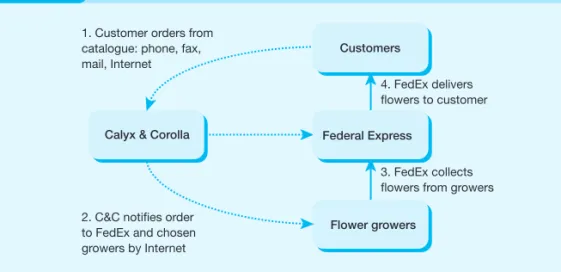
l Escalating customer diversity– in many markets buyers are demanding increas- ing value but also uniqueness in their purchases: one-to-one marketing, or micro- segmentation, is becoming a reality. To respond positively to this demand may be beyond the scope of a single company in terms of expertise and economy, and may require new ways of doing business. For example, Calyx & Corolla (C&C) reinvented the US market for fresh flowers by developing a network organisation (see Figure 16.1). Traditionally, fresh flowers are a week old when purchased and displays are expensively made to order at a retail flower shop level, if a standard display is not what the customer wants (and if the shop has a wide enough range in stock). The C&C network markets fresh flowers by catalogue (print and online), offering more than 100 flower arrangements and designs. Customer orders are phoned/faxed/e-mailed to C&C, and the information is transmitted by computer link to one of the growers in the network and to Federal Express. The growers make up the chosen design, branded by its packaging as a C&C product, which is then collected by Federal Express and shipped to the customer. The customer has a far greater choice, the flowers received are up to nine days fresher, and three middlemen are avoided. This is a new way of going to market that reflects the need for ‘mass customisation’, but that offers superior value at the same time. It has only been achieved by developing an effective network organisation.
l A borderless world – Ohmae (1990) wrote about the interlinked economy of The Borderless World. Companies are increasingly driven to compete globally, and collaboration offers an attractive alternative to competing alone in a new
16.2.1
environment. For example, British Airways’ globalisation strategy is driven by international partnerships with other carriers – a partnership with USAir offered access to the US internal market, although this partnership collapsed and BA entered an alliance with the stronger American Airlines to control more than 60 per cent of transatlantic traffic. The competitive importance of this alignment is demonstrated by the outraged opposition provided by the other international airlines, led by Richard Branson of Virgin, and the continued hostility of the European competition regulators.
Skills and resource gaps
It follows that there are growing pressures on firms to collaborate to compete effect- ively in globalised, technology-driven markets. The costs of developing internally the full range of skills and capabilities needed to compete effectively may be bey- ond the resources of a single company, or simply more cheaply available through alliances with specialised partners – where each partner can concentrate on applying its own core competencies, i.e. what it does best.
This may be of most importance with strategic accounts – the powerful major customers upon whom we have greatest dependence as a seller (see Chapter 15).
Strategic customers generally seek ‘solutions-oriented’ packages that relate to their business problems and opportunities, and will accept nothing less from their strategic suppliers. Selling products or services is not acceptable. The problem faced is that constructing the appropriate ‘solution’ for the strategic customer may involve expertise and technology that forces the seller to partner with others. Johnson Controls, for example, is the highly successful seller of automotive seating and electrical switching. While Johnson manufactures seats and switches, it has had to partner with others to provide the simple ‘bolt-on’, modularised seating and electronics components systems required by modern car assembly plants.
Figure 16.1 The Calyx & Corolla network organisation
Source: Adapted from Piercy (2002).
16.2.2
Filling skills and resource gaps may also involve the creation of new brands and new business forms in surprising ways. For example, 2006 saw Honda Motor and Hong Kong Disneyland form a strategic alliance. As part of the alliance, Honda sponsors the Disneyland’s Autopia attraction, which allows visitors to ‘drive to the future’ in electric cars and experience ‘outer space’, and supports the park’s safety features. Honda gets exclusive rights to use Disneyland images to promote their cars, motorcycle and power equipment products in Hong Kong and China. The partners are looking for further opportunities for both brands to collaborate, and appear to have found ways to merge automotive and entertainment industry interests (Japan Corporate News Network, 12 July 2006).
In other cases, an alliance may provide enhanced market access and open new ways of trading. For example, in 2006 the world’s largest fast-food chain, McDonald’s, announced an alliance with Sinopec, the state-owned oil company in China that operates 30,000 petrol stations (and adds around 500 more every year). The alliance is to support McDonald’s strategy of expanding drive-through restaurants in China.
The strategy is based on changing eating habits in heavily populated Chinese cities, which are becoming more Westernised, with more widespread car ownership and mobile lifestyles among the young, which favour purchases directly from vehicles.
McDonald’s believes that Sinopec will provide a platform to build its China business around drive-through restaurants (Yeh, 2006).
Supply chain management
One manifestation of the pressure to collaborate has come through the proposal for the ‘lean enterprise’ (Womack and Jones, 1996), and perhaps most clearly in the related efficient consumer response (ECR) programme in the grocery business.
One powerful example of lean thinking is ECR, which is advanced in the US and starting to impact in Europe. ECR is based on ‘cooperative partnerships’ between retailers and manufacturers who commit to collaborate in reducing costs in the supply chain. Three years after launch in the US, 90 per cent of firms in the grocery business were participants in ECR. Launched in 1996 in the UK, participants included the six major retailers and the leading manufacturers of packaged goods.
The key elements of ECR are: category management instead of the traditional prod- uct and brand approach, and the elimination of weak brands; more efficient pro- motion by substituting value pricing for special offers; continuous replenishment systems and cross-docking to reduce and possibly eliminate stocks in the channel;
electronic data interchange for automated ordering and information flow; and organisational change – Procter & Gamble in the US has replaced its sales organisa- tion with its new customer business development organisation. ECR is a powerful weapon which demonstrably reduces supply chain costs, but has been criticised for reducing consumer choice and competition and restricting manufacturer strategic development (Piercy, 2002).
These developments are dangerous to ignore as they provide powerful pressures towards collaboration between companies conventionally viewed as having only a buyer–seller relationship, or which were traditionally competitors. It is important that in evaluating our markets and our strategies for the future we should carefully
16.2.3
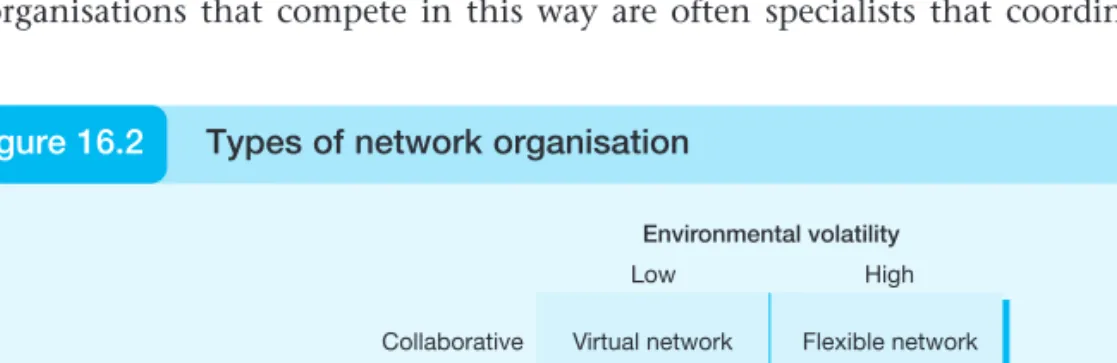
Figure 16.2 Types of network organisation
Source: Adapted from Cravens et al.(1996).
16.3
and systematically consider the emergence of factors like those listed above, which may drive our competitors’ and our own strategies into collaborative network forms.
The next questions to consider are the types of networks which can be identified and the nature of the links which hold them together. As strategic alliances have become one of the most important organisational forms in modern business, man- agers are constantly faced with decision choices in terms of which type and form of alliance should be adopted (Pansiri, 2005).
Types of network
There is no broadly accepted typology of network organisational forms. However, two approaches are useful in clarifying our ideas about the types of network which exist and may emerge in our markets.
First, Cravens et al. (1996) integrated the perspectives offered by Achrol (1991), Powell (1990), Quinn (1992) and Webster (1992) to propose the model of network organisation types shown in Figure 16.2. They argued that networks differed and could be classified in two important respects:
1 The type of network relationship, which can vary from the highly collaborative (involving various forms of interorganisational cooperation and partnership), to the mainly transactional (the traditional buyer–seller transaction, for example).
2 The volatility of environmental change– the argument that, in highly volatile environments, external relationships with other organisations must be flexible enough to allow for alteration – and possibly termination – in a short time period.
On the other hand, when the environment is more stable, more enduring forms of collaboration are more attractive.
Using these dimensions to classify networks produces the model in Figure 16.3, suggesting that there are at least four types of network prototype:
1 The hollow network– a transaction-based organisational form, associated with highly volatile environments. The term ‘hollow’ emphasises that the core organisa- tion draws heavily on other organisations to satisfy customer needs. For example, organisations that compete in this way are often specialists that coordinate an
extensive network of suppliers and buyers. One example of this type of network is Monster.com, the online recruitment and careers company. Monster connects job seekers with employers, as well as providing them with careers advice online.
Some 75 million individuals have established personalised accounts with Monster, which operates in 36 countries with 4,200 employees. The hollow organisation offers a buffer against the risks in a frequently changing environment (Achrol, 1991).
2 The flexible network– associated with conditions of high environmental volatil- ity but characterised by interorganisational links which tend to be collaborative and long term in duration, where the network coordinator manages an internal team that identifies customer needs and establishes sources of supply to satisfy customer requirements. For example, many of the multinational pharmaceutical firms are tied to core competencies in organic and inorganic chemistry and are seeking to establish alliances with entrepreneurial biotechnology firms. The larger firms have too much invested in their current technology to switch completely to biotechnology, but want to exploit partnerships to ensure they have a source of biotechnology-based products. The Calyx and Corolla (C&C) example discussed earlier also provides a model of a flexible network, where C&C acts as a hub per- forming internally product design, packaging design, promotion and pricing, but using a network of external partners to provide the flowers and deliver them to the customer. It is notable, for example, that ICL, once the ‘British’ computer Figure 16.3 The marketing exchange company
Source: Adapted from Achrol (1991).
company (renamed Fujitsu Services in 2002 to reflect its changed ownership), no longer owns factories to manufacture computers; it focuses on service and design and sources hardware from partner organisations.
3 The value-added network– associated with less volatile environments and based mainly on transactional relationships between network members. For example, the network coordinator may use a global network of suppliers, but still maintain substantial internal operations – the core organisation may contract for many added-value functions such as production, but retain responsibility for innova- tion and product design. The Bombay Company, a successful speciality furniture retailer in the USA, is an example of this network form. The Bombay Company has transactional (buyer–seller) links with speciality producers throughout the world – the company buys from 27 countries, with focus on suppliers in China, Malaysia, Vietnam, Taiwan, India and Indonesia. The Bombay role in the network is to design, source and market products in home furnishings and décor. Suppliers provide 90 per cent of Bombay’s purchases to design. A particular supplier may produce only a contracted quantity of table tops, which are assembled by another company along with other items produced by other suppliers to produce tables.
The transactional relationship is appropriate because the supplier is simply filling a contract for one of their standard products. Members of the network are spe- cialists in performing certain value-adding functions at low cost. The Bombay Company’s ability to construct and market a unique product selection through its network has achieved substantial success in the US marketplace, with licensed stores now opening in the Middle East and Caribbean areas. Other industries using this type of network are clothing manufacture, furniture, eye-glasses and some services – the link is that the value-added network fits situations where complex technologies and customised product offerings are not required.
4 The virtual networkis associated with situations where environmental volatility is relatively low, and the core organisation seeks to establish collaborative rela- tionships with other organisations. This is similar to what has been called the
‘virtual corporation’ (Business Week, 1993), which seeks to achieve adaptability to meet the needs of segmented markets through long-term partnerships rather than internal investment. Examples of companies forming virtual networks include GE, Hewlett-Packard and Motorola. In these cases market access and technology access are the key drivers and, as with the flexible network, formal strategic alliances are the most common method for collaborating. The virtual network provides a buffer against market risks and access to new technology.
A broader and more complex view of network types has been provided by Achrol (1997), who has attempted to reflect three important characteristics that may dif- ferentiate different types of network: whether they are single-firm or multi-firm;
whether they are single-industry or multi-industry; and whether they are stable or temporary. Achrol’s (1997) view of networks identifies the following types:
l Internal market networks– this describes the re-formation of major companies to break free of the restrictions of traditional hierarchies and multi-divisional forms, by organising into internal enterprise units that operate as independent profit
centres. For example, General Motors has reorganised its rigid and inefficient component manufacturing units into eight internal market units, each specialised in an automotive system area and able to sell its products on the open market as well as to GM, including GM’s competitors in automotive manufacture.
l Vertical market networks, or marketing channel networks, reflect the tradi- tional view of vertical channel relationships, but go further to recognise the focal firm that coordinates upstream supplier firms and downstream distributor firms.
Often the integrator specialises in marketing functions and uses specialists for manufacture and distribution. Early forms included the ‘hollow corporation’, for example Casio, Nike, Liz Claiborne. In such networks, the typical pattern is that the integrator is the firm which owns the brand and which specialises in the marketing function, while alliance partners are specialised resource centres pro- viding some aspect of product or production technology. Another example is provided by IKEA, the retailer of Swedish furniture, which successfully operates a global sourcing network of 2,300 suppliers in 67 countries, to get 10,000 pro- ducts on the shelf at prices up to 30 per cent cheaper than traditional rivals.
On the other hand, in technology-based markets the integrator may well be a technology specialist – Sun Microsystems has subcontracted chip manufac- turing, distribution and service functions to specialise in designing advanced computers. Achrol suggests this is not so much a strategic alliance as a functional alliance.
l Intermarket or concentric nFetworks – this is largely the province of the Japanese and Korean economies – the well-known keiretsuand chaebol‘enterprise groups’ representing alliances among firms operating in a variety of unrelated industries. The intermarket network involves institutionalised affiliations among firms operating in different industries and the firms linked in vertical exchange relationships with them. They are characterised by dense interconnections in resource sharing, strategic decision making and culture and identity. The centre may be a trading company – possibly functioning as the marketing arm of the
IKEA
Alamy/Vario Images GmbH & Co. KG
16.4
network – associated with manufacturing affiliates, which in turn have large vertical clusters of subcontractors, distributors and satellite companies, and are often involved in technology alliances with competitors. For example, Toshiba has around 200 companies in a direct exchange relationship, and another 600 ‘grand- child companies’ below them. While the Japanese and Korean networks may appear impenetrable, it is interesting to note that recent commentators have attempted to explain the operation of Virgin as a keiretsu, to explain the growth of the business through music and entertainment, transportation, financial services and diverse branded goods linked primarily by the Virgin brand and mainly funded by partner organisations.
l Opportunity networks– this is represented as a set of firms specialising in various products, technologies or services that form temporary alignments around specific projects or problems. Characteristically, the hub of the network is a marketing organisation specialising in collecting and disseminating market information, negotiating, coordinating projects for customers and suppliers, and regulating the network. Achrol (1991) has described this as the ‘marketing exchange company’, as we saw earlier (see Figure 16.3). One prototype is the direct marketing company using media like the Internet to market a wide variety of consumer products and novelties.
This review illustrates the diversity and potential complexity of network organisa- tional forms as they are emerging and as we are trying to classify and understand them. However, it remains true that our general understanding is not well developed:
‘network and virtual organizations have been here for a long time, although our ability to define them and communicate their true content is still limited’
(Gummesson, 1994).
We may be able to improve that understanding if we turn our attention next to the nature of the links which tie organisations together in these various forms of collaboration.
Alliances and partnerships
Achrol (1997) underlines the importance of thinking of networks in the terms of relationship marketing, where the relationships between network partners go beyond those that would be defined by contract or written agreement or buyer–
seller exchanges in the channel of distribution. He argues that ‘the mere presence of a network of ties is not the distinguishing feature of the network organiza- tion’, but that ‘the quality of the relationships and the shared values that govern them differentiate and define the boundaries of the network organization’
(Achrol, 1997).
This said, a starting point in understanding the dynamics of the network organisa- tion, and its attractiveness or otherwise in developing a specific marketing strategy lies in analysing partnership. It is important that we do not see strategic alliances and network formation as ends in their own right, but as a means to an end – the implementation and regeneration of our marketing strategy and the enhancement
of our process of going to market – to be used selectively and appropriately based on our objectives and our capabilities for managing collaborations with other organisations.
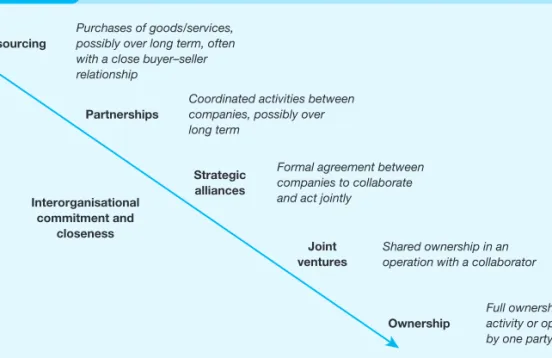
One way of categorising collaborative relationships is shown in Figure 16.4. These relationships form a spectrum running from a largely traditional, transactional relationship to full-scale vertical integration. The relationships shown have the following characteristics.
Outsourcing
At one extreme is an ‘arm’s length’ relationship, where we may simply buy in goods and services from outside, as the alternative to producing them internally. This might involve outsourcing for services like advertising, market research, the sales- force, and direct marketing expertise. It may also describe how we buy in goods for resale, or handle relationships with our distributors. However, increasingly even at this end of the spectrum people may see suppliers and distributors as partners and use terms like ‘strategic alliance’ to describe what appear to be no more than con- ventional, though close, buyer–seller relationships. This may be inaccurate, but underlines Achrol’s point above that networks are about more than the nature of the legal ties between partners. Transactional relationships of this kind also characterise what Cravens et al.(1996) described as value-added and hollow networks (see above).
It is also true that in many situations arm’s length relationships are reshaping into closer collaborative relationships – for example, in the efficient consumer response programme (see above), and in the customer pressure in business-to-business marketing
Figure 16.4 Forms of collaboration and interorganisational commitment
16.4.1
for suppliers to build closer relationships between all their resource departments and the equivalents in customer organisations (see Chapter 15). In such cases, what starts as outsourcing may acquire many of the collaborative characteristics of a formal strategic alliance.
For example, British Airways is outsourcing significant sections of its business, as part of an array of franchising, alliance and partnership relationships with other companies, in moving towards the concept of a ‘virtual airline’.
For quite other reasons, 2006 saw Gap Inc. opening its first franchised stores.
Faced with falling sales in North America and Europe in its owned stores, Gap has partnered with Singapore retailer F.J. Benjamin Holdings to open franchised Gap stores in Singapore and Malaysia. These are to be followed by Banana Republic fran- chises (Gap’s upmarket brand). Faced with problems in its established markets, Gap has turned to franchising to gain rapid entry to new markets, where its brand is known to consumers who travel to the US and Europe and buy in Gap stores (Lim, 2006).
Partnerships
These are collaborations that involve a closer relationship between organisations, but stopping short of a formal strategic alliance agreement, shared ownership in a joint venture or vertical integration. Lambert et al. (1996) suggest that partnerships vary in the degree and type of integration. They suggested that: (1) some partnerships are short term in focus and involve limited coordination; (2) other partnerships have a longer-term focus and move beyond coordination to integration of activities; and (3) the closest partnerships are viewed as ‘permanent’ and each party views the other as an extension of its own firm.
For example, in a strategic alliance extending to 2011, Dell Inc. and EMC have a partnership relationship in the data storage business, providing advanced networked
GAP
16.4.2
Alamy/PSL Images
storage solutions for organisations of all sizes. The partnership has made Dell the fastest growing disk storage systems seller, and EMC the mod-tier market share leader in revenue. The combined capabilities of Dell and EMC have made a major impact on the data storage business; Dell and EMC have leveraged a unique model of sales, marketing, engineering and manufacturing collaboration to exploit each other’s strengths and deliver superior value to customers (Al Bawaba, 2006a).
A different form of marketing alliance is shown by the Jigsaw Consortium formed by Cadbury Trebor Bassett, Unilever and Kimberley-Clark. The consortium is man- aged for the members by direct marketing agency OgilvyOne. The members of the consortium own brands like Persil, Flora, Lynx, Huggies, Cadbury Creme Egg and Flake. The alliance has created a consumer database covering the purchasing beha- viour and brand attitudes of 9 million consumers. Importantly, while retailers like Tesco and Sainsbury’s have the strength of consumer purchase data through point- of-sale scanning, the consortium database includes attitudinal data for additional insight and predictive power.
Strategic alliances
Strategic alliances are more formal arrangements, sometimes under contract, for companies to collaborate and act jointly. The defining characteristics of strategic alliances are that (1) two or more companies unite to pursue a set of agreed goals, but remain independent even though in an alliance; (2) the alliance members share the benefits of the alliance and control over the assigned tasks; and (3) the firms in the alliance contribute on a continuing basis to one or more strategic areas (e.g.
technology sharing, product development or marketing) (Taylor, 2005; Todeva and Knoke, 2005).
For example, AT&T (the leading US high-speed DSL, Internet and consumer voice services company) and Yahoo (the global Internet destination company) have oper- ated a successful strategic alliance since 2001, to bring broadband Internet services to a wide range of consumer and small business customers. Together the companies provide a fully integrated, co-branded broadband experience serving the majority of AT&T’s 8 million high-speed DSL Internet customers (FinancialWire, 2006).
Joint ventures
These are alliances where the ownership of a project or operation is shared between the parties concerned. For example, Mercedes, the German car company, and Swatch, the Swiss watch company, entered into a short-lived joint venture to produce the smart minicar, supported by partnership sourcing by its ten key suppliers, which relocated their operations to a ‘smart ville’ in France. This relationship focused on partners from different industries sharing innovative design abilities, technological expertise and marketing capabilities to innovate. The concept was that the partners were selling ‘mobility’ as a total product, not just a car – the overall market offer included the ability to borrow larger cars when needed for particular mobility needs.
The joint venture became a wholly owned subsidiary of DaimlerChrysler (it is now part of Mercedes Car Group).
16.4.3
16.4.4
16.4.5
16.5
Vertical integration
An activity in another part of the value chain is fully owned by the core organisa- tion, although the relationship may still be seen as a strategic alliance, even though strictly one company owns another. Apple Inc. provides an interesting example of a company which is vertically integrated using both outsourcing and direct finan- cial ownership. Apple designs the computer hardware, accessories, operating system and much of the software itself, but does not manufacture. Production is outsourced to specialist suppliers like Foxconn. Apple has recently established a chain of high- profile, upmarket retail outlets to protect its consumer market position, using forward vertical integration to retain control over its product presentation in the marketplace.
It is important that we consider the strengths and weaknesses of these different degrees and types of partnership in developing appropriate alliance strategies, and that we recognise that in reality networks may contain a mix of different partner- ship styles. It should also not be assumed that interorganisational relationships are static – collaborative forms may change or be removed during the course of a pro- ject, for example if one partner is gaining benefits while the other(s) is/are not. For example, BMW and Rolls-Royce operated an alliance in the form of a joint venture – BMW Rolls-Royce GmbH – for some ten years in the aerospace industry, focused on advanced aero engine development. The partners succeeded in producing a com- mercially successful family of advanced engines. The alliance provided Rolls-Royce with a stronger product strategy, but after ten years BMW withdrew to concentrate on the automotive industry and the business became wholly owned by Rolls-Royce as Rolls-Royce Deutschland (Smith, 2003).
Strategic alliances as a competitive force
It is important that we recognise in our marketing strategy development that, in some markets, competition is increasingly based on the relationship between alliances and the networks they create and no longer between individual companies. This is particularly true in global businesses:
l 2007 saw German car manufacturer Volkswagen establishing a strategic alliance – half-ownership but with management control – with Proton in Malaysia. While struggling Proton was looking for an established global player to bring greater economies of scale in operations, purchasing and R&D, the attraction for VW was gaining better access to the south-east Asia passenger car market and its expected growth. The Proton alliance offers VW a filler for a gap in its coverage of the south-east Asia region, but also complementary capacity to its plants in China and its Skoda factory in India (Shameen, 2007). Increasingly, the global auto- motive business is characterised by global networks, rather than free-standing manufacturers. As part of its massive restructuring and downsizing strategy, Ford Motor Co. is not merely willing to cut some of its brands, but is looking for strat- egic alliances with other carmakers (industry rumours suggest that Renault-Nissan may be a target) (Business Week, 2006).
16.6
l In the aerospace industry, 2007 saw a strategic alliance between Boeing and Lockheed-Martin. By working together the companies can leverage their expertise in air traffic management and aircraft-focused solutions to transform air traffic control system products. Lockheed-Martin brings air traffic route management experience, while Boeing contributes expertise in aircraft systems, avionics and airspace simulation and modelling (Airline Industry Information, 2007).
l The international airline business is dominated by alliances, each anchored by a small number of major airlines, and built through relationships with a cluster of smaller companies offering additional geographical coverage and links. The main alliances and their anchors are: Star Alliance (Lufthansa and United); Oneworld (BA and American); SkyTeam (Air France/KLM, Delta). Moves towards more extensive partnering around China and the Far East are under way. The airline alliances have pioneered the establishment of alliances as brands in their own right (He and Balmer, 2006).
At the very least, our analysis of competitive structures would be potentially mis- leading if we did not account for the potential impact of strategic alliances.
The risks in strategic alliances
We stressed earlier that strategic alliances are no panacea. They may be an import- ant way to achieve the things we need, but there are significant risks also. To begin with, we should be aware that, for one reason or another, strategic alliances some- times simply do not work, and they may crash spectacularly:
l IBM and Microsoft were partners in the 1980s, and Microsoft provided the DOS operating system that drove IBM’s PCs. However, IBM did not have exclusive rights to DOS and it was adopted by their competitors in clones of the IBM PC.
IBM lost much market share and profit, while Microsoft benefited from the addi- tional sales of DOS under licence. In 1985 IBM signed a formal joint development agreement with Microsoft to create the next generation operating system – OS/2.
The development of OS/2 proceeded slowly. Meanwhile, Microsoft developed Windows, which was quickly taken up by the market – the same market IBM wanted for OS/2. The alliance exploded in an acrimonious press conference in Las Vegas in 1989. The partners finally parted company in 1991. As a partnership, the alliance had been a total failure. However, as in many ‘divorces’ the division of costs and benefits was far from equal: Microsoft got the time and space to develop the worldwide success of Windows, while IBM was left with the unpopular OS/2 system in a market now dominated by Microsoft. Perhaps unsurprisingly, Microsoft and IBM are now deadly rivals.
l A key component of British Airways’ globalisation strategy was its partnership with USAir, to gain access to the critical internal US market. By 1996 the two com- panies were in court because BA had announced a new alliance with American Air. The first that the chairman of USAir knew of this was when he read the news in the Wall Street Journal. The USAir/BA alliance crumbled immediately. However, competitors including Virgin and a new alliance of US airlines is doing its utmost to prevent the BA/AA alliance.
l Rover and Honda formed an early R&D and marketing partnership in the UK automotive industry. Some fifteen years into that partnership, in secret negotia- tions, Rover was sold to BMW, the German car company. Rover appeared to believe that the Honda partnership was part of the deal. The acquisition came as a surprise to Honda which, on considering its options, withdrew from the partnership to avoid allowing BMW access to Honda technology.
l We described above how the strategic alliance has become the dominant compet- itive form in the global airline business. Nonetheless, airline alliances have proved unstable with sometimes dramatic membership shifts and withdrawals. Indeed, some passenger groups are critical of the code-sharing that results in a passenger buying a ticket with Airline A, only to find themselves sitting in a seat on an air- craft owned by Airline B (which was by definition not their chosen carrier). In addition, there are growing concerns that the strength of the alliance brand may undermine the brands of the partner organisations (Kalligianis et al., 2006).
l A study by Cravens et al.(1993) found that in 82 large multinational corporations fewer than half the companies operating strategic alliances were satisfied with the effectiveness of those alliances.
It is perhaps wise not to overestimate the strength and durability of strategic alliances. Quinn noted some time ago:
Like earlier decentralization and SBU concepts, some of these newer organizational modes have been touted as cures for almost any managerial ill. They are not. Each form is useful in certain situations, and not in others. But more importantly, each requires a carefully developed infrastructure of culture, measurements, style and rewards to support it. When properly installed, these disaggregated organizations can be awesomely effective in harnessing intellectual resources for certain purposes. When improperly supported or adapted, they can be less effective than old-fashioned hierarchies. (Quinn, 1992) Indeed, as well as the outright failure of an alliance and the crash of the network involved, there are a number of other important issues to bear in mind as potential limitations to the application of strategies of collaboration.
Achrol (1997) argues that we should consider the following factors as key elements of designing and operating network organisations (see Figure 16.5).
l Power: we need to take a careful look at the relative dependence and power within a network, both in terms of whether the relative position we take is accept- able to us and if we are going to be able to cope with the way power is likely to be exercised in the network, and how vulnerable this may make us.
l Commitment and interdependence: at its simplest, are the people in the part- nering companies going to be behind the alliance, and what mechanisms may be needed like interlocking directorships and exchange of personnel or other liaison mechanisms? In the keiretsu, the Japanese refer to what is necessary to ‘keep each other warm’ (Gerlach, 1992); their example suggests we should not underestimate the importance of people’s commitment, or lack of it, in an effective network organisation.
l Trust: the network organisation requires that each partner give up some influ- ence or control over important issues and become vulnerable to ineffective or
hostile actions by other network members. This is a key aspect of relationship management in a network. The cases of network failure cited above illustrate the vulnerability involved. Compare this with the risk of lack of commitment to a collaboration through an unjustified lack of trust in the partner organisation, and the significance of the issue becomes clearer. This point is underlined in Morgan and Hunt (1994).
l Social norms: it is suggested that network organisations should be considered in terms of behavioural issues like (a) solidarity – the unity of action among net- work members, (b) mutuality – network partners acting in the common good and receiving a pay-off in terms of benefits from the collaboration, (c) flexibility – the willingness of partners to change the joint arrangements as conditions change, (d) role integrity – clarity in what each partner organisation is to do, (e) conflict handling – agreement on how conflicts will be handled in the network. The important point to bear in mind is that, while organisations are familiar with how to handle these questions in conventional, independent, hierarchical structures, we are still learning how best to manage them in the very different setting of the collaborative network of organisations.
We need to consider the attractiveness of a collaborative or alliance-based strategy in terms not simply of the pressures of factors like resource gaps and market access, but also in the light of whether we can design and implement an effective network, and whether we have the skills and capabilities to manage through a network of relationships with other companies.
We shall consider these points in more detail in the managerial agenda in the next section. Issues like trust, commitment and power may hold the key to identifying the large business risks involved in reliance on strategic alliances. For example, we discussed earlier the successful partnership between AT&T and Yahoo to provide integrated broadband services to AT&T customers. Notwithstanding the success of the relationship, in 2007 AT&T placed a story with the Wall Street Journalindicating that its DSL partnership with Yahoo was in jeopardy. The story led to a 5 per cent drop in Yahoo’s share value and removed $2.2 billion in Yahoo’s market value. In
Figure 16.5 The jigsaw of network organisations
16.7
fact, Yahoo obtains $250 million a year in high margin revenue from monthly fees for AT&T’s subscribers to the broadband service. AT&T wants to retain more of the customer revenue and to pay Yahoo only a percent of revenue for the sale of the products Yahoo provides (music, photo services, etc.). One reason AT&T now believes it should not have to share its broadband subscription revenue is approaches from other Internet companies prepared to pay to reach its broadband customers – rumours suggest the most significant approach has been from Google (Arrington, 2007). As situations change, so may the commitment of a partner to an alliance. The risk of opportunistic behaviour by a partner is an important issue to be monitored (Kale et al., 2000).
Competing through strategic alliances
The discussion above and the examples examined in this chapter suggest that the managerial issues that should be addressed carefully and systematically in evaluat- ing the strategy of collaboration and alliance as a route to market are the following.
Core competencies
One of the fundamental attractions of collaboration and partnership with other organisations is that it allows each organisation to focus on its own core competen- cies and to benefit from the specialisation of other organisations in their own areas of expertise (Achrol, 1991; Webster, 1992). Quinn (1992) notes: ‘If one is not “best in world” at a critical activity, the company is sacrificing competitive advantage by performing that activity internally or with its existing techniques.’ Certainly, research by Buffington and Frabelli (1991) in the telecommunications industry suggests that, when partners in a collaboration do not contribute their core com- petencies, then the probability of success for the alliance is substantially reduced.
This suggests that clarity in defining those core competencies may be critical to negotiating and sustaining effective interorganisational relationships of this type.
However, there are two problems. First, it is clear that the identification of core competencies may be far from straightforward within an organisation or between partners (e.g. see Piercy and Cravens, 1996). Second, we have to factor in not just existing and recognised core competencies, but issues of complementarity and ‘fit’
between potential partners, and the potential for synergy through collaboration (Sengupta and Bucklin, 1994).
Strategic priorities
The issue of core competencies also raises important questions about competitive strategy and the choices faced in when, where and how to compete (Prahalad and Hamel, 1990). While networking offers a company the opportunity to focus on and exploit its core competencies, it will rarely create such capabilities for a company.
However, this focus and concentration may create vulnerabilities. We saw earlier that the British Airways alliance with USAir collapsed before the new alliance with American Airlines was approved. This left BA potentially with no US-based
16.7.1
16.7.2
collaborator and highly exposed to competitive attack by other alliances. While there is much current favour in corporate thinking for strategic focus and concentration, using collaborations as a vehicle, we should be aware of the risks involved in this prioritising. Reliance on partners to perform critical activities involves risks if the partnership fails or underperforms, and may leave us without the capacity to develop new competencies.
Managing network organisations
It is apparent from the case examples above that organisations differ markedly in their ability to manage effectively in networks. Forming and managing networks calls for a different set of management skills and issues compared with the conven- tional organisation. Business Week(1993) concluded that for managers in the ‘virtual corporation’:
They’ll have to build relationships, negotiate ‘win-win’ deals, find the right partners with compatible goals and values, and provide the temporary organization with the right balance of freedom and control.
Research suggests that lack of success in business partnerships and alliances is frequently because companies pay inadequate attention to planning. Lack of careful planning leads to conflicts about strategy, problems with governance and missed opportunities (Bamford et al., 2004). Bamford et al.(2004) suggest forming a team dedicated to exposing tensions as early as possible, and to deal with four challenges:
(1) to build and maintain strategic alignment across the partner companies; (2) to create a shared governance system; (3) to manage the economic interdependencies between the partner organisations; and (4) to build a cohesive organisation.
Indeed, many of the problems which have emerged in the management of alliance- based organisations were captured in Bensimon’s (1999) executive guidelines.
l Assimilate the competencies of your partner.
l Think of your partner as today’s ally and tomorrow’s competitor.
l Share power and resources, but share information wisely.
l Structure your alliance carefully.
Before making the commitment to enter an alliance, we should consider the follow- ing factors:
l Drivers – which of the drivers of collaboration strategies apply in this case?
What does a collaboration strategy offer us in terms of: asset/cost efficiencies;
customer service improvements; marketplace advantage over the competition, profit stability/growth (Lambert et al., 1996)?
l Choice of partners– which potential partners are available, and what basis do we have for believing that we could create an environment of trust, commitment and cooperation between the members of the alliance (Cravens et al., 1997)?
l Facilitators – are the circumstances and environment favourable for a partner- ship? Lambert et al.(1996) suggest that partnerships are more likely to be successful if the following conditions prevail:
16.7.3
– corporate compatibility: the cultures and business objectives of the partners must mesh;
– managerial philosophy and techniques: are the partners’ organisational structures, attitudes towards employees and method of working compatible?
– mutuality: are there equally important benefits for both partners?
– symmetry: are the partners similar types of company that understand each other?
– exclusivity: are partner organisations willing to shut out others who are not part of the network?
– shared competitors: partnerships work best as an alliance against a common foe;
– prior history: experience in successful collaboration is a plus;
– shared end user: when partners serve the same customer, collaboration is likely to be more successful.
l Components– these are the activities and processes that management establishes and controls throughout the life of the partnership, and effective partnerships understand these from the outset (Lambert et al., 1996). This includes arrangements for joint planning, joint operating controls, communications between partners, equitable risk/reward sharing, facilitating trust and commitment between partner organisations, a contract acceptable to both sides, the definition of the scope of the partnership and clarity about the financial investments to be made by partners.
l Network effectiveness– we saw earlier that Cravens et al.(1993) found that many companies pursuing alliance-based strategies were dissatisfied with the results.
Defining realistic expectations at the outset and evaluating progress against them is required. We may have to think in terms of somewhat different measures to the conventional evaluation of effectiveness – network stability and sustainability, relationship strength, network synergy, and the like. If we cannot offer convin- cing evidence that the network provides a superior way of going to market, it is unlikely to endure. We consider the evaluation and appraisal process in more detail below.
l Organisational change– it is highly likely that the formation of network organ- isations will be stimulated by, and in turn lead to further changes in, alliance companies’ internal organisational structures and processes. The requirements for effectiveness here may be complex and currently outside the experience of many senior managers in traditional organisations (Cravens et al., 1996). The complexity of this issue is underlined by Gummesson (1994): ‘organizing a network business requires continuous creation, transformation and maintenance of amoeba-like, dynamic processes and organizational structures.’
l Market orientation and customer service– a particular point of concern for the marketing strategist is the impact of networked operations on the market orienta- tion of the new type of organisation and its ability to deliver the required levels of customer service and superior customer value. Where the primary motivation for collaboration is technological or supply-chain efficiency, this may be a particu- larly significant concern. For example, we reported elsewhere that some com- panies in the airline business are moving towards the concept of the ‘virtual
airline’ which owns no aircraft or facilities and exists primarily as a brand and information system with a small core staff. Some executives suggest that, while the core organisation is highly market-oriented and committed to high-quality service, in a networked organisation they lack the means to share these imperat- ives with their partners. Quite simply, we may believe in service quality at the core airline, but is this shared by the people who run the operation the customer experiences at check-in (Piercy and Cravens, 1996)? This suggests that one of the major questions we need to consider is what mechanisms we may need to create to drive goals like service and quality through a network to the end user.
l The role of marketing in network organisations– there is some lack of clarity about how marketing is located and operated in a network organisation. In some models, like the ‘marketing exchange company’, the hub of the network is the marketing facility (Achrol, 1991). Others suggest that the critical role for market- ing in the alliance-based network is applying relationship marketing skills to managing the links between partners in the network (see Chapter 17 and our dis- cussion of internal marketing as an implementation approach in partnerships).
Certainly, there is a compelling argument that the concepts and processes of relationship marketing are pivotal to the management of networks. Relationship marketing involves the creation and distribution of value through mutual co- operation and interdependence (Sheth, 1994), and we have seen that cooperation and interdependence are central features of network organisations. It is too early to reach conclusions about the role that marketing can and will take generally in these new organisational forms, although it is highly likely that there will be some redefinition of its role which may be radical.
Staying vigilant
As experience grows in the advantages and pitfalls of going to market or operating key processes through strategic alliances, it is apparent that there may be tempta- tions to persist with alliance relationships way past the point where this makes sense. The benefits of some interorganisational relationships may be transitory, and the relationship may need to be reconsidered on a regular basis. Indeed, one of the attractions of networked organisations is that they may be designed to be temporary and to exploit a given opportunity, and then be dissolved. However, there is evid- ence that recognising the point when the alliance should end and managing the dissolution or disengagement process may pose some problems.
For example, there is some evidence that managers may be reluctant to end alliance relationships, even though they have evidence that the alliance is failing to meet its purposes and there is little chance that things will improve. This appears to be most likely with large joint ventures when closing costs may be high, sunk costs may have escalated, and where the alliance has high visibility – terminating large expensive partnerships may impact negatively on management careers and prospects (Delios et al., 2004).
While an early concern about strategic alliances was that they could be unstable and unreliable because of the nature of interorganisational, non-ownership relation- ships, it has been suggested, for example, that alliances may be too stable. Companies are urged now to routinely review and rethink their alliance arrangements. Rather
16.7.4
than waiting for a crisis to emerge, a company should scan its major alliances to see which need restructuring, to understand the root causes of the venture’s problems, and to estimate how much each problem is costing the company (Ernst and Bamford, 2005).
Indeed, there may be greater risks that emerge in some situations which are even more threatening than inertia allowing underperforming alliances to stay in place.
The outsourcing or contract manufacturing area provides an illustrative example of the risks to be considered. Contract manufacturing is attractive to an original equip- ment manufacturer (OEM), the traditional brand owner, because it reduces labour costs and frees up capital to outsource manufacturing, leaving the OEM free to focus on product research, design and marketing. This practice started in the computer business, and has spread to areas as diverse as toys, clothing, footwear, beer and pharmaceuticals. Even in the automotive sector, Finland’s Valmet Automotive assembles the Porsche Boxer, and Austria’s Magna Steyr assembles cars for Mercedes, BMW and Saab. However, research suggests that the outsource relationship may develop in threatening ways, where the contract manufacturer displays:
l Promiscuity– the contract manufacturer seeks business with OEM’s competitors.
l Infidelity – the CM becomes a competitor by selling to the OEM’s retailers and distributors.
l Betrayal – the CM shares the OEM’s intellectual property with competitors or retains it for its own exploitation.
Meanwhile, the OEM cannot terminate the outsourcing because there are no altern- ative sources of product. Considerable care is required in making outsourcing decisions and deciding when they should end (Arruñada and Vázquez, 2006).
It is likely that reliance on strategic alliances will continue to increase but, as situations change, companies will need to consider what is involved in effective disengagement from an alliance.
Asessing the performance of strategic alliances
It is perhaps symptomatic of the relative lack of maturity of the strategic alliance organisational model that it is claimed that a major reason for the high failure rate of alliances is that relatively few have developed and implemented formal perform- ance measures (Cravens et al., 2000). Appropriate control mechanisms will depend upon the underlying rationale for the alliance relationship, i.e. the strategic intent of the partners; the form of the alliance relationship; and the strategic objectives of the relationship. This context provides the basis for selecting evaluation criteria and methods of evaluation and implementing an alliance evaluation plan. For example, the evaluation criteria for a global airline alliance, reflecting the ‘Balanced Scorecard’
approach (Kaplan and Norton, 1996), and the several stages of management control activity are shown in Table 16.1.
This provides a generic template, but one that should be adapted and refined for specific application. The goal of establishing and clarifying the performance criteria for an alliance and evaluating performance against those criteria is, however, a gen- eral requirement.