
This book aims to provide a compact overview of the most relevant concepts and developments in International Management. Institute for Trade and International Marketing) and director of the Europe Institute at Saarland University.
Configuration refers to the location where each value chain activity takes place, including the number of locations (Porter 1986, p. 17). A mode of doing business abroad can be defined as an institutional arrangement or organizational arrangement used to organize and manage an international business transaction, such as producing goods, servicing customers, or obtaining various inputs (Andersen 1997, p. 29; Welch). /Benito/Petersen 2007, p. 18).
Multinational Corporations as Networks
From Centralised Hubs to Integrated Networks
The competitive advantages of MNCs are no longer necessarily developed in the home country and then transferred and exploited abroad, but can be established by individual foreign affiliates or through participation in the entire MNC network. Learning becomes necessary for the rapid creation and dissemination of knowledge within the MNC (Schmid/Kutschker 2003, pp. 163-164).
Heterogeneity between Foreign Subsidiaries
Network models also assume that subsidiaries can become "centers of excellence" (or competence centers) for the MNC. Centers of excellence may concern products or processes or functions of the MNC (Frost/Birkinshaw/Ensign 2002, pp.
Flows in the MNC Network
A Center of Excellence is “an organizational unit that embodies a set of capabilities that have been explicitly recognized by the company as a major source of value creation, with the intent that these capabilities be leveraged and/or distributed to other parts of the organization. the company” (Frost/Birkinshaw/Ensign 2002, p. 997). Research has shown that most multinationals have foreign subsidiaries that take on the role of knowledge centers (Schmid/Bäurle/Kutschker 1999, pp. 108-109).
Intra- and Inter-organisational Networks
The subsidiary's remote, local network is a strategic resource for subsidiary-specific benefits. Moreover, the local embedding increases the subsidiary's absorption capacity for new local knowledge.
Coordinating the MNC Network
A strong local anchoring of the subsidiary can increase its competitiveness and also the knowledge creation of the multinational in total. A shortcoming of the firm's organizational structure as a means of coordinating the multinational lies in its heterogeneity.
Conclusion and Outlook
However, even in the model of the differentiated network, the headquarters still exists and has a somewhat hierarchical position in the network. While the heterarchical models have gained prominence, most empirical studies increasingly reveal a higher power at headquarters, mostly in the home country.
Case Study: British Petroleum *
Profile, History, and Status Quo
By the spring of 2014, the company had completed the sale of assets worth USD 38 billion and announced a further divestment of USD 10 billion, which should be completed by the end of 2015. Thus, in less than 5 years, BP has drastically reduced and will carry out the divestment of almost 50 billion USD.
The Value Chain of BP
The accident in the Gulf of Mexico has led to a significant reorganization and reconfiguration of BP's upstream business. Again, several companies and – as is often the case with natural resources – the state are involved.
Partnerships of BP
AAR rightly argued that BP's proposed rival joint venture with Rosneft would have breached the shareholder agreement governing TNK-BP (Webb 2011). As Reuters (2014) reported that BP CEO Dudley said: “President (Putin) has encouraged us today to invest in shale oil”.
Summary and Outlook
Questions
Hints
Transnationales Management: Texte, Fälle und Lesungen zum grenzüberschreitenden Management, 7. Auflage, Boston, McGraw-Hill. Entwicklung der Forschung zu Koordinationsmechanismen in multinationalen Konzernen, in: Journal of International Business Studies, Band 2014): BP Investor Update of the Chief Executive Upstream, http://www.bp.com/content/dam/bp /pdf /investors /Investor_Update_script_s lides_v2.pdf, aufgerufen im August Institutionalization and Coordination of Foreign Units: An Analysis of Industrial and Service Firms, Wiesbaden, Gabler.
The Integration/Responsiveness- and the AAA-Frameworks
Multinational flexibility, i.e. the ability of a company to exploit the opportunities arising from this heterogeneity, is necessary. Many government drivers also influence the need for globalization in an industry.
The I/R-Framework as a Matrix
Therefore, the company does not adapt to the specific host country, nor are the foreign activities systematically integrated into the MNC. Usually these production facilities are located in the home country, and the most relevant task for the foreign subsidiary is to act as a "pipeline".
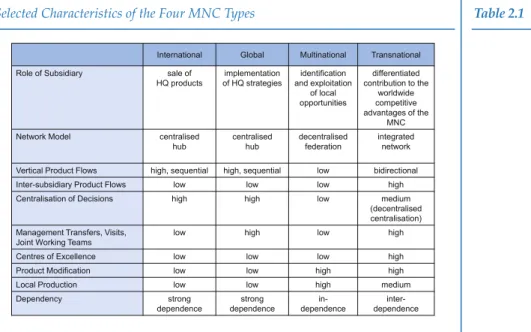
Different Levels of Integration and Responsiveness
Here, instead of forces, the degree of integration and the degree of localization of the MNC are used. Thus, in the "differentiated network" perspective (Nohria/Ghoshal 1997), the subsidiary level should be planned separately.
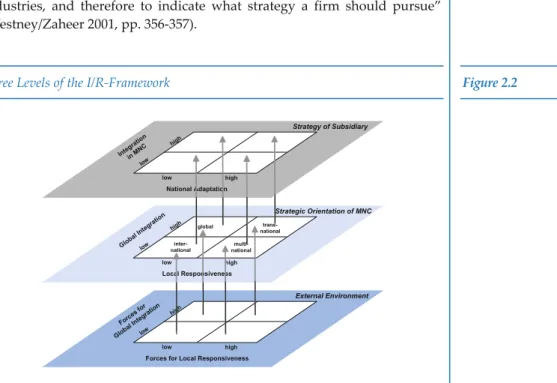
AAA-Framework
Based on the three dimensions of the framework, a multitude of MNC strategies are possible, although again it is recommended to avoid excessive complexity. Ghemawat also recommends focusing on one or two of the three dimensions, which would result in about six overall strategies.
Case Study: Retailing *
2007): Managing Differences: The Central Challenge of Global Strategy, in: Harvard Business Review, Vol. 2000): An Empirical Analysis and Extension of the Bartlett and Goshal Typology of Multinational Firms, in: Journal of International Business Studies, Vol.
The Retail Industry
Over the past few decades, strong forces for global integration have affected the retail industry. The existence of different skin types, hair colors, etc., in the human population globally, requires a high global integration and a local response at the same time.
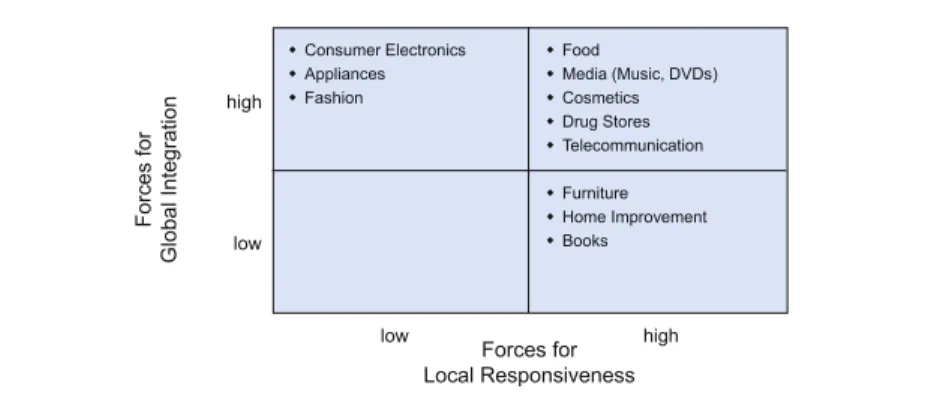
Strategic Orientation of Retail Companies
One of the advantages of the transnational strategy is the (only) marginal adaptation of the format - the retailer can open stores with and without petrol, urban walking stores or stores in strip centers - another is the "retail information system", which enables the retailer to follow trends faster than competitors. DELOITTE (2011): The Changing Face of Retail: The Store of the Future – The New Role of the Store in a Multichannel Environment, London.
Role Typologies for Foreign Subsidiaries
Heterogeneous Roles of Subsidiaries
It can be "defined as the business - or elements of the business - in which the subsidiary participates and for which it is recognized to have responsibility within the MNC" (Birkinshaw/Hood 1998, p. 782). Usually the distinction is difficult, and the subsidiary's specific task and activity is partly assigned by the headquarters, partly self-determined and partly negotiated between the two.
Selected Role Typologies
A foreign subsidiary receives and sends a small portion of its inputs and outputs to the rest of the MNC. Conversely, a vertical front is a foreign unit that purchases its materials, products, and components from external sources in the host country and ships its products primarily to the rest of the MNC.
Weaknesses and Deficits of Role Typologies
Thus, it produces with low integration with the MNC and sells its products to external customers. A backward vertical subsidiary obtains a major portion of its inputs from the MNC and sells its products to external customers.
Benefits of Role Typologies
The criticism that role typologies are an oversimplification is reminiscent of the Indian tale of the six blind scholars and the elephant. International Human Resource Management, Proceedings of the University of Vaasa, Vaasa, Vaasan Yliopiston Jalkisuja, pp.
Case Study: Walmart *
Profile, History and Status Quo
In 1991, it entered into a joint venture with a Mexican retailer and opened its first store in Mexico. 2011 Africa 578 acquisition of majority stake in Massmart Holdings with 288 stores in 14 African countries (focus on South Africa).
Different Roles for Walmart’s Foreign Subsidiaries
In Bartlett/Ghoshal terminology (see Figure 3.1), the combination of a strategically important country and a low-skilled subsidiary is a “black hole”. Walmart Japan is located in one of the largest economies in the world and the second largest retail market.
Motives for Internationalisation
Heterogeneous Strategic Objectives for Internationalisation
Market Seeking
Normally, customers abroad are consumers or companies resident in the host country. In the follow-customer scenario, the company has a strong advantage because the uncertainty of entering the foreign market is much lower.
Resource Seeking
In addition to activities in the host country, the company should identify market opportunities in other countries that are easier to enter from this bridgehead. At the same time, sourcing is associated with a strong interdependence with the rest of the MNC, as goods and resources obtained in a foreign market are directly delivered to other organizational units of the MNC, e.g.
Efficiency Seeking
On the other hand, efficiency advantages in the host country can also be exploited by forcing the subsidiary to perform complete value chains and assigning it a product mandate that gives it full responsibility (regional or worldwide) for one or several products. Manufacturing in the host country – at least compared to simple sales activities – is associated with very high capital costs and therefore a risky undertaking.
Strategic Asset Seeking
However, there must be a close connection between the foreign subsidiary and the rest of the MNC, because internal communication flows (horizontal with other subsidiaries and vertical with headquarters) are important factors for the innovation capacity of an organization (Nohria/Ghoshal 1997, p. 39) . In particular, it is important that the foreign subsidiary has both the necessary ability to generate new knowledge and the necessary motivation to share this knowledge with the rest of the MNC (Nohria/Ghoshal 1997).
Follow-the-Leader
Local partners can, as in a joint venture, support access to the necessary sources of knowledge. This strategy-based consideration becomes more relevant with the increasing degree of internationalization of the relevant competitors and with increasing competitive concentration.
Bundles of Motives
For example, it could use its power in the US to attack a competitor there who attacked it in a European market. For example, Korea has become one of the world's centers of innovation in consumer electronics.
Case Study: SAP *
At the turn of the century, SAP rose to become the world's leading provider of e-business software solutions for companies. The global financial crisis in the first decade of the new millennium forced SAP to make some cuts in response to a falling stock market.
The Software Industry
Only some of the largest and most successful companies in this sector are not based in the United States (see Table 4.3). The fact that most of the largest software companies are from the United States also leads to a certain industrial focus on this market.
Internationalization covers the fundamental possibilities for creating suitable software solutions that can be implemented during basic software development, enabling customers to use different languages, work in different time zones, and adapt to the given currency and other characteristics of small. This can be considered as highly standardized content that provides a basis for further adjustments to suit the particular environment.
Global Activities of SAP
It is through these local service centers that customers get the necessary support to find the best solutions for their goals in the given market. The SAP Labs and SAP Research organizations work together with partners, customers and universities to create new global solutions.
Approaching New Markets - Forming a Global Brand
Transatlantic Investments by Multinational Firms: A Rivalistic Phenomenon, in: Journal of Post-Keynesian Economics, Fall, pp. A meta-analysis on the choice between wholly owned subsidiaries and cooperative arrangements, Best Paper Proceedings of the Academy of International Business Annual Meeting 2008, Milan.
Emerging Country Multinationals
Outward Foreign Direct Investment from Emerging Markets
10% of the global total, with China being the third largest investing country in 2012, after the US and Japan (UNCTAD 2013). The transition of the role of emerging markets in international business is characterized by the rise of multinationals from emerging countries, MNCs, whose origins are in emerging economies.
Characteristics of Emerging Country Multinationals
However, multinational companies in emerging countries have to face the responsibility of being latecomers to international markets, which is why some scholars refer to them as latecomers (Mathews 2006). Closely related to the institutional environment is the fact that the influence of the state on multinationals of emerging countries is greater than on traditional MNCs (Peng 2012).
Trends in Emerging Country Multinationals’
Internationalisation
The usual expansion path for multinationals from emerging countries generally differs from that of most traditional multinationals. Emerging country multinationals also tend to differ on the main ways in which they enter new international markets.
Explaining Emerging Country Multinational Expansion
Mathews (2006) proposed the LLL framework, which is closely linked to these firm-specific advantages of multinational companies from emerging countries. In this framework, the international expansion of multinational companies from emerging countries is driven by resource linking, leverage and learning.
Models of International Expansion
One of the most striking characteristics of developing country multinationals is their pace of international expansion into global markets. This reinforces the need to continue to tailor goods and services to regional needs, one of the main strengths of developing country multinationals.
Case Study: Tata Group *
A Perspective on Regional and Global Strategies of Multinational Enterprises, in: Journal of International Business Studies, Vol.
Profile and Company Structure
Given the Tata Group's origins as a family-run business, it is closely connected to the surrounding community. The Tata Group has its origins in 1868, when Jamsetji Nusserwanji Tata established a trading company in Bombay.
Development of the Tata Group since 1990
In the case of Tetley, the Tata Group decided to stick with the original name. In 1990, many companies of the Tata Group were in leading positions in the Indian domestic market.
Important International Management Theories
Introduction
Transaction Cost Theory and Internalisation Theory
Again, the necessary flexibility to adapt to changing situations can be better granted with internalized modes of operation. Thus, with a greater number of transactions, the relative cost of a wholly-owned subsidiary is reduced.
Dunning’s OLI Paradigm
Property-Specific Advantages (O): The company must have some unique competitive advantages (company-specific advantages, FSA) that outweigh the disadvantages of competing with local companies in their home market (foreigner liability). Location-Specific Advantages (L): If foreign direct investment is to take place, it must be more profitable for the company to carry out the activity abroad than in the home country.
Resource-Based View
There are many strategic questions that can be analyzed from the perspective of the RBV. In the latter case, the value of the resources abroad and the question of how best to transfer the resources there must be considered.
Dynamic Theories of Internationalisation
In the IP model, only the company (as an organization) is able to gather international experience. Moreover, in the industries in which globals are most often observed, demand in different markets is not very heterogeneous.
Selected Theories to Explain the Relationship between Headquarters and Subsidiaries
In addition, the principal-agent theory posits that there is usually an information asymmetry in favor of the agent. On the other hand, limiting the subsidiary's autonomy could reduce the MNC's network effectiveness because it could reduce the subsidiary's access to a strategic resource.
Contingency Approach and Configurational Approach
Theories of the Multinational Enterprise: A Multidimensional Being in the Global Economy, Cheltenham, Edward Elgar Publishing. Towards a theory of international new ventures, in: Journal of Business Studies, Vol. 1981): Power in Organizations, Boston, Pitman Publishing.
Market Barriers, Global and Regional Integration
Types of Market Barriers
These limit the amount of goods that can be exported or imported during a certain period of time, such as a year. In addition to permanent tariff and non-tariff barriers, international trade is also affected by temporary barriers that are introduced as a response to specific events in intergovernmental relations: trade sanctions.
Restricting Foreign Direct Investment
Global Integration
June 2002 The Indian government first allows 26% FDI in news and current affairs in print media. February 2006 The Indian government opens up the retail sector by allowing FDI up to 51% in sole trader companies.
Regional Integration
North American Free Trade Agreement (NAFTA), including Canada, Mexico and the US, which led to 80% of all Canada and Mexico's trade being within NAFTA countries, while for the US, trade with NAFTA countries accounts for 33 .5% (in 2012). In terms of transaction costs, a customs union has a major advantage over free trade zones: certificates of origin are not required for intra-trade transactions.
Effects of Economic Cooperation
In anticipation of this move, the former European Community agreed to rename itself the European Union, a truly optimistic sign. The effects of the common market on trade within the European Union (intra-EU trade) are shown in Table 7.3.
Impact of Economic Integration on Firms
The flow of foreign direct investment (FDI) between EU countries increased from EUR 64 billion in 1992 to EUR 260 billion in 2010. This provides many opportunities for companies in terms of exports and imports, for outsourcing, offshoring, strategic alliances and greenfield and brownfield investments.
Case Study: Mazda *
Today, the company employs approximately 38,000 people and generated net sales of approximately 2,205 billion yen in 2013, with the majority attributable to the North American region (see Table 7.4).
Trade Liberalisation in the Mexican Automotive Industry
Mexico’s Automotive Industry
In Mexico, the automotive sector accounted for 21% of total foreign direct investment; the auto parts sector reached a total of USD 1,770 million in 2012 (Promexico 2012). The main assemblers in Mexico's consolidated auto sector are Nissan, Volkswagen and the Big Three – Ford, General Motors and Chrysler, which accounted for more than 93% of total production and 94% of internal sales between January and May 2014 .
Entry and Operating Strategy of Mazda in Mexico
AMIA (Asociación Mexicana de la Industria Automotríz) (2014): Producción total, http://www.amia.com.mx/prodtot.html., accessed 24 August 2014. THE METROPOLITAN CORPORATE COUNSEL (2012): India's foreign Direct investment policy opens the door to multi-brand retail, http://www.metrocorpcounsel.com, accessed August 24, 2014.
Competitive Advantage of Nations and Regional Clusters
National Competitive Advantage
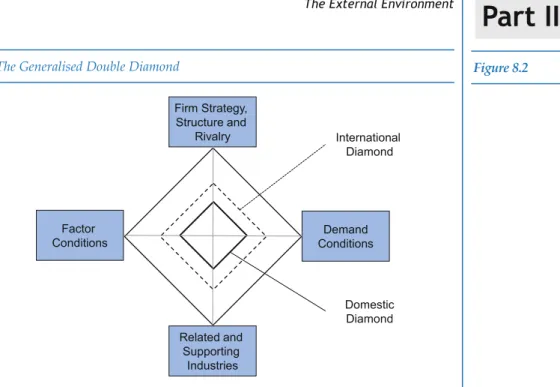
Porter’s Diamond Model
The first element of the diamond is the nation's possession of factors of production. As already mentioned, the fundamental underlying concept of the diamond model is that competitive advantages can be created.
Regional Clusters
Such relationships encourage informal cooperation and knowledge transfer between companies and institutions in the cluster. In doing so, increasing the attractiveness of the cluster for everyone in the cluster is one of the main motives of public authorities.
Case Study: London Financial Cluster *
Facilitation of innovation processes and pace of innovation: Potential areas for innovation are often detected earlier and progress faster in regional clusters due to access to specialized resources, information sharing, close communication and cooperation between group members. Stimulation of the foundation of new businesses: The foundation of new businesses is promoted as a result of favorable site-related factors in regional clusters, such as specialized suppliers, infrastructure or customers.
History
While London's commercial cluster has suffered from a continuous decline, the process of financialisation, which means "the growing importance of financial markets as a source of profits in the economy". Nowadays, the London Financial Cluster can still be considered one of the most important financial centers in the world.
Profile
The alignment of the various entities that make up the London financial group has been key to its strong performance. In addition, it has accelerated the process of consolidation of stock exchanges, finding expression, for example, in several acquisitions that the London Stock Exchange Group finalized in recent years.
Driving Forces of the Cluster Formation
Cluster-specific human resources are trained financially in institutions that belong to the best in the world. Also, stable, transparent and consistent immigration rules that do not restrict international mobility and do not prevent highly qualified international students from becoming local professionals are essential to the success of the London Financial Cluster.
