
The third is the period of contact with whites, which began in 1847 with the arrival of Mormon settlers. This distribution of cultural elements suggests that the Utes were culturally similar to their western neighbors before acquiring the horse. The acquisition of the horse seems to have been responsible for the development of the band at Basin.
When the traders came to their territory, Ute found a new way to acquire material possessions.
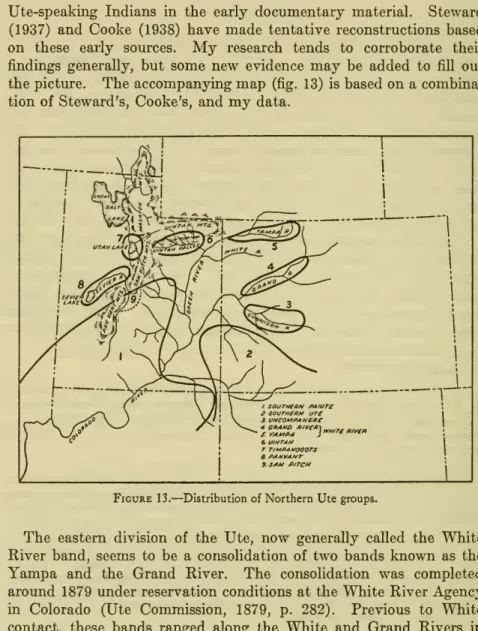
WHITE- CONTACT PERIOD
The Indians who had lived in this area were settled on Spanish Fork and Salt Creek (in San Pete County) on farms. Since Sanpitch was a relative of Tabby, who was then a Uintah chief, this upset the Uintah.
THE RESERVATION PERIOD
Critchlow reported in 1874 that the Ute under his supervision appeared from spring to fall on their annual hunt (Critchlow, 1874, p. 584). Intertribal rivalry reported as early as 1883 indicates that the Ute had learned that aggression against whites was best suppressed. Congress finally took note of this situation, and on May 27, 1902, another act of Congress authorized the allocation of 80 acres of farmland to each head of a household and 40 acres of such land to each other member of the Ute tribe then resident. in reserve.
In protest against this invasion of what the Ute considered their domain, 600 of them took their livestock and went... Unable to build a bond with the Ute at Whiterocks, he was forced to abandon Southern Ute informants in Ignacio, Colorado, for most of his data. The Ute around Fort Duchesne have been using peyote "slyly" since before 1916; By the spring of 1916, the cult around Randlette, Utah, was powerful.
Unfortunately, in achieving this, the Ute has given the white neighbors another characterization to add to the stereotype of the flat, dirty, drunken Indian that has grown out of the contact situation. His view was that the Ute were in a state of extreme deculture, having lost much of their old culture, without much success in substituting elements of white culture in its place. Kroeber visited the Ute Reservation in 1900 on a collecting trip for the American Museum of Natural History, he saw almost no mixed Indians there.
THE REORGANIZATION PERIOD
It is one of the few attempts to achieve group solidarity as Indians, which emerged from the culture after its introduction. By mid-December, most roads in this part of Utah were blocked by deep snow, and many of the Ute were kept out of the polls. This explains the light vote on the ratification of the Charter, and also explains why disapproval was not actively expressed at the ballot box.
The first change in culture brought about by the reorganization was the replacement of the old chiefs by the Tribal Business Committee. Having one English-speaking parent who is a member of the dominant culture, usually dominant in the home, has a certain advantage for mixed-blood Indians. Common ownership of the land is assumed by the India Office to be the universal Indian custom, and it has been enforced wherever possible.
Today on the Uintah and Ouray reservations, peyote is taken in weekly ceremonies by most of the fuUblood Ute. This matter was discussed at the General Council Meeting of Uintah and Ouray, May 31, 1949 (p. 8 of the minutes). Dale quotes a statement from the superintendent of the Uintah and Om-ay Agency given to him on January 10, 1947.
SUMMARY
Most of them still live in one-room huts on the ground in winter, and in tents in summer. The men wear jeans and large cowboy hats, and the women wear cheap cotton dresses and scarves. Both men and women spend their leisure time on the gambling grounds, rather than in the fields, and therefore live in the summer on a diet of garden vegetables, wild fish and game, and go hungry.
The shaman was a specialist in the sense that he fulfilled a special role in the culture, but there was probably not enough demand. The post-horse, pre-White contact period was particularly marked by changes in the subsistence economy, and in social organization. They were raided both for their horses and for entry by Arapaho, Cheyenne, Sioux, and WindRiver Shoshone, and the Utele learned the Plains war patterns this way.
Some of the gangs returned to raiding settlements as a substitute for hunting, and between the 1850s and 1870s trouble broke out occasionally between the two peoples. The period of reorganization began in 1937 after the ratification of the Ute Constitution, and the subsequent election of the Tribal Business Committee. For the first time in the history of the tribe, political power was placed in the hands of a group that was activated by the desire to conform to the standards of white culture.
THE SUN DANCE
INTRODUCTION AND HISTORY OF THE SUN DANCE IN UTE CULTURE The Sun Dance is generally believed to have been introduced to
I spent the forenoon dissuading them from going, but they say the White Man has nothing to do with this, it is the order of the Indian God and if they do not go they will get sick and die. By 1860, the Mormons had expanded from their original settlement through most of the fertile valleys in western Utah. The Ute were displaced in the same way that the Californian tribes were, and suffered from the same kind of economic insecurity, caused by the breakdown of their indigenous economic patterns.
The Ute had just captured Kiowa Sun Dance dolls from a Kiowa war party and may have wanted to put their new possession to use. An example of using the sun dance in this way is as follows: In 1870, the Comanche, a Shoshone-speaking plains tribe. Although they participated in the new Sun Dance under the guidance of a shaman, the medicine man of Aboriginal culture, such participation was on an individual basis and was motivated by the hope that he had personally received healing for a personal illness.
The following year, fearing that agency officials would ban the performance of the Sun Dance, the Utes moved the dance floor into apartments. Many present used the festive atmosphere as an excuse to get drunk. Sun Dance alive is probably the realization of the Indians that the agency would like it to disappear.
THE MODERN SUN DANCE
Red clay was then rubbed into the peeled surface of the center pole so that it would feel cool when touched by the dancers, and a blue ring was painted around the pole at the top of the peeled portion. When the center pile is prepared for lifting, the work crew gathers on either side of the pile. By the time the side rafters are up, the brush is ready to lean against the side of the lodge, and the lodge is quickly completed.
Except for the center post, and the east-pointing rafter to which a dozen falcon feathers are attached, no decoration is made of any part of the lodge at this time. Actually, some of the dancers work on the lodge, and the dance leader must always be present to supervise its construction. The dancers kneel in front of the center pole, facing the east, and sing a prayer that ends with the blowing of the eagle bone whistles.
As he leaves the pole, the dancers rise and take their positions close to the lodge. A few minutes before the sun actually rises, the dancers throw off their blankets and line up to the left and right of the center pole facing. An old dance lodge was torn up for harnesses and the sacred area west of the center pole was passed without protest from the dancers.
NATIVISTIC ELEMENTS IN THE SUN DANCE
The dancers walk around the lodge before entering as "Christ walked around Jerusalem," and the dance of three nights represents the "three nights Christ was on the cross." The morning prayer becomes a prayer to the Christian God, and it They want the government to return to the practice of issuing rations so that greater financial security can be achieved. Most of all, they want an end to the dictatorial powers or the agent that interferes too much and too often in their lives.
This board member was elected because of his success as a Sun Dance leader. He is of mixed blood and the purebloods say that he used the Sun Dance to gain popularity so that he could be elected to political office. The actual Sun Dance ceremony is still taken very seriously by those who identify with Indian culture.
As a symbol of the native culture, and as the rallying point of resistance against the overbearing white culture, the Soldansen has an emotional value that is very strong in NorthernUtelife. I was informed by an old Ute chief that requests were sent by mail for a dance leader to be sent to the Fish Lake Valley Paiute to conduct a dance in 1950. Steward mentions that the Sun Dance was introduced to the Shoshone at Elko, Nev, in 1935, but the people there did not accept it; it was too hard (Steward, 1941, p. 266).
CONCLUSIONS
Christian elements were incorporated into the dance either through the proselytization of the Wind River Shoshone around. The lofty ideals of the India Office were not realized in their application, and the emphasis on native values was. Exhibitionism is a prominent feature of the dance, and the individual who channels his exhibitionistic tendencies into cultically acceptable ways is re-.
Christian symbolism has been attributed to various elements of the dance form, and the ceremony itself is held in honor of a Christian God. The political uncertainty that grew out of the implementation of the Wheeler-Howard Act increased other uncertainty. One sign of stress is the turning of aggressive feelings inward toward members of the culture when the dominant culture is.
In conclusion, the Sun Dance of the Northern Water should be historically oriented to the Sun Dance of the Plains. Here the main function seems to be to reinforce the bonds that held the group together. Fighting was forbidden and military societies strictly enforced the peaceful behavior of all members of the group to ensure the right atmosphere for the dance.
LITERATURE CITED
The conditions operating today in Ute culture cannot be compared to the conditions operating among the Plains Indians at the height of their cultural flowering, however, and the roles played by the Sun Dance among the Northern Utes are understandably different from those of a hundred years ago among the Plains Indians. . Simpson's report of explorations across the Great Basin of Utah Territory for a direct wagon road from Camp Floyd to Genoa, in the Carson Valley, in 1859. Exploration of the Colorado River of the West and its tributaries, explored in and 1872, under the direction of the Smithsonian Institution.
Exploration and survey of the Great Salt Valley of Utah, including an exploration of a new route through the Rocky Mountains.
