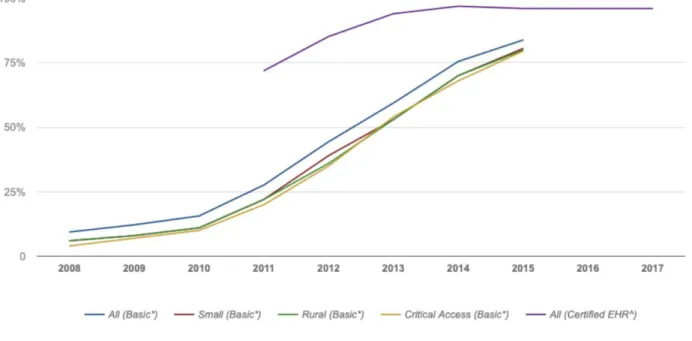
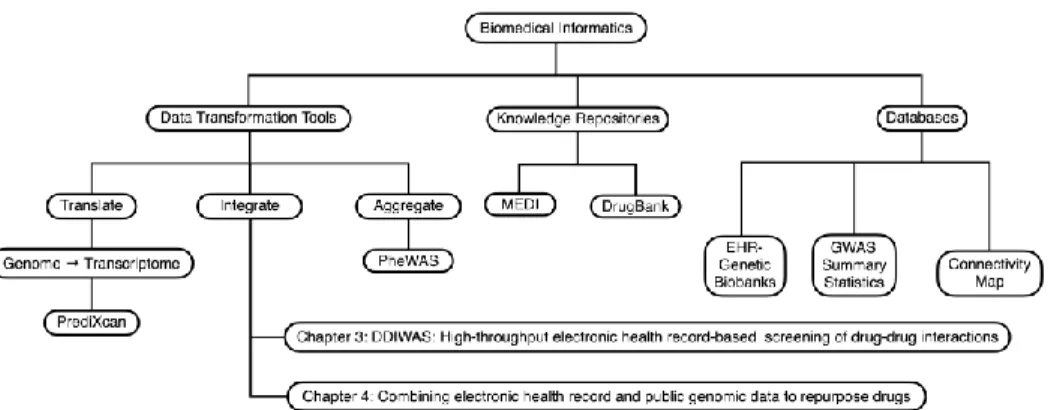
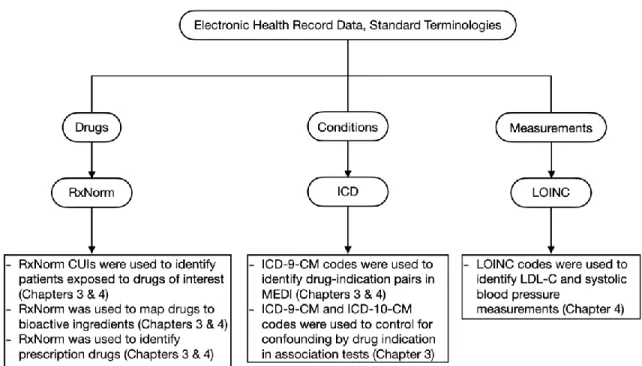
This change provided the opportunity to develop portable methods to reuse EHR data for biomedical research. In this dissertation, I describe the development and application of portable methods to reuse EHR data for identifying DDI signals and validating drug reuse candidates (Figure 1).
BACKGROUND
Electronic Health Record Data
Standardized terminologies in EHR data
Disadvantages of phenotyping based on ICD codes include its primary use for billing, as specificity may differ depending on the phenotype of interest. SNOMED-CT is also the terminology chosen to represent diagnoses in the OHDSI/OMOP CDM because it is much more expressive and has an extensive hierarchical structure.[21] Diagnoses shown in SNOMED-CT can be mapped to ICD codes using existing publicly available mappings. In Chapter 3 I use ICD codes to check for DDIs that may be confounded by indication.
Large EHR data
CDM OMOP/OHDSI,[11,28] is based on standard terminologies providing a template to organize data in relational databases, thus allowing query code written in one institution to be used, with minimal modifications, in external databases also organized using OMOP /OHDSI CDM. OMOP/OHDSI CDM, thereby increasing the ability of other researchers to see if the findings described in these studies are replicable in their own database.
Human Transcriptomic Data
SNP imputation is possible because of the significant investment and work in creating tools and resources to annotate the human genome. The project has enabled the research community to understand some of the links between genetic variants and human diseases.[59] The most recent version of GTEx contains RNA-seq data linked to patient genotypes spanning 49 different tissues.[60] For S-PrediXcan models, the SNP weights are calculated using an elastic net model, with the SNPs as independent variables and gene expression as dependent variables.
Drug Perturbation Data
ConnectivityMap (CMap),[62] L1000,[63] and DrugMatrix.[64] The data in these drug databases are drug-induced gene expression signatures. For DrugMatrix, the gene expression signatures were obtained from primary non-human animal tissue, such as rat liver, induced by drug exposure.
Drug-Drug Interactions
Existing methods to identify DDIs using EHR data
Iyer et al mined EHRs to confirm and discover potential new DDIs.[12] They used patient medication lists to infer drug exposure and developed a simple text annotation tool to search unstructured text for ADRs in clinical narratives that were mapped to MedDRA terms. They chose 14 ADRs to showcase their pipeline; 14 side effects were those that occurred frequently in their database.
Gap in knowledge for using EHR data to detect DDIs
Drug Repurposing
Etanercept, a drug originally developed to treat sepsis, has been modified to treat rheumatoid arthritis (RA).[85] Bupropion was originally approved for depression and then for smoking cessation.[86] Bupropion has recently been shown to be effective in the treatment of methamphetamine use.
Repurposing drugs with retrospective observational analysis
Repurposing drugs using human genetic data
The best drug candidates were those that reversed the gene expression signature of inflammatory bowel disease. Nevertheless, while gene expression signature-based drug repurposing is a promising approach, reading gene expression is currently much more expensive than genotyping.
Gap in knowledge for using human ’omic data and clinical data in EHRs to identify drug repurposing candidates
And that reversing the phenotypic gene expression signature could potentially reverse the biological processes underlying the phenotype. Dudley et al [99] used publicly available gene expression data to identify small molecule drugs as good candidates for the treatment of inflammatory bowel disease.
DDIWAS: HIGH-THROUGHPUT ELECTRONIC HEALTH RECORD-BASED SCREENING OF DRUG-DRUG INTERACTIONS
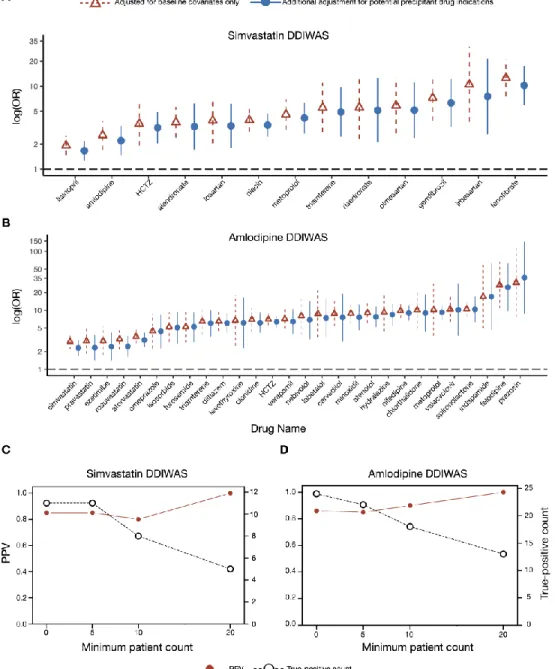
This new method detects potential drug interactions (DDIs) using data from an electronic health record (EHR) allergy list. The positive predictive value for detection of known DDIs was 0.85 for simvastatin and 0.86 for amlodipine, respectively.
Introduction
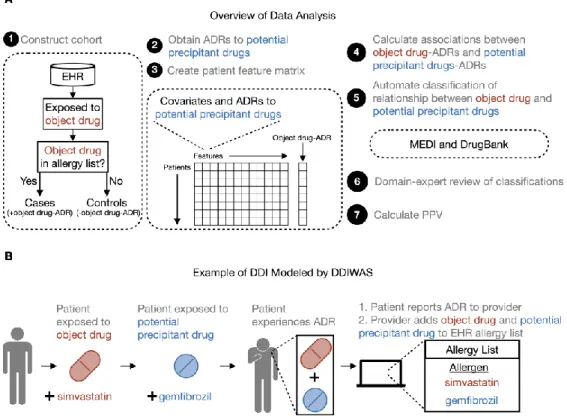
In this example of a DDI modeled by DDIWAS, the subject drug is simvastatin and the potential precipitating drug is We searched for potential precipitating drugs that were disproportionately co-documented with the target drug on patients' allergy lists.
Materials and Methods Defining a drug-drug interaction (DDI)
Study design
For both cases and controls, we designated the date on which drug exposure occurred at the facility as the start of the observation period (T0) (Supplementary Figure 1B). For cases, we set the date on which the subject drug was first documented on their allergy list as the end of the observation period (Te).
Data preprocessing and association analysis
To prevent false positive associations due to the absence of entries on the allergy list, we excluded.
Labeling of DDIWAS output
We used DrugBank to identify potential staining drugs known to adversely affect the drug of interest. For the final classification of subjects and possible drug pairs, all labels were manually reviewed by an expert in the field (S.N., pharmacist).
Measuring DDIWAS performance to replicate known DDIs
We labeled potential precipitating drugs that meet the two conditions, to help us interpret the DDIWAS results and to measure the ability of the method to replicate known DDIs. True positive” if the Drug Bank description indicates that for both the target drug and the potential drug, drug metabolism is decreased, serum concentration is increased, drug absorption is increased, drug elimination is decreased, or drug utilization is decreased. simultaneously increases the risk of ADRs (eg, rhabdomyolysis with the use of simvastatin).
Adjusting for potential confounders and sensitivity analysis
Our gold standard reference for “True-positive” findings was DrugBank[16] followed by domain expert review. We also performed a sensitivity analysis by calculating PPVs and true-positive counts using the minimum patient count thresholds of 1, 5, 10, and 20 patients in each cell of the 2x2.
Data visualization
Validation studies for potentially novel DDIs
Results Simvastatin DDIWAS
Two false-positive (+amlodipine-ADR, +levothyroxine-ADR) patients had neither the object nor the potentially triggering drug on their allergy list. Fourth, for valaciclovir, 4/5 of the DDIWAS-labeled (+amlodipine-ADR, +valaciclovir-ADR) patients had both drugs on their allergy list.
Replication sensitivity analysis
The single false-positive DDIWAS marked (+amlodipine-ADR, +ezetimibe-ADR) patient had neither drug listed on their allergy list. Third, for omeprazole, all (10/10) DDIWAS-marked (+amlodipine-ADR, +omeprazole-ADR) patients had both drugs documented on their allergy lists.
Discussion
This finding is supported in the literature, as patients using both calcium channel blockers (eg, amlodipine) and alpha-1 blockers (eg, prazosin) are at increased risk of developing. We found that the amlodipine-ezetimibe association was most likely confounded by interactions between amlodipine and statin drugs.
Conclusions
Fifth, to increase the transferability of the DDIWAS, we did not use the ADR information that was present in some of the allergy list entries. In summary, we developed and evaluated DDIWAS, a new method that uses EHR allergy list entries to detect DDIs.
Acknowledgements
Funding Statement
Competing Interests Statement The authors have no competing interests to declare
Data Availability Statement
Supplementary Information
Supplementary Figure 1. Data processing and analysis overview
Supplementary Figure 2. Algorithm to calculate PPV for DDIWAS
Supplementary Figure 3. Interpretation of DDIWAS results and 2x2 contingency table
Supplementary Figure 4. Patient counts and number of unique potential precipitant drug ingredients
Supplementary Table 1: Statistics for the primary simvastatin and amlodipine DDIWAS experiments
Columns “nA”, “nB”, “nC” and “nD” are the patient scores in the 2x2 contingency table (Supplementary Figure 3). Column “label” indicates the final label for the object and potential precipitating drug pair after automatic classification followed by domain expert review (Supplementary Figure 2).
Supplementary Table 2: Comparison of outputs from logistic regression adjusted for baseline covariates and with additional adjustment for potential precipitant drug indications
Supplementary Table 2: Comparison of logistic regression results adjusted for baseline variables and with additional adjustment for potential precipitating drug indications. The “model” column indicates whether the results are from a regression adjusted for baseline variables only or with additional adjustment for potential precipitating drug indications.
Supplementary Table 3: PPVs for Simvastatin and Amlodipine DDIWAS
Supplementary Table 4: Comparison of results from baseline regression and regression with additional adjustment for potential precipitant drug-ADRs
COMBINING TRANSCRIPTOMIC DATA AND ELECTRONIC HEALTH RECORDS TO REPURPOSE DRUGS
Abstract
An initial list of drug repurposing candidates was obtained from iLINCs; drugs in this list induced perturbations that reversed the S-PrediXcan estimated phenotype transcriptomic signatures. In the discovery study, potential new drug repurposing candidates were clinically validated using real-world data from two independent EHR databases.
Phenotype transcriptomic signatures and drug database query
Replication study
Discovery study
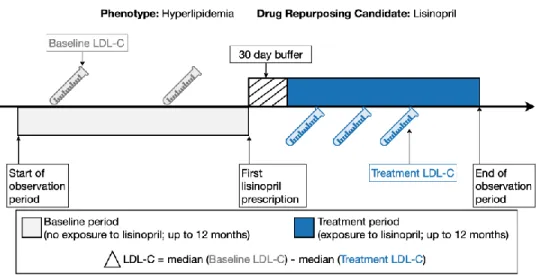
For hypertension, we validated ten drug repurposing candidates with the largest sample sizes in the Vanderbilt EHR. As shown Figure 2, consider the clinical validation study of lisinopril as a drug reuse candidate for hyperlipidemia.
Querying iLINCS database for drug repurposing candidates
In conclusion, we have demonstrated as a proof-of-concept a high-throughput generalizable approach to identify drug repurposing candidates using genome-wide transcriptomic signatures. To query iLINCS for drug repurposing candidates, we searched for drugs that reversed the S-PrediXcan estimated phenotype transcriptomic signatures.
Replication of approved drugs for target phenotypes
To measure the similarity between S-PrediXcan estimated phenotype transcriptomic signatures and drug-perturbed transcriptomic signatures in iLINCS, either a weighted Pearson correlation[144] or moderated z-score was used.[63] Promising drug repurposing candidates were those with perturbations that reversed the phenotypic transcriptomic signature estimated by S-PrediXcan (ie, negative correlation coefficient/concordance) with a P < 0.05 for. We used the LINCS dataset for hypertension because the drug list contained more known antihypertensive drugs than other datasets in iLINCS.
Discovery study: selection of drug repurposing candidates for clinical validation in the EHR
To identify drug ingredients approved for the treatment of hyperlipidemia, we used the ICD-9-CM codes 272.0 "Pure hypercholesterolemia," 272.2 "Mixed hyperlipidemia," and 272.4 "Other and unspecified. Discovery study: clinical validation of drug repurposing candidates using real-world clinical data in the EHR.
Discovery study: clinical validation of drug repurposing candidates using real- world clinical data in the EHR
We reported the mean and standard deviation (SD) for the median plasma LDL-C level for both periods and for the change in LDL-C. Discovery study: external clinical validation of drug repurposing candidates in the All of Us dataset.
Discovery study: external clinical validation of drug repurposing candidates in the All of Us data set
To measure the treatment effect of the drugs on LDL-C, we calculated the difference between the median LDL-C levels during the baseline period and the levels during the treatment period. defined as 1.5 x the interquartile range, outside the first and third quartiles). The treatment effect was measured in a cohort of patients without exposure to known antihypertensive drugs during the observation period.
Code availability
We used a one-tailed paired t-test to measure the effect of each drug on plasma LDL-C levels with a type 1 error rate set at a Bonferroni-corrected value of 0.05. The null hypothesis was that the drug had no effect or increased plasma LDL-C levels, and the alternative hypothesis was that the drug decreased LDL-C levels.
Supplementary Material
Supplementary Figure 2. Selection of drug repurposing candidates to clinically validate in EHR
Supplementary Figure 3. Cohort selection for Vanderbilt clinical validation studies
Supplementary Figure 4. Cohort selection for All of Us clinical validation studies
Supplementary Table 1: S-PrediXcan Scored Transcriptomic Signatures Used to Query iLINCS for Repurposing Hyperlipidemia Drug Candidates. Supplementary Table 2: S-PrediXcan Scored Transcriptomic Signatures Used to Query iLINCS for Repurposing Hypertension Drug Candidates.
SUMMARY
Summary of findings
The NIH All of Us Research Program Worksheet was in beta when these experiments were conducted, and only demonstration projects focused on replicating known findings[145] and predictive models[167]. To my knowledge, this is the first study to present a new method for biomedical discovery conducted in the NIH All of Us Research Program database.
Limitations
Future Directions
In vitro drug interaction studies - guidance on drug interactions with cytochrome P450 enzymes and transporters for industry. 119 Study of the Effectiveness of Additional Reductions in Cholesterol and Homocysteine (SEARCH) Collaborative Group, Armitage J, Bowman L, et al.