Mahoney, Kelos Legacy: Eminent Domain and the Future of Property Rights, 2005 S Ct Rev T]heel Kelos could be an inadequate or even counterproductive protection of property rights."). Epstein, Takings: Private Property and the Power of Eminent Domain 15- 18 (Harvard 1985) (arguing that property rights should be treated like other constitutionally protected rights); C.
ENTRENCHMENT: W HAT AND How
Much of the literature on entrenchment operates at this conceptual level." Democratic theorists argue about what entrenchment means for self-determination. Legislation that cannot formally be repealed is at one end of the spectrum." At the other end is planting a tree, passing a road budget or carrying out some of the other routine functions of local government.
Local Governments and Private Law
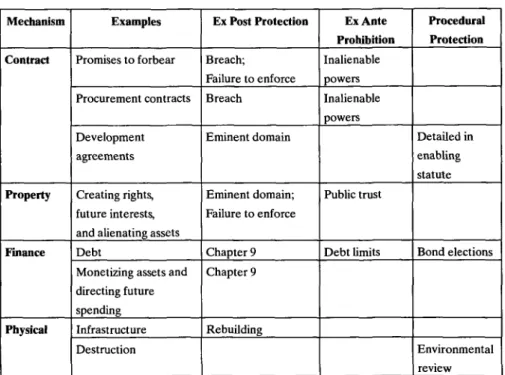
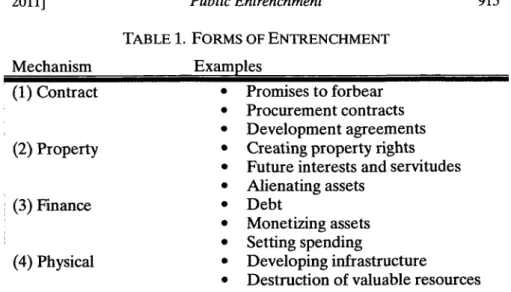
SOURCES OF ENTRENCHMENT
- Promises to regulate or to forbear
- Long-term procurement contracts, franchises, and proprietary
- C onsent decrees
Governments have become increasingly sophisticated in using such contracts to capture immediate benefits and lock in policy for the future." Moreover, the consent decree becomes largely immune to efforts by subsequent government actors to modify or rescind it."
Property Entrenchm ent
- Creating property rights
- Creating future interests and servitudes
- A lienating im portant assets
- D edicating public land
If the government wants to change the use, it can do so only by confiscating the property (or through penalty, of which later).." Congress passed it as an objectionable charge, however, requiring the owner to continue using the property. as a war memorial."
Financial Entrenchm ent
- M unicipal debt
- R estricting future incom e
- D irecting future expenditures
- D evelopm ent
- D estruction
- PROTECTION FROM ENTRENCHMENT
- Breach
- Em inent dom ain
- Bankruptcy
- Failure to enforce
The more expensive it is for a government to secede, the less flexibility successive governments have."'. But this provides little relief from the entrenching effect of vested contractual rights, like franchises."'. As the Supreme Court expressly stated in The proviso from this necessary authority of the state is considered to be part of the contract.”8.
194 Id at 650 ("To enjoy bankruptcy protection, a location must meet five threshold requirements, which are different (and more difficult) than the requirements other debtors face.").
Ex A nte Prohibitions
Inalienable powers and public trust
Kearney and Thomas W. Merrill, The Origins of the American Public Trust Doctrine: What Really Happened in Illinois Central, 71 U Chi L Rev. 222 The public trust doctrine “emerged from the watery depths [of navigable waters] to embrace the dry sand.” area of a beach, rural parks, a historic battlefield, wildlife, archaeological remains, and even a downtown." Richard J. Lazarus, Changing Concepts of Ownership and Sovereignty in Natural Resources: Questioning the Public Trust Doctrine, 71 Iowa L Rev .
For example, the New Jersey Supreme Court held that the public trust doctrine cannot be static but must evolve over time to meet the needs of the public.
D ebt lim its
The point remains: substantial entrenchment protections limit a government's ability to bind the future by cutting out things the government is simply not allowed to do. In short, local governments have become increasingly adept at circumventing the protections that states introduced in the nineteenth century, specifically in response to concerns about entrenchment.
Procedural Protection
Interlocal com petition
This entrenchment may increase as a result of increased competition among local governments for mobile capital and high-value applications. Local governments and local officials generally try to attract businesses and residents who contribute more to property taxes than they consume.244 For example, wealthy empty nesters, commercial office space, and some types of light industry are all net winners for a community. Typically, these are perceived by government officials to consume more resources or cause greater damage than the benefits they contribute through property taxes or in-kind benefits.2 As a result, local governments compete with each other over high-value uses and seek to capture the low-valued outdoors. to hold. The classic story is the famous Tiebout hypothesis, which suggests that local governments compete with each other for residents by offering different combinations of services and property taxes.2 51 But the competition has also taken increasingly aggressive and creative forms.
Nevertheless, as mentioned above, one of the main risks facing any developer or investor in the municipality is the risk of regulatory changes.
Volatility in preferences
It may therefore be that interlocal competition for mobile capital and desirable residents has increased, so that the demand for new tools for competition, such as the ability to make binding prior commitments in the future, has also increased. In fact, in recent years, so-called red states have generally become redder and blue states have become bluer, indicating greater within-state stability in political preferences.” The same is true at the local level, where local governments have also become more politically homogeneous. . eventually.2 58 This trend toward increased political homogeneity, coupled with the nonpartisan nature of many local issues (and elections), suggests that local governments are safe from the polarization that infects national politics."'. The political power of baby boomers in local governments may be at the peak or even past.
262 Therefore, control over local governments is slipping away from the "baby-boomers", who have largely dominated local politics for years.26 Suspicion that the next generation does not share their values and priorities, therefore, may motivate baby boomers to get involved in politics before their power disappears completely.
ENTRENCHMENT W HY AND W HEN
- Costs
- Benefits
The overriding cost of entrenchment is simply the loss of future flexibility.6 5 2 To be precise, the cost of entrenchment is the opportunity cost created by the entrenched government action; it is the difference between the value of the entrenched policy and the preferred policy in the future. The government of the future is not the same as in the past, and the plans and priorities of its constituents may well have changed. In each scenario, the future government is stuck with the costs of the previous government's actions.
A more general version of this point calls courts important players in creating the stability necessary for public-private agreements. the price of the contract, especially with regard to contracts for complex services... which require substantial initial investments in resources, training and capital expenditure"); Gersen, 74 U Chi L Rev, 281 (cited in note 5) ("Indeed, long-term negotiations entail a greater risk of breaking the law.
The Politics of Entrenchm ent
Interest group pressure
Because governments are agents, there is always the risk that they may not be acting in the best interests of their constituents, even when enacting a law or policy. Despite the potential increase in the costs of a government decision, it is often the case that no significant interest group is likely to organize on the other side of the issue. At the time of pre-commitment, the costs may not be obvious enough, the issue may be too esoteric, or the affected interest groups may simply be too dispersed or apathetic to generate much political opposition.
The possibility to review decisions in the future can actually prevent interest groups from overreaching in the policy concessions they initially ask from the government.
Intertem poral agency costs
In theory, it should also be unpopular to delay the legislation and instead promise to redevelop the property in the future. In reality, however, the political costs may be moved into the future if the realignment does not become noticeable to most voters until it is more imminent. Indeed, upfront commitments by corporate executives can raise some of the same set of problems if the costs of some upfront commitments or promises can be moved far into the future.
Of course, the likelihood that a government will shift costs into the future is at least partially dependent on political conditions.
Preventing future political m alfunction
In small municipalities, with few demographic pressures and relatively stable preferences, the opportunity for local politicians to externalize costs for the future also appears relatively small. Not only do they have significant control over local decision-making, but they are also generally united in their interest in preserving local property values.291 There is little opportunity to shift costs into the future if those costs are capitalized in property values."' And even if it is not true - although the market is not as sensitive to the long-term political commitments of local authorities - residents themselves can expect to bear the future costs of government actions because homeowners move less often than others.29 3 In societies with less stable populations and preferences—larger municipalities or cities or suburbs facing demographic change—this policy feedback largely disappears.Unfortunately, it can be difficult, if not impossible, to tell whether a government action prevents a policy mistake in the future or is an in-between generations of power.
Indeed, this impulse is consistent with the idea that the desirability of entrenchment increases with the variance of policy preferences over time.299 Despite its theoretical appeal, therefore, preventing future entrenchment is not an advantage that justifies real-world entrenchment. political malfunction. too hard to distinguish from a bare attempt to assert preferences into the future.
Comparing Entrenchment's Costs and Benefits Ex Ante
RECALIBRATING ENTRENCHMENT PROTECTION
Vested R ights and Em inent D om ain
Conversely, if eminent domain becomes too cheap, it will be more difficult to induce reliance on the development rights. Conversely, governments are likely to be relatively insensitive to the costs of eminent domain up to a point at which their responsiveness will increase dramatically. Focusing on the deterrent role of eminent domain also sheds new light on recent efforts at eminent domain reform.
In other words, through a complete lack of attention, eminent domain reform has significantly limited a fundamental mechanism of eradication.
Breach of Contract and Development Agreements
Of course, when private parties enter into a contract, the law generally leaves it to their discretion as to the extent of the advance commitments they wish to make, and imposes a level of compensation that will theoretically enable the parties to maximize the value of their contracts.” But the possibility that political error on the front end—imposing a disproportionate share of contract costs on the future—means that governments should in many cases have more room to change course than private parties. This analysis also raises new concerns about development agreements, which have gained both academic and political favor as a tool to attract development.” The specific benefits are clear. Hanna Chung, commentary, minor exchanges; Larger Regimes: How Trading in Small, Interdependent Units Affects Treaty Stability, 10 Chi J Intl L C]contract damages focus on forcing the breacher to internalize the costs of the injured party, so that the breacher only breaches if it is equal or better for both parties to the contract. ").
However, unlike other government contracts, development agreements can sometimes be enforceable through specific performance.i' This is likely to provide more protection than developers need and may therefore be unnecessarily entrenching.' Offering compensation in the event of regulatory changes will also provide protection. , while the next government will have more freedom to change course.
The Public Trust and Inalienable Powers Doctrines
So people have long understood the need for certain types of limits on municipal debt to prevent a government from mortgaging the future.' The extensive, if ultimately porous, restrictions on municipal debt make the contrast with other forms of financial hedging all the more striking. If anything, there is a greater need for protection against some of these alternative forms of financial hedging than against traditional municipal debt.
Calibrating the protection requires empirical work, but thinking about the problem in terms of hedging reveals both the commonality between municipal debt and other forms of financial hedging and suggests general solutions that can operate either ex ante or ex post.