
Type-2 diabetes and obesity are two major health complications that affect many Mississippians, namely the African-American population. More recently, efforts to reach the African American population about diabetes education and prevention in other southern states have focused on faith-based organizations.
Introduction
American Church for African Americans in Mississippi, but discusses the extent to which these churches can be used as a more effective means of health education and diabetes prevention.
Statistics
United States Diabetes Statistic
According to national maps provided by the CDC, obesity is most commonly found in the southern region of the United States, with Texas, Oklahoma, Louisiana,. These states correlate perfectly with 2010 data on states in the highest quartile of age-adjusted percentage of the population with diagnosed type-2 diabetes (CDC).
Mississippi Statistics
Kentucky and West Virginia have at least 29.6% of their total population classified as obese (2010). To put these statistics into perspective for the rest of the country, only 36.3% of Mississippi residents identify as African American, and Mississippi's poverty rate hovers around 19.9%.
Type-‐2 Diabetes and the Diet
Carbohydrates
Carbohydrates are responsible for most of the energy needed by the body and are therefore needed in the highest amounts (Mann, 2004). Cells in the pancreas called β cells secrete insulin when the body has higher than normal blood glucose levels in an attempt to restore blood sugar levels to normal amounts (Rhodes, 2005; Schwartz, 2005).
Proteins
Furthermore, dietary fiber intake has been shown to be lower in obese men and women and in contrast to fiber intake in lean individuals. However, not enough long-term studies have been conducted to determine the effect of protein and amino acids in the diet on diabetic control.
Fats
If the body's energy supply is sufficient, fatty acids are stored for later use as TAG in adipose tissue located throughout the body. This means that diets high in unsaturated fats can have detrimental effects on the body's ability to stay healthy (Watkins, 2001).
Appropriate Diets
- Dietary Energy Density
Broadly speaking, high energy density foods provide large amounts of energy in a small amount of food. Fiber can also manipulate the energy density of food due to its ability to bind water and take up space.
Nutritional Boundaries Mississippi
The Southern Cuisine
In terms of the largest contributors to energy intake, soft drinks were the largest contributors to energy intake in African Americans in the lower Mississippi River Delta (LMD), followed by white bread and fried chicken (Subar, 1998). Nearly 81% of these African Americans reported eating fried chicken and 67% ate fried fish during a three-month food recall conducted in 2007 with 204 African Americans living in a southern state (Bovell-Benjamin, 2009; Jefferson). , 2010; Weinrich, 2007).
African American “Soul Food”
Elderly African American women in the South ate more meat than bread, vegetables, and dairy products (Lee, 1998). Therefore, it is crucial to the future success of type 2 diabetes intervention in the African American population to understand and harness the power of culture and community to spark change, while the importance and value of cultural identity is recognized in the context of cuisine.
Poverty and Health
Food Insecurity and Health
In LMD, 73.5% of a select list of fresh vegetables was found in most supermarket stores and packaged in a variety of ways, but only 4.5% of these choices were found in convenience stores and often offered only one type of package. Dietary fiber intake was significantly lower than the national average in LMD white and black adults while intake of foods with added sugar and fat was higher among Delta adults, due to a lack of fresh vegetables and cereals in the diet (Champagne, 2004).
Type-‐2 Diabetes and Exercise
At the molecular level, it is important to recognize the benefits of exercise in maintaining healthy function and reducing the incidence of type 2 diabetes. However, it is important not to exceed the lactate threshold, the point at which lactate begins to form in the bloodstream due to the lack of oxygen reaching the muscles, because it will the body is forced to obtain energy from carbohydrates through anaerobic metabolism and will not be able to burn FFA (Sato, 2000). In addition to a lack of nutritious food choices, many Mississippians do not exercise enough to balance energy intake and regulate blood sugar levels.
In a study comparing the physical activity of urban and rural women, participants living in rural areas were less likely to exercise due to barriers such as caregiving responsibilities, lack of time, lack of energy, lack of sidewalks, and a lack of safe places to exercise. exercise (Wilcox, 2000).
The Black Church and the African American community
The Black Church as a Setting for Health Intervention
Furthermore, the medical community is often perceived as turning its back on the African American population, resulting in a large underserved population and a general distrust of the health care system (Jones, 1993; Levin, 1984; Rosser, 1993). Also, African Americans seeking culturally competent health care are often unable to find African American physicians, as only 3% of the one million general practitioners in the United States are black (Ellis, 2011). Many African American churches have successfully hosted church-based health intervention programs, including prostate cancer, HIV, breast cancer, substance use, and arthritis prevention (Barry, 2006; Blocker, 2006; Irvin, 2006; Markens, 2002; Wooster, 2011).
Of particular relevance to this study, African American churches have been identified as valuable settings for diabetes intervention because of the high disparity among the African American population and the increased level of concern among church congregations (Ammerman, 2003; Hoyo, 2004; Mann, 2000). ).
A Review of Church-‐Based Interventions
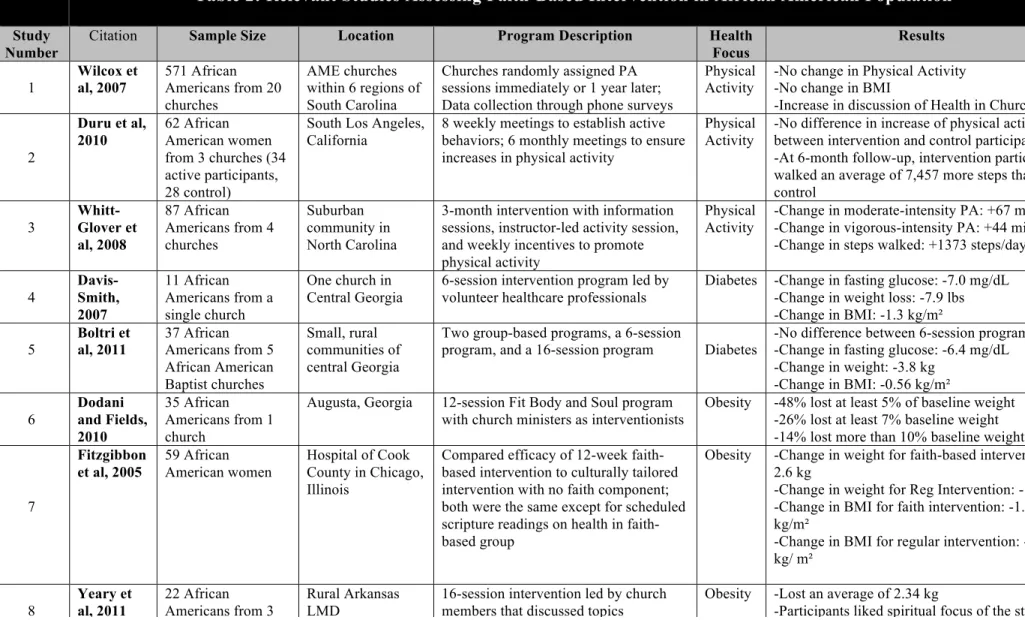
- Church-‐Based Interventions on Physical Activity
- Church-‐Based Interventions on Diabetes
- Church-‐Based Interventions on Obesity and Nutrition
Implementation strategies for the church-based intervention were most similar between Study 2 and Study 3. Those churches that had pastoral support for the program or active communication about the importance of physical activity recorded better. Each session for Study 4 and Study 5, which was held inside the church, began and ended with a prayer given by one of the church members.
Each study attempted to reduce issues of distrust by conducting all aspects of the study, from initial screenings to sessions, within the church.
Church-‐Based Interventions in Mississippi
One article that was on the list described money going to religious anti-smoking organizations. The Mississippi State Department of Health website provided information on grants for faith-based intervention research and stated the goal of increasing community-level action to combat diabetes. Mississippi Faith-Based Health and Wellness Network, a collaborative group of health and faith-based health professionals.
This study, located in the Mississippi Delta, incorporated ten faith-based organizations into a 12-week intervention that focused on creating healthy lifestyles in diabetics.
Methods
- Selection of Churches
- Participant Eligibility
- Data Collection
- Data Analysis
Pastors were contacted by phone or email and determined to be eligible to participate in the study if they met the following eligibility criteria: .. a) Was the current pastor of the church;. The interview questions were asked to prompt discussion about a wide range of topics, including the church's food service, the health status of the congregation, and the pastor's opinions of the church's stance on physical health. Interviews were transcribed by the principal investigator and relevant quotes were selected for inclusion in the paper.
Additional comments, opinions, and suggestions not related to the questions in the scripted interview guide were included as “Additional Comments” in the results section.
Results
Food Service within the Church
Yes, Wednesday night meals are designed to be a "Healthy Meal". We tried to show them some healthier eating tips and hoped it would get them back into a regular diet routine. When a speaker comes, we will usually do some kind of salad, not meat and bread." We will have two vegetables, such as vegetables prepared with smoked turkey neck, corn or green beans.
But now, if we have foods that are not diabetic safe, we will inform them in advance.
Community and Church Health
Anyone can come into the walls of the church and say they love Jesus, but it's what we do outside the walls that really shows if we really love Jesus. There is still a strong sense of the church's role and responsibility in civic engagement... This is one of the biggest things in the ministry that has helped the community and the church.
Well, it's the same principle: in the church, people are food lovers, and the church had to be a place for them.
Discussion
Discussion of Findings
- Discussion of food service in the African American Church
- Discussion of Community Health and the Church’s Potential Role in Preventative
The second half of the interview was designed to assess observations of health in the church, as well as to investigate the potential of the church to become a model for preventive health. The church is usually a place for spiritual guidance and counsel, but the African American church plays a key economic and political role in the lives of many African Americans. One obstacle to this emphasis on church leadership in health education is the unhealthiness of pastors.
The pastor of Church 5 has highlighted this issue, stating that the biggest problem in the church's efforts to combat health complications is generally unhealthy clergy.
Strengths and Limitations
Others were also convinced that the church would accept the changes when they understood that it is the duty and responsibility of the church to take care of the physical and spiritual health of its congregation. Through personal conversation with pastors, the interviews may have prompted introspection into this current health ministry focus and may have inspired a desire to use health as another means to help the congregation and further their spiritual understanding of the Bible. Of the other churches I have been in contact with, most have not been able to provide me with a direct conversation with the pastor, even after multiple attempts.
A more scientific and objective study might have provided a better indication of the current state of health in the African American church, as well as a means to better assess the church as a setting for preventive health care intervention from a purely quantitative standpoint.
Suggestions for Future Research
Further studies should provide information about nutrition especially to pastors or members of the health ministry. These organizations are better suited to reach out and influence members of the community than more formal approaches. Type-2 diabetes is a very serious problem in Mississippi and the incidence and prevalence rates must be reduced for the sake of the citizens of Mississippi and for the preservation of our culture.
By better informing pastors about health, Mississippi's public health agencies would be better able to reach and inform the majority of the population.
Pastor Interview Guide
Dietary intake in the Lower Mississippi Delta region: results from the foods of our delta study. Perception of factors influencing healthy food consumption behavior in the Lower Mississippi Delta: Focus group findings. Perceptions, behaviors, and ability to purchase healthy foods in the Lower Mississippi Delta.
High prevalence of food insecurity and hunger in households in the rural lower Mississippi Delta.
