POLITICS
THE BASICS
4TH EDITION
This highly successful introduction to the world of politics has been fully revised and updated in collaboration with a new co-author, Nigel Jackson of the University of Plymouth. The new edition builds on the reputation for clarity and comprehensive coverage of the previous editions. It explores the varieties of political systems, the main political movements and key issues at the beginning of the twenty-first century.
New to the fourth edition:
• comparison of quantitative and qualitative methods
• more international examples
• greater discussion of non-Western concepts of politics
• the problem of voter apathy and lack of trust in politicians
• more discussion of the ‘war on terrorism’
• extended analysis of the role of the Internet in politics including blogs, search engine censorship and e-democracy
• analysis of further key concepts such as genocide and policy networks
• more links to web pages including case studies, further questions to explore and additional learning activities.
Accessible in style and topical in content, this book assumes no prior know- ledge of politics. These features make it ideal reading for general readers as well as for those who are just beginning to study politics at undergraduate level.
S
Stteepphheenn DD.. TTaannsseeyy has taught Politics at the universities of Ife (Nigeria), Exeter and Bournemouth, for the Open University and the WEA. He is the author of Business, Information Technology and Society(also published by Routledge).
N
Niiggeell JJaacckkssoonn has worked as a parliamentary agent for a UK political party, for an MP and as a parliamentary lobbyist. Teaching at the University of Plymouth, his research interests are in political communication and political marketing, especially online.
THE ROUTLEDGE DICTIONARY OF POLITICS DAVID ROBERTSON
FIFTY MAJOR POLITICAL THINKERS (SECOND EDITION)
IAN ADAMS AND R.W. DYSON
FIFTY KEY FIGURES IN TWENTIETH-CENTURY BRITISH POLITICS KEITH LAYBOURN
FIFTY KEY THINKERS IN INTERNATIONAL RELATIONS MARTIN GRIFFITHS
INTERNATIONAL RELATIONS: THE KEY CONCEPTS MARTIN GRIFFITHS AND TERRY O’CALLAGHAN
THE ROUTLEDGE COMPANION TO FASCISM AND THE FAR RIGHT PETER DAVIES AND DEREK LYNCH
INTERNATIONAL RELATIONS: THE BASICS PETER SUTCH AND JUANITA ELIAS
POLITICS THE BASICS
4TH EDITION
stephen d. tansey and nigel jackson
Second edition published 2000 Third edition published 2004 Fourth edition, 2008 by Routledge
2 Park Square, Milton Park, Abingdon, Oxon, OX14 4RN Simultaneously published in the USA and Canada by Routledge
270 Madison Ave, New York, NY 10016
Routledge is an imprint of the Taylor & Francis Group, an informa
© 1995, 2000, 2004 Stephen D. Tansey; 2008 Stephen D. Tansey and Nigel Jackson
We, Stephen Douglas Tansey and Nigel Jackson, hereby assert and give notice to our right under section 77 of the Copyright Design and Patents Act 1988, to be identified as the authors of this work.
All rights reserved. No part of this book may be reprinted or reproduced or utilised in any form or by any electronic, mechanical, or other means, now known or hereafter invented, including photocopying and recording, or in any information storage or retrieval system, without permission in writing from the publishers.
British Library Cataloguing in Publication Data
A catalogue record for this book is available from the British Library Library of Congress Cataloging in Publication Data
Tansey, Stephen D., 1942–
Politics : the basics / Stephen D. Tansey and Nigel Jackson. — 4th ed.
p. cm.
Includes bibliographical references and index.
1. Political science. I. Jackson, Nigel A. II. Title.
JA66.T35 2008
320—dc22 2007038803
ISBN 10: 0–415–42243–4 (hbk) ISBN 10: 0–415–42244–2 (pbk) ISBN 10: 0–203–92919–5 (ebk) ISBN 13: 978–0–415–42243–7 (hbk) ISBN 13: 978–0–415–42244–4 (pbk) ISBN 13: 978–0–203–92919–3 (ebk)
This edition published in the Taylor & Francis e-Library, 2008.
“To purchase your own copy of this or any of Taylor & Francis or Routledge’s collection of thousands of eBooks please go to www.eBookstore.tandf.co.uk.”
ISBN 0-203-92919-5 Master e-book ISBN
ESPECIALLY ELIOT, TOBY, FREYA AND JAKE
CONTENTS
List of illustrations xi
Preface xiii
Acknowledgements xix
1 Politics 1
This chapter . . . 1
Politics in everyday life 1
What is politics? 3
Approaches to the study of politics 7
Traditional scholarship 9
Social science and politics 12
Schools of political science 15
Theories, models, paradigms 18
Radical and postmodernist criticism 19
Conclusion 23
Recommended reading 23
Websites 24
2 Systems 26
This chapter . . . 26
States and societies 26
Politics without the state: tribal societies 27
Feudalism 31
States without nations: kingdoms 33
States without nations: empires 36
Nations and states 38
The nation state and sovereignty 39
Politics between states 40 Politics beyond the state: international institutions 41 Multinational enterprises and ‘globalisation’ 42
Politics as a universal activity 47
Recommended reading 48
Websites 48
3 Concepts 50
This chapter . . . 50
Human nature and politics 50
Is the state necessary? 52
Why should i obey the state? 54
The nature of authority 56
What is justice? 57
Individualism versus collectivism 60
Rights: natural, human, legal 61
Equality 62
Positive and negative freedom 64
Analysing political concepts 65
Recommended reading 67
Websites 68
4 Ideologies 69
This chapter . . . 69
Ideology 69
‘Right’ versus ‘left’ 71
The old right: monarchism 72
The radical right: Nazism and fascism 74
Marxism 76
Leninism and Stalinism 77
Other Marxisms 79
Radicalism 81
Radical theism – Catholic, Protestant and Islamic 81
Ecology as political radicalism 84
Feminism as political radicalism 86
Liberalism 89
Conservatism 92
Thatcherism and neo-conservatism 94
Christian democracy 95
Socialism and social democracy 97
Communitarianism and the ‘third way’ 99
Recommended reading 101
Websites 102
5 Processes 103
This chapter . . . 103
Political identity 103
Political socialisation and political culture 104 Localism, nationalism, religion and ethnicity 107
Racial and ethnic conflict 110
Dominance, assimilation and social pluralism 112
Elites, classes and political pluralism 114
Political change 117
Coups d’état and revolutions 120
Terror and terrorism 121
Class conflict in the twenty-first century 123
Post-industrial politics: the information polity? 125
‘North’ versus ‘South’? 129
Conclusion 133
Recommended reading 134
Websites 134
6 States 136
This chapter . . . 136
Types of state 136
Democracy, the welfare state and the market 139
Forms of representative democracy 142
Military autocracy 146
Civil autocracy 148
Totalitarian governments 150
Nazi government 151
Soviet government 152
Islamic government – breaking the mould? 153
Multi-level government 155
European political institutions 159
Local government 164
Conclusion 168
Recommended reading 168
Websites 169
7 Democracy 170
This chapter . . . 170
How can government be ‘democratic’? 170
Participation and direct democracy 171
Choosing rulers 173
Electoral systems 173
The executive 175
The legislature 177
The judiciary 179
Constitutions and constitutionalism 181
Rights and constitutions 182
Pluralist policy making 185
Corporatism 186
Centralisation 187
Political communication 189
Political parties 191
‘Spin’ and political marketing 193
The permanent campaign 194
Interest groups 195
The mass media 197
The Internet 202
Democracy and communication 204
Recommended reading 204
Websites 206
8 Policies 209
This chapter . . . 209
Public policy problems and solutions 209
The choice of social decision-making mechanisms 210
The case for the market 212
Problems of market decision making 213
Voluntary organisation 215
Rational policy making: bureaucracy 217
Problems with ‘rational’ policy making 220
Incremental decision making 222
The policy process 224
Implementing public policy 225
Managing local public policy 228
Multi-level governance 229
Evaluating public policy 231
Monitoring performance in public policy 232
Evaluating policy outcomes: the distribution of wealth and income 234
The political policy-making process 236
A crisis in democratic politics? 237
Taking political action 238
Recommended reading 239
Websites 240
Appendix: sources on politics 241
References 249
Index 267
ILLUSTRATIONS
FIGURES
4.1 Classifying ideologies 73
8.1 Levels of inter-organisational bargaining 227
8.2 Managing local public service provision 229
BOXES
1.1 Definitions of ‘politics’ and ‘power’ 4
1.2 Assessing the use of methodology in politics 23
2.1 Definition of ‘state’ 27
2.2 Definitions of globalisation 46
2.3 Globalisation – challenges to the nation state 46
3.1 Definitions of anarchism 52
3.2 Justice 59
3.3 Concepts of equality: summary 63
3.4 Definitions of freedom 64
4.1 Ideology as a political concept 71
5.1 Definitions of political socialisation 105
5.2 Political culture 105
5.3 Propositions from pluralist, elite and Marxist models of power 116 5.4 North v South: a major fault line in international relations? 132
5.5 Major political divisions 133
6.1 Republican, autocratic and totalitarian states 137
6.2 Capitalism 140
6.3 The welfare state 141
6.4 Forms of representative democracy 142
6.5 The principle of subsidiarity 157
6.6 Relations between levels of government 158
7.1 Political parties 191
7.2 Pressure or interest groups 195
8.1 Choice of social decision-making mechanism 211
8.2 Weber’s characteristics of bureaucracy 218
8.3 A rational–comprehensive model of decision making 219 8.4 Why organisations are not always rational 220 8.5 Hogwood and Gunn’s model of the policy process 224 8.6 Ten principles for reinventing government 230 8.7 The 3 ‘E’s: efficiency; economy; effectiveness 232
TABLES
1.1 Major contemporary approaches to politics 10
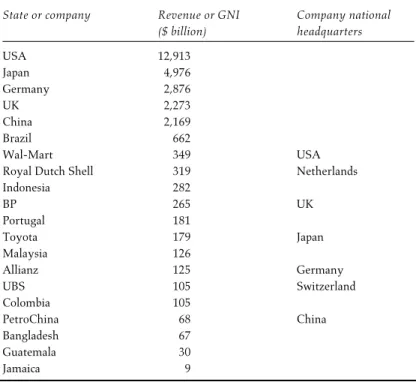
2.1 Multinationals and countries compared 43
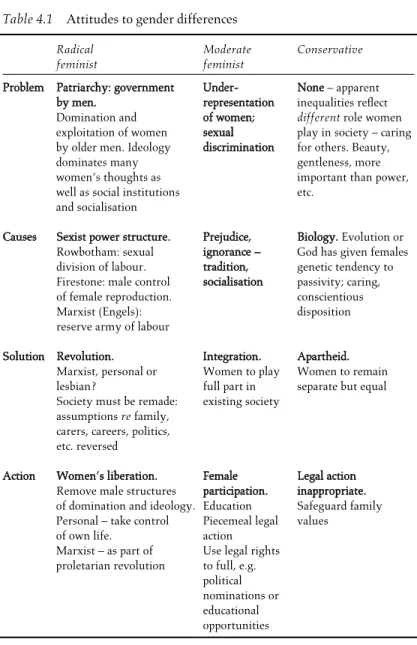
4.1 Attitudes to gender differences 88
5.1(a) Typical socialisation research findings: attitudes to president 106 5.1(b) Typical socialisation research findings: most popularly
used sources of information about foreign people 106 5.2 Typical research findings: political culture 107
5.3 Summary: critics of pluralism 117
5.4 From public administration to information polity 129
6.1 The trend to democracy, 1974–2000 139
6.2 Parliamentary versus presidential systems 143
7.1 Political marketing and New Labour 194
8.1 Marketable wealth in Britain 234
8.2 World population below international poverty line (2001) 235
PREFACE
WHO THE BOOK IS FOR – AND WHAT IT IS ABOUT
This book is designed as a basic introduction to twenty-first century politics. We do not claim to be able to predict with certainty the political shape of the new century. However, it is already clear that many of the old perspectives of superpower rivalry and class and ideological warfare which dominated the era of the Cold War seem to be of reduced relevance. Issues such as ecology, new technology, Islam, terrorism, feminism and the role of what used to be described as the Third World (referred to as ‘the South’ in this book) are likely to move to centre stage. An introduction to politics that takes a parochial single-country approach no longer seems sensible in an era of increased international interdependence.
The readers we have in mind are without a systematic knowledge of, or rigid attitudes towards, politics. This book is intended both to enable such readers to make up their minds about politics and to understand more about the academic discipline of politics (or, as it is more grandly described in the United States, ‘political science’). In particular, pre-university students, whether or not they have studied politics at school, have found this book a useful indication of the ground covered by university courses. The book has also been found useful for undergraduates beginning courses in politics. It has also formed the basis of short subsidiary courses in politics at under- graduate, postgraduate and extra-mural level. However, we hope that open-minded and intelligent older and younger readers alike will also
find much of interest in this approach. Nor would we have any objection to the occasional practising politician quarrying something useful from the work!
We have not taken the view that a ‘social scientific’ approach requires the assumption of an attitude of detachment from the politics of the day. But neither have we tried to sell a short-term political programme. The approach here is to search for long-term principles that can help guide political actions. ‘Politics’ has been taken to mean the essential human activity of deciding how to live together in communities. This activity has been put in a long-term and wide geographical context. Frequent reference has been made to both Europe as a whole and the United States as well as to the United Kingdom. The focus is on the relatively prosperous industrialised countries of the ‘West’, but this cannot be detached from those of the rest of the world. In considering such an ambitious agenda we have drawn extensively on the work of many academics, whose ideas have in many cases already been borrowed (often in caricatured form) by politicians.
In a book designed to help readers make up their own minds about politics, no attempt has been made to hide the authors’ liberal and socially progressive point of view. This has inevitably been reflected in such matters as the choice of topics for discussion. But it is hoped to give a fair representation of all other major points of view and to give an indication of where the reader can find accessible versions of alternative perspectives.
HOW THE BOOK IS ORGANISED
The book begins with a discussion of the nature of politics and the variety of academic approaches to its understanding. Chapter 2 illustrates the variety of contexts in which political activity takes place. Chapters 3 and 4 then survey competing ideas about the aims of that political activity.
The final four chapters of the book consider in more detail what and how political decisions are reached. Chapter 5 covers what kinds of decisions are made and how political systems change. Chapter 6 reviews the variety of different states. Chapter 7 focuses on how modern democracies make their decisions. Finally, considering more specifically some particular areas of public policy making, the
limitations of public policy-making processes and the role of indivi- duals in politics are discussed in Chapter 8.
The book is not divided up in the same way that many politics courses are into sub-disciplinary areas. But, in these terms, Chapter 1 is about methodology, chapters 3 and 4 are mainly political theory, 2 and 5 mainly political sociology, chapters 6 and 7 are mainly political institutions/comparative government and Chapter 8 public policy and administration.
To assist users of the previous editions of the book, it may be helpful to point out the major innovations in the fourth edition.
These are:
• explicit treatment of the need for political theories and comparison of quantitative and qualitative methods in Chapter 1;
• decline in the partisan interpretation of politics is stressed in Chapter 1;
• some more specific definitions of globalisation in Chapter 2;
• continued emphasis on the implicit message that Western demo- cratic politics should not be assumed to be the norm in Chapter 2;
• a discussion of genocide in Chapter 3;
• revision of the discussions of ideology and the Third Way in Chapter 4;
• more discussion of the ‘war on terrorism’, in Chapter 5;
• linking of the discussion of representative democracy to the ideas of Burke;
• updated discussion of the role of the Internet to refer to blogs and e-democracy;
• analysis of the permanent campaign with more on spin and inter- national politics;
• two new sections in Chapter 8 on changes in the political policy process and the crisis of modern democracy. This has been put in the context of the US/UK axis on the market economy as opposed to the French/German more statist approach;
• Each chapter now ends with a list of useful websites, as well as recommended reading.
This new edition, in addition to obvious changes following such developments as the departure as prime minister of Tony Blair in Britain and developments in the ‘war on terror’, has also been further
amended to strengthen its international references both for the bene- fit of its many international readers (including readers of editions in Polish and Chinese) and to counter the parochialism of many intro- ductory courses and books in Britain.
At all times the intention is to assist readers to make up their minds about issues, rather than to argue for some predetermined conclusion.
HOW TO USE THIS BOOK
There are many ways to attempt to introduce students to a discipline, and in this book we have chosen to concentrate on introducing some of the major arguments within politics and the concepts associated with them. Logically we have begun with the methodology and boundaries of a discipline. Complete novices to the subject may find this introductory chapter of limited interest at first and can be for- given for skipping through the second half of the chapter on initial reading.
Students already started on a politics course should find that this broader perspective on their studies stimulates more thought than many more detailed and limited textbooks. It should prove useful especially at the beginning of such courses and by way of revision at the end. It is also intended to help those contemplating such courses to decide if politics is the appropriate subject for them. By encour- aging an evaluation of the reader’s own political position and evaluating many basic political concepts as part of a sustained argument, we hope to encourage a critical and individual approach which is more valuable than a more ‘factual’ approach both in the examination room and in practice.
The Appendix on ‘Sources on politics’ will be found useful in locating additional material in an academic or public library, includ- ing the use of newer electronic information sources. Many years of experience teaching at this level have shown that most students greatly underestimate the library resources they have available.
References are organised on the Harvard system so that a date in curved brackets after an author’s name indicates a full entry in the References section at the end of the book. Such dates normally indicate the edition used by the author for references but the latest edition for items recommended for further reading. Readers new to
the Harvard system should note that the date of the edition used is not necessarily an indication of the date of composition – especially in the case of older and translated works. In addition to the References, each chapter is followed by some recommendations for suitable further reading. Pairs of dates in square brackets after a person’s name indicate dates of birth and death – approximate in the case of early figures.
A feature of the book which readers should find particularly useful is the definition of key concepts found in boxes at intervals in the text and indexed in initials at the end. Students will quickly find that any work they submit which does not clearly define its terms will obtain an unfriendly reception, and, conversely, such definitions contribute greatly to clear analysis and communication.
ACKNOWLEDGEMENTS
Finally a word of thanks to students on various politics and public sector management and public relations courses at Plymouth, Exeter and Bournemouth universities, and with the Workers’ Educational Association (WEA), for their comments and suggestions on this material.
In addition to the help from colleagues and friends acknowledged in earlier editions, this latest edition has also benefited from useful comments and suggestions from a number of readers, and the work of our editor at Routledge, Craig Fowlie and production editor Abigail Humphries has been much appreciated. The blame for infelicities and errors remains, of course, with us.
POLITICS
THIS CHAPTER . . .
discusses what politics is and the ways in which scholars have attempted to understand it. The first serious professional students and teachers (Greeks such as Plato [427–347 BC] and Aristotle [384–322 BC]) made politics the centre of the curriculum. In the twenty-first century academics are still seeking to explain politics
‘scientifically’. This chapter discusses the meaning, importance and problems of such an enterprise.
POLITICS IN EVERYDAY LIFE
Is the study of politics a sensible activity? Any watcher of tele- vision news can see that democracies vary in apparent effectiveness, equality and longevity, from peaceful and egalitarian regimes as in Switzerland and Sweden, through the controversial case of the United States of America, to apparently fragile new democracies in Eastern Europe and Latin America. Dictatorships seem to thrive at one time like the former Soviet Union, sending the first satellite into space and dominating half the world, only to crumble away as the result of forces which few seemed able to predict. There are times when it is difficult not to sympathise with the view that such matters
1
are both out of the control and beyond the understanding of ordinary people.
Yet we have seen ordinary people bravely dismantling regimes which seemed immovable, and dying for abstract ideas about politics:
thousands of Bosnians and Albanians ‘ethnically cleansed’ in the name of Serbian national identity in the former Yugoslavia; tens of thousands of ordinary citizens protesting in the Ukraine which led to the Orange Revolution. It seems wrong in the face of such evidence of the capacity of ordinary people to effect, and be affected by, political change not to consider both the nature of political institutions and what action we should take in relation to them.
Leaving aside the dramatic examples of political action and change in faraway places, it is worth examining our own lives and the impact of politics upon them.
Suppose you are an 18-year-old living in the United Kingdom, working at a McDonald’s, and hoping for a university place in the autumn. Waking up you may realise that the government (strictly Parliament) has legislated to convert what was a local time of 6:33 or so (depending on the latitude) to 7:30. Turning on the local radio station (whose franchise was granted by a QUANGO (quasi autono- mous national (or non-) governmental organisation) you may hear the weather forecast from the government-financed Meteorological Office. After hearing several CD tracks (payment of royalties to the authors and performers must be made by law by the radio station), you drag yourself out of bed (legally mattress materials must be non- flammable), down to your cornflakes (ingredients listed on packet in due form by another law). If you unwisely reach for a cigarette, the government (/European Union) has both insisted on a health warning on the packet and taken a large rake-off in the form of tax.
Without going through every minute of your day, it is clear that government is likely to be affecting almost every one of them in similar ways (air quality, traffic regulations, employment law – fill out the story yourself).
The bigger issues are, of course, affected in the same way. Can you afford to go to university? What bursaries and loans are available, or fees payable, as a result of government policy? How many places has the government financed in universities? How many other students have been educated by the state educational system to university entry level? If, on the other hand, you are unable to make it to
university, then your prospects for permanent employment will depend upon the government’s management of the economy. Pros- pects for continued employment with McDonald’s are dependent on, among other things, government policy towards foreign companies and the extent and effectiveness of health education campaigns!
So far we have only considered you and the government. Suppose on reaching the kitchen your father snaps at you: ‘Can’t you clear up the beer glasses and pizza cartons you and your friends littered the place with last night?’ Arguably this is a political situation too.
Within the family, fathers are sometimes thought to have ‘authority’
– some sort of legitimate power over children. As an 18-year-old, you might react to the speech as an assertion of authority and react back negatively on the grounds that you are no longer a child to be given orders. Conversely, your father may merely feel that in a community all should play their part and clear up their own mess. But in any case if he wants you to clear up and you do not, this can be seen as a clash of wills in which only one can prevail.
Similarly when you arrive at McDonald’s it may well be you have discovered that the assistant manager (who is in charge in the absence of the manager on holiday) is busy establishing in the eyes of the area manager that he can do a better job than his boss. Here we have a struggle for power in which people within the organisation may take sides (form factions as political scientists might say) – in short, organisational politics is being practised.
It soon becomes clear that ‘politics’ is used in at least two senses, both of which are immediately relevant to everyone’s everyday experience. In the narrowest conventional (dictionary) usage – what governments do – politics is affecting us intimately, day by day, and hour by hour. In the wider sense – people exercising power over others – it is part of all sorts of social relationships, be they kinship, occupational, religious or cultural.
WHAT IS POLITICS?
If we try to define ‘politics’ more formally and precisely, we run into the sort of problems which will be found to recur again and again in this book. It is actually quite tricky to define concepts in scientific disciplines like physics and chemistry, but if you do so, you are not so likely to be accused immediately of failing to understand the problem,
of lacking scientific objectivity or of making unwarranted assump- tions, as is a writer on politics. One of the problems is associated with whether we are talking about politics as a human activity or politics as an academic activity – or, in American terminology, politics or political science. The search for truth about how human beings exercise power might be thought to be completely separate from actually seeking to exercise that power. But in practice, as we shall see, political ideas are some of the most important weapons in the politician’s armoury. Attempts to ignore this are either naive or, quite frequently, a deliberate attempt to present a controversial poli- tical ideology as an indisputable political fact.
In this light it is worth considering rather critically the impli- cations of some of the standard academic definitions of politics and of power (Box 1.1).
BOX 1.1 DEFINITIONS OF ‘POLITICS’ AND ‘POWER’
Politics
The science and art of government; the science dealing with the form, organisation and administration of a state or a part of one, and with the regulation of its relations with other states.
(Shorter Oxford English Dictionary) . . . a way of ruling divided societies by a process of free discussion and without undue violence.
(Bernard Crick, 2000) . . . who gets what, when, how.
(H. Lasswell, 1936) . . . man moving man.
(Bertrand de Jouvenal, 1963) . . . the authoritative allocation of value.
(David Easton, 1979)
The definitions in Box 1.1 show very considerable differences, reflecting the viewpoint of the author. Most political scientists’
definitions of politics are much broader in scope than the first, dictionary, definition which focuses on the state (although admittedly
‘part of a state’ could be interpreted widely). In effect they largely endorse the view suggested above: that politics is about the social exercise of power, rather than just the state. However, this may reflect the natural ‘imperialism’ of academics on behalf of their own discipline. Sociologists might argue that ‘man moving man’ would be more appropriate as a definition of their concerns.
Consider also, though, the unit of analysis, in terms of which these definitions are couched. Weber, Lasswell and de Jouvenal appear to be thinking primarily in terms of individuals exercising power, Crick and Parsons focus upon whole societies, the Shorter Oxford English Dictionarytalks about governments, whilst Poulantzas views classes as the primary political ‘actor’. This reflects a split between indivi- dualistic and collectivist theories which will be discussed in greater detail in Chapter 3.
Power
. . . the production of intended effects.
(Bertrand Russell, 1938) . . . the probability that one actor within a social relationship will be in a position to carry out his own will despite resistance regardless of the basis on which the probability arises.
(Max Weber, in Gerth and Mills, 1948) . . . the capacity to mobilize the resources of society for the attainment of goals for which a general public commitment . . . may be made.
(Talcott Parsons, 1957) . . . the capacity of a social class to realise its specific objective interests.
(Nicos Poulantzas, 1973)
Another contrast in these definitions is that between what has been described as ‘zero-sum’ and ‘non-zero-sum’ theories of politics.
This terminology is derived from the mathematical theory of games.
A zero-sum game is the usual sort of game, such as chess, in which a win by one player is, by definition, a loss on the part of the opposing player or players. There is a fixed amount of ‘winnings’ which means that the gains of one side are, by definition, losses to the other.
Obviously many politicians, and political scientists, see politics this way. Thus Weber and (implicitly) Lasswell both seem to suggest that the political success of one individual may well be at the expense of others who oppose them. It is also a feature of Marxist theories, like that of Poulantzas, that the interests of classes are opposed and are gained at the expense of each other.
However, not all games are of this sort – for instance in collective make-believe children’s games, new themes introduced by one player can enrich the enjoyment of the game for everyone – in a game of Cowboys versus Indians, the introduction of Aliens may lead to everyone having a better time. There is not a fixed amount of
‘winnings’, but by co-operation both sides can achieve more. In a similar way, Parsons explicitly argues that, by co-operation, different groups in society can each obtain greater benefits than would be the case if they work in competition. This view seems to fit well with contemporary emphasis in many parts of the Western world on the practice of mainstream politicians seeking to build coalitions, which involves compromise. Thus different theories place radically different emphasis on consensus (agreement) and conflict in their theories of politics.
There is a growing sense that politics in the established Western democracies is struggling. This unease has been referred to as a democratic deficit, political alienation or civic disillusionment. The possible explanations for such changes are examined by Gerry Stoker (2006), but the argument is that citizens have been increasingly
‘turned off’ by traditional political behaviour, such as voting in elec- tions. This has manifested itself in a decline in partisanship, or a lessening sense of identifying with key political actors and structures.
It has been suggested that increasingly politically active citizens have ignored the coalitions and compromises offered by the existing political elite, and have instead turned to single-issue pressure group activity. But does this apparent decline in traditional partisan
electoral politics in some countries necessarily indicate a decline in the importance of politics?
The authors’ sympathies lie with Maurice Duverger (1972: 19) who argues, ‘The two-faced god, Janus, is the true image of power’. In other words, both conflict and consensus are essential elements to the creation of a political situation. The imposition of one person’s or group’s interests on another by force and without any element of consent seems far from what most people understand by ‘politics’, as Crick (2000) argues. On the other hand, a situation (perhaps unlikely) in which a group in total agreement (as to goals and methods), proceeds to achieve more and more of its objectives does not sounds like a political process either.
Thus ‘politics’ encompasses a broad range of situations in which people’s objectives vary, but in which they work together to achieve those aims they have in common as well as competing where aims conflict. Both co-operation and competition may involve bargaining, argument and coercion. Politics may often be more an art than a science, and the art of politics may often be to see the potential for alliances rather than antagonisms amongst differing groups.
APPROACHES TO THE STUDY OF POLITICS
One of the joys, and also one of the frustrations, of the study of politics lies in the variety of approaches adopted by academic writers to the subject. This is a joy in the sense that within one course of study you will be introduced to a rich spectrum of writing ranging from classic philosophers like Plato (1866) and Aristotle (1946), through radical sociologists such as C. Wright Mills (1956) and Pareto (1976), to dedicated modern social scientists wielding statis- tical tests of significance to analyse huge volumes of computerised data, e.g. Robert Dahl (1971). It is frustrating in that the conclusions of such writers cannot be simply accumulated to form a certain body of knowledge representing the political scientist’s view of politics.
Students of politics must be ready to live with uncertainty, to sift through varied sources and accept what seems to them to be relevant and valid.
The remainder of this chapter attempts to provide tools to enable students to do their own ‘sifting’, and to recognise why writers on politics differ so radically. We shall look at three main approaches to
the study of politics, and within these various schools of thought.
These should be thought of only as a sort of preliminary crude map of the terrain to be covered, not as a rigorous analysis of what kinds of writing on politics is possible, or as a series of watertight divisions.
However, it will be found that two writers within a ‘school’ generally have more in common, and are more likely to agree on what has already been established, and perhaps to refer to each other, than two writers in different schools.
The three main contemporary academic approaches to the study of politics can be described as ‘traditional scholarship’, ‘social science’
and ‘radical criticism’. With an element of exaggeration they might also be thought of as the British, the American and the French approaches (although the ‘American’ approach has gained much ground in Britain and internationally in recent years).
‘Traditional scholars’ often approach matters on a rather piecemeal basis looking at one specific country, political institution, theoretical concept or writer in depth, often with the tools and preconceptions of another academic discipline – especially history or philosophy. Thus the core of the politics curriculum in Britain, at least until recently, has been the study of individual British political institutions in their historical context; the great political philosophers; and what was misleadingly titled ‘comparative government’. The latter was, in practice, largely the study of American, French and Soviet govern- ment and politics separately. Often British courses have been part of a humanities-oriented programme such as the Oxford PPE (Philo- sophy, Politics, Economics) programme. A comparison of the leading UK and US journals showed that the leading UK journal, Political Studies, had 91 per cent of its articles focusing on institutional, descriptive, conceptual or philosophical topics (including history of political thought), whilst the American Political Science Reviewhad 74 per cent of its articles in the behavioural/empirical or deductive/
rational choice categories (Norris, 1994: 15). In continental Europe politics has often been a subsidiary part of departments of faculties of law, sociology or history.
‘Social scientists’ would denounce the traditional approach as
‘idiographic’ (a word derived from ‘ideogram’ – a personal mark or signature), espousing instead a ‘nomothetic’ or generalising approach in which the endeavour of scholars of politics must be ultimately to derive general theories or laws about the nature of political behavi-
our. Thus a typical American-style curriculum presents political science as one of a group of related social science disciplines, including sociology and economics, all using modern quantitative/computer- oriented methods of ‘analysing data’ scientifically.
‘Radical critics’, whilst not denying the need to produce useful generalisations from the study of politics, have denounced the conservative bias of US-dominated political science. Often their primary allegiance has appeared not be to an academic discipline but to a general doctrine calling for the radical change of existing (Western) societies – most frequently some variety of Marxism, but similar criticism can be produced from an ecological, theological or feminist perspective.
The basis of the distinction being drawn is mainly in terms of what writers see their task to be, the methods they employ, the level and type of their analysis, and the values they espouse, rather than the details of specific theories advanced. In addition, though, a com- parison of the specific theories advanced by different schools and approaches does show a concentration on different areas of human experience, broad patterns of difference in their content, and a tendency to draw upon similar models and to use the same concepts within schools. On examination it will often be found that where writers from different approaches and schools deal with what is apparently the same topic (e.g. ‘democracy’, ‘elections’, ‘society’) their concerns and assumptions are often so different that no real dialogue can be said to have occurred. Table 1.1 offers an overview of these major approaches and schools.
TRADITIONAL SCHOLARSHIP
The first academic writers on politics – Plato and Aristotle – whose works are still studied in detail in most British universities – were unaccustomed to the modern practice of compartmentalising know- ledge into separate disciplines. Hence they combined insights from history and current affairs with discussions on the big moral issues such as ‘What is the best form of government?’ or ‘What is justice?’
This somewhat ‘eclectic’ approach (combining insights from various different sources) was also adopted by some of the more readable classic writers in the nineteenth century such as John Stuart Mill [1806–1873], Bryce [1838–1922] and De Tocqueville [1805–1859].
These writers saw the rise of democracy as the major political development of their time and sought to analyse not only the idea, but also its contemporary manifestations in different countries, and to suggest improvements and accommodations with the emerging reality of democratic government.
Serious writers on politics now tend to be university lecturers, who have to have specialist interests and lists of articles in professional journals and/or monographs published by respectable academic publishers. They tend now to adopt a much more limited conception
Table 1.1 Major contemporary approaches to politics
Traditional Social science Radical
Task Piecemeal explanation Science of politics Radical social change Methods Descriptive, historical, Quantitative or Ideological criticism
philosophical analysis theorising illustrated
Values Liberal democratic Pro-US democracy Anti-establishment and ‘development’
Level of Political, philosophical, Political and social Multi-level analysis psychological
Scope Individual institutions USA or area studies Global and historical or countries
Content Constitutional Pluralism Class/gender/species
consensus disturbed conflict
by cataclysmic events
Schools (a) Liberal- (a) Functionalist (a) Marxist institutional (b) Economic (b) Feminist (b) Historical (c) Systems (c) Ecologist
(c) Philosophical (d) Religious
fundamentalist (e) Postmodernist
Typical Constitutional Political Contradiction,
concepts convention, culture, patriarchy, jihad
great man market,
feedback Source: Adapted from Tansey (1973)
of their role, with philosophically trained writers exploring concepts and the history of ideas, historians limiting themselves frequently to small periods of time and limited geographical areas, and students of political institutions specialising in electoral systems, UK parlia- mentary select committees or the politics of privatisation. There is no doubt that such academic specialisation may reap benefits in terms of specific discoveries (and in terms of obtaining rapid publication in academic journals). But this gain is also undoubtedly at the cost of some loss of perspective and the loss of a non-academic audience – who often fail to see the relevance of much of this work to current policy issues.
Within British university politics departments much admirable scholarly work continues to be produced on political theory and
‘political institutions’ without any systematic attempt to relate findings to general theories of political behaviour or ‘social science’. A few holders of professorial chairs may still describe themselves as historians or philosophers rather than ‘political scientists’.
Students of ‘political theory’ in this mode have tended to divide roughly into two main camps. One group are the philosophers who see their main task as the elucidation of political concepts (such as justice and democracy) with at least an eye to their relevance to contemporary concerns. A second group are the historians of ideas who have been concerned to trace the evolution of writings on politics, the intent of the writers of these texts and their influence on events.
Those who have written on ‘political institutions’ have often been less explicit in their theoretical intent, but writers such as Ridley (1975) and Rhodes (1997) have articulated the rationale and assump- tions of much of this writing. In established and relatively stable democracies like Britain and the United States, it is evident that much of what we call politics centres around important governmental institutions like parliaments, elections, government departments, local authorities and the like. The study of how these institutions have evolved, the rules and practices surrounding them, and con- sideration of how they may be improved, is clearly of the utmost importance. As citizens, and possibly future public employees or even politicians, we may feel that such activities scarcely need elaborate justification.
However, the sceptical and the ambitious may combine to throw doubt upon the academic credentials of such activities. Is the result
really ‘knowledge’ which can legitimately be examined in univer- sities – or merely pragmatic common sense which can be used by those who agree with its (conservative and liberal?) assumptions? To meet such objections there has been a development of more methodo- logically aware ‘new institutionalism’ of which Peters (1999) discerns no fewer than seven varieties. The sceptical will continue to argue that the operations of representative institutions are merely a deceptive mask for the real politics of exploitation below (see the section on Radical criticism, p. 19), whilst the ambitious see only scientifically established theories as the acceptable basis of knowledge in the twenty-first century.
SOCIAL SCIENCE AND POLITICS
The proposition that our knowledge of politics should be scientifically derived seems, at first sight, undeniable. The application of scien- tific method in many other spheres (e.g. physics, biochemistry, astronomy) has yielded not only a broad consensus on the truth of various scientific ‘laws’, but also practical results in the shape of space travel and ‘miracle’ drugs. If the application of systematic obser- vation, computerised analysis of data, the testing of hypotheses through experiment and the painstaking building of small bricks of fact into enormous edifices of knowledge can work in one sphere, why not in another? Since human beings are currently at such logger- heads over the nature of politics, it might be thought, indeed, that the construction of a science of politics is the most urgent intellectual task of our time.
The problems of creating a valid science of politics seem, however, to be so enormous as to place the whole project in some doubt. They include problems of value conflict, of complexity, of method and of philosophy.
It is tempting to dismiss conflicts of value as irrelevant to scientific investigation. The conventional argument is that science is morally neutral (‘value-free’), but can be used for good or evil. Thus the struc- ture of the atom is the same everywhere, whether our knowledge of this structure is used to destroy civilisations, to fuel them or merely to understand their most basic constituents.
It is easier to apply a knowledge of biochemistry to creating individual health than it is to use a knowledge of politics to create a
healthy society. But that is because there is more agreement on what an ill person looks like than on what is an ill society. However, such ethical problems of objectives are seen as separate from scientific problems as to how things work. In principle the authors would accept this proposition, although this then drastically reduces the likelihood of increasing social consensus by creating a science of politics because scientific analysis cannot resolve the problem of conflicting human objectives.
In social analysis, however, it has been impractical to create a
‘value-free’ vocabulary acceptable alike to social democrats, neo- conservative free-marketeers, Marxists and feminists. Suppose we try to describe a university staff meeting. A social democrat might observe academic democracy at work. A neo-conservative may see only a series of individuals asserting their interests. A Marxist may see wage-slaves ideologically dominated by the imperatives of the capitalist system. Meanwhile a feminist sees a series of males exert- ing patriarchal domination.
Another example is the Internet, whose creators wanted infor- mation to be freely available online, a value in its own right, but now increasingly it is being challenged by a different value of those who want to control and use such access to information. Thus the concepts we use to observe social reality have values ‘built-in’ to them which make ‘objective’ analysis difficult if not impossible.
An additional problem in applying scientific analysis to the social/
political arena is the complexity of the phenomena being studied.
Scientific method has so far been most successfully applied to phy- sical systems, less successfully to biological systems composed of physical systems, and with only limited success to human psycho- logical systems composed of biological systems. So that it should be no surprise that social systems comprising a still higher and more complex level of system are most resistant to analysis.
Typically science is seen as characterised by the testing of hypo- theses, through experiment. The experimental method is largely closed to political scientists since they do not possess the power to dictate to whole human societies how they should behave. In any case experiments require identical control groups for comparison which, it is arguable, cannot be created. Some small-scale laboratory simu- lations of human power situations have been attempted with interest- ing results (e.g. Milgram, 1965), but the applicability of the results of
these to whole societies is disputable. Statistical manipulation of existing sets of data about human societies may be a partial substitute for experimental techniques, but it could be argued that few con- vincing data sets exist. Some attempts at marshalling these include the World Handbook of Political and Social Indicators(Taylor and Jodice, 1983), and the Country Indicators for Foreign Policy Project at Carleton University, Canada (www.carleton.ca/cifp). One very basic problem for international data sets is that many countries do not have reliable population figures, for example Nigerian census figures have been politically contested because of their influence on the ethnic balance of power. It is also difficult to compare financial values in different currencies because of artificial exchange rates and diffe- rences in purchasing power.
Scholars committed to a scientific approach to politics have sought to overcome this problem by collecting quantitative data about poli- tical behaviour. Classically this has been done through social surveys which may be carried out on a large scale by market research firms, or on a smaller scale by researchers themselves. These tend to be focused upon voting behaviour and mass attitudes to political systems.
However, legislative voting patterns and the texts of newspapers, political speeches, expenditures by governments and a wide variety of other observations can also be treated as quantitative data to be subjected to statistical analysis.
Modern statistical analysis is a very sophisticated discipline which enables the researcher to make judgements on the existence, or not, of significant associations between variables. These are commonly assessed as being 95 per cent or 99 per cent unlikely to have occurred by chance. However such questions as what proposition to investi- gate, what variables to examine, whether to treat variables as depen- dent or independent require an explicit or implicit theory of what is happening to be tested. There is a logical gap between a statistical association and a causal relationship which is what such researchers generally aspire to (see John, 2002).
On a philosophical level it has been argued that the sort of causal explanation that would be perfectly satisfactory in physical science would be unsatisfactory in explaining social phenomena – social explanations need to explain the motives of the persons involved, not just predict successfully what will happen (Runciman, 1969).
Additionally, if we accept that human knowledge and motivation are
an important part of every political system, every advance in poli- tical knowledge is potentially available to the members of the systems we study. The knowledge we produce by analysing political systems becomes potentially a part of those systems and may, of course, upset any predictions we make about them (Popper, 1960, and see Chapter 5).
Such considerations often lead to an emphasis on more qualitative methods of investigation, for example participant observation, in- depth interviews, case studies, textual deconstruction and focus groups. The emphasis in such investigations is often on contex- tualising and understanding the meaning of events to participants (see Devine, 2002). Such methods are more frequently applied by traditional or radical scholars – especially postmodernists.
SCHOOLS OF POLITICAL SCIENCE
Some of the problems of establishing a social science of politics become evident if we examine the writings of some of those most committed to the enterprise. It quickly becomes evident that there is no consensus on the concepts and methods to be employed, or the theories which can be assumed to have been already established.
Perhaps the most influential group of ‘political scientists’ are those stemming from Gabriel Almond and the deliberations of the Committee on Comparative Politics of the American Political Science Association in the 1960s. Although much criticised on theoretical grounds, the terminology and approach adopted by these ‘func- tionalist’ writers is still widely prevalent in empirical studies of American, British and comparative politics.
In a vastly influential early work, Almond and Coleman (1960) argued that we should speak of:
‘Political System’ instead of ‘State’
‘Functions’ instead of ‘Powers’
‘Roles’ instead of ‘Offices’
‘Structures’ instead of ‘Institutions’
‘Political Culture’ instead of ‘Public Opinion’
‘Political Socialization’ instead of ‘Citizenship Structure’.
Their argument was that by studying the processes necessary to maintain any political system in a variety of environments, rather
than focusing on conventional liberal democratic institutions, they were creating the basis for a scientific approach:
This is not only a matter of conceptual vocabulary [sic]; it is an intimation of a major step forward in the nature of political science as science . . . towards a probabalistic science of politics.
(Almond and Coleman, 1960) This attempt has been very successful in that thousands of writers have employed the vocabulary suggested, virtually every modern country has been described in these terms, and a vocabulary separated from that of everyday political discourse has been widely adopted by professional political scientists. Unfortunately there is little evi- dence that the vocabulary is used any more precisely than its ‘old- fashioned’ predecessors (Sartori, 1970), or that the assumptions implicit in the approach are any less arguable than (or, indeed, very different from) the liberal institutional approach. For instance, there has been no substantial agreement on what functions are necessary to maintain a political system (Dowse, 1972) or on the desirability of understanding politics in terms of the maintenance of the stability of existing sovereign states. Luard (1990) argues for a global perspective – see Chapter 2.
A good illustration of some of the problems of employing this newer vocabulary is to consider the concept of ‘political system’. This is used rather loosely by most of the functionalists to indicate that politics is not merely limited to traditional constitutional institutions but that they are influenced by social and economic conditions within a country. As Nettl (1966) has pointed out, this usage often assumes that the system is an entity that exists and carries out some defined role – such as ‘the allocation of value’. Alternatively the idea of sys- tem may be used more as a conscious analogy with engineering systems as with Deutsch (1963) who sees the political system as a steering mechanism for society – a flow of information through decision-making mechanisms which can be improved.
Systematic sociological thinkers such as Talcott Parsons (1957) see that ‘functions’ are highly theoretical processes analytically distin- guished from a messy empirical reality. The problem then becomes to see what predictions such a theory is making. The ‘emptiness’ of system theory is perhaps most clearly seen if the writings of David
Easton (1979) are considered. He states that ‘political system’ is a purely analytical concept which can be applied to any collection of entities the theorist finds convenient. He then suggests the possibility of the system responding to ‘input’ from the outside ‘environment’
by ‘outputs’ which in turn may affect the environment so as to stabi- lise it. In such a case a stable ‘homeostatic’ system has been achieved.
However, such an outcome is by no means inevitable – the problem then is to know when such an analysis is appropriate, and when a breakdown of the system might occur.
Thus many writers now claim to be adopting a ‘system’ approach, but it is often unclear whether they believe that political systems are observable entities, analytical frameworks, useful analogies or a problem-solving device.
By way of contrast, let us consider a more recent and perhaps trendier group of political scientists – the ‘rational choice’ theorists (or as we will usually refer to them, the ‘economists’). They have adopted an alternative approach which, instead of starting with the behaviour of whole societies, focuses on the behaviour of individual political ‘actors’. Mainstream economists have analysed markets starting with the behaviour of individual consumers and entre- preneurs who are assumed to rationally pursue their own interests (maximise utility or profit). The behaviour of individual voters, bureaucrats or legislators can be considered in the same way (Downs, 1957; Tullock, 1965; Himmelweit et al., 1985). As with economics, it is not asserted that all actors are rational. The assumption is only that the system functions on the basis that most actors will be rational, and that irrational actors will cancel each other out/go ‘bankrupt’, etc.
(Nor does maximising utility exclude the proposition that some actors will derive utility from altruistic actions.)
As an example of this approach, the behaviour of bureaucrats is not seen in constitutional terms as giving impartial policy advice to minister’s, or in functional terms as part of both the interest- aggregation and rule-enforcement functions. Their behaviour is described as seeking to maximise their agency budgets in order to maximise their own power, salary and prestige. An alternative example is voters who vote in their own self-interest, rather than what they might objectively think is best for the country as a whole.
Both examples stress the importance of ‘economics’.
THEORIES, MODELS, PARADIGMS
Faced with a thicket of rival approaches and theories, readers may be tempted to demand who is right and who is wrong, or despairingly conclude that they will return to the subject in thirty years’ time when the ‘experts’ have made up their minds. Alas neither tactic is likely to succeed, since no omniscient oracle is available to answer the question and thirty years of waiting will probably increase the complexity of the choice. What perhaps may help to clarify matters is to try to separate out a number of activities that are frequently con- fused in the effort to generate a science of politics. To do so, we need to consider how scientists normally work.
Popper (1960) has convincingly argued that scientific laws are useful general predictive propositions, which have been extensively tested and not disproved. Few of the propositions advanced by political scientists seem to meet this test. As we have already seen, many of the propositions advanced by ‘empirical political theorists’
are difficult to apply to the real world of politics, do not make unequivocal predictions, and certainly have not yet been extensively tested. Some more limited propositions might be regarded as testable hypotheses, the production of which constitutes a preliminary to the creation of usable theories.
It used to be thought that scientists derived their hypotheses for testing from the observation of as many ‘facts’ as possible (the
‘positivist’ view of science). More recent historians of science have observed that in fact most innovative hypotheses come from a combination of acute observation and the application of ‘models’ of reality often derived from another area of science. Observers need to have an idea of what they are looking for! A ‘model’ is a simpli- fication of reality that enables us to suggest relationships between the things we observe.
In politics numerous different models have been, and still are, applied. For instance, as we shall discuss at greater length later on, one of the dominating models in early modern (liberal) thought was the legal model of a contract applied to relationships between citizens and rulers or the state. Medieval thinkers tended to prefer an organic model of the state – e.g. seeing the parts of a state as being like the parts of the human anatomy. Easton/Deutsch’s application of a cybernetic (information system) model in the age of the computer thus becomes unsurprising in the ‘postmodern’ age.
Clearly, as Deutsch (1963) points out, models are not in them- selves right or wrong, merely, helpful or unhelpful. Choice of models will depend on their relevance, economy and predictive power – the latter encompassing ideas of rigour (do theories based upon it give unique answers?), combinatorial richness (the number of patterns that can be generated from it) and organising power (can a model be applied in many different circumstances?).
Really successful models can be at the heart of what Kuhn (1970) terms a scientific paradigm. Thus the Newtonian model of matter as a series of particles whose relationships could be described in terms of a series of simple mathematical equations dominated physics for several centuries. Evolutionary development proposed by Darwin continues as the dominant paradigm in modern biology. Despite the positivist view of scientific development referred to above, Kuhn argues that most scientific endeavour (‘normal science’) consists in the further application of existing models to new areas, or the explanation of apparent deviations from the dominant model in terms derived from it. Nor should this be despised; a great deal of modern technological and scientific progress has rested upon this process of ‘pygmies standing on the shoulders of giants’ – ordinary know- ledge workers amassing detailed information within the dominant paradigm.
In these terms, political studies can be seen as an academic dis- cipline in the pre-scientific stage in which no dominant paradigm has yet emerged. What are described here as ‘schools’ can be seen as aspirant paradigms. The main question that has to be asked is how useful a source they are of models applicable to new situations, of testable hypotheses and of concepts for helpfully describing and analysing events. Absolute truths cannot be found.
RADICAL AND POSTMODERNIST CRITICISM
One characteristic of a scientific theory is that it should be value-free – there is no left-wing physics and right-wing physics, just good physics and bad physics. It is not that ‘ideological’ (see section on Ideology in Chapter 4) distortions are impossible or unlikely – theological and political considerations have hindered the acceptance of the Darwinian paradigm in biology for instance. But, in the long term, the insistence on observational, statistical, and above all
experimental verification of theories, and probably the existence of a relatively united world professional organisation of scholars in particular subject areas, has enabled a consensus on paradigms, theories and concepts to emerge.
Consideration of many approaches put forward by political scientists reveals that the models upon which they are based, the concepts they employ and the theories they espouse frequently imply a clear set of values which others might well wish to dispute. If we consider Almond’s functionalist model for instance, it seems clearly to view politics as a matter of maintaining political stability by enab- ling political interests in a system to be conciliated (‘interest articu- lation and aggregation’). This is done by a state that functions through a traditional liberal pattern of legal rules (‘rule making, rule enforce- ment and rule adjudication’). This model then stresses values of
‘pluralism’ (see section on Elites, classes and political pluralism in Chapter 5) and consensus which may be uncontroversial in the United States (where most political scientists live) but were clearly not acceptable in the old Soviet Union, amongst left-wing thinkers in Paris or in Tehran. Moreover, it creates a set of interesting challenges for China’s political elite. Similarly, a glance at the individualistic model put forward by the ‘economists’ reminds one of the famous Margaret Thatcher remark that ‘there is no such thing as society – only individuals’. Such theories clearly imply a fashionable suspicion of big government and stress on the ‘profit motive’ in the broad sense.
The obvious rival approach to political analysis stressing indivi- dualism and consensus is to consider the collectivist and conflict- oriented view of politics put forward by Marxists. There are, in fact, as we shall see later in Chapter 4, as many varieties of Marxism as there are of political science. But the basic model, stemming back to Marx and Engels’s Communist Manifesto (1848), is of a society divided into large collectivities (classes) whose interests are in basic conflict. The only long-term resolution of such conflicts which stem from the basic relationship of exploitation between the capitalist bourgeoisie (the owners of the ‘means of production’) and the proletariat (‘wage-slaves’) is through a socialist revolution.
Although to readers in the Western world such an approach seems biased, is this judgement any more than taking-for-granted the values of our own society? Many Soviet citizens took these assump- tions for granted in the same way that most British or American
citizens assume that ‘democracy’ means a society in which everyone can vote at periodic elections where the rich can buy unlimited media exposure for their views.
A number of writers (Milliband, 1969; Gramsci, 1969) have approached the analysis of modern politics through a variety of Marxist models with, in some cases, enlightening results. Conven- tional assumptions have been questioned, and further economic and political dimensions to problems exposed. In the Western world, for instance, the cultural and media influence of capitalism has been emphasised, whilst in the ‘third’ world the Marxist emphasis on the international economic environmental influences (Williams, 1976) seems much more realistic than analysis of political parties that are liable to disappear overnight in a military coup (Sklar, 1963; Weiner, 1962).
As with conventional political scientists, the work of Marxist writers is of variable quality and interest to the ordinary reader. Here too a tendency to mistake assumptions for conclusions, or to jump to conclusions favourable to the initial model adopted can be discerned.
In addition, perhaps, there may be a greater tendency to engage in
‘theological’ disputes within the school about the proper use of concepts and to take explicit policy positions. It is not always clear how academic (in accord with the canons of conventional scholarship) some books are intended to be. Conversely, of course, some Marxist works – particularly the Communist Manifestoitself – have been subjected to an orgy of academic criticism despite their explicitly polemical role.
More recently a number of radical feminist writers have emerged, who have questioned the assumptions implicit in conventional political analysis. They too have seen society primarily in terms of an exploitative relationship (‘patriarchy’) between collectivities (adult heterosexual males versus the rest). (It should be emphasised that this is a discussion of radical feminist writers – many feminists adopt a more liberal, moderate, stance.) Like later Marxists they have stressed cultural and media aspects of political relationships, but also stressed the political aspects of personal relationships. Whereas conventional analysis has looked at explicit political conflicts reflected in conventional party divisions, these writers have seen potential (seismic) splits repressed by conventional politics. Some writers on animal liberation and ecology could also be seen in the same