THE EFFECTS OF MACROECONOMICS DETERMINANTS AND SECURED FINANCING OF
ISLAMIC BANKS ON PERSONAL INSOLVENCY:
AN EMPIRICAL INVESTIGATION ON MALAYSIA
Zuraina Aliasa, Ruzita Azmib and Rosylin Mohd Yusofc
aSchool of Islamic Business Studies, Universiti Utara Malaysia, Sintok, Malaysia. (Email: [email protected])
bSchool of Law, COLGIS University Utara Malaysia Sintok/Kuala Lumpur, Malaysia. (Email: [email protected])
cOthman Yeop Abdullah Kuala Lumpur/School of Islamic Business Studies, University Utara Malaysia Sintok, Malaysia. (Email:
ABSTRACT
Recent statistics from the Malaysian Department of Insolvency (MDI), and reports from the Malaysian Credit Management Counseling Agency (CMCA) highlight the increasing number of bankrupt borrowers and borrowers registered under the Debt Management Programme (DMP) organized by AKPK. Rising indebtedness can unfavorably influence economic monetary development as it successfully evacuates people from participating or contributing to the economy. Hence, this research is to investigate the issues of personal insolvency in Malaysia and to analyze several macroeconomic determinants, banking variables and Islamic secured financing that affects personal insolvency. The study attempts to inaugurate a long-run cointegration relationship between personal insolvency and independent variables by employing the Auto-Regressive Distributed Lag (ARDL) bounds testing approach and the Vector Autoregression (VAR) model. Based on quarterly data covering the period 2007Q1 to 2016Q4, this study documents evidence of a long-run dynamics with strong bidirectional causality between the house price index and personal insolvency in Malaysia.
Accordingly, policies leading to a more efficient housing market while reducing the demand and supply gap affecting house prices will reduce insolvency in Malaysia.
JEL Classification: E1, D140, G200
Keywords: Personal insolvency, Macroeconomics, Secured financing, Islamic banking, ARDL
1. INTRODUCTION
Statistics from the Malaysian Department of Insolvency (MDI, 2017) reported a staggering total number of 101,958 bankrupt borrowers from 2012 to December 2016. Reports from the CMCA in 2017 similarly revealed that as of May 2017, the number of borrowers registered under the Debt Management Programme (DMP) was 185,304, an increase of 15,780 from the year before. In addition, the Financial Stability and Payment Systems Report (2017) further highlights that approximately half of the Malaysian household monthly disposable income is potentially directed toward loan repayment. The household borrowings profile is mainly due to secured financing such as residential loans (52%) and hire purchase loans (14.1%). Unsecured financing such as personal financing (14.6%) and credit card financing (3.4%) are the other major components.
Furthermore, the Financial Stability and Payment Systems Report 2017 found that Malaysian household debt decreased to 84.3% debt to gross domestic product (GDP) ratio compared to 88.3% in 2016. In terms of debt to GDP, Malaysia ranks third in Asia after Singapore and South Korea, thus reflecting a growing concern of increased indebtedness among individuals in Malaysia (Barua, 2015). Rahman and Masih (2014) in their study revealed that during the 1997 Asian financial crisis, household financing offered by financial institutions in Malaysia had become a larger segment in the financial system. This translated into creating more shocks to the economy, resulting in a higher ratio of household debt to GDP.
Jappelli, Pagano and Maggio (2013) suggest that insolvency is associated with the biggest debt in a household. In order to mitigate such shocks, earnings, unemployment and the price of assets are identified and need to be considered as a part of precautionary measures (Meniago, Petersen, and Mongale, 2013). Personal insolvency has been increasing during the last three years where in 2015 about 143,703 people were insolvent, followed by 169,524 in 2016 and 210,814 in 2017. If left unchecked, personal insolvency may adversely affect individual productivity and in the long run will deter economic development of a nation such as Malaysia.
This paper therefore aims at examining the determinants of personal insolvency by focusing on macroeconomic and secured financing variables under Islamic banking. By focusing on these variables, the findings of the study will help financial institutions to
design innovative home financing products and enable policymakers to come out with policies that enhance housing market efficiency and in turn stabilize house prices. If these measures can be achieved, it may reduce future personal insolvency cases in Malaysia. The research is systematized as follows: Section 1 is on the introduction.
Section 2 presents the background and problem statement. Section 3 illuminates the literature review. Section 4 deliberates on the methodology. Lastly, section 5 conclusion.
2. BACKGROUND AND PROBLEM STATEMENT Spending more than means and paralleled with poor personal financial planning and mismanaging financial resources would possibly be the causes for enormous debt. Financial distress and difficulties ultimately affect not only the borrowers but their immediate family as well (Othman and Sipon, 2014). The report by CMCA (2017) revealed that about 210,814 borrowers who were listed under the DMP (Debt Management Programme), affirm that household indebtedness has meant that about half of monthly income goes toward repaying liabilities (The Consumers Association of Penang (CAP), 2011).
Limited studies have been conducted on personal insolvency in Malaysia. However most of the research focused on the determining factors of household debt and bankruptcy (Abid, Zouari and Ghorbel, 2012; Jappelli, Pagano and Maggio, 2013; Meniago et al. 2013; Ma’in, Tajuddin and Nathan, 2016; Meng, Hoang and Siriwanda, 2011;
Nizar, 2015; Rahman et al. 2014). Nizar (2015) empirically investigated the macroeconomic determinants of household debt by employing Auto-Regressive Distributed Lag (ARDL) methodology on quarterly data over the period between 1996 and 2016;. The results show that GDP significantly contributes to indebtedness in Malaysia.
Other studies conducted by Mainal et al. (2016) and Ma ’in, Tajuddin, and Nathan (2016) suggest that the house price index has a positive effect on household debt determinants.
A brief discussion on personal insolvency by Bishop and Gripaios (2010) identified the causes in determining dissimilarities of personal insolvency rates in England and Wales. The findings concluded that economic factors including income and employment were significant. Sullivan (2008) suggests that the fundamental economic factors in the UK’s insolvency rate such as interest rates and disposable income are the most significant variables. Similar empirical literature by Baek and Hong (2004) reveal that indebtedness
is also significantly affected by changes in the macroeconomic environment such as interest rate fluctuations.
On the other hand, Ramsay and Sim (2010) asserts that the increase in personal insolvencies in Australia by 261% between 1990 and 2008 was particularly due to middle class phenomena including personal income, occupation, household income and property ownership. Another study by Allen and Damar (2012) reiterated that the Canadian indebtedness increased from 110 percent (1999) to 127 percent (2007) and subsequently to 150 percent (2011) due to individual disposable income which makes borrower more exposed to shocks and consequently led to insolvency.
A more recent study by Jureviciene, Taujanskaite, and Sukacevskyte (2016) lends support to the earlier studies where the findings suggest that interest, unemployment and inflation rates contributed to personal insolvency in the Lithuanian consumer credit market. In addition, social and demographic factors such as employment status, occupation, age, ethnicity and income are found to have direct influence on insolvency (Bishop, 2013; Bishop et al, 2010).
3. LITERATURE REVIEW
3.1 MACROECONOMICS VARIABLES AND PERSONAL INSOLVENCY
High level of indebtedness can generate exposure where macroeconomic and asset price shocks are transferred across the economy internationally (Sutherland and Hoeller 2012). Blasio (2010) analyzed the quality of loans to households where macroeconomic variables principally involving the debt burden, borrowing cost and the state of the economy might affect the quality of household lending.
Dinh, Mullineux, and Muriu (2012) investigated the effects of the UK macroeconomic determinants using the Vector Error Correction Model (VECM) and found a significant impact on household loans, house prices, disposable income, unemployment rates and interest rates.
By employing the baseline bivariate regressions, Sutherland and Hoeller (2012) assert that debt affects macroeconomic performance through several channels. These channels can persuade modifications in investment behavior, consumption and borrowing.
Simultaneously they increase shocks that might increase debt levels and household sensitivity. These outcomes suggest some important
financial frictions that affect performance in macroeconomics, for example borrowing being driven by changes in the credit supply (Mian Sufi and Verner (2017). Meniago et al. (2013) employed VECM to test macroeconomic factors that determine borrowers’ financial insolvency in South Africa and the result confirmed that a long-run cointegrating relationship exists between house prices, lending rate, GDP and other macroeconomic variables and personal insolvency.
By employing quarterly data for the period between 1996 and 2013 for ARDL, Nizar (2015) documented evidence that GDP, personal disposable income, interest rate and the house price index affected personal insolvency in Malaysia. Koning (2016) further echoed that by using quarterly time series data ranging from 2003- 2014 and by employing a SUR-TAR model to analyze the dynamics of insolvencies in Germany and the UK. The result showed a positive relationship between personal insolvency and the unemployment rate and the house price index but a negative correlation with GDP growth.
The next section examines each selected macroeconomic variable to establish its relationship with personal insolvency.
3.1.1 DISPOSABLE INCOME
According to the permanent income theory by Friedman (1957), based on the expected increase in future permanent income, households prefer taking on debt to smoothen their consumption. Under the financial intermediation theory, the bank as financial intermediary is accountable to present the appropriate product design, clear information and accurate provisions and should also measure the financial capability of borrowers to ensure they can fulfil their commitments (Mises, 1912).
As proposed by Hall (1978) under the permanent income- rational hypothesis, households try to maximize their life cycle efficacy by integrating all available income related information for their consumption decisions. Therefore, these households’
consumption will not depend on present but on lifetime income.
Debelle (2004) asserts that a household can borrow the service of a loan if the financial institutions restrict the maximum amount of disposable income. This means that the amount of borrowing affect household indebtedness. Yerex (2011) reaffirms that household consumption increase is not only determined by the type of economy in which borrowers take part but a number of social factors.
Meanwhile Jurevičienė and Sukačevskytė (2014) in their research
stated that in the U.S. disposable income has already been surpassed when the level of consumption rose in recent decades and the savings level has even touched the lowest point. They also cited that personal debt happens when a borrower is unable to complete regular disposable income and therefore the borrower obtains financing in order to fulfil their inevitabilities.
3.1.2 UNEMPLOYMENT RATE
Unemployment affects the stability and financial strength of countries (Hussainat, Ghnimat and Al-dlaeen, 2012). The authors found that the percentage of job loss by the household is between 4 to 10 percent, which represents a cut back in spending. At the same time, households are able to smoothen their personal consumption and household expenditure decisions in the event of shock and job loss (Browning and Crossley, 2001, 2008, 2009). An estimated error correction model ((ECM) was employed to analyze the real household indebtedness in Taiwan using data set from 1997 to 2009 and the results found that unemployment rate has long-run dynamics with household loans where an increase of the loan rate would put pressure on the borrowers, leading to defaults (Nakornthab 2016).
Boeri, Garibaldi, and Moen (2012) proved and developed a model to show that there is a drop in land pricing if higher employment is linked with economic sectors during a banking crisis. Therefore, the authors agree that the real interest rate remains persistent and constant if the crisis in employment and banking is reduced. The increasing unemployment rate negatively impacts the individual and community when the borrower cannot fulfil basic needs. This blocks their future perspectives, causing additional problems (Hussainat et al., 2012).
Buera, Jaef and Shin (2015) explored the issue using quantitative analysis and concluded that a crisis in credit would lead to unemployment.
3.1.3 HOUSE PRICE INDEX
Generally, the house price index is predictable since the housing market is geographically confined to urban areas (Case, Pollakowski, and Wachter, 1991). The relationship between credit and house prices has been broadly studied. Fitzpatrick and McQuinn (2007) adopted the time-series econometric approaches and multivariate vector autoregressive (VAR) model in Ireland and the result showed that a relationship exists between house prices and domestic bank credit.
This confirmed a long run relationship between house prices and credit.
Philbrick and Gustafsson (2010) discovered the long-run cointegration analysis and a short run error correction model and showed that the debt ratio depended positively on house prices.
Meanwhile, Eunmi (2012) emphasized that interest rates and housing price affected household debt.
Meng et al. (2013) analyzed the time series data from the Australian Bureau of Statistics (ABS) via the Cointegration Vector Autoregression model and showed that the house price index has a positive impact to the household. In Korea, borrowers who are charged with high financing price are subjected to complex risk and hazard when the house price fluctuates (Mainal et al., 2016).
A cross country analysis comprising of Malaysia, Indonesia, Singapore, Korea, Taiwan, the Philippines and Thailand for the period between 2000 to 2008 found that house prices were significant in affecting household indebtedness. Mian and Sufi (2016) further clarified that increases in house prices let borrowers borrow more. The study also proved that an expansion in credit supply tended to raise house prices. Ma’in et al. (2016) examined the determinant of debts in Malaysia via time series data from 2008 until 2015. The study employed the OLS model with the result showing that house price is the most significant variable affecting indebtedness in Malaysia.
3.2 SECURED FINANCING AND PERSONAL INSOLVENCY 3.2.1 CORRELATION BETWEEN AMOUNT OF FINANCING AND
INSOLVENCY
Typically the largest transaction of housing is the purchase of the house and the property either under guarantee of debt or collateral (Chambers, Garriga, and Schlagenhauf, 2009). Under principles of financing, the financier can collect the debt from the guarantor if a borrower fails to pay and does not fully cover the debt repayment (Chambers et al., 2009). Nizar (2015) asserts debt can be mortgage debt and can be categorized as ‘secured debts’. This is because in the event of default the financier has the option to claim ownership of the property, resulting in the financier seizing the mortgage as collateral.
In terms of credit risks and compared to consumer debt, mortgage debt is considered as lower risk and the percentage of default payments is higher (Nizar, 2015).
Movements of house price affect the availability of credit and cost. From an Islamic point of view, a home is a need for humans and wealth. The importance of having a home, clothing and food has also been discussed in Maslow’s Theory of Motivation.
Dynan and Kohn (2007) asserted in their statement that higher house prices would bring about an increase in household expenditures and therefore more borrowing. Studies by Mian et al. (2009) using data on debtors and defaults from 1997 to 2008 showed a significant increase in the US from 2002 to 2006 against the increase from 2006 to 2008 by homeowners with home equity defaults. Sinai and Souleles (2005) as well as Campbell and Cocco (2007) remarked that the expansion in wealth in home equity comparable to the cost of future housing consumption might not have an impact on borrowers. House owners will also face credit limit when house prices increase.
3.2.2 HOME FINANCING
In developing countries, affordability pertaining to the housing market is the most argumentative issue (Nguyen, 2005). Baqutaya, Ariffin, and Raji (2016) made an effort to recognize how and why affordability problems existed and what kind of impact they had. The precise explanation of housing affordability is a very difficult and complex matter, which remains to be debated among all experts and authorities in different studies (Baqutaya et al., 2016).
One of the determinants of borrower defaults is the capability to pay represented by the debt service ratio together with the income level (Wong, Fu and Sze, 2004). As long as income flows are sufficient to meet the periodic payments then defaults can be avoided.
Finocchiaro et al. (2011) also reiterate that under life- cycle/permanent income theory it is worthwhile to estimate the likelihood of missing debt repayments by using both debt to income and debt to asset ratios. This will enhance the constraints on the borrower and will allow households to improve their welfare and smoothen their consumption level.
Debt to income ratio is very important and plays an important role in assessing a borrower’s creditworthiness (Da Costa, 2014). This is consistent with the study conducted by Bartiloro, Michelangeli, and Rampazzi (2015) which confirmed that debt service ratio is the most widely used indicator in household finance literature. Similarly, Burge (2016) affirms that the debt to income ratio helps banks to assess the monthly mortgage payments.
3.2.3 HIRE PURCHASE FINANCING
Agarwal, Mabrose, and Chonsisengthet (2008) empirically analyzed the risk of repayment amount and default for borrowers purchasing both new and used vehicle where the sample consisted of 20,466 borrowers. By adopting the competing risks framework, the study then revealed that financing of new vehicles showed a higher probability of repayment default. Another research conducted by Heitfield and Sabarwal (2003) also provided competing risks models of default and vehicle loans repayment and the result highlighted the effects of macroeconomic conditions on default and prepayment probabilities.
Davis and Frank (2011) also concluded that interest rates resulting from mark-ups from car dealers led to a higher amount of loans which led to higher probabilities of default payment. Nizar (2015) also confirms that motor vehicle financing is the second largest portion of household debt.
3.2.4 INTEREST RATE
Kim and Moreno (1994) in their study concluded that the interest rate is considered as a significant determinant of the total amount of financing. Low interest rates in mortgage caused house prices to increase during the financial crisis in 2007-2008 (Bianco, 2008;
Crotty, 2009; McKibbin and Stoeckel (2010). Accordingly, interest rate increase also affects investment and savings. Extreme indebtedness in households creates vulnerability to shocks which may possibly lead to financial problems (Nakornthab 2016). Tudela and Young (2005); Dinh, Mullineux, and Muriu (2012) and Gathergood (2012) conducted studies on the determinants of household debt in the UK by using a Vector Autoregression (VAR) Model and found that the effects of interest rates and macroeconom ic factors on mortgages is more noticeable than on unsecured loans. Meanwhile losses on loans are influenced by the type of debt.
According to Nakornthab (2010) higher rates positively affect non-performing loans on households. They also affect current borrowers when they face problems in debt repayment and can later cause distress, offences and wrongdoings. Before taking any financing decisions, borrowers have to ensure how interest rates might affect loan repayments. To remain safe, it is advised to consolidate debts to suit the individual budget and negotiate the interest rates to avoid future indebtedness.
4. METHODOLOGY
Secondary data is obtained from annual reports and other published materials. Data for AKPK is available from Quarter 1 2007 to Q4 2016 with 40 observations. All macroeconomic data and Islamic banking variables on secured financing are extracted from the Monthly Statistical Bulletin, Bank Negara Malaysia. The measurements of variables are summarized in Table 1.
TABLE 1
Measurement of Macroeconomics and Islamic Secured Financing Variables
To unravel the short run and long run dynamics between macroeconomic variables, secured financing and personal insolvency, the ARDL approach is adopted. Pesaran, Shin, and Smith (2001) highlight the benefits of this method and its acceptability when variables has a mixture of I (0) and I (1) data. Most importantly, based on Narayan (2005), ARDL could be used to develop a set of critical values with limited sample data from 30 to 80 observations.
Variables Measurement Period Sources
Personal Insolvency
Number of personal insolvency
1Q 2007 to 4Q 2016
BNM Monthly Statistical Bulletin Industrial
Production Index
Industrial Production Index
1Q 2007 to 4Q 2016
Department of Statistics House Price Index Malaysian
house price index (HPI)
1Q 2007 to 4Q 2016
BNM Monthly Statistical Bulletin Unemployment
Rate
Malaysian unemployment rate
1Q 2007 to 4Q 2016
BNM Monthly Statistical Bulletin House
financing
1Q 2007 to 4Q 2016
BNM Monthly Statistical Bulletin Vehicle
financing
1Q 2007 to 4Q 2016
BNM Monthly Statistical Bulletin Interest rate Malaysian
interest rate
1Q 2007 to 4Q 2016
BNM Monthly Statistical Bulletin Islamic Bank
Secured Financing
4.1 MODEL SPECIFICATION
The hypothesized model is therefore specified as follows:
𝐼𝑁𝑆𝑂𝐿𝑡 = 𝛽0 + 𝛽1𝐼𝑃𝐼 + 𝛽2𝑈𝐸𝑀𝑃 + 𝛽3𝐻𝑃𝐼 + 𝛽4 𝐻𝐼 + 𝛽5 𝑉𝐼 + 𝛽6 𝐼𝑁𝑇 + 𝜀𝑡
Under this study, 𝐼𝑁𝑆𝑂𝐿 is explained by four macroeconomics variables and two variables specific to the Islamic amount of financing. Where: 𝐼𝑁𝑆𝑂𝐿𝑡 is the amount of personal insolvency. 𝐼𝑃𝐼 is the industrial production index which proxies to disposable income, 𝑈𝐸𝑀𝑃 is the unemployment rate, 𝐻𝑃𝐼 is the house price index, 𝐻𝐼 is the amount of Islamic house financing, 𝑉𝐼 is amount of Islamic vehicle financing and 𝐼𝑁𝑇 is the interest; 𝜀𝑡 is the white noise error term and 𝛽0 -- 𝛽6 are the coefficients clarifying the resistances of explanatory variables. These values are constants. The error term, 𝜀𝑡 is expected to be stationary where the six variables under this model are expected to be cointegrated. 𝛽4 is expected to be positive and anticipated to affect the personal insolvency positively.
4.2 EMPIRICAL FINDINGS
Descriptive analysis is the first analysis to be performed and that best describes the basic information of the variables of the econometric models. Table 2 presents the information such as mean, median, maximum, minimum, standard deviation, skewness and kurtosis.
TABLE 2 Descriptive Analysis
LNINSOL IPI HPI UEMP LNHI LNVI INT
Mean 10.984 109.866 172.750 3.228 8.183 8.090 5.060 Median 11.233 108.955 164.450 3.200 8.594 8.237 4.863 Maximum 12.041 133.900 245.100 3.700 9.112 8.714 6.550 Minimum 9.008 95.030 123.400 2.900 5.483 6.319 4.480 Std. Dev. 0.919 9.180 40.814 0.224 0.933 0.569 0.640 Skewness -0.892 0.646 0.344 0.660 -1.202 -1.675 1.238 Kurtosis 2.796 2.677 1.660 2.873 3.438 5.131 3.046 Jarque-Bera 5.369 2.953 3.780 2.935 9.958 26.269 10.217 Probability 0.068 0.228 0.151 0.231 0.007 0.000 0.006 Sum 439.357 4394.640 6910.000 129.100 327.319 323.591 202.419 Sum Sq. Dev. 32.938 3286.755 64966.600 1.960 33.976 12.608 15.973
The second analysis is to conduct the unit root test. The present study considers the Philips-Perron (PP) test (1988) is used to determine and verify whether selected variables are stationary at level, I (0) or stationary at first differencing, I (1).
TABLE 3
Result of ADF and PP Unit Root Tests
Notes: *, **, *** indicate level of significance at 10%, 5% and 1%, respectively.
As evident in Table 3, certain variables become stationary at 1 per cent significance level, 5 per cent significance level and 10 per cent significance level including 1st difference based on intercept and intercept and trends assumptions. The results show that there is a mix- stationarity either at I (0) or I (1) (at level or at first difference). This is also consistent with the study by Nizar (2015) that examined the existence of unit roots in a time series where the study selected ADF and PP tests to determine the order of integration of the variables. The empirical results point out that mortgage debt is integrated of order I (1) and HPI is integrated of order I (0). This therefore allows us to proceed with the cointegration test.
Variable
LNINSOL -0.096 -4.398 *** -4.586 *** -1.682
IPI 1.301 *** -6.649 *** 0.770 -0.602
HPI -0.228 -3.933 *** 2.205 -2.679
UEMP -1.597 -1.480 -1.675 -1.566
LNHI -2.050 -2.760 -5.652 *** -3.069
LNVI -3.887 *** -2.752 -7.364 *** -3.830 *
INT -3.594 * -4.232 -2.609 * -1.696
LNINSOL -2.730 *** -2.661 *** -7.228 *** -10.955 ***
IPI -3.942 *** -1.903 *** -6.700 *** -15.926 ***
HPI -4.903 *** -3.653 ** -5.296 *** -6.103 ***
UEMP -6.419 *** -6.384 *** -6.419 *** -6.384 ***
LNHI -2.911 ** -4.352 *** -6.449 *** -14.858 ***
LNVI -4.612 *** -5.545 *** -6.145 *** -8.272 ***
INT -2.645 *** -2.671 *** -4.517 *** -4.906 ***
First Difference
ADF Test Statistic
Intercept Intercept
PP Test Statistic
Level
Trend and Intercept
Trend and Intercept
4.3 COINTEGRATION TEST
For the purpose of testing the cointegration, this study employs the ARDL approach which was introduced by Pesaran and Shin (1998) and Pesaran et al. (2001). Cointegration happens where the data of two variables are stationary despite those variables being individually non- stationary (Gujarati, 1995).
Therefore, the ARDL can be applied regardless of whether the fundamental regressors are entirely I (0), entirely I (1) or mutually co- integrated. The ARDL is appropriate even when the sample size is small (Pesaran, Shim and Smith, 1999). Furthermore, in a general-to- specific modelling framework, the ARDL considers sufficient number of lags to capture the data generating process. At the same time, the ARDL provides unbiased and efficient estimates as well as removing the absent variables and autocorrelations (Narayan 2005).
Procedurally, ARDL involves three steps. First is to establish a single long-run relationship under the F-statistics (Wald test).
Second, the formation of long-run relationship with the following error correction version of the ARDL model where originally the regression model was done to determine the short-run relationship of consumption as measured by both the dependent and independent variables. Then finally to establish a long-run cointegration relationship between personal insolvency and independent variables with the auto-regressive distributed lag (ARDL) bounds testing.
The equations below represent multivariate causality based on ARDL for models of the study:
𝛥𝐼𝑁𝑆𝑂𝐿 = 𝛿0+ ∑ 𝛿1 𝛥𝐼𝑁𝑆𝑂𝐿𝐼𝑡−𝑖+
𝑘1
𝑖=1
∑ 𝛿1 𝛥𝐼𝑃𝐼𝑡−𝑖 𝑘2
𝑖=1
+ ∑ 𝛿2 𝛥𝑈𝐸𝑀𝑃𝑡−𝑖 + ∑ 𝛿3𝛥𝐻𝑃𝐼𝑡−𝑖
𝑘4
𝑖=1 𝑘3
𝑖=1
+ ∑ 𝛿4 Δ𝐻𝐼𝑡−𝑖+
𝑘5
𝑖=1
∑ 𝛿5 Δ𝑉𝐼𝑡−𝑖 𝑘6
𝑖=1
+ ∑ 𝛿6 Δ𝐼𝑁𝑇𝑡−𝑖 𝑘7
𝑖=1
+ 𝛼1𝐸𝐶𝑇𝑡−1+ 𝜀𝑡
In the above equations, ∆ is the first difference operator. The symbol with the summation signs represent the error correction dynamics while 𝛿 corresponds to the long-run relationship. 𝜀𝑡 is assumed to be white noise.
The establishment of single long-run relationship is explained under Table 4.
TABLE 4
Critical Value for F-Statistic, (k=5, n=40)
Result A Result B
F-statistic F-statistic
553.96*** 553.96***
Critical Values for F- statistic#
Lower Bound, I (0)
Upper Bound, I (1)
1% 3.41 4.68
k=5 5% 2.62 3.79
10
% 2.26 3.35
Note: # the critical values are obtained from EViews 9. K is a number of variables, critical values for the bounds test: unrestricted intercept and no trend.
*, **, and *** represent 10%, 5% and 1% level of significance, respectively.
Result A under F-Statistics show that 553.96 is bigger than the upper bound value at 10% significance level. On the other hand, Result B shows that 553.96 is also bigger than upper bound value at 10% significance level. Therefore, the outcome under this estimation shows that macroeconomics and Islamic secured financing have a positive relationship on personal insolvency in Malaysia during the period of study and are found integrated in the long-run. The establishment of long-run estimates is explained under Table 5 and Table 6.
TABLE 5
Results of Ardl Bound Cointegrating and Long Run Estimates
Variable ARDL
R-squared Cointegrating and Long Run Estimates
0.999982
Coefficient Probability
IPI -0.0458 0.0174
HPI 0.0207 0.0016
LNHI 0.0348 0.6185
LNVI -0.4363 0.0025
INT 0.2156 0.1018
Table 6 shows that all the independent variables are found to be statistically significant except for IPI and LNVI. Accordingly, the HPI, LNHI and INT are found to be positively significant in affecting personal insolvency in Malaysia. HPI is found to be the most significant variable (at 1 percent significance level) in affecting personal insolvency.
TABLE 6
Results of Ardl Bound Cointegrating and Long Rung Estimates
Variable ARDL
Cointegrating and Long Run Estimates
R-squared
Coefficient Probability
UEMP 0.999992 -0.3428 0.0087
HPI 0.0064 0.0001
LNHI -0.1822 0.1202
LNVI -0.5000 0.0032
INT -0.3665 0.0196
As evident in Table 6, only HPI is found to be significant in affecting personal insolvency in Malaysia based on this model. This finding suggests that rising house prices has a positive effect on the mortgage debt and enables homeowners to take out a bigger mortgage and affect the consumption decision over the life cycle. This is consistent with the study done by Lai
, Chan, Shum and Zhou
(2017) that house price movements are the significant force behind household indebtedness across 36 countries including Malaysia.4.4 FORECAST ERROR VARIANCE DECOMPOSTION ANALYSIS In order to examine the short run dynamics between the macroeconomic determinants, secured financing and personal insolvency, we further employ the forecast error variance decomposition analysis. Forecast error variance decomposition (FEVD) is used to support in the interpretation of the VAR model once it has been fixed and this indicates the number of information each variable contributes to the other variables.
Based on Table 7 and by following the Cholesky ordering based on Hoffman (2004), our results indicate that HPI is the most
significant variable in affecting personal insolvency even in the short run. HPI contributes about 19.62 percent of shocks to personal insolvency. This is followed by DLNVI 7.44% and DLNHI which makes up around 6.42% of the total shocks attributable to the selected independent variables. This result is consistent with the research done by Yusof and Usman (2015) where in the short run, the variations in HPI of forecast error variance are the most significant determinants of home financing given by Islamic banks.
TABLE 7 Variance Decomposition
4.5 GRANGER CAUSALITY
The two-step residual-based procedures by Engle and Granger (1987) is the most common cointegration techniques used to allow empirical tests for the existence of long-run relationship among variables.
Toda and Yamamoto (1995) investigated the direction of causality between determinants for personal insolvency and independent variables by using the Granger non-causality test over the vector autoregressive (VAR) model. This technique is practical whether a series is I (0), I (1) or I (2), non-cointegrated or cointegrated of any order.
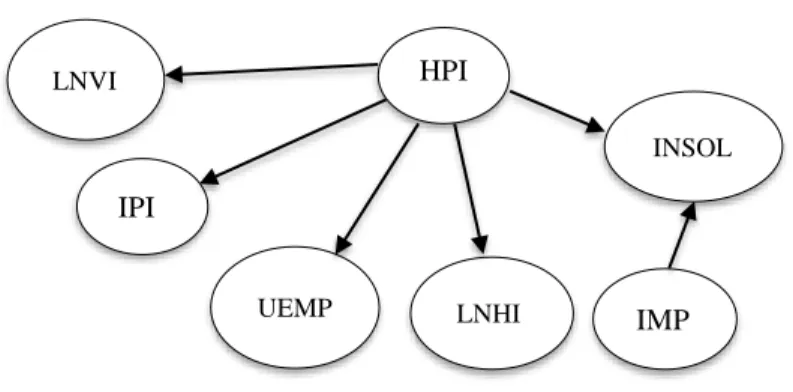
Table 8 confirms that causalities exist among (a) HPI and INSOL, (b) INSOL and LNHI, (c) IMP and INSOL, (d) HPI and IPI, (f) HPI and UEMP, (g) HPI and LNVI. This relationship shows that HPI has strong directional causalities at 1% significant level detected to personal insolvency in Malaysia. This means rapid expansion of house prices leads people to borrow with limited capacity to pay back
Period S.E. DLNINSOL DIPI DHPI DUEMP DLNHI DLNVI DINT 1 0.163 100.000 0.000 0.000 0.000 0.000 0.000 0.000 2 0.199 75.399 0.060 22.486 0.090 0.096 0.641 1.229 3 0.206 70.946 0.931 21.177 0.187 0.200 5.364 1.195 4 0.217 63.985 1.137 19.990 0.328 5.705 7.627 1.229 5 0.223 62.681 3.707 19.019 0.640 5.440 7.256 1.256 6 0.230 60.839 3.679 19.469 0.604 5.932 7.385 2.092 7 0.231 60.098 4.022 19.804 0.731 5.882 7.290 2.174 8 0.233 59.398 3.978 19.865 0.808 6.346 7.463 2.142 9 0.234 59.080 4.194 19.735 1.065 6.324 7.471 2.132 10 0.234 58.999 4.204 19.625 1.076 6.428 7.442 2.226
their financing. This leads to a tendency toward insolvency. The Granger causality relationship can be seen in Figure 1.
TABLE 8 Granger Causality
DHPI does not Granger Cause DLNINSOL 37 6.4899 0.0043 DLNINSOL does not Granger Cause DHPI 0.2352 0.7918
DLNHI does not Granger Cause DLNINSOL 37 0.1954 0.8235 DLNINSOL does not Granger Cause DLNHI 5.8177 0.0070
DIMP does not Granger Cause DLNINSOL 37 5.0948 0.0120 DLNINSOL does not Granger Cause DIMP 0.8325 0.4442
DHPI does not Granger Cause DIPI 37 5.3929 0.0096 DIPI does not Granger Cause DHPI 0.5199 0.5995
DUEMP does not Granger Cause DHPI 37 0.1235 0.8842 DHPI does not Granger Cause DUEMP 4.4302 0.0200
DLNVI does not Granger Cause DHPI 37 1.4335 0.2534 DHPI does not Granger Cause DLNVI 2.8254 0.0741
FIGURE 1
Granger Causality Relationship
HPI fffd
INSOL
LNHI IMP UEMP
IPI LNVI
5. CONCLUSION
The empirical relationship between macroeconomics and banking variables on secured financing has received enormous attention.
Various studies concerning insolvency are being conducted across the country. However, limited studies have been carried out to examine which influences significantly affect personal insolvency in Malaysia.
Personal insolvency has become one of the major problems and the number of defaulters is increasing yearly. The analysis is conducted utilizing the ARDL and VAR. The identified determinants are grouped into two categories namely: macroeconomic factors and unsecured financing factors.
Findings from this paper indicate that there is a long-run cointegrating relationship among the industrial price index, the house price index, unemployment rates and interest rates. For secured financing, the results suggest that home financing has a higher probability of repayment default than vehicle financing.
To ensure a higher order in correlation among variables and to come out with a robust conclusion on the stationarity of variables, the unit root test analysis is conducted. Referring to the results of ADF and PP it can be confirmed the use of ARDL cointegration long-run form is justified because of the existence of mix-stationarity either at level or at first difference. To further assess the short run dynamics between independent and dependent variables, we employ variance decompositions. Based on Choleksy ordering of variables, we find that the house price index is the most important determinant in the short-run by contributing 19.625% of shocks in personal insolvency.
The Granger causality test findings further suggest that causalities exist between the macroeconomic variables and secured financing with personal insolvency. This relationship shows that the house price index has strong directional causalities at 1% significance level to personal insolvency in Malaysia.
To summarize, the house price movement is expected to be a significant force in household indebtedness. Changes in house prices have a direct effect on household wealth. It is important to manage the financial risk pertaining to housing market volatility to reduce cases of personal insolvency in Malaysia. The existence of AKPK should continue to equip the public with awareness of the importance of personal finance management. This paper cautions that prudent measures are required to cope with the rapid increase in household indebtedness since it may harm national financial stability and also adversely affect societal, economic and individual wellbeing.
References
Abid, L., and S. Zouari-Ghorbel. (2012). “Household Indebtedness in Tunisia.” no. 3(10) (2012): 341–50.
Agarwal, S., B.W. Ambrose, and S. Chomsisengphet. “Determinants of Automobile Loan Default and Prepayment.” Economic Perspectives, (2008): 17–28.
Aikman, D., A. Lehnert, N. Liang, and M. Modugno. “Financial Vulnerabilities, Macroeconomic Dynamics, and Monetary Policy,” Finance and Economics Discussion Series 2016-055.
Washington: Board of Governors of the Federal Reserve System (2016).
Allen, J., and E. Damar. "Household Insolvency in Canada." Bank of Canada Review Winter 2011–2012 (2012): 43–54.
Baek, E., and G.S Hong. “Effects of Family Life-Cycle Stages on Consumer Debts.” Journal of Family and Economic Issues 25, no. 3 (2004): 359-85.
Bank Negara Malaysia, Financial Stability and Payment Systems Report (2017). http://www.bnm.gov.my/
Baqutaya, S., A.S. Ariffin, and F. Raji. "Affordable Housing Policy:
Issues and Challenges among Middle-Income Groups."
International Journal of Social Science and Humanity 6, no.
6 (2016): 433–6.
Bartiloro, L., V. Michelangeli, and C. Rampazz. "The Vulnerability of Indebted Households During the Crisis: Some Evidence from The Euro Area." Banca d’Italia. mimeo, (2015).
Bianco, K.M. The Subprime Lending Crisis: Causes and Effects of the Mortga ge Meltdown. New York: CCH, Wolters Kluwer Law
& Business, 2008.
Bishop, P. "The Spatial Distribution of Personal Insolvencies in England and Wales, 2000–2007." Regional Studies 47, no. 3 (2013): 419–32.
Bishop, P., and P. Gripaios. "Personal Insolvency in England and Wales: A Spatial Analysis." Urban Studies 47, no. 8 (2010):
1687–702.
Blasio, G. De. "Questioni di Economia e Finanza." Occasional Papers (2010).
Boeri, T., G. Pietro, and R.M. Espen. "The Labor Market Consequences of Adverse Financial Shocks." IZA Discussion Papers, No. 6826, Institute for the Study of Labor (IZA), Bonn. (2012).
Browning, M., and F.C. Thomas. "Shocks, Stocks, And Socks:
Smoothing Consumption Over a Temporary Income Loss." Journal of the European Economic Association 7, no.
6 (2009): 1169-92.
Buera, F.J., R.N.F Jaef, and Y. Shin. "Anatomy of a credit crunch:
from capital to labor markets." Review of Economic Dynamics 18, no. 1 (2015): 101-17.
Campbell, J.Y., and F.C. Joao. "How Do House Prices Affect Consumption? Evidence from Micro Data." Journal of Monetary Economics 54, no. 3 (2007): 591-621.
Case, B., O.P. Henry, and M.W. Susan. “On choosing Among House Price Index Methodologies.” Real Estate Economics 19, no. 3 (1991): 286-307.
Chambers, M. S., C. Garriga, and D. Schlagenhauf. "Loan Structure and Housing Tenure Decisions in an Equilibrium Model of Mortgage Choice." Review of Economic Dynamics 12, no. 3 (2009): 444-68.
Credit Management Counseling Agency. Fact Sheet. (2017).
Crisis, U. S. H. L., and A. Mian. "House Prices, Home Equity-Based Borrowing." (2009): 2132-56.
Crotty. J., “Structural Causes of the Global Financial Crisis: A Critical Assessment of The ‘New Financial Architecture.” Cambridge Journal of Economics, no. 33 (2009): 563-80.
Da Costa, P.N., "Janet Yellen Decries Widening Income Inequality." Wall Street Journal (2014).
Davis D., and J.M. Frank. “Under the Hood: Auto Loan Interest Rate Hikes Inflate Consumer Costs and Loan Losses.” The Center for Responsible Lending. (2011). http://www.responsible lending.org/other-consumer-loans/auto-financing/research-an alysis/Under-the-Hood-Auto-Dealer-Rate-Markups.pdf Debelle, G. "Household Debt and the Macroeconomy." BIS Quarterly
Review, part 5, March (2004): 51–64.
Dinh, M. T. H., A.W Mullineux, and P. Muriu "Macroeconomic Factors Influencing UK Household Loan Losses." Journal of Financial Regulation and Compliance 20, no. 4 (2012): 385–
401.
Dynan, K.E., and D.L. Kohn. "The Rise in U.S. Household Indebtedness: Causes and Consequences Karen." Finance and Economics Discussion Series (2007): 1–45.
Engle, R.F., and C. Granger. “Co-integration and error correction:
Representation, estimation, and testing.” Econometrica, no.
55 (1987): 251-76.
Finocchiaro, D., C. Nilsson, D. Nyberg, and A. Soultanaeva.
"Household Indebtedness, House Prices and the Macroeconomy: A Review of the Literature." Sveriges Riksbank Economic Review 1 (2011): 6–28.
Fitzpatrick, T., and K. McQuinn. “House Prices and Mortgage Credit:
Empirical Evidence for Ireland.” The Manchester School, 75 no.
1 (2007): 82-103.
Friedman, M. A Theory of the Consumption Function. Princeton:
Princeton University Press, 1957.
Gathergood, J., "Debt and Depression: Causal Links and Social Norm Effects." The Economic Journal 122, no. 563 (2012): 1094- 114.
Gujarati, D.N. Econometrics. 3rd Edition, McGraw-Hill, Inc., New York, 1995.
Hall, R. “Stochastic Implications of the Life Cycle Permanent Income Hypothesis: Theory and Evidence.” Journal of Political Economy 86, no. 6 (1978): 971-87.
Heitfield, E., and T. Sabarwal. What Drives Default and Prepayment On Subprime Auto Loans?” Journal of Real Estate Finance and Economics 29, no. 4, (2003): 457–77.
Hussainat, M. M., Q.M Ghnimat, and M.A. Al-dlaeen. “The Impact of Unemployment On Young People in The Jordanian Community: A case study from unemployed perspective.”
Asian Social Science 9, no. 1 (2012): 155–64.
Jappelli, T., M. Pagano, and M. Maggio. "Households’ Indebtedness and Financial Fragility." Journal of Financial Management Markets and Institutions 1, no. 1 (2013): 23–46.
Jurevičienė, D., and V. Sukačevskytė. "Factors Affecting Personal Insolvency." KSI Transactions on Knowledge Society 7, no. 3 (2014): 5–11.
Jureviciene, D., K. Taujanskaite, and V. Sukacevskyte. "Indirect Factors Affecting Personal Solvency: Empirical Analysis of Lithuanian Consumer Credit Market." European Scientific Journal 12, no. 1, (2016): 157–74.
Koning, N. “ Personal Insolvency Dynamics in Germany and the UK – A SUR-TAR Approach.” DEP (Socioeconomics) Discussion Papers Macroeconomics and Finance Series. (2016): 1-45.
Lai, F., S.N. Chan, W.Y. Shum, and N. Zhou. "Household Debt and Housing Price: An Empirical Study Across 36 Countries."
International Journal of Business and Management 12, no. 11 (2017): 227–41.
Ma’in, M., N.A. Ismaru Tajuddin, and S.B. Saiful Nathan.
"Household Debt and Macroeconomic Variables in Malaysia." 3rd International Conference on Business and Economics, 3 (eISSN: 2357-1330) (2016): 21–3.
Mainal, S.A., N.A. Mohd Kassim, C.S.F. Ho, and J. Mohd Yusof.
"Preliminary Investigation on the Determinants of Household Debt Burden." 2014 AAGBS International Conference on Business Management (AiCoMB 2014) (2016): 47–67.
McKibbin W.J., and A. Stoeckel. “The Global Financial Crisis:
Causes and Consequences.” Asian Economic Papers, 9 no. 1 (2010): 54-86.
Meng, X., N.T. Hoang, and M. Siriwardana. “The Determinants of Australian Household Debt: A Macro Level Study.” Journal of Asian Economics. 29 (2013): 80–90.
Mian, A., and A. Sufi. "Who Bears the Cost of Recessions? The Role of House Prices and Household Debt." In Handbook of Macroeconomics 2 (2016): 255-96.
______, S. Amir and V. Emil. "Household Debt and Business Cycles Worldwide." The Quarterly Journal of Economics 4 (2017) 1755-817.
Meniago, C., J.M. Petersen, M.A Petersen, and I.P. Mongale. “What Causes Household Debt to Increase in South Africa?”
Economic Modelling 33 (2013): 482-92.
Nakornthab, D. "Household Indebtedness and Its Implications for Financial Stability." Research Studies (2016): 67-88.
Narayan, P.K., “The Saving and Investment Nexus for China:
Evidence from Cointegration Tests.” Applied Economics 37 no. 17, (2005): 1979-90.
Nizar, N. Proceeding - Kuala Lumpur International Business, Economics and Law Conference 6, no. 1. April 18 – 19, 2015.
Hotel Putra, Kuala Lumpur, Malaysia 1 (2015): 97–107.
Othman, K., and S. Sipon, "The Relationship of Financial Stress and Religious Coping from Islamic Perspective." International Review of Management and Business Research 3, no. 1 (2014): 133–38.
Pesaran, M.H., and Y. Shin. “Generalized Impulse Response Analysis in Linear Multivariate Models.” Economics Letters 58, no. 1 (1998): 17–29.
______, Y. Shin, and R.J. Smith. “Bounds Testing Approaches to the Analysis of Long Run Relationships.” Journal of Applied Econometrics 16, no. 3 (1999): 289–326.
______, Y. Shin, and R.J. Smith. “Bounds Testing Approaches to The Analysis of Level Relationships.” Journal of Applied Econometrics 6 no. 3 (2001): 289-326.
Philbrick, P., and P. Gustafsson. Australian Household Debt: An Empirical Investigation into the Determinants of the Rise in the Debt-to-Income Ratio. (Masters Thesis) Lund University Australia, Australia, 2010.
Rahman, S., and M. Masih. "Increasing Household Debts and Its Relation to GDP, Interest Rate and House Price: Malaysia’s Perspective." Munich Personal RePEc Archive (MPRA) no.
62365 (2014). https://mpra.ub.uni-muenchen.de/62365/1/MP RA_paper_62365.pdf
Ramsay, I., and C. Sim, “Personal insolvency in Australia: An Increasingly Middle Class Phenomenon.” Federal Law Review, 38 (2010): 283–310.
Sinai, T., and S.S. Nicholas "Owner-Occupied Housing as A Hedge Against Rent Risk." The Quarterly Journal of Economics 120, no. 2 (2005): 763-89.
Sullivan, J.X. “Borrowing During Unemployment: Unsecured Debt as a Safety Net.” Journal of Human Resources 43, no. 2 (2008):
383-412.
Sutherland, D., and P. Hoeller. "Debt and Macroeconomic Stability:
An Overview of the Literature and Some Empirics." OECD Economics Department Working Papers, 1006 (2012).
Tudela, M., and G. Young. “The Determinants of Household Debt and Balance Sheets in United Kingdom.” Bank of England Working Paper, 66 (2005): 1-33.
Toda, H.Y., and T. Yamamoto. "Statistical Inference in Vector Autoregressions with Possibly Integrated Processes." Journal of Econometrics 66, no. 1-2 (1995): 225-50.
Wong, J., L. Fung, and A. Sze. “Residential Mortgage Default Risk and The Loan-To-Value Ratio.” Hong Kong Monetary Authority Quarterly Bulletin 4 (2004): 35-45.
Yerex, R. P. "The Consumer-Driven Economy at a Crossroads."
Business Economics, 46 (April) (2011): 32–42.
Yusof, R. M., and F.H. Usman. “Islamic Home Financing and The Real Sectors in Malaysia: An ARDL Bound Testing Approach to Cointegration.” International Journal of Economics, Management and Accounting 23, no. 1 (2015): 79-107.