The presence of the broad arrow on the shot was not conclusive evidence that the ship had been British, as ammunition stores could have been captured. The references are given in the manner in which they are numbered in the Publication Collections.
TO CARRY GOVERNOR CLINTON TO NEW YORK AND THEN ATTEND ON SO. CAROLINA
And if the captains of the said ships shall at any time send you notice of the Enemy. You must not fail to transmit to us, once in two months, an exact copy of the Journal, that it may be seen what care and diligence you have used in carrying out our instructions, and ordering the captains of His Majesty's ships under your command. to do the same.
TO CRUIZE BETWEEN CAPE FLORIDA, AND THE NORTH WEST PART OF THE GRAND BAHAMA WHEN THE SEASON OF THE
About 10:00, to Utting's great joy, a sloop was seen from the sea and a signal was made to her, but the sloop stood out to the north-west.^"^ The captain immediately armed all the boats and, together with lieutenant Randell and Mr. insecurity was the plain fact that in a blow of any force the whole island would be swept away by waves. When they came ashore, Randell and Bishop reported that on the approach of the armed boats the Spanish crew had left the sloop and were no doubt now on their way to Havanain their boat.
As they rowed away, the ship shot to the top of her masts and "exploded in several places, and was in flames fore and aft." The burning ship was visible until sunset and although its hull was completely destroyed, Utting feared that the Spanish would return and save her guns and anchors. , as information about the end of the Loo was to be passed on to the Spanish in Havana by the escaped crew of the sloop. He put First Lieutenant Randell and Third Lieutenant Lloyd in charge of the sloop, his sailing master Bishop was given command of the ship and "amate". In the statement, Lyford stated that in his opinion the course taken by the Loo before she ran aground was "the best through the Gulf (and generally allowed to be) and was of the opinion at the time that such a course would ship closer to the Bahamas. coast then the Florida; and this deponent further takes an oath and takes an oath that he is well acquainted with the Gulf of Florida which it used thirty years ago.
John Manley and Henry Spencer, the two sailors who had recognized the Prize as their former ship, appeared before James Grome, Judge of the Court of Vice Admiralty of the Province of South Carolina, and swore under oath that the Prize was the former Billander Betty . , and that on the voyage from England to the Isle of May and South Carolina, she was captured off the coast of South Carolina on the 9th of April, 1743. The Augustin returned to Havannahand in herpassage was cast away, that the Billander was taken as above stated above was carried to Havannah, and there turned into a snow, and intended to travel to Campeachee, but afterwards these Deponents said she was bound for the Mississippi.
26 SMITHSONIAN MISCELLANEOUS COLLECTIONS VOL. I3I by the Spaniards and converted into a Snow that the said Snow was taken by
The next day, Utting reported his arrival to the Admiralty and requested an early court-martial for the loss of the Loo. On May 31, the court of 12 captains sat aboard the ship-of-the-line Sandzvich with Vice-Admiral James Steuart presiding. Asliby Utting to the Secretary of the Admiralty reporting his arrival in England on 24 May 1744 to be tried by court-martial for the loss of the Loo.
After his acquittal, Utting frequently attended the Secretary of the Admiralty while he awaited a reply to his request for another warrant. On 12 June he discussed with the secretary the possibility of taking command of the Mary Galley, and the next day he advised Corbett that some of Loo's men and petty officers wished to be transported with him on his next voyage. He also reminded Corbett of his desire to return to the Carolina station since she was his wife.
No one knew better than he of the danger of invasion to which the colony was exposed by the loss of the Loo, and he was anxious for the safety of Mrs. for the loss of the Loo, the Lord of the Ad-.
APPENDIX A
EXTRACTS FROM THE NAVY LIST RELATING TO THE "LOO"
32 SMITHSONIAN MISCELLANEOUS COLLECTIONS VOL. I3I Period
34 SMITHSONIAN MISCELLANEOUS COLLECTIONS VOL. I3I Period
34;Tocruiz Between Bilbao and St.Jean de Luz, to intercept some Caracca ships expected at St. was made on the first day of the month).
APPENDIX B
LETTER FROM CAPTAIN ASHBY UTTING TO THE ADMIRALTY REPORTING THE LOSS OF THE "LOO"
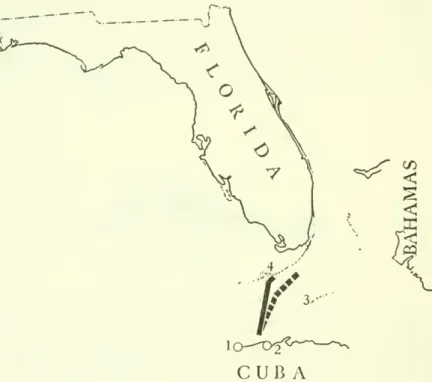
Soon after he came and told me that the steering wheel was gone and that she made a little water in the plug, but not much, we put all the pumps on. By this time the "Snow," which shared the same fate, was on her broadside, the ship was battering heavily and to pieces, and having no prospect of getting away, ordered the mains to be cut and all the upper deck guns were thrown overboard and the anchors were thrown out. that shemight was quiet and mean she saved them which fortunately she did, though all this time she thought I was boarded at Shott Bank when at daylight to my great surprise we were riding on a switch small sandy beach about 1./1/2 cables ^ long and ./1/2 broad lying on the edge of Martiers Shore 3 leagues^" without them and from CapeFloridaWSW 7 or 8 leagues siteseepttoo, not having no terrain at 50 up and down not 10 minutes before the ship wasashoreandis the only dangerous place on the Florida coast and I assure you that from the day I got on that station I always had the Drapsy^^ line running every 1/2 hour from 6 o'clock at night till morning, the only reason I can give for finding myself on the coast of Florida, when I expected double that time. SEbE and other NN bN at least 16 leagues, must be caused by a new current very extraordinary and very unusual; as soon as day broke I landed all the men (but those who were employed in breaking down the decks ^- and taking what water and what provisions we could have, but we could only take 2 ass all day); at 10 o'clock this morning, Sunday, we saw a small drift, when I immediately armed all the boats, and sent them with orders to board her at all events, and bring her here, as she would be the means of take us from this miserable. place, which I clearly. I could go to work which was only a little, though it was for their own good, but they were all frightened and wanted me away for fear of the Indians, and I was very riotous and riotous breaking into parties and howling among them.
After they were gone, I went on board the wreck with what kegs of powder we had saved (except a little we took in each boat), and put in their proper places on the Starboard side the gun-deck, on that side out of the water. her departure for the Harbor and FewelP*' in every place we could when all lay down, about 2 o'clock in the afternoon, I set her on fire, and rowed to the boats, as we saw her before her till sunset, and she blown up in several places, and was on fire fore and aft, but I much fear that the guns and anchors will fall into the hands of the Spaniards as they have frequent correspondence and trade with the Indians, and it is my opinion that the men left their backs that we took . , went to Cuba on a direct mission to give them intelligence. I kept light for them all night, but they all overtook me, they kept so far ahead that I lost sight of them at 12 o'clock at night, when I was obliged to go up and keep to the north, which I did after I made the signal right, but in the daylight I could see nothing of them. , and the fresh swell and steep fall with the men could not sail, forced me to leave and take my fate through Florida Bay for any part of the Carolinas, even to St. Augustine (if I could get nowhere else) in instead of being all drowned, which Doe assures you had very little other prospect, but thank God they met with exceedingly good weather and arrived at Port Royall on the 13th of February at night, and have no doubt but the boats are safe for Providence a long time ago.
I had two of the best pilots on board for the Gulf of Florida in all America, who insist on it that there could be no better course, and I have been through the Gulf many times and am better acquainted with it and the coast of Carolina than any part of the world, and if I had the honor to command20 the navigation and direct all my life, I should have steered the same course, or rather towards the north, which, as I observed before, I cannot 13 Addition of planks in the boat's armed whalebones increasing its capacity. Some of them seem inclined to go to the WestIndies and somewhere in the Mercantile Service and some at home.
MEMBERS OF THE CREW OF THE "LOO" ON HER LAST CRUISE The following is a list of names of all the men and officers appearing
Able Seaman Able Seaman Able Seaman Able Seaman Able Seaman. Able Seaman Able Seaman Carpenter's Mate Able Seaman Able Seaman Captain's Servant Corporal. Able Seaman Boatswain's Mate Able Seaman Able Seaman Able Seaman Mate and Able.
Skilled Seaman Skilled Seaman Skilled Seaman Skilled Seaman and Ordinary Seaman. Able Seaman Able Seaman Able Seaman Able Seaman Able Seaman Ordinary Seaman Captain. Sailor Sailor Sailor Sailor Surgeon Sailor Sailor Sailor Sailor Sailor Countryman.
Able Seaman Captain's Servant Ordinary Seaman Mate Mate Able Seaman Able Seaman Trumpeter (?) Able Seaman Midshipman. Able .Seaman Quarter Gunner Able Seaman Able Seaman Boatswain Servant Able Seaman Ordinary Seaman Able Seaman.
APPENDIX D
ROSTER OF THE FAMILY AND SERVANTS OF GEORGE CLIN- TON, GOVERNOR OF NEW YORK FROM SEPTEMBER 1743 TO
APPENDIX E
COMMANDING OFFICERS OF THE "LOO"
A small (Jncen .\nne pewter teapot fmni the wreck of tlic Loo. A gift to the National Museum from K. .\. Link. Link riyging the main boom of the Blue Hcroii to raise the i-ton iron barrel from the wreck site.