World Trade Organization Centre William Rappard Rue de Lausanne 154 CH - 1211 Geneva 21 Switzerland
' + 41 (0)22 739 51 11 7 + 41 (0)22 731 42 06
www.wto.org
The WTO Agreements Series Agriculture Third edition
The WTO Agreements Series Agriculture
The WTO agreements series
The WTO’s agreements are the legal foundation for the international trading system that is used by the bulk of the world’s trading nations. This series offers a set of handy reference booklets on selected agreements. Each volume contains the text of one agreement, an explanation designed to help the user understand the text, and in some cases supplementary material. They are intended to be an authoritative aid for understanding the agreements, but because of the legal complexity of the agreements, the introductions cannot be taken as legal interpretations of the agreements.
The agreements were the outcome of the 1986–1994 Uruguay Round of world trade negotiations held under the auspices of what was then the GATT (the General Agreement on Tariffs and Trade). The full set is available in The Results of the Uruguay Round of Multilateral Trade Negotiations: The Legal Texts. It includes about 60 agreements, annexes, decisions and understandings, but not the commitments individual countries made on tariffs and services. A full package of agreements that includes over 20,000 pages of commitments is available from WTO Publications in a 34-volume set, as well as a CD-ROM, The Results of the Uruguay Round.
The volumes in this series Agreement Establishing the WTO Agriculture
GATT 1994 and 1947
Sanitary and Phytosanitary Measures Technical Barriers to Trade
Print version ISBN 978-92-870-4109-8 PDF version ISBN 978-92-870-4150-0 ISSN 1020-4768 This publication will also be available
in French and Spanish
© World Trade Organization Revised in 2016
Contents
Introduction 3
The basic structure of WTO agreements
5
Agriculture
Agreement 9
An overview 9
Introduction to the Agriculture Agreement
10
Key principles:
The three pillars 14
Other provisions 30
Transparency:
Sharing information 33
The Agriculture
Committee 37
A database of information on agricultural trade policies and measures
42
Resolving disputes 43
Negotiations:
built-in agenda and Doha Round
52
Cotton 55
Summary 59
Frequently asked
questions 63
The legal texts on
agriculture 71
Agreement on
Agriculture 71
2013 Bali Package on agriculture
103
2015 Nairobi Package on agriculture
121
Introduction
The WTO Agreement on Agriculture entered into force when the World Trade Organization (WTO) came into being on 1 January 1995. Its main objective is to reform agricultural trade so that it is closer to competitive market conditions — but also to serve other objectives.
The first steps in that reform are already in place. Developed countries phased in their reform over six years from 1995 to 2000, developing countries (other than least developed countries, who did not have to cut tariffs and subsidies) did so over 10 years, from 1995 to 2004.
The new lower limits on tariffs, domestic support and export subsidies are now locked into place. Some countries that negotiated to join the WTO after 1995 implemented their reforms after they joined, and some more recent members are still doing so. New negotiations since 2000, now part of the Doha Round, aim to make further reductions in tariffs and subsidies.
The “agricultural” products covered by the Agreement are specific to it. They include processed food and drink but exclude forestry and fisheries products.
This publication explains the Agreement, which is part of a larger package of WTO treaties signed in Marrakesh, Morocco, on 15 April 1994 at the end of the 1986–94 Uruguay Round of multilateral trade negotiations. The package updated the agreements of the trading system previously managed under the General Agreement on Tariffs and Trade (GATT, which deals with goods and is legally known as GATT 1994), expanded their scope to include services and intellectual property, and created the WTO. The Agriculture Agreement was also new, and a result of the negotiations. A separate booklet, Sanitary and Phytosanitary Measures, deals with a related agreement on regulations on food safety and animal and plant health.
The WTO Secretariat has prepared this publication to help the public understand the Agriculture Agreement. The publication starts with a brief description of how the WTO agreements relate to each other. Next comes a short explanation of why this new agreement was negotiated and what it covers. The Agriculture Agreement and its key principles are then described in some detail. This includes accounts of how they have been viewed in official disputes, the main means of interpreting legal complexities in WTO agreements.
The publication turns next to the work on agriculture in the WTO, particularly the Agriculture Committee. Reaching agreement is only the start of reform. Countries still have to implement what they have agreed, and a crucial part of the WTO’s work is to allow governments to monitor each other to see how well they are keeping their promises. That means they have to share information with each other and to have an opportunity to discuss that information
— “transparency” and “peer review”. In agriculture, this is handled by regular sessions of the Agriculture Committee. The committee also meets in “special sessions” for Doha Round
negotiations on the sector. The committee’s mandate, role and activities are described in this section, along with the issues in the negotiations.
A separate section answers a number of frequently asked questions about the Agreement.
The publication concludes with legal and official texts in full: the Agreement, its annexes, the 2013 Bali ministerial decisions and one declaration on agriculture, and the Nairobi decisions on agriculture. These include the historic decision to eliminate agriculture export subsidies and set disciplines on export measures with equivalent effect, the most important reform of international trade rules in agriculture since the WTO was founded.
In order to make the publication easier to read, the terms “country” and “member” are used interchangeably for much of the text even though legally some members are “separate customs territories”, and one member (the European Union) is a group of countries. This is also in the spirit of the 1994 Marrakesh Agreement Establishing the WTO, which includes this explanatory note:
“The terms ‘country’ or ‘countries’ as used in this Agreement and the Multilateral Trade Agreements are to be understood to include any separate customs territory Member of the WTO.
“In the case of a separate customs territory Member of the WTO, where an expression in this Agreement and the Multilateral Trade Agreements is qualified by the term
‘national’, such expression shall be read as pertaining to that customs territory, unless otherwise specified.”
The basic structure of WTO agreements
The conceptual framework
Broadly speaking, the WTO agreements for the two largest areas of trade — goods and services — share a common three- part outline, even though the details are sometimes different (see Figure 1).
• They start with general disciplines contained in the General Agreement on Tariffs and Trade (GATT) (for goods), the General Agreement on Trade in Services (GATS) and the Agreement on Trade- Related Aspects of Intellectual Property Rights (TRIPS).
Figure 1: The basic structure of the WTO agreements
Umbrella AGREEMENT ESTABLISHING THE WTO
Goods Services Intellectual
property
Basic principles GATT GATS TRIPS
Additional details
Other goods agreements and
annexes Services annexes
Market access commitments
Countries’
schedules of commitments
Countries’
schedules of commitments (and MFN exemptions) Dispute settlement DISPUTE SETTLEMENT
Transparency TRADE POLICY REVIEWS
Then come additional agreements and annexes dealing with the special requirements of specific sectors or issues.
These deal with the following:
For goods (under GATT) Agriculture
Regulations for food safety, animal and plant health protection (SPS) Textiles and clothing
Technical regulations and standards for products (technical barriers to trade) Trade-related investment measures Anti-dumping measures
Customs valuations methods Pre-shipment inspection Rules of origin
Import licensing
Subsidies and countervailing measures Safeguards
For services (the GATS annexes) Movement of natural persons Air transport
Financial services Shipping
Telecommunications
• Finally, there are the detailed and lengthy schedules (or lists) of commitments made by individual countries allowing specific foreign products or service providers access to their markets. For GATT, these take the form of binding commitments on tariffs for goods in general, and combinations of tariffs and quotas for some agricultural goods. For agriculture,
the GATT “schedules” now include a part containing countries’ commitments on subsidies to support the disciplines of the Agriculture Agreement in this area.
For GATS, the commitments state how much access foreign service providers are allowed for specific sectors, and they include lists of types of services where individual countries say they are not applying the “most-favoured-nation”
principle of non-discrimination.
Much of the Uruguay Round dealt with the first two parts: general disciplines and disciplines for specific sectors. At the same time, market access negotiations were possible for industrial goods. Once the principles had been worked out, negotiations could proceed on the commitments for sectors such as agriculture and services.
Negotiations after the Uruguay Round and before the Doha Round began in 2001 focused largely on market access commitments: financial services, basic telecommunications, maritime transportation (under GATS) and information technology equipment (under GATT).
The agreement in the third area of trade covered by the WTO — on intellectual property (IP) — covers general IP disciplines as well as disciplines covering specific IP areas, such as copyright, patents, trademarks and geographical indications.
Other details come from conventions and agreements outside the WTO.
The agreement on dispute settlement contains specific procedural disciplines on how to conduct WTO disputes while the Trade Policy Review Mechanism aims to ensure that WTO members’ trade policies and practices are transparent.
Also important
One other set of agreements not included in the diagram above is also important: the two “plurilateral” agreements not signed by all members: fair trade in civil aircraft and government procurement. (Originally there were four agreements, but those concerning dairy products and bovine meat were terminated at the end of 1997.)
Finally, members who joined the WTO since 1995 through the ‘accession’ route have legally binding membership documents — known as their “protocols of accession”
— which are an integral part of the WTO Agreement. A protocol also contains legally binding provisions that apply to the new member.
The legal framework
The conceptual structure is reflected in the way the legal texts are organized. The short Marrakesh Agreement Establishing the World Trade Organization sets up the legal and institutional foundations. Attached to it is a much lengthier set of four annexes.
• Annex 1 contains most of the detailed rules, and is divided into three sections:
– 1A, containing the revised General Agreement on Tariffs and Trade, the other agreements governing trade in goods, and a protocol which ties in individual countries’ specific commitments on goods
– 1B, the General Agreement on Trade in Services, texts on specific services sectors, and individual countries’
specific commitments and exemptions
– 1C, the Agreement on Trade-Related Aspects of Intellectual Property Rights.
Collectively, the agreements included in Annex 1 are referred to as the multilateral trade agreements since they comprise the substantive trade policy obligations which all the members of the WTO have accepted.
• Annex 2 sets the rules and procedures for dispute settlement.
• Annex 3 provides for regular reviews of developments and trends in national and international trade policy.
• Annex 4 covers the plurilateral agreements which are within the WTO framework but which have limited membership.
Finally, the Marrakesh texts include a number of decisions and declarations on a wide variety of matters that were adopted at the same time as the WTO Agreement itself.
Agriculture Agreement
An overview
Historically, governments have intervened in the agriculture sector more than in other sectors. Agriculture was always covered by the General Agreement on Tariffs and Trade, which entered into force in 1948. But numerous exemptions meant agricultural trade escaped most of the disciplines that applied more generally to trade in industrial products. The result was the widespread use of measures that obstructed imports
— import bans, limits on quantities that could be imported (quotas), high import duties, import duties whose rates varied and so created market uncertainty, minimum import prices, and various impediments not related to tariffs such as regulations and the activities of state trading enterprises.
Major agricultural products such as cereals, meat, dairy, sugar and a range of fruits and vegetables faced trade barriers on a scale unseen in the rest of merchandise trade.
The exemptions also allowed huge subsidies in richer countries. These artificially increased production and exports from the subsidizing countries, driving down world prices. Farmers in developing countries and developed countries with lower, or non- existent, subsidies struggled to compete with subsidised production and exports in wealthier countries. Developing countries’
own governments often made life worse for their farmers by taxing exports or requiring purchases at low prices. These policies seriously distorted agricultural trade.
Traditionally, GATT negotiations had focused on opening markets. In agriculture, it became increasingly obvious that the problems were much broader. When the Uruguay Round negotiations were launched in 1986, the reform programme for agriculture aimed to tackle the sector comprehensively. All measures affecting agricultural trade came under scrutiny, from the various forms of trade barriers to domestic price and income support and export subsidies.
Clearer rules for regulations on food safety and animal and plant health (sanitary and phytosanitary) were needed in order to discipline the measures. Regulations for protecting consumers, livestock and crops had to be genuine and not an excuse to be protectionist, to bypass agreements on opening markets.
Balance is the key to rule-making deals in the WTO. The balance that emerged from the Uruguay Round in the Agriculture Agreement is between agricultural trade liberalization and governments’ rights to pursue legitimate policy goals in the sector.
Those goals include “non-trade concerns”
such as food security, rural development and environmental protection. The two agreements on Agriculture and Sanitary and Phytosanitary Measures were negotiated in parallel.
Introduction to the Agriculture Agreement
The 1986–94 Uruguay Round negotiations produced the first comprehensive set of multilateral trade rules specifically on agriculture. There are four main components:
(1) the WTO’s Agreement on Agriculture (sometimes abbreviated as AoA) (2) the “schedules” or lists of commitments
WTO members have made to set new limits on tariffs and other aspects of market access, and on domestic support and export subsidies (they are called “schedules” because they include timetables for moving to the new tariff and subsidy limits)
(3) the Sanitary and Phytosanitary (SPS) Measures Agreement
(4) the Ministerial Decision on Measures Concerning the Possible Negative Effects of the Reform Programme on Least-Developed and Net Food- Importing Developing Countries.
“Agriculture” does not mean the same in all these documents. In particular, the Agriculture Agreement does not include fisheries and forestry products. The SPS Agreement does.
The Uruguay Round deal provided a framework for the long-term reform of agricultural trade and domestic policies.
The Agriculture Agreement reflects the compromises made to satisfy the many interests represented in the negotiations.
Over 120 countries participated, including
developed, developing and least developed countries, and net importers and exporters.
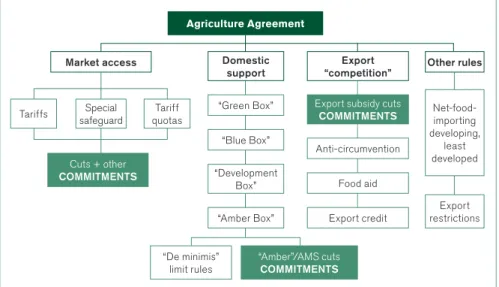
The Agreement establishes a number of general rules and commitments, mainly in three areas sometimes called the
“three pillars”. These are: market access, domestic support and export competition (which covers export subsidies and export-related measures with equivalent effect). The Agreement came into effect in 1995 along with the WTO. Its 21 articles are divided into 13 parts. It has five annexes.
The 1995 Agreement is described in detail below. Briefly, it starts by defining the agricultural products that it covers. It deals with legally binding commitments on market access such as reduced import duties and related issues, domestic subsidies such as price and income support that have an impact on trade, and export subsidies.
The Agreement does allow governments to support their rural economies. This should preferably be through policies that do not distort trade, or do so minimally. It also allows some flexibility for developing and least developed countries in the way they and other countries implement their commitments.
The cuts that developing countries made on their subsidies or tariffs as a result of the Uruguay Round were smaller than for developed countries, and they were given extra time to do it. Least developed countries were not required to make any reductions.
Special provisions deal with the interests of poorer countries that rely on imports for their food supplies, and the concerns of least developed economies.
In this way, the Uruguay Round deal kicked off a reform programme in agriculture. The Agreement’s preamble recognizes that the reform has the long-term objective of establishing a fair and market-oriented
Figure 2: The Agriculture Agreement in a nutshell
Market access Export Other rules
“competition”
Domestic support
Cuts + other COMMITMENTS
“Amber”/AMS cuts COMMITMENTS
Export subsidy cuts COMMITMENTS
“Green Box”
Food aid
Net-food- importing developing,
least developed
Export restrictions Export credit
“Blue Box”
Anti-circumvention
“Amber Box”
“Development Box”
“De minimis”
limit rules
Agriculture Agreement
Tariff quotas Special
safeguard Tariffs
agricultural trading system. The Agreement committed WTO members to continue the reform by resuming negotiations in 2000. It also takes into account non-trade concerns, including food security, and environmental protection. Developing countries enjoy treatment (such as more lenient and flexible terms, officially known as “special and differential treatment”). This includes a pledge to improve opportunities for their exports to gain access to other markets, under improved terms.
Cuts in richer countries’ subsidies means their exports are no longer artificially cheap, and therefore food supplies can be more expensive for importing countries. The Uruguay Round included a separate ministerial decision to deal with the concerns of two groups of countries that relied on cheaper, subsidized food from industrial countries: least developed countries
as a whole, and other developing countries that are net food importers. This “Decision on Measures Concerning the Possible Negative Effects of the Reform Programme on Least Developed (LDCs) and Net-Food-Importing Developing Countries (NFIDCs)” recognizes that these two groups of countries might need help temporarily to adjust to higher priced imports resulting from the reforms.
Backing up this set of rules are the commitments member governments have made to limit tariffs and provide access to their markets in other ways, and to reduce domestic support and export subsidies.
These pledges are listed in legally binding documents known as “schedules” (because they include timetables for reaching the commitment levels). They are an integral part of the updated General Agreement on Tariffs and Trade (GATT).1 The other
1 Lawyers distinguish between two versions of GATT: (1) the original pre-Uruguay Round version, now called GATT 1947; and (2) GATT 1994, the original GATT 1947 updated by the Uruguay Round. For simplicity, this introduction simply uses GATT. References to provisions applying after 1994 (including in the Agriculture Agreement) can be assumed to be GATT 1994.
WTO agreements complement the Agriculture Agreement — governments have to observe them as well, when devising agricultural trade policies.
Relationship with other WTO agreements
In principle, all WTO rules on trade in goods apply to agriculture. These rules are in the agreements themselves and various legal documents known as “understandings”.
They include the General Agreement on Tariffs and Trade, and pacts such as those dealing with sanitary and phytosanitary measures, customs valuation (how customs authorities value goods in order to calculate import duties), import licensing, pre-shipment inspection (when governments require imports to have been inspected for price, quantity and quality before they were exported), safeguard measures (temporary increases in tariffs to deal with import surges or price falls), subsidies in general, and various standards, regulations and labelling requirements that imports have to meet (known as “technical barriers to trade”). The WTO agreements on services (the General Agreement on Trade in Services or GATS) and on “trade-related aspects of intellectual property rights” (TRIPS) also apply to agriculture.
The relationship is spelt out legally in the Agriculture Agreement’s Article 21. This says that the GATT and all other WTO agreements on trade in goods (officially Annex 1A of the Marrakesh Agreement establishing the WTO) apply but if there is a conflict, then the rules in the Agriculture Agreement prevail (Article 21.1).
Products covered by the Agreement
The products covered are specific to the Agriculture Agreement. Included are commodities and other farm produce, and processed products such as confectionery, alcoholic and non-alcoholic drinks and tobacco products. Excluded are fish, fishery products, forestry products, and those manufactured from fibres such as cloth and clothing.
The legal provision defining the coverage is Annex 1 of the Agriculture Agreement, with a reference in the Agreement’s Article 2.
This definition of agricultural products is based on the product categories set up under the World Customs Organization, specifically the 1992 version of the WCO’s
“Harmonised System” (HS92). Annex 1 defines the agricultural products covered by the Agreement as those within Chapters 1 to 24 of the Harmonized System (excluding fish and fish products), including, for example:
• basic agricultural products such as wheat, milk and live animals, and products derived from them, such as, bread, butter and meat
• processed agricultural products, for example chocolate and sausages
• wines, spirits, and tobacco products
• fibres, such as, cotton, wool and silk
• raw animal skins for leather production
Rules and commitments
The Agriculture Agreement then spells out a number of general rules for governments’
actions affecting agricultural trade. This works
in three main areas: market access (measures applying to imports), domestic support granted to farmers and export “competition”
(a term used for export subsidies and export- related policies having similar effect).
Many of these rules translate into commitments that each country makes to improve market access and reduce subsidies that distort trade by affecting prices or production. The commitments vary: they are specific to each country, which is why they are known as “specific” commitments.
Officially they are called individual countries’
“schedules of commitments”, documents listing the new commitments and when the new limits will be met (plus some exceptions).
They are legally binding and are an integral part of the umbrella treaty covering all trade in goods, the General Agreement on Tariffs and Trade (GATT).
Time to implement commitments
Reforms cannot be introduced overnight.
Once the Uruguay Round deal was struck, negotiators gave their countries a period to phase in the commitments they had pledged. This was designed so that each could adjust more easily to the tariff and subsidy reductions it had made. The agreed
“implementation period” for developed countries to phase-in their commitments was six years from 1995. Developing countries, whose cuts were in any case more modest, were also given more time:
10 years. Governments could choose the type of year used to implement these cuts:
12-month periods based on the calendar, or the marketing or crop seasons, or the government’s own fiscal year.
For this reason, the exact implementation period could even vary within a country:
the year that one country used for tariff
reductions might not be the same as the one it used to cut export subsidies, for example.
(Even though the phase-in period is now long completed for the original WTO members, that difference still remains in the annual notifications that they continue to submit on how they are living up to their pledges.)
Schedules: the commitments and phase-in timetable
The commitments on agriculture come from the 1986–94 Uruguay Round talks, or from newer members’ negotiations to join the WTO.
The goods schedules cover commitments on all products, including non-agricultural goods, with a timetable for phasing in reductions. Those on agriculture are listed in two of the four parts, I and IV:
• the legally bound maximum tariff rates (“bound tariffs”) for each product, phased in from the start to the end of the implementation period (six years for developed countries, ten for developing) are in Part I, Section IA
• tariff quota commitments (minimum quota sizes and the lower tariff rates within the quotas) are set out in Part I, Section IB
• domestic support commitments are in Part IV, Section I
• export subsidy commitments are in Part IV, Sections II and III.
Almost every WTO member has a schedule of commitments. Exceptions include EU members who have a single combined schedule, as do Switzerland and Liechtenstein. The schedule is legally binding because it is part of the WTO
agreements. For original members, the schedules are annexed to an agreement called “the Marrakesh Protocol to the General Agreement on Tariffs and Trade 1994”. For newer members, the schedules are annexed to their “Protocol of Accession”.
Peace Clause
In WTO agreements, “peace clauses” are usually provisions that shield members from legal action under other agreements or the dispute settlement system. This is also known as “due restraint”. The Agriculture Agreement includes one, a temporary peace clause that has now expired. This is the “due restraint”
of Article 13. Agricultural subsidies allowed under the Agriculture Agreement were shielded from legal challenge (or other action) for nine years under specific provisions of the umbrella General Agreement on Tariffs and Trade or the more specific Subsidies and Countervailing Measures Agreement. This peace clause expired at the end of 2003.
Therefore, the Subsidies Agreement now applies to agricultural subsidies (subject to the Agriculture Agreement’s Article 21 which deals with the relationship between the Agriculture Agreement and other WTO agreements).
Key principles:
the three pillars
Market access
The conceptual framework
The Uruguay Round and the Agriculture Agreement introduced an important change
into agricultural markets. Previously trade flows had been impeded by a myriad of regulations and restrictions other than tariffs — so-called non-tariff measures.
Some, such as standards for food safety, animal and plant health and other purposes, are now disciplined by the agreements on Sanitary and Phytosanitary Measures and Technical Barriers to Trade. The Agriculture Agreement itself tackles other non-tariff barriers (discussed in more detail in another section, below), in particular one group:
restrictions on the quantities that could be imported either through various forms of quotas, or outright import bans — known as
“quantitative restrictions”. They have been replaced by protection that is only in the form of tariffs. And in addition, the tariffs have to be within legally-bound limits.
The change stimulated agricultural investment, production and trade in several ways. First, with the shift primarily to tariffs, access to markets became more transparent, predictable and competitive.
Second, the change strengthened links between national and international agricultural markets and this helped redistribute scarce resources to activities where they were most productive.
The Uruguay Round did not invent tariff-only protection for individual agricultural products but it strengthened it considerably. Countries already had tariffs on many products and in many cases countries also promised to keep the tariffs within legally-bound ceilings known as “bindings”. Before the Uruguay Round, 35% of agricultural products (defined at a detailed level known as “tariff lines”) had these ceilings. The negotiations made this more consistent and comprehensive — all countries now legally bound their tariffs on all agricultural products and specified them in WTO schedules.
In order to achieve this, countries had to deal with the many products where access to markets was restricted by quotas and import bans. Often the restrictions protected major temperate zone agricultural products, but others were also sheltered.
The Uruguay Round negotiations aimed to end these restrictions. The agreed means was “tariffication”: replacing the non-tariff barriers on agricultural products with tariffs giving an equivalent level of protection.
As a result, in developed countries tariffs replaced other forms of trade barriers on around one fifth of all agricultural products.
The share was considerably smaller for developing countries. The result: the Agriculture Agreement outlaws all quotas and import bans on agricultural products, and — unlike in other sectors — virtually all agricultural products traded internationally now have tariff limits that are legally binding in the WTO.
‘Bound’ tariff limits: concessions and schedules
Countries open their markets largely by promising to keep their customs duties within lower limits. In negotiations, the promise to open markets — or to keep them open
— is seen as a “concession”, a response to demands from trading partners. In a sense, tariff negotiations are about exchanging concessions.
Once agreed, those commitments are written into legal documents called tariff
“schedules”, listing not only the agreed maximum levels on each country’s tariffs by product, but also the timetable for phasing in those limits. Each WTO member has a schedule of tariff commitments covering all agricultural products. The schedules are an integral part of the General Agreement on Tariffs and Trade (GATT), the umbrella treaty
covering trade in all goods, and are therefore legally binding. The schedules are usually detailed, listing hundreds or thousands of products for each country, although in some cases the agricultural products are defined more generally. The tariff limits in the schedules include the results of tariffication
— when restrictions on quantities were converted to equivalent tariffs. In many cases, tariffication resulted in duty rates that were considerably higher than for industrial products, reflecting the high level of protection for agricultural goods before the Uruguay Round and the WTO. Many developing countries bound their previously unbound tariffs at “ceiling” levels, which were considerably higher than the rates they were actually applying before the WTO era.
Developed countries agreed to reduce their tariffs by an average of 36% on all agricultural products, so long as no product had a cut of less than 15%. This would be completed in six years from 1995.
For developing countries, the average cut was 24%, subject to a 10% minimum, phased in over 10 years. Many developing countries, with bound “ceiling” rates, did not have to cut those rates. Least developed countries had to bind all agricultural tariffs, but did not have to reduce any of them.
Access opportunities and tariff quota commitments
Tariffication still resulted in high tariffs, some of them prohibitive. So as part of the package, WTO members agreed to keep their markets open for tariffied products at the same level as in 1986–88, the first three years of the Uruguay Round negotiations
— they agreed to maintain “import access opportunities” at levels corresponding to those existing in that base period.
But there might have been little or no market access for a product in 1986–88. So if this had been less than 5% of domestic consumption, the market opening had to be topped up and made available to all supplying countries equally (“on a most- favoured-nation basis”) so that eventually it reached 5% of domestic consumption. More specifically, WTO members agreed that in these cases, the combined effect should be a market access opportunity of at least 3% of 1986–88 consumption in 1995, the first year of the Agriculture Agreement and the WTO, rising gradually to 5% by 2000 for developed countries, and by 2004 for developing countries.
How is a “market access opportunity”
provided? The most common form is a tariff quota (sometimes called a tariff-rate quota, TRQ), where quantities inside the quota are charged a lower duty or no duty at all. For these market access opportunities, the duty inside the quota had to be low or minimal either in absolute terms or in relation to the
“normal” ordinary customs duty charged on out-of-quota imports. As with tariffs, these tariff quotas are legally bound. The size of the quota, the tariff rates inside and outside the quota, and any other conditions, are listed in the schedules of those members who use them.
Most tariff quotas in agriculture come from the Uruguay Round negotiations. A number also resulted from new members’
negotiations to join the WTO later.
Altogether, at the time of writing (May 2015), 37 WTO members (counting the EU and its 28 member states as one) had tariff quotas specified in their schedules.
There are more than 1, 000 tariff quotas on individual products across the WTO’s membership. These tariff quotas are binding commitments. However members are allowed autonomous tariff quotas at any
time, for example to stabilize the domestic price after a poor harvest.
Non-tariff border measures prohibited
Article 4.2 of the Agriculture Agreement prohibits a range of non-tariff measures that were previously used on agricultural goods when they crossed borders as imports or exports. These include:
• quantitative import restrictions (quotas and import bans)
• variable import levies (where duties were raised or lowered according to world market prices, so that import prices matched domestic prices supported by the government)
• minimum import prices (also protecting domestic producers)
• discretionary government powers when issuing import licences
• voluntary export restraint agreements (often agreed by exporters under pressure from importers)
• non-tariff measures maintained through state-trading enterprises (such as requiring some or all imports to be handled by these enterprises).
Only “ordinary customs duties” are now allowed when agricultural goods cross borders. This applies to all products covered by the Agriculture Agreement, whereas for other goods, including fisheries and forestry products, non-tariff import restrictions can still be used under Article XI:2(c) of the umbrella General Agreement on Tariffs and Trade.
Article 4.2 of the Agreement on Agriculture does not outlaw all forms of non-tariff import restrictions. Measures available to governments — provided the measures are consistent with the GATT or other WTO agreements applying generally to all goods
— include:
• import restrictions to reduce balance-of- payments problems (Articles XII and XVIII of the GATT)
• general safeguards (Article XIX of the GATT and the Safeguards Agreement)
• general exceptions (Article XX of the GATT, which deals with a range of concerns such as public morals, conservation of resources, and human, animal and plant life and health)
• the Sanitary and Phytosanitary Measures, covered by the SPS Agreement, which deals with food safety and animal and plant health
• the Technical Barriers to Trade, such as product standards, technical regulations and labelling covered by the TBT Agreement
• other measures covered by general WTO provisions that are not specific to agriculture.
Special treatment
As an exception, a small number of WTO members were allowed to continue with the restrictions that are normally prohibited on a handful of products. They had to meet the strict conditions of Annex 5 of the Agriculture Agreement. One required them to provide access to their markets for those products through import quotas that gradually expanded.
Four countries were allowed this “special treatment” as a result of the Uruguay Round:
Japan, Republic of Korea and the Philippines for rice, and Israel for cheese and sheep meat. Chinese Taipei, which completed its membership negotiation in 2001, was also allowed special treatment for rice. By May 2015, four of the five had ceased to apply these restrictions, and are now limited to tariffs only. Japan, Chinese Taipei, Israel and Republic of Korea have converted the restrictions to equivalent tariffs (they have
“tariffied”) and started to apply ordinary customs duties on the relevant products. The Philippines has been allowed to postpone the transition to ordinary customs duty for rice until June 2017.
The special safeguard
When countries converted their restrictions to tariffs, their producers faced increased competition from imports. Uruguay Round negotiators agreed that some temporary protection was needed for extreme cases. So, as a third element of the tariffication package, members have the right to raise import duties temporarily on tariffied products in order to deal with import surges or a fall in world prices. This is known as the special safeguard (SSG) provision of the Agriculture Agreement (Article 5). It can only be used if the right is reserved. “SSG” has to appear beside the products concerned in the member’s list of commitments (its “schedule”). Thirty-three members — both developed and developing
— have reserved this right (counting the EU as a single member), for a limited number of products in each case.
The special safeguards provisions for agriculture differ from normal safeguards under the separate Safeguards Agreement.
For agriculture, the government does not have to show that the import surge
or price fall is causing serious injury to domestic producers. The duty increases can be triggered automatically when import volumes rise above a certain level (the volume trigger), or if prices fall below a specified reference price shipment by shipment (the price trigger). When the special safeguard is triggered by an increase in volume, the higher duty applies until the end of the year. If it is triggered by a price fall, any additional duty can only be imposed on the particular shipment. The additional duty cannot be applied to imports within a tariff quota.
From 1995 to 2015 the special safeguard has been used at least once by only one third of the members that had claimed the right — 11 of the 33 — triggered either by volume or price changes.
Market access in the post- Uruguay Round negotiations
New negotiations on agriculture began in March 2000, under the Agriculture Agreement’s Article 20 (“Continuation of the Reform Process”). When the Doha Round was launched in 2001, the agriculture talks became part of the round. Members agreed that for market access in agriculture, the talks should aim for substantial improvements.
In the early phase of negotiations five key points emerged:
• the type of formula for reducing tariffs that would lead to “substantial improvements in market access”
• how products that countries consider to be politically sensitive might be treated (all countries have these)
• how developing countries might be given additional flexibility for their “special
products” and be able to raise tariffs temporarily under “special safeguards” for dealing with import surges or price falls
• how to deal with conflicting interests between developing countries that have preferential access to developed countries’ markets and those that do not
• how to provide market access for tropical products and crops grown as alternatives to illicit narcotics — also an issue concerning developing countries.
By 2008, members had developed a comprehensive draft text on these and other issues in agricultural market access but did not reach agreement despite their intensive efforts. The text is known as the
“draft modalities” (sometimes called “Rev.4”
because it is the fourth revision of document:
TN/AG/W/4/Rev.4).
At the 2011 Ministerial Conference in Geneva, members recognized that they needed to try something different, to focus on issues in the Doha Round where progress might be possible. This included the possibility of agreement — provisional or final — on selected subjects ahead of a possible final deal on the entire set of Doha issues.
The next Ministerial Conference, in Bali in 2013, saw agreement on one component of the market access pillar — an “understanding” on the administration of tariff(-rate) quotas (“TRQ administration”).
The issue arose because some countries felt that the methods used to allocate shares of the tariff quotas among importers could impede imports, leaving the quotas under- filled. The solution is to monitor chronic underfill. If a quota is persistently under- filled, then members will try to resolve this by sharing information and consulting
each other in the Agriculture Committee.
If that fails, the importing government has to change the method it uses to administer the quota. Developed countries have to allow imports in, first-come first-served, at the importing ports until the quota limit is reached, or issue import licences upon every request (“automatic licence on demand”) up to the quota limit. Developing countries can choose any alternative administration method, including continuing with the one they are already using. The understanding will be reviewed in 2019: the paragraph dealing with the change of administration method — including the flexibility for developing countries — will lapse in 2019 unless members agree to extend or modify it.
Even then, countries on an opt-out list would not need to apply it. They are: Barbados, Dominican Republic, El Salvador, Guatemala and the United States.
Domestic support
The conceptual framework
• The agricultural package of the Uruguay Round fundamentally changed the rules on the domestic support that governments provide for agriculture. As with many WTO deals, it strikes a balance between different objectives. One is to discipline and reduce domestic support, particularly when trade is “distorted” — when prices are raised or lowered artificially or production is stimulated. The other is to leave governments with ample scope to cater for the diverse circumstances in their agricultural sectors. The agreed approach also aims to ensure that the countries’ commitments on market access and export subsidies are not undermined by the way they support agriculture domestically.
• Under the Agriculture Agreement, all domestic support that benefits farmers is subject to rules. Conceptually, there are two basic categories of domestic support, based on whether trade is “distorted” — when prices and supply or production differ from their normal market levels — or not:
• support that does not distort trade, or does so minimally. This has been nicknamed “Green Box” support because it is allowed without any limit. It includes measures such as government-funded agricultural research or training)
• trade-distorting support such as a government buying-in at a guaranteed price. Most of this is called “Amber Box” support because it is constrained (“amber”, or yellow, comes from the “slow down” colour on traffic lights). Variants are described in the sections below.
In addition, all WTO members have included pledges to reduce or limit Amber Box support, expressed in money values, in their lists of commitments (their “schedules”) — with some exceptions.
The Green Box
“Green Box” support is allowed without any limit (which also means there are no
“reduction commitments” — again, the colour is taken from “go” on traffic lights). It covers two broad categories: Government service programmes and direct payments. The criteria
— general or for specific types of measures — are in Annex 2 of the Agriculture Agreement.
Generally, the measures must not distort trade or production, or at most do so minimally. They must be provided through publicly-funded government programmes (including when a government foregoes revenue). They must not involve transfers from consumers, and
they must not have the effect of supporting prices for producers. In addition, in the case of developing countries special treatment is provided in respect of governmental stockholding programmes for food security purposes and subsidized food prices for urban and rural poor. The Green Box is available to both developed and developing countries.
Government service programmes
Annex 2 of the Agriculture Agreement groups specific government programmes under these headings: general services, public stockholding for food security, domestic food aid, direct payments to producers, decoupled income support (i.e.
not linked to current production or prices or to inputs or other factors of production used), government funding in income insurance and income safety-net programmes, relief from natural disasters, structural adjustment through producer retirement (producers withdrawing from production), structural adjustment through resource retirement (resources withdrawn from production), structural adjustment through investment aid, environmental programmes, and regional assistance programmes.
Each of these qualifies for the Green Box provided the general criteria are met (e.g.
not distorting trade, not supporting prices), along with conditions for each specific type of measure.
General services are divided further to include:
• research in general and for environmental protection or on particular products
• pest and disease control programmes, in general and for pests and diseases related to specific products
• agricultural training, extension and advisory services
• inspection services, including general inspection services and the inspection of particular products for health, safety, grading or standardization
• marketing and promotion services
• infrastructural services, including electricity, roads and other means of transport, markets and ports, water supply, and other.
The Bali Ministerial Decision on General Services (document WT/MIN(13)/37 of 11 December 2013) expanded the list of general services by adding several programmes considered to be particularly important for developing countries for rural development, food security and poverty alleviation. These programmes are related to land reform and rural livelihood and all are given a clearer “green light” to continue.
Direct payments and other support to producers
Also in the Green Box are direct payments to producers that are not linked to production decisions: although the farmer receives money from the government, this does not influence the type or volume of agricultural production — it is “decoupled” payment.
The amount paid must not be linked to production, prices or factors of production (e.g. land, labour, inputs) in any year after a fixed base period. That also means the farmer receiving the payment must not be required to produce at all. The criteria for Green Box direct payments depend on the type, which may include: income insurance and safety-net programmes; natural disaster relief; a range of structural adjustment
assistance programmes; and certain payments under environmental and regional assistance programmes.
Other exempt measures
Some support outside the Green Box is also allowed without any limit – in WTO jargon, it’s exempt from “reduction commitments”
under the Agriculture Agreement (Article 6).
One type is for development in developing countries. Another involves direct payments when production is limited. Finally, conceptually small (de minimis) levels of support are capped without having to be reduced.
Developmental measures
The Green Box includes special treatment for developing countries. In addition, outside the Green Box, developing countries can also support agriculture as part of their development programmes.
These are direct or indirect assistance designed to encourage agricultural and rural development, including investment subsidies generally available to agriculture, agricultural input subsidies generally available to low-income or resource- poor producers, and domestic support to producers to encourage diversification away from illicit narcotic crops.
Blue Box
Amber Box support distorts trade by encouraging over-production. “Blue Box”
measures reduce the impact partly by limiting production. Payments are allowed without limit (and exempt from “reduction commitments”) if they are made on fixed areas and yield or a fixed number of
livestock. The payments also qualify if they are made on 85% or less of production in a defined base period. While the Green Box covers decoupled payments and the Amber Box covers payments that have a direct link to current production, Blue Box direct payments fall somewhat in between in terms of their potential to distort trade:
the actual payments do not relate directly to current production while production is limited overall.
De minimis
Green Box, Blue Box and the development support listed above are allowed without limit. All other domestic agricultural support has to stay within limits. In most cases, it also had to be cut under “reduction commitments”
because it involved market price support, direct production subsidies, input subsidies, or other similar measures.
However, all countries are allowed a minimal (“de minimis”) amount of support without having to reduce it, even if it distorts trade, provided the support stays within a percentage of the value production. That percentage applies to support for each agricultural product (it is “product-specific”).
If the support is available to all products (“non-product-specific”) then it also applies to agriculture as a whole. The percentage for developed countries is 5% and for developing countries generally (with few exceptions) 10%. That means de minimis payments are limited but the limit can rise when the value of agricultural production expands, and fall when the value declines.
Reduction commitments
Twenty-eight members (counting the EU as one) had trade-distorting Amber Box
domestic support exceeding de minimis during the base period. Therefore, they had to make commitments at the end of the 1986–94 Uruguay Round to reduce the support. These reduction commitments are listed in their legal documents called “schedules”. The commitments are expressed as a “total aggregate measurement of support” (“Total AMS”, see below) which includes all support for specific products and support that is provided generally, in one single figure.
Developed countries with Amber Box support above their 5% de minimis limit had to reduce the level of Total AMS support in the base period by 20% over six years. For developing countries, this was 13% over ten years. If the countries that negotiated to join the WTO after the Uruguay Round are included, 32 members (counting the EU as one) now have reduction commitments specified in their schedules or membership agreements (the “protocols of accession”).
That means that the committed maximums are legally binding in the WTO, in the same way that the tariff ceilings in the schedules are. In any year, the Current Total AMS value must not exceed the “scheduled” Total AMS limit (i.e., the committed maximum in the schedule) as specified for that year.
All other members have no scheduled reduction commitments. That means their domestic support other than the Green Box, Blue Box or development exemptions has to be within the “product-specific” and “non- product-specific” de minimis limits.
Aggregate Measurement of Support
Price support is the most important measure in the Amber Box. It can be provided either through administered prices (which could also involve transfers from consumers
as well as purchases by the government) or through certain types of government funding. When calculating Current Total AMS, price support is generally measured by first taking the gap between the applied administered price and a specified fixed external reference price (normally based on prices for the first three years of the Uruguay Round, 1986–88), and then multiplying it by the quantity of production eligible to receive the administered price.
When this method cannot be used, the actual money spent by the government can be instead.
Annexes 3 and 4 of the Agreement describe how to calculate the aggregate measurement of support (and an alternative called “equivalent measurement of support”, described below). The calculation is legally binding through “supporting material”
incorporated into members’ schedules. For each product, the size of the subsidy implied by price support is added to other product- specific subsidies — a fertiliser subsidy for a specific product such as wheat, for example.
This produces a figure for product-specific support, which is then checked against the de minimis threshold for that product. If the support figure exceeds the de minimis level, then it is counted as part of Current Total AMS.
Non-product-specific subsidies are calculated separately and, as in the product- specific case, are included in Current Total AMS only if they exceed the relevant de minimis level. The example in Box 1 illustrates the calculation of Current Total AMS in year Y for a developed country with a 5% de minimis threshold; Box 2 illustrates the calculation of Current Total AMS in year Y for a developing country with a 10% de minimis threshold.
Box 1: Calculation of Current Total AMS, member X (developed country), year Y
Wheat:
Intervention price for wheat $255 per tonne
Fixed external reference price (world market price) $110 per tonne
Domestic production of wheat 2,000,000 tonnes
Value of wheat production $510,000,000
Wheat AMS (AMS 1): ($255–$110)* 2,000,000 tonnes = $290,000,000
de minimis level $25,500,000
Barley:
Deficiency payments for barley $3,000,000
Value of barley production $100,000,000
Barley AMS (AMS 2) $3,000,000
de minimis level $5,000,000
Oilseeds:
Deficiency payments for oilseeds $13,000,000
Fertilizer subsidy $1,000,000
Value of oilseeds production $250,000,000
Oilseeds AMS (AMS 3) $14,000,000
de minimis level $12,500,000
Non-product specific support
Generally available interest rate subsidy $ 4,000,000
Value of total agricultural production $860,000,000
Non-product specific AMS (AMS 4) $4,000,000
de minimis level $43,000,000
CURRENT TOTAL AMS (AMS 1 + AMS 3) $304,000,000
Box 2: Calculation of Current Total AMS, member X (developing country with 10% de minimis), year Y
Wheat:
Intervention price for wheat $255 per tonne
Fixed external reference price (world market price) $110 per tonne
Domestic production of wheat 2,000,000 tonnes
Value of wheat production $510,000,000
Wheat AMS (AMS 1): ($255–$110)* 2,000,000 tonnes= $290,000,000
de minimis level $51,000,000
Barley:
Deficiency payments for barley $3,000,000
Value of barley production $100,000,000
Barley AMS (AMS 2) $3,000,000
de minimis level $10,000,000
Oilseeds:
Deficiency payments for oilseeds $13,000,000
Fertilizer subsidy $1,000,000
Value of oilseeds production $250,000,000
Oilseeds AMS (AMS 3) $14,000,000
de minimis level $25,000,000
Non-product specific support
Generally available interest rate subsidy $ 4,000,000
Value of total agricultural production $860,000,000
Non-product specific AMS (AMS 4) $4,000,000
de minimis level $86,000,000
CURRENT TOTAL AMS (AMS 1) $290,000,000
Other Amber Box measures include input subsidies and various types of direct payments related to current area or production.
Equivalent Measurement of Support
When it is not practical to calculate a product- specific AMS as set out in the agreement, provisions are made for an “equivalent measurement of support” (EMS). The EMS is generally calculated on the basis of budgetary outlays — the money spent by governments to support a product, for example, rather than market price support calculated in comparison to a fixed external reference price. Like the AMS, the EMS is compared to the de minimis level and, if above that level, included in the Current Total AMS.
Evolution since 1995
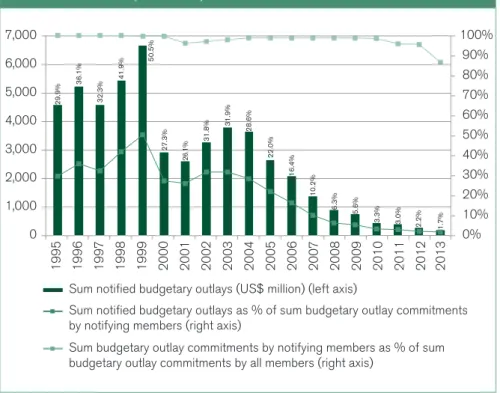
Since the Uruguay Round and its new disciplines and reduction commitments there has been a significant fall in the most trade-distorting support provided by the members that were traditionally considered to be the biggest subsidizers. For example, since 1995, the EU’s Current Total AMS has decreased by almost 90% (from €50.2 billion to €6.9 billion in 2011-12), by 82%
in Japan (from ¥3,507.5 billion to ¥608.9 billion in 2012), and by 48% in Switzerland (from CHF4.3 billion to CHF2.2 billion). For the US, Current Total AMS has also clearly fallen since 2000, by 60% (from US$16.8 billion to US$6.9 billion in 2012). Much of this is either due to changes in domestic policies triggered by the Uruguay Round disciplines, or in anticipation of new rules expected to emerge from the post-Uruguay Round negotiations, or both. High prices have also played a part in some cases. While Green
Box support has increased significantly in the same periods, these changes represent a move away from the most trade-distorting domestic support.
Domestic support in the post- Uruguay Round negotiations
Domestic support has been a central part of the agriculture negotiations that began in early 2000 under Article 20 of the Agriculture Agreement, one year before the launch of the Doha Round and were incorporated into the Doha Round in 2001.
The 2001 Doha Ministerial Declaration commits members to comprehensive negotiations aimed at substantial reductions in trade-distorting domestic support, among other objectives.
On 1 August 2004 members agreed on a framework for achieving this in the agriculture sections of the decision on the Doha work programme (Annex A of document WT/L/579). Since then, the work has concentrated on developing new disciplines.
At the 2013 Bali Ministerial Conference, ministers from the WTO’s membership adopted two decisions on domestic support. One was the decision on general services in the Green Box described above (document WT/MIN(13)/37 of 11 December 2013). The other was the decision on Public Stockholding for Food Security Purposes (document WT/MIN(13)/38 of 11 December 2013). This established an interim solution — while members continued to negotiate a permanent one — to shield public stockholding programmes for food security in developing countries involving food purchases at administered prices (as provided for in the Agreement), so that they would not be challenged legally under the
Agreement on Agriculture even if a country’s agreed limits for trade-distorting domestic support were breached. At the 2015 Nairobi Ministerial Conference, a ministerial decision was adopted that encouraged members to make all concerted efforts to agree on a permanent solution and to continue holding negotiations in this regard in an accelerated time-frame. By adopting the Nairobi Ministerial Declaration members also committed themselves to advance negotiations on the remaining Doha Round issues, including on domestic support.
Export subsidies
The conceptual framework
Export subsidies increased considerably in the years leading to the 1986–94 Uruguay Round. They became one of the key issues to be tackled in the agricultural negotiations.
Export subsidies for industrial products were already strictly disciplined under the General Agreement on Tariffs and Trade, and for developed countries they had been outlawed, following previous GATT negotiations. But for agricultural and other primary products, the disciplines were loose in theory and ineffective in practice.
The Agriculture Agreement resulting from the Uruguay Round says agricultural export subsidies are outlawed except in specific circumstances (Articles 3.3 and 8 of the Agreement):
• when a country has commitments to reduce its export subsidies on individual products or groups of products, within the limits specified in the legally binding document known as its “schedule”
of commitments: these subsidies are identified in Article 9.1
• for a limited period of time — while export subsidies were being reduced (years 2–5 of the implementation period), countries were allowed to overshoot their annual limits by a limited amount provided totals for the whole period were within the agreed limits (Article 9.2(b))
• for developing countries, during the implementation period, some export subsidies, including for some marketing and transport costs, under the special treatment provisions in Article 9.4
• Export subsidies not listed in Article 9.1 provided they are not used to get around (“circumvent”) the commitments either to cut export subsidies or not to subsidize at all — a provision designed essentially to block any possible loophole.
Commitments to cut export subsidies
What are export subsidies?
Exports are considered to be subsidized if the support provided depends on the products being exported, or on meeting export targets. The Agriculture Agreement refers to “subsidies contingent on export performance”. That includes types of support listed in Article 9.1, covering most types of export subsidy in agriculture:
• direct export subsidies provided by governments or their agencies contingent on export performance
• exported agricultural products released from non-commercial stocks at prices lower than on the domestic market
• payments on the exports of agricultural products financed by virtue of governmental actions, such as levies on all production which are then used to subsidise the exports of part of that production
• subsidies to reduce costs, such as subsidies for marketing goods exports;
this can include costs of upgrading, handling and international freight
• when domestic transport charges on export shipments are provided on terms more favourable than products that are sold domestically, such as for bringing exportable produce to one central point for shipping
• subsidies on products used to make other products (“incorporated products”), such as subsidies on wheat used to make biscuits on condition that the biscuits are exported.
All these export subsidies had to be reduced (they are “subject to reduction commitments”). The committed limits are on both the subsidized export quantities and the level of expenditure for such subsidies (the corresponding “budgetary outlays”).
Product categories
Countries’ export subsidy limits and how they are reduced are listed among the commitments that they legally bound in the WTO (in their “schedules” of commitments).
These limits apply by product or group of products. Members originally divided all agricultural goods into 23 products or product groups, such as wheat, coarse grains, sugar, beef, butter, cheese and oilseeds. Some members’ commitments are on subdivisions of these.
Expression of commitments
Each of the limits on