Figures 1 and 5 are from the Dibner Library of the History of Science and Technology, Smithsonian Institution Libraries, photography by the Smithsonian Office of Imaging, Printing, and Photography. The Dibner Library Lectures contribute immeasurably to the Smithsonian Libraries' efforts to acquaint the greater public with the valuable materials in the Dibner Library of the History of Science and Technology and how they are used by researchers. I intend to provide a much more detailed and comprehensive treatment of the subject of this lecture in a later article.
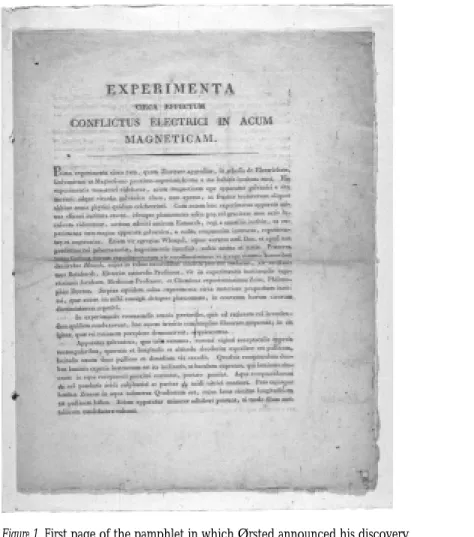
He once spoke of the “current [course] of the electric forces in the connecting wire” (4 bzw. 218). A 1959 copy by Daniel Hvidt hangs in the library of the Dibner Institute in Cambridge, Massachusetts. While he applied the term electromagnetism to his specific theory of the form of action of spiral electromagnetic activity, others simply applied it to the new phenomena.
Seebeck and thermoelectricity
But Ørsted early left the development of this new field to others, and his particular conceptualization of the phenomena died without issue. If this is what Ørsted understood by electromagnetism, then we need to reconsider what we mean by saying 'Ørsted discovered electromagnetism.' He did find that a magnetic needle is deflected by some action present in the connecting wire, but that was not the meaning. of discovery for him. Before the dust was settled, however, the question of whether the phenomena were to be traced to an electric current or an underlying magnetism gave rise to several theories of so-called transverse magnetism, which postulated the existence of small magnets running tail-to-tail around the circumference of the conducting wire. .14 Such ideas never gained much traction outside the German-speaking scientific community, and their appeal quickly waned as Ampere's electrodynamic theory gained ground, but for a time they were a serious contender for explaining what virtually everyone recognized as a phenomenon electromagnetic.
Seebeck reported his early findings at three meetings of the Academy of Sciences in Berlin in August and October of 1821.16 The earliest published reports reported that he had discovered how to produce magnetic effects in metals other than. Breger added: "In the terminology of the time, Seebeck thus transformed heat into magnetism." As pointed out in relation to Ørsted in note 5, above, this was not the way contemporaries typically spoke. One establishes the current in this circuit by disturbing the equilibrium of temperature.”21 By noting that “[one can discover these electric currents only by means of the magnetized needle,” he has already raised the question of the legitimacy of speaking in terms ignored. of an electric current when what one observes are magnetic effects.22 He went on to propose several new coins, which would eventually become standard: "It will doubtless be necessary henceforth to introduce this new class of electric circuits by a distinguish appropriate term; and as such I suggest the expression thermoelectric circuits...; at the same time one would be able to distinguish the galvanic circuit by the name hydroelectric circuit."23 His later Danish version already reported impersonally—if not completely.
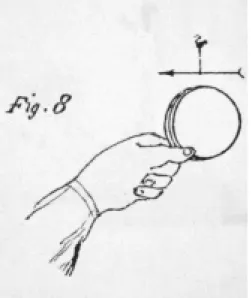
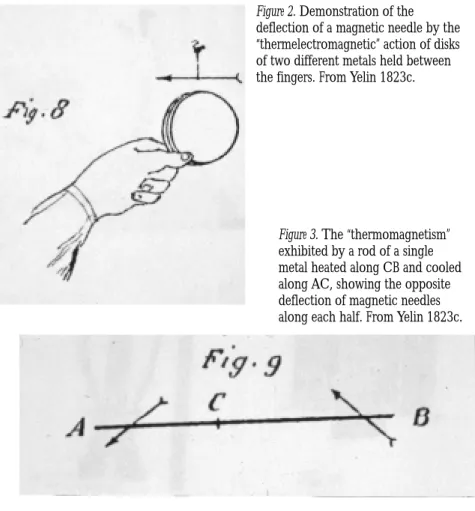
Should the phenomena be described simply and generically as electromagnetic, in a more phenomenological sense of the word than Ørsted had intended with his coin, or perhaps, more specifically, as thermal-electromagnetic, as Yelin proposed? Yelin, who had thus been led to regard the breaking of the temperature equilibrium as the principal cause of the electromagnetic action of Seebeck's circuit, determined to try the effect of this breaking on a circuit or on a piece of a single metal. Means of Temperature Differences.”29 In repeating and extending Ørsted's experiments, Seebeck came to suspect that any disparity in the action of the metals used in the galvanic circuit might lead to what he persisted in calling a “magnetic polarization” of the circuit, his choice of terms indicating that he is not inclined to trace Ørsted's electromagnetic trail.
Although time prevents me from even outlining the details of the community-wide reception of the work of Seebeck and others, by the 1840s it appears that the language of thermoelectricity had for the most part completely displaced that of thermomagnetism. Few seem to have ever noticed that Seebeck himself had spoken of "magnetic polarization."
Ritter and ultraviolet light
In his last article on the subject, Ritter emphasized the fundamental distinctiveness of the invisible chemical and thermal radiation that he and Herschel had discovered from the light of the visible spectrum.38 There seemed to be three distinct spectra, which by appropriate arrangement of prisms could separate themselves from the sun's rays. Things began to change decisively in 1842 with the combined arguments of Macedonio Melloni and Edmond Becquerel for the fundamental identity of all differently named rays of the solar spectrum, and with Ludwig Moser's more limited argument for the fundamental identity of all rays of the solar spectrum. Countering previous researchers who had failed to detect any heat towards and beyond the violet end of the spectrum, Melloni claimed that it was now possible to measure the heat developed by all types of rays striking a black surface.
However, it was Becquerel who provided what would prove to be perhaps the most decisive evidence in favor of the identity thesis, as he took advantage of recent developments in photography for scientific purposes. On the basis of certain peculiar phenomena, Moser explicitly argued against the identity of the rays of light and heat (Moser 1842d = 1843a). Moser did not advocate any theory of the nature of light, although his mild support for the wave theory is suggested by his favorable quotation of J.
If, to be sure, the argument for the ontological identity of the various types of radiation depended heavily on the accumulation of good and strong evidence, it also derived much of its credibility from the increasingly taken-for-granted implications of the wave theory of radiation. Edmond Becquerel's demonstration of the correspondence between dark lines in the solar luminous and chemical spectra. Embracing this new conceptualization of light, Wilhelm Friedrich Eisenlohr soon thereafter introduced the term that defined the region beyond the violet end of the spectrum not in terms of its chemical action but simply in terms of its location along a spectrum that was now.
Light itself consists accordingly of the visible systems of waves and, moreover, of waves longer than red and of waves shorter than violet. It should be clear that this required major conceptual transformations regarding the common understanding of light – entailing both general acceptance of the wave theory of light and the consequent conclusion that solar rays simply could not have qualitatively distinctive features.

Reflections on the form and function of scientific discoveries
Where Ørsted saw the effect of an electrical conflict extending beyond the boundaries of the connecting wire, others saw the effect of a transverse magnetism within the wire. What Ritter actually observed was the localized darkening of silver chloride beyond the violet end of the visible solar spectrum, but he, like everyone else, saw this as due to the action of invisible rays. This, in turn, brings us to one of the most important functions of anachronistically rearranged discovery accounts: to validate them as genuine current views about both the nature of reality and the nature of science.55 More than that, by saying that such and such -and-so one implies that this-and-that was always there, waiting to be discovered, an objective part of physical reality whose nature is determined by the structure of the world itself, and not by a laborious process of consensus building.56 .
Recognizing a historical element in the characterization of basic scientific phenomena threatens their status as objective facts.57 The perceived danger of the so-called social construction of scientific knowledge is that, by historicizing knowledge that claims a contingent context, it threatens with depriving them. of any claim to objective truth and thus to undercut the authority of science.58 Reworked accounts of discovery help to avert this danger, especially since conventional representation itself seems to imply a kind of objectivity. Although the name of the discoverer survives as an identifying icon, anything that was personal, historically conditioned, and inconsistent with current concepts and language is erased from the public record. Therefore, canonized accounts of discovery strengthen a particular perception of the individual scientist's role as originator of the facts, concepts and phenomena that make up the lasting edifice of science.59.
58 One of my reasons for preferring to speak of the collective – not social – construction of scientific knowledge is because 'social' tends to be understood as 'merely social', in which case the conclusion against any kind of objective truth seems inevitable. These stories are crucial to maintaining the values of the institution of science – the specificity and unique character of the knowledge it produces, for example” (Pestre. Even if the complex stories that can be told about the kinds of 'discoveries' discussed here will in fact enables us to make other important points about the history of science and the nature of the processes by which scientific knowledge is produced, we usually do not have time to clarify the contexts within which the work of—for example—Ørsted, Seebeck and Ritter must be placed in order to be properly understood.
60 An important part of the process described by Fleck involves the roles of what he called "vademecum science". Handbuchwissenschaft) - that is, of the selective restoration and canonization of scientific knowledge in compendia, textbooks and the like, prepared for the professional - and of the "popular science" prepared for the non-expert, the interested amateur.
Acknowledgements
Bibliography
Jahrestag der Vorlesung „Über die Erhaltung der Kraft“ von Hermann Helmholtz („Preprint 130“; Berlin: Max-Planck-Institut für Wissenschaftsgeschichte), 23.–33. Colding, Ørsted und die Bedeutung von Gewalt.“ Historische Studien in den physikalischen und biologischen Wissenschaften, 28, Pt. Objektivität, Relativismus und das Individuum: Eine Rolle für eine postkuhnsche Wissenschaftsgeschichte.“ Studium der Geschichte und Wissenschaftsphilosophie.
Mit einem Nachtrag zu den physiologisch-optischen Ergebnissen dieser Untersuchung [von Hermann Helmholtz].“ Bericht über. „Über die chemische Wirkung der Strahlen des Sonnenspektrums auf Präparate aus Silber und anderen Substanzen, sowohl metallischen als auch nichtmetallischen, und über einige fotografische Prozesse.“ Philosophical Transactions of the Royal Society of London, [130], Pt. Enthält drei zusätzliche Notizen, die erst am 12. März 1840 gelesen wurden.
Jahresbericht der Halleschen Naturforschenden Gesellschaft von 3. Die historische Struktur wissenschaftlicher Entdeckungen. 6, 8 und 9 beschreiben detailliert die Entdeckungen der Wirkung von Licht auf alle Körper, latentes Licht und unsichtbare Lichtstrahlen.“ Bericht über die königlichen Verhandlungen zur Veröffentlichung geeignet. Über das Sehen und die Wirkung von Licht auf alle Körper. Wissenschaftliche Memoiren, ausgewählt aus Protokollen ausländischer Akademien der Wissenschaften und Gelehrtengesellschaften sowie aus ausländischen Zeitungen, 3, S.
Magnetische Polarisation von Metallen und Erzen durch Temperaturunterschiede. Thesen der Königlichen Akademie der Wissenschaften zu Berlin. Eine Methode zur Untersuchung von Brechungs- und Dispersionskräften durch prismatische Reflexion. Philosophische Transaktionen der Royal Society of London, [92], Pt. Eine Methode zur Untersuchung von Brechungs- und Dispersionskräften durch prismatische Reflexion.“ Journal of Natural Philosophy, Chemistry, and the Arts, 8vo ed.
Neue Experimente zu den magnetomotorischen Eigenschaften bisher sogenannter nichtmagnetischer Metalle. Annalen der Physik pl.
Dibner Library Lectures on the History of Science and Technology