This work may not be translated or copied in whole or in part without the written permission of the publisher (Springer Science + Business Media, LLC, 233 Spring Street, New York, NY 10013, USA), except for brief extracts in connection with reviews or scientific analysis. Vignettes and case studies from Australia, Africa and Asia 119 5 Systemic governance from mode 1 to mode 2.
PREFACE: SYSTEMIC GOVERNANCE A Way to Address the Divides across Evidence,
REPRESENTATION AND THE CHANGED LANDSCAPE OF SCIENCE AND SOCIETY
Entropy – the failure of open, trusting communication systems – would be more likely to occur in these contexts. If we think about it in terms of many dimensions and 'unfolding' stakeholder values and so-.
DEDICATION
MEDITATIONS Systemic thinking
SYSTEMIC GOVERNCANCE FOR PARTICIPATORY DESIGN AND
VIGNETTE: RECONSIDERING GOVERNANCE AND INTERNATIONAL RELATIONS
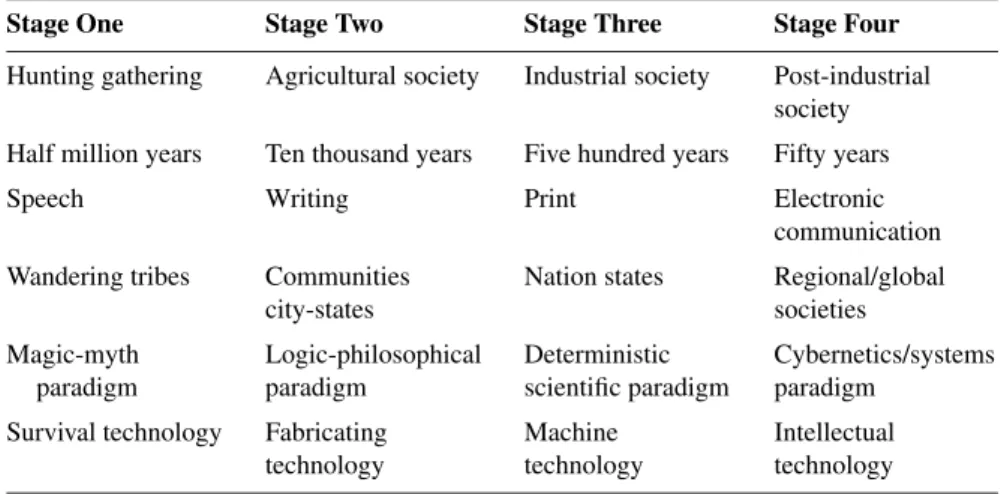
Communication is the basis of transcendence from lower levels of the hierarchy, and it is the basis of systemic governance. One-way media communication within Western democracies and the rest of the world tends to dominate via television today.
DIALOGUE AND ETHICAL GOVERNANCE
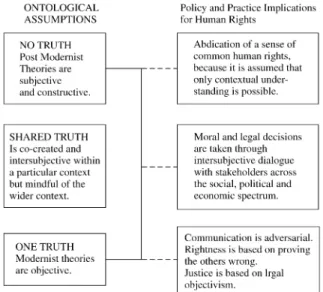
The testing process involves the exploration of attitudes in terms of the three worlds of the domain 'perceived objectively, perceived subjectively and perceived intersubjectively' and their implications for stakeholders by 'unfolding' the values of the participants and 'sweeping' social, cultural, political and economic values within the context. Since February, the Assembly of States Parties to the Court - the governing body of the ICC - has elected the first 18 judges of the Court. 36 Boyle, A., 2005, 'The Human Strain', Weekend Australian, 14-15 May, discusses the potential for human beings to evolve in many different directions.
THE PRAXIS OF SYSTEMIC, SUSTAINABLE GOVERNANCE
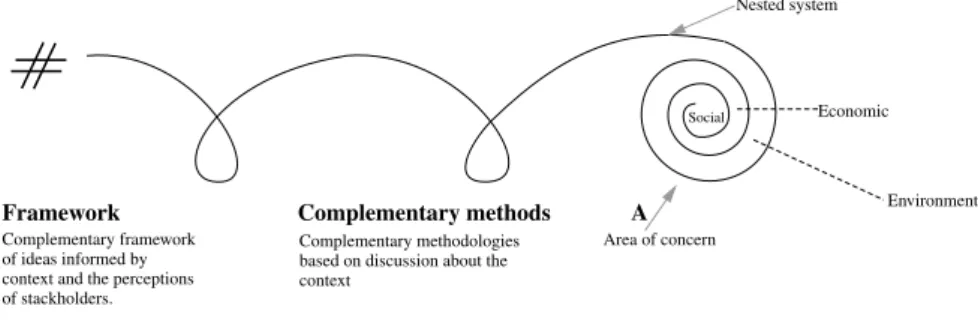
Emotions run high when political decisions are imposed that do not consider the feelings of others. Systemic governance must take into account the positives and the negatives – the unfolding of values and 'embeddedness' in the social, political, economic and environmental context achieved through conscious communication. Although identity can be rooted in categories, it can also emerge if our thinking is able to be mindful of the fluidity of life.

MOLAR AND MOLECULAR IDENTITIES AND KNOWLEDGES 55
Masculine and feminine categories and continuums are discussed in terms of the rights of people who do not fit binary oppositional categories. The concepts of "knowledge" and "knowledge management" are rooted in the way we understand the world and the way we undertake research and what is considered legitimate research. Perhaps democratic rights based on rights and responsibilities of citizens should be extended to all people who can be free to the extent that they do not undermine the rights of others (including sentient beings).
WHEN IS AUSTRALIA AUSTRALIA?
On October 11, the Chief of the Defense Force was told that the information was doubtful, but by then photos of the children rescued from the sinking SIEV 4 had already appeared in the media. The conclusion of the Senate investigation was that the problem in the first two cases lay in the lack of information management and inadequate accountability. To what extent does the Border Protection Act 2001 undermine human rights, criminal and civil law violations in Australia and the Pacific Islands that are part of the so-called solution?
POWER AND PRAXIS FOR SOCIAL AND ENVIRONMENTAL JUSTICE
STRIVING FOR BALANCE
Knowledge management is a phrase coined by Nonaka and Takeuchi (1995), based on the experience of the company's organizational context. In the wake of the suicide bombings in London by British insiders on 7 July 2005, 'the enemy within' must be addressed. Yallop emphasizes that: “For Benedict, leadership was not the application of a strict set of rules; it was to reconcile people of different beliefs and personalities", he said "the abbot's role in the monastery was to create unity out of that diversity".
WORKING AND RE-WORKING THE BOUNDARIES OF KNOWLEDGE, INTERNATIONAL RELATIONS
- Design and Transformation: Scanning the Policy and Governance Horizon
- Considering Bonds, Boundaries and Norms
When a fetus moves - the part of the landscape (organic rock lizard or inorganic rock) that the mother sees is the totem of the child. From this point of view, it is argued that knowledge is constructed in the interest of the powerful. The civil servants and the members of the government should be their agents.
ENHANCING PARTICIPATORY DEMOCRACY
Don Edgar (2001) takes this further and argues that diversity at the local level should be promoted. For example, young children and young families need space (Stretton, 2001) and the argument that cost savings in terms of infrastructure cost savings can be enhanced by high density housing needs to be considered carefully. The long-term consequences for quality of life must be considered in terms of triple bottom line ac-.
APPRECIATING COMPLEXITY WHEN MAKING PUBLIC POLICY THROUGH SYSTEMIC LEARNING
Sometimes extreme diversity is positive, sometimes it can have negative consequences that governments need to consider. Although identity can be rooted in categories, it can also emerge if our thinking is able to accommodate the fluidity of life. Idealism (as an appreciation of the connections and relationships that make up social and environmental systems) and practical and pragmatic implications for a sustainable future.
CHALLENGES FOR PARTICIPATORY DEMOCRACY
Being is a complex interaction of conceptual, biological, ecological and social variables and is not static. Pragmatic risk management, based on valuing multiple points of view, goes hand in hand with participatory design and democracy. This is not necessarily a problem, because people are involved in political activities in many fluid and non-formal contexts.
ACCOUNTABILITY, SELF INTEREST AND THE WILL TO PARTICIPATE
64 Chapter 2 feedback loops and the implications these have for us as researchers, practitioners and people. Appreciation of the many domains of knowledge that can be addressed through a system of inquiry that takes the objective, the subjective and the intersubjective into account when trying to understand the nature of governance and international relations challenges. Instead, the divisions across thinking, speech and action must be recognized and the divisions across forms of life healed.
METHODOLOGY
Systemic approaches reflect on and can elaborate on the range of approaches available (through the ability to think critically and ask questions). 58 Contextual and collaborative governance must be based on respectful communication (according to Habermas, 1984) that is (hopefully) appropriate and takes into account current and future generations (Banathy, 2000). Questions may be more important to democracy than answers, which should always be contextual and open to negotiation, based on the need and desire to work with others.
KNOWLEDGE, IDENTITY AND CULTURE
APPRECIATING DIVERSITY FOR RISK MANAGEMENT
- Facilitation Styles
According to her, "an essential problem-solving skill" is the ability to work with groups of people and to understand the contributions that all participants could make to the understanding of the situation (Wolf, 1989: 54). The new science, based on the knowledge of quantum physics, is also aware of the continuity of reality and matter (Utke, 1986). Individual perception of problems in the sense that it is "personally political" and therefore part of the same moment takes into account critical or conflict models and humanistic or process models.
AN OVERVIEW OF CRITICAL SYSTEMIC THINKING AND PRACTICE (CSP)
- Accountability and Complexity Thinking
- Facilitating the CSP Learning Process
This ability to separate self from object enabled dualistic thinking to break out of the "enchanted circle" (Popper, in Zhu, 2000). According to Flood and Romm, it is based on the assumption that of the three options: isolation of paradigms, incommensurability (meaning incomparable) and comparability (comparable), the latter makes the most sense. Time spent deconstructing an argument or a practical suggestion could be just as well spent trying to find what Gouldner (1971) called the "liberating potential" within the arguments and using the potential to co-create and develop with respect to some useful changes within a specific context.
DESIGN OF AN INQUIRY SYSTEM FOR SYSTEMIC GOVERNANCE
INTRODUCTION: C. WEST CHURCHMAN AND SYSTEMIC PRAXIS
- Constructing a Mandala of Knowledge
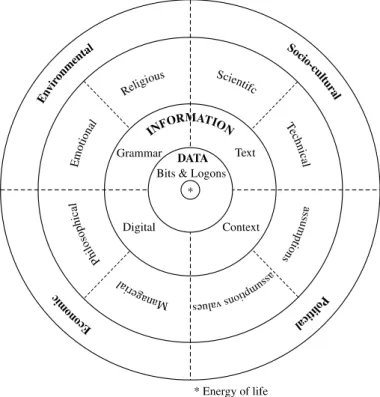
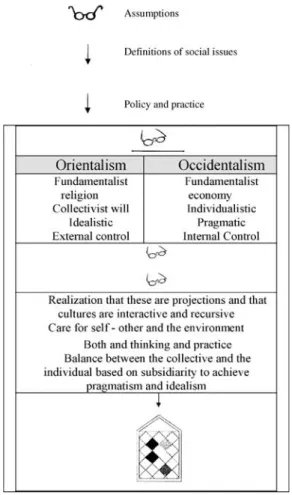
What's going on?" The report emphasizes that all levels of government should foster the conditions for creativity, knowledge creation and knowledge management/sharing across regional areas to enable more developed regions to help less developed regions (by helping to create suitable conditions for development - ment). Issues of privacy, anonymity, responsibility, honesty, so-called professional expertise and issues of representation in research, humility and willingness to learn from the experience of the "other" can be addressed through theoretical and methodological literacy. A diagram (derived from many years of teaching and action learning) symbolizes sets of assumptions about the world. The colors themselves may or may not have any meaning!) A set of lenses (single model) and lenses numerous12 that together make up the stained glass window in the world.

BATESON’S APPROACH TO WORKING THE BOUNDARIES
Distinguishing between the way the "researcher" and the "researched" see the world. The class could be asked to consider their expectations of social justice in Australia in comparison to other places in the world. Being sensitive to the "other's" point of view is based on a recognition that we do not all see things the same way.
IMPLICATIONS OF ASSUMPTIONS FOR THINKING AND PRACTICE
The way we see the world or construct the world is shaped by life experiences, our situation in time and place, and our personal interpretations of our experiences. Bracketing15 or setting aside our taken-for-granted views, involves trying to see the world through a different set of lenses.16. The diagram illustrates the implications of assumptions and values on the way we see the world and the way we construct social policy.
THE TETRAD APPLIED BY MCLUHAN AND POWERS
It encourages us to look not only at the dark foreground, but also the white space. It also encourages us to think not only in terms of right and wrong, but in terms of paradoxes. Greenfield (2002) emphasizes plasticity of the brain and that consciousness is a product of connectivity, the model by McLuhan and Powers (1989) which characterizes left hemisphere thinking as quantitative and right hemisphere thinking as qualitative appears to be "old hat".
WEST CHURCHMAN’S “SWEEPING IN” AND CRITICAL UNFOLDING APPROACH 20
Flood and Romm (1996) emphasize that managers tend to concentrate on "what questions" and "how questions", which are task and process questions and less on "why questions", which are rationale questions that get to the heart of issues. .22. His questions from the above chapter are as follows: “Who is the real customer of the system design. What conditions of successful planning and implementation of the system are really controlled by the decision maker.
MINDFULNESS, POLICY MAKING AND GOVERNANCE
DEY’S COMPLEMENTARY APPROACH TO METHODOLOGY
- Rich Pictures
A research approach based on open and closed questions for collecting qualitative and quantitative data would be appropriate. Participation”, the independent variable should be operationalized or made measurable in terms of indicators, such as the number of stakeholders and the frequency of meetings. For example, success,” the dependent variable, would be defined in terms of the number of people employed and the number of people pursuing further education.

THE ITERATIVE RESEARCH CYCLE AND ITS RELEVANCE TO PARTICIPATORY DESIGN
- Big Picture and Small Picture Design
- A Checklist for Effective Research
- The Iterative Research Cycle and its Relevance to Participatory Design
Wadsworth, Y., 2000, “The mirror, the magnifying glass, the compass and the map: facilitating participatory action research”, Handbook of Action Research, Sage, London. The subjective dimension of a rural water and sanitation project includes people's perceptions of water quality and the causes of the disease, typhoid. To explain the research process and the logic of the research cycle, we must imagine that we are part of a rural community development support group.
GROUPWORK AND MODELLING RESPECTFUL COMMUNICATION FOR PROBLEM SOLVING
We tried to find aerial photos of the area and were disappointed with this as well. These techniques enable participation, and in the case of the nominal group, the technique can ensure that ideas are not associated with individuals because they are noted in confidence, collected and then shared without reference to the originators. Size Roles Status of the individuals and. profession Values that are consistent with. group is the basis for defining in- and out-groups.
SHAPING OURSELVES AND OUR FUTURES Vignettes and Case Studies from Australia,
Writing and talking to me is about healing and it is sometimes therapeutic. Some of the time it makes me all too aware of my limitations, which is fortunate. White, female, professional a lot of the time, Australian, in some ways - the boundaries are drawn.
SYSTEMIC GOVERNANCE FROM MODE 1 TO MODE 2 CONSCIOUSNESS
CHOOSING HOW WE LIVE OUR LIVES AT THE LOCAL LEVEL 1
- Appreciating Complexity When Making Public Policy through Systemic Learning and Lived Experience
She decided to return to Alice Springs from Sydney and build a home for herself (with the help of CAT - Center for Appropriate Technology). She could have chosen to live in Sydney near her daughter, but she chose to live on her mother's Arrernte land and build a mudbrick house with local materials. It tells positive stories about how to live with the environment by recycling and saving water and energy.
THE FUTURE DIRECTION OF GOVERNANCE
- Communication and Participation for Governance
- The Praxis of Systemic, Sustainable Governance
- Vignette of a Systemic Approach
- Time, Place, ‘Know How’ and the Systemic Approach
The invitations should be extended to everyone who is on the receiving end of the decision.” As policy researchers, we must consider the contributions of many theorists and many disciplines. Schizophrenia was central to the diagnosis, based on divided, compartmentalized thinking.