Top Skills Honing for Today's Accountants: a Literature Review
Article in The Indonesian Journal of Accounting Research · July 2024
DOI: 10.33312/ijar.765
CITATIONS
0
READS
170
2 authors:
P L Joshi
122PUBLICATIONS 1,630CITATIONS SEE PROFILE
Suzan Dsouza
American University of the Middle East 39PUBLICATIONS 190CITATIONS
SEE PROFILE
All content following this page was uploaded by Suzan Dsouza on 23 July 2024.
The user has requested enhancement of the downloaded file.
* Corresponding Author: [email protected]
Top Skills Honing for Today’s Accountants: a Literature Review
PREM LAL JOSHI*
Former Faculty at MMU Malaysia and UOB, Bahrain SUZAN DSOUZA
American University of Middle East, Kuwait
Abstract: Employability abilities are becoming increasingly important in today's technologically sophisticated, globally integrated job markets. The departments' continued adoption of new technology, automation tools, and software will ultimately change the expectations of the accounting teams. With the assistance of prior literature, this essay examines the vital abilities and skills accountants should possess today.
Today's accountants need to acquire the most cutting-edge skills for effective performance. The earlier studies, which drew their conclusions from literature published in the last 20 years, laid the groundwork for the fundamental knowledge and abilities that modern accountants must possess. The four main skill areas that comprise the whole skill set needed by accountants in the modern workplace are business skills, soft skills, digital and technology skills, and ethical skills. It emphasizes how important it is to provide professional accountants with the most recent skill sets available so they may perform efficiently in a dynamic workplace. Accounting professionals must learn to use new technologies to continue in their field. The study suggests a theoretical framework by classifying twenty-three skills into four main categories: business, soft, ethical, and technology and digital skills. Future research directions are also suggested.
Keywords: Accountants, Business Skills, Soft Skills, Technical and Digital Skills, Ethical Skills, Human Capital Theory, Accountants’ Performance
Abstrak: Kemampuan untuk mendapatkan pekerjaan menjadi semakin penting dalam pasar kerja yang canggih dan terintegrasi secara global saat ini. Penerapan teknologi baru, alat otomasi, dan perangkat lunak baru yang berkelanjutan oleh departemen pada akhirnya akan mengubah ekspektasi tim akuntansi. Dengan bantuan literatur sebelumnya, esai ini mengkaji kemampuan dan keterampilan penting yang harus dimiliki akuntan saat ini. Untuk kinerja yang efektif, akuntan masa kini perlu memperoleh keterampilan paling mutakhir. Studi-studi sebelumnya, yang mengambil kesimpulan dari literatur yang diterbitkan dalam 20 tahun terakhir, meletakkan dasar bagi pengetahuan dan kemampuan mendasar yang harus dimiliki oleh akuntan modern.
Empat bidang keterampilan utama yang mencakup seluruh rangkaian keterampilan yang dibutuhkan oleh akuntan di tempat kerja modern adalah keterampilan bisnis, soft- skills, keterampilan digital dan teknologi, dan keterampilan etis. Hal ini menekankan betapa pentingnya membekali akuntan profesional dengan keahlian terkini sehingga mereka dapat bekerja secara efisien di tempat kerja yang dinamis. Profesional akuntansi perlu mempelajari cara menggunakan teknologi baru jika mereka ingin
266
melanjutkan bidangnya. Kajian ini memberikan saran kerangka teoritis dengan mengklasifikasikan dua puluh tiga keterampilan ke dalam empat kategori utama:
keterampilan bisnis, keterampilan lunak, etika, serta keterampilan teknologi dan digital. Arah penelitian di masa depan juga disarankan
Kata Kunci: Akuntan, Keterampilan Bisnis, Soft Skills, Keterampilan Teknis dan Digital, Keterampilan Etis, Teori Sumber Daya Manusia, Kinerja Akuntan
1. Introduction
Due to elements like business globalization, the internationalization of economic relations, the expansion of multinational organizations, foreign investments, and information systems, the environment in which accounting professionals work today is continually changing. Along with the more traditional financial management duties and financial reporting duties, accountants also perform organizational, strategic, and communication support roles (Reig, Ulrich, & Finckh, 2022). They need to learn more about the current role and priorities of their organization to use their hard and soft skills to build lasting values for the company. However, the role of the accountant is changing in the modern era. Accountants must possess additional soft skills and technical accounting knowledge to make the case that their knowledge needs to be updated in the current business environment. Graduates are sometimes accused of lacking the abilities required in the workplace, a common criticism (Jackson & Chapman, 2012). The
"expectations gap" that arises when accounting graduates complete their degrees without having attained the level of competence in general skills expected by employers has been the subject of numerous studies (e.g., Jackling & de Lange, 2009; Low et al., 2016). Since there are several 21st-century skills that accountants are universally required to have, we must discuss the top skills for modern accountants (Sally et al., 2023; Lawson, 2019).
People with advanced accounting skills will be able to secure better employment since employers are in greater need of accountants due to their ability to understand money and budgeting in ways that go beyond traditional understandings (Kwarteng &
Mensah, 2022). Success in accounting now requires more than technical and regulatory
267 knowledge (Houston, 2023). Clients now expect services that are very different from what they did in the past, primarily due to technology's major role in the profession's rapid evolution. Furthermore, these services call for a completely different set of skills.
Financial industry managers and business leaders claim entry-level management accounting and finance professionals lack technical and non-technical abilities (McCann, 2015). CEOs may find it challenging to find applicants with the skills needed to fill professional-level positions in financial analysis, business services, compliance, and accounting and auditing (Half, 2020).
The conceptual basis for this study is the human capital theory (HCT). The human capital hypothesis postulates that people are born with a particular set of talents they may add to or improve via education and training. It was first put out by Becker (1962) and Rosen (1976). Because of their innate skills and investments in themselves as individuals, workers with higher levels of education have higher production, efficiency, and skill levels. Individuals become economically productive because of this stock.
Human capital is an intangible asset not represented on a business's balance sheet.
Employees' experience and skill set are believed to be examples of their human capital.
Employers may enhance their human capital by funding workers' benefits, education, and training because not all labor is equal.
Educating workers benefits individuals and societies (Becker, 1993). Because educated and skilled employees are essential to the information economy's future, workforce development is vital for individuals and governments (Tusar & Sooraksa., 2019). Employers, however, frequently lament their inability to find job seekers with the necessary skills for the workforce. Accounting businesses claim they have trouble finding candidates with the requisite skills and competencies even though there is often a high demand for accounting graduates (Robert Half, 2015, cited by Sandifer, 2018).
Furthermore, an unprecedented confluence of factors created the talent gap for the certified public accountant (CPA) (Thomson, 2017).
When applied to organizations, HC theory contends that people who spend money on education and training will become more productive and skillful than those who do not, allowing them to make more money overall. Economically speaking, it is
268
challenging to quantify the costs and benefits of human capital and how improved education and training boost business profitability (Sweetland, 1996). Additionally, the main idea of the theory is that improving accountants' education and training leads to improved abilities, dexterity, decision-making, and work performance, all of which support a business's ability to survive longer (Sweetland, 1996). Public accountants, for instance, must stay current on changes to tax legislation, international auditing standards (ISAs), and international financial reporting standards (IFRS). To be more productive and successful, companies must invest in the growth of their workforce's skills and acquire new information (Mugayar-Baldocchi, Schaninger, & Sharma, 2021).
This paper aims to elucidate the importance of essential skills that modern professional accountants ought to possess to navigate the dynamic business environment and job demands effectively. The skill set is derived from research published in professional magazines and prestigious academic journals over the past 20 years from multiple databases such as Proquest, SCOPUS, and Researchgate. It concludes by outlining the desired skills that future accountants should have when most corporate functions are automated in the next few years. The article ultimately will group the twenty-three skills into broad categories and provide the direction for future research on testing these skill sets through various research methods.
2. Literature Review
During the 1980s in the United States, surveys on the knowledge and skills needed by accountants began. The expectations-performance gap between practice and accounting education has been brought to light in part by the American Accounting Association (AAA, 1986) and the American Institute of Certified Public Accountants (AICPA, 1999). These publications described how the development of technology has caused changes in the accounting profession. Accounting has various subfields, all of which demand comparable technical skills but very different sets of soft skills. Many accounting positions call for a variety of soft and technical skills. Due to software, automation, and digitalization improvements, accounting professionals are called upon to upgrade their skills for better performance and industry survival. Although
269 accountants work with new technology, they still lack technical and digital abilities (Kroon, do Céu Alves, & Martins., 2021).
Robles (2012) argues that "soft skills are the intangible, non-technical, personality- specific skills that determine one's strengths as a leader, facilitator, mediator, and negotiator." (p. 457), while Kermis and Kermis (2010) relate soft skills to the notion of professionalism and argue that these should include judgment, critical thinking and analysis, integrity, and openness and should be directly linked to the requirements of the workplace and that the accountant must be able to function as a professional in their field.
According to Dwaase, Awotwe, and Smith's (2020) study findings in Ghana, the accounting profession is evolving from a purely documenting function to include managerial-type challenges, indicating its strategic relevance. Findings also show that besides the technical and functional skills needed for accounting, accountants also require interpersonal, intellectual, and analytical abilities as well as IT, communication, organizational, and company management skills.
Tan and Fawzi (2017) examined the employability skills of accountants as advertised in newspapers in Australia and New Zealand, working under the premise that employability skills are critical in today's competitive employment market. Their study's findings suggested that a positive attitude, the capacity for teamwork, and the capacity to present, debate, and defend ideas are the abilities that employers value the most. According to their analysis, a team player with a positive outlook and effective communication skills appears to be the behavioral trait most prized by employers.
The professional abilities and capabilities of accountants that promote a successful application of International Financial Reporting Standards (IFRS) were recognized by Maradona, Chand, and Lodhia (2022) in the Indonesian context. They look into the extent to which professional accountants have acquired these abilities through formal education and discover that accounting judgment is regarded as the most critical competency for implementing IFRS. The results also suggest that ethical skills and some generic abilities are crucial for adequately applying IFRS. Still, cultural sensitivity skills are viewed as being of the least importance. The results also show that
270
professional training programs must strongly emphasize the development of judgment and other pertinent skills, which are crucial skill categories for using IFRS.
According to the findings of Asonitou and Hassall's (2019) study conducted in a Greek setting, professional skills were valued. However, there was a difference in the weights assigned by different stakeholder groups to relevant talents and how those abilities should be developed through education. Based on the results, it is imperative to enhance the critical thinking abilities of prospective accountants by implementing creative teaching approaches and developing courses that support graduates' career readiness and sustainable growth.
Academic studies and practical research on the connection between accountants' skill sets and job performance are lacking. An employee's career path and productivity can be improved through knowledge and interpersonal skills (networking) (Anggiani, 2017; Sisson & Adams, 2013). Ardina, Wahyuni, and Suarjana's research (2021) indicate that hard and soft abilities positively and significantly impact accounting students' competitiveness. Furthermore, Fratzeska and Nancy's (2021) study shows that four soft skills—communication, problem-solving, flexibility, and teamwork—
significantly impact workers' contextual performance.
Accounting managers who enhance their general competencies or learn new skills in a professional development setting are more likely to observe advances in performance and, as a result, effectiveness (Trivellas et al., 2015). Rouwelaar, Schaepkens, and Widene (2021) found that management accountants' effectiveness is correlated with all three skills (interpersonal skills, conceptual skills, and technical skills), while their perception of their influence over decision-making is linked to their conceptual and interpersonal skills. This survey included 215 controllers in Dutch healthcare organizations. Furthermore, their findings show that, whereas technical and conceptual skills are jointly related to the influence of MAs, conceptual and interpersonal abilities are jointly associated with their effectiveness. Kroon, Alves, and Martins (2021) conducted a comprehensive literature evaluation of 157 articles from the recent accounting literature, emphasizing the implications of developing technology for the functions and competencies of accountants. Their study's primary analytical
271 findings specify the competencies required of modern accountants and their designated roles. According to Atiqur et al.'s (2019) research, employees' job performance and managers' use of soft skills—such as communication, leadership, teamwork, and critical thinking—are positively correlated. Finally, but just as importantly, Vitali and Giuliani (2024) state that the new technology will help auditors and accountants in their daily work by enabling them to do tasks more efficiently and effectively.
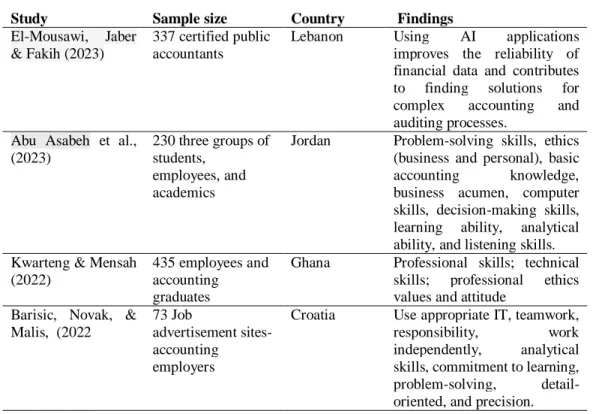
Table 1 lists some significant research findings from the past 20 years regarding the skill sets needed for accountants. It includes the authors, sample size, country setting, and critical findings. Multiple databases, such as Proquest, SCOPUS, and Researchgate, were used to obtain the prior research articles.
Table-1.
Empirical Studies on Accounting Skills for Accountants
Study Sample size Country Findings
El-Mousawi, Jaber
& Fakih (2023)
337 certified public accountants
Lebanon Using AI applications improves the reliability of financial data and contributes to finding solutions for complex accounting and auditing processes.
Abu Asabeh et al., (2023)
230 three groups of students,
employees, and academics
Jordan Problem-solving skills, ethics (business and personal), basic accounting knowledge, business acumen, computer skills, decision-making skills, learning ability, analytical ability, and listening skills.
Kwarteng & Mensah (2022)
435 employees and accounting graduates
Ghana Professional skills; technical skills; professional ethics values and attitude
Barisic, Novak, &
Malis, (2022
73 Job
advertisement sites- accounting
employers
Croatia Use appropriate IT, teamwork, responsibility, work independently, analytical skills, commitment to learning, problem-solving, detail- oriented, and precision.
272
Study Sample size Country Findings
Carvalho & Almeida (2022)
Focus groups:
Accountants of large and medium- sized companies;
private and public sector accountants;
accountants in accounting offices;
managers or administrators;
“Big 4” and “non- Big 4” reviewers or auditors
Portugal Communication; proactive;
successful teamwork; ability to adapt to new contexts.
Ebaid (2021) 68 working accounting graduates
Saudi Arabia Communication, teamwork, emotional stability, financial accounting and reporting, and analytical thinking skills Kwarbai &
Omojoye (2021)
277 employees of Audit firms
Nigeria Artificial intelligence has a positive, significant effect on reporting accuracy, anomalous detection, and data analytics in the Nigerian accounting profession.
AI is an essential skill for accountants as it significantly improves reporting accuracy, anomaly detection, and data analytics.
Khemiri, (2021) 306 CPA and CPA trainees
Tunisia Analytical/critical thinking, oral communication, foreign language, professional demeanor, measurement, risk analysis, and written communication.
Dwaase, Awotwe,
& Smith, (2020)
Secondary data Ghana Accountants require not just technical and functional skills in accounting but also soft skills, intellectual and analytical abilities, IT skills, communication skills, organizational skills, and business management skills.
273
Study Sample size Country
Findings Cernușca (2020) 250 students and
300 accounting professionals
Romania Soft for students and hard skills for professionals.
Technical and functional skills;
intellectual skills; personal skills;
interpersonal and
communication skills;
organizational and business management skills
Atanasovski, Trpeska
& Lazarevska (2018)
68 accounting students and 57 employers
South East European (SEE) countries
Time management; good presentation; characteristics of self-confidence; motivation and self-promotion; oral communication; knowledge of foreign languages, ethical attitude and credibility; and commitment to life-long learning
AL Mallak (2018) 256 accounting students, 109 accounting graduates, and 33 accounting educators
Saudi Arabia Stakeholders considered all generic skills necessary for accounting graduates to succeed in employment, with ethical skills rated as the most important.
Sandifer (2018) 330 USA Critical thinking; decision-
making skills; analytical and problem-solving; self- motivation/self-direction;
listening attentiveness
Hussein (2017) 119 professional accountants from audit firms and 126 final-year
accounting students
Egypt Intellectual and
communication; interpersonal;
creative ability; organization;
research and analytical skills Osmani et al.
(2017)
462 accounting students
Middle east Interpersonal, planning and organization, communication, self-management, and analytical skills
Lim et al. (2016) Asian employers, lecturers, auditors, and students,
Asia Communication skills,
analytical skills, critical thinking skills, time
management skills,
information technology skills, ability to work in team skills, and interpersonal skills
274
Study Sample size Country
Findings Warwick & Howard
(2015)
62 accounting educators and industry practitioners
The UK. Communication; oral skills;
analysis skills; problem- solving interpersonal skills;
team working Ahadiat & Martin
(2015)
330 Accountants - Members of AICPA or members of IMA
United States Trustworthiness,
Dependability, Oral communication skills, Cleanliness, and Punctuality.
Weaver & Kulesza (2014)
Three thousand three hundred fifty- three members of the Connecticut Society of CPAs.
Both managers and young professionals included
USA Critical/strategic thinking, time management and organization, memos and
writing skills,
intermediate/advanced Excel skills, problem-solving, and work paper skills.
Afolabi (2014) 350 employers, Nigeria Written communication;
computer knowledge;
awareness of global issues;
work-based experiences;
interpersonal; problem- solving; leadership; knowledge of spreadsheet and word processing.
Weaver & Kulesza (2013, 2014)
Young accounting professionals
United States Critical/strategic thinking;
intermediate/advanced Excel skills; basic work paper skills;
time management and organization, and writing skills Klibi & Oussii
(2013)
81 accounting students and 48 practitioners
Tunisia Employers primarily look for personal talents (autonomy, morality, and dynamism), interpersonal skills (teamwork,
communication, and
leadership), intellectual skills (critical thinking, time management, and pressure), and IT skills (software selection and usage).
275
Study Sample size Country
Findings Milliron (2012) 85 young
professional accountants and 30 experienced CPAs
United States Ethical standards: Work ethics, communication skills, working with teams, IT skills.
Cory & Pruske (2012)
464 Employers United States Creativity in problem-solving, spreadsheet, and word processing; awareness of ethical issues.
Chaker & Abdullah (2011)
77 College graduates
United Arab Emirates
Leadership development;
auditing skills; professional ethics; interpersonal and communication skills
Uyar & Gungormus (2011)
39 accounting professionals
Turkey All 21 skills except
"knowledge of accounting software" were perceived as necessary or important.
Massey (2011) 309 CPAs in public accounting
United States Analytical/critical thinking;
oral communication; ethics principles; spreadsheeting; and teamwork.
Awayiga et al.
(2010)
131 accounting graduates and 25 employees
Ghana Professional demeanor;
communication skills;
analytical/critical thinking;
computing technology;
technical and functional skills.
Jones & Abraham (2009)
26 Practitioners Australia Analysis and ethical standards;
intelligence, leadership, work experience, and team skills.
Jackling & de Lange (2009)
174 Accounting graduates
Australia Communication skills, problem-solving skills, and personal skills.
Wells et al. (2009) 26 Accounting graduates in public practice
New Zealand Understanding and interactions with client’s timely manner;
work organization; effective job performance.
276
Study Sample size Country
Findings Kavanagh &
Drennan (2008)
28 Employers and 322 graduating students
Australia Communication, analytical, professional, and teamwork skills, business awareness, and knowledge.
De Lange, Jackling,
& Gut (2006)
310 graduates from two Victorian universities
Australia Communication, team skills, leadership, problem-solving, analytical and interpersonal skills.
Joshi & Bremser (2004)
36 companies’
accountants
Bahrain The most critical skill
requirements were
professional skills,
"communication skills, analytical skills, and managerial skills.
2.3 Important Skills Requirements
As shown in Table 1, the following 23 important skills accountants must possess are discussed in depth with the aid of earlier research published in professional periodicals and peer-reviewed journals for the last 20 years, starting from 2004.
Organization Skill
Some of the most crucial accounting skills and aptitudes depend on organization because an accountant must be highly technical. Since everything must tally up precisely on the bottom line and every cent a corporation receives or expends must be reported, the most successful accountants have an eye for detail. Every accounting practitioner should develop good organizational skills since they are beneficial and desirable. This involves the capacity to focus on many clients' data, prioritize various professional obligations, and multitask (AOLCC, 2017). Managing and working with enormous amounts of data requires a high level of familiarity. The Cernușcă (2020) and Osmani et al. (2017) research rated organizational and business management abilities as crucial.
277 Leadership Skill
Fast-growing companies look for professionals with specific leadership qualities in the accounting field. The best accountants use a cooperative approach to issue- solving. Successful leaders can bring people together in constructive ways. The distinction between success and failure is made by paying attention to detail. The most successful accountants produce accurate, meticulous, and detail-oriented work.
According to Kavanagh and Drennan (2008), leadership should be a competency for contemporary accountants.
Also, they should uphold their moral standards and be proactive thinkers, constantly learning new things. They are conscious that the public depends on them to provide a truthful and accurate representation of the company's current condition.
Leadership abilities are in demand by employers in the accounting industry today (Chaker & Abdullah, 2011; Jackling & de Lange, 2009).
Critical Thinking Skill
The ability to solve problems, add value to data, spot trends in a business, and adopt a more comprehensive commercial perspective that benefits a company are all examples of critical thinking. An accountant with this ability may assess challenging situations, weigh many possibilities, and draw reasonable conclusions. When a subject or topic is studied from all perspectives, an accountant can use accounting principles to analyze recent and historical financial data to pinpoint problems and create ethically sound remedies. Companies want to know that they can trust the accountant to be a self- starter, conduct research, consider multiple solutions to a problem, and use deductive reasoning to overcome obstacles (Wang, 2020).
In the context of the US and Tunisia, analytical and critical thinking are among the top three professional qualities required of accountants, according to Khemiri's (2021) poll. Similarly, "critical thinking and problem-solving skills" were the skills that industry executives (61.7%) felt were most crucial for accountants in Tunisia and the United States. Similarly, "critical thinking/problem-solving skills" was the skill that industry executives (61.7%) ranked as most significant. Reporting no longer refers to
278
just presenting data and graphs. To be an effective business partner, accountants must have a bigger hand in providing more strategic and deeper insights. Other studies supporting the previous findings include Osmani et al. (2017).
Networking Skill
Professional accountants can stay up-to-date with changes in the accounting field by networking. Also, they converse with people in their area to learn about the most recent news, trends, and best practices. They also converse with peers from other organizations to learn about the market. As a result, networking is crucial for establishing open communication channels and building more reliable relationships.
Nonetheless, a widespread myth holds that accountants frequently identify as introverts who like to work alone. The reality is somewhat different, particularly given the current corporate environment. Due to their critical role and active participation on corporate teams, accountants must engage and speak with people constantly. Regardless of their field, all accountants must analyze and comprehend complex financial data and effectively convey their conclusions to clients. The position also requires excellent interpersonal skills since many accountants work in teams and frequently interact with clients (Warwick & Howard, 2015; Dolce et al., 2020).
The conclusions of the Mandilas et al. (2014) study highlight the value of networking for accountants in the workplace. An accountant's ability to network and interact with people is crucial to driving business for the company, as they interact with a range of groups both inside and outside the organization. Derekoy's (2019) study results show that they are rated poorly by both professional accountants and accounting students.
Adaptability
A flexible accountant can handle a heavy workload, anticipate changing circumstances, maintain composure under pressure, accept new assignments at short notice, and think quickly. The circumstances in which accountants operate, both legally and technologically, are ever-changing. The best accountants are, therefore, adaptable and open to changing how they go about their everyday work. According to Rotich
279 (2023), accountants demonstrate adaptability when they promptly respond to demands from clients or other co-workers and meet their needs. To fulfill deadlines or alter financial statements, such as budgets, to reflect actual expenses, they may also employ flexibility to obtain and analyze data quickly.
Accountants had to switch to working remotely during the COVID-19 pandemic outbreak while still meeting the needs of every department and keeping operations running smoothly. The study findings of Carvalho and Almeida (2022) show that, apart from other essential skills required by accountants, the ability to adapt to new contexts is crucial.
Time Management Skill
For an accounting practice to be successful, time management is crucial. The productivity of the accountants depends on their capacity for time management. Having a handle on time management will ultimately result in better service for their clients and a more effective operation of the firm. Accountants must meet the following deadlines: They must possess the skills and aptitude to handle responsibilities, expectations, workflows, and interactions with their clients because they work on numerous projects and in teams. In this procedure, time management is a crucial aspect that accountants must comprehend (e.g., Wells et al., 2009; Weaver & Kulesza, 2013).
Furthermore, the study conducted by Atanasovski, Trpeska, and Lazarevska (2018) showed that one of the most critical skills professional accountants should possess is time management.
Research Skill
Burke et al. (2008) assert that the accountant of the twenty-first century should be more of a consultant than in the past and be able to locate both financial and non- financial data. Accountants must understand how to extract the pertinent data, arrange and evaluate the data, and create suggestions. They also need to know which databases and other resources they can access. Albrecht and Sack (2000) proposed that to educate students for an increasingly complicated corporate world, accounting educators should place a greater emphasis on teaching critical-thinking abilities than on adding additional
280
knowledge. They must develop research abilities to locate pertinent sources of data and information, assess the data, make inferences, and present findings.
A firm's growth or recovery also frequently depends on the knowledge gleaned through accounting study. The research forms the basis of an accountant's work to assist clients' financial plans by analyzing their present financial state and recommending improvements. Based on the findings of studies conducted by Khemiri (2021), Wells et al. (2009), Weaver and Kulesza (2013), Kavanagh and Drennan (2008), and Wells et al. (2009), accountants can significantly benefit from having business research skills and talents.
Knowledge of Business
The scope of an accountant's duties has expanded over time, especially in recent years. Good business acumen is a skill that accounting professionals may bring to their jobs as business partners in various sectors, aiding in developing strategies and providing critical information for decisions. Relationships with people outside the accountant's department will be more successful if the accountants are more knowledgeable about the company's general operations and how they and their team fit into them. According to a Massey (2011) poll of Pennsylvania CPAs employed in public accounting, having a solid understanding of general business is crucial.
Similarly, Siriwardane et al. (2014) discovered that knowledge of accounting standards, risk assessment, and general business knowledge was necessary.
Team Collaboration Skill
Regardless of the specific industry in which they work, accountants must first analyze and comprehend complex financial data before effectively expressing their results to clients. As a result of the fact that many accountants work in teams and frequently engage with clients, this role also calls for strong interpersonal skills (Kwarteng & Mensah, 2022; Ingram, 2022). Working with co-workers and other staff members is essential to completing a task of the highest caliber on time. The accounting and finance teams must work efficiently and cross-functionally with other staff members because they impact every company facet. Budgets, cash flow predictions,
281 and other employee-driven initiatives like cash flow analysis or strategic planning can be difficult and require much teamwork. Gaining this information now is crucial for future growth because, even though entry-level accountants might not be in charge of these projects alongside other company executives, they will eventually need to work with teams from throughout the corporation.
For accountants to be successful, they must collaborate with other employees and co-workers. The accounting and finance teams must collaborate well with other employees across functional lines since they significantly impact every aspect of the business. Budgeting, cash flow forecasting, and other employee-involved processes like strategic planning or cash flow analysis can be challenging and require much teamwork.
Ghani, Rappa, and Gunardi (2018) believed that teamwork was the most crucial skill accounting graduates should possess when they entered the industry. Researchers have also discovered that cooperation is vital for accounting professionals (Kavanagh &
Drennan, 2008; Milliron, 2012). Similarly, Tempone et al. (2012) demonstrate that collaboration contributes to good customer connections and trust-building and that team performance is superior to individual performance. Similarly, Ghani, Rappa, and Gunardi (2018) report that employers chose teamwork as the most critical skill that accounting graduates should possess at the time of their entry.
Regardless of their work field, accountants should analyze and understand complex financial data before clearly and coherently communicating their conclusions to clients. Strong interpersonal skills are also necessary for this position because many accountants work in teams and frequently interact with clients (Ingram, 2022).
Writing Skill
Perceptions of aptitude and competence are commonly linked to good writing.
Accounting professionals with solid writing skills outperform their peers regarding performance ratings, career advancement, and job satisfaction (Cleaveland & Larkins, 2004). Accurate reporting using both words and numbers is the cornerstone of the accounting profession.
282
Most accountants write more frequently than the general public realizes, so they begin to hone their writing skills during their undergraduate studies. There is no denying that accountants have various writing assignments (Prather & Allec, 2022). According to Siriwardane et al. (2014) and Weaver and Kulesza (2013), supervisors and young accounting professionals must be proficient memo writers.
Oral Communication Skill
Accountants must examine and improve financial records and communicate their conclusions to clients and colleagues unfamiliar with intricate financial concepts. As a result, accountants effectively act as data interpreters. Strong communication abilities can improve these encounters (Prather & Allec,2022). One of the most essential skills the finest accountants possess is the ability to transform data into a story that the average person can understand. The finest accountants are skilled communicators who can make sense of the vast amount of data. This makes it simpler to eliminate irrelevant information that makes a presentation hard to follow. Past empirical investigations have demonstrated that a critical skill needed for accounting professionals in the workplace is oral communication (e.g., Joshi & Bremser, 2004; Siriwardane et al., 2014; Deal et al., 2015; Osmani et al., 2017; Derekoy, 2019). Tan and Fawzi's (2017) study reveals similar findings: companies' employers greatly favor team players with a positive attitude and effective communication skills among accountants.
Technical Skill/ Spreadsheet
In the age of digitalization, an accountant's role is to help businesses make informed decisions by providing information and support on how the market is changing (Hasin, Johari, & Jamil, 2022). Since accountants are assumed to use spreadsheets daily, being able to produce them efficiently will set them apart from other entry-level employees. As a result, accountants can greatly benefit from being up-to- date with and understanding the latest technologies.
The accountant's job involves performing account reconciliations and heavily using spreadsheet software. The general accountant should know project management software, database reporting, financial reporting and analysis, financial statements, and
283 compliance. Accountants must be familiar with tax software if they plan to prepare taxes. A further argument made by Ahmi et al. (2016) is that, given the rapid growth of IT and the sophistication of accounting systems, it may be impossible for auditors to examine those applications without the aid of IT. Accounting professionals must be heavily involved in IT governance to safeguard data and ensure the system is supplied according to company principles (Pan & Seow, 2016).
Khemiri (2021) surveyed accounting professionals in Tunisia and the United States. Both groups acknowledge the accounting industry's value of word processing, spreadsheets, and internet searching. These three technological aptitudes appear heavily utilized in practitioners' daily duties. Information technology security was identified as the fourth-most important skill by accounting professionals, according to the findings of a study by Derekoy (2019). According to previous surveys, the most highly rated subject knowledge categories were intermediate and advanced Microsoft Excel skills for accounting students and working accountants.
Artificial Intelligence (AI) and Machine Learning (ML) Skills
Everything in accounting is getting a boost from artificial intelligence (AI), from finding mistakes in record-keeping to forecasting future costs. Both clients and accounting companies want to offer it to their clients. However, they both require specialists in the field of technology. While the use of data and techniques by computers to simulate the learning process used to be known as "machine learning," computer algorithms gradually became more accurate over time. Engineers, data analytics experts, and technical managers may need to upgrade their skills in machine learning.
Accountants used to base their choices on frequently out-of-date data. Still, with automated data processes (e.g., AI), decision-makers can now access up-to-date information that may significantly impact corporate performance (Santra, 2024).
Artificial intelligence (AI) in accounting is essential in today's digitally transformed world because technology skills are in high demand. Artificial intelligence (AI) is the development of computer systems that can carry out operations that humans previously performed. Results and productivity may be enhanced as a result. AI will
284
continuously impact the workplace in the future. A survey found that 57% of chief financial officers (CFOs) look for candidates with experience in artificial intelligence (AI) and machine learning (ML) (Grant Thorthon, 2021). Decision-makers now have access to information that might significantly influence business performance, unlike accountants, who used to base their decisions on frequently outdated data due to automated data procedures (e.g., AI) (Santra, 2024). Accounting professionals wishing to thrive in their next job hunt should focus on developing AI abilities to help them stand out from the competition.
Furthermore, by 2025, Gartner Hyper predicts that over half of the work for finance and accounting BPO providers will come from technologies that enable hyper- automation. Automation is a digitalization method that employs artificial intelligence (AI) and machine learning (ML) to automate complicated jobs requiring human judgment, such as financial statement analysis. According to a study by Onwughai (2022), artificial intelligence (AI) will open up new possibilities for the upwardly mobile accounting professional to pursue a more fulfilling career path outside of being a mere "bookkeeper.".
Modern technologies in accounting and auditing practices have leveraged the possibility of processing massive volumes of financial data, facilitating the identification of patterns, trends, and anomalies. According to Abdullah and Almaqtar (2024), research, accounting, and auditing procedures may be enhanced by utilizing deep learning, cloud computing, artificial intelligence, and big data analytics advances.
AI technology helps companies make better decisions more quickly and accurately, which improves financial reporting and auditing procedures. Bin-Abbas and Bakry (2014) and Papagiannidis et al. (2022) posited that the accounting industry has seen a dramatic transformation due to the development of AI under Industry 4.0, which has improved data quality and accuracy. Additionally, it has been determined that incorporating technology into accounting processes is a way to increase the efficacy of management control (Al-Hattami & Kabra, 2022). Few studies have confirmed these claims (e.g., Tjahjono et al., 2017; Polak, 2021).
285 The literature shows AI's impact on workers' physical and manual skills. Parker and Grote (2022) state that AI tools can automate tasks requiring physical and manual skills, allowing workers to focus on more complex and demanding tasks. Morandini et al.'s (2023) study findings show that companies must implement processes to support workers by providing ad hoc training and development opportunities to ensure workers' attitudes and mental models towards AI are open and ready for the changing labor market and its related challenges.
Tandiono (2023) conducted a literature analysis of the top twenty publications and found that academics have voiced concerns about the effects of AI on accounting education for a considerable amount of time. Several themes also surface, such as a desire for accounting curriculum reform, an interest in expert systems, and a study of the use of AI in accounting education. According to the study, accounting instructors must modify their lesson plans and course offerings to give graduates the tools they need to succeed in a changing field.
A systematic literature review by Odonkor et al. (2024) shows that AI greatly increases the efficiency and accuracy of financial reporting by automating repetitive processes and providing predictive analytics for tactical decision-making. However, there are several significant obstacles, like the high cost of AI integration, the requirement for trained staff fluent in AI, and data protection issues. The paper also emphasizes that a reluctance to change is one major obstacle to AI adoption in accounting processes. The study suggests integrating AI into accounting in a balanced way, highlighting the importance of ongoing learning, adaptability, and strategic planning. It highlights the significance of ethical issues and regulatory compliance and promotes investment in training and development to increase AI expertise.
Finally, Joshi (2021) showed that most accountants and auditors surveyed online disagreed that AI and other future technologies would completely replace them, citing the need for human intelligence in strategic thinking, data analysis, and consulting. AI will, therefore, transform accounting in the future by focusing more on data analytics, strategic thinking, and business consulting (see Michael, 2018; Santra, 2024).
Procedures will still call for the use of accountants' judgment, nevertheless.
286
Blockchain Technology
Blockchain has been making news for several years. This technology is an excellent representation of the courses that the accounting industry wants to take.
Blockchain uses peer-to-peer technology to enable users to conduct real-time transactions without the aid of a bank while keeping current contracts and asset registrations. This paradigm supports standardization, verification, authentication, and privacy (Javaid, 2023).
According to the IAA Group's forecast for 2023, global spending on blockchain solutions will increase to almost $15.6 billion. Companies are vying for advantages of distributed ledger technologies across practically all industries, and the transition to a financial system based on blockchain presents various opportunities for the accounting profession. As a result, the ability to use and execute blockchain is becoming necessary for accountants in the modern world. Accountants' knowledge of business drivers from blockchain implementation increases efficiency, reduces costs, eliminates fraud, and improves regularity compliance (INAA Group, 2020). Furthermore, along with data analytics and machine learning, the blockchain will make some tedious tasks easier to automate. Still, accountants will be needed to ensure accuracy and provide the analysis of the information their employers or clients need (Kunselman, 2021).
Data Analytics
Big data and data analytics (BDA) have recently become highly popular because of the expanding dependence on digital and automation and the increasing volumes of data available (Herath & Joshi, 2023; Joshi & Marathandan, 2020). Pratama and Komariyah's (2023) study findings suggest auditors are adopting BDA technology as a current innovative technology in auditing.
Data analytics have become more critical as technology streamlines accounting professionals' workflows in various ways, especially for those in their early careers.
Using different software and tools is only one part of the equation. Accountants need to be able to find patterns, draw conclusions, and analyze data strategically. Accounting professionals will increasingly be expected to bring value to business decision-making
287 for their clients and within their organizations, according to Wendell Gilland of UNC Kenan-Flagler Management School in the United States (UNC Kenan-Flagler, 2021).
Additionally, accountants employ data analytics to assist firms in identifying insightful financial information, pinpointing process enhancements that can boost productivity, and improving risk management.
Making informed business decisions requires data analytics, the process of taking processed data and applying it meaningfully and practically. Due to their exceptional technical abilities, accountants become excellent data scientists. According to industry experts, accountants are accustomed to combining data to produce an overall image of a company that condenses the specifics of each transaction. People with great quantitative skills find working with descriptive, predictive, and prescriptive analytics easier. Accountants also understand the broader context and commercial ramifications.
Accountants are highly familiar with instances where judgments are made utilizing data-driven insights in a commercial setting. They employ an integrated strategy to solve various business difficulties (Aziz, 2023).
El-Dalahmeh (2021) in Jordan finds that big data analysis significantly impacts accounting roles and improves the quality of accounting characteristics. As data analytics becomes more widespread worldwide, accountants require skills in data analytics. Despite the necessary skills, a survey study by Omitogun and Al-Adeem (2019) reveals that accountants lack the necessary technical knowledge and are unfamiliar with associated data analysis tools, except Excel.
Clients Focus Through Creative Problem Solving
It does not matter if the accountants operate in public or private accounting; strong client-service abilities are essential. Accounting professionals working for public accounting firms must be able to keep and acquire new clients. If they operate in corporate accounting, the needs of the company's other departments and managers should be met. Creative problem-solving ability is essential for efficient and effective customer service (Huber & Jiles, 2023).
288
Thanks to the automation of numerous administrative activities, accountants now have more time to focus on the strategic decision-making aspect of their jobs, which their clients are aware of. Clients and businesses will highly value those who have invested in their accounting education and have good commercial abilities (Jui &
Wong., 2013).
To select the course of action that, given the available data, has the best probability of success, accountants must have good problem-solving skills in situations including risk, ambiguity, and uncertainty. Using critical thinking techniques over a long period will improve decision-making, assessment, and problem-solving skills (Latif et al., 2004). (2019). Weaver and Kulesza's (2013) research demonstrates that creative and strategic problem-solving is a crucial talent for accountants to perform better.
According to Abu Asabeh et al. (2023), problem-solving was deemed by accounting students, accounting professionals, and academicians as one of the most critical skills for accountants in the Jordanian setting.
Project Management
Since accountants are involved in every part of the business, their knowledge, discretion, and perception are always in demand. It may be simple to disappoint one part while focusing on helping another. Being skilled at handling various projects, timelines, business requirements, reporting deadlines, filing deadlines, and personalities takes much practice. According to a survey conducted by Cernușcă (2020), accounting professionals must have knowledge of the present function and priorities of the organization they work for and expertise in project management, change management, and partnerships. Additionally, project accountants must polish their skills and abilities in time management, connection building, leadership, evaluating project budgets, and creating financial reports (e.g., FCTI, 2022).
The Preparation of Financial Statements and Their Interpretation and Analysis According to Stobierski (2021), any accountant or financial analyst must have the knowledge and aptitude to thoroughly comprehend accounting concepts, read and generate financial statements, and then analyze and interpret them for the benefit of
289 their clients. As such, financial statements, which chronicle an organization's business activity and financial situation, may be considered the general accountant's bread and butter. The results of Derekoy's (2019) study show that accounting professionals ranked
"financial statement preparation" and "financial statement analysis" as their top two most essential skills requirements.
Regulatory Management
An accountant may specialize in various fields, including forensic accounting, business, taxation, and non-profits. Most businesses must abide by accounting and financial regulations to keep accurate records and lower the risk of fraud. Accountants must accurately and morally manage, examine, and report to regulatory agencies on an organization's financial activities. Regulatory management requires compliance capabilities to ensure the company or organization complies with all national and international regulatory frameworks and rules (Joshi & Tariq, 2024)
The SOX compliance program was directed and carried out through ongoing collaboration with the business unit and the external auditor, corporate adherence to IFRS and company laws, the filing of and compliance with numerous tax authorities, the review and implementation of new laws and regulations, and the development of policies and procedures for regulatory compliance, content, and applicability.
Companies' financial accounting must abide by several accounting concepts and standards. Most public companies must adhere to or follow IFRS. As accountants crunch numbers and produce financial statements, they do so by a standard set of standards and best practices known as IFRS (Abrouse, 2019).
In their study, Corsi and Mancini (2015) explore the function of accountants and the techniques they use to embrace laws and regulations (regulatory compliance) in an Italian context. The empirical findings present some evidence about the essential abilities and skills accountants need for successful regulatory compliance.
Negotiation Skill
For accountants, the capacity for negotiation is a critical skill. Whether they negotiate internally with co-workers or externally with vendors, clients, and regulators,
290
their capacity to execute their jobs well, build strong relationships, and forward the goals of their business rests on their ability and talent to bargain. For accountants, negotiation skills are essential. The common misconception is that accountants solely work with paperwork and figures. However, effective negotiation techniques should benefit accountants at every stage of their careers (Kniffin, 2023).
The success of your interactions with people, whether in an internal negotiation with co-workers or an exterior negotiation with potential clients, depends on your negotiating abilities. An accountant often negotiates when talking about budgets or interacting with banks and clients' payments. Effective negotiation techniques can achieve some of the best long-term partnerships. Monica (2011–23) states that with their negotiation skills, accountants perform better in the following areas: Improving profitability, Improving connections, settling disputes, and improving communication.
Knowledge and Interpretations of Accounting Standards
The two primary accounting standards that all accountants should be familiar with are Generally Accepted Accounting Principles (GAAP) and International Financial Reporting Standards (IFRS) (Stobierski, 2021). The regulations, known as International Financial Reporting Standards (IFRS), must be followed by all accountants. In particular, the IFRS, which are guiding principles and standards, regulates financial reporting.
One of the accountants' most important accounting skills is staying current with the most recent accounting standards and understanding how they relate to business organizations with pertinent and correct interpretations. Owing to inadequate training and education, auditors and accountants may occasionally lack these abilities.
Compared to reviewing financial statements based on historical costs, Roekhudin's (2018) study revealed that auditors from big and small accounting firms feel that evaluating fair value financial reports is more challenging and risky.
The study results by Maradona, Chand, and Lodhia (2022) demonstrate that accounting judgment is considered the most crucial ability for using IFRS. The results also suggest that ethical skills and some generic abilities are essential for adequately
291 applying IFRS. Still, cultural sensitivity skills are viewed as being of the least importance. Furthermore, professional training programs must strongly emphasize the development of judgment and other pertinent skills, which are crucial skill categories for using IFRS. Similar findings from the Ebaid (2021) study indicate that financial accounting and reporting skills are fundamental abilities needed for accountants in Saudi Arabia.
Professional Behaviour
To do their duties, accountants may be required to abide by rules of professional behavior, which vary depending on the workplace. Because an organization's financial well-being and position impact both those inside and outside, accountants are expected to maintain objectivity, ethics, and honesty in their work. Higher levels of affective professional commitment in accountants increase their likelihood of understanding the significance of accounting ethical principles, according to research by Rogosic and Perica (2022; Kwarteng & Mensah, 2022). The five core accounting ethics principles—
integrity, objectivity, professional competence, due care, confidentiality, and professional behavior—should be encouraged to reduce unethical behavior among professional accountants.
Adherence to the Code of Conduct
The application of the accounting ethics code has been supported by prior research (Cory & Pruske, 2012; Bonaci et al., 2013; Huterski, Voss, & Huterska, 2020; Ishaque, 2021; Egiyi & Ugwoke, 2022 ) because it raises awareness and provides guidelines, both of which lead to accountants acting in a more appropriate professional manner.
The results of Jaijairam's (2017) study show that the ethics of the accounting profession influence the accountant's role. Results from Maradona, Chand, and Lodhia (2022) show that maintaining moral principles and having certain general skills are considered necessary for using IFRS effectively.
Research Gap
According to a recent survey of finance and accounting experts conducted by Caseware, an automated software company, the skill gap in accounting is widening.
292
62% of respondents, up from 51% in 2016, indicated a "severe skills gap" in the industry (Chan, 2020). Similarly, Mohamed and Deresse's (2020) study results show that while there is some agreement between employers' and accountants' perceptions of knowledge, skills, and attitudes, a sizable difference persists.
The work of accountants is being impacted by digitization and developing technologies, which necessitates the acquisition of new skill sets. Since globalization necessitates working across cultures and languages while automation and technology disrupt social connections, soft skills enable practitioners to create trustworthy relationships with their clients and co-workers (Pincus, 2017). However, representative digital technology gradually empowers the fields of accounting and auditing, but research work in this area is limited. As a result, there are still gaps in the research on this subject, and performance and expectation discrepancies occur. Accounting educators could develop an up-to-date curriculum that includes the most crucial skills for aspiring accountants with the help of a clear understanding of the necessary skills, particularly technical and digital skills for accounting graduates and working accountants. This would also help to create highly employable and creative thinkers who can successfully compete globally (Asonitou & Hassall, 2019).
3. Concluding Remarks
3.1 Proposed Framework and Implications
The entire range of necessary skills for today’s accountants can be categorized into broader categories: (1) business skills, (2) soft skills, (3) technical and digital skills, and (4) ethical skills.
The following framework is advised in light of the previous summary of the essential skills needed for today's accountants. The list of 23 skills can be divided into four main categories: business skills, soft skills, technological and digital abilities, and ethical skills (Figure 1).
293 Table 2.
Summary of Skills for Today’s Accountants
Business skills Soft skills Technical & Digital skills Ethical skills
●Knowledge of business
●Research
●Project management
●Regulatory management
●Networking
●Leadership
●Organisation
●Critical thinking
●Time management
●Adaptability
● Problem- solving
● Knowledge and
interpretations of accounting standards
● Oral
communication
●Writing
●Spreadsheet
●Artificial intelligence (AI) and Machine learning (ML)
● Blockchain technology
●Data Analytics
●Preparation of financial statements and their interpretation and analysis
●Professional behavior ●Adherence to code of conduct
Professional accountants in the digital era need to embrace this change and recognize that technology is always changing, as indicated by 89% of research participants, according to Webb (2020). Professional accountants should be well-versed in these freshly created abilities since AI, ML, blockchain, and data analytics dominate the commercial sector. Learning data analysis and coding skills is just as crucial for accountants as learning artificial intelligence. Because artificial intelligence (AI) can manage massive amounts of data in real time, it gives accountants and their teams access to the most recent trends, insights, and information. Understanding the fundamentals of data analytics computer languages, including Python and R, may help today's accountants offer ways in which they could help customers, claims ICAE&W (2024).
Additionally, researchers (e.g., Mohammad et al., 2020) argue that when accountants and accounting firms stay up to date with AI's ongoing advancements, accounting-related expenses to the organization will decline, improving the efficiency and performance of accounting functions and ultimately contributing to the accounting industry. Accountants may shift their attention from tedious activities to data-driven and analytics-based decision-making.
294 Figure 1.
Honing Essential Skills for Accountants’ Performance
The first and most important thing that business and accounting professionals do is ensure that their companies run with honesty and integrity, which helps them win over stakeholders. It strongly emphasizes openness in financial reporting, disclosures, and management procedures, all of which help build trust with clients, staff, and investors. As a result, it is impossible to ignore the importance of business ethics and competencies for current and future accountants in the fast-paced, cutthroat corporate environment (Jaijairam, 2017).
The top soft skills crucial for contemporary accountants include teamwork and interpersonal skills, attention to detail, time management, organization, verbal communication, leadership, adaptability, problem-solving, and critical thinking.
Accounting educators may collaborate with communication specialists to ascertain the needs and expectations of practicing accountants, according to Siriwardane and Durden (2014). Then, accounting instructors could create innovative accounting programs and teaching techniques using this information. Moreover, organizations and accounting professionals may offer soft and technical skill training to newly hired accounting graduates. The Human Capital theory highlights that enhancing the education and
Accountants
‘Performance
Soft skills Business
skills
Technical
& Digital
skills
Ethical skills
295 training of accountants results in enhanced skills, dexterity, decision-making, and job performance, hence bolstering the longevity of a corporation (Sweetland, 1996).
Accountants ' business skills and talents include business knowledge, research, project management, regulatory management, and networking. As accountants take on more responsibilities as internal advisers and business partners, the value of their business acumen is growing (Tsiligiris, 2019). Accountants' commercial acumen, abilities, and insights can aid in our comprehension of the changing demands of various industries. By fusing their perspectives with their professional backgrounds, aspiring accountants can uncover areas of innovation and skill shortages in the industry.
Thus, Future accountants will require qualitative advancements in professional skill development, self-management, business acumen, digitalization, and analytical and decision-making capacity to compete and prosper in the quickly changing corporate world. This study contributes to the corpus of literature by carefully examining previous studies on the competencies that employable accountants in the twenty-first century would require. It appears that accountants still have large skill gaps across several areas.
It offers a conceptual framework that categorizes the twenty-three talents this study looked at into four major groups. The areas where accountants will need to grow the most in the future are digitalization and business abilities.
3.2 Direction for Future Research
Future research might be undertaken in a broader context, and it would be especially beneficial to consider the opinions of a bigger sample pool of employers, educators, and professional accountants across countries. Future research could also gather richer qualitative data by conducting more interviews with a bigger sample of all stakeholder groups. A more accurate picture of the expectation gap would be presented if we did so. Future research could compare and contrast respondents' impressions of men and women with the following effects on cultural dimensions:
Further, future accountants should focus more on consulting and advisory services.
Hence, future accountants must develop their communication and digital skills and understand how to interact with clients by providing advice, consultation, and actionable recommendations. Any ineffective digital and communication skills will