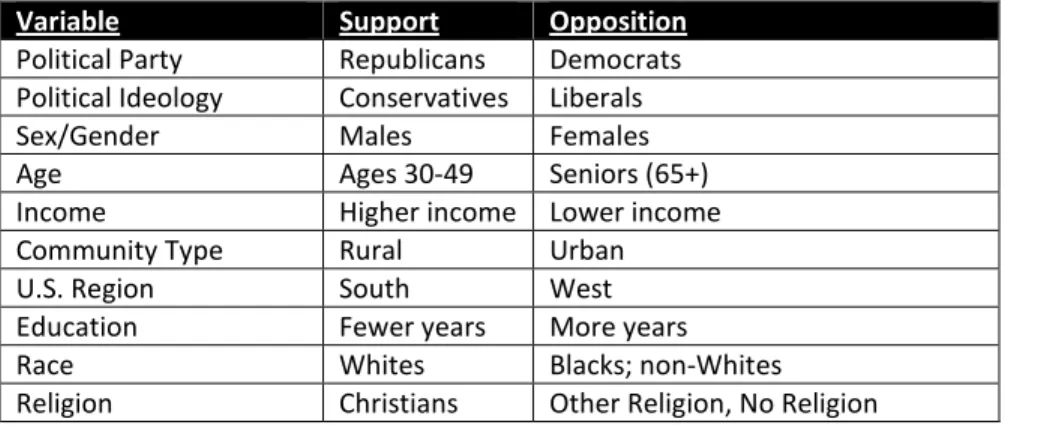
These dimensions are undoubtedly important in formulating a complete understanding of the role of religion in torture opinion. This is a project in the field of Religion, Psychology and Culture, which itself is part of the wider academic study of religion and includes both the study of psychology and religion and the psychology of religion.
A DESCRIPTIVE ANALYSIS OF TORTURE OPINION
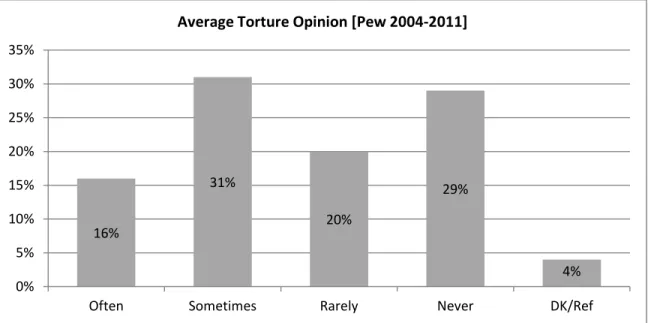
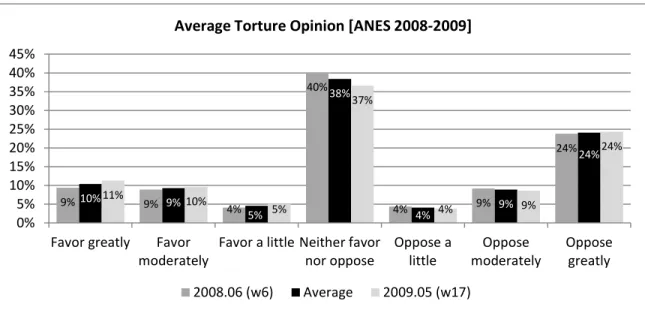
In this project I use the opinion of torture as a case study to understand the role of religion in collaboration with collective violence. My question is: "What is the role of religion in the opinion of torture?" The analyzes of the first chapter reveal two main findings.
INTERPRETING TORTURE OPINION THROUGH THE LENS OF POLITICAL PSYCHOLOGY & AUTHORITARIANISM
Adorno et al.'s experiments have been criticized for not controlling for education and income, and their interpretation of responses has been criticized for uncritically pathologizing those at the high end of the scale but not those at the low end. The traits considered to be indicative of authoritarianism tend to include things like obedience, good manners, conformity to gender roles, niceness, and.
INTERPRETING TORTURE OPINION THROUGH THE LENS OF CULTURAL PSYCHOLOGY OF MORALITY & RELIGION
The time bomb scenario's implicit argument in favor of torture thus depends on torture's utility and exceptionality. Yet, while the time bomb scenario conveys two implicit arguments in favor of torture based on torture's utility and exceptional use, it is the scenario's.
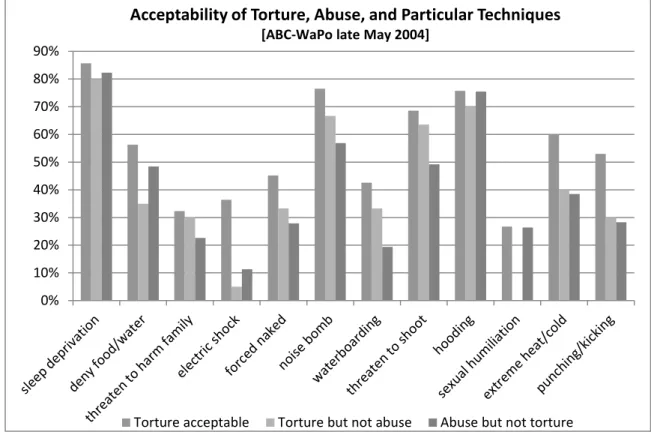
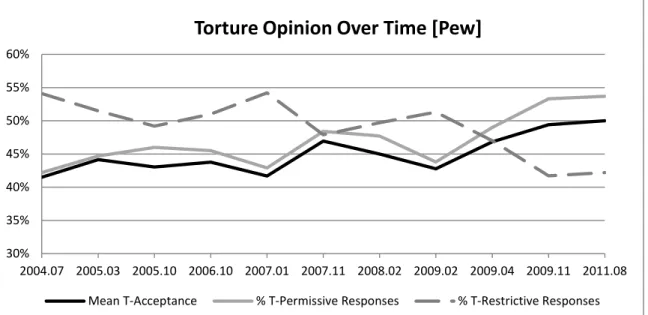
Torture Opinion Over Time [Pew]
CHRISTIAN TRADITION IS MOST TORTURE PERMISSIVE
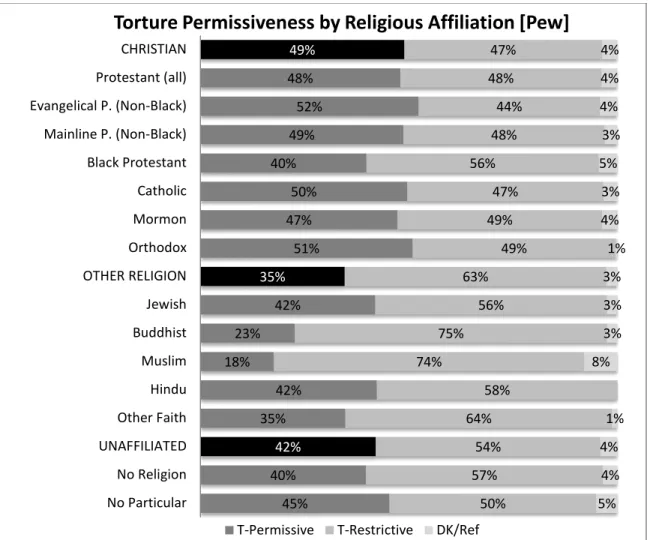
Within the Pew data, belonging to the Christian tradition in particular is associated with greater support for torture, while belonging to every other tradition except Judaism corresponds to less support for torture than is found among the unaffiliated. Within the ANES data, belonging to the Jewish tradition is associated with the greatest support for torture.
Torture Permissiveness by Religious Affiliation [Pew]
Part of the reason for Christians' high level of torture support may have to do with the outsized proportion of Christians compared to other groups. These Christian groups are also the most accepting of torture, showing rates of respectively and and .47 mean acceptance of torture.
Mean Torture Acceptance by Religious Affiliation [Pew]
THE ROLE OF CHRISTIAN AFFILIATION AND RELIGIOSITY IN TORTURE OPINION IS MEDIATED IN PART THROUGH RACE AND POLITICAL ORIENTATION
While Lib/Dems make up 46% of Religiously Unaffiliated, only 7% of Unaffiliated are Consv/Reps. White Lib/Dems are the only social group in the Pew data for whom Christian affiliation is associated with greater support for torture compared to the unaffiliated. Among Consv/Reps and Blacks, in contrast, Christian religious affiliation is associated with less support for torture compared to Consv/Reps and Unaffiliated Blacks.
When it comes to views of the Bible, greater literalism is associated with less acceptance of torture among practicing Christian Consv/Reps and with more torture. Second, why is Christianity associated with reduced support for torture among Consv/Reps and Blacks, but increased support for torture among white Lib/Dems. Controlling for political orientation, whiteness remains positively associated with greater acceptance of torture among Consv/Reps (+4%) and Mod/Indeps (+8%), but not among Lib/Dems (-3%).

COGNITIVE STYLES
Nonauthoritarians tend to be more opinionated about a variety of things than authoritarians, to be more accurate in political knowledge, and to be perceived as more intelligent than authoritarians. Using ANES data to test torture opinion against these cognitive styles, I found that, consistent with the authoritarian tendencies noted above, greater torture support was related to opinions about fewer things, a preference for simpler problems, and less accurate political knowledge . However, torture support does not appear to be positively correlated with less opinions than average or with aversion to responsibilities that require thinking (although among those who dislike responsibilities that require thinking, torture support is associated with greater aversion).
SOCIAL CONFORMITY VS INDIVIDUAL AUTONOMY
Hetherington and Weiler 2009 find that authoritarians tend to believe more strongly in the importance of upholding certain ground rules than nonauthoritarians, and to think that there is a right and wrong way to do almost anything, while not -authorities tend to disagree with these statements. Testing torture opinion against these preferences, I found that torture permissives in the Pew data were also 4% more likely than torture restrictors to agree that “there are clear guidelines about what is good or bad that all apply, regardless of their situation.”. Authoritarians look to established figures and sources of authority to maintain social order when it is threatened, and tend to give authorities great latitude to do whatever needs to be done to enforce such order.
Testing their measure of authoritarianism against these preferences, Hetherington and Weiler 2009 find that authoritarians tend to place greater emphasis on: “preserving traditional ideas of right and wrong”; "respect for. Using the Pew data, I also found that torture-permissives are more likely than torture-restrictives to agree that "the government should do more to protect morals in society" (+13% ); "it is generally right for the government to monitor the phone and email communications of Americans suspected of having terrorist connections without first obtaining authorization from the courts" (+25%); and that "the police should be allowed to search the homes of people who might be sympathetic to terrorists without a warrant" (+21%). Torture enablers are also more likely to agree that "to curb terrorism in this country, believe me, it will be necessary for the average person to give up some civil liberties" (+11%); "the best way to ensure peace is through military force". 17%); "using overwhelming military force is the best way to defeat terrorism around the world" (+25%); and "we should come to terms with any country that tries to take.
TOLERANCE OF DIFFERENCE
The correlation of opinion about torture with this attitude toward subordinate racial and gender categories suggests that the use of torture in the war on terror also has elements of (1) racial and ethnic difference, and (2) feminism and family—the other two of the four sets of issues structured with authoritarianism, which helped shape the modern political landscape according to Hetherington and Weiler (2009). Hetherington and Weiler 2009 differ somewhat from Merolla and Zechmeister 2009 and argue that much of the explanatory power of authoritarianism as a political force is among non-authoritarians. Additionally, the line graph shows that support for torture in the general population tracks the percentage of the population who believe that terrorists now have a better chance of new attacks.
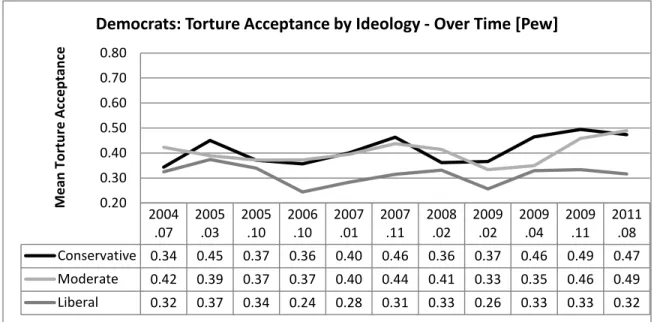
Meanwhile, Hetherington and Weiler's assertion that the most significant increases in expressed intolerance can be found among non-authoritarians helps shed light on the apparent increase in support for torture that occurred on the left side of the political spectrum in 2009. Unlike liberal morality, which tends to be ambivalent about three of the six foundations, conservative morality relies on all six foundations. Of the three foundations that shape liberal moral intuitions, liberals tend to be most committed to the foundations of Care and Freedom.

FAIRNESS/CHEATING
The Care/Harm foundation was created in response to the adaptive challenge of protecting your offspring. Unlike fairness as equality, which is more closely related to the psychology of freedom and oppression (the third foundation), Fairness as proportionality is more closely related to the psychology of reciprocity and exchange (Haidt 2012, 169). Liberals are also more likely to sacrifice fairness for proportionality when this exacerbates oppressive inequalities, perhaps because these are seen as social harms.
Liberals may rely more on fairness as proportionality than Haidt acknowledges, but for liberals they are the freeloaders about who they are. To achieve more equal outcomes, liberals rely on justice as proportionality (i.e., fairness) in their advocacy for special protections and support for historically disadvantaged groups. Authoritarian elements within conservatism emphasize the need for order which leads to black and white thinking and to the simpler idea of justice as equality.
LIBERTY/OPPRESSION
Through this inward-looking lens, government-sanctioned torture is one way the government keeps us free. They are critical of the government's pursuit of a neoliberal economic and aggressive foreign policy that promotes the US. The importance of the foundations of Care and Liberty in shaping public opinion about torture is evident in the discourses surrounding the issue, reducing concern.
Presenting the torture question within the context of the time bomb scenario appeals to the Care Foundation by emphasizing the possibility of saving lives. Most of the world's population are members of non-WEIRD cultures, and therefore represent the statistical norm in terms of morality. Compared to the rest of the world's population, people from WEIRD cultures are statistical outliers who.
AUTHORITY/SUBVERSION
SANCTITY/DEGRADATION
Christian affiliation is not associated with greater support for torture among all, but primarily among white Lib/Dems. Even when different levels of religiosity are taken into account, Christian affiliation is associated with greater support for torture among white Lib/Dems and less support for torture among Consv/Reps and Blacks. It is difficult to interpret this increase in support for torture among religious Lib/White Bulls.
Just as Christianity is associated with greater torture support among white Lib/Dems, Christianity among white Lib/Dems is also associated with greater racial intolerance toward Blacks in the form of explicit prejudice and implicit prejudice. In other words, just as Christianity is associated with reduced torture support among Consv/Reps (who generally tend to be the most torture supportive), Christianity is also associated with reduced racial intolerance among Consv/Reps (who generally tend to be under). the most expressly racially intolerant). At the same time, just as Christianity is associated with increased torture support among Lib/Dems (who are generally most opposed to torture), Christianity is also associated with increased racial intolerance among Lib/Dems (who generally tend to be among the be most explicitly racially tolerant).
Consv/Reps tend to be more authoritarian and support for torture is itself associated with greater authoritarianism. Authoritarianism, I propose, makes a key difference in the religion of the Lib/Dems and Consv/Reps.